Best Subwoofers of 2026

A subwoofer is the one speaker in your home you feel before you hear it, which is exactly why a bad one is so hard to live with. The wrong box adds a constant low hum to movie night, rattles the shelf above it during quiet scenes, or booms so enthusiastically that your downstairs neighbor learns your schedule. The right one does something more useful: it takes the heavy lifting off your main speakers, so dialogue stays clean and the low end lands in your chest instead of your ears.

I've spent the past six months with eight subwoofers in my own living room and my team has run the rest through their setups, and the pattern is that the numbers on the box tell you the least. Wattage is the spec everyone compares and the one that matters least; cabinet volume and your room's size decide what you actually hear, and how a sub connects — a single LFE cable, speaker-level taps, or a wireless link to a soundbar — often matters more than another 100 watts. Whether you're chasing bass for movies, music, or a desk setup, the picks below were chosen for how they behave in a real room, not on a spec sheet.

Keeper Score summarizes customer ratings and review volume. Read it alongside the product details and trade-offs. How the score works.

1

Best Overall

Klipsch R-12SW

96 /100
Keeper Score Outstanding

Key details

Woofer
12 inches
Cabinet Size
20"D x 20"W x 17.75"H
Amplifier Power
400W
Low-Frequency Response
29 Hz
Check Price on Amazon

Twenty inches deep, twenty wide, and just under eighteen tall, the R-12SW is the biggest cabinet in this group, and it spends all of that space on output: a 12-inch copper-spun woofer on the front baffle, a 400-watt digital amplifier behind it, and a rating that reaches down to 29 Hz. Nothing else here combines that much driver and that much power at the bottom of the price range.

That combination is why it's our top pick. We ran it off a receiver through the LFE input, which is a single cable and nothing else, and the low-pass and phase controls sat on the back where we could reach them while dialing it in. Action scenes had the weight we wanted without the cabinet sounding like it was straining, and we ended up running the gain lower than expected and leaving it there. On music it's more entertaining than precise, and the sealed SB-1000 Pro below is the sharper tool for critical listening, but it never embarrassed itself.

The brushed black vinyl and satin plinth read better than the price tier suggests, which matters when the subwoofer has to sit in a living room rather than a dedicated theater. Getting it out of the carton is easier with a second pair of hands, and you'll want to decide on its spot before you lift it, because dragging a box this size across carpet is not a job you want to repeat.

There's no app and no room-correction wizard here. You tune the Klipsch with three controls on the back and your ears, which took us one evening, two adjustments, and then nothing for weeks. If you want to change settings from the couch, the two SVS models on this list put everything on your phone.

Pros

  • 400 watts into a 12-inch front-firing woofer
  • Rated down to 29 Hz
  • LFE input plus low-pass and phase controls
  • Finish looks better than its price tier

Cons

  • Takes up a 20-inch square of floor
Our verdict

We recommend it to almost anyone building a first serious system: 400 watts and a 12-inch driver with the inputs and controls to work with any receiver.
Check Latest Price
2

Best for Music

SVS SB-1000 Pro

92 /100
Keeper Score Outstanding

Key details

Woofer
12 inches
Cabinet Size
13"D x 14.76"W x 13.5"H
Amplifier Power
325W RMS (820W+ peak)
Low-Frequency Response
20 Hz
Check Price on Amazon

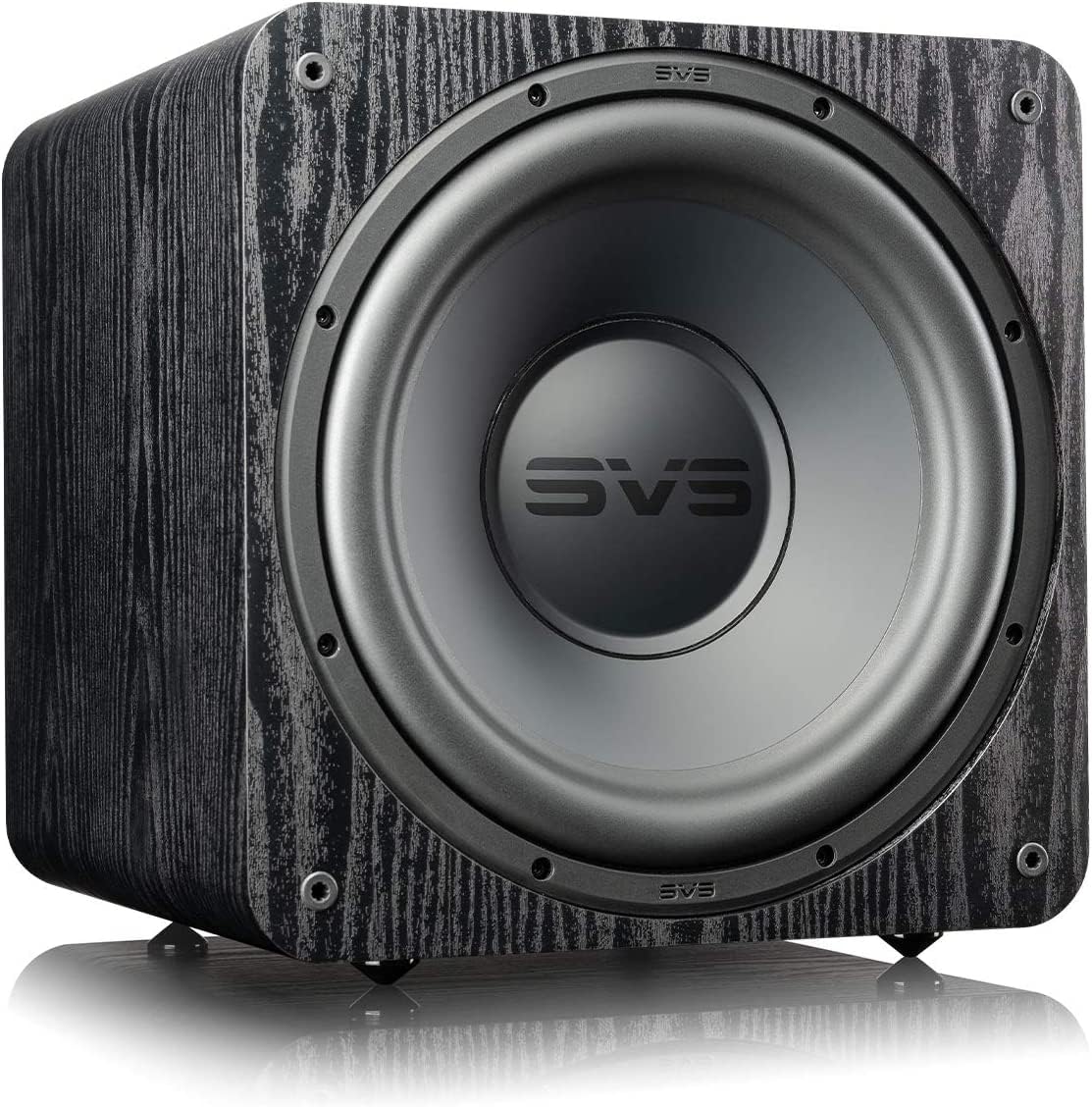
Tuning a subwoofer usually means crawling behind it with a flashlight. The SB-1000 Pro puts volume, phase, crossover, and three custom presets into an app, and within a week we had stopped reaching for the rear panel entirely. For a system built around music, this is the subwoofer we recommend.

The hardware underneath deserves as much credit as the app. It's a sealed cabinet with an extra-thick MDF front baffle and internal bracing, a 12-inch high-excursion driver, and a 325-watt RMS amplifier rated to 20 Hz. Sealed designs trade a little deep output for control, and that's what we heard: double bass and kick drums arrived with a beginning and an end rather than a smear. We set one preset slightly hotter for movies and switched between the two from the sofa, a small feature we ended up using constantly.

At 14.76 inches wide and about 27 pounds it tucks behind a chair, which the bigger Klipsch cannot do, and that is the reason the price is easier to justify. Because that is the trade: it costs meaningfully more than the Klipsch and gives up some output for the privilege. Buy it if music is the point of your system, or if the subwoofer has to live somewhere a two-foot cube simply will not go.

Pros

  • App control from the listening position
  • Sealed cabinet gives tight, quick bass
  • Rated down to 20 Hz
  • Compact 14.76-inch-wide cabinet

Cons

  • Pricier than the Klipsch with a smaller amplifier
Our verdict

Our pick when music comes first: a sealed, compact 12-inch you can tune from your seat, with bass that stops when the note stops.

Check Latest Price
3

Best for Small Rooms

Polk Audio PSW10

95 /100
Keeper Score Outstanding

Key details

Woofer
10 inches
Crossover
80-160 Hz
Cabinet Size
17"D x 14.25"W x 14.5"H
Amplifier Power
50W RMS (100W peak)
Check Price on Amazon

Bedrooms, dens, and apartment living rooms are where the PSW10 makes sense. It's a 10-inch woofer in a cabinet 14.25 inches wide and 17 inches deep, light enough for one person to move, with a detachable grille that lets it pass for a small piece of furniture rather than a black box with a speaker in it.

The back panel is the part we appreciate most. Alongside the line-level RCA inputs there are speaker-level inputs and outputs, which means it can be wired into an older stereo receiver that has no subwoofer output at all, a genuinely useful trick if your amplifier predates home theater. A modern receiver connects over the RCA pair, and a single LFE cable needs a Y-adapter to split into it. The crossover sweeps from 80 to 160 Hz and the phase toggle helps it blend with small bookshelf speakers.

The 50-watt RMS amplifier and 100-watt peak figure tell you what to expect: this adds the bottom octave rather than rearranging your ribcage. Push it hard and the port can start to huff, and idle hum is worth listening for in the first week while returning is still easy. Neither showed up at the volumes a bedroom or a small living room allows, where we never got near that edge, and the five-year cabinet warranty is longer than most in this group.

Pros

  • Compact 14.25-inch-wide cabinet
  • Speaker-level inputs work with older receivers
  • Blends easily with small bookshelf speakers
  • Five-year warranty, three on the amplifier

Cons

  • Limited output outside small rooms
Our verdict

If your room is small, this is the subwoofer to buy: compact, easy to wire into an older receiver, and honest about its limits.

Check Latest Price
4

Best Compact Sub

SVS 3000 Micro

91 /100
Keeper Score Outstanding

Key details

Weight
26 lb
Woofers
Dual 8 inches
Cabinet Size
10.9"D x 11.7"W x 10.9"H
Amplifier Power
800W RMS (2,500W+ peak)
Check Price on Amazon

Set the 3000 Micro beside the Klipsch and it looks like a different species: a 10.9-inch cube weighing 26 pounds, with two 8-inch drivers mounted on opposite faces so their forces cancel and the cabinet stays planted instead of walking across a hardwood floor.

That design is why it earns a place even at the top of the price range. The 800-watt RMS amplifier and the same SVS app as the SB-1000 Pro mean you can tune it from your seat, and in a room that cannot take a real subwoofer cabinet the amount of bass it produces is genuinely surprising, enough that we backed the gain off. It's also the best-looking subwoofer here; our review unit came in piano gloss white, and it reads as furniture rather than audio equipment.

The catch is the arithmetic. It costs more than the larger sealed SB-1000 Pro, so you are paying for the cabinet and for the engineering that shrank it, not for raw output. If a big open room is the goal, a 12-inch box will always win that argument. If the choice is between a small sub and no sub at all, a loft, a desk, a room where the sofa backs onto the only free wall, this is the one.

Pros

  • Dual force-canceling 8-inch drivers
  • 800W RMS from a 10.9-inch cube
  • App tuning and presets
  • Piano gloss finish looks like furniture

Cons

  • Costs more than the larger SB-1000 Pro
Our verdict

The subwoofer we point to when there is no floor space for one: a 10.9-inch cube that puts out far more than its size suggests.

Check Latest Price
5

Best for Medium-Size Rooms

Polk Monitor XT12

87 /100
Keeper Score Excellent

Key details

Woofer
12 inches
Warranty
5 years
Cabinet Size
16"D x 18"W x 16"H
Amplifier Power
100W Class A/B
Check Price on Amazon

A hundred watts is the smallest amplifier rating attached to any 12-inch subwoofer in this group, and on paper that reads like a mismatch. In practice the Monitor XT12 is a reminder of how little that one number tells you: the 12-inch long-throw woofer and the braced MDF cabinet do most of the work, and the result has more weight in a normal room than the specification implies.

It's also the best-behaved subwoofer here in a family room. The precision-fit grille covers the driver completely, so you get a 12-inch subwoofer without a bright cone facing the sofa, and the cabinet at 18 inches wide and 39 pounds feels like furniture rather than a shipping crate. Polk backs it with a five-year warranty, the longest in this group.

Setup is conventional in the way we like: volume, a variable crossover, and phase on the cabinet itself, with line-level RCA and a dedicated LFE input for a modern Dolby Atmos or DTS:X receiver. There is no app and no auto-setup, so plan an evening with one familiar movie and a hand on the gain control.

On paper the Klipsch beats this one on power and on price, and we aren't going to pretend otherwise. What the XT12 offers instead is the accumulation of details: the grille, the heavier braced cabinet, the longer warranty, and Polk's own voicing if the rest of your speakers are Polks. In a medium-size room where the subwoofer stays on show and the equipment stays put for years, that's a fair trade.

Pros

  • Five-year warranty, the longest here
  • Grille hides the driver in a family room
  • Braced MDF cabinet with real heft
  • LFE and line-level inputs

Cons

  • Wide 18-inch cabinet needs floor space
Our verdict

We like it for a medium room where the sub sits on show: the grille, braced cabinet, and five-year warranty make it the sensible buy.

Check Latest Price
6

Best Budget

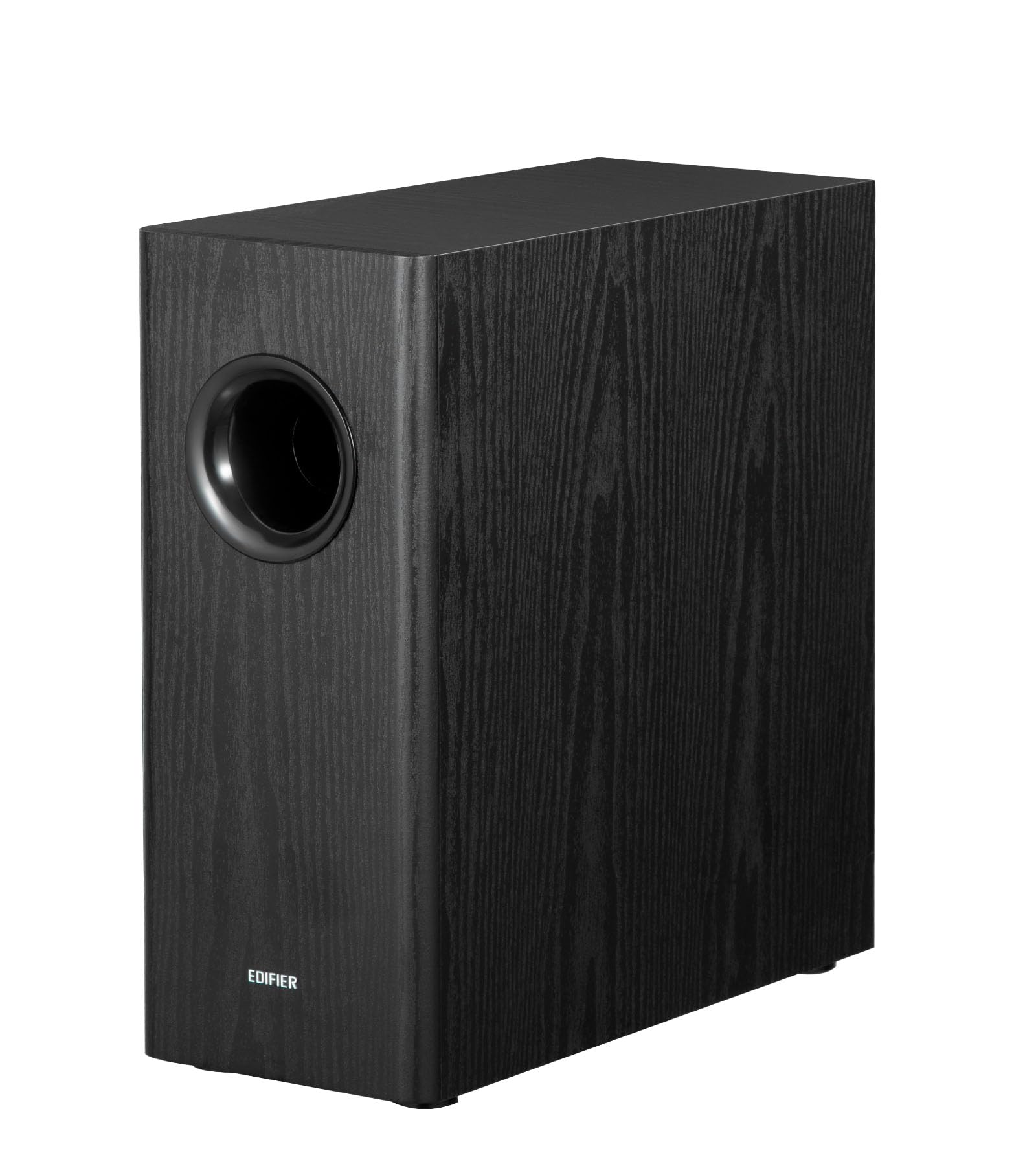
Edifier T5s

88 /100
Keeper Score Excellent

Key details

Woofer
8 inches
Cabinet Size
15.71"D x 6.69"W x 16.14"H
Amplifier Power
70W RMS
Low-Frequency Response
35 Hz
Check Price on Amazon

At 6.69 inches wide, the T5s is the only subwoofer here that will slide into a gap beside a bookcase, and it is the least expensive of the group. It also does the job a budget subwoofer is supposed to do: it adds low end to a small system without turning the bass into one muddy note that follows every song around.

Edifier gives you two ways in. If your amplifier or powered speakers have a subwoofer output, one RCA cable to the Signal In is the entire installation. If they don't, you run the source into the T5s and the main speakers out of it, which is the route that makes this useful with gear never designed to have a subwoofer at all. The low-pass sweeps from 30 to 160 Hz and there's a 0 or 180 degree phase switch, so matching it to small speakers takes a few minutes rather than an afternoon. Auto-standby after 15 minutes of silence means it stops drawing power when the TV goes off.

Seventy watts and an 8-inch driver will not fill a large room, and the 35 Hz rating is a specification rather than a promise at volume. What we like is how little it asks: an 18mm MDF cabinet, a front-firing driver with a side-firing port, and a footprint narrow enough to disappear. In a den, an office, or a bedroom system it delivers considerably more than its position at the bottom of the price ladder suggests.

Pros

  • Narrow 6.69-inch cabinet fits gaps
  • RCA input plus a series connection route
  • Auto-standby saves power
  • Least expensive subwoofer here

Cons

  • Not compatible with every Edifier speaker set
Our verdict

The budget subwoofer we hand to someone with good small speakers and no room: narrow, inexpensive, and hard to fault at its size.

Check Latest Price
7

Best for Desktops

Audioengine S6

92 /100
Keeper Score Outstanding

Key details

Inputs
RCA and 3.5mm
Woofer
6 inches
Amplifier Power
210W
Low-Frequency Response
33 Hz
Check Price on Amazon

The S6 is 8.74 inches wide and 15.4 pounds, which is small enough to sit behind a monitor or under a desk without anyone noticing it's there. That's the entire brief, and it's why the smallest subwoofer in this guide still belongs in it.

It's built for powered desktop speakers rather than a receiver. A 3.5mm cable and an RCA pair both come in the box, so it connects to Audioengine's own A2+ and A5 speakers as readily as to anything with a line output. The cabinet is metal, which is unusual at this size and makes it feel more solid than 15 pounds would suggest.

A 6-inch driver and 210 watts look like a mismatch next to the rest of this group, and in a living room they would be. At a desk, a foot or two from your ears, the calculation changes completely: it's rated to 33 Hz and it fills a small office with bass you feel through the desk surface rather than in your chest.

Audioengine's three-year warranty is the longest on any of the budget subwoofers here, and the sound stayed clean enough that we never felt the need to push the volume. Buy it when the desk is the system. If one subwoofer has to serve both the office and the television, something larger from this list is the better purchase.

Pros

  • Fits behind a monitor
  • 3.5mm and RCA cables included
  • Metal cabinet feels solid
  • Three-year warranty

Cons

  • No speaker-level inputs for older receivers
Our verdict

This is the one we keep at a desk: small enough to hide, with the inputs and the warranty a computer setup actually needs.

Check Latest Price
8

Sonos Setups

Sonos Sub Mini

91 /100
Keeper Score Outstanding

Key details

Woofers
Dual 6 inches
Cabinet Size
8.98"D x 8.98"W x 11.93"H
Amplifier Power
250W
Low-Frequency Response
25 Hz
Check Price on Amazon

The Sub Mini is a Sonos accessory, not a general-purpose subwoofer. It pairs over Wi-Fi with a Beam, Ray, or Arc Ultra and adds nothing to a receiver-based system, so if your television audio doesn't come from a Sonos soundbar, the rest of this list is where you should be looking.

Within that world it's a tidy piece of design: two 6-inch woofers facing each other inside a sealed cabinet 8.98 inches wide, with the force-canceling arrangement keeping the box still, and Trueplay room tuning handled through the Sonos app on an iOS device. At around 14 pounds it's the easiest subwoofer here to move, and it looks like a small speaker rather than a piece of AV equipment.

The bass itself is fuller and warmer rather than violent. It rounds out a Beam beautifully and it will not shake a wall the way the Klipsch does, which is either the point or the disappointment depending on what you wanted. Network setup can be stubborn; if the Wi-Fi is marginal where the subwoofer goes, plan on a wired connection. For a Sonos household in an apartment, it's the obvious upgrade, and the only one here that fits that description.

Pros

  • Adds real depth to a Sonos soundbar
  • Force-canceling dual 6-inch woofers
  • Trueplay tuning from the app
  • Compact 8.98-inch cabinet

Cons

  • Only works with Sonos speakers
Our verdict

If your TV audio runs through a Sonos soundbar, we think it's the obvious add-on, and if it doesn't, this subwoofer cannot help you at all.

Check Latest Price

How We Tested the Best Subwoofers

We built the shortlist from spec pages, owner forums, and the questions people actually ask before buying, then filtered it down by cabinet size and shape, driver size and count, amplifier power, and connections — line-level LFE, speaker-level inputs, and wireless pairing with a soundbar or TV. That left eight subwoofers, from compact 8-inch models meant for a desk or a small den to 12-inch sealed cabinets built for a dedicated media room.

Each unit lived with one of us for six months in the spot it was actually bought for: living room movie nights on Saturday, two-channel music on weekday evenings, game sessions with a lot of low-end rumble, and a couple of small office setups for the compact models. We started every placement by walking the room with a tape measure and a sound-level app while a low test tone played, moving each sub until it stopped droning in one corner.

Then the less glamorous part. With nothing playing, we put an ear a few feet from each cabinet to listen for transformer hum. We pushed each sub to the loudest volume we'd realistically watch a movie at and listened for port chuffing, cabinet rattle, and panel vibration under a hand. To check how well each one blended, we replayed a familiar dialogue scene and adjusted the crossover, noting whether voices thickened or the sub announced itself. We also lifted and weighed every unit, tapped the cabinets, checked how hot the amp plate got after two hours, and timed wireless pairing — including whether the connection survived a router reboot.

How to Choose a Subwoofer

Match the Cabinet to the Room

The most common buying mistake is sizing the subwoofer to the budget instead of the room. A 12-inch subwoofer in a small bedroom spends its life at a quarter gain, where a cheaper 10-inch would sound just as full in half the floor space. Go the other way and a compact 8-inch subwoofer in an open living room runs out of headroom right where a movie needs it.

Work from the room's volume and the floor space you can give up, then look at driver size and cabinet dimensions together, because the cabinet is the part you have to place. A subwoofer that fits badly gets turned down, and a subwoofer that gets turned down was the wrong purchase regardless of what it can do.

Sealed or Ported

A sealed cabinet, such as the SVS SB-1000 Pro or the Sonos Sub Mini, gives up some deep output in exchange for control: bass starts and stops with the music, and the box stays smaller for a given driver. A ported cabinet uses a tuned opening to Reinforce the low end, so you get more output from the same driver, which is why the Polk PSW10 and the Edifier T5s use one.

Ported boxes can chuff when pushed hard, and a port that fires backward needs clearance behind it. Either way, keep the cabinet out of a corner unless you like boom; a subwoofer jammed into three walls will sound bloated no matter where you set the crossover.

Check What Your Receiver Can Send

A modern AV receiver gives you an LFE output: one RCA cable, and the receiver handles the crossover. Older stereo amplifiers and many integrated amps have no subwoofer output at all, and that is where speaker-level inputs earn their keep. The Polk PSW10 has them and passes the signal through to your main speakers; the Audioengine S6 does not and needs a line output.

Look at the back of your amplifier before you shop, because this one detail eliminates more subwoofers than any other specification on the page.

Where the Controls Live

Rear-panel knobs are fine as long as you can reach them, which is not guaranteed once the subwoofer is tucked into a corner behind a chair. App control, which both SVS models here offer, lets you change volume, crossover, and phase from the listening position, and in our experience that is worth real convenience during the first week and close to nothing afterward.

Buy the app when it comes attached to the subwoofer you already want. Don't pay a premium for it on its own.

Plan the Spot Before It Arrives

A subwoofer needs floor space, a power outlet, and access to its back panel. Measure the gap you have in mind and allow a couple of inches on every side, then confirm a cable reaches without crossing a doorway.

Two more things worth settling in advance: whether the grille covers the driver (the Polk XT12's does, the Klipsch's copper woofer stays on show) and whether you want to look at the finish for the next decade. In most systems the subwoofer is the largest single box in the room.

Frequently Asked Questions

Final Verdict

For most people the Klipsch R-12SW is the answer. A 12-inch driver and 400 watts for less than nearly everything else here, with the LFE input and the crossover and phase controls that let it slot into any receiver-based system without fuss.

The reasons to look elsewhere are specific. A small room suits the Polk PSW10, a room that cannot spare a cabinet suits the SVS 3000 Micro, and a music-first system suits the sealed SVS SB-1000 Pro. Measure the floor space you can give up, count the inputs on the back of your receiver, and the choice narrows to one of those four.