Best Softboxes of 2026

A softbox does one job: it turns a small, harsh light into a big, soft one. The wider the front panel and the closer it sits to your subject, the gentler the shadow edge — which is why a 35-inch octagon and a 24-inch handheld box don't solve the same problem. What separates the one you keep from the one that lives in a closet is what happens at 9 p.m., alone, when a rib won't seat.

My team and I spent six months setting up, tearing down, and shooting with 10 of them, from handheld boxes to full parabolics. All take a Bowens mount and all promise tool-free assembly, so the sorting came down to build quality, lighting quality, and how much grief each one caused in a dim room.

Two things I'd tell a first-time buyer: diffusion matters as much as the box — a front panel softens the light, an inner baffle plus a grid lets you aim it — and packed weight matters more than panel size, because a box you dread carrying stays home. The eight below are the ones I kept reaching for.

Keeper Score summarizes customer ratings and review volume. Read it alongside the product details and trade-offs. How the score works.

1

Best Overall

SmallRig LA-O90 Softbox

94 /100
Keeper Score Outstanding

Key details

Mount
Bowens
Weight
900 g / 31.7 oz
Diameter
35 in / 90 cm
In The Box
Softbox, inner and outer diffusers, honeycomb grid, storage bag
Check Price on Amazon

One click opens it, one click closes it, and it weighs 31.7 ounces. For a 35-inch octabox that combination is the whole argument, and it is why this is the one we reach for first. Eight stainless steel ribs under double-layer fabric hold a clean octagon instead of sagging between the spokes, and the whole thing folds into the bag SmallRig ships with it.

The light is the even, wrapping kind you want from a source this size. The inner diffuser does most of the softening; adding the outer layer smooths skin further and costs you output, which is the trade every double-diffused box makes. The honeycomb grid is the piece we end up using most, because it keeps the light off the backdrop instead of letting a white wall bounce it back into the shot.

Nothing about the frame feels like it needs babying, though 35 inches is still 35 inches: it wants a stand with a wide footprint and three or four feet of clear space in front of a face. It is a modifier, not a kit, so it adds to gear you already own rather than replacing anything. Mount it on a COB LED and the box becomes the biggest thing in your setup, which is exactly the point.

Pros

  • One-click frame opens and closes in seconds
  • 900 g is light for a 35-inch octabox
  • Grid and two diffusers included
  • Eight steel ribs hold a clean octagon

Cons

  • 35-inch span needs room and a solid stand
Our verdict

For most shooters this is the softbox to buy: 35 inches of soft, even light that one click opens and a single hand can carry.
Check Latest Price
2

Best Beauty Dish

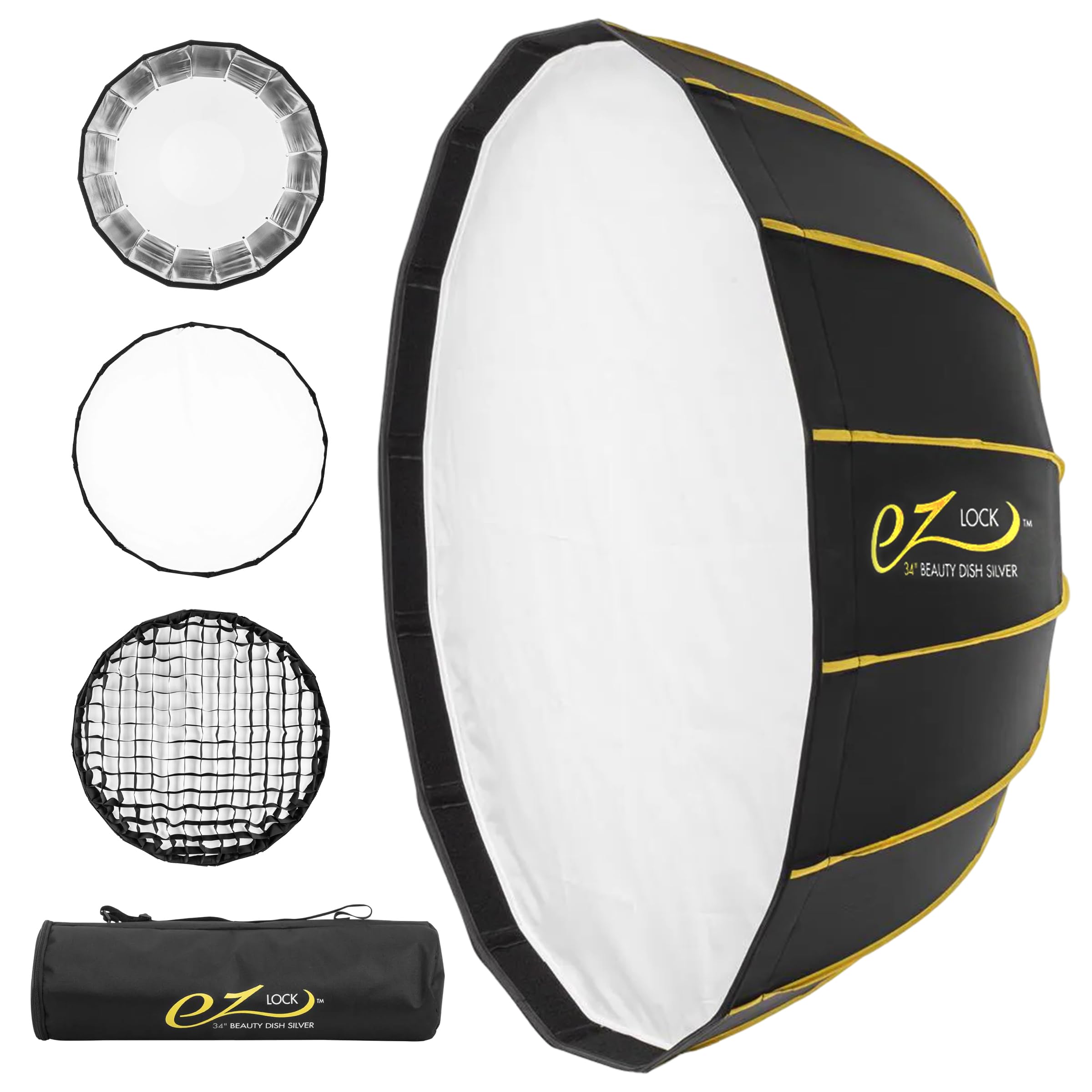
Glow EZ Lock Beauty Dish

95 /100
Keeper Score Outstanding

Key details

Weight
7.3 lb
Diameter
34 in
Interior
Silver
In The Box
Beauty dish, inner and front diffusers, eggcrate grid, deflector disc, carry bag
Check Price on Amazon

The deflector disc in the middle is what makes this a beauty dish rather than another octabox. It catches the flash and throws it back into the silver bowl, so the light leaves around the edges of the disc: crisp through the center of a face, falling away fast at the jaw and shoulders. That falloff is what gives portraits their shape, and it looks nothing like the flat, even wash a white-interior box produces.

Pull the disc out and it works as a 34-inch silver octabox, harder and more contrasty than the white boxes but broader than the dish. Both diffusers and the eggcrate grid come with it, the speedring insert is sized for Bowens lights, and setup is the umbrella motion: open the frame, lock the snaps, hang the diffusers.

At 7.3 pounds it is a studio fixture, not a location tool. Ours lives on a stand and gets walked around the room rather than folded into a backpack, and that weight asks for a stand with some authority behind it. What you get in return is the only modifier here that does two genuinely different jobs, which makes it the most useful second box we tested.

Pros

  • Deflector disc gives punchy, fast-falloff portraits
  • Silver interior adds contrast over white boxes
  • Doubles as a silver octabox without the disc
  • Grid and both diffusers included

Cons

  • Snaps need a firm grip to release
  • Frame wire and zipper seam are the wear points
Our verdict

Buy this if you want the crisp, sculpted look of a beauty dish and a silver octabox in one frame, and you have a studio stand to leave it on.

Check Latest Price
3

Best for Small Studios

Godox S65T Umbrella Softbox

91 /100
Keeper Score Outstanding

Key details

Depth
30 cm / 11.8 in
Mount
Bowens
Weight
1.88 lb
Diameter
65 cm / 25.6 in
Check Price on Amazon

Eleven and three-quarter inches is the number that decides where this one works. That is the depth of the S65T front to back, roughly half of a conventional softbox, so it can hang in a spare bedroom or a tight commercial corner where a full box would be through the ceiling or in your subject's lap. In a small room that shallow profile buys you more than another six inches of diameter would. Setup is an umbrella motion on all-metal struts, and at 851 grams it comes on and off a stand without a second pair of hands.

With both diffusers in, 65 centimeters gives the soft, even output you want for a head-and-shoulders portrait or a talking head. The shallow shape spreads wider than a deep parabolic, which is friendlier for a one-light shoot and less precise when you are trying to keep light off a background, and the fix there is repositioning rather than another accessory. Both diffusers detach when you want more punch out of the same box.

Pros

  • 11.8-inch depth fits tight rooms
  • All-metal struts feel solid for the weight
  • Detachable inner and front diffusers
  • Opens umbrella-style in seconds

Cons

  • No grid in the box for spill control
Our verdict

The one to buy when your shooting space is small: its shallow frame hangs where a full-size box cannot, and 65 cm of diffusion still flatters a face.

Check Latest Price
4

Best Value

Neewer NS92P Parabolic Softbox

93 /100
Keeper Score Outstanding

Key details

Mount
Bowens
Weight
2.3 lb / 1108 g
Diameter
35.4 in / 90 cm
In The Box
Softbox, inner and outer diffusers, honeycomb grid, carrying bag
Check Price on Amazon

Push the mounting plate and the frame unfolds and locks; hook-and-loop tabs hold the diffusers down. There is no rod threading and no wrestling, which puts this on the short list for anyone who sets up alone. At 35.4 inches and 2.3 pounds it sits in the same size class as the SmallRig and the Godox parabolic while costing a good deal less than either.

The shape is the interesting part. The silver coating sits on a deeper parabolic cut than a flat octa, so the light comes out slightly more directional: it wraps a face but still leaves some shape at the edges, and it falls away before it reaches the backdrop. The included honeycomb grid tightens that further for product shots and low-key portraits.

Where it gives ground is in the details. The grid is thin and takes patience to seat on the frame, and the locking plate does not have the machined feel of the pricier picks. Neither changes the light landing on your subject. If you want 35 inches of soft, controllable light and the budget is the deciding factor, this is the one we point people to.

Pros

  • Parabolic depth adds direction to the light
  • Push-plate setup with no rod threading
  • Grid and two diffusers included
  • Cheapest 35-inch octabox here

Cons

  • Grid is thin and fiddly to fit
Our verdict

The value pick: 35 inches of parabolic light with a grid and both diffusers, for noticeably less than the two boxes above it.

Check Latest Price
5

Best Lantern

Neewer NS26L Lantern Softbox

93 /100
Keeper Score Outstanding

Key details

Mount
Bowens
Shape
360° lantern
Diameter
26 in / 65 cm
In The Box
Lantern softbox, storage bag
Check Price on Amazon

A lantern has no front face. Light leaves this one in every direction at once, which makes it the wrong tool for a shaped portrait and the right one for a room: boom it over a table, stand it behind the camera as fill, or put it in the middle of a set and let the walls do the work.

We ended up treating it as a one-light solution for small spaces, a dark bedroom or a dim office, where the goal is to lift the whole scene instead of carving a face out of it. Twelve ribs hold it round, the one-step release opens it as fast as any box here, and 26 inches folded into the included bag is the easiest thing in this group to carry.

The trade follows directly from the design: it lights your background, your camera side, and everything else in the room. In a white-walled space with no flags, that is a lot of uncontrolled bounce, so this is a modifier for a room you can manage. For interviews, small product scenes, and video where the environment is part of the frame, that behavior is the feature.

Pros

  • 360-degree output fills a room from one light
  • Twelve ribs keep a round, even shape
  • One-step open and fold
  • Folds into the included storage bag

Cons

  • Throws light in every direction, including the backdrop
Our verdict

Buy it when the room needs lifting rather than a face sculpting: this 360-degree lantern fills a space from one light and packs smaller than anything else here.

Check Latest Price
6

Best Deep Parabolic

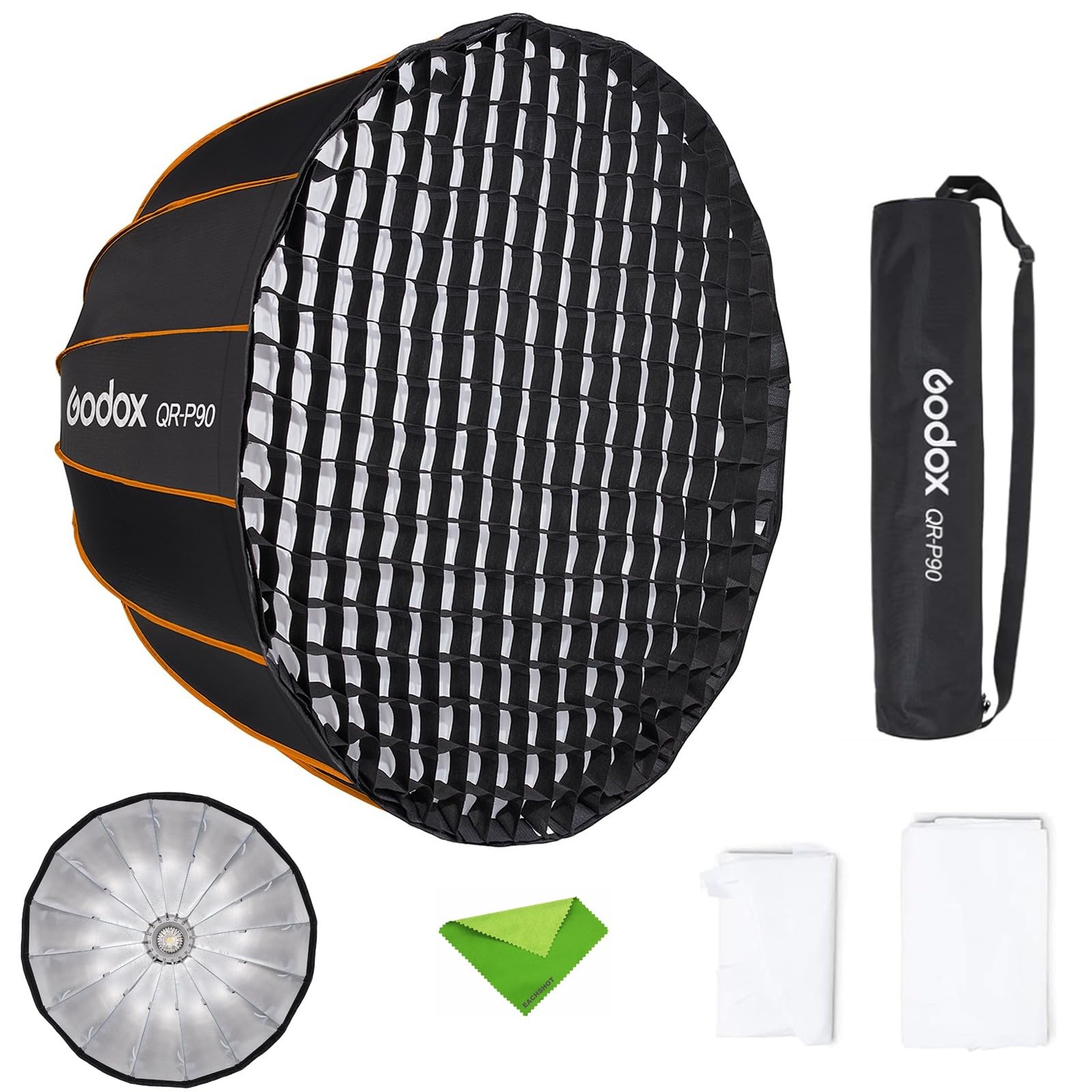
Godox QR-P90 Parabolic Softbox

90 /100
Keeper Score Outstanding

Key details

Mount
Bowens
Weight
4.19 lb
Diameter
35.4 in / 90 cm
Interior
Silver
Check Price on Amazon

This is the most expensive modifier in the group, and the money goes into the depth of the bowl. The QR-P90 is a deep parabolic with a reflective silver interior, which makes it a different optical animal from the shallow octas: more like an oversized reflector than a sheet of diffusion.

The difference shows up as control. Light comes off the deep bowl in a tighter, punchier beam with a fast falloff, so you can shape a key, add a rim, or hold contrast on a face without washing the whole room. The included grid underlines it. This is the pick when the lighting is the point rather than the documentation.

It is a 1.9-kilogram frame that opens quickly and stays rigid once it is up, the kind of box that lives assembled on a stand in a corner between jobs. Treat it as studio equipment rather than travel equipment and the weight stops mattering.

What that means in practice is a modifier for a studio that wants shaping options, or for a shooter with one good light who wants the most out of it. If your work is even, flattering coverage of a subject who moves, the shallower boxes here will serve you better.

Pros

  • Deep silver bowl focuses light and adds contrast
  • Fast falloff shapes a key or rim
  • Grid and both diffusers included
  • 1.9 kg frame travels without a helper

Cons

  • Rods need a firm pull to break down
Our verdict

Worth the premium if you shape light for a living: the deep silver bowl gives you contrast, direction, and a fast falloff the shallow boxes cannot match.

Check Latest Price
7

Best for Speedlights

Lapgood 24-Inch Softbox Kit

92 /100
Keeper Score Outstanding

Key details

Mount
Bowens with S-type bracket
Weight
1.2 kg / 2.64 lb
Diameter
24 in / 60 cm
In The Box
Softbox, Bowens mount, S-type bracket, screws, honeycomb grid
Check Price on Amazon

A speedlight has no Bowens mount, which is why most of the boxes here are closed to anyone shooting flash on camera. This kit includes an S-type bracket that clamps a speedlight or round-head flash and gives it a Bowens face, so the 24-inch box, the grid, and the frame all work with the flash already in your bag.

Setup is a single step: open the box, lock the frame, hang the diffusion, and the bracket takes the flash on top. The detachable piece at the bottom of the Bowens mount swaps between round lights and square-head speedlights, and the whole package folds small enough for a shoulder bag.

Twenty-four inches is a close-quarters source, and a speedlight has less to give than a 200 W COB, so this is a box for head-and-shoulders frames, tight product shots, and situations where you are moving fast in someone's living room. Used near the subject it is soft and clean; pulled back to cover a group it runs out of both softness and power.

For a one-person shoot with a speedlight, this solves the mount problem and the packing problem at once, and that is the reason to pick it over a bigger octabox that needs a studio strobe to be useful. It is a stand-and-shoot tool rather than something to hold for an hour, and that is fine, because the alternative is leaving the softbox at home.

Pros

  • S-type bracket puts a speedlight on a Bowens box
  • Works with square and round-head flashes
  • Honeycomb grid included
  • Single-step open and close

Cons

  • Heavier at 1.2 kg than its size suggests
Our verdict

Buy it if your light is a speedlight: the included bracket opens up Bowens softboxes to a flash, and the 24-inch box stays manageable on a stand in a small room.

Check Latest Price
8

Round Catchlights

Aputure amaran Light Dome 60

89 /100
Keeper Score Excellent

Key details

Shape
16-sided circular
Diameter
60 cm / 2 ft
In The Box
Softbox, diffusion cloth, inner baffle, control grid, carrying bag
Max Fixture Power
600 W
Check Price on Amazon

Sixteen fiberglass rods, threaded one at a time, is how this one goes up, since there is no umbrella mechanism to click. We think the roundness is worth the extra few minutes, but only in a studio where the box stays assembled between jobs.

Sixteen sides is the point. Where an eight-sided box leaves faint corners in a catchlight and a slightly uneven edge to the falloff, this one reads as a circle: round catchlights, a smoother wrap across a face, and a cleaner edge where the light stops. Aputure rates it for fixtures up to 600 W, so it will sit in front of a serious COB, and the diffusion cloth, inner baffle, control grid, and bag all come with it.

The catch is size. Two feet across is smaller than the 35-inch boxes here at similar money, and softness follows the size of the source, so this one wants to be close to the subject: headshots, product, a desk setup. Back it off to fit a standing subject and you are paying a premium for light that is harder than it needs to be.

Pros

  • Sixteen sides give rounder catchlights
  • Handles fixtures up to 600 W
  • Grid, inner baffle, and diffusion cloth included
  • Smooth, even falloff across the face

Cons

  • Sixteen rods to thread at every setup
  • Two-foot span limits working distance
Our verdict

Choose it for round catchlights and a smoother falloff in a fixed studio, and only if you are happy threading rods every time it goes up.

Check Latest Price

How We Tested These Softboxes

I started with a few dozen Bowens-mount boxes between 24 and 35 inches, then narrowed the list by what actually ships in the box: an inner baffle, a front diffuser, a grid, and a carry bag. A frame I could open without a tool, and a mount that would take both a strobe and a COB LED, were non-negotiable. Ten made the cut, and we've now lived with them for six months.

They got used where softboxes actually get used: a corner of my living room for headshots, a dining table for product shots, a rented studio over two long portrait days, and the trunk of a car that is smaller than it looks. I set each one up alone, in low light, with a stopwatch running. The quick-release frames that seat with a single push were up in under a minute; the ones that meant stretching fabric over every rib took three or four, and one pinched me hard enough to make me say something unprofessional.

For light quality, I photographed the same white mug and the same face against the same wall with every box, then compared the shadow edge, the hot spot at the center of the panel, and how much spill escaped past the grid. Silver interiors read brighter and slightly cooler than white ones, and the deeper parabolics threw a tighter beam. After every session I collapsed and re-racked each box, watching for ribs that lost tension, seams that started to pull, and bag zippers that jammed. Every box also went onto a strobe and then a small LED in turn, since versatility in this category usually means one modifier doing both jobs.

Finally, I weighed each one packed in its bag and carried it up and down a flight of stairs, because the box you leave at home is usually the one that was too heavy to bother with. We'll keep shooting with these and update as the frames age.

How to Choose a Softbox

Size and distance decide softness

Two things make light soft: the size of the source and how close it sits. A 35-inch box four feet from a face is a gentler source than a 24-inch box in the same spot, but a 24-inch box pulled in to two feet beats a 35-inch box left across the room. Buy the largest modifier your stand, your trunk, and your ceiling allow, then spend the first foot of distance before you spend the last.

The trap is a big box on a light stand that cannot hold it. A 35-inch modifier catches air like a sail, so a wide-footprint stand and a sandbag belong in the same order as the softbox.

Shallow boxes and deep parabolics

Depth changes where the light goes. A shallow umbrella-style box like the Godox S65T is barely a foot deep, which keeps it out of the way in small rooms and spreads light wide and forgivingly. A deep parabolic like the Godox QR-P90 or the Neewer NS92P aims the output forward, holds contrast, and falls off faster, which is how you get shape on a face or separation from a background.

Choose shallow for coverage in a tight space, deep when you want to control the edges of the beam. Neither is better; they solve different rooms.

Match the mount before anything else

Bowens is the common bayonet on studio strobes and COB LEDs, and it is what all of the modifiers here use. If your light is Bowens-mount, the decision comes down to size and shape. If you shoot speedlights, you need a bracket that converts the flash to a Bowens face, which is exactly what makes the Lapgood kit the speedlight pick.

Check your fixture's mount and its wattage rating before ordering. An adapter between two mounts adds depth you did not plan for, and a box rated for a smaller fixture is not the place to save.

Setup speed, weight, and what you carry

An umbrella-style frame opens in a second; a sixteen-rod dome takes a few minutes every time. If the box lives on a stand in a spare room, that difference costs you once. If you are setting up in a client's office or on a sidewalk, it is the difference between a modifier you use and one that stays in the car.

Weight matters for the same reason. Under a kilogram is easy to hang on a boom and easy to carry; seven pounds is a two-hand job, a sturdier stand, and a sandbag.

Diffusers, grids, and what they cost you

Each layer of diffusion softens the light and takes output with it, so a double-diffused box needs more power or a higher ISO than the same box bare. A grid is the opposite kind of control: it narrows the spread without changing the softness, which is how you keep light off a backdrop while keeping it soft on a face.

Most of the boxes here include both diffusers and a grid, and the interiors are silver or reflective, which reads punchier and more contrasty than a plain white bounce. Know which pieces are in the bag before you order.

Frequently Asked Questions

Final Verdict

Most people should buy the SmallRig LA-O90. It is 35 inches of soft, even light in a frame that opens with one click and weighs less than every other 35-inch box here, and that combination covers portraits, interviews, and product work without a second modifier. The Neewer NS92P is the pick when the budget leads and you can live with a fiddly grid.

If the room, not the money, is the constraint, the Godox S65T's shallow depth gets soft light into spaces a full-size box cannot reach. Buy for the space you shoot in, then for the light you want.