Best Refractor Telescopes of 2026

The picture on the box shows a spiral galaxy in full color. What you actually see your first clear night is a gray smudge, a moon that keeps drifting out of the eyepiece, and a tripod shaking in the breeze. Closing that gap — between the marketing and what your eye can genuinely pick out — is what a good refractor does, and it has almost nothing to do with the magnification number printed in the biggest font.

I started with a hand-me-down refractor on a driveway with too many streetlights, and I still judge every scope by whether it makes me want to carry it outside on a Tuesday. Over the past nine months, my team and I have set up 10 refractors, from 70mm starter scopes to 90mm tubes, and the differences showed up fast: how steady the mount felt, how quickly the finder landed on target, and whether the focus held where I left it.

Nobody tells a first-time buyer that the app guidance and phone adapters bundled with most of these scopes matter more than they sound — getting the tube pointed at the right patch of sky is what keeps you coming back out on night four. The picks below cleared that bar, and then some.

Keeper Score summarizes customer ratings and review volume. Read it alongside the product details and trade-offs. How the score works.

1

Best Overall

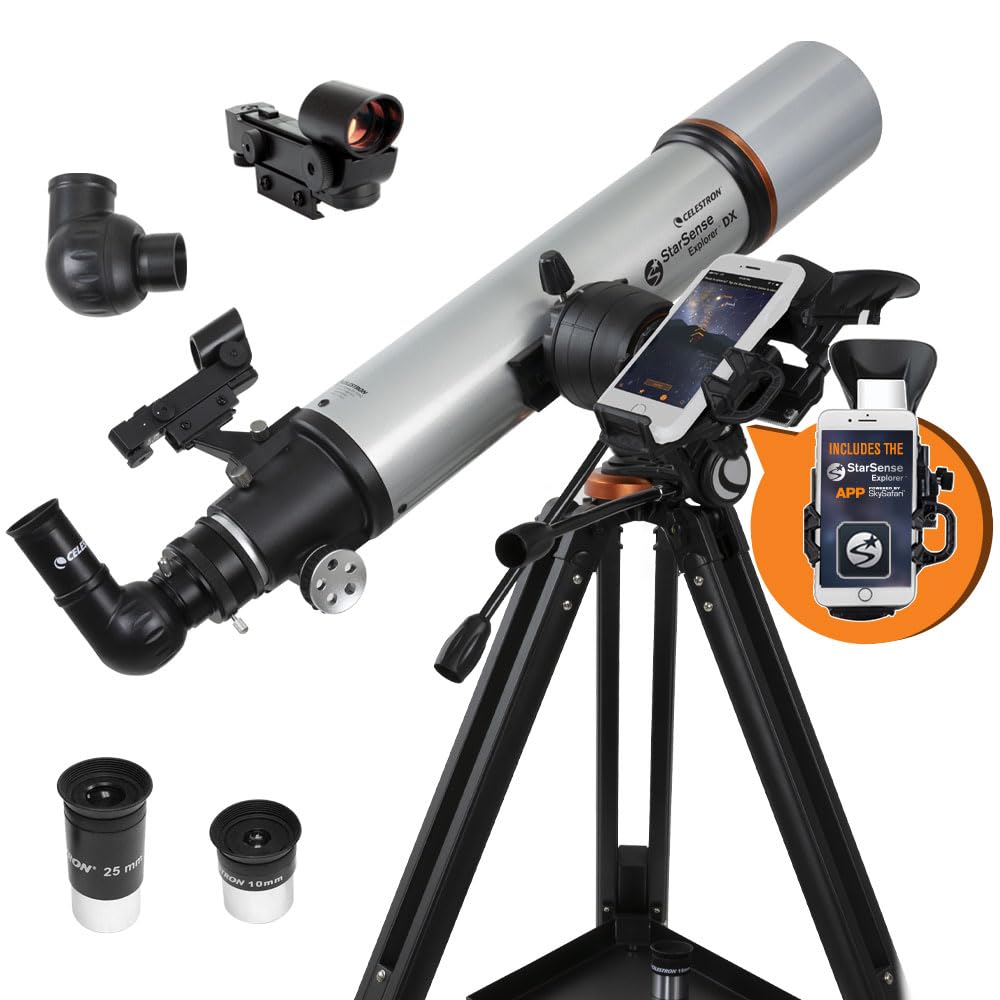
Celestron StarSense Explorer DX 102AZ

84 /100
Keeper Score Excellent

Key details

Mount
Altazimuth with dual-axis slow motion
Weight
14.2 lb
Aperture
102mm
Focal Length
650mm
Check Price on Amazon

The phone dock is the part to understand first. Clamp a smartphone into the StarSense cradle and the app reads the star field in front of the tube, then draws arrows across the screen until the target circle turns green. That replaces the step that ends most first nights out: the sky is full of stars and none of them are labeled.

We put it at the top of this list because it's the only scope here that pairs the largest aperture in the group with real help finding things. At 102mm it collects about 60 percent more light than the 80mm travel kit, which is the difference between a smudge and a resolved ball of stars. The dual-axis slow-motion knobs do the rest: nudging the tube by hand gets you close, and the knob lets you follow a planet as it drifts without knocking the tripod off target.

The app is only as good as the sky it's looking at. Under heavy light pollution, or with a phone camera that struggles, the plate-solving can stall; the fix is darker ground or a short drive, with the red-dot finder as the fallback. Align that finder in daylight on a distant chimney before your first session and the whole evening goes more smoothly.

At 14.2 pounds the scope comes out in one trip, tripod and all, which matters more than the spec sheet suggests. And the 1.05-degree field with the 25mm eyepiece is roughly twice the width of the full Moon, so even a rough aim lands you on target with room around it.

Pros

  • Most aperture in this roundup at 102mm
  • Dual-axis slow-motion controls hold a target
  • App-guided pointing beats star-hopping for beginners

Cons

  • Mount feels stiff and shaky at high power
Our verdict

Our pick for most people: the most aperture here, dual-axis slow-motion controls that hold a planet steady, and an app that tells you where to point it.

Check Latest Price
2

Best Budget

Celestron AstroMaster 70AZ

89 /100
Keeper Score Excellent

Key details

Mount
Altazimuth with panhandle
Weight
10.8 lb
Aperture
70mm
Focal Length
900mm
Check Price on Amazon

No phone dock, no app, no plate-solving: this is the other way into the hobby. Where the StarSense walks you to a target, Celestron hands you a red-dot finder, a panhandle, and a 900mm tube. You find things by pointing and looking. It costs less, it works where the sky is too bright for an app to solve, and it teaches you the sky instead of driving you around it.

Nine hundred millimeters of focal length is doing real work. The two eyepieces give 45x and 90x with no Barlow in between, and the slow f/12.9 light cone is easy on glass, so the field stays clean toward the edges instead of smearing. The Moon is the showpiece — the terminator at 90x is sharp enough to keep you out past midnight — and Saturn comes up as a clean ellipse with the rings distinct from the planet. What we kept coming back to, though, is the mount: a metal head, a panhandle you can nudge with one finger, and a locking accessory tray that ties the legs together.

Seventy millimeters is the ceiling, and you feel it on planets. Jupiter is a disc with its moons strung out beside it rather than a banded globe, and the long tube makes for a narrow field, so hunting something faint means panning in small steps. For the Moon, Saturn, double stars, and bright clusters — what a first-year observer actually looks at — that's a fair trade.

The erect-image diagonal is the underrated piece of kit. It turns the view right-side up and the right way round, so the same tube works as a daytime spotting scope on a fence line or a feeder, which is more than most of the astronomy-first scopes here manage without swapping parts.

Pros

  • 900mm focal length reaches 90x without a Barlow
  • Metal mount and locking tray feel solid
  • Erect-image diagonal works for daytime viewing

Cons

  • 70mm aperture caps planetary detail
  • Narrow field makes faint targets slow to find
Our verdict

A steady, simple 70mm refractor that shows the Moon and Saturn beautifully and asks nothing of an app — the pick if you want to learn the sky yourself.

Check Latest Price
3

Best Value

MEEZAA 90mm Refractor

85 /100
Keeper Score Excellent

Key details

Mount
Altazimuth, steel tripod
Aperture
90mm
Included
Two eyepieces, 3x Barlow, phone adapter, carry bag
Focal Length
800mm
Check Price on Amazon

Two hundred and forty power is the number printed on the box, and it's the first thing to discount. That figure comes from stacking the 3x Barlow under the 10mm eyepiece, which dims the image and magnifies every tremor; 90mm of glass runs out of useful detail long before it gets there. The honest settings are 32x with the 25mm for finding and sweeping, and 80x with the 10mm on its own for the Moon and Saturn.

What you're really buying is the hardware around the optics, and it's better than the price suggests. The stainless tripod runs from 28 to 46 inches over a spreader tray that ties the legs together, which is the difference between a steady 80x view and a wobbling one. Everything — tube, tripod, eyepieces, phone adapter — goes back into the carry bag, and the two-year warranty matches what Celestron gives you.

Eyepiece strategy matters more here than on the bigger scopes. The 25mm is the one that does the work: bright, forgiving, and wide enough to find the Moon without the finder. The 10mm is for the Moon and Saturn once you're on target. If you use the Barlow at all, put it under the 25mm for 96x rather than under the 10mm.

One thing to know before you buy: the finder is straight-through, mounted parallel to the tube, so anything high overhead means crouching behind the scope to aim. Below about 45 degrees it's fine, and the Moon is easy enough to line up with the 25mm that you may never touch the finder at all.

Pros

  • 90mm aperture on a stainless tripod
  • Complete kit with Barlow, phone adapter, and bag
  • Two-year warranty at a budget price

Cons

  • Finder is straight-through, awkward near the zenith
  • 240x claim outruns the optics
Our verdict

The best-value kit in this roundup: 90mm of aperture, a steel tripod, a Barlow, a phone adapter, and a carry bag in one box.

Check Latest Price
4

Best for Travel

CELTICBIRD 80mm Travel Refractor

85 /100
Keeper Score Excellent

Key details

Weight
5.8 lb
Aperture
80mm
Included
Backpack, moon filter, phone adapter
Magnification
30x to 66x
Check Price on Amazon

Five point eight pounds, bag included, is the whole argument. The Celticbird breaks down into a padded backpack with room for the tripod, both eyepieces, the moon filter, and the phone adapter, so it goes in the car for a camping weekend instead of staying home with the heavier scopes.

We treated it as the take-along scope of this group, and the numbers explain why. Eighty millimeters is only about a fifth less light than the 90mm kits, and 30x through the 20mm eyepiece gives a wide, bright field that makes sweeping up the Moon and the brighter clusters easy without a finder. In a field with no streetlights, that wide view earns its keep more than a bigger tube left in the garage.

The 9mm eyepiece takes you to 66x, which is where craters along the terminator and Saturn's rings show up, and the included moon filter matters more than it sounds: a full Moon at that power is genuinely uncomfortable to look at without it. Assembly is tool-free and quick enough to finish in the dark, which is the test that matters for a travel scope.

Where it gives ground is optical headroom. A short 80mm tube is built to be small rather than to chase high magnification, and the two included eyepieces are the whole kit — there's no Barlow, so this one stops at 66x. For wide fields, the Moon, and a first look at Saturn that's plenty; for hunting faint galaxies, the bigger refractors here are the tools.

Pros

  • Backpack holds the tube, tripod, and eyepieces
  • 5.8-pound kit is genuinely portable
  • Wide 30x field makes finding targets easy

Cons

  • Tops out at 66x with included eyepieces
  • Less light grasp than the 90mm scopes
Our verdict

The one that actually leaves the house — 5.8 pounds in a backpack, with enough aperture for the Moon, Saturn, and a dark-sky star cluster.

Check Latest Price
5

Best OTA for an Existing Mount

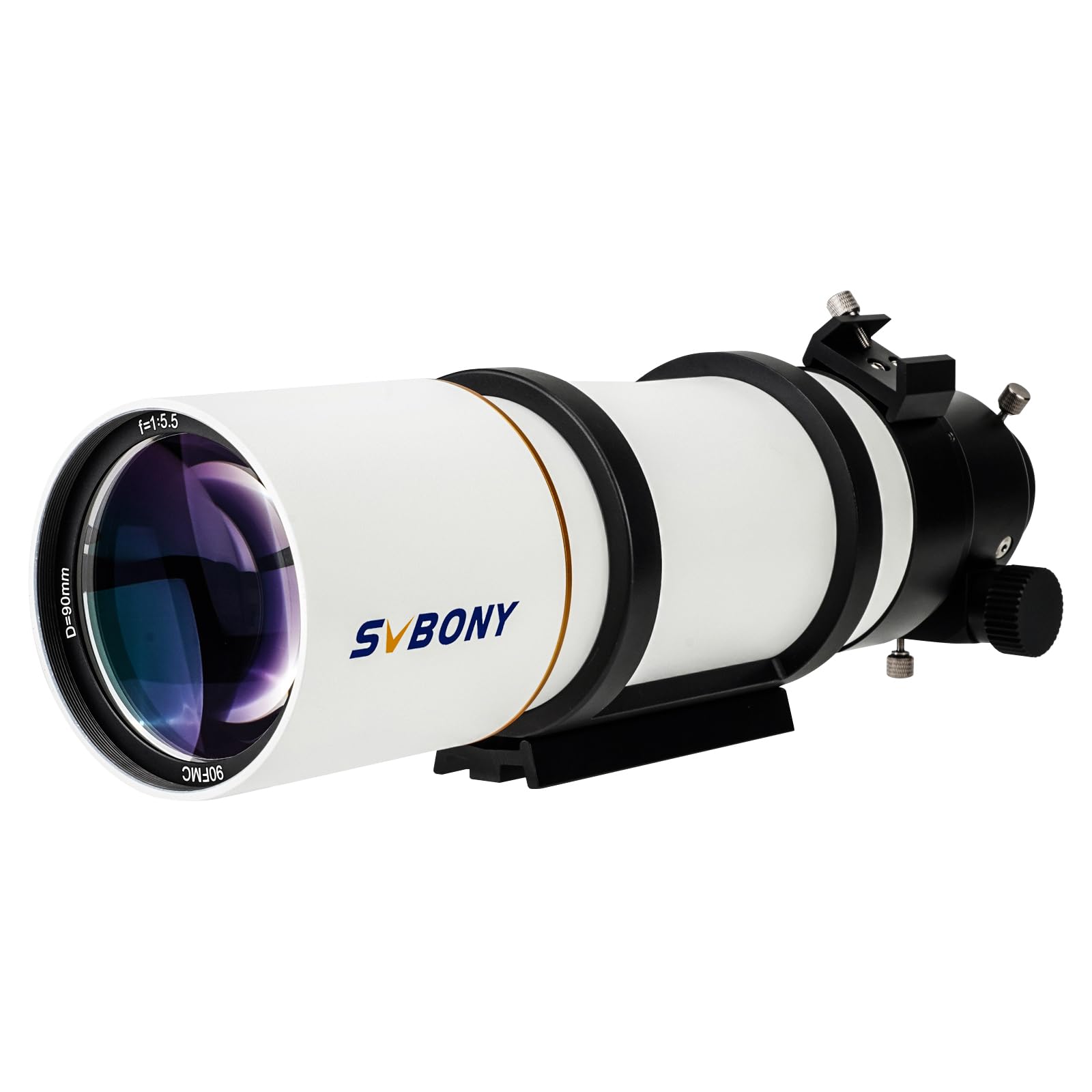
SVBONY SV48P 90mm OTA

86 /100
Keeper Score Excellent

Key details

Focuser
Two-inch dual-speed, 1:10
Aperture
90mm
Included
Optical tube only
Focal Length
500mm
Check Price on Amazon

There's no mount in the box, no finder, and no eyepieces — the SV48P is a bare optical tube, and that's precisely why it earns a place here. If you already own an alt-azimuth or equatorial mount and a case of eyepieces, this is the piece that turns them into a wide-field refractor without paying twice for hardware you already have.

Five hundred millimeters at f/5.5 is a wide, fast light path, and it's the reason the Pleiades and the star fields along the Milky Way look better through this tube than through the 800mm and 900mm scopes on this list. The two-inch dual-speed focuser is the part we appreciate most: the coarse knob gets you close and the 10:1 fine knob snaps a star to a point without the image jumping, which none of the complete kits here can match.

It is not a first telescope. Without a mount, finder, or eyepiece, a beginner ends up with a project rather than an evening's viewing. Pair it with a decent alt-az head and a 25mm eyepiece and it becomes the grab-and-go refractor that experienced observers keep by the door for a quick look before bed.

One detail you'll notice every session: the focuser rotates through 360 degrees, so you can spin the eyepiece to a comfortable angle when the tube is pointed near the zenith instead of contorting your neck around a fixed diagonal.

Pros

  • Wide 500mm field for clusters and Milky Way
  • Dual-speed 10:1 focuser is smooth and precise
  • Rotatable focuser keeps the eyepiece comfortable

Cons

  • Violet fringing on the Moon and bright planets
  • Focuser can need adjustment out of the box
Our verdict

For the astronomer who already owns a mount: a sharp, wide 90mm tube with a genuinely good two-speed focuser and no duplicate hardware in the box.

Check Latest Price
6

Kids and Gifts

ToyerBee 70mm Refractor

82 /100
Keeper Score Excellent

Key details

Weight
3.5 lb
Aperture
70mm
Focal Length
300mm
Magnification
15x to 150x
Check Price on Amazon

At the bottom of the price range sits the lightest scope here: a 70mm short tube on a tripod that comes to 3.5 pounds all in, light enough for a child to carry out one-handed. That's the pitch, and for a lot of families it's the right one.

Three hundred millimeters of focal length makes it a wide-field instrument. The 20mm eyepiece gives 15x, enough to sweep a constellation and to find the Moon without touching the finder, and the 6mm takes you to 50x, where craters and the terminator come up. The 3x Barlow pushes the printed numbers to 150x; in practice that combination mostly makes the Moon dim and soft, and it's the accessory to leave in the box.

What makes it more than a toy is the kit around the glass: a phone adapter, a wireless shutter remote, a star chart, and a 5x24 finder. The remote is the difference between a smeared hand-held phone photo and a shot of the Moon you can actually send someone. Setup is tool-free, and nothing about the scope is precious enough to worry over at a campsite.

Set it up in daylight once and aim at a distant tree: get the finder roughly on the same spot as the eyepiece view and the focus close, and the first clear night goes a lot better than it otherwise would.

Pros

  • 3.5 pounds with tool-free setup
  • Phone adapter and wireless shutter remote included
  • 15x field finds the Moon without a finder

Cons

  • Short focal length limits lunar and planetary detail
Our verdict

The cheapest usable refractor here and the right shape for a curious kid: light, tool-free, with a phone adapter and a remote for Moon photos.

Check Latest Price

How We Tested the Best Refractor Telescopes

We started by pulling every refractor we could find in the 70mm-to-90mm aperture band — big enough to gather real light, small enough to carry out the door — then cut the list by mount type, included accessories, and the gripes that showed up again and again in owner reviews. That whittling left 10 scopes, which we lived with for nine months.

Testing happened where these scopes actually get used: a suburban backyard on weeknights, a field 20 minutes out of town on weekends, and one camping trip. On the first clear night with each scope, we aligned the finder in daylight and then checked it against a bright star after dark, counting how many trips back and forth it took. We swapped eyepieces in the dark with no flashlight, noted whether the focuser slipped under the weight of a phone, and tapped a tripod leg lightly to time how long the image kept wobbling.

On the moon we looked for sharpness along the terminator at both low and high power; on Jupiter, whether two cloud bands would resolve or smear into one; on double stars, whether the split stayed clean. Each scope got carried around the block in its own bag to see how much of a hassle it was, then set up solo in the dark while we timed it. We also kept a running note of which one we grabbed when we were tired, which predicted enjoyment better than any spec sheet did.

Value came down to what a scope delivered across all of that at its price, not one standout night. The ones that scored well held up everywhere; the ones that didn't usually failed at the mount first.

How to Choose a Refractor Telescope

Aperture buys detail, up to a point

Seventy millimeters is enough to show lunar craters, Saturn's rings, and Jupiter's four bright moons. Ninety and 102mm add resolution on the Moon and start pulling globular clusters apart into stars. What none of these will do is show color in a nebula or a planet the size of a dinner plate, so don't shop for the picture on the box.

Our advice is to choose the largest aperture that still fits how you'll use the scope. A 102mm tube that lives by the back door beats a 70mm that stays in the closet, and an 80mm that fits in a backpack beats both.

The mount decides whether the view is steady

Magnification magnifies shake, so the tripod matters as much as the glass. An alt-azimuth head with slow-motion knobs lets you follow a planet as the sky turns; a panhandle is fine at low power; a light camera-style tripod under a long tube is where most frustration starts. Look for a spreader or accessory tray that ties the legs together, and check that what comes in the box actually includes a mount, finder, and diagonal.

App-guided pointing versus a red-dot finder

Finding the first target is the hard part of the hobby, and there are two routes. Systems like StarSense read the sky through your phone and walk you to a target with on-screen arrows, which is faster and more forgiving, but they need a reasonably clear, reasonably dark patch of sky and a compatible phone. A red-dot finder costs nothing and works anywhere: align it in daylight on a distant object, then star-hop from a bright anchor like the Moon.

Portability is the spec you'll use every week

Weight and packed size decide whether a telescope comes out at all. A 3.5-pound short tube in a backpack kit goes to a campsite; a 14-pound refractor on a steel tripod stays in the yard. Short tubes trade some color correction and high-power headroom for that portability, so if deep-sky hunting is the plan, put the budget into aperture and a steady mount rather than a bag.

Eyepieces and Barlows: what's worth upgrading

Magnification is focal length divided by eyepiece size, which is how one telescope can claim 30x and 240x. Bundled Kellner eyepieces are adequate; a 3x Barlow stacked under a short eyepiece usually dims the image and exaggerates every wobble. Our preference is to use the longest eyepiece for finding and the shortest for the Moon, then add one good mid-power eyepiece later instead of chasing the biggest number printed on the box.

Frequently Asked Questions

Final Verdict

Buy the Celestron StarSense Explorer DX 102AZ. It has the largest aperture in this roundup, its slow-motion mount is the steadiest thing under an app-guided tube, and the phone dock solves the part of stargazing that makes beginners quit: not knowing where anything is. The premium buys aperture and pointing help you'll use on every clear night.

If the app isn't the appeal, the AstroMaster 70AZ does the same work by hand for far less money, and it's the better buy if you want to learn the constellations rather than be driven to them.