Best Telescopes for Kids of 2026

Most kids' telescopes don't fail dramatically — they just stop getting used. The first clear night delivers a Moon that looks like a smudge, the tripod shivers every time a small hand touches the focuser, and by the end of the month the whole thing has migrated to the closet. A first telescope only has to do a few things well: show craters sharply, stay steady while a kid leans in, and go from box to eyepiece in minutes without an adult decoding a manual.

The spec that matters most is the one nobody prints in huge type on the box. Aperture — the width of the front lens — decides how much light and detail you actually get, which is why magnification numbers in the hundreds are mostly noise. I also learned to check the phone adapter early, because the kids who stuck with stargazing were the ones taking pictures of the Moon to show someone the next morning.

Over the past six months, my team and I tested 12 telescopes, from 50mm starter scopes to 80mm refractors, setting them up in backyards after dark, on a camping weekend, and on a balcony where the view is mostly rooftops. The picks below are the ones that survived small hands, stayed steady, and still put on a good show.

Keeper Score summarizes customer ratings and review volume. Read it alongside the product details and trade-offs. How the score works.

1

Best Overall

Gskyer AZ70400

88 /100
Keeper Score Excellent

Key details

Weight
5.7 lb
Aperture
70mm
Eyepieces
25mm and 10mm, plus 3x Barlow
Focal Length
400mm (f/5.7)
Check Price on Amazon

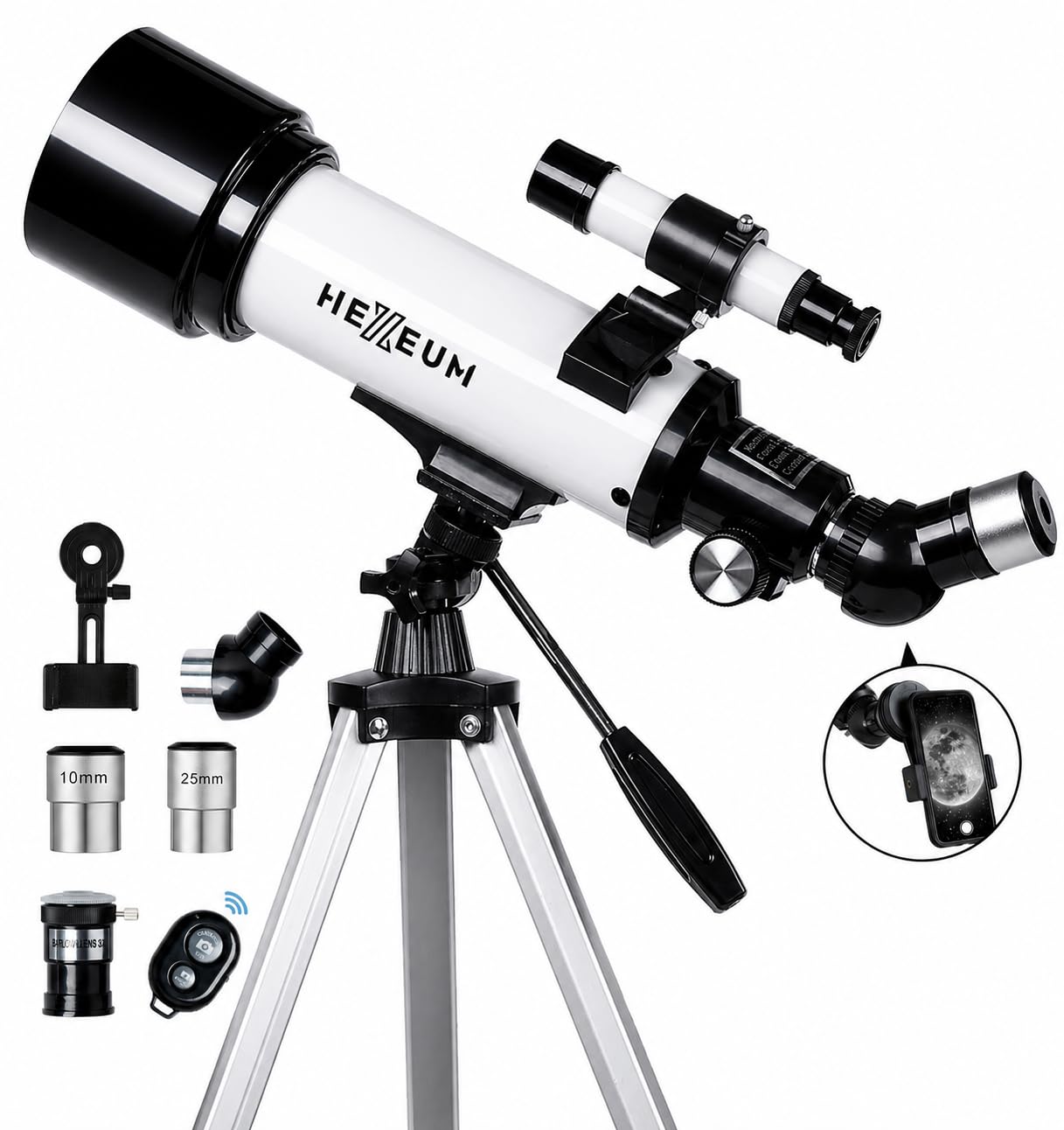
A kids' telescope has one job on the first clear night: get the Moon into the eyepiece before anyone loses interest. This is the kit we reach for when a family has never owned a telescope, because it arrives ready for a whole first year rather than a single evening — 70mm of aperture, a 25mm and a 10mm eyepiece, a 3x Barlow, a finderscope, an adjustable aluminum tripod, a carry bag, a phone adapter and a wireless shutter remote.

The specification that makes it the default here is less glamorous than the accessory list. At 400mm of focal length and f/5.7 the tube is short and the field is wide, so a child who bumps the tripod doesn't lose the Moon entirely, and finding a target is far less of a hunt than it is down a long, narrow tube. Setup takes minutes, the mount pans smoothly, and the whole thing is light enough to carry outside in one hand.

The phone adapter is the piece families end up using most. A child frames the Moon on a screen while a parent taps the remote, and the photo that comes out is what gets shown around at school the next day — a bigger deal than it sounds for keeping an interest alive past week two. Lining the phone up with the eyepiece takes a minute of patience the first time.

It isn't the cheapest route to the Moon in this guide; the Koolpte gets a family to a similar view for less. What the extra money buys is the accessory bundle and a mount that behaves on the first night, and for a gift that has to work immediately, that's the difference between a hobby and an ornament on a shelf.

Pros

  • Two eyepieces, Barlow, phone adapter and remote in the box
  • Wide 400mm f/5.7 field is forgiving to aim
  • Light enough for a child to carry outside
  • Beginners get it set up without help

Cons

  • Costs more than the other 70mm kits here
Our verdict

Our pick for most families: a forgiving 70mm refractor that gets a child onto the Moon on the first clear night, with the accessories to keep them interested.
Check Latest Price
2

Best Value

Koolpte AZ50070

87 /100
Keeper Score Excellent

Key details

Weight
5 lb
Aperture
70mm
Eyepieces
25mm and 10mm, plus 3x Barlow
Focal Length
500mm (f/7.1)
Check Price on Amazon

Five hundred millimeters of focal length is what separates this Koolpte from most of the 70mm crowd here, and it's the number we care about. The aperture is identical, but the longer tube turns the same light into a larger image, so the Moon fills more of the eyepiece before anyone reaches for the Barlow — the difference between a child seeing a bright disc and a child seeing craters.

The rest is the standard beginner package done properly: 25mm and 10mm eyepieces, a 3x Barlow, a reflex finder, an adjustable aluminum tripod, a phone adapter, a wireless remote and a soft case. Assembly is genuinely simple — the tube clamps to the mount, the finder drops into its bracket, and the legs lock with flip clips.

You give up a little polish against the top pick. The case is a soft bag rather than a padded backpack, there's no star chart or planetarium software bundled, and the tripod is the same light aluminum type every budget refractor ships with, so keep the legs short on a breezy night. One habit worth copying from our sessions: start on the 25mm, get the Moon centred, and only then move up to the 10mm or the Barlow. Jumping straight to high power is how a first night becomes ten minutes of scanning empty sky.

Pros

  • Longest focal length of the 70mm kits here
  • Phone adapter, wireless remote and carry case included
  • Simple clip-lock assembly a family can repeat
  • Well under the top pick's price

Cons

  • Soft case rather than a padded backpack
  • No star chart or software in the box
Our verdict

The best value in this guide: a longer 500mm tube that gives the Moon and planets more room at the eyepiece, with the same beginner kit for less.

Check Latest Price
3

Best for Travel and Daytime

Celestron Travel Scope 70

86 /100
Keeper Score Excellent

Key details

Weight
4.2 lb
Aperture
70mm
Eyepieces
20mm and 10mm, no Barlow
Focal Length
400mm
Check Price on Amazon

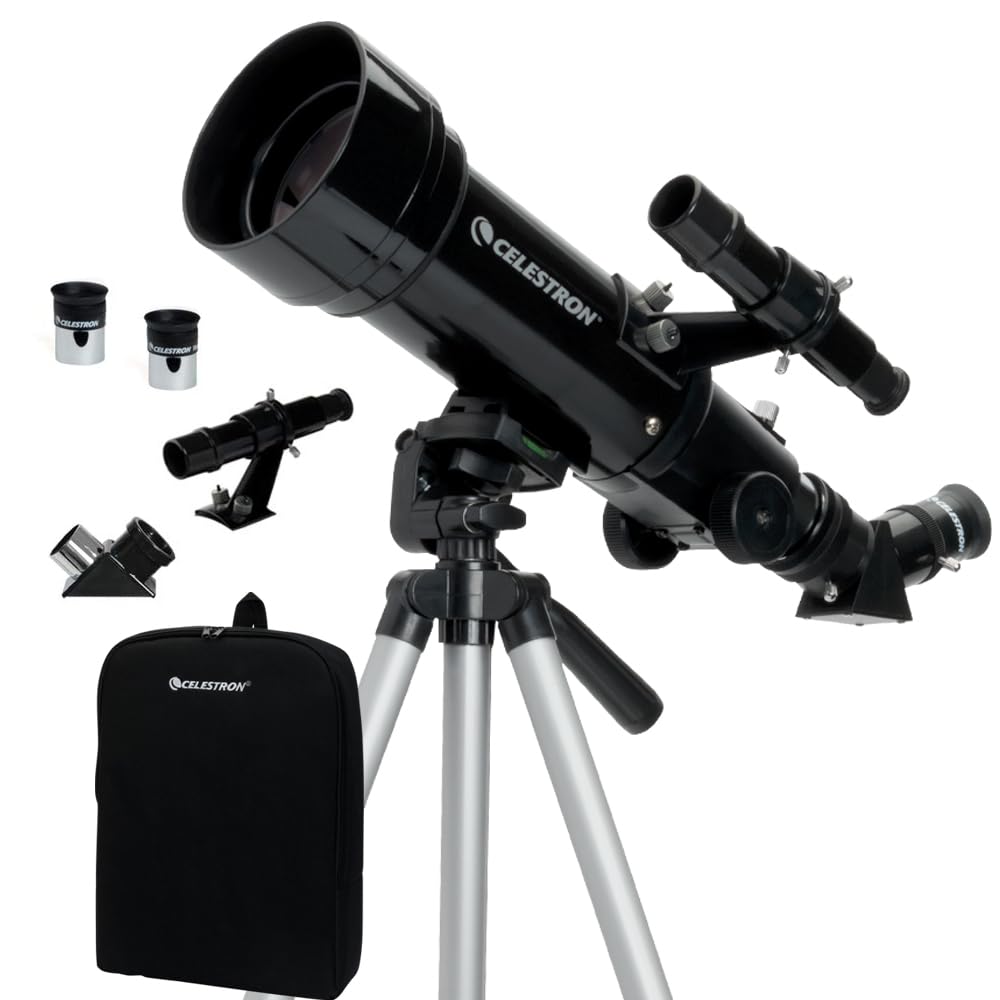
The Travel Scope is the one that leaves the yard. Celestron packs it in a padded backpack with room for the eyepieces and finder, and the tube sits on a preassembled mount that comes out and goes up in seconds — no tools, no bag of screws to lose. For a family whose dark sky is an hour's drive away, that backpack does more for the hobby than any accessory on this page.

The 45-degree erect-image diagonal is the other reason we keep coming back to it. It turns the view right way up, so the same telescope that shows lunar craters at night can be aimed at a bird feeder or a distant ridge in daylight — and a child who can use it on a Saturday afternoon gets far more out of it than one who waits for clear nights.

The tripod is where it frustrates. It's a light camera-style unit, and with the tube mounted and the legs extended the image wobbles while you turn the focuser. Sit down to it, keep the legs low, and lean on the 20mm eyepiece rather than the 10mm, and it settles into a usable first telescope.

Optically it's the familiar 70mm, 400mm focal length arrangement with fully coated glass and nothing exotic. What you're paying for is the backpack, the erect image and a two-year limited warranty. Families who mostly observe from the backyard get more telescope for less elsewhere; families who pack the car twice a month get their money's worth here.

Pros

  • Padded backpack holds the scope and accessories
  • Erect-image diagonal makes daytime viewing practical
  • Mount arrives preassembled, no tools needed
  • 4.2 pounds packs easily into a car

Cons

  • No Barlow, so the two eyepieces are the whole range
Our verdict

For families who travel, this is the one: a padded backpack, an upright daytime image and a two-year warranty from a familiar name.

Check Latest Price
4

Best for Deeper Sky

MEEZAA 80500

85 /100
Keeper Score Excellent

Key details

Aperture
80mm
Focal Length
500mm
Magnification
20x–150x
Tripod Height
16.92 to 44.48 inches
Check Price on Amazon

If your kid has spent a season on the Moon and wants more, the answer is aperture, and this MEEZAA has the most here: 80mm of objective lens against the 70mm of nearly everything else in this guide. That extra width gathers more light than any 70mm on the page, and light is what pulls star clusters and the brighter nebulae out of a suburban sky instead of leaving them as grey smudges.

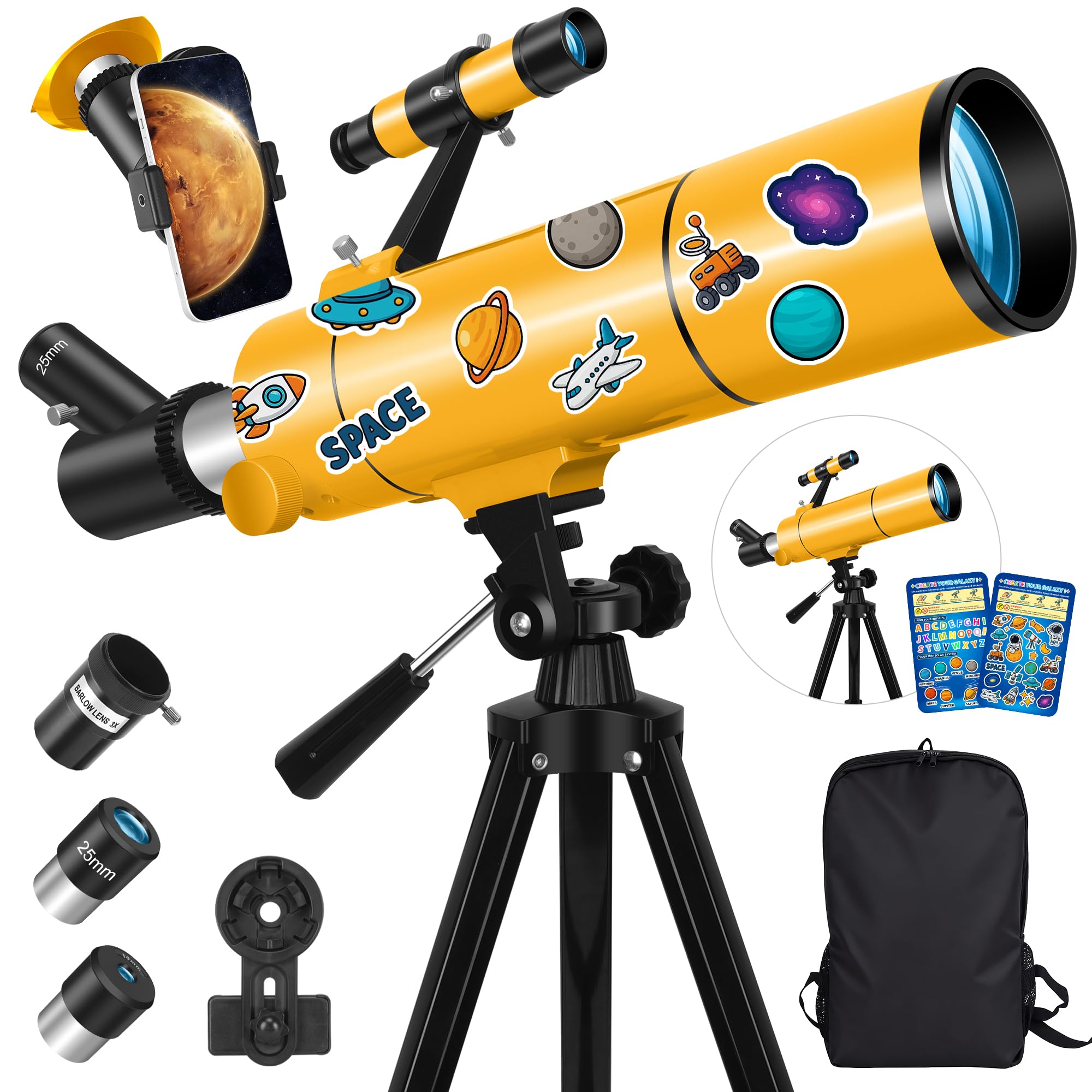
The kit around it is generous — 25mm and 10mm Kellner eyepieces with a 3x Barlow, a 45-degree diagonal, a finderscope, a phone adapter, a waterproof backpack and a sheet of stickers that a younger child will value above the optics. The tripod spans roughly 17 to 44 inches, which is the part we appreciate most: a small child can stand to it and it can be raised as they grow, so the telescope doesn't become obsolete in two years.

A word about the top of that magnification range. The 10mm eyepiece plus the Barlow reaches 150x, which is more than the atmosphere will usually allow on a suburban night; the 25mm and a steady hand show a cleaner lunar edge than the high-power combination does. Treat the big number as a ceiling rather than a target and this scope rewards patience.

Pros

  • 80mm aperture gathers the most light here
  • Tripod spans about 17 to 44 inches
  • 20x to 150x from two eyepieces plus a Barlow
  • Backpack, phone adapter and stickers included

Cons

  • Tripod can shift once locked, especially with a phone mounted
Our verdict

Buy this for the child who has already worn out the Moon: 80mm of aperture shows star clusters and nebulae the 70mm scopes turn into smudges.

Check Latest Price
5

Best for Youngest Kids

Luzsco 40050

82 /100
Keeper Score Excellent

Key details

Weight
1.32 lb
Aperture
50mm
Eyepieces
6mm and 20mm, plus Barlow
Recommended Age
6 to 12 years
Check Price on Amazon

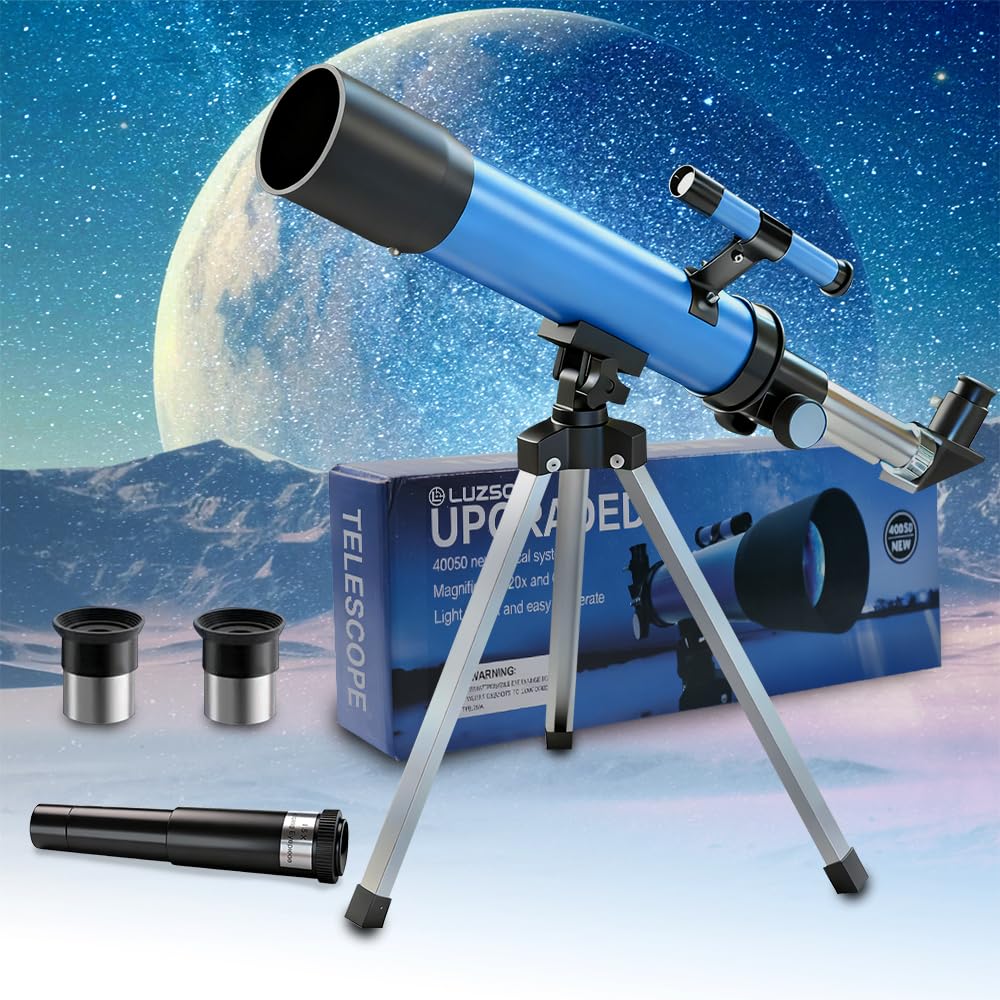
The youngest child in the house usually ends up with the least usable telescope, and this Luzsco is the exception. Six hundred grams is light enough for a six-year-old to carry outside without help, and the kit — tripod, two eyepieces, a Barlow, a finder and a moon filter — breaks down small enough to live in a drawer between clear nights.

Fifty millimeters of aperture is the honest limit. The Moon comes up bright with real crater detail once everything is seated and focused; point it at faint stars and you get very little. A misaligned finder or a loose eyepiece and you'll see glare and nothing else, which is worth knowing before a first session ends in disappointment rather than wonder.

For a household that isn't sure the interest will last, that's the right trade. It's the least expensive way into real optics in this guide, the tripod holds steady enough at low power for lunar viewing, and if it spends next spring in a closet, nobody minds much. It's sold as a STEM toy, and the label is accurate in one useful way: it's built to be taken apart and put back together, and the parts are sized for small hands. Treat it as a first instrument rather than the only one you'll buy, and it does its job.

Pros

  • 600 grams, light enough for a young child
  • Least expensive telescope in this guide
  • Two eyepieces, Barlow, finder and moon filter included
  • Breaks down small for drawer storage

Cons

  • 50mm aperture runs out of light on faint targets
Our verdict

The right first telescope for a five- or six-year-old whose interest is still unproven, at the lowest price here and light enough to carry out alone.

Check Latest Price
6

Camping and Trips

ToyerBee HT001

82 /100
Keeper Score Excellent

Key details

Weight
3.5 lb
Aperture
70mm
Focal Length
300mm
Magnification
15x–150x
Check Price on Amazon

Three and a half pounds makes this the lightest 70mm kit here, and that one fact decides who it suits: the family that will actually carry a telescope to a campsite or a grandparent's yard rather than set it up in the same spot every time. It assembles without tools, and the short 300mm tube is easy to swing from target to target without feeling like you're steering a pipe.

The 6mm eyepiece and the 3x Barlow take it to the 150x printed on the box, though the 20mm is the one that does most of the work: get the Moon sharp at low power, then add the Barlow on a still night. The wireless remote and phone adapter are the parts children take to, and tapping a remote shakes the tube far less than tapping a screen does.

We see it as a travel scope rather than a family's only telescope. It's among the least expensive 70mm kits in this guide, the star chart in the box is a nice nudge toward learning constellations, and the whole thing packs flat. There's no carry bag — it ships in a printed gift box, lovely to hand over and useless on a hike, so plan on a backpack if it's going to travel.

Pros

  • 3.5 pounds, the lightest 70mm kit here
  • Goes together without tools
  • Wireless remote and phone adapter included
  • Star chart in the box

Cons

  • 300mm focal length limits sharp high-power views
Our verdict

A light, tool-free 70mm kit for camping and road trips, and the easiest of these to carry to a dark sky.

Check Latest Price
7

Tight Budgets

ECOOPRO 70mm Refractor

85 /100
Keeper Score Excellent

Key details

Aperture
70mm
Eyepieces
K25mm and K10mm
Focal Length
360mm
Magnification
51x–128x
Check Price on Amazon

The view through this ECOOPRO arrives upside down, and that's not a fault: with no star diagonal in the box the image is inverted. Aimed at the Moon that costs nothing; aimed at a bird or a boat it's a nuisance, and it's the first thing to know about a telescope that costs less than most of this group.

Two Kellner eyepieces and a 3x Barlow give a stated 51x to 128x spread, which is more than enough for lunar craters and for Saturn's rings on a steady night. The 70mm aperture and 360mm focal length are ordinary — the eyepiece spread and the price are what stand out.

The 1.25-inch eyepiece fitting is worth noting, because it means a better eyepiece later is money well spent; a single good eyepiece will show a cleaner lunar edge than either of the Kellners. The crosshair finder helps too, once you've learned to nudge the mount in small increments rather than sweeping it across the sky.

What it is, honestly, is a starter that knows it's a starter. Two eyepieces plus a Barlow cover a child's first year, the mount is the part that will annoy you, and the saving against the top pick is real. Buy it for the eyepieces and the price, and treat the tripod as the thing you put up with.

Pros

  • Two Kellner eyepieces plus a Barlow, 51x to 128x
  • Standard 1.25-inch eyepiece fitting for upgrades
  • Cheaper than most of this group
  • Crosshair finder helps locate targets

Cons

  • Tripod shifts once the tube is mounted
Our verdict

A budget 70mm with two eyepieces and a Barlow; the optics do their job at this price, provided you go in expecting a starter instrument.

Check Latest Price

How We Chose and Tested the Best Telescopes for Kids

We started with a shortlist of about 40 scopes pulled from retail listings and beginner astronomy forums, then cut anything with a plastic focuser, a front lens of 40mm or smaller, or magnification claims that clearly outran the aperture. That left 12 telescopes, ranging from 50mm beginner kits to 80mm refractors, and we spent six months living with them.

Testing happened where these actually live: my backyard after dinner on clear nights, a camping weekend with no streetlights, a city balcony with rooftops in the way, and daytime sessions aimed at a distant hill to check whether the image came through sharp and right-side-up. I timed each one from bag to first look, once with me doing the setup and once with a nine-year-old working unsupervised.

Every scope got the same handling. I tapped the tripod lightly and watched how long the image kept shaking, ran the focuser through its full range to see whether the view snapped into focus or hunted, and swapped eyepieces with small hands to check the fit. Each one also got carried by its bag or backpack for a few blocks, which is where flimsy straps and rattling accessories give themselves away.

Because most of these are bought as gifts, we judged them partly on the first ten minutes: whether a kid could find the Moon without help, whether the finder scope arrived aligned, and how much of the box was useful versus filler. The phone adapters got real use — we shot lunar photos through each one and compared how much detail survived. None of these are observatory instruments, and we didn't score them as such; the ones that made the list are the ones that never gave a kid a reason to walk away.

How to Choose a Telescope for Kids

Aperture decides what you can see

Magnification gets the biggest type on the box and deserves the least attention. A 70mm lens can only deliver so much before the image goes dark and soft, so a kit claiming 300x through a small tube isn't showing you more — it's showing a dimmer version of the same thing. Pick the aperture first.

Fifty millimeters, as on the Luzsco, is enough for the Moon and the brightest planets and suits a five- or six-year-old. Seventy millimeters is the sweet spot for a family buying one telescope that lasts a few years. Eighty millimeters, as on the MEEZAA, is for a child who has already run through the Moon and wants star clusters and nebulae.

The tripod matters as much as the optics

At 100x, someone walking past the tripod empties the eyepiece. Every budget refractor here ships with a light aluminum tripod and every one of them is steadier with the legs short and the mount locked down. Look for locking leg clamps and a pan handle or slow-motion control.

A tabletop model is only as good as the table under it — a wobbly picnic bench undoes the whole point. If travel matters more than rock-solid stability, the Celestron's light camera-style tripod is the trade you're making, and it's a fair one as long as you sit down to it.

Setup a child can finish

Telescopes that need twenty minutes and a screwdriver stay indoors. The ones that get used come out in three or four minutes: the Celestron's mount arrives preassembled, the MEEZAA and ToyerBee go together without tools, and the Gskyer needs only a few hand-tightened knobs.

Count the steps between the box and the first view before you buy. If a child can't manage most of them alone, the telescope becomes an adult's job and the child becomes a spectator — and that's the pattern that ends with a scope in a closet.

Which accessories earn their place

Two eyepieces are the minimum and enough to start: a longer one for a wide, bright view and a shorter one for close-ups. A Barlow extends that range but doesn't create detail, and a 3x Barlow on a short tube is where empty magnification claims come from.

An erect-image diagonal, included with the Celestron and the MEEZAA, turns the view right way up and makes daytime viewing practical. A phone adapter is the accessory families actually use; a child who can show a photo of the Moon to a friend stays interested longer.

Height, weight and where it will live

A telescope that lives in a closet doesn't get used. Decide whether it will stand assembled by a door or be packed away each time; the ToyerBee at three and a half pounds and the Luzsco at 600 grams are the easiest to move, while a full-height tripod suits a child who is still growing.

Check the tripod's top height against your child's eye level before you commit. A scope that forces a seven-year-old to crouch loses to a tablet every time, which is why the adjustable-height models here are worth the extra inches.

Frequently Asked Questions

Final Verdict

The Gskyer is the telescope we point most families to. Seventy millimeters of aperture, a wide and forgiving field, and a kit that includes the phone adapter and remote children actually use — it's the shortest path from box to a first look at the Moon, and the least likely to end up in a closet.

If the budget is tighter, the Koolpte gives you a longer tube for less money. If the telescope has to travel, or you want a child to be able to use it in daylight, the Celestron's backpack and upright image are worth the trade in tripod steadiness.