Best Photography Lighting Kits of 2026

The first time I tried to shoot a friend's pottery at night, I taped a white shower curtain to a bookshelf and aimed two desk lamps at it. The photos were barely usable, and the rig tipped over twice. A photography lighting kit fixes that: it gives you softer, brighter, more controllable light and stands that stay where you put them.

Over the past eight months, I've set up and broken down 12 kits in my spare room, and my team has used them for portraits, product shots, and video calls. What separates a kit you'll keep using from one that ends up in a closet isn't the wattage on the box. It's whether the light is bright and soft enough to flatter a face or a product, whether the stand stays steady when you adjust the softbox, and whether setup is easy enough that you don't dread pulling it out. Remote control and color-temperature range matter more than most first-time buyers expect, and a kit only earns its place if it holds up after repeated teardown—the picks below did.

Keeper Score summarizes customer ratings and review volume. Read it alongside the product details and trade-offs. How the score works.

1

Best Overall

NEEWER 660 LED 2-Pack

94 /100
Keeper Score Outstanding

Key details

CRI
96+
Power
AC or NP-F battery
Light Output
3300 lux at 1m
Color Temperature
3200K-5600K
Check Price on Amazon

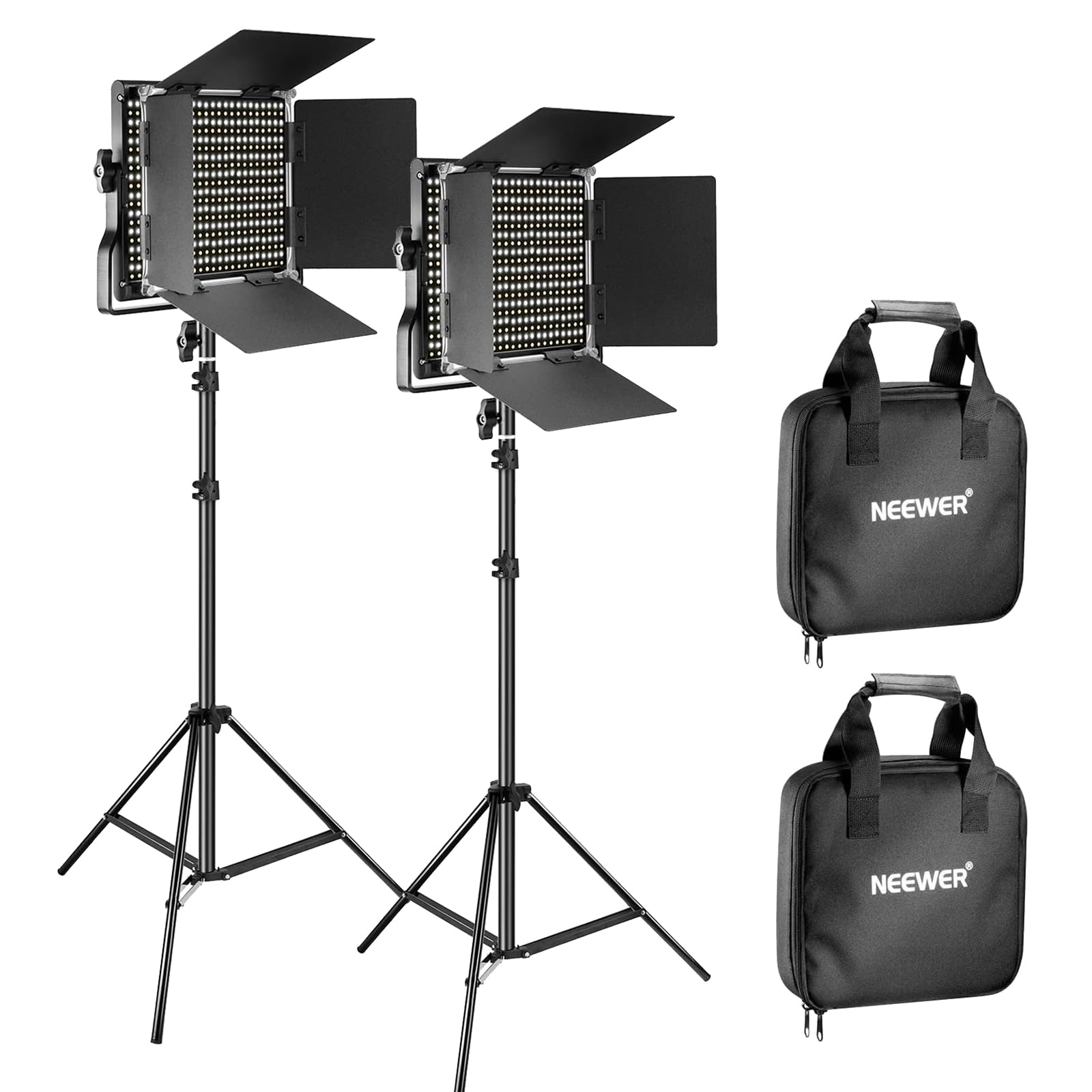
Three thousand three hundred lux at one meter, a CRI rating of 96+, and a color range that slides from 3200K to 5600K: on paper these two panels are the most capable lights in this group, and in a spare bedroom they behaved like it. We recommend them first because they are the pair that stays useful as your work gets harder. Dial the brightness down for a moody portrait or run both at full over a product table, and the color stays where you set it.

Control is what sells us on panels over a softbox kit. The metal barn doors cut spill off a background or keep light from bouncing around a small room, and because the housing is aluminum there is no fan noise creeping into a take. The included diffusers take the edge off, though a panel this size is still a harder light than a 24-inch softbox. Move it in close and let the diffusion work rather than expecting it to wrap the way a big box does.

Power is the other reason this is the pair we pack for a shoot away from home. Each light runs from the wall or from an NP-F battery, and the LCD screen tells you exactly where the brightness sits, so matching two heads in a dim room is not guesswork. The stands go from 26 to 75 inches, which covers a seated portrait up to a standing subject with the light just above eye level. Batteries are not included, so plan on a couple if you want to work untethered.

The limit is scope: no softboxes, no backdrops, nothing to hang behind your subject. If a background has to come in the same box, the EMART kit below covers that ground for similar money. As two lights you will still be using after the starter phase, though, this is the strongest pair in the set.

Pros

  • CRI 96+ keeps skin and product color accurate
  • Barn doors and diffusers shape and soften light
  • Runs on AC or NP-F batteries
  • Aluminum housing with no fan noise

Cons

  • No softbox or backdrop in the kit
  • Batteries sold separately
Our verdict

We recommend these panels to anyone who wants light they will not outgrow: high color accuracy, real dimming, battery power, and barn doors that keep spill in check.
Check Latest Price
2

Best All-In-One Studio Kit

EMART Backdrop Kit

91 /100
Keeper Score Outstanding

Key details

Bulbs
50W LED, 5500K, CRI 80
Backdrops
3 muslin, 6 × 9 ft
Softboxes
2 × 24 in
Backdrop System
8.5 × 10 ft frame
Check Price on Amazon

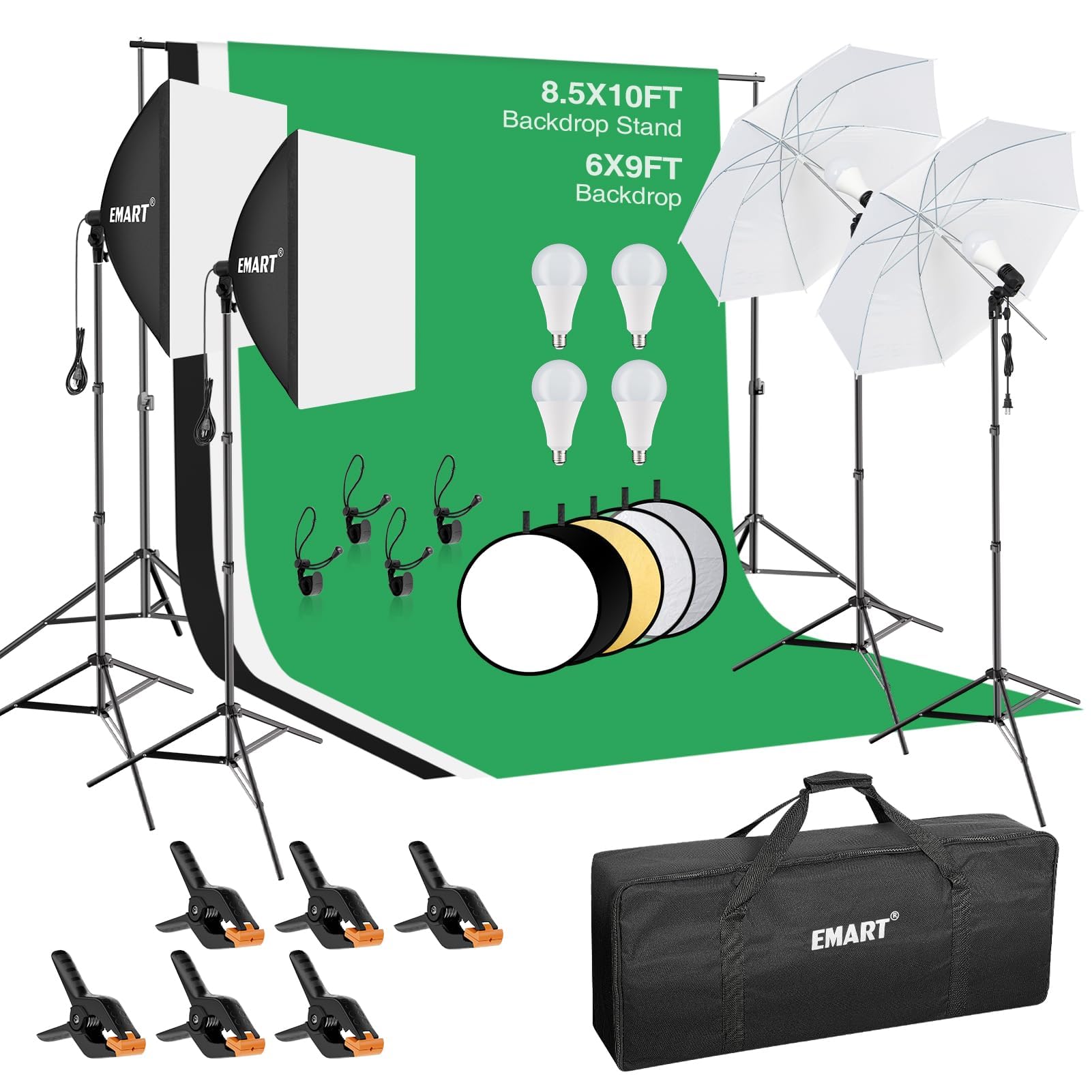
If your shot needs a background, this kit answers the whole question at once: two softboxes, two umbrellas on their own stands, a backdrop frame, and black, white, and green muslin to hang on it. Unpacking it the first time feels less like assembling a light and more like opening a small studio.

We like it most for the frame. It reaches 8.5 feet and spans wide enough to put a standing subject in front of it with room to spare, which is more than the other backdrop kit here manages. The cotton muslin has enough weight to hang without flapping, and the six spring clamps are the difference between a smooth sweep and a wrinkled one. Use all of them, pull the fabric taut, and steam it before the first shoot. Setup is a one-person job, and we had the frame and stands up without needing a second pair of hands.

The lights are where it is ordinary. Fifty-watt LED bulbs at CRI 80 are fine for bright, even fill and perfectly good for family portraits or product shots, but they will not flatter a skin tone the way the NEEWER panels do. Treat the lamps as the part you will want to improve first and the frame, stands, and backdrops as the part worth keeping.

Pros

  • Backdrop frame, three muslins, and six clamps included
  • Frame reaches 8.5 feet for standing subjects
  • Two softboxes and two umbrellas for mixed light
  • One person can set it up quickly

Cons

  • 50W bulbs at CRI 80 limit color-critical work
  • Frame is indoor-only in any breeze
Our verdict

Buy this one when the backdrop matters as much as the light: it is the only kit here that puts a full frame and three muslins in the box with the lamps.

Check Latest Price
3

Best Softbox Kit

NEEWER 700W Softbox Kit

90 /100
Keeper Score Outstanding

Key details

Bulbs
2 × 35W LED, 3150 lumens
Stands
2 × 83 in
Carry Bag
Included
Softboxes
2 × 24 in
Check Price on Amazon

Cheaper than our top pick and built around two 24-inch softboxes instead of panels, this is the kit we point portrait shooters toward. A softbox does one job better than anything else here: put it close to a face and the light wraps, softens the shadows under the eyes, and flatters skin without asking you to learn anything.

The bulbs are 35W LEDs rated at 3150 lumens each, UL certified, with a fixed 5700K daylight balance, so you light for daylight and leave it alone. Assembly was the pleasant surprise. The softboxes open like a pop-up tent, the 83-inch stands lock with a single action, and everything packs back into the included bag with the bulbs in their own pouch. We carried the whole thing in one trip and had it up in a spare bedroom without moving furniture.

Two softboxes and two tall stands for less than the panel kit is the value story, and it is why this one holds a place rather than reading as the cheap option. What you get for that is genuine softness: the boxes are large enough to light a face evenly at four or five feet, and the second one gives you fill without a reflector.

Pros

  • 24-inch softboxes soften and wrap portrait light
  • Two 3150-lumen daylight bulbs included
  • 83-inch aluminum stands with single-action locks
  • Carry bag holds the whole kit

Cons

  • Softbox angle can slip under its own weight
  • Fixed daylight balance, no color control
Our verdict

For portraits on a budget, this is the pair we point people to: two big softboxes, bright daylight bulbs, and a bag that keeps it all together.

Check Latest Price
4

Best Budget Two-Light Kit

NiceVeedi 25W Panel Kit

88 /100
Keeper Score Excellent

Key details

Dimming
10-100%
Light Panels
2 dimmable LED
Tripod Height
Up to 73 in
Color Temperature
2900K, 4800K, 7000K
Check Price on Amazon

Two panels, two tripods, two AC adapters, and a bag: this is the least expensive way here to get a matched pair of lights on stands, and it is aimed squarely at the desk. If you record at a computer, photograph products on a tabletop, or stream from a spare bedroom, the small footprint matters more than raw output.

The panels are thin enough to sit either side of a monitor without swallowing the desk, and the tripods run up to 73 inches so the light can come from above eye level. The three presets, 2900K, 4800K, and 7000K, cover a warm lamp-lit room, neutral, and a cooler look without gels. Dimming runs from 10 to 100 percent, which is the part that makes them usable in a small room: at the low end you can light a face without bouncing a white wall back at the camera.

We think it is the best value in this set for video, and the ceiling is honest. Output is modest, so plan on placing the lights within a few feet of the subject rather than across the room, and a 25W panel lights a head-and-shoulders portrait or a product on a table, not a full-length subject or a group. For everything shot at a desk, this is the pair that earns its space.

Pros

  • Three color temperatures from 2900K to 7000K
  • Dims to 10 percent for small rooms
  • Tripods reach 73 inches
  • Light enough to move room to room

Cons

  • Panel output limits large scenes and groups
  • Light tripods can be knocked over by a cable
Our verdict

Streamers and desk shooters should start here: three color temperatures, real dimming, and a footprint that fits beside a monitor.

Check Latest Price
5

Best Portable Two-Light Kit

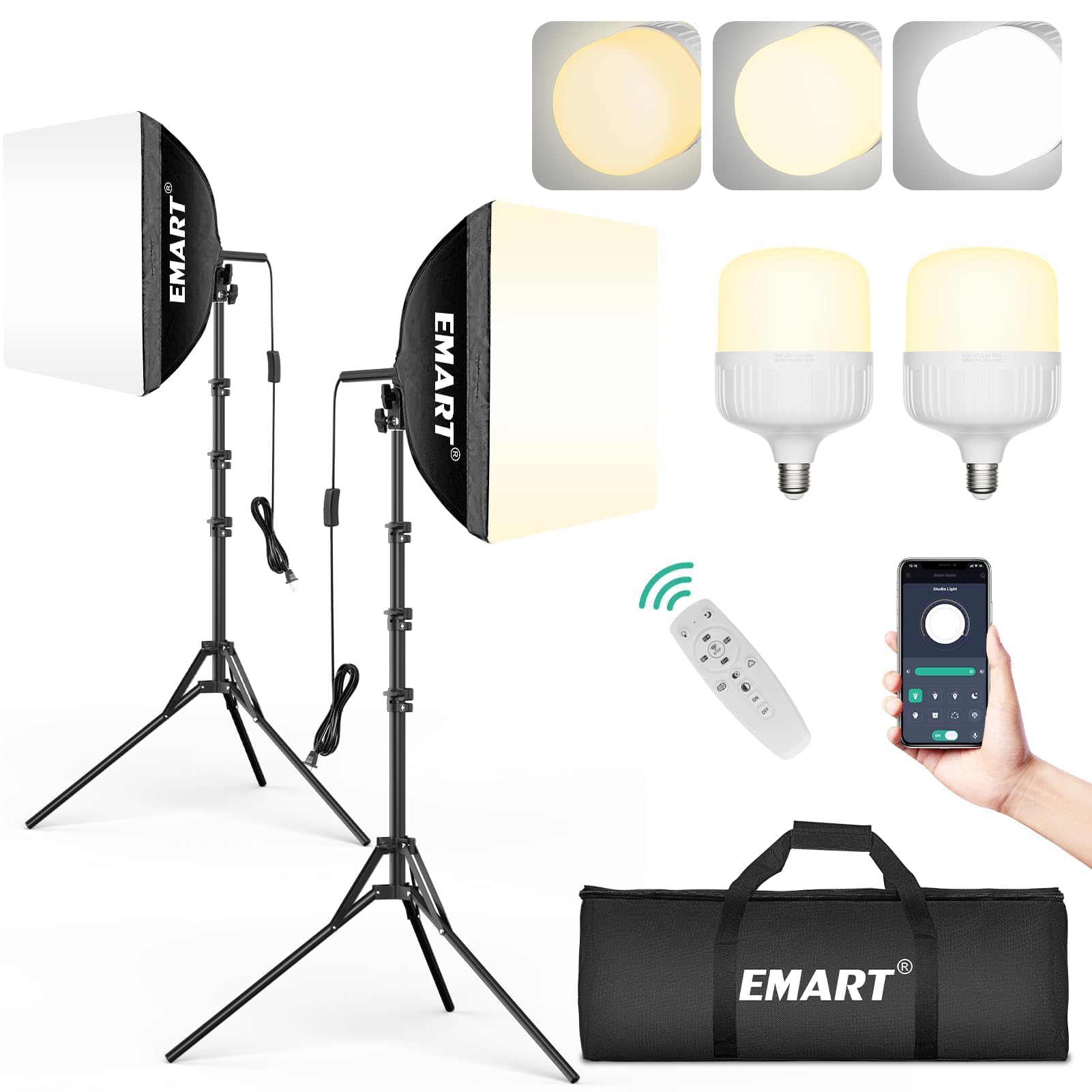
EMART Pull Softbox 2-Pack

83 /100
Keeper Score Excellent

Key details

Bulbs
2 × 50W LED
Softboxes
2 × 16 in, pull-open
Stand Height
17-63 in
Color Temperature
3000K-6000K
Check Price on Amazon

The softboxes on this kit open the way an umbrella does. Press the button, pull the rod out, and the 16-inch box is up: no tent poles, no wrestling a diffuser over a frame, no second person. We set both up, took them down, and did it again just to see whether the mechanism was as quick as it looked. It was.

Each 50W bulb is controlled separately through a remote or the EMART app, which is unusual at this end of the set. Color temperature runs from 3000K to 6000K and brightness is adjustable, so you can set one light warm and the other cool without touching either head. The heads rotate 120 degrees, which makes it easy to angle a box down onto a table, and the two lights plus a bag are light enough to leave in a cupboard between shoots. For a spare bedroom or a corner of a living room, this is the pair we would hand someone first.

The catch is that the remote is the control surface. Brightness and color live there and in the app, so if the remote stops responding you are left with a light you can switch on and off and not much else. Keep the remote clipped to the bag and treat the app as the backup rather than the other way round.

Pros

  • Pull-open softboxes set up in seconds
  • 3000K to 6000K and dimmable per light
  • App and remote control each head
  • Carry bag holds both lights

Cons

  • 63-inch stands sit below standing eye level
  • 16-inch boxes give a narrow spread
Our verdict

Small rooms and fast setups are what this kit is for: two softboxes that open in seconds and lights you can tune warm or cool from across the room.

Check Latest Price
6

Best Starter Single Light

Torjim Softbox Kit

88 /100
Keeper Score Excellent

Key details

Bulb
85W LED, 3000K-7500K
Control
Remote
Softbox
16 × 16 in
Stand Height
Up to 60 in
Check Price on Amazon

The bulb is the interesting part. A single 85W LED with a 3000-7500K range is a lot of adjustment to get from one lamp, and paired with a 16-inch softbox on a 60-inch tripod it makes the most affordable complete light in this set. We think that is the right first purchase for someone testing whether a softbox suits their work: one light, one stand, one bag, nothing left over.

One light means one direction. Point it at a face and the far side goes dark unless you bounce something back, and a sheet of foam board opposite the box does more for the result than a second cheap lamp would. The 210-degree rotating head lets you tip the box down over a table for product shots, setup is a couple of minutes, and the whole thing packs into a bag small enough to leave in a cupboard. The remote is the part we trust least: it carries the color and brightness control, and when it does not pair you are down to on and off.

Pros

  • One 85W bulb with 3000K-7500K range
  • Rotating head tips the box over a table
  • Setup takes a couple of minutes

Cons

  • 60-inch tripod is short for standing portraits
  • Color and brightness depend on the remote
Our verdict

This is the cheapest complete light here, and the right one to start with if you are testing whether a softbox suits your work.

Check Latest Price
7

Overhead Boom Lighting

Andoer 3-Light Boom Kit

82 /100
Keeper Score Excellent

Key details

Lights
3 × 85W bi-color
Stands
26-78 in
Boom Arm
Included
Softboxes
3 × 20 × 28 in
Check Price on Amazon

The boom arm is why this kit exists. Clamp a light to the end of it, weight the other end, and you can put a head above and slightly in front of your subject with no stand in the frame: the setup you need for a hair light, a rim, or a top light on a product shot.

Three 85W bi-color heads, three 20 x 28-inch softboxes, three stands, and three remotes come with it, so key, fill, and rim can all come from one box. The boxes are a useful size for a small studio, big enough to soften a face at a few feet and small enough to angle into a corner. The remotes are not tied to individual heads, so one will talk to any of the three, which is fine in practice as long as you keep them together.

What we noticed on the stand side is how much the boom asks of the hardware. An 85W head with a 20 x 28 box on the end of an arm is a lever, and the arm needs weight at the short end, a sandbag does the job, plus a wide leg spread before it stops feeling top-heavy. Set it up once in a corner and leave it there rather than striking it every shoot.

As a three-light kit it is the most complete studio-in-a-bag here, with color control on every head and an overhead position nothing else in this group offers. The light itself is good rather than exceptional: CRI 80 and the bi-color range put it a step behind the NEEWER panels on color accuracy, and the hardware is honest budget gear. If overhead light is on your list, nothing else here does it.

Pros

  • Boom arm reaches overhead positions
  • Three bi-color 85W heads with remotes
  • Three 20 x 28-inch softboxes included
  • Stands extend to 78 inches

Cons

  • CRI 80 trails the best color accuracy here
  • Three lights and stands need real floor space
Our verdict

It is the only kit here with a boom arm, so if you need overhead or rim light without a stand in the frame, this is the one to buy.

Check Latest Price
8

Modifier Experiments

Kshioe 5-Light Kit

88 /100
Keeper Score Excellent

Key details

Bulbs
5 × 65W
Softboxes
3 × 20 × 27 in
Umbrellas
5 × 33 in
Backdrop Frame
6.5 × 10 ft
Check Price on Amazon

Five 65W bulbs, five light stands, three softboxes, five 33-inch umbrellas, a five-in-one collapsible reflector, and a backdrop support system: this kit arrives with more pieces than anything else here, and the first hour with it is spent working out what to put where rather than what to buy next.

The modifiers are the reason to look at it. White, silver, and gold umbrellas change the color and contrast of the light without a gel, and the gold one in particular warms a face in a way that no other kit in this group can out of the box. Add the reflector and you can experiment with fill and bounce while the camera stays where it is. The stands run from 2.2 to 6.5 feet, so the highest light sits at roughly standing head height.

The trade-offs are real. The 65W bulbs are the dimmest in this set, so you will be working close or adding light from somewhere else, and five stands plus a backdrop frame claim a lot of floor. The backdrop frame is the smaller of the two here at 6.5 by 10 feet, which is fine for a head-and-shoulders shot and tight for a standing subject. One detail worth confirming before you order: the parts list names two single lamp heads alongside five bulbs, so check how many sockets the kit actually provides if you plan to run everything at once.

This is a kit for the person who wants to learn what umbrellas and reflectors do, not for the person who wants two good lights and a clean setup. On that terms it earns a place, because the equipment to experiment costs more bought separately, and the gold umbrella alone will change how you think about skin tones.

Pros

  • Five umbrellas in white, silver, and gold
  • Five-in-one reflector included
  • Three softboxes and five stands in one box
  • Backdrop support system included

Cons

  • 65W bulbs are the dimmest in this set
  • Five stands claim significant floor space
Our verdict

If you want to try every modifier in one purchase, this is the kit that lets you do it without buying them one at a time.

Check Latest Price

How We Tested Photography Lighting Kits

We started by researching kits sold for home studios, portrait work, product photography, and streaming, then narrowed the field by specs, price, and the size of the softboxes and stands. Several kits looked similar on paper, so the shortlist came down to what was actually included and whether the design seemed workable in a small room. We tested 12 kits over eight months.

Most testing happened in a spare bedroom and a living room corner, with a few sessions on a kitchen table for product shots. I timed how long each kit took one person to unpack, assemble, and get to a first usable frame; then I shot the same still life, the same portrait setup, and a video-call frame with every kit so I could compare brightness, softness, and color. I adjusted stands and softboxes at full extension, nudged them to see how much they wobbled, and checked whether the locks held. For remote-control kits, I changed brightness and color temperature from across the room while watching the light on the subject.

After each shoot I broke the kits down and packed them away, repeating that cycle over the eight months to see what loosened, frayed, or stopped working. I noted whether softbox fabric wrinkled, stand legs got sticky, or remote commands became unreliable. To judge value, I looked at what came in the box against what I actually reached for: diffusers, reflectors, umbrellas, and carrying bags count for more than extra bulbs you never swap in.

How to Choose a Photography Lighting Kit

Softboxes, panels, or umbrellas

A softbox turns a small bulb into a large, soft source, which is why it flatters faces: the bigger the front panel and the closer it sits, the softer the shadow edges. Panels give a harder, more controllable beam, and barn doors keep light off a wall or a background, which is why video shooters like them. Umbrellas throw light wide and wrap it around a subject, but they also bounce it off every wall in the room.

Pick by the shot rather than by the spec sheet: faces and products for softboxes, streaming and on-camera work for panels, and umbrellas when you want broad fill cheaply.

Read lumens and CRI, not wattage

Wattage tells you what a light draws, not how bright it looks, and a kit sold as 700W equivalent is quoting an incandescent comparison rather than a number you can use. Look for lux at one meter or lumens, then check the CRI: 90 and up keeps skin and colored products honest, while an 80-CRI bulb is fine as fill but shifts reds and greens.

We put color accuracy above raw output. You can move a light closer or add a second one; you cannot fix a color cast on set.

Fixed or adjustable color temperature

A fixed daylight bulb around 5500-5700K is all you need in a dark room, and it keeps a two-light kit consistent. Bi-color heads earn their extra cost when you mix with window light, shoot in a warm interior, or want a cooler rim to separate a subject from the background. Wider ranges such as 3000-7500K let one bulb do both, which is handy for a single-light setup.

Whatever you choose, set both lights to the same temperature unless the difference is deliberate.

Height, footprint, and what the stands will hold

Most kit stands top out between 6.5 and 7 feet, which puts a softbox at eye level for a seated subject and slightly below it for a standing one; tilt the box down and head-and-shoulders work is fine. For full-length portraits you want the head at or above eye level, so look for a stand over 7 feet.

Budget a couple of feet of floor per tripod and a wall at least as wide as your backdrop frame. A loaded softbox is a sail, so weight the legs before you walk away from it.

What is in the box decides what you can shoot

One light shapes a face; two let you light both sides and control the ratio. That difference matters more than the bulb count, and it is the biggest gap between the kits here. Then look at softbox size, since 16-inch boxes are tabletop tools and 24-inch boxes light a head and shoulders, and at whether a backdrop frame comes with it, because adding one later is a purchase of its own.

Bags and clamps are small line items that decide whether the kit ever leaves the house.

Frequently Asked Questions

Final Verdict

Most people should buy the NEEWER 660 pair. Two bi-color panels at CRI 96+ with barn doors, battery power, and stands that reach 75 inches will cover portraits, products, and video, and they will still be the lights you reach for after the kit around them has been replaced.

If a backdrop is part of every shoot, the EMART all-in-one saves you buying the frame and muslins separately. If you want the softbox look and a simpler setup, the NEEWER 700W pair is the softer, plainer alternative.