Best Geared Tripod Heads of 2026

A geared head solves the one problem a ball head can't: it moves the camera in measured increments instead of one loose swing. Turn a knob and the frame travels a fraction of a degree, then stays put while you work the other two axes. That's why studio and architectural shooters keep one bolted to their tripods.

I photograph small objects on a table most weeks, so I care less about how fast a head moves than whether it stays where I put it. Over eight months my team and I shot with 11 geared heads, from heavy studio three-ways to compact pan-tilt models, and the spread was wider than the spec sheets suggest.

One thing a spec sheet won't tell you: Arca-Swiss compatibility matters more than capacity, because a proprietary plate is a small tax on every camera body you buy afterward. The coarse/fine knob split isn't a gimmick either — on a still-life setup it's the difference between nudging a frame and rebuilding it. The heads below are the ones that rarely made me start over.

Keeper Score summarizes customer ratings and review volume. Read it alongside the product details and trade-offs. How the score works.

1

Best Overall

Benro GD3WH

91 /100
Keeper Score Outstanding

Key details

Plate
Arca-Swiss PU70
Max Load
13.2 lb (6 kg)
Head Weight
1.92 lb (870 g)
Coarse And Fine Knobs
Separate knob per axis
Check Price on Amazon

What put the GD3WH at the top of this group is a ratio: 13.2 lb of camera and lens on a head that weighs 1.92 lb. You don't have to choose between a head that travels and a head that holds a heavy rig, because the same one handles a lit interior on Monday and a hillside on Saturday. For most people shopping for a geared head, that's the decision made.

The gearing is what we kept coming back to. Each axis carries a coarse knob for the big reposition and a fine knob for the last few degrees, and the fine side is genuinely fine: squaring a vertical to the frame edge takes a thumb and a short turn rather than a re-aim and a fresh horizon. The spirit levels sit where you can still see them with a camera mounted, which sounds like a small courtesy until you're leveling on uneven ground.

Arca-Swiss compatibility is the quieter advantage. The PU70 plate fits the same clamps as the plates on our other bodies, so moving a camera between the GD3WH and a ball head doesn't mean moving plates too. The panning motion makes it as useful for panoramas and real-estate work as for macro, and the frame stays composed when you switch.

Where it asks for patience is the coarse adjustment. Those knobs need a firm grip and a steadying hand on the camera, which is how a geared head avoids the creep that makes a loose one maddening. We prefer the stiffness to the slip, and after an afternoon you stop noticing it.

Pros

  • 13.2 lb capacity at 1.92 lb of head
  • Arca-Swiss PU70 plate fits existing clamps
  • Separate coarse and fine knobs on each axis
  • Spirit levels stay visible with a camera mounted

Cons

  • Screw-knob plate clamp needs a firm twist
Our verdict

Our top pick because it carries 13.2 lb at 1.92 lb, takes the Arca-Swiss plates you already own, and holds a composition once you set it — buy it if you want one head for studio and field.

Check Latest Price
2

Best for Architecture and Interiors

Manfrotto 410 Junior

87 /100
Keeper Score Excellent

Key details

Plate
Manfrotto 410PL
Max Load
11 lb (5 kg)
Pan Range
360°
Head Weight
2.7 lb (1.22 kg)
Check Price on Amazon

The 410 announces itself by weight: 1.22 kg, about 2.7 lb, a good deal more than our top pick, in a body not much bigger than a large mug. That mass isn't waste. On a tall tripod with a long lens aboard, it was the head in this group that felt least likely to move between frames, and for architectural work, where you line up verticals and then leave the camera alone, that steadiness is the feature.

Three geared axes are what you're carrying the weight for. The knobs step the head in small, repeatable increments, and the 360-degree panning base swings the whole rig without disturbing tilt. It's the head we hand anyone shooting interiors or architecture for a living, and the one we trust under a camera we can't easily replace.

The other trade-off is knob effort. The coarse knobs need a solid grip and the gap between free and locked is narrow, so a big reposition is a two-handed job. On a studio stand or a copy table you will never think about it; on a hillside at dusk you will.

Pros

  • Steadiest platform in this group
  • 360-degree panning base with geared tilt
  • Step-by-step adjustment that stays put

Cons

  • 410PL plate, not an Arca-Swiss dovetail
Our verdict

We recommend the 410 for work that stays near the car: the steadiest platform here for a tall tripod and a long lens, with geared pan and tilt that don't drift.

Check Latest Price
3

Best Lightweight Option

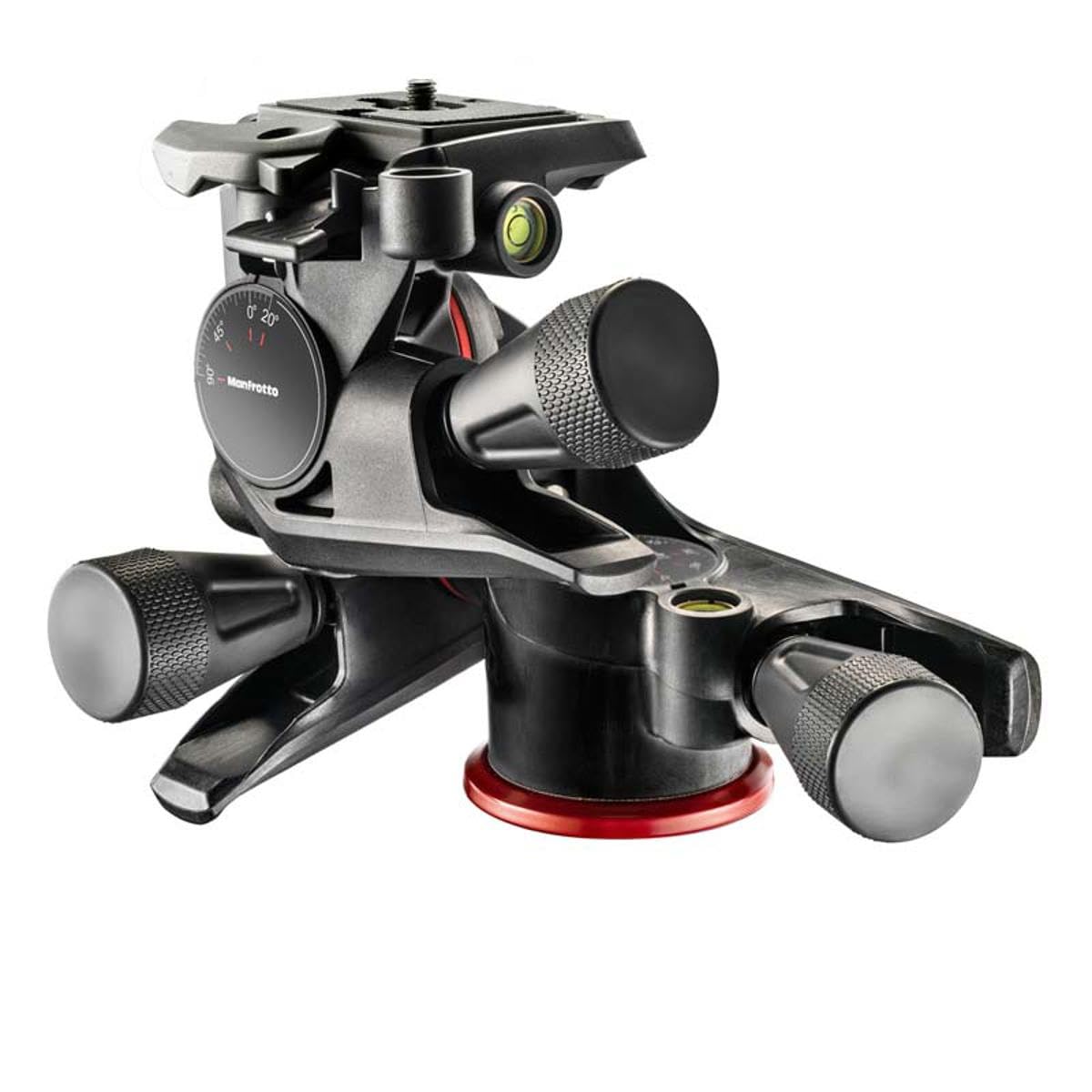
Manfrotto MHXPRO-3WG

86 /100
Keeper Score Excellent

Key details

Plate
Manfrotto quick release
Gearing
Geared on all three axes
Max Load
8.8 lb (4 kg)
Head Weight
1.7 lb
Check Price on Amazon

If the head has to be carried to the picture, this is the one we take. The MHXPRO-3WG weighs 1.7 lb and carries 8.8 lb, enough for a full-frame body and a landscape zoom, and it's the geared head here that stows in a daypack the way a ball head does.

Three geared axes at that weight is the trick. The knobs move the head in micro-steps, and lining up a horizon in near-dark takes a few small, repeatable turns instead of the guess-and-check a ball head demands. It was the head we stopped thinking about during testing, which is the highest compliment a support gets.

It isn't the 410. The body doesn't have the same machined solidity, and you can feel it when you torque a knob against a long lens: the assembly gives where the heavier head won't. That's the trade for the weight saved, and for landscape and travel work it's the right one, because the head on the hill beats the head left in the car.

Pros

  • 1.7 lb carrying an 8.8 lb payload
  • Geared on all three axes, one micro-step at a time
  • Small enough to live in a daypack

Cons

  • 8.8 lb payload caps heavy telephoto setups
  • Manfrotto's own plate, not an Arca-Swiss dovetail
Our verdict

The geared head we carry when the shot is a hike away: 1.7 lb, three geared axes, and enough payload for a full-frame landscape kit.

Check Latest Price
4

Best Budget

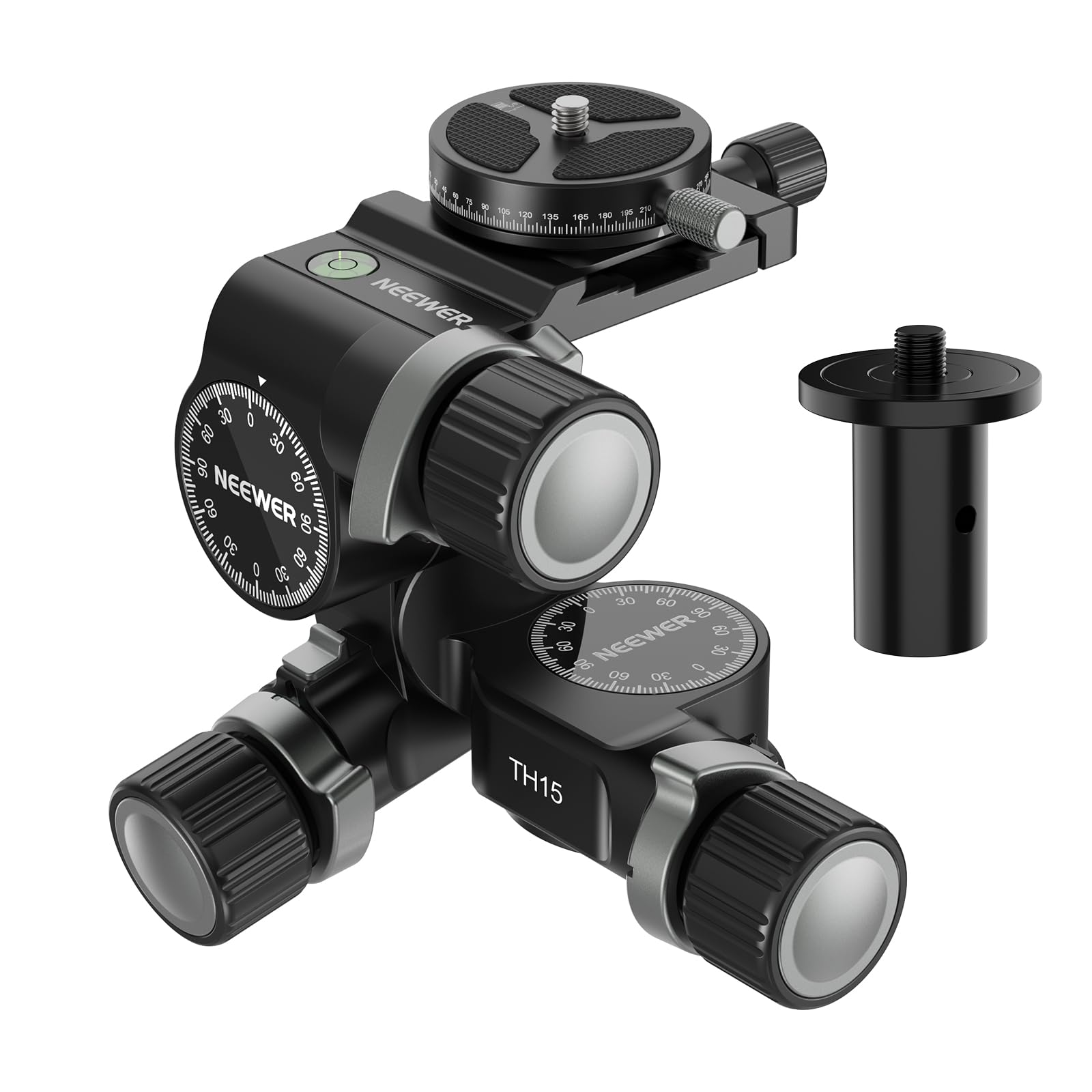
Neewer TH15

78 /100
Keeper Score Very Good

Key details

Plate
Arca-type round, 360° pan
Max Load
13.2 lb (6 kg)
Front Tilt
-45° to 90°
Head Weight
2 lb
Check Price on Amazon

Two small retractable switches change how the TH15 works, and they're the reason it's our budget pick. Push them in and each axis runs on its gears for fine work; pull them out and the head moves freely, so you can throw it into roughly the right position before engaging again. On most heads at this price you wind a knob for the big move, and you wind it a great deal.

The rest of the package is generous. It carries 13.2 lb while weighing 2 lb, the round Arca-type plate pans a full circle, and the base takes a 3/8-inch stud while the camera side uses a standard 1/4-inch screw. We lined it up against the Benro on the same tripod and it did the same job for less money; the difference shows up in how it feels, not in what it produces.

Feel is where the budget shows. The finger knobs ask for real force, and a long session of large moves leaves your fingers aware of it. Locked-off work, a set interior or a night-sky sequence, is where it's happiest, and that is most of what a geared head is asked to do.

Pros

  • Retractable switches separate coarse and fine moves
  • 13.2 lb capacity at 2 lb of head
  • Arca-type round plate with 360-degree pan
  • 1/4-inch screw and 3/8-inch tripod socket

Cons

  • Doesn't fold down, so it takes bag space
  • Gearing can work loose over months of use
Our verdict

Our budget pick earns it with the retractable switches that let you jump between coarse and fine on any axis, and 13.2 lb of capacity for 2 lb of head.

Check Latest Price
5

Value-Focused Setups

K&F Concept GD3W

82 /100
Keeper Score Excellent

Key details

Body
Full CNC aluminum
Max Load
13.2 lb (6 kg)
Base Mount
3/8" socket, 1/4" screw included
Head Weight
0.81 kg (1.79 lb)
Check Price on Amazon

The GD3W is the head here most likely to surprise you on the first turn. The machining is excellent, full CNC aluminum including the knobs, but the gear feel is the variable: an axis can arrive stiff, and it doesn't reliably loosen up with use.

What the money buys is a compact, genuinely metal head. It weighs 0.81 kg and carries 6 kg, the body is small enough to leave on the tripod between shoots, and the base has a 3/8-inch socket with a removable 1/4-inch screw in the box. Independent micrometric knobs on all three axes do the job the category promises.

Where it lands is simple. If you want a machined three-axis head and will check the gears on arrival, it does the work for less than our top pick. Set it up, run each axis through its travel with a lens mounted, and you'll know within a minute whether you got a good one. If you'd rather not think about it again, we take the Benro and consider the extra money well spent on finer, more consistent gearing.

Pros

  • Full CNC aluminum body and knobs
  • 6 kg capacity in a 0.81 kg head
  • 3/8-inch socket plus a removable 1/4-inch screw

Cons

  • Axis stiffness varies from head to head
  • Plate jaw screw can work loose
Our verdict

We point buyers here when they want a machined aluminum three-axis head and will accept some variance in gear feel to spend less than the top pick.

Check Latest Price

How We Tested 11 Geared Tripod Heads

We started by pulling spec sheets, manuals, and parts lists for every geared head we could find across three price tiers, then cut anything that used a plate standard we couldn't buy spares for or that had no published load rating. That left 11 heads, which we mounted on three different tripods — a light travel set of legs, an aluminum studio stand, and a heavy column tripod — and used for eight months.

Precision got measured the boring way: I counted knob turns to move a composition one degree, marked a knob's position, turned past it, and turned back to see how much slop remained. Then I shot the same tabletop setup twice from scratch with a macro lens and compared the frames, which is where backlash actually shows up.

Everything else came from living with them. Heads rode in bags on walks, sat clamped to a railing on a windy afternoon, and held a 200mm pointed at the sky for 20-minute stretches while I checked for drift. I swapped plates between two camera bodies dozens of times and noted where my fingers went in the dark, and I shot verticals indoors to see how much work it took to level a column on a geared pan axis.

Durability showed up in the small stuff — knobs that developed play, grease that stiffened on a cold morning, locking levers that needed a second push, machined housings that stayed tight when the cast ones didn't. We also weighed each head against its stated capacity, since a head that claims to hold a full kit and flexes under half of it will cost you a sharp frame. Value wasn't a separate score; it fell out of the comparison, and a plainer head that returned to the same position every session beat a busier one that needed re-zeroing.

How to Choose a Geared Tripod Head

How Many Geared Axes You Need

Every head here is geared on three axes, which is what most people searching for this tool actually want: the ability to correct tilt without disturbing pan. If your work is architecture, interiors, product, macro, or night sky, three geared axes earn their weight, because you make small corrections repeatedly and often in poor light.

If you mainly need a stable platform that pans and tilts for a spotting scope or a long lens, a plain three-way head costs less and repositions faster. Count the axes you genuinely re-aim in a session before you pay for gearing you won't turn.

Payload Ratings Are Measured at the Plate

The listed maximum load — 13.2 lb on the Benro and the Neewer, 11 lb on the Manfrotto 410, 8.8 lb on the MHXPRO-3WG — assumes the camera sits over the head. A long lens pushes the center of mass forward, and that leverage, not the raw weight, is what makes a head sag.

Add up body, lens, plate, and any bracket, then keep roughly a third of the rating in reserve if you shoot long glass. When a head creeps under load, the arithmetic is usually the problem rather than the gears.

The Coarse-to-Fine Workflow Is What You'll Live With

Geared heads differ most in how they let you move fast. Some put a second, coarser knob on each axis; some add a bypass or a retractable switch that disengages the gear so the head swings freely; others make you wind the fine knob for everything. The Neewer's switches and the Benro's paired knobs are the two good answers in this group.

The difference is minutes per setup, not seconds. A head where a 30-degree correction takes dozens of turns will stay in the case, however precise it is.

Match the Plate Before You Match the Head

Arca-Swiss dovetails have become the default for L-brackets and camera plates, and the Benro, Neewer, and K&F heads take them. Manfrotto's heads use Manfrotto's own plates, including the 410PL on the 410, which is no problem if your cameras already wear them and an extra purchase if they don't.

The trap is buying a sturdy head and discovering at the shoot that every plate in the bag is the other standard. Look at the plates on your bodies first; an adapter clamp solves it, but it adds height and one more joint to flex.

Weight, Size, and What Actually Packs

These heads run from 1.7 lb to about 2.7 lb, and none folds down the way a ball head does — a geared head stays roughly its own size, knobs and all. If it lives on a studio stand, mass is a feature: the heavier the head, the less the rig rings after you touch it.

If it goes in a daypack, the gap between 1.7 lb and 2.7 lb is the difference between carrying it and leaving it behind. Measure your bag's internal depth before you commit.

Frequently Asked Questions

Final Verdict

Buy the Benro GD3WH. It carries as much as anything in this group at 1.92 lb, takes the Arca-Swiss plates your other cameras already wear, and its fine gearing holds what you set without a second correction.

Two situations change the answer. If the head never leaves the studio or the car, the Manfrotto 410 puts more mass under a long lens and feels like a machine tool. If it goes on your back, the MHXPRO-3WG is the lightest geared head here and still gears all three axes. Everyone else starts with the Benro.