Best Nikon Mirrorless Cameras of 2026

Nikon's mirrorless lineup is genuinely confusing, and I say that as someone who shoots with one most weeks. The model numbers climb without much logic, one body looks like it fell out of 1985, and the smallest of them is built for vloggers rather than beginners. What actually separates these cameras is sensor size and autofocus: the full-frame bodies buy you cleaner shadows and shallower depth of field, while the compact crop-sensor models keep the whole bag light enough to carry all day.

We spent ten months with eight of them — farmers markets, badly lit gyms, a lot of desk-side video — and the same lesson kept landing. Sensor size decides what you'll spend on glass; autofocus decides whether you come home with the shot, and it's the one thing a spec sheet can't tell you. The generations differ most in dim light, not in good.

The picks below run from a pocketable walkaround kit to a full-frame pro body. What they share is that none of them got in the way of the shot.

Keeper Score summarizes customer ratings and review volume. Read it alongside the product details and trade-offs. How the score works.

1

Best Overall

Nikon Z6 III

88 /100
Keeper Score Excellent

Key details

Video
6K/60p internal N-RAW; 4K/120p
Sensor
24.5MP full-frame CMOS
Viewfinder
5,760k-dot, 4,000-nit EVF
Continuous Shooting
120 fps
Check Price on Amazon

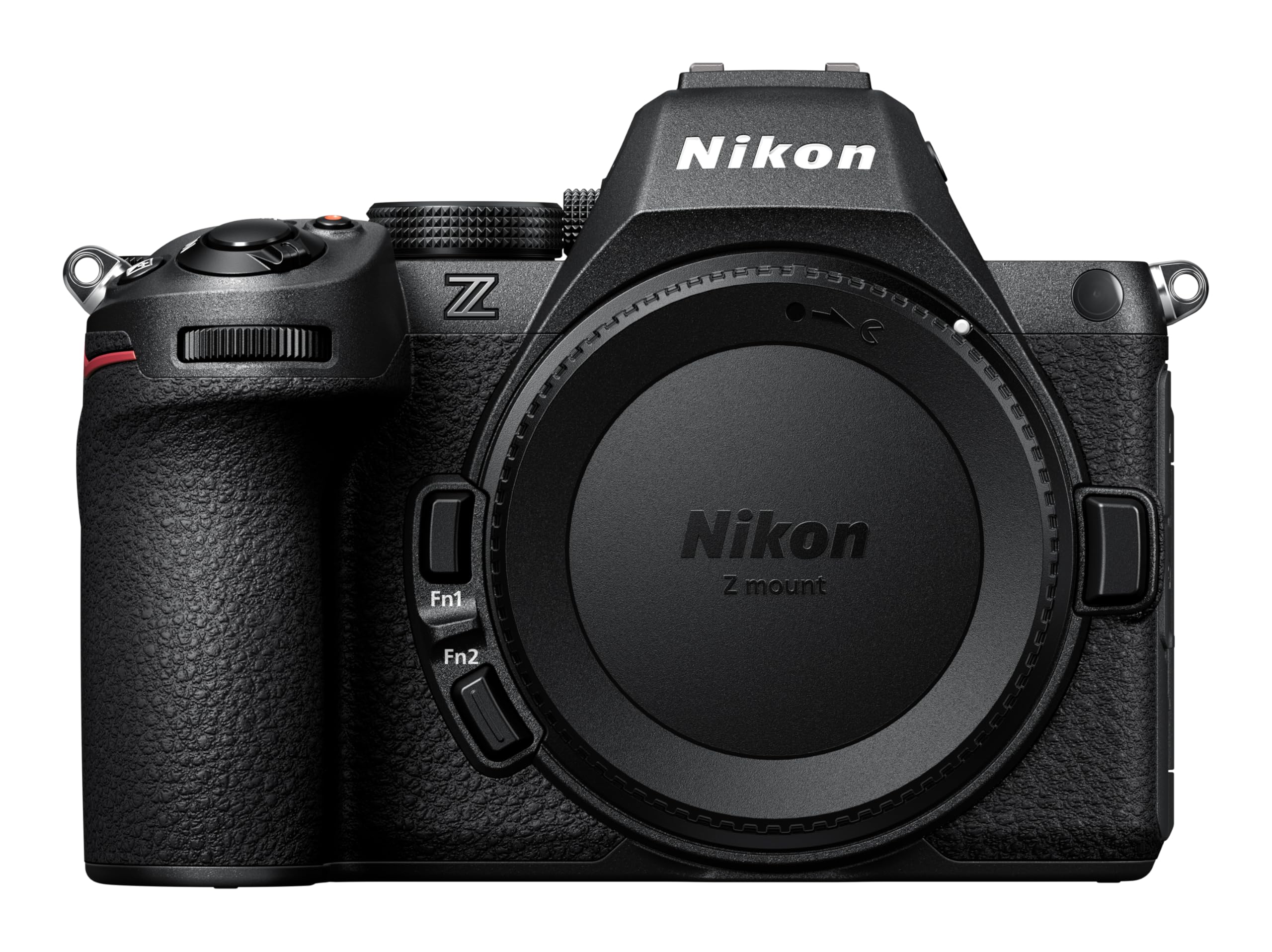
The Z6 III is the Nikon we reach for when we don't know what the day will bring. Its 24.5MP full-frame sensor is modest by today's headline numbers, but the camera pairs it with 6K/60p internal N-RAW, 4K/120p, and a 5,760k-dot viewfinder that hits 4,000 nits. That is a serious stills-and-video toolkit in a body that still feels manageable.

That balance is why it earns our top spot. Autofocus detection down to -10 EV and 120 fps continuous shooting mean it can follow a moving subject in poor light, and the bright finder made manual focus easier for us when we were working with shallow depth of field. The 24.5MP files are forgiving to edit without demanding huge cards and drives.

Compared with the Z5 II, the Z6 III gives videographers more headroom: 6K RAW, 4K/120p, and a brighter EVF. For stills-only work, that extra video capability may not matter. We also appreciated the articulating screen for low-angle shots, which is the kind of practical detail that keeps a hybrid camera in use.

The 24.5MP files are the quiet win. They are large enough to crop and print, but small enough that a day of shooting doesn't bury a laptop. That practicality is why the Z6 III stays our default even when the Z8 is on the shelf.

Pros

  • One body covers stills, video, and fast action
  • 6K/60p RAW and 4K/120p video
  • Bright 4,000-nit viewfinder
  • Autofocus works down to -10 EV

Cons

  • Premium price for the video headroom
  • Heavier than the Z5 and Z30
Our verdict

We recommend the Z6 III to anyone who wants one full-frame Nikon for both stills and video, because its fast autofocus and 6K RAW recording cover the widest range of work here.
Check Latest Price
2

Best Value Full-Frame

Nikon Z5 II

93 /100
Keeper Score Outstanding

Key details

Sensor
24.5MP full-frame BSI CMOS
Autofocus
299-point hybrid AF; 9 subjects
Stabilization
5-axis VR, up to 7.5 stops
Continuous Shooting
30 fps
Check Price on Amazon

The Z5 II asks the question every full-frame shopper should ask: why pay more for the Z6 III? For most stills-focused buyers, the honest answer is that you don't need to. The 24.5MP full-frame sensor, EXPEED 7 processing, and 7.5 stops of stabilization put current Nikon performance in a less expensive body.

What we appreciated most is how complete it feels. Autofocus detects nine subject types, from people and birds to cars and trains, down to -10 EV, and the 3,000-nit EVF is bright enough to compose outdoors without guessing. The 5-axis VR also made handheld shooting feel steadier than the body's position in the range suggests.

If video is central to your work, the Z6 III remains the stronger choice with 6K/60p RAW and 4K/120p. For stills, events, and travel, the Z5 II is the smarter full-frame buy. Compared with the Z5, it is the easier recommendation for anyone who shoots moving subjects.

The 30 fps burst is the sleeper feature: it turns a practical full-frame body into one that can catch a child or a pet before the moment passes. We did not expect that speed from a camera positioned as the value option.

Pros

  • Current EXPEED 7 autofocus and 30 fps
  • Up to 7.5 stops of stabilization
  • Nine subject types, down to -10 EV

Cons

  • Body-only; lens adds to the cost
Our verdict

We point stills-focused buyers to the Z5 II for current full-frame autofocus, strong stabilization, and a lower outlay than the Z6 III.

Check Latest Price
3

Best for Pro Speed and Resolution

Nikon Z8

87 /100
Keeper Score Excellent

Key details

Video
8K/60p; 4K/120p
Sensor
45.7MP full-frame stacked CMOS
Autofocus
493-point AF; -9 EV
Continuous Shooting
Up to 120 fps
Check Price on Amazon

A stacked sensor is the difference between a camera that can follow a bird across the frame and one that makes you wait for the finder to catch up. The Z8 pairs a 45.7MP stacked full-frame sensor with 8K/60p video, 4K/120p, and up to 120 fps stills. That is a professional workload in a body that still feels like a camera rather than a computer.

We paid close attention to the autofocus, because that is where a camera like this earns its keep. Nikon's deep-learning subject detection tracks people, animals, and vehicles, with 493 points and sensitivity down to -9 EV. The two card slots and 2.1-million-dot tilting screen make it feel like a working tool rather than a spec sheet. The finder also stays blackout-free during bursts, which makes tracking easier.

For wildlife, sports, and event work, the Z8 is the Nikon we choose when the shot won't wait. The 45.7MP files leave room to crop, and the 120 fps burst gives you options the Z7 II can't match. For a high-resolution camera, it is also unusually quick to switch between stills and video. The 4K/120p slow-motion mode is the one most hybrid shooters will actually use, even if the 8K headline gets the attention.

Pros

  • 45.7MP stacked sensor with fast readout
  • 8K/60p and 4K/120p internal video
  • Up to 120 fps stills
  • Dual card slots and 493-point AF

Cons

  • Heavy 1.8-pound pro body
  • Premium price
Our verdict

We recommend the Z8 to wildlife, sports, and event photographers who need 45.7MP files, blistering speed, and pro video in one body.

Check Latest Price
4

Best APS-C All-Rounder

Nikon Z50 II

87 /100
Keeper Score Excellent

Key details

Video
4K/60p; Full HD/120p
Sensor
20.9MP APS-C CMOS
Autofocus
231-point AF; 9 subjects
Kit Lenses
16-50mm and 50-250mm VR
Check Price on Amazon

The Z50 II is the camera we hand someone who wants a real camera without a full-frame bag. It uses a 20.9MP APS-C sensor, adds 4K/60p video and 120p slow motion, and comes as a two-lens kit with 16-50mm and 50-250mm VR zooms. That is a useful range from wide street scenes to distant details.

The autofocus is the part that makes it feel newer than its sensor size suggests. It recognizes nine subject types, including birds and airplanes, and the 231-point hybrid system tracks them across the frame. We also appreciate the built-in flash for indoor snapshots, which saves you from carrying a separate unit for casual evenings.

The two kit lenses are the practical reason to choose it. The 16-50mm keeps the camera small enough for a day bag, while the 50-250mm gives you reach without swapping to a heavy telephoto. We found the pair covered most travel situations, and the tilting screen made low-angle shots easier.

For travel and family shooting, the Z50 II is the APS-C Nikon we recommend most often. It gives you subject recognition and 4K/60p without the weight of a full-frame kit, and the pair covers more ground than a single zoom. Buy the kit rather than the body alone; the small body only makes sense with a small lens.

Pros

  • Two VR zooms cover wide to telephoto
  • Nine-subject detection with bird mode
  • 4K/60p and Full HD/120p video

Cons

  • Relies on lens VR, not in-body stabilization
  • 5 fps burst limits fast action
Our verdict

We recommend the Z50 II to travelers and family shooters who want a light two-lens kit with reliable subject detection and 4K/60p video.

Check Latest Price
5

Best for Vlogging

Nikon Z30

85 /100
Keeper Score Excellent

Key details

Video
4K UHD; Full HD/60p streaming
Screen
3-inch flip-out touchscreen
Sensor
20.2MP APS-C CMOS
Weight
12.3 oz
Check Price on Amazon

The Z30 is built around the flip screen. Nikon gave it a 3-inch flip-out touchscreen, a built-in stereo mic, and USB-C streaming, all in a 12.32-ounce body. That is a creator-first checklist rather than a stills-camera checklist.

For vlogging and streaming, that focus makes sense. The screen flips to face you, the mic is good enough to start without extra gear, and the camera can run from USB-C power for longer sessions. We found the controls simple to reach when the camera was on a small tripod, and the 4K footage looked crisp on a phone screen. The eye tracking also held up when we moved around the frame.

The Z30 earns its place as a second, video-first body or a first camera for someone who mostly publishes to social. If you need a camera for stills and video equally, the Z50 II is the better all-rounder. The 4K/30p HDMI output also gives you a clean feed for a monitor or capture device. The red REC light is a small thing, but it makes a solo shoot easier to manage when you are both talent and crew.

Pros

  • Flip-out screen and built-in stereo mic
  • USB-C streaming and constant power
  • Light 12.32-ounce body

Cons

  • No electronic viewfinder
  • Lens-based stabilization only
Our verdict

We recommend the Z30 to vloggers and streamers who work from the flip screen and value a small body over an electronic viewfinder.

Check Latest Price
6

Best Retro-Style Nikon

Nikon Zfc

88 /100
Keeper Score Excellent

Key details

Video
4K UHD
Sensor
20.9MP APS-C CMOS
Weight
1.6 lb
Controls
Analog ISO, shutter, exposure dials
Check Price on Amazon

The Zfc's analog dials are the first thing you notice, and they set the tone for the whole camera. Those controls for ISO, shutter speed, and exposure compensation sit on a silver-and-black body, while the 20.9MP APS-C sensor and 4K video are modern where it counts. The Zfc is the Nikon we pick up when the point is to enjoy taking pictures.

We appreciate that the retro design is not just a skin. The dials are readable without the screen, and the flip-out LCD makes it usable for self-recording. The 16-50mm kit lens keeps the package light enough to carry all day, and eye detection is reliable for people.

The Zfc makes more sense as a second camera or a style-first daily carry than as a primary action body. The dials are the reason to choose it over the Z50 II, and the reason we keep coming back to it. The Zfc is not the camera we choose for a paid shoot, but it is the one we take when we want to make pictures for ourselves. It is a camera that rewards a deliberate pace, and that is exactly why it stays in our rotation when the work does not demand speed.

Pros

  • Tactile ISO, shutter, and exposure dials
  • Light 1.6-pound retro body
  • 20.9MP APS-C sensor and 4K video

Cons

  • Digital stabilization only
Our verdict

We recommend the Zfc to photographers who want a compact APS-C camera with tactile dials and a design that makes shooting feel less clinical.

Check Latest Price
7

High-Res Stills

Nikon Z7 II

91 /100
Keeper Score Outstanding

Key details

Video
4K UHD/60p
Sensor
45.7MP full-frame CMOS
Autofocus
493-point phase-detect AF
Card Slots
CFexpress/XQD and UHS-II SD
Check Price on Amazon

The Z7 II is the resolution-first Nikon. Its 45.7MP full-frame sensor, dual card slots, 493-point phase-detect autofocus, and 5-axis in-body VR are aimed at photographers who crop deeply and print large. The 4K/60p video and 10 fps burst are useful, but they are not the reason to buy it. It is a camera for photographers who would rather have more detail than more frames per second.

What we appreciate is how little the resolution costs you in size. At 1.9 pounds it is lighter than the Z8, and the grip still feels substantial. The dual CFexpress/XQD and UHS-II SD slots are a practical touch for wedding and landscape work, where losing a card should not mean losing the shoot. It is a practical choice for a working landscape bag.

For landscape, studio, and high-resolution stills, the Z7 II remains a compelling alternative to the Z8. It gives you the same 45.7MP count for less money, with a lighter body and dual slots. The 45.7MP files reward good glass: you can crop a landscape to a detail and still have a print file. That makes it a strong second body for a high-resolution workflow.

Pros

  • 45.7MP full-frame resolution
  • Dual CFexpress/XQD and SD slots
  • 5-axis in-body VR
  • 4K/60p video and 10 fps

Cons

  • Older EXPEED 6 processor
  • 10 fps burst trails action bodies
Our verdict

We recommend the Z7 II to landscape and studio shooters who want 45.7MP files and dual card slots without paying Z8 money.

Check Latest Price
8

Entry Full-Frame

Nikon Z5

89 /100
Keeper Score Excellent

Key details

Video
4K/30p; 1080/60p
Sensor
24.3MP full-frame CMOS
Card Slots
Dual SD
Stabilization
5-axis in-body VR
Check Price on Amazon

The Z5 is the entry point to Nikon full-frame, and it keeps the basics simple. It has a 24.3MP full-frame sensor and 4K/30p video, and it sits at the budget end of this full-frame group. Those are serious ingredients for an entry-level body.

We appreciated the simplicity. The camera handles like a smaller DSLR, with a comfortable grip and controls that do not demand a menu dive for basic exposure changes. The tilting screen is useful for low-angle landscapes, and the electronic viewfinder gives you a clear preview of exposure before you press the shutter.

What it does well is the basics. The 24.3MP files have plenty of room for cropping, and the 5-axis VR helped us hand-hold in dim light. The dual SD slots are a practical bonus for a first full-frame body, letting you keep a backup card in the camera without buying expensive media.

For a first full-frame camera, the Z5 is still a sensible place to start. It gives you the full-frame look without the complexity of the pro bodies. If your subjects are landscapes, portraits, and everyday scenes, it covers the basics well. The 24.3MP sensor is the Goldilocks size: detailed enough to crop, not so large that every file needs a new drive.

Pros

  • Full-frame 24.3MP sensor
  • 5-axis in-body stabilization
  • Dual SD card slots

Cons

  • 4.5 fps burst limits action
  • Subject detection omits birds and vehicles
Our verdict

We recommend the Z5 to first-time full-frame buyers who prioritize image quality, stabilization, and dual SD slots over speed.

Check Latest Price

How We Tested Eight Nikon Mirrorless Cameras

We started by pulling every current Z-series body, then filtering by sensor size, card slots, weather sealing, and price band so the final list wouldn't be eight versions of the same camera. That left eight bodies, which we shot with for ten months in ordinary conditions rather than on a test bench.

Every camera went to the same places: a Saturday farmers market with a fast-moving toddler, an indoor birthday party under mixed light, a cold morning on a trail, and a desk setup for streaming. For autofocus we fired bursts at a subject running toward us and counted how many frames actually had the eye sharp, then repeated it outdoors at dusk. For image quality we shot the same scene on every body, pushed the shadows two stops in editing to see what fell apart, and compared high-ISO files side by side instead of trusting the numbers.

Battery life got measured the unglamorous way: a full charge, a full day, and a count of frames plus video minutes before the warning appeared — and whether the camera would top up from a power bank at lunch. We handed each one to someone who'd never shot mirrorless and timed how long it took them to change ISO and drive mode. Connectivity meant pairing every body to a phone, timing a twenty-image transfer, and seeing whether the link held in a crowded room. Reliability meant light rain, lens swaps in the wind, and a card filling mid-burst. Value ran underneath all of it: what the body plus one kit zoom actually asks of you, and how many lenses you can grow into.

How to Choose a Nikon Mirrorless Camera

Full-Frame or APS-C?

Full-frame versus APS-C is the choice that shapes everything else. Full-frame bodies like the Z5, Z5 II, and Z6 III give you more low-light room and a shallower depth of field, while APS-C models such as the Z50 II, Z30, and Zfc are smaller and cheaper to build a kit around. We start with the lenses you can afford and carry, because a compact body with a fast full-frame zoom is not a pocket camera. Pick APS-C for travel, vlogging, and family use; pick full-frame for portraits, events, and available-light work.

Autofocus and Subject Detection

Autofocus is where the newest Nikons separate themselves. The Z6 III, Z5 II, and Z50 II use newer processing and recognize more subjects, including birds and vehicles, while the Z5 and Z7 II are more people-and-pet focused. We pay more attention to the subject modes than the point count: a camera that recognizes your subject is easier to live with than one with a bigger number. If you shoot wildlife or sport, make bird or vehicle detection a priority; for portraits and weddings, eye detection and reliable tracking matter more.

Video and Viewfinder

Video and viewfinder needs pull in different directions. A flip-out screen makes the Z30 and Zfc easy to frame from the front, while a bright electronic viewfinder makes the Z6 III and Z8 easier to use in sunlight. Check frame rates only after you know how you will publish: 4K/60p is useful for motion, and 6K or 8K RAW is a workflow choice rather than a default. A useful rule: buy the screen for video, the finder for stills, and accept that few bodies here are equally strong at both.

Handling, Lenses, and Power

Handling and power are the quiet deciders. A full-frame body with a long lens gets heavy by the end of a day, so try the grip before you commit. Budget for the lens, not just the body: the Z5 II is body-only, while the Z50 II comes as a two-lens kit that covers wide to telephoto. We also treat a spare battery and a fast card as part of the kit, because high-frame-rate stills and RAW video drain both.

Frequently Asked Questions

Final Verdict

We recommend the Nikon Z6 III as our top pick for most buyers. It has the speed, autofocus, and 6K RAW video to handle stills and motion without stepping up to the Z8, and it remains manageable in the hand. If your work is mostly stills, the Z5 II is the smarter full-frame buy; if you want a light travel kit, the Z50 II is the one to pack. Choose the Z8 only when 45.7MP and 120 fps are genuine requirements.