Best Monopods of 2026

A monopod looks like the simplest piece of camera gear you can buy—one pole, one screw—until you try to pan with a long lens and the whole thing shivers. What you want is a walking-stick-sized support that steadies a camera without the setup time and bulk of a tripod, whether you're shooting a ceremony from the back row or hiking to an overlook. Over the past six months, I've tested 12 monopods with cameras mounted, and the differences come down to stability under real weight, how the leg locks feel after repeated use, and whether the feet or base come off when you want a pure travel stick.

Spec sheets brag about maximum load, but a monopod can be rated for a huge payload and still wobble when you pan. I paid more attention to whether the sections creep down under a camera, how quickly it extends one-handed, and whether the folded length fits a daypack. The right pick balances portability, stability, and adjustability—not just the biggest number in the title. The picks below earned their place.

Keeper Score summarizes customer ratings and review volume. Read it alongside the product details and trade-offs. How the score works.

1

Best Overall

iFootage Cobra 3 C180F-P

88 /100
Keeper Score Excellent

Key details

Weight
1.27 kg (2.8 lb)
Folded Length
27 in
Load Capacity
17.6 lb
Maximum Height
180 cm (71 in)
Check Price on Amazon

The pedal is the reason to look at this one. Press it with your foot and the ball swivel in the base releases; step off and the whole monopod locks at whatever angle you left it, so you can change the angle of a pan without taking a hand off the grip. The rest of the package is carbon: 180 cm at full extension, 1.27 kg on the scale, and rated for 17.6 lb of camera and lens.

We keep reaching for it because that is the balance most shooters actually need — stiff enough for a long lens, light enough that it stays clipped to the bag instead of sitting in the car. The top plate is a proper quick release: press the sleeve, the plate pops out, push it back and it locks, with 1/4-inch and 3/8-inch threads so a camera, gimbal, or mic bar goes straight on. The base also unscrews into a tabletop mini tripod, which is more useful than it sounds when you want a low angle on a desk or against a wall.

It ships as a leg, so a head is a separate purchase — worth doing the arithmetic against the kits that arrive with one attached. The pedal is also happiest on something flat, and on a slope you will shuffle around looking for a footing. Both are small things against what it gets right, which is being the support we never think twice about carrying.

Pros

  • Foot pedal locks the base angle hands-free
  • 17.6 lb payload at 1.27 kg of carbon
  • Quick-release plate with 1/4 and 3/8 screws
  • Base doubles as a tabletop mini tripod

Cons

  • Packs to 27 inches, longer than the compact picks
Our verdict

The monopod we recommend to anyone who shoots both stills and video, because it carries a real lens without weighing down the bag.

Check Latest Price
2

Best for One-Handed Height Changes

SmallRig 5565 Video Monopod

86 /100
Keeper Score Excellent

Key details

Head
Fluid head included
Folded Length
29.9 in
Load Capacity
11 lb (5 kg)
Maximum Height
175 cm (68.9 in)
Check Price on Amazon

Set this next to our top pick and the SmallRig's case is simple: the fluid head is already fitted. That saves a purchase and a plate swap, and the head pans and tilts smoothly enough for event and interview work. The leg is carbon and aluminium, four sections, 175 cm at full height, 29.9 inches folded, and rated for 11 lb.

The one-button lift and lock is the part we touch most. Press the button, slide the column to the height you want, let go, and it is locked — one hand, no spinning three collars with a camera already mounted. The feet come off on a quick release too, so the same pole can be a plain monopod in a crowded press pen or a three-footed one when you want to leave it standing between takes.

Speed is where it wins: button plus quick-release feet gets you from bag to eye level in a couple of moves, and the head means panning shots do not need a second purchase. If your work is mostly video and you prefer not to build a kit out of parts, this is the one to pick.

Pros

  • Fluid head included, ready out of the box
  • One-button lift and lock for one-handed height changes
  • Quick-release feet convert it to a plain monopod

Cons

  • 11 lb payload rules out big telephoto rigs
  • Heaviest of the video kits here at 5.51 lb
Our verdict

Worth the extra money if you want a video monopod that arrives ready to shoot, with a head on top and a height lock you can work one-handed.

Check Latest Price
3

Best Value

COMAN KX3232Q6

85 /100
Keeper Score Excellent

Key details

Head
Q6 fluid head
Folded Length
26 in
Load Capacity
22 lb
Maximum Height
73.2 in (186 cm)
Check Price on Amazon

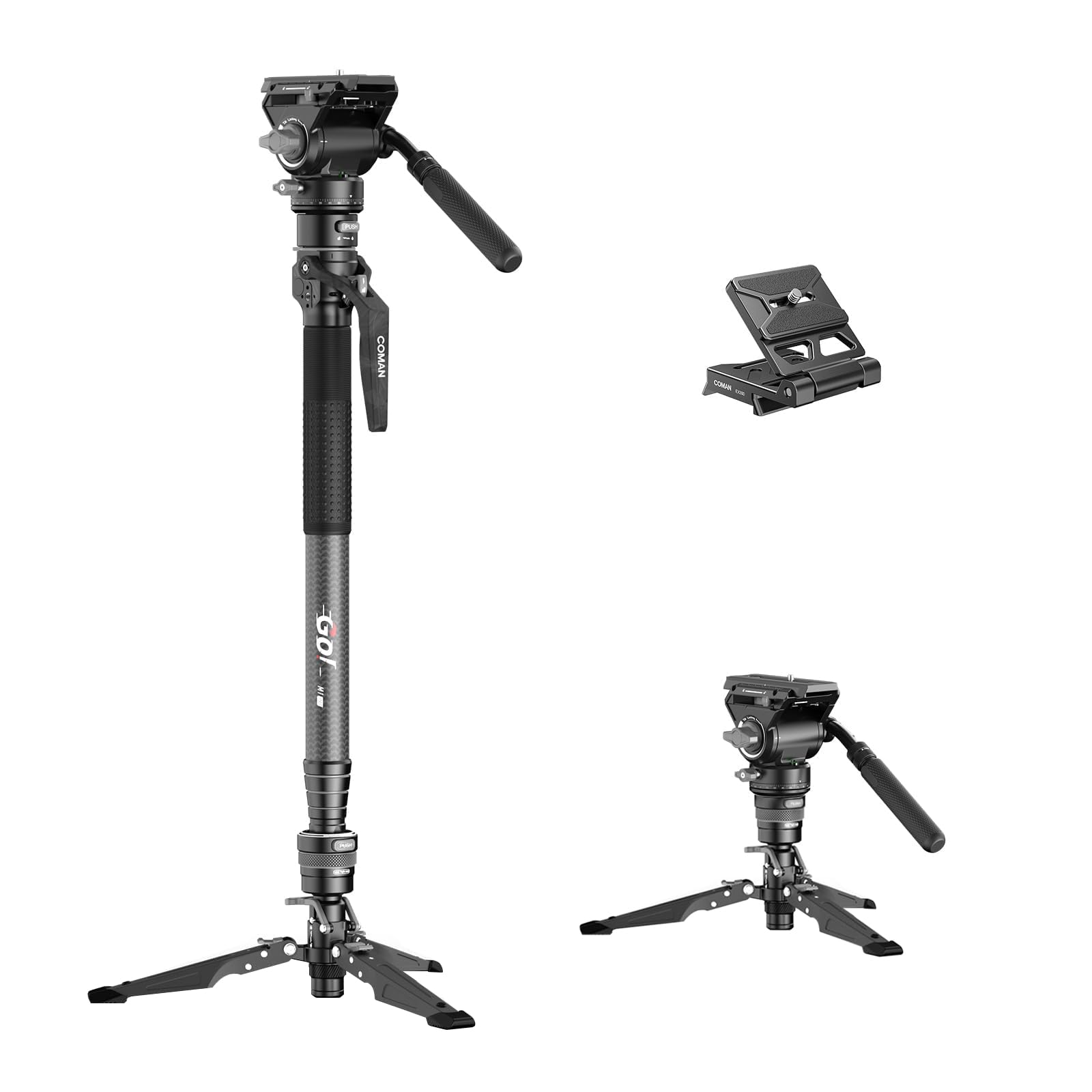
Twenty-two pounds of payload and 73 inches of reach, with a fluid head already on top — nothing else here pairs that much capacity with a head for the money. If your monopod has to hold a built-up camera and a long lens, that combination is the whole argument. Five aluminium sections fold to 26 inches and the package weighs about 4.6 lb.

The Q6 head takes its plate from above: press it in and it locks, which is quicker than sliding a plate in from the side when the camera is already rigged and heavy. The tripod base unscrews, so you can leave it at home for a tight room and run the bare pole instead.

Pan and tilt are where it asks for patience. The drag is stiff — good for locking off a frame, less good for a slow follow across a stage — and that is the trade for a head at this level. For weddings, sport, and locked-off event coverage it is a fair one; for long cinematic moves, spend more.

Pros

  • 22 lb payload with a fluid head included
  • Reaches 73 inches and folds to 26
  • Top-loading quick-release plate

Cons

  • Base foot works loose in use
  • Leg clamps need a firm hand when new
Our verdict

The value pick for anyone mounting a heavy camera on a fluid head, as long as you can live with a stiff pan and a base that needs occasional tightening.

Check Latest Price
4

Best for Shooting Over Crowds

Manfrotto XPRO+ Video Monopod

89 /100
Keeper Score Excellent

Key details

Head
500 video head
Folded Length
30.7 in
Load Capacity
3.3 lb
Maximum Height
79.9 in
Check Price on Amazon

Shooting over a standing crowd — a press scrum, a wedding aisle, a parade — is where height stops being a specification and starts being the job, and the XPRO+ goes higher than anything else here at 79.9 inches. It is a four-section aluminium video monopod with Manfrotto's 500 head on top and a fluid base with three retractable feet.

The base is what sells it to us. The fluid base gives pan, tilt, and swivel from the bottom, so the pole can lean and rotate in one movement while the head handles the finer framing; the combination behaves much more like a small tripod than a stick. The D-shaped tubes resist twisting when you swing quickly, and the Power Quick Lock stows the lever flat against the tube so it does not snag on a bag.

What it will not do is carry much. The stated limit is 3.3 lb, which is a mirrorless body and a compact zoom — not a 70-200 and not a rigged cinema camera. That is the price of a light, tall leg with a fluid base, and if your kit is heavier the COMAN KX3232Q6 carries far more for less.

Pros

  • Tallest monopod here at 79.9 inches
  • Fluid base pans, tilts, and swivels
  • D-shaped tubes resist twisting on fast moves

Cons

  • Folded length of 30.7 inches
Our verdict

Buy it if you shoot over crowds with a light camera, because the height and the fluid base are worth more than the payload it gives up.

Check Latest Price
5

Best Budget

Amazon Basics 67-Inch Monopod

93 /100
Keeper Score Outstanding

Key details

Weight
12.8 oz
Folded Length
21.4 in
Load Capacity
6.6 lb
Maximum Height
170 cm (67 in)
Check Price on Amazon

If you are not sure a monopod will earn its place in your bag, this is the one to find out with. It weighs 12.8 ounces, folds to 21.4 inches, sits among the cheapest here, and is rated for 6.6 lb — enough for a DSLR with a kit lens or a mirrorless body with a modest zoom.

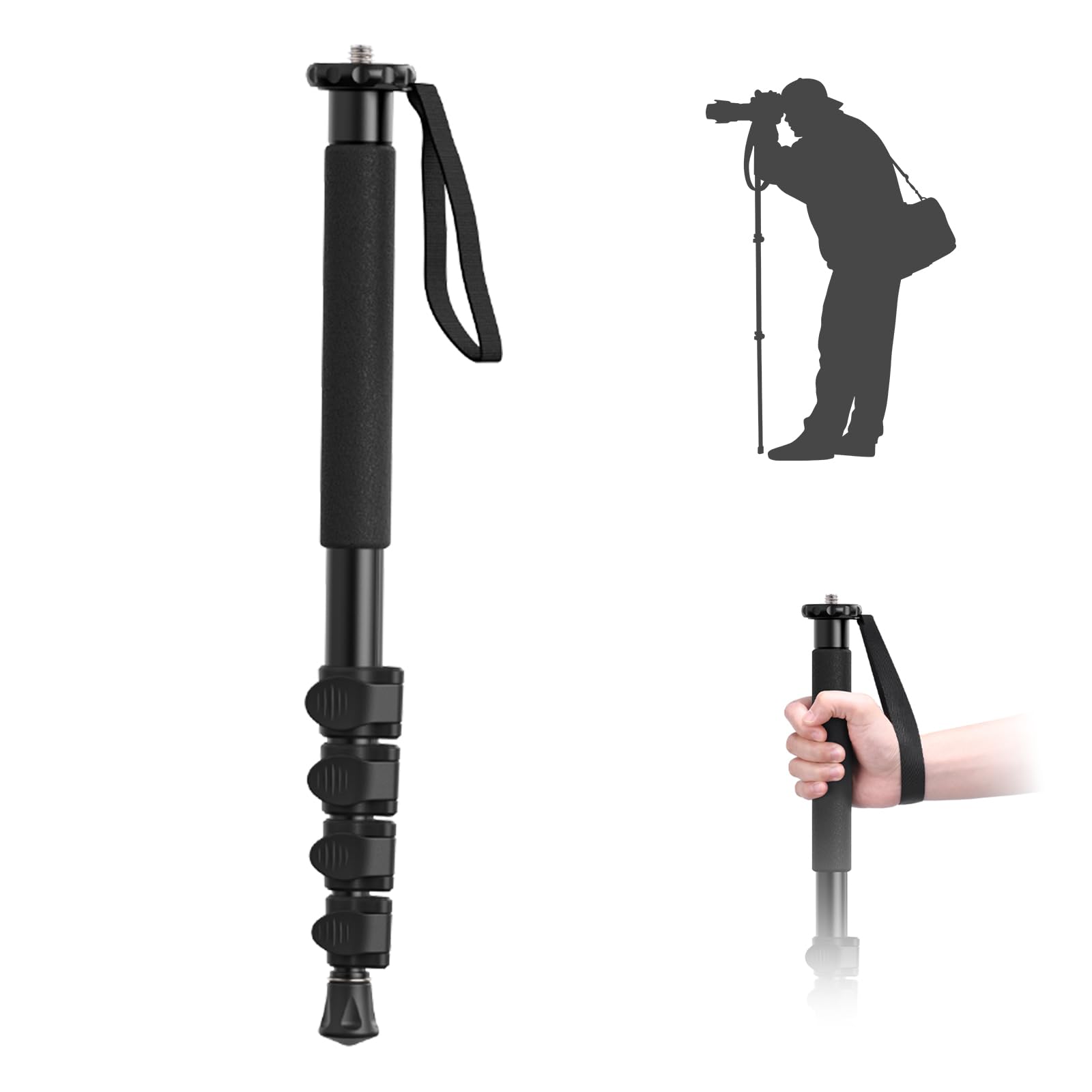
Four flip-lock sections reach 67 inches, the foam grip is comfortable over a long day, and there is a wrist strap plus a rubber foot with a retractable spike underneath. It doubles as a walking stick, which is a pleasant bonus on a hike and not something to lean on.

The threaded stud on top is the part to watch. It is where these poles have given way under heavier cameras, and a stripped stud means the camera goes down. Keep to the 6.6 lb rating, check the stud is snug before each session, and it does the one job you need: it holds the camera still and takes the weight off your arms.

Pros

  • 12.8 ounces and 21.4 inches folded
  • Flip locks that stay put in use
  • Rubber foot with retractable spike

Cons

  • 6.6 lb ceiling rules out long telephoto rigs
Our verdict

The low-risk way to find out whether you will actually carry a monopod, provided your camera and lens stay under 6.6 pounds.

Check Latest Price
6

Hiking and Travel

ULANZI TB12

89 /100
Keeper Score Excellent

Key details

Weight
378 g (0.83 lb)
Folded Length
16.9 in (43 cm)
Load Capacity
11 lb (5 kg)
Maximum Height
155 cm (61 in)
Check Price on Amazon

At 16.9 inches folded and 378 grams, the TB12 disappears into a daypack, which is the whole case for it. This is a monopod you take on a hike because you will not notice it is there, and five aluminium sections still get it to 61 inches.

It is a shapeshifter by design: monopod, selfie stick, walking stick, trekking pole, with a rubber foot that covers a spike for soft ground. The clip locks are tight and step through their positions cleanly, so setting height takes seconds rather than a wrestling match.

Where we draw the line is load. An 11 lb rating is generous for a 13-ounce pole, and a compact body with a small zoom is the sweet spot; hang a 70-200 off it at full extension and the top section starts to feel alive. As a trail support that happens to hold a camera, it is hard to beat for the size.

Pros

  • Folds to 16.9 inches and weighs 378 g
  • Works as monopod, selfie stick, or hiking pole
  • Tight clips with no slip at height

Cons

  • Ground tip threads loose while walking
Our verdict

A trail-first monopod for a small camera, and the one here you will genuinely forget you packed.

Check Latest Price
7

Budget Tripod Base

NEEWER T222 Monopod

88 /100
Keeper Score Excellent

Key details

Base
Detachable 3-leg base
Weight
1.3 lb
Folded Length
20.5 in
Maximum Height
168 cm (66 in)
Check Price on Amazon

A three-leg base that unscrews from the bottom of the column is the reason to look at the T222. It tilts about 15 degrees and rotates a full turn, so you can leave the camera mounted and re-aim without moving the feet — the sort of thing that matters in a cramped room where you cannot reposition the whole rig.

The pole is five aluminium sections, 20.5 inches folded and 66 inches up, with a foam grip and an 11 lb rating. At 1.3 lb it slides into a camera bag's side pocket without a fight, which is more than the tall video kits here can claim.

It arrives as a leg with a 1/4-inch screw on the mounting plate, so a ball head is an extra purchase if you want to level a horizon or swing between portrait and landscape quickly. Budget for that and the value calculation shifts a little.

Treat it as a monopod with a helpful foot and it earns its keep: the base makes small angle changes quick, the column rises fast, and the whole thing packs smaller than the video rigs. Expect it to stand on its own and you will be picking your camera up off the floor.

Pros

  • Detachable base tilts and rotates 360 degrees
  • Packs to 20.5 inches at 1.3 lb
  • Fast five-section height changes

Cons

  • Top-heavy with the column fully extended
Our verdict

A cheap way to add a pivoting base to your kit, best treated as a monopod with a helpful foot rather than a stand you can walk away from.

Check Latest Price
8

Long Lenses

COMAN M1Pro V5

82 /100
Keeper Score Excellent

Key details

Head
V5 hydraulic head
Folded Length
30 in
Load Capacity
22 lb (10 kg)
Maximum Height
69 in
Check Price on Amazon

Twenty-two pounds of payload on a carbon leg that reaches 69 inches — the M1Pro V5 is built for a rigged camera: a body with a long lens, or a small cinema build with a monitor and a mic. That rating is why it is here rather than the lighter kits.

The one-click lifting system releases the four-section column with a single press, so height changes happen with the camera still mounted. The V5 head tilts 90 degrees each way and pans a full turn, and there are quick releases at both the head and the base, so swapping from three-legged to ground pod does not mean unscrewing anything.

The 600 g steel foot supports are 190 mm long and give it a wider stance than the budget bases here, with a two-stage pedal to set the base angle. It is a heavy, deliberate piece of kit at 2.5 kg, and the 2 mm carbon tube wall with a UV coating is the sort of construction you notice the moment you compare it with an aluminium pole.

We reach for it when the camera stays rigged on a long lens all day and the shots need smooth pans: the payload headroom means no compromise on the rig, and the one-click column turns a height change into a two-second job instead of a break in the shooting. It costs like a serious tool and carries like one.

Pros

  • 10 kg payload on a carbon leg
  • One-click column release for fast height changes
  • Quick release at both head and base

Cons

  • Head lock can creep at steep down angles
  • 30-inch packed length limits bag options
Our verdict

The pick for a rigged camera on a long lens, where the payload headroom and the one-click column matter more than the packed length.

Check Latest Price

How We Tested the Best Monopods

To build the shortlist, I started with the monopods that show up again and again in camera forums and retailer reviews, then filtered by packed length, maximum height, claimed load capacity, head type, and whether the feet were removable. That left 12 models—aluminum and carbon fiber, flat rubber feet and folding tripod bases, video heads and bare mounts—which I used for six months.

I carried each one on a weekend trail hike, through a crowded indoor event, and into a makeshift living-room video setup, packing and unpacking it every time. I mounted a camera, extended every section, and checked each handle lock and twist collar by trying to force it loose under load; then I noted whether the section crept, how much play remained in the joints, and whether the quick-release plate felt secure after repeated attach-and-remove cycles. I also ran each monopod from its shortest to tallest working height and timed how long it took to set up one-handed.

The feet mattered more than I expected. I removed and reinstalled every detachable base, used each monopod as both a stand and a straight stick, and watched for wobble when panning or tilting with a camera mounted. I checked the folded length against a daypack and a car trunk, carried each one by the handle or strap on hikes, and looked for scratches, loose collars, and joint play at the end of the test. Value came down to what held up after six months of that routine, not what looked good on the spec sheet.

How to Choose a Monopod

Start With Payload, Not Price

The rating on the box covers everything you hang on the pole: camera, lens, head, and anything clamped to the rig. The spread in this group runs from 3.3 pounds on the Manfrotto to 22 pounds on the two COMANs, which is roughly the difference between a mirrorless body with a compact zoom and a 600mm lens. We would leave headroom — a pole rated at exactly your rig's weight feels marginal once the column is fully up. Where two otherwise similar monopods differ, the higher-rated one usually has the stiffer top tube.

Height and Packed Length

Maximum height is quoted with the column fully extended and nothing mounted, which is also the least stable the monopod ever gets. Most standing shooters are comfortable somewhere between 63 and 71 inches; the Manfrotto's 79.9 inches exists for framing over a crowd or shooting upward, not for everyday eye level.

Packed length decides whether the thing leaves the house. Anything from 16.9 to 21 inches drops into a daypack, while 27 to 30 inches is a strap-it-on-the-outside pole. Decide which you will tolerate before the spec sheet talks you into the tall one.

What Feet Actually Do

Three small feet steady a pan and give you somewhere to park the pole between shots; they do not turn a monopod into a tripod. The useful part on the COMANs and the Manfrotto is the swivel in the base, which lets you re-aim without lifting the whole rig. Longer, heavier feet are steadier and worse to carry.

If you need a camera to stand alone while you step away, buy a tripod. If you want smoother pans and a place to rest the pole, feet earn their keep — as long as you keep a hand on the grip.

Fluid Head, Ball Head, or None

A fluid head with pan and tilt drag is what makes video feel smooth. A ball head is quicker for stills and for levelling a horizon. A bare 1/4-inch screw means you supply the head yourself, which is fine if you already own one you trust. Two picks here arrive with a video head, one arrives with a hydraulic head, and the rest are legs.

The head is also where cheaper kits cut corners, and stiff drag is the usual symptom. Test the pan before you commit: it should start moving under light finger pressure, not a firm shove.

Locks: Speed Versus Creep

Flip locks are fast and visible, twist collars are compact and quiet, and one-button or pedal systems are fastest of all and cost the most. What they share is a failure mode: a lock that bites when new can creep under a heavy camera a season later, which shows up as a slow slide during a long exposure or a pan.

Test any new monopod with your heaviest rig at full extension, and put a strip of tape at your usual working height so you can see slippage before it ruins a shot.

Frequently Asked Questions

Final Verdict

Buy the iFootage Cobra 3 C180F-P. It is the lightest support here that will carry a serious lens, the pedal base turns re-aiming into a one-foot job, and nothing else in this group combines that payload with that packed weight.

If you want the head already in the box, take the SmallRig 5565. If a 22-pound rig or a tight budget is the deciding factor, the COMAN KX3232Q6 is the better buy.