Best Microscope Slide Kits of 2026

The letdown usually lands about ten minutes into the first microscope session: the slide is blank, the lens is focused on nothing, and whoever you bought the scope for wants to know what else there is to look at. That's the gap a slide kit fills. I've spent the past three months with 14 of them on my dining table, on classroom desks, and in the hands of a nine-year-old who was not gentle with any of it.

Two things separate the good kits. Ground, pre-cleaned edges, because chipped glass is the fastest way to end a science afternoon, and a sensible balance of prepared slides to blanks. The prepared ones carry the first hour; the blanks, coverslips, and stains carry every hour after that.

Clarity was the hardest thing to judge, since a nicely boxed kit is worthless if the specimen blurs above 100x, and so was value, because price doesn't track contents here nearly as neatly as you'd hope. Suitability varies more than the packaging admits, too: a set that captivates a seven-year-old can bore a twelve-year-old inside a week. Below are the kits we'd buy again, sorted by who they actually suit.

Keeper Score summarizes customer ratings and review volume. Read it alongside the product details and trade-offs. How the score works.

1

Best Overall

Rs' Science All-in-One Slide Kit

89 /100
Keeper Score Excellent

Key details

Stains
Ready-to-use methylene blue and eosin Y droppers
Kit Size
40 pieces
Slide Mix
Prepared slides, blank slides, and coverslips
Check Price on Amazon

Two squeezable dropper bottles of stain, not envelopes of powder, are the first thing we noticed when the Rs' Science kit came out of the box, and they are a large part of why it is our top pick. Mixing a stain from powder is one more step before you have looked at anything, and it is the step a beginner is most likely to get wrong.

What we like most is the balance of the contents. There are prepared slides to look at immediately, blanks and coverslips for your own samples, and the tools that actually change what you can do: transfer pipettes, plastic tweezers, a petri dish, gloves, lens papers, and a handheld microtome that cuts a section thin enough to be worth putting under a lens. The instruction booklet is the piece that ties it together; without one, a box with this many small parts is a puzzle rather than a kit.

The honest caveat is scale. A 40-piece kit can only carry so many prepared slides, so treat the specimens as a sampler and the preparation as the main event. If a broad specimen library is what you are after, the LAKWAR set covers that ground far better. Check the contents against the list when it arrives, too, and keep the small parts together in the tray rather than loose in a drawer.

The microtome deserves its own sentence: it is the tool that turns a stem or a carrot into a section you can see through, and the AmScope SP-14 kit does not include one. That is the difference between a kit you look at and a kit you use.

Pros

  • Ready-to-use stain droppers, no mixing
  • Includes a handheld microtome
  • Prepared and blank slides in one box
  • Instruction booklet included

Cons

  • Prepared slide count is a sampler, not a library
Our verdict

For a first slide kit, this is the one we recommend: ready-to-use stains, working tools, and a booklet that explains them, for about what a bare-bones kit costs.

Check Latest Price
2

Best Budget Prep Kit

AmScope SP-14 Slide Prep Kit

90 /100
Keeper Score Outstanding

Key details

Pieces
22
Stains
Eosin red and methylene blue powders
Case Material
Polycarbonate
Slides Included
5 blank and 5 prepared, with coverslips
Check Price on Amazon

Cheaper than our top pick, the AmScope SP-14 is the older, plainer route into slide preparation, and for an adult hobbyist it works. The difference sits in the chemicals: the eosin red and methylene blue arrive as powders you dissolve yourself, which saves money and adds a measuring step before your first slide. That is a fair trade for someone who wants to learn the staining side properly, and a poor one for a classroom, where every extra powder is something to supervise.

The kit runs to 22 pieces: five blanks, five prepared slides, coverslips, tweezers, a swab, ID stickers, and a case. Five blanks go quickly, because a single afternoon of practicing coverslipping can use them up, so price in a pack of 50 alongside it. The prepared five are well chosen as a taste of what a finished mount looks like.

Where it comes up short beside the Rs' Science kit is tooling. There is no pipette and no microtome, so measured drops and thin sections come from whatever you already own. If you have a drawer of lab odds and ends to raid, that hardly matters; if you do not, the all-in-one kit earns its extra cost in the first session. The case, meanwhile, is the nicest here — a hard polycarbonate shell that keeps slides intact in a cupboard full of other things.

Pros

  • Costs less than our top pick
  • Hard polycarbonate case
  • Prepared and blank slides included

Cons

  • Stains arrive as powders that need mixing
Our verdict

A solid, cheaper prep kit for an adult who does not mind dissolving stains — just add blank slides and expect to supply your own pipette.

Check Latest Price
3

Best Blank Slides and Coverslips

ZEEGOO 50 Slides + 100 Coverslips

93 /100
Keeper Score Outstanding

Key details

Coverslips
100, 22 x 22 mm, 0.15 mm thick
Slide Size
1 x 3 in, 1.0 to 1.2 mm thick
Edge Finish
Ground edges, 45° clipped corners
Blank Slides
50
Check Price on Amazon

Ground edges and 45-degree clipped corners are the detail that separates the ZEEGOO pack from a plain box of blanks. The long edges are smoothed and the corners are cut back, so a slide is far less likely to catch a finger as you lift it out of the box — the sort of thing that only registers once you have handled a slide cut square.

Fifty slides and a hundred 22 mm coverslips is the ratio we want, since two per slide covers the breakages. The glass is optical quality and pre-cleaned, so a slide can go under the lens without a wipe-down, and at 1.0 to 1.2 mm thick these are the standard wafers most microscope stages and clips are built for. This is the pack to buy when the kit is already on the shelf and you are restocking, or when a classroom needs a safe, cheap supply that will not be mourned.

What you do not get is any of the rest of it: no stains, no pipette, no prepared slides to look at on day one. That is the point of the price, and it is fine as long as you are pairing this with a kit rather than starting from nothing. The little storage box keeps the stack together between sessions, which matters more than it sounds when the slides live in a cupboard with everything else.

Pros

  • Ground edges and clipped corners
  • Two coverslips for every slide
  • Pre-cleaned optical glass

Cons

  • Slides only, with no stains or tools
Our verdict

Buy this if you already have stains and tools and want a generous, well-finished supply of blanks, not if you are assembling a kit from scratch.

Check Latest Price
4

Best Prepared Slide Set

LAKWAR 120 Prepared Slides

93 /100
Keeper Score Outstanding

Key details

Weight
1.94 lb
Labeling
Specimen name on each slide, plus a printed list
Slide Size
1 x 3 in (25 x 75 mm)
Prepared Slides
120
Check Price on Amazon

A hundred and twenty prepared slides is enough that a child can browse rather than ration. The LAKWAR set covers plants, insects, and animal tissue on standard 25 x 75 mm glass, each slide labeled with the specimen name and accompanied by a printed list of what is in the box.

What we appreciated is the range rather than the raw count. There are enough different tissue types here that a kid can move from one to the next for an entire rainy afternoon without repeating, and because the slides are glass, the image is as clean as the specimen allows. The 8.27 by 6.3 inch box keeps them upright and findable.

The labels are where it stops short. A name like "Earthworm C.S." tells you the organism and that it was cut crosswise, and nothing about magnification or what you are meant to notice, so keep a biology reference or a phone within reach. That said, if a specimen library rather than a technique lesson is the whole point of the purchase, this is the set we point to first: the breadth is the best in this group for roughly what a midrange prep kit costs. Add a blank-slide pack later if the making-your-own side starts to appeal.

Pros

  • 120 labeled glass specimens
  • Wide range of plant, insect, and animal tissue
  • Includes a printed slide list

Cons

No notable drawbacks to flag.

Our verdict

For a ready-made specimen library that will hold a curious kid's attention for months, this is the set we reach for first.

Check Latest Price
5

Best for Young Kids

DIY-SCIENCE 48 Plastic Slides

93 /100
Keeper Score Outstanding

Key details

Material
High-transparency plastic
Specimen Types
Insects, animals, flowers, plants
Prepared Slides
48
Check Price on Amazon

Plastic is the reason to buy this set rather than an apology for it. Forty-eight prepared specimens in high-transparency plastic means no sharp corners, no shattered glass on the kitchen floor, and a price low enough that a lost slide does not matter. For a young child with a microscope and an adult nearby, it is the right first set, and the specimen mix — insects, animals, flowers, plants — is broad enough to outlast a single evening of curiosity.

The trade-off is optical. Plastic whole mounts look their best under a stereo microscope lit from above and below, so a compound scope working at high power will ask more of them than plastic gives. That is the boundary: a primary-school set, not a secondary-school one. Each slide carries a classification label, and the entire set packs into a box about the size of a thick hardback, which is exactly what you want for something that lives on a shelf between uses.

Pros

  • Plastic slides with no sharp edges
  • 48 labeled specimens
  • Broad plant, animal, and insect mix

Cons

  • No blank slides or prep tools included
Our verdict

The set we hand to a young child: plastic, labeled, and cheap enough that a broken slide is not a household incident.

Check Latest Price
6

Kids' Gift Kit

AmScope SP-18 Deluxe Kit

82 /100
Keeper Score Excellent

Key details

Pieces
40
Stains
Two types included
Experiment
Brine shrimp hatchery
Slide Types
Prepared and blank
Check Price on Amazon

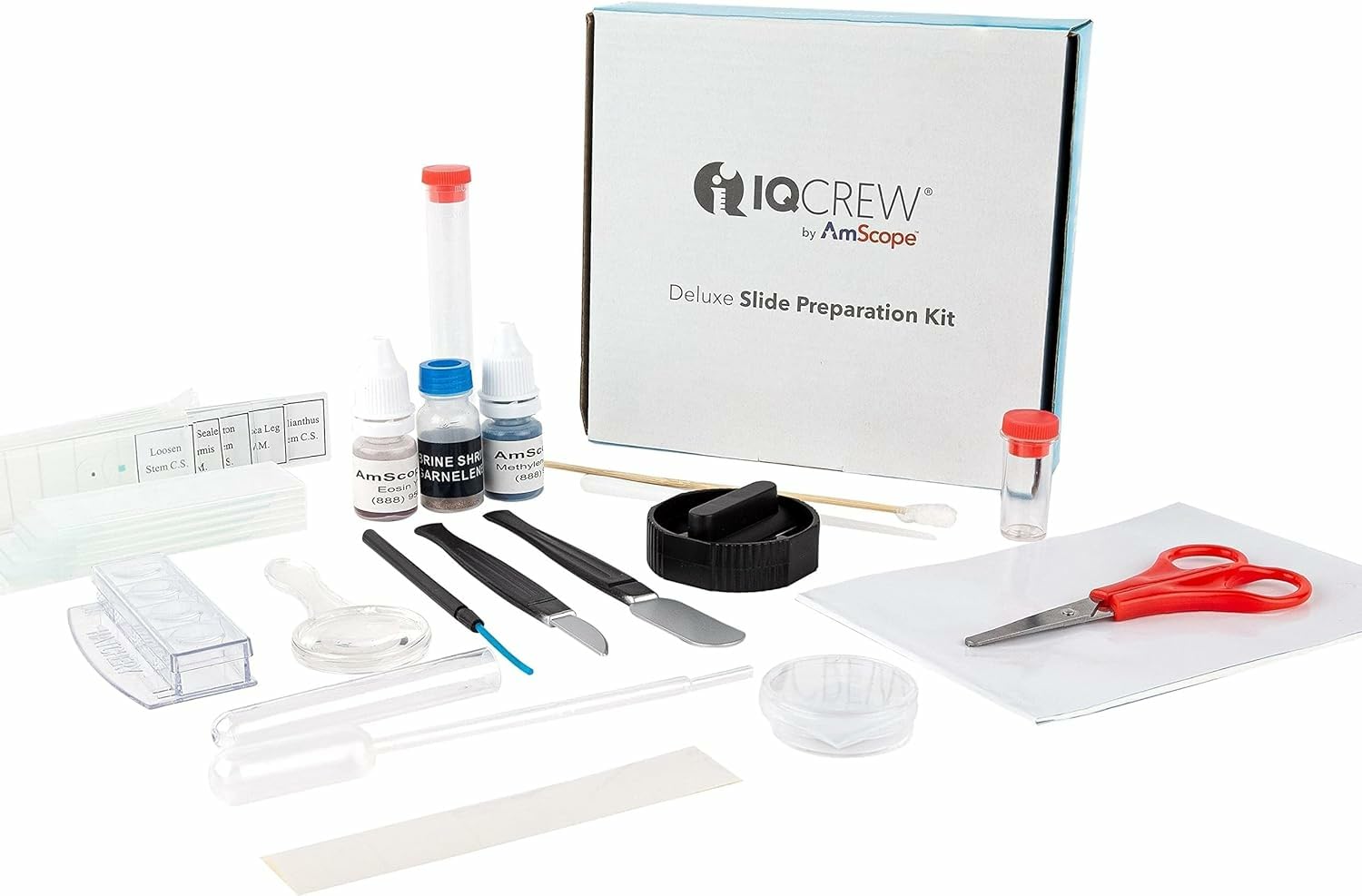
There is a brine shrimp hatchery inside the AmScope SP-18, which tells you most of what you need to know about who it is for. It is a 40-piece children's kit: prepared and blank slides, two stains, and around 20 small tools, with the hatchery as the experiment that gives the whole box a storyline. Nothing about it pretends to be lab equipment.

As a gift, that is well judged. The shrimp project turns a drawer of slides into something with a beginning and an end, and the prepared slides mean there is something to look at on day one while the culture gets going. AmScope describes the tools as safe and easy for children of all ages to use, and the plastic and paper construction backs that up.

Our reservation is depth. Two stains and a modest tool set go a long way with a seven- or eight-year-old and not very far with a teenager, and the kit costs about half what our top pick does, which is an honest measure of how much is in the box. It also lists a one-year warranty, worth knowing for something that will be handled by a child. Buy it as a gift; buy the Rs' Science kit if the goal is learning to prepare slides properly.

Pros

  • Includes a brine shrimp hatchery experiment
  • Prepared and blank slides with two stains
  • Designed for children to handle

Cons

  • Built as a children's kit, not prep equipment
Our verdict

A well-pitched gift for a child who already owns a microscope: the slides, stains, and shrimp experiment give them something to do on day one.

Check Latest Price
7

Organized Classroom

DIY-SCIENCE 60 Glass Slides

89 /100
Keeper Score Excellent

Key details

Weight
15.9 oz
Storage
Included case
Labeling
Color-coded by subject, with an identification guide
Prepared Slides
60
Check Price on Amazon

The case is what separates this set from a stack of slides in a blister pack. Sixty glass specimens sit in an organized box, color-coded by subject and labeled with the specimen name and magnification, so a student can pull the one they need without unpacking the lot.

Sixty slides across plant, animal, insect, bacteria, algae, microbe, fungi, mammal, and human tissue is a real curriculum rather than a sampler, and the identification guide does the teaching that a bare label cannot. We liked that the labeling carries magnification, because it answers the first question a beginner asks and sets expectations for what the specimen should look like at the eyepiece.

It is glass in the standard 1 x 3 inch format, and the listing names compound, stereo, USB, and kids' microscopes as compatible, which covers most of what a household or a small classroom owns. At 450 grams the box is light enough to go to a co-op class and back in a tote bag.

The awkward middle of this group is where it lands: it is not the biggest library and it is not the cheapest, but it is the most organized, and that is worth more to a teacher than another sixty slides would be. We would put it in the hands of a homeschool parent who wants slides sorted by topic and a box that survives a backpack. If the count is what matters, the Prolee set goes three times further for the money.

Pros

  • Color-coded and labeled by subject
  • Sturdy storage case included
  • Light enough to carry to class

Cons

  • Fewer specimens than larger sets at a similar price
Our verdict

Better organized than it is generous: 60 labeled, color-coded glass slides in a case that travels, for a teacher or a homeschool family.

Check Latest Price
8

Large Specimen Library

Prolee 200 Prepared Slides

0 /100
Keeper Score Fair

Key details

Labeling
Specimen lists and labels
Slide Size
1 x 3 in
Package Weight
3.63 lb
Prepared Slides
200 (100 plant, 100 animal)
Check Price on Amazon

Two hundred prepared slides is a different kind of purchase from a 48-slide starter set, and the Prolee box feels like it: 3.63 pounds packed, most of that glass. This is not something you tuck under an arm; it is something that gets a shelf.

The split is even, 100 plant structures and 100 animal tissues, with rounded edges on every slide and the standard 1 x 3 inch footprint that fits ordinary stage clips. Specimen lists and labels keep them in order, which matters more than it sounds once the count passes a hundred and the search for one particular slide begins.

The extra money went into packing as much as specimens: layers of protective sponge, a plastic box inside, and a condensed cardboard tray outside to stop the boxes colliding in transit. For a school, that is the difference between a set that lasts a term and a box of chips.

It is the most expensive set here, and the one we point a science club or a school at rather than a household, because 200 slides is more than one family will exhaust in years. The cases are built to be kept, with slides slotting back into the sponge after a session, so the set stays a set instead of dissolving into a drawer of loose glass.

Pros

  • 200 slides split evenly plant and animal
  • Multi-layer sponge and box packing
  • Specimen lists and labels

Cons

  • The most expensive set here
  • Bulky box for a home shelf
Our verdict

For a school, a club, or a family that has already worn out a smaller set, this is the library to buy.

Check Latest Price

How We Tested Microscope Slide Kits

We built the shortlist by reading what each kit actually contains rather than what the title claims: how many prepared specimens versus blanks, whether coverslips and stains were included or sold separately, and whether the edges were ground. Kits got cut for padding their piece counts with coverslips and blank labels, and we favored listings whose buyers reported receiving what the box promised.

That left 14 kits, which we lived with for three months — at the kitchen table with a nine-year-old on rainy Saturdays, at the sink on weeknights while we stained onion skin and cheek cells, and in a group session with four kids at different reading levels to see which sets held attention past the first hour.

Out of the box, I ran a thumb along every slide edge and set aside any with chips or a rough lip, then held each slide up to a lamp to check for dust and smudges before the first viewing. Every prepared specimen went under 40x, 100x, and 400x, and I noted where detail broke down and whether the label matched what was actually visible through the eyepiece. I checked that slides sat flat in standard stage clips, let the storage boxes fall off a counter once, and recounted the contents against the listing after a week of use.

The stains got their own round: whether eosin and methylene blue actually colored a specimen, whether they rinsed clear, and how much they dyed the fingertips. Kits that kept coming back out of the cupboard without me suggesting it scored highest for enjoyment, and we worked out value per usable slide rather than per box.

How to Choose a Microscope Slide Kit

Prepared, blank, or both

Prepared slides are sealed mounts that go straight under the lens, which is what a child or a first-time owner actually wants. Blank slides and coverslips are what you build your own samples on. A kit that includes both, like the Rs' Science all-in-one, is the least frustrating start, because there is something to look at while you learn to prepare.

If the specimens are the whole point, put the budget into a prepared set and skip the tools. If you already own stains and pipettes, buy blanks in bulk and keep them in the drawer. The kit to be wary of is the one with five blanks and no refill: five slides disappear in a single practice session.

Powders or dropper bottles

Stains come two ways, and the difference shows up on your first slide. Powdered eosin and methylene blue go further: you dissolve a little in water, and the concentration you mix decides whether the specimen is washed out or too dark to read. Dropper bottles skip that step and stay consistent, which is why we prefer them for beginners and for children.

Powders are the better buy if you plan to stain often and do not mind keeping stock solutions on hand. Either way, work over an absorbent pad — these dyes mark skin and clothing on contact.

Glass or plastic

Glass gives the cleaner image and is what you need if you intend to coverslip your own samples. Plastic prepared slides are the sensible choice for a young child: no sharp edges, nothing to shatter, and the specimen sealed in. Ground edges and clipped corners on glass slides are worth a little extra when students will be handling them.

The limit worth knowing is optical. Plastic sets are built for whole-mount viewing under a stereo microscope lit from above and below, so they show their constraints once you move to a compound scope at high power.

Counts, cases, and how the box is packed

Prepared sets start around 48 slides and run past 200; 120 is a comfortable home library, while 200 is classroom territory. For blanks, 50 is the sane unit, and coverslips arrive 100 to a pack because two per slide is normal.

Check the packing and the storage before you buy, since glass in a thin sleeve can arrive chipped, and a labeled set that stays organized is a set that gets used. Loose slides end up at the back of a drawer; slides that slot back into a case get looked at again.

Frequently Asked Questions

Final Verdict

Start with the Rs' Science All-in-One. It covers both halves of the hobby — something to look at on day one, and the tools, stains, and blanks to make your own slide on day two — and the ready-mixed stains remove the step beginners most often get wrong. The AmScope SP-14 is the cheaper way in if you are happy dissolving powders.

If you already own the equipment, the ZEEGOO blank-slide pack is how you restock. And if the specimens rather than the technique are the point, the LAKWAR 120-slide set gives you the widest range here for about the same outlay as a midrange prep kit.