Best Matte Boxes of 2026

A matte box has two jobs: keep stray light off the front element, and hold the filter that saves your shot when the sky blows out behind your subject. What separates a good one from a fussy one rarely shows up in the specs. It shows up around hour six, when the top flag has sagged an inch and the clamp has started to creep on the lens barrel.

We've spent the past six months clamping 11 of them onto everything from a heavy cine zoom to a compact 35mm prime — on tripods, on a gimbal, and handheld on a bright, windy afternoon. The ones that held up were the ones that stayed put and let us change a filter or a lens without hunting for a screwdriver.

One thing worth knowing before you shop: the filter format sets almost everything else. A box built around circular drop-ins stays small and fast; one that takes 4 x 4 or 4 x 5.6 glass gives you more looks but more bulk. Neither is wrong — the rest of the decision follows from that choice, and the picks below cover both.

Keeper Score summarizes customer ratings and review volume. Read it alongside the product details and trade-offs. How the score works.

1

Best Overall

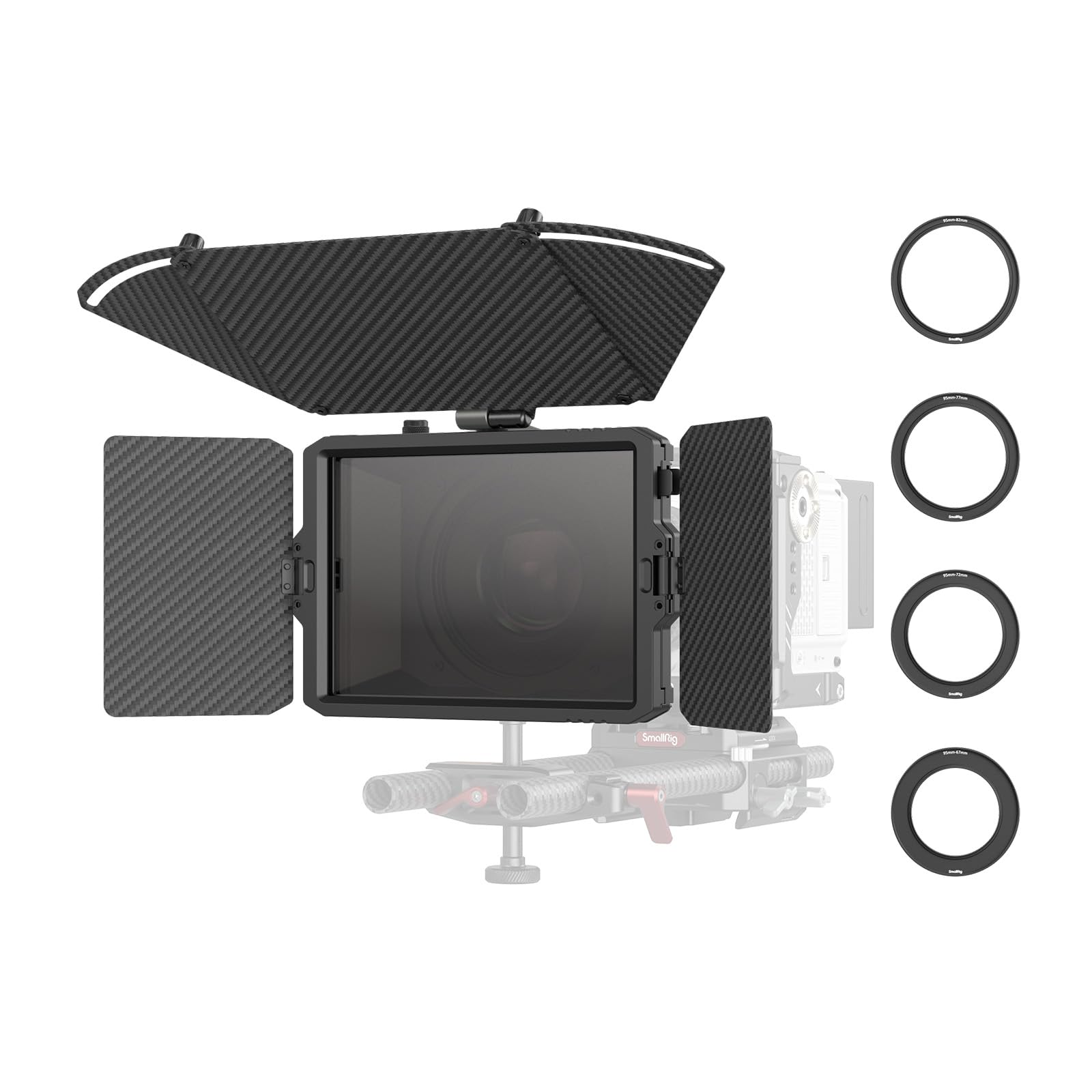
SmallRig Mini Matte Box Lite

92 /100
Keeper Score Outstanding

Key details

Weight
3.8 oz
Top Flag
Carbon fiber
Filter Slots
One 4 x 5.65 inch
Lens Fitting
67/72/77/82mm adapter rings
Check Price on Amazon

At 108 grams, the SmallRig Mini Matte Box Lite disappears on the front of a small mirrorless body, and that is most of why it earns our top spot. It threads onto 67, 72, 77, or 82mm lens fronts with the included adapter ring, then opens to 95mm so a single 4 x 5.65-inch filter can slide in behind the carbon fiber top flag. We paid attention to the weight because a matte box that makes a compact rig front-heavy is one you leave at home; this one does not.

The filter slot takes one 4 x 5.65-inch filter up to 4mm thick, and it accepts circular filters up to 92.5mm behind the tray. That gives you two routes: a square ND in the tray, or a round polarizer you already own. The carbon top flag is easy to set and stays where you put it, which is the part that matters when the sun is just outside the frame. For a one-filter handheld kit, that is a sensible way to keep the package small.

The 95mm figure is the box opening, not a lens diameter, and the included rings cover the common small-lens threads rather than every lens. The included storage bag is basic. Neither changes the recommendation for a compact rig, but they are worth checking against the lenses you own before you order.

Pros

  • Light 108 g body for compact rigs
  • Carbon top flag and 95mm opening
  • Four common adapter rings included
  • Accepts round filters up to 92.5mm

Cons

  • Second square filter needs extra tray
  • Only one top flag in the kit
Our verdict

We recommend the SmallRig Lite for a light mirrorless or DSLR kit when one square filter and a carbon top flag are enough.
Check Latest Price
2

Best Budget

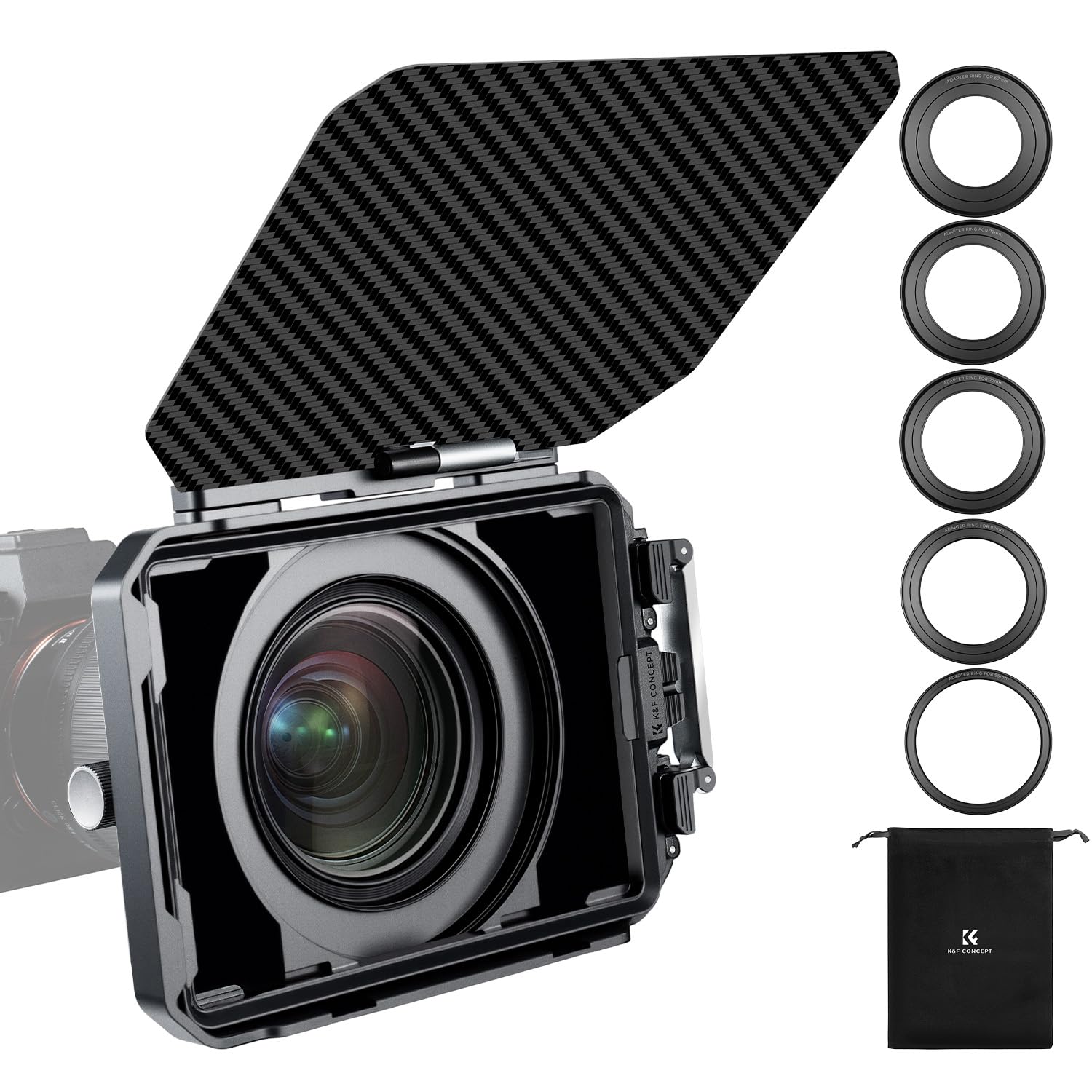
K&F Concept FM702

89 /100
Keeper Score Excellent

Key details

Filter Slots
Two 4 x 5.65 inch
Lens Fitting
67/72/77/82/95mm adapter rings
Body Material
Carbon fiber
Mounting Points
1/4-inch, 3/8-inch, cold shoe
Check Price on Amazon

Five adapter rings, two 4 x 5.65-inch filter slots, and a carbon fiber top flag: the K&F Concept FM702 makes the case that you do not need to spend premium money to get a usable matte box. The rings cover 67, 72, 77, 82, and 95mm lens threads, and the tray has a locking mechanism to keep filters seated. The kit packs into a velvet pouch, which is simple but enough for a camera bag.

What we appreciate most is the two-filter capacity at this end of the range: one slot for an ND, one for a polarizer or diffusion, without stacking adapters. The 1/4-inch, 3/8-inch, and cold-shoe mounting points also give you a place to hang a monitor or mic without adding a cage. For run-and-gun work, the shallow 34mm profile keeps the front of the camera from feeling like a science project.

The fit list is not universal: the 95mm ring is an adapter, not a promise that every 95mm lens will clear the tray, and the four smaller rings stop at 82mm. Check your lens front diameter before you order. The rest of the kit is straightforward: thread on the right ring, seat the tray, and check that the filter slides freely before you pack it.

Pros

  • Two 4 x 5.65 filter slots
  • Five adapter rings included
  • Carbon body with top flag
  • Extra mounting points

Cons

  • Does not fit Sony FE PZ 28-135mm
  • No side flags in the kit
Our verdict

We see the K&F FM702 as the value choice for DSLR and mirrorless shooters who want two square filters and five adapter rings.

Check Latest Price
3

Best for Gimbals

Tilta Mini Matte Box

90 /100
Keeper Score Outstanding

Key details

Weight
4.94 oz
Support
15mm rod adapter
Filter Slots
One 4 x 5.65 inch
Lens Fitting
Lenses 85mm or smaller
Check Price on Amazon

Gimbal work is where the Tilta Mini Matte Box makes the most sense: 140 grams of aluminum, a clamp-on mount, and a single 4 x 5.65-inch filter slot. We reach for this one when a gimbal or a stripped-down handheld rig leaves no room for a rail system. The included 15mm rod adapter is there when a heavier lens needs support, but the box itself adds very little to the front of the camera.

The Mini takes one square filter and can stack circular filters behind it, so a polarizer plus a square ND remains possible. The top flag is easy to adjust, and the clamp is a real time-saver compared with threading a filter on and off between setups. Four adapter rings are included for common lens threads, and the aluminum body feels more substantial than its 140 grams suggests.

The clamp knob is small enough that a slick adapter ring needs a deliberate turn to feel secure. That is a minor annoyance, not a reason to skip the box, but it is the kind of detail that matters on a cold morning. If your work stays within the coverage of the box and you want to keep the rig light, it remains an easy pick.

Pros

  • 140 g aluminum body
  • Square filter plus circular stacking
  • 15mm rod support included
  • Adjustable top flag

Cons

  • Not ideal for very wide lenses
  • No Tilta variable ND compatibility
Our verdict

We reach for the Tilta Mini on gimbal and handheld rigs that need compact flare control, one square filter, and circular stacking.

Check Latest Price
4

Best Premium VND Kit

Tilta Mirage VND Kit

88 /100
Keeper Score Excellent

Key details

Filters
4 x 5.6 inch and 95mm circular
Included ND
95mm variable ND
Lens Fitting
95mm cine clamp; 67/72/77/82mm rings
Body Material
Aluminum
Check Price on Amazon

A variable ND built into the matte box is the reason to choose the Tilta Mirage VND Kit over the clamp-on boxes here. It clamps to 95mm cine lenses or steps down to 67, 72, 77, or 82mm threads, and the kit includes a 95mm variable ND tray, a 4 x 5.6-inch filter stage, a 15mm LWS support, and a soft case. The modular aluminum body is designed to strip down for gimbals and build up for a larger rig.

Remote control is possible through the Nucleus Nano motor adapter, and the VND can otherwise be adjusted by hand. What we keep coming back to is the workflow: one box holds the VND and a square filter, so you can cut light and add diffusion without breaking the rig apart. That is a premium convenience, and it is the reason this kit sits at the top of the price range here.

Variable NDs are not magic on every lens. Check the widest focal length you plan to use, because these filters can show uneven density or an X pattern as you increase stops. On a normal-to-long lens that is a manageable trade for the speed of a VND; on a very wide lens it is the first thing to test before a shoot.

If you mostly shoot locked off or on a tripod and change ND by hand, the simpler clamp-on boxes here do the same flare control with less bulk and setup. The Mirage earns its place when the VND saves you time on a moving shoot or when you want the option to add a motor later. That is a narrower job than the top pick does, but it is one the Mirage does well.

Pros

  • Built-in 95mm variable ND
  • Modular aluminum body
  • Takes 4 x 5.6 and 95mm circular filters
  • 15mm LWS support and case included

Cons

  • Motor needed for remote VND control
  • Uses Tilta's 95mm circular filters
Our verdict

We choose the Tilta Mirage when a built-in variable ND and a modular 95mm cine kit justify the premium.

Check Latest Price
5

Best for 4 X 4 Filters

Fotga DP3000 M3

79 /100
Keeper Score Very Good

Key details

Flags
Top and two side
Mount
15mm rails
Swing-away
90 degrees
Filter Slots
Two 4 x 4 inch
Check Price on Amazon

A 90-degree swing-away hinge is the feature that makes the Fotga DP3000 M3 more useful than a basic rail box. It mounts on standard 15mm rods, holds two 4 x 4-inch filters in plastic trays, and includes a top flag plus removable side flags. The whole box swings aside without disturbing the camera, which is the point when you change lenses on a tripod.

The rotatable tray is useful for a polarizer, and the three flags give you more control than the single-flag clamp-on boxes here. The swing-away mechanism and rail clamp feel sturdy enough for a working rig. For the money, it is a practical way to get a 4 x 4 workflow onto a rail setup.

We think the swing-away is worth the fuss if you change lenses often, but the rail clamp is not the most confidence-inspiring part of the kit. The pinch screw needs a firm turn to feel secure, and a heavy lens can make that small contact point feel like the weak link. In controlled light and on a modest rig, the swing-away still earns its place; on a heavy camera, check the clamp carefully.

Pros

  • 90-degree swing-away for lens changes
  • Two 4 x 4 filter trays, one rotating
  • Three flags for light control
  • Mounts on standard 15mm rails

Cons

  • Flag hinges and screws can lose tension
  • Plastic body feels less refined
Our verdict

We like the Fotga DP3000 M3 for rail rigs that need a 90-degree swing-away and two 4 x 4 filter trays.

Check Latest Price
6

95mm Cine Rails

Proaim MB-600

80 /100
Keeper Score Excellent

Key details

Masks
4:3 and 16:9
Mount
15mm rails
Lens Fitting
Lenses up to 95mm
Filter Stages
Two rotating
Check Price on Amazon

Format masks are the detail that lifts the Proaim MB-600 above a generic rail-mounted matte box. It mounts on standard 15mm rods, fits lenses up to 95mm, and includes top and extendable side flags, two rotating filter stages, and both 4:3 and 16:9 masks. The tool-less adjustment means you can set the flags and trays without hunting for an Allen key.

The two rotating stages give you room for an ND and a polarizer, and the 95mm capacity covers a lot of cine glass. The aluminum body weighs two pounds, which is reasonable for a tripod or shoulder rig but not for a gimbal. The format masks are the part we value most: they let you tune the opening to the sensor shape instead of accepting one compromise.

We think the mask-and-stage combination is the reason to choose this over a simpler rail box. The two rotating stages take more setup than a single tray, and the two-pound body wants a proper rig rather than a bare camera. On a 15mm setup with 95mm cine glass, that is a fair trade for the control the masks and rotating stages give you.

Pros

  • Two rotating filter stages
  • 4:3 and 16:9 masks included
  • Top and extendable side flags
  • Tool-less adjustment

Cons

  • No adapter rings for smaller threaded lenses
Our verdict

Our pick for 15mm rail rigs with 95mm cine lenses is the Proaim MB-600, especially when format masks and rotating stages matter.

Check Latest Price
7

Two-Filter Cinema Rigs

SmallRig Mini Matte Box Pro

83 /100
Keeper Score Excellent

Key details

Flags
Top and side
Weight
13 oz
Filter Slots
Two 4 x 5.65 inch
Lens Fitting
67/72/77/82mm rings; 95mm cine
Check Price on Amazon

A second 4 x 5.65-inch filter frame is the upgrade that makes the SmallRig Mini Matte Box Pro worth considering over the Lite. The filter frame and side flag slide on and off through a quick-release slot, and the adapter ring releases with a button, which makes the box easier to strip down between setups. It is still a compact matte box, but it is a more complete one.

The Pro is built for 95mm cine lenses and steps down to 67, 72, 77, or 82mm threaded lenses, with a 95mm opening and support for circular filters up to 92.5mm. The two frames let you keep an ND and a polarizer ready instead of swapping one tray in and out. We like that flexibility on a narrative rig where light changes between setups and you do not want to rebuild the front of the camera.

At 368 grams it is more than double the weight of the Lite, which is the price of the extra frame and side flag. That is still light enough for a small cinema rig, but it is a noticeable step up when you are packing a minimal kit. The quick-release hardware is the part that makes the extra bulk easier to live with.

For us, the two-filter workflow justifies the extra weight when an ND and a polarizer are part of every setup. The Lite remains the easier box for a one-filter shooter, and the Pro is the more complete option when you want a side flag and a second square filter without a full-size box. That is a narrow upgrade, but a useful one on a small cinema rig.

Pros

  • Two 4 x 5.65 filter frames
  • Top and side flags
  • Quick-release frame and adapter ring
  • Accepts circular filters up to 92.5mm

Cons

  • Filter frames can stick and are awkward to separate
  • Not for 95mm threaded mirrorless lenses
Our verdict

For small cinema rigs that need two square filters and a side flag, we suggest the SmallRig Mini Matte Box Pro.

Check Latest Price

How We Tested: Six Months of Real Shooting Days

We started by pulling together every matte box a solo shooter or a small crew could realistically buy, then sorted them into three groups: clamp-on mini boxes, rod-mounted 4 x 4 rigs, and cartridge systems built around circular filters. From that shortlist we ordered 11 and shot with them for six months. Along the way we kept a running note of what came in the box — adapter rings, flags, filter frames — because that's where value actually lives in this category.

Fit got tested first, and it was the most common point of failure. We screwed each box onto lens barrels from 67mm up to 95mm, checking whether the adapter rings threaded cleanly, whether the box still rotated once it was clamped down, and whether the corners vignetted on a wide lens. A box that couldn't reach our widest glass without a workaround dropped down the list.

On set, we loaded each one with the filters it was designed for — circular drop-ins in the cartridge boxes, 4 x 5.6 glass in the frame boxes — and swapped them mid-shot to see how many hands it took. We adjusted flags one-handed while looking through the viewfinder, changed lenses with the box mounted, and counted how long it took to break the rig down at the end of the day.

Build quality got judged over time rather than on day one: stripped threads, clamps that loosened under a heavy lens, hinges that developed play, flags that chattered in the wind or started to droop. We weighed each box on a kitchen scale against a bare lens, since on a gimbal a few extra ounces is the difference between balanced and not.

How to Choose a Matte Box

Start with the mount, not the flags

Clamp-on boxes thread onto the front of the lens through an adapter ring and suit gimbals, handheld rigs, and small mirrorless setups. Rail-mounted boxes clamp to 15mm rods, which supports heavier lenses and lets the box swing away for lens changes, but they add bulk and require a rig. If your lens has a rotating front element or a long zoom that extends, a rail mount is usually the more stable choice. Check the lens front diameter and the adapter rings included before you decide.

Match the filter stage to your filter kit

Most matte boxes take 4 x 5.65-inch filters; 4 x 4-inch filters are smaller, cheaper, and common on rail boxes, but they can vignette sooner on wide lenses. A single stage is enough for one ND or polarizer, while two stages let you combine them without stacking round filters. If you already own circular filters, look for a box that accepts them behind the tray. We treat the second stage as the feature worth paying for when you regularly shoot in changing light.

Check wide-angle coverage before you commit

Matte boxes sit in front of the lens, so the opening, the depth of the box, and any stacked filters can intrude on the image at wide focal lengths. The Tilta Mini is a good example: it is happiest at normal-to-long focal lengths, with roughly 17mm on APS-C or 24mm on full frame as the sensible limit. Test your widest lens with the filters you plan to use, and remember that a format mask or a second tray can tighten the safe focal length further.

Weight, balance, and the hardware that keeps flags put

Carbon fiber and aluminum boxes are light enough to carry, but the camera mount still takes the load. A heavy lens and box combo belongs on rails or a lens support, not hanging from the lens mount. Then check the small hardware: flag hinges and clamp knobs need to hold position without constant retightening, and filter trays need to slide smoothly. A box that slips or drifts is worse than a simpler one that stays put. We prioritize a secure clamp over an extra flag.

Frequently Asked Questions

Final Verdict

Start with the SmallRig Mini Matte Box Lite. It is the easiest of these to live with on a mirrorless or DSLR kit: light enough to leave on, compact enough for a small bag, and supplied with the common small-lens adapter rings. The carbon top flag and single square-filter slot cover the everyday reason to own a matte box.

If your priority is two filters on a budget, the K&F Concept FM702 is the stronger value; if you want a variable ND built into the box, the Tilta Mirage is the premium route. Rail shooters with 4 x 4 glass should look at the Fotga DP3000 M3, provided they are willing to keep an eye on the flag hardware. Match the box to the lens and filter system you already own, and the choice gets simple.