Best LED Light Panels for Video and Streaming of 2026

An LED panel is a grid of diodes behind a diffuser, and two controls decide whether it's any good: brightness and color temperature. Get those right and a face on camera looks like a face; get them wrong and everything goes waxy and green. I've owned panels that promised the world on the box and one that quietly ruined a year of video calls, so my team spent six months with 12 of them and judged each the way you'd actually use it.

The spec most shoppers skip is CRI, which measures how faithfully a light renders color; below about 95, skin tones drift no matter how far you push the brightness. Adjustability cuts two ways as well — the panel has to dim and shift smoothly, and the bracket has to hold where you aim it. Factor in battery life, sturdiness, how fast a kit goes from box to lit, and whether the whole thing feels like money well spent, and that's the filter every pick below had to pass.

Keeper Score summarizes customer ratings and review volume. Read it alongside the product details and trade-offs. How the score works.

1

Best Overall

NEEWER 660 LED Kit

94 /100
Keeper Score Outstanding

Key details

Kit
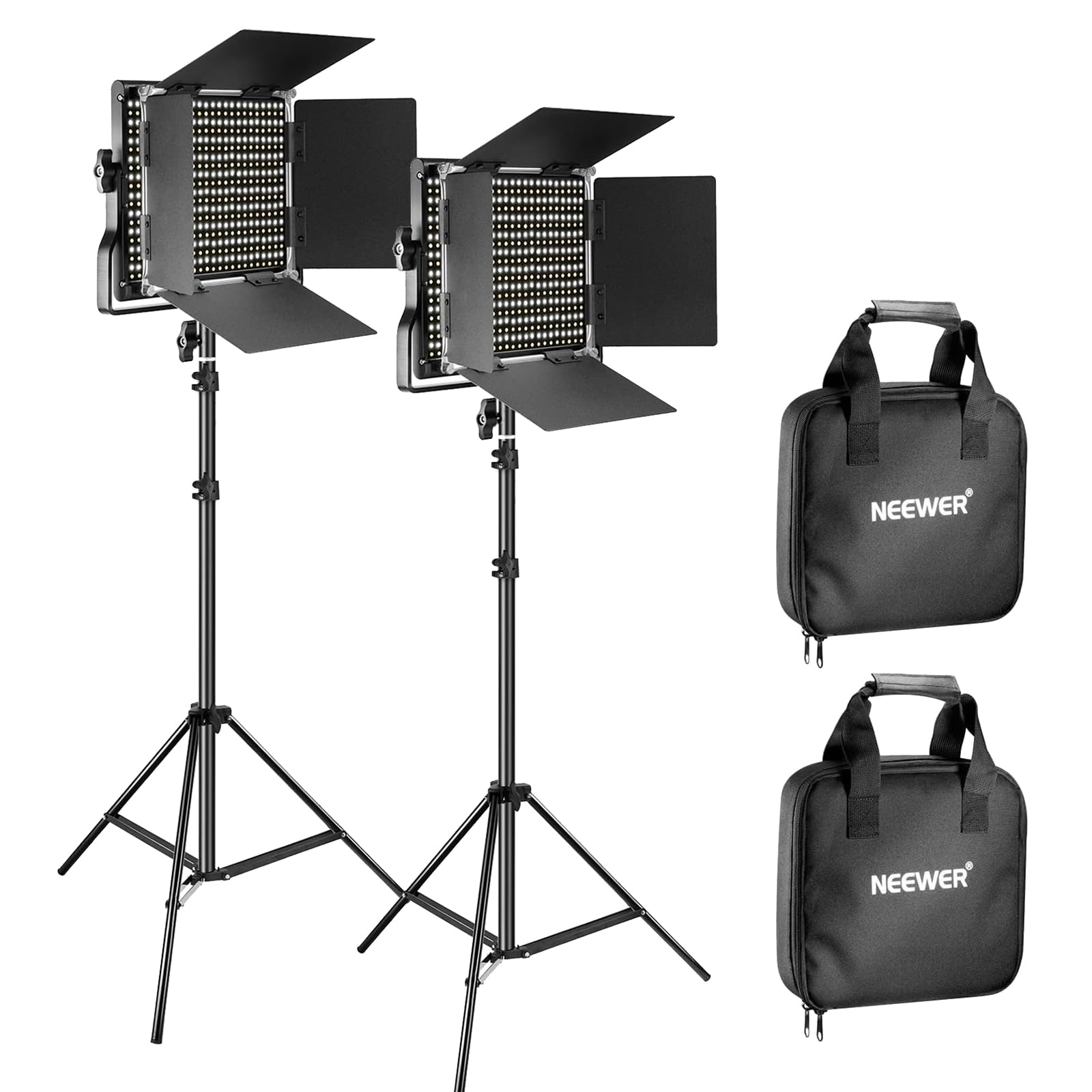
2 lights, 2 stands, 2 barndoors, 2 diffusers
Color
3200-5600K, CRI 96+
Power
AC or NP-F battery
Output
40W, 3300 lux at 1m
Check Price on Amazon

For a small studio, the NEEWER 660 kit is the two-light setup we recommend first. It puts two 40W bi-color panels, two 75-inch stands, barndoors, diffusers, and carry bags in one purchase, and each panel is rated for 3300 lux at 1m with CRI 96+. That is enough output to light a face or a product table from a few feet back, with room to dim rather than pushing the panel to its limit.

The metal housing and U-bracket are the details we appreciated most. The panels feel like equipment rather than plastic props, and the barn doors let you cut spill off a background without flagging the whole light. We also found the separate warm and cool dimming easy to match to a room: you can shift the color temperature without losing the brightness level you set.

The 75-inch stands get the panels above eye level, and the included bags make the pair practical to store between shoots. This is not a kit you toss in a backpack; the stands and panels take up real space, and the AC adapters are the way to run it in a fixed room. What earns it the top spot is the completeness: two matched lights, tall stands, and shaping tools that turn the panels into a usable two-light setup.

Pros

  • Two matched 40W panels in one kit
  • 3300 lux at 1m with CRI 96+
  • Barndoors, diffusers, and 75-inch stands included
  • Separate warm and cool dimming

Cons

  • NP-F batteries are sold separately
Our verdict

We recommend the NEEWER 660 kit as the default two-light setup for interviews, YouTube, and small product shoots, provided you have space for stands.

Check Latest Price
2

Best for App Control

GVM 480 LED Kit

91 /100
Keeper Score Outstanding

Key details

Kit
2 lights, 2 stands, 2 barndoors, hard bag
Color
2300-6800K, CRI 97+
Power
AC or F970/F750 battery
Control
App control, digital display
Check Price on Amazon

The GVM kit is the closest alternative to our top pick, and it wins on flexibility. Its 2300-6800K range reaches warmer and cooler than the NEEWER's 3200-5600K, and the app lets you change color and brightness from a phone instead of walking to the panel. For mixed lighting or a warm practical look, that wider range is genuinely useful.

We still rank it second because the app is the reason to choose it, not because it beats the NEEWER on the core light. The 480 LEDs and CRI/TLCI 97+ ratings produce clean color for interviews and product shots, and the digital display makes small adjustments repeatable. The app is genuinely useful when the camera is across the room, but it is an extra dependency in a kit that otherwise works with physical controls.

The hard carrying bag is a nice upgrade over a soft sack, and the included barndoors give you some spill control. If you shoot with a phone at the camera position, the app is a real convenience; if you prefer physical knobs and a simpler setup, the NEEWER is the easier kit to live with.

Pros

  • 2300-6800K color range
  • App control for brightness and color
  • CRI/TLCI 97+ color accuracy

Cons

  • Included stands feel light at full height
Our verdict

We pick the GVM kit when app control and a 2300-6800K range matter more than the NEEWER kit's simpler, more settled feel.

Check Latest Price
3

Best Budget Kit

NiceVeedi 2-Pack Kit

89 /100
Keeper Score Excellent

Key details

Kit
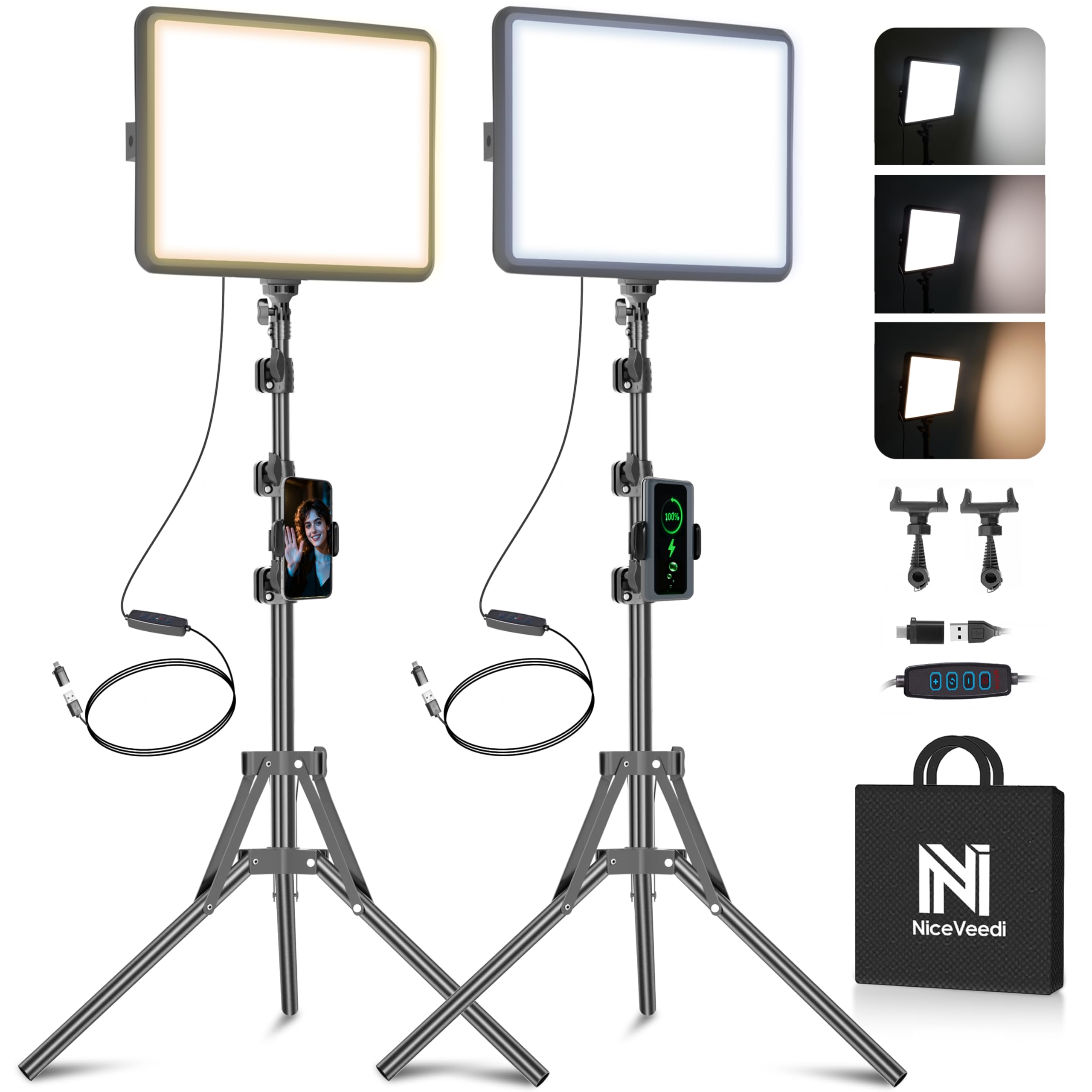
2 panels, 2 tripods, 2 phone holders
Color
2800K, 4800K, 6500K
Power
USB-C adapters
Panel Size
10 x 7.8 in
Check Price on Amazon

The NiceVeedi kit is the budget two-light setup we point a new creator toward. It includes two 10 x 7.8-inch panels, two tripods, two phone holders, and a storage bag, which covers the first desk or bedroom studio in one purchase. The panels are smaller than the studio kits here, and the color control is a set of three presets rather than a continuous dial.

What makes it worth a place is how quickly it gets to usable light. Setup is straightforward, the tripods adjust from desk height to standing height, and the phone holders let you frame a shot without a separate clamp. We paid attention to the stands because that is where budget kits usually show their limits: at full extension with a panel and phone mounted, they feel top-heavy.

Three color temperatures (2800K, 4800K, 6500K) cover warm room light, neutral, and cool daylight, and the 10 brightness steps are enough for close work. It is a desk and small-room kit, not a replacement for a pair of 40W studio panels. The storage bag is the detail that makes it easy to clear the dining table between shoots, and the phone holders are why it feels complete rather than like two loose lights.

Pros

  • Complete two-light kit with tripods and phone holders
  • Three color temperatures cover warm to cool
  • Easy to set up and pack away

Cons

  • Color temperature is limited to three presets
Our verdict

We recommend the NiceVeedi kit for new creators who need two panels, stands, and phone holders without spending like a studio.

Check Latest Price
4

Best Portable Panel

SmallRig RM120

93 /100
Keeper Score Outstanding

Key details

Color
2500-8500K, CRI 98+
Mount
Dual cold shoe
Weight
7.2 oz
Battery
5000mAh, up to 3h
Check Price on Amazon

The RM120 is not a room light. It is a 7W, 7.2-ounce panel that mounts on a camera or a small stand, and that limitation is exactly why it earns a place: it puts controllable fill in a bag without adding a tripod to the walk. We reach for it for run-and-gun interviews, TikTok, and gimbal work because it stays small enough to keep mounted and bright enough at close range.

The built-in 5000mAh battery is rated for up to 180 minutes at maximum brightness, and USB-C charging means you can top it up from a power bank. The 2500-8500K range, 360-degree hue control, and 12 effects make it more versatile than a plain bi-color fill, though the RGB modes are for color accents, not accurate skin tone. The diffuser is worth keeping on for close-up faces; bare LEDs are harsh at arm's length.

The metal frame and dual cold-shoe mount feel more substantial than the panel's size suggests, and the OLED screen is easy to read in a dim room. It will not replace a 9- or 13-inch panel for a desk stream, but it is the one here that lives in a camera bag. The dual cold shoe also gives you a way to add a microphone or another small accessory without a cage.

Pros

  • Pocket-sized 7.2-ounce metal body
  • Up to 3 hours at maximum brightness
  • 2500-8500K plus RGB effects
  • Cold-shoe and 1/4-inch mounting

Cons

  • 7W output limits it to close-up fill
Our verdict

The SmallRig RM120 is the pocket panel we reach for when the camera is moving and a full stand light is impractical.

Check Latest Price
5

Best Desk Panel

NEEWER NL-116AI

91 /100
Keeper Score Outstanding

Key details

Color
3200-5600K, CRI 95+
Mount
Cold shoe and mini tripod
Output
10W, 600 lux at 0.5m
Battery
4000mAh, up to 1.5h
Check Price on Amazon

A 9-inch panel on a mini tripod is the least intimidating way to fix a desk stream, and the NL-116AI is the one we keep coming back to for that job. The two knobs for brightness and color temperature adjust in 1% steps, which is more precise than the stepped controls on the budget kits here. That precision matters when you are trying to match a window without turning the whole frame blue.

At 10W and 600 lux at 0.5m, it is a close-range key or fill light, not a room light. The 9-inch panel is large enough to soften a face at desk distance, and the 3200-5600K range is enough to match a window or a warm lamp. The USB-C port makes it easy to keep powered at a desk, and the included cold-shoe adapter gives you a camera-mount option.

We rank it as the best desk panel here because the controls are quick to dial in and the light is soft enough to flatter a face without a softbox. The 1% knobs are the detail that sells it: you can nudge the color temperature until the screen stops looking blue, without cycling through presets. It is not the panel for lighting a group or a full room, and the included tripod is strictly a tabletop stand.

Pros

  • 9-inch soft panel with 1% dimming
  • 3200-5600K and CRI 95+
  • Cold-shoe mount and mini tripod included

Cons

  • 1.5-hour battery limits all-day use
Our verdict

The NL-116AI is the compact desk panel we choose for streaming and video calls when we want soft light without a full stand kit.

Check Latest Price
6

On-Camera Fill

ENEGON LED Light

89 /100
Keeper Score Excellent

Key details

Color
2500-9900K
Weight
7.65 oz
Battery
4000mAh
Panel Size
5.9 x 3.0 x 0.4 in
Check Price on Amazon

The ENEGON is the smallest and least expensive way into an on-camera panel here. It pairs a 4000mAh battery with a 2500-9900K range and a metal body that weighs 7.65 ounces, and it disappears into a camera bag. That makes it a useful backup fill light, even if it does not match the SmallRig's output or polish.

The 5.9 x 3.0 x 0.4-inch panel and included shoe mount make it a natural fit for a DSLR or mirrorless camera, and the brightness and color temperature controls are more granular than the budget studio kits. The OLED screen is readable, and the metal housing feels more solid than the price suggests. It is a close-range light: good for a face at arm's length, less useful for a group or a room.

We rank it behind the SmallRig because the output is best at close range and the panel is not as refined in hand. It earns its place as a second fill light for the camera bag, not as a primary studio panel. If you need a light you can trust for a client shoot, the SmallRig is the safer buy.

Pros

  • 4000mAh battery in a 7.65-ounce body
  • 2500-9900K color range
  • Metal housing and shoe mount included

Cons

  • Battery life varies widely with brightness
  • Long-term reliability trails the SmallRig
Our verdict

We keep the ENEGON in the bag as a low-cost on-camera fill light for tight spaces, not as a primary studio panel.

Check Latest Price

How We Tested the Best LED Light Panels

We started with every panel that published a CRI rating, then narrowed by price so we had both a portable tier and a two-light kit tier, and dropped anything that shipped without a bracket or stand — a panel you can't aim is a panel you won't use. That left 12 lights. Each one went from sealed box to lit in a timed run, alone, with no instructions, because that's the actual experience at 9 p.m. in a dim room.

Then we lived with them. Panels sat on desks for video calls and streams, went into backpacks for weekend shoots, and got clamped to cameras in a spare room lit by one window. We dimmed each from full to minimum and watched for flicker on camera, ran brightness at 100 percent for half an hour and felt the housing, then slid color temperature from warm to cool and photographed the same hand at each end to see what happened to skin tone.

The brackets took the roughest treatment: we aimed each light, nudged the stand, extended it to full height, and noted which ones drifted. Battery panels ran at half brightness until they died and we timed it, then checked whether they'd charge while lit. Six months of regular use — a few times a week each — surfaced the quieter problems: a loosened port, a stand that stopped locking, a diode that quit. We also counted what came in the box, since barndoors and a carry bag can be the difference between a kit and a shopping list.

How to Choose Led Light Panels

Match panel size and output to the shot

A 9-inch panel at half a meter is a desk and close-up tool; a 40W panel rated at 3300 lux at 1m can light a face or a small product setup from farther back. For interviews and two-person shoots, a pair of larger panels gives you a key and fill, and barndoors keep spill off the background. If you shoot alone at a desk, a single 9- to 12-inch panel is often enough.

We prioritize beam control over raw brightness. A dimmable panel with barn doors and a diffuser is more useful than a brighter bare panel you cannot shape.

Choose color control you can repeat

CRI and TLCI tell you how faithfully the panel renders color; 95+ is a sensible floor for skin and product work. A bi-color range around 3200-5600K covers tungsten to daylight, while a wider 2300-6800K range gives more room for warm effects and mixed light. Presets are quicker, continuous dials are more precise.

If you need colored accents, RGB panels like the SmallRig add effects, but do not expect RGB to replace a high-CRI white mode.

Plan for power beyond the spec sheet

AC power is the simplest choice for a studio, while built-in batteries and NP-F slots make a panel portable. Headline runtime is usually measured at low output; at full brightness, expect a shorter run. For a desk panel, USB-C charging is convenient; for a two-light kit, check whether batteries are included.

We treat a 1.5-hour built-in battery as a short-shoot tool, not an all-day solution.

Stands and mounts decide how usable the kit is

Light stands are where budget kits cut corners. A stand that is stable at desk height can feel top-heavy with a panel and phone mounted at full extension, so check the folded height, maximum height, and load rating. For camera-mounted panels, a cold shoe or 1/4-inch thread is enough; for a desk, a mini tripod is more convenient. If you plan to move the kit, a carry bag matters as much as the light.

Buy the kit that matches your workflow

Two-light kits make sense for interviews, YouTube, and product work because you get a key and fill that match. A single panel is easier to store and better for streaming, calls, and tight spaces. Portable panels trade output for size, and studio kits trade portability for control. We prefer adding a second panel later to buying a kit whose stands or controls fight us every time.

Frequently Asked Questions

Final Verdict

Most people building a small studio should start with the NEEWER 660 kit. It gives you two matched panels, tall stands, barndoors, and enough output to light an interview or a product table, and its controls are simple enough to repeat from shoot to shoot. If you work from a phone and want the widest color range, the GVM kit is the alternative; for a desk, the NEEWER NL-116AI is the smaller answer.

The exception is portability: if the light needs to travel in a camera bag, choose the SmallRig RM120 and accept that it is a close-range fill. That is the decision that matters most; the rest is matching the kit to the room you shoot in.