Best Video Lights of 2026

A bad video light doesn't announce itself. It makes you look slightly gray, or blows out one cheek while the other goes dark, and you spend the edit trying to fix it. What you want is a light you can shape: bright enough to compete with a window, adjustable enough to warm a dim room, stable enough that you aren't re-aiming it between takes. My team and I spent six months shooting with 12 of them in the setups people actually film in — a spare-room desk, a dim living room, a kitchen table.

Two things I'd tell a first-time buyer. Color temperature range and color rendering matter more than peak brightness — a light that reaches 6500K but turns skin gray is worse than a slightly dimmer one that gets skin right. And the stand or tripod in the box is often the first thing to fail.

The picks below run from pocket lights that live on their own batteries to a two-pack you can leave standing in a corner, so there's something here for a phone-and-desk setup as much as a fuller studio rig.

Keeper Score summarizes customer ratings and review volume. Read it alongside the product details and trade-offs. How the score works.

1

Best Overall

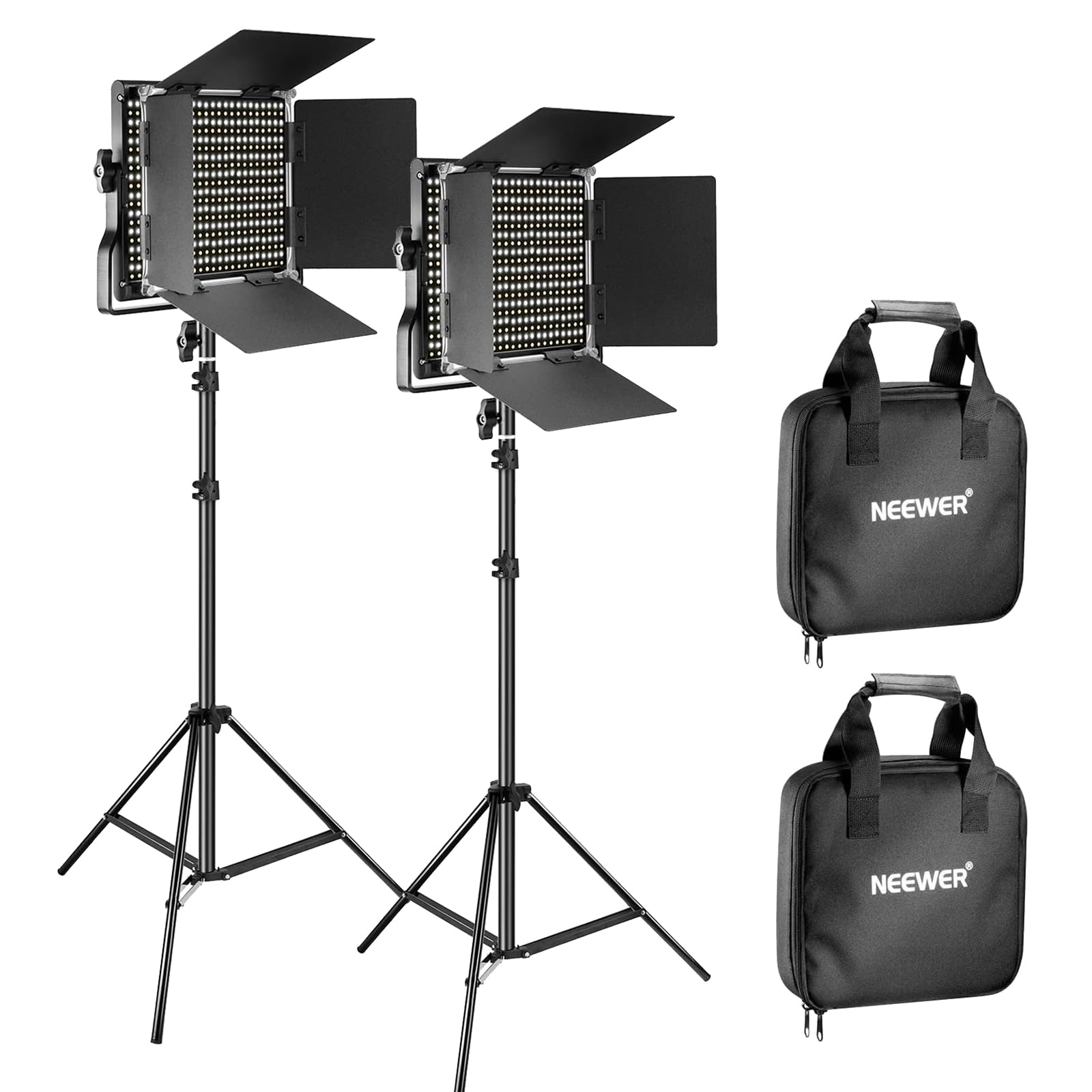
NEEWER 660 Bi-Color 2-Light Kit

94 /100
Keeper Score Outstanding

Key details

CRI
96+
Output
40W, 3300 lux/1m
Stand Height
26–75 in
Color Temperature
3200–5600K
Check Price on Amazon

There's no fan in these panels, and that turned out to be the detail we appreciated most. The aluminum housing pulls heat away on its own, so nothing hums into a microphone two feet from the light during a quiet take. Panels with active cooling force you to choose between a cool light and a clean audio track; this one doesn't.

That's the pattern with the 660 kit — the money goes into the parts you stop noticing. Each panel carries 330 warm and 330 cool LEDs, rated at 40W and 3300 lux at a meter, with CRI 96+ so skin doesn't drift green. We set temperature anywhere from 3200K to 5600K and dimmed from 0 to 100% on two knobs, checked the reading on the LCD, and got the same result take after take. It's the only kit here that behaves like lighting gear rather than accessories.

The barn doors are what make it work in a small room. Swing them to a narrow slot and the light lands on a face and leaves the back wall alone; open them onto the diffuser and you get a broad, soft wash. Both panels ride on 75-inch aluminum stands with locking knobs that hold a heavy head without creeping down mid-sentence.

Two purchase notes worth planning around. The panels run on Sony-style NP-F batteries for cordless work and none are included, so add two NP-F970s and a charger if you'll shoot away from outlets. The supplied power cables are also short enough that an extension cord earns its place in the bag. Do both and you have a kit that comes down into two padded cases and goes back up fast enough that setup stops feeling like a chore.

Pros

  • Barn doors cut spill and shape the beam
  • CRI 96+ across a 3200–5600K range
  • Fanless aluminum body stays quiet on set
  • 75-inch stands hold a panel without drifting

Cons

  • Heaviest kit here at 14.7 pounds
  • The most expensive pick in this group
Our verdict

If you shoot often enough that lighting is part of the job, this is the kit we point you to: barn doors, high CRI, and stands that stay where you put them.
Check Latest Price
2

Best Budget Two-Light Kit

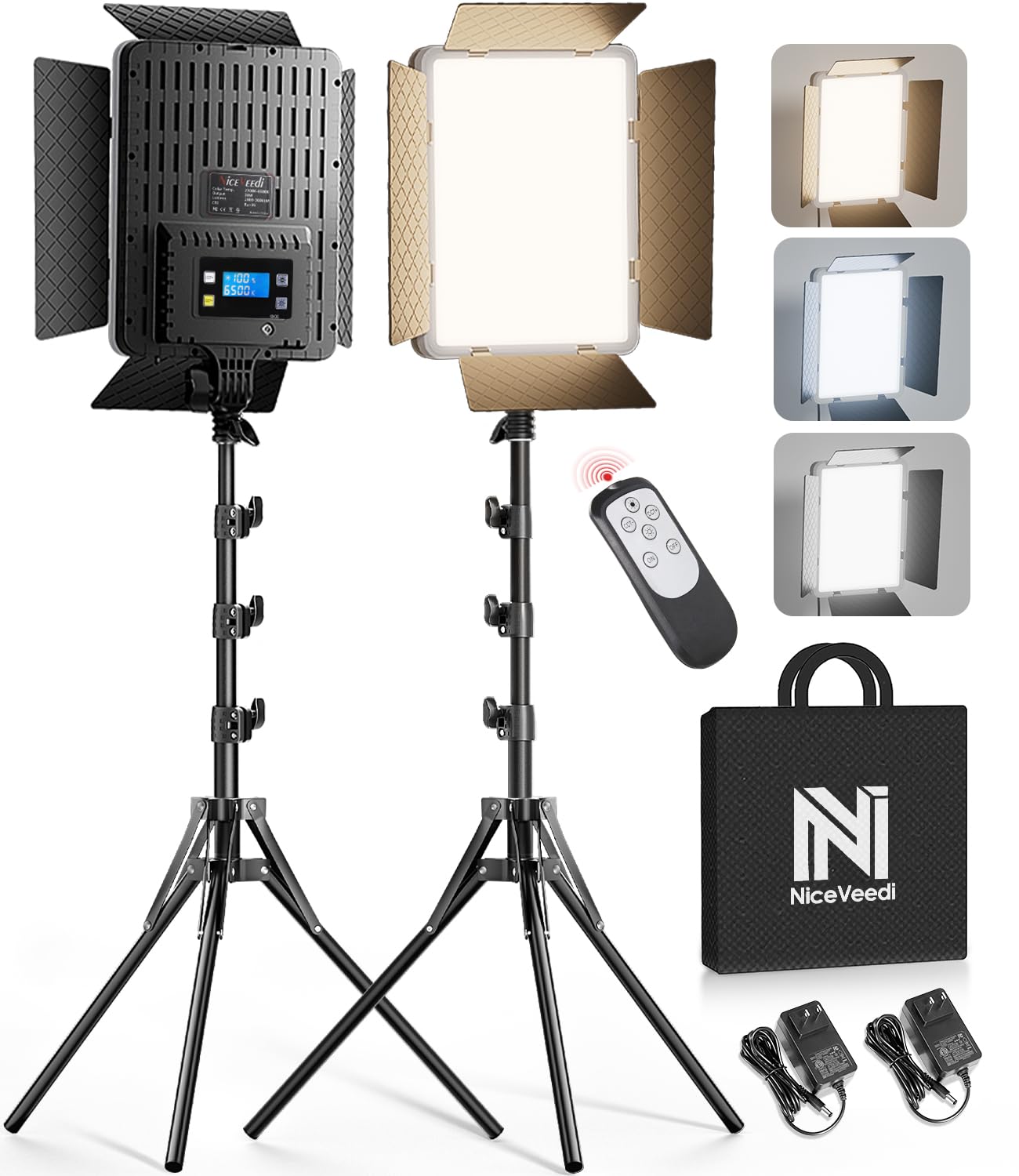
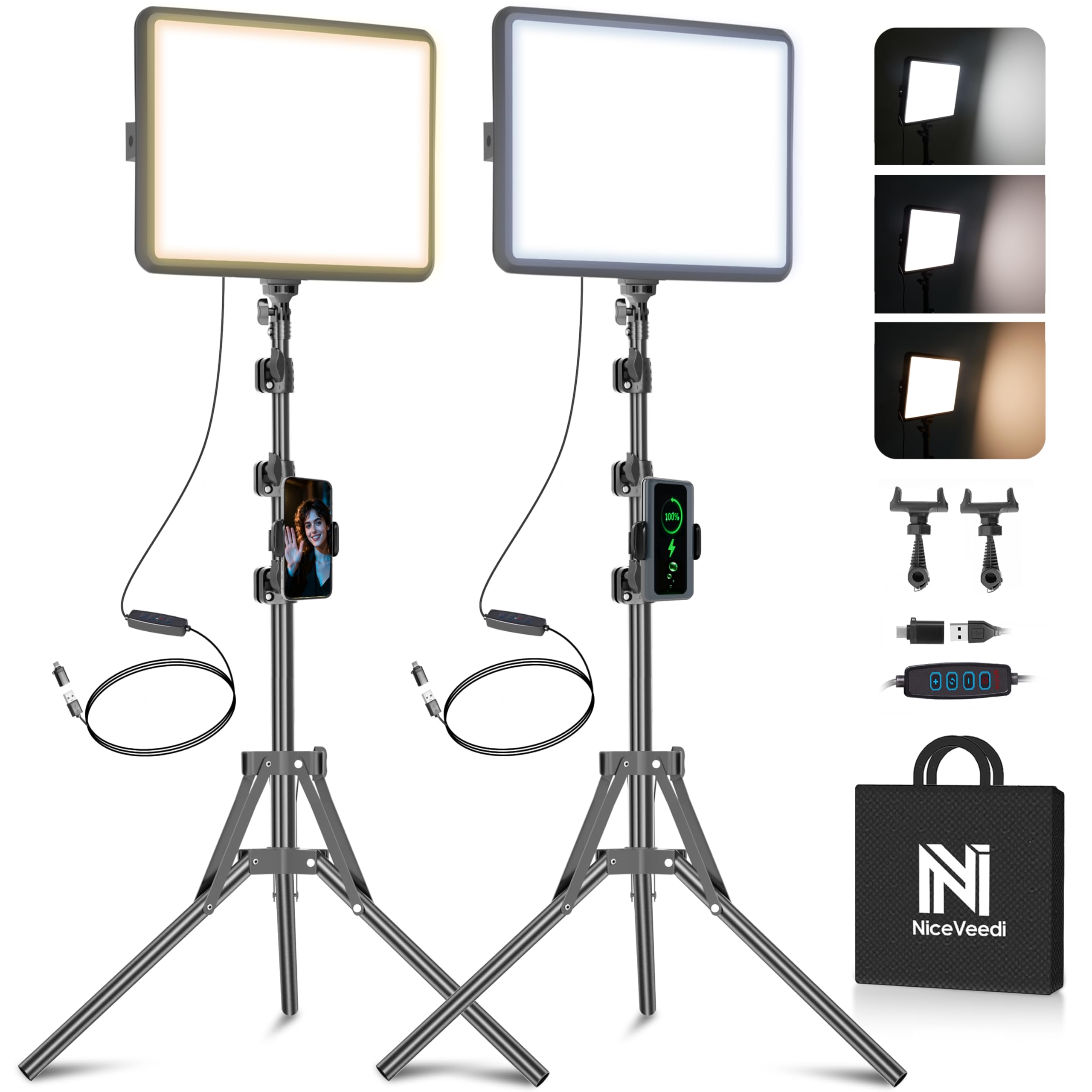
NiceVeedi 2-Pack LED Video Light Kit

89 /100
Keeper Score Excellent

Key details

Power
USB-C
Kit Weight
3.7 lb
Stand Height
73 in
Color Temperature
2800K, 4800K, 6500K
Check Price on Amazon

This is the least expensive complete kit here, and the one we hand to someone buying a first set of lights. Two panels, two stands that reach 73 inches, a phone holder and a carry bag arrive together, and the whole thing weighs 3.7 pounds. Moving the setup from the office to the living room costs one trip and no planning.

The controls are simple to the point of being limited: three color temperatures — 2800K, 4800K and 6500K — and brightness that steps up rather than sliding smoothly. There's no dialing in 4200K when the light in your room falls between presets, and we did miss that after working with the bi-color kits. What you get instead is speed. Warm for a lamp-lit corner, cool for a window, and a panel that tilts to whatever angle the stand allows.

Stands are where the savings show. The aluminum legs are light, and with a panel up high the assembly is top-heavy enough that a bumped desk sets it rocking, so keep the legs spread wide and drop the height when you don't need it. Past that, the phone holder is the detail that turns this into a one-person kit: clamp a phone in and you can watch the highlight on your cheek while you tilt the panel.

Pros

  • Complete two-light kit for the least money here
  • 3.7-pound kit folds into a carry bag
  • Stands extend to 73 inches
  • Phone holder makes solo framing easier

Cons

  • Only three color-temperature presets
Our verdict

For a first two-light setup on the tightest budget, this is the kit we recommend: light enough to move, tall enough to place properly, and simple enough to learn on.

Check Latest Price
3

Best for Filming Solo

Torjim 12-Inch Video Light Kit

91 /100
Keeper Score Outstanding

Key details

Output
30W
Panel Size
12 in
Brightness Levels
1–9
Color Temperature
3000–6500K
Check Price on Amazon

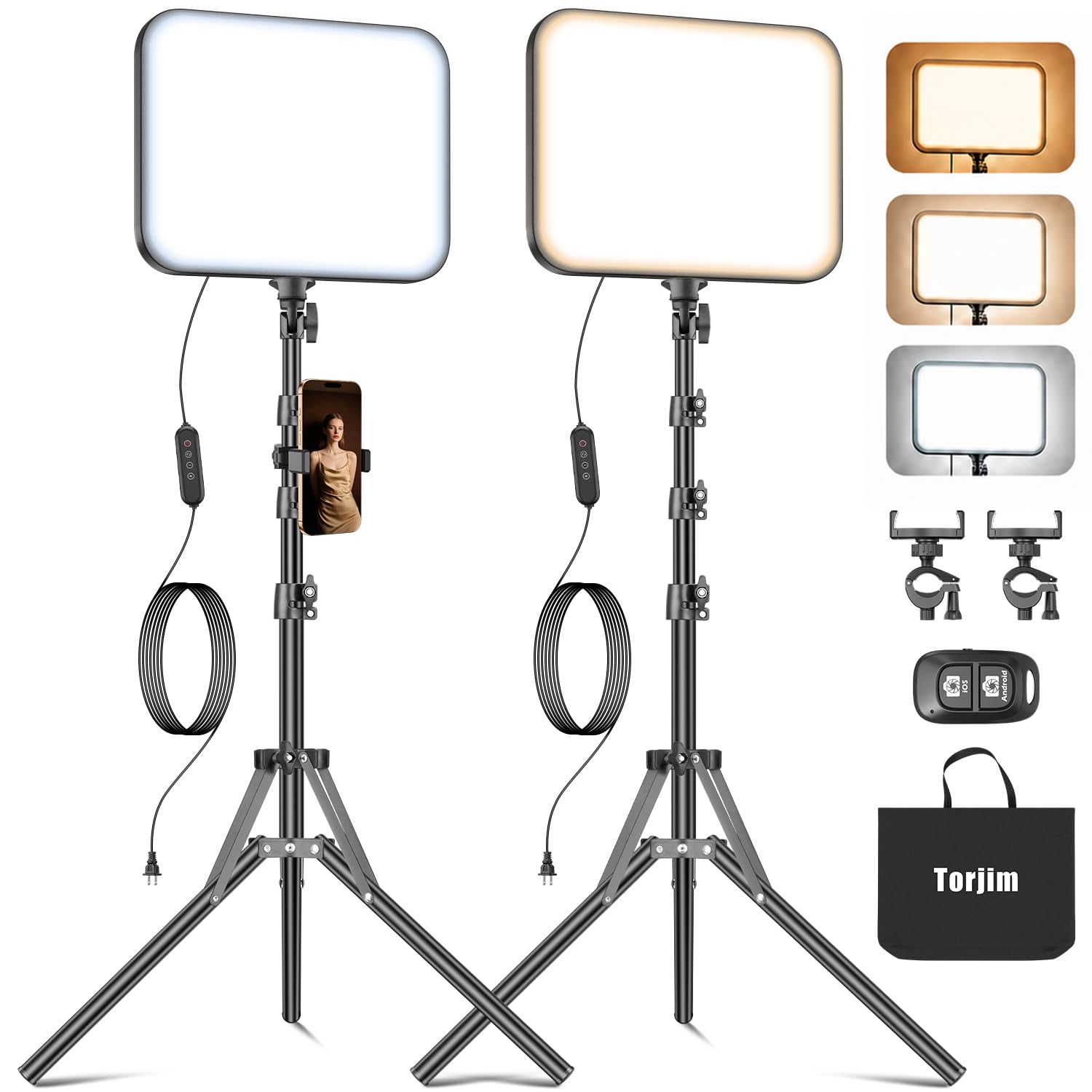
The little clicker in the box is what separates this kit from the other budget sets here. It pairs with your phone over Bluetooth and fires the shutter, so you can start recording from across the room instead of walking into frame and back out again. If you film alone, that's worth more than another brightness step.

The panels are the largest of the budget lights — 12 inches — with 30W behind them and a continuous 3000K to 6500K range rather than three fixed presets. Brightness runs in nine steps, two phone holders mean you can run a phone on each stand, and skin tones came out clean in our footage. The panels are also light enough that one person can shift a stand with the light still mounted.

What you're buying here is convenience, and it isn't a small thing: a bag that swallows the whole kit, a remote that keeps you out of your own shot, and panels big enough to soften a face in a small room. It's the budget kit we point at people who film alone, and it earns that place on the strength of the clicker and the panel size rather than on raw output.

Pros

  • Bluetooth shutter remote keeps you out of frame
  • 12-inch panels with 30W of output
  • Continuous 3000K–6500K color range
  • Two phone holders and a carry bag

Cons

  • A panel can quit within the first weeks
Our verdict

For phone-first creators who film alone, the shutter remote and 12-inch panels make this the most practical budget kit here.

Check Latest Price
4

Best High-Output Key Light

NEEWER CB100C RGB LED Light

90 /100
Keeper Score Outstanding

Key details

Mount
Bowens
Output
130W, 27000 lux/m
CRI / TLCI
97+ / 98+
Color Temperature
2700–6500K
Check Price on Amazon

This is the only light here with a Bowens mount, and that single fact explains the price. Bolt on a softbox and the light stops being a bright rectangle and becomes a soft, directional source; add a grid or a snoot and you can drop a pool of light exactly where you want it. None of the panels here can change character that way.

It's also far more powerful than anything else in this group: 130W, 27000 lux at a meter, CRI 97+ and TLCI 98+. For a desk setup that's enormous headroom, and the useful part isn't the peak — it's that you can dim well down and the color stays where you set it, with plus or minus 50 GM correction when you want to shift the tint without touching the Kelvin value. We ran it as a streaming key and stopped thinking about output entirely, which is the point of buying headroom.

The hardware is quieter than the price suggests, too. The aluminum shell and heatsinks carry most of the heat, and the fan holds a low speed until the housing warms up; in a small office we stopped noticing it after a few minutes. The app is where the color controls actually make sense — dialing hue on the back of the light while watching a monitor is a two-hand job, and the 2.4G radio lets you run a whole set from one phone.

The 17 preset scenes — lightning, TV, fireworks — are the part we touched least, and you probably will too. What earns the space in the bag is the modifier mount and the color accuracy, the two things that are very hard to add later.

Pros

  • Bowens mount takes standard modifiers
  • 130W output with CRI 97+ and TLCI 98+
  • App and 2.4G control for multi-light sets
  • Quiet fan and metal housing

Cons

  • No stand or softbox in the box
  • Corded only, with no battery option
Our verdict

If you want one serious key light you can soften and shape, this is the one to buy — as long as you already own a stand and shoot near an outlet.

Check Latest Price
5

Best On-Camera Light

ULANZI VL49 RGB Camera Light

93 /100
Keeper Score Outstanding

Key details

Size
66 x 80 x 30 mm
Weight
3.53 oz
Battery
2000mAh
Color Temperature
2500–9000K
Check Price on Amazon

At 66 by 80 by 30 millimeters and around 100 grams, this is the light that actually lives in the camera bag. It's the one we reach for when a face is going muddy under a ceiling fixture and there's no room for a stand, and it's the one that ends up as a hair light or a colored accent behind a product shot more often than as a key.

The range is what makes it useful in odd corners: 2500K to 9000K of white, plus full hue control from 0 to 359 degrees and dimming from 0 to 100%, all through a 120-degree beam. A magnet on the back sticks it to a metal shelf or the leg of a stand when you need light where nothing else fits, and there's a cold-shoe foot for the top of a camera plus a 1/4-inch thread for a tripod or an arm.

The controls take a few minutes to learn, since one button cycles between white, color and effects while the other two change brightness and value, but after that it's a set-and-forget light. We use it as fill and accent rather than as a key, which is the honest job for a panel this size.

Pros

  • Fits in a pocket at 100 grams
  • 2500–9000K plus full hue control
  • Magnetic back and cold-shoe mount
  • Charges over USB-C

Cons

  • About two hours of run time at full brightness
Our verdict

For camera-mounted fill, colored accents, and desk product shots, this pocket panel does more than its size suggests — and the battery is the one thing to plan around.

Check Latest Price
6

Barndoor Spill Control

NiceVeedi 36W Bi-Color 2-Pack

84 /100
Keeper Score Excellent

Key details

CRI
95+
Output
36W
Stand Height
72 in
Color Temperature
2700–6500K
Check Price on Amazon

The barn doors are built into the panels here rather than bolted on, which is unusual at any price and the main reason to look at this kit instead of the cheaper two-packs. Four leaves, nothing separate to lose, and enough control to keep light off a background you can't move.

The rest of the package is a step up as well: a 2700K to 6500K range instead of three presets, CRI rated 95+, 36W of output and aluminum stands that reach 72 inches. The IR remote works from about 26 feet, which matters when the panels sit behind the camera, though it needs line of sight — don't plan on tucking a light in a corner and controlling it from the next room.

Durability is why this sits in our second tier rather than higher. Panels that stop working within a month are the pattern to know about before ordering; ours came through testing fine, but buy from a seller with a straightforward return window and run both lights for a week before you rely on them. Get a good set and you have barn doors, a wide color range and tall stands for well under what the top pick costs.

Pros

  • Four-leaf barn doors built into each panel
  • 2700–6500K with CRI 95+
  • IR remote reaches about 26 feet
  • 72-inch aluminum stands included

Cons

  • A panel can stop working within the first month
Our verdict

A sensible middle step when you want barn doors and a wide color range without top-pick money — order from a seller with an easy return and test both panels early.

Check Latest Price
7

Colored Background Light

Amazon Basics 2-Pack LED Video Light

85 /100
Keeper Score Excellent

Key details

Colors
7 RGB plus 3 white presets
Dimming
0–100%
Tripod Height
62.3 in
Color Temperature
2500–6500K
Check Price on Amazon

Seven RGB colors plus three white presets is the pitch, and it's a real one if you've been lighting yourself with a desk lamp. A panel set to blue behind you and a warm white in front does more for a YouTube frame than a brighter single light will, because it separates you from the wall instead of just illuminating you.

The white settings run 2500K to 6500K and dim from 0 to 100%, and the panels are slim enough to sit behind a laptop screen without showing up in the shot. A 360-degree gimbal head with 180 degrees of rotation lets you aim one down at a desk or bounce it off a wall, which is more aim than a fixed tilt joint gives you.

Power comes over USB at 5V/2A, so a laptop brick or a power bank will run them, and the wall adapter is not in the box — sort that out before your first shoot. The 62.3-inch tripods are the weak link: fine with a panel at seated height, increasingly light-feeling as you raise them.

The part that convinced us is that this kit treats color as a tool rather than a novelty. These are fill and background lights, not keys, and used that way they add production value a plain white panel can't.

Pros

  • Seven RGB colors plus three white presets
  • Slim panels with a 360° gimbal mount
  • USB power runs from a battery bank
  • Tripods extend to 62.3 inches

Cons

  • Best used as fill, not a key light
Our verdict

If you want colored background light on a small budget, this pair is the easiest way in — just add a USB wall adapter.

Check Latest Price

How We Picked and Tested 12 Video Lights

We started by gathering every light a solo shooter could realistically buy, set up, and carry alone — small bi-color panels, pocket lights that run on a battery, and one bigger COB fixture — then narrowed by color temperature range, stated color rendering, control options, mounting, and what came in the box for the price. That left 12 lights, from budget two-packs to a single serious unit, and we lived with each for six months.

Testing happened where these lights actually get used: a spare-room desk for talking-head footage, a dim living room for streaming, a kitchen table for product photos, and a garage at night. With each one I shot a white card and then my own face at full power and at the lowest dim step, watching whether light fell off at the edges or pooled in the middle, and I shot the same fabric swatch under every unit to see if colors stayed true or drifted. Battery units ran at full brightness until they dimmed or quit.

Every stand and tripod got built solo and timed, then nudged the way a camera bag nudges a leg in a small room, and I noted how far the light swung. I worked each remote and app from across a dark room, changing brightness and color temperature without looking, tracking lag, missed presses, and whether two paired lights stayed in sync. Each light also got mounted every way it allowed — clamped, on a cold shoe, on its own stand.

Reliability turned up in the dull moments: a panel that flickered on camera, a mount that crept under the weight of a barndoor, a light that had to be re-paired every session.

How to Choose Video Lights

Start With How You Shoot

Video lights split into three families, and buying into the wrong one is the expensive mistake. Panels on stands, sold as two-light kits, suit anyone filming in a fixed room: talking heads, tutorials, streams. On-camera lights are small, battery-powered, and built to ride a hot shoe or a phone rig. COB lights with a Bowens mount are studio instruments — you buy them for the modifiers, not for the panel.

If you film in one room, buy stands. If you film in five places a week, buy something that clamps to the camera. If you're building a set you'll keep for years, buy the mount and accept that the light itself is only half the purchase.

Read the Brightness Numbers Carefully

Lux figures only compare when they're measured at the same distance, and many listings leave the distance out entirely. A panel quoting 27,000 lux at one meter sits in a different class from one quoting 600 lux at half a meter, and a bare number with no distance is marketing rather than measurement. Wattage tells you about power draw, not about how your face will look.

What matters more for video is color accuracy and color control. CRI of 95 or better keeps skin tones natural, and a continuous color-temperature range lets you match the window light in the room instead of approximating it with three presets. If you shoot in mixed light, that dial is worth paying for.

Plan for Height and Stability

A key light belongs above eye level and angled down, so the stand matters as much as the panel. A 62-inch tripod puts a light at seated head height; a 75-inch stand clears it with room to spare, and that extra foot is what gives you cheekbones instead of a flat, shadowless face.

Tall stands get top-heavy quickly. Spread the legs fully, keep the heaviest section low, and weight the base if people walk past it. If you film alone, check whether the kit includes a phone holder — it's the cheapest way to see what the camera sees while you adjust the light.

Check the Power and What's in the Box

USB panels run from a power bank or a laptop brick, which is liberating until you find the wall adapter isn't included. Battery-capable panels usually take Sony-style NP-F cells, sold separately, and two of them plus a charger can add serious money to a kit that looked like a bargain. Corded studio lights are the simplest and the most powerful, but they tie you to an outlet and a cable long enough to reach it.

Before you compare two kits, price the accessories each one needs to work the way you intend. A cheaper box and a more expensive box often land in the same place once you've added what's missing.

Frequently Asked Questions

Final Verdict

The NEEWER 660 kit earns the top spot because it's the one here that behaves like lighting equipment: barn doors to shape the beam, CRI 96+ color, and stands that hold a panel where you aimed it. If the budget is smaller, the NiceVeedi two-pack lights a first setup and folds into a bag.

And if your plan involves a softbox, skip panels entirely — the CB100C is the only light here built to take one.