Best Laser Levels of 2026

A laser level does one job, and it does it invisibly: it throws a straight line of light across a room so you can hang a shelf, tile a backsplash, or frame a wall without a pencil, a helper, and three trips up the ladder. The trouble is that all of them look accurate in a dim hallway. The ones that ruin a Saturday are the units that drift out of calibration, throw a beam too faint to read in daylight, or wobble so long after you bump the tripod that you give up and eyeball it.

Over the past nine months, my team and I have run 12 of them through real projects — gallery walls in a sunlit hallway, a tiled shower surround, a basement ceiling grid. The line count on the box mattered far less than two things. Green beams read brighter than red but drain faster, and a level is only as good as its bracket, since a perfect beam on a mount that sags is worse than no beam at all. The picks below are the ones we'd hand to a friend mid-project.

Keeper Score summarizes customer ratings and review volume. Read it alongside the product details and trade-offs. How the score works.

1

Best Overall

CIGMAN CM-701 Laser Level

93 /100
Keeper Score Outstanding

Key details

Beam
Green
Battery
4,000 mAh rechargeable
Laser Coverage
3 x 360 degrees, 12 lines
Self-leveling Range
Plus or minus 4 degrees
Check Price on Amazon

A cross-line laser draws two lines on one wall. This one wraps three 360-degree planes around the room — a horizontal ring plus two verticals — and it costs less than the red cross-line DEWALT in this guide. That combination is why it's our top pick: full-room coverage, a rechargeable battery and the accessories to actually use it, at a price sitting in the middle of this group.

Twelve lines is more than most people switch on at once, but the coverage matters the moment you're squaring a room or setting a row of cabinet uppers. What we appreciated most is the mini tripod base in the box: it lets you put the tool at the height you're working at instead of hunting for a steel stud to stick the magnet to. The remote earns its place too, when the unit is up on a bracket and you're across the room.

Self-leveling absorbs about four degrees of tilt; past that the lines flash and the base needs shimming, which is worth knowing on an old floor. The housing is rated IP54, so dust and a splash are fine and rain isn't — the difference between a tool that lives in a workshop and one that lives in a truck.

Pros

  • Three 360-degree planes cover a whole room
  • Rechargeable 4,000 mAh battery, no AAs to buy
  • Mini tripod base and remote included
  • Quick to set up and accurate out of the box

Cons

  • Green line washes out in direct sun
  • Ships in a soft bag, not a hard case
Our verdict

Full three-plane coverage, a rechargeable battery and a complete kit make this the laser level we recommend first for remodels, tile and cabinet work.
Check Latest Price
2

Best Value

Huepar HM03CG Laser Level

92 /100
Keeper Score Outstanding

Key details

Beam
Green
Runtime
Up to 8 hours
Warranty
5 years
Laser Coverage
3 x 360 degrees (1 horizontal, 2 vertical)
Check Price on Amazon

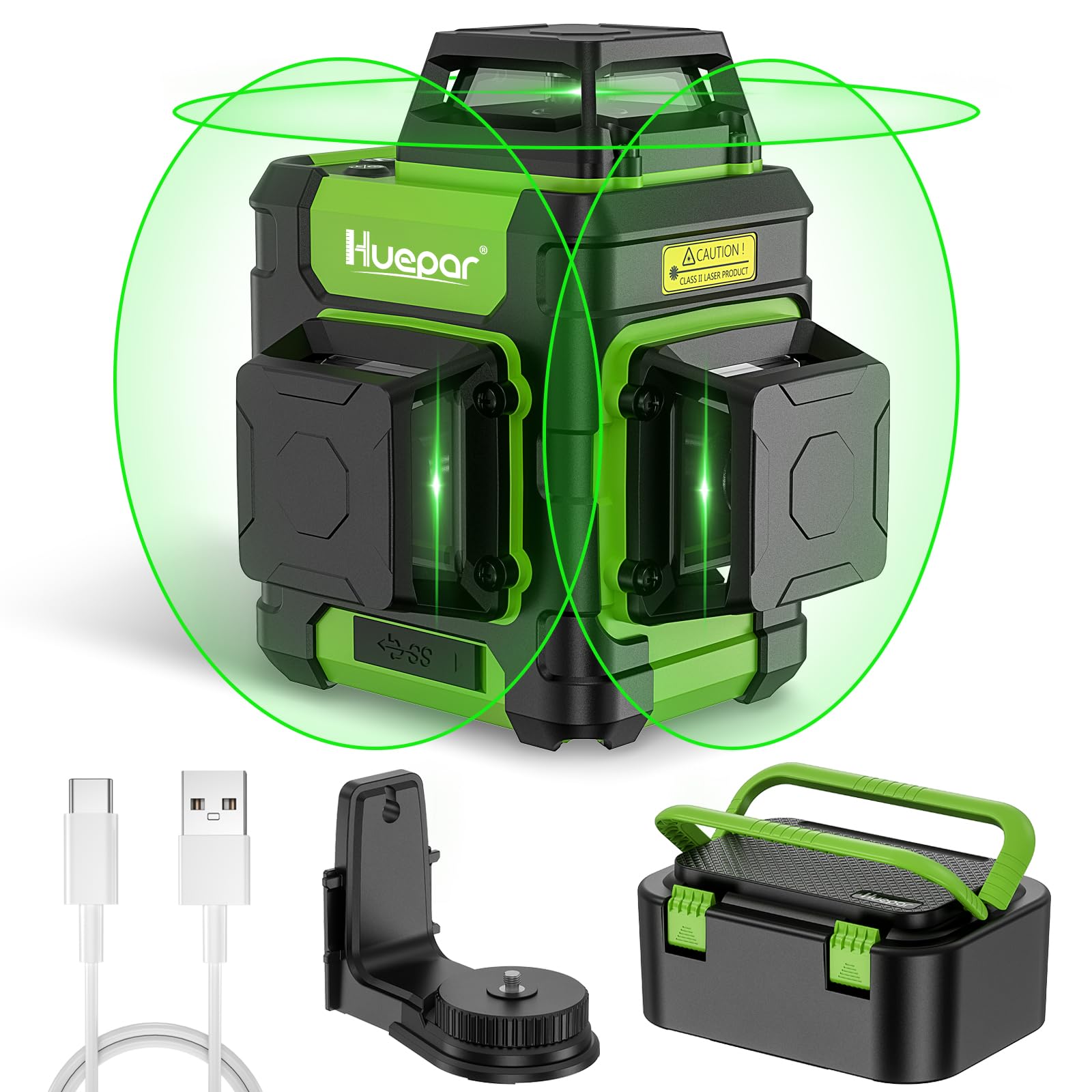
Five years is the longest warranty in this guide, and it comes attached to a tool that costs less than our top pick. The HM03CG carries the same three 360-degree planes, a rechargeable battery rated for eight hours of continuous work, and a hard case that keeps the bracket and cable together in the back of a van.

Setup is short: unlock the pendulum, let it settle, and the lines are true enough to set cabinets or a tile row against. Pulse mode is there for outdoor work with a detector, and the strong magnetic bracket holds the housing flat against a steel post so the line lands where you need it without a tripod.

For a day of interior work — cabinets, tile, a run of frames — three planes and eight hours cover it comfortably, and the case means it survives being carried between jobs. The savings against the top pick are real, and nothing about the alignment feels like a compromise.

Pros

  • Five-year warranty, the longest stated here
  • Hard carry case included
  • Eight hours of continuous runtime
  • Three planes with fast, simple setup

Cons

  • No remote or tripod base in the box
Our verdict

The same three planes, plus a five-year warranty and a hard case — this is where we send anyone shopping on value.

Check Latest Price
3

Best Cross-Line

DEWALT DW088K Cross Line Laser

95 /100
Keeper Score Outstanding

Key details

Beam
Red
Range
Up to 165 ft with detector
Laser Lines
Cross line (horizontal and vertical)
Ingress Rating
IP54
Check Price on Amazon

The beam is red, and red is the first thing to disappear in a bright room. That's the trade here, and it's worth saying up front — but indoors, in ordinary room light, the line reads clearly on drywall, and there's no menu, no mode and no learning curve: switch it on and it levels itself.

What this one has is a housing built for a jobsite. An overmolded body with a one-meter drop rating and an IP54 seal, a magnetic bracket that grips steel corner bead, and a case that takes being thrown in a truck. Moving from room to room with it, we never once worried about setting it down too hard.

For chair rail, cabinet height, tile rows and shelf lines on one wall, a cross line is all the geometry the job needs, and this one asks nothing of you in return — no mode to select, no pendulum lock to remember. That simplicity is the feature.

Pros

  • One-meter drop rating and IP54 sealing
  • Strong magnet holds to steel corner bead
  • Accurate self-leveling with almost no setup
  • Two-line layout with nothing to configure

Cons

  • Two lines only
  • Detector for the 165-foot range is sold separately
Our verdict

For one wall at a time, this is the cross-line laser we hand people: drop-rated, magnetic, accurate and free of a learning curve.

Check Latest Price
4

Best for Pro Crews

DEWALT DW089LG 3x360 Laser Level

92 /100
Keeper Score Outstanding

Key details

Power
12V MAX battery and charger
Accuracy
Plus or minus 3 mm at 10 m
Ingress Rating
IP65
Laser Coverage
3 x 360 degrees
Check Price on Amazon

The most expensive tool here, and the only one built around a power-tool battery. This is aimed at people who set layout every day — commercial interiors, HVAC, framing — and what the money buys is sealing, stated accuracy and a battery platform rather than more lines.

Three 360-degree green planes, plus or minus 3 mm at 10 m, and a 100-foot range that a detector extends once you switch to pulse mode. The kit adds an extended ceiling bracket for drop-ceiling work plus 1/4-inch and 5/8-inch threads, so it goes straight onto the tripod or pole already in your truck.

IP65 is the real differentiator — the only rating here against dust and water jets, which is the difference between a laser that lives on a shelf and one that lives on a jobsite. The 12V MAX pack and charger come in the box, so if you already run DEWALT 12V tools you're carrying one charger for the whole kit.

For a weekend remodeler the arithmetic doesn't work: the CIGMAN and the Huepar draw the same three planes for far less, and neither needs a charger kept track of. Buy this one when the laser is a work expense and the sealing, the accuracy figure and the battery platform are things you bill for.

Pros

  • IP65 sealing against dust and water jets
  • Stated accuracy of plus or minus 3 mm at 10 m
  • Runs on DEWALT 12V MAX batteries
  • Ceiling bracket and 1/4- and 5/8-inch threads included

Cons

  • Heavy at 3.74 kg for ladder work
Our verdict

Worth it only as a work expense: we recommend it to crews setting layout daily who want IP65 sealing and DEWALT 12V batteries.

Check Latest Price
5

Best Pocket Pick

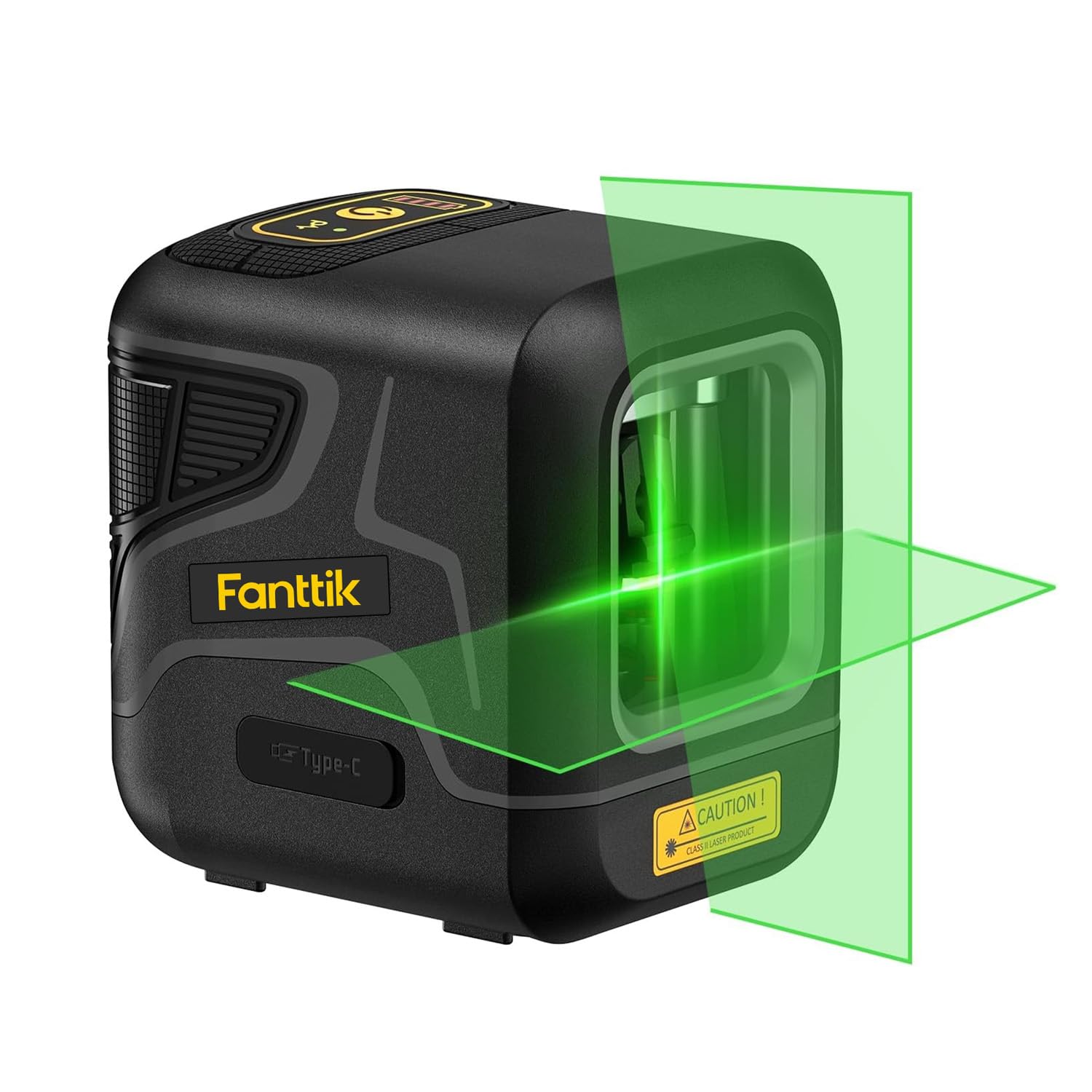
Fanttik D2 Pocket Laser Level

89 /100
Keeper Score Excellent

Key details

Beam
Green
Battery
2,200 mAh, USB-C
Runtime
Up to 10 hours
Laser Lines
Cross line (horizontal and vertical)
Check Price on Amazon

At roughly three inches square it disappears into a kitchen drawer, which is the whole argument: the D2 comes out for a row of frames, a curtain rod or a shelf, with no tripod and no case to dig out first. The 2,200 mAh battery charges over USB-C and is rated for up to ten hours, far more than a morning of picture hanging needs.

The body rotates through 360 degrees on its bracket, so you can spin the cross to line up with a picture rail without pulling the magnet off the wall — and the magnet is stronger than the size suggests, holding on a door hinge at exactly the height you want. Self-leveling is the one part that can take a second attempt to settle; give it a steady surface or a small tripod rather than a door frame and it behaves.

Pros

  • USB-C charging with up to 10 hours of runtime
  • Rotates 360 degrees on its bracket
  • Small enough to keep in a drawer
  • Magnet holds on hinges and steel

Cons

  • Pulse-mode receiver is sold separately
Our verdict

Our pocket pick — small enough for a drawer, USB-C charged, and enough cross line for a wall of frames.

Check Latest Price
6

Budget Room Coverage

IKOVWUK 3x360 Laser Level

92 /100
Keeper Score Outstanding

Key details

Beam
Green
Battery
5,200 mAh, up to 8 hours
Laser Coverage
3 x 360 degrees (1 horizontal, 2 vertical)
Self-leveling Range
Plus or minus 3 degrees
Check Price on Amazon

A remote control on a laser level at this price is easy to dismiss until the tool is up on a bracket and you want the vertical line off without climbing down for it. That, a 5,200 mAh battery rated for eight hours and an L-shaped magnetic bracket make this the value outlier at the budget end of the group.

Three planes switch independently, self-leveling covers three degrees of tilt, and pulse mode is there for outdoor work with a detector. That's a tighter self-leveling window than the CIGMAN's four degrees, so a sloped floor sends you looking for a shim sooner — the coverage itself is the same three-plane layout.

The knock is consistency. Accuracy is the thing to check on arrival, against a long spirit level or a line you already trust, and once it's set this does the work of tools costing considerably more.

Pros

  • Remote control at the budget end
  • 5,200 mAh battery rated for eight hours
  • Three planes switch independently
  • L-shaped magnetic bracket and metal plate included

Cons

  • 18-month warranty, the shortest stated here
Our verdict

A lot of three-plane laser for the money, and the one we suggest as a second unit or a first 360 for occasional projects.

Check Latest Price
7

Floors and Ceilings

Takamine GM160 4x360 Laser Level

91 /100
Keeper Score Outstanding

Key details

Beam
Green
Mounting
1/4-inch thread and rotating base
Ingress Rating
IP54
Laser Coverage
4 x 360 degrees, 16 lines
Check Price on Amazon

The fourth plane is the reason to look at this one. Alongside the ceiling-height horizontal, it shoots a line about half an inch off the floor, which is exactly what tile layout and bottom plates want — no crouching with a tape, no chalk line to snap.

Sixteen lines across four planes, IP54 sealing, a 360-degree rotating base, a 1/4-inch thread for a tripod and a remote in the case. The rotating base is the detail we appreciated most: you dial the line in by degrees instead of nudging the whole tripod and starting over.

It's a bigger, more specialist kit than the rest, and the fourth plane only pays for itself on floors and ceilings. On a wall-only job you're carrying a larger case for a line you won't switch on.

Where it earns its place is a tiling or drop-ceiling project, where that floor line saves a step on every row you set. Take it over the three-plane picks if that's your work; otherwise the CIGMAN or the Huepar get you the same alignment with less to carry.

Pros

  • Floor-level line about half an inch up
  • Four 360-degree planes, 16 lines
  • IP54 sealing and a rotating base
  • Remote control and 1/4-inch tripod thread

Cons

  • Battery life is the weak spot on long days
Our verdict

Buy this one for floors and ceilings; the fourth plane earns its keep there, and the three-plane picks here do the rest for less.

Check Latest Price
8

Gallery Walls

PREXISO Multi Surface Laser Level

90 /100
Keeper Score Outstanding

Key details

Leveling
Manual, against bubble vials
Mounting
Wall base with pins or adhesive strips
Batteries
2 AA
Laser Projection
Horizontal and vertical lines to 30 ft
Check Price on Amazon

A gallery wall in a rental is the job this was made for: two pins or an adhesive strip hold the base against the wall, and the unit projects a horizontal and a vertical line onto the surface up to 30 feet away. The angle dial runs from 15 to 75 degrees for a stair rail or a fan of frames, the vial is lit so a dim hallway isn't a problem, and the kit is two AA batteries and ten adhesive strips — nothing to charge.

For frames, shelves and curtain rods on one wall, nothing else here is this quick to stick up and use. That's the job it's for, and it does it well.

Pros

  • Pins and adhesive strips mount it to the wall
  • Angle dial from 15 to 75 degrees
  • Lit vial for dim hallways
  • Lines up to 30 ft on the surface

Cons

  • Not self-leveling
  • Marks only the surface it faces
Our verdict

The picture-hanging specialist: it puts lines right on the wall, and it's the fastest thing here for a row of frames.

Check Latest Price

How We Tested Laser Levels on Real Walls

We started by gathering every self-leveling cross-line and multi-plane laser we could find from the brands that turn up in contractor forums and home-improvement aisles, roughly 40 models, then cut the list by beam type, self-leveling range, what came in the box, and price. Anything that shipped without a mounting bracket or a case slid to the bottom. That left 12, which we bought at retail and used for nine months on actual jobs rather than on a bench.

Accuracy got checked against references we already trust: a six-foot spirit level, a chalk line snapped across a 30-foot basement wall, a plumb line dropped from a joist. We marked each laser line against those at both ends and in the middle, then repeated the check after the unit sat overnight and after a battery swap, since a beam that drifts quietly is worse than one that's visibly off. To test leveling, we nudged each unit off-level and timed how long it took to find itself again, and whether the warning beep carried over a running saw. For alignment, we rotated each one on its bracket to see whether the horizontal held or the cross wandered.

Visibility we judged in the worst light we had, a hallway with west-facing windows at four in the afternoon, noting how far back we could walk before the line disappeared, and whether it flickered once the battery dropped below half. Durability meant a truck bed, a crowded tool bag, and a drop from the second rung of a ladder. We also weighed what came in the box against the price, because a bare tool plus a bracket and a battery adds up fast.

How to Choose a Laser Level

How Many Planes Do You Need?

A cross-line laser throws one horizontal and one vertical line at whatever it faces, which covers cabinet height, chair rail, tile rows and shelf lines on a single wall. A 3 x 360 tool wraps a horizontal ring and two verticals around the room for squaring and two-wall work, and a 4 x 360 adds a floor-level line for tile and ceiling layout. More planes mean more height and setup to think about, not more accuracy.

If most of your jobs happen one wall at a time, a cross line such as the DEWALT DW088K is all the geometry the job needs. Remodeling a room or setting out a kitchen? Start at 3 x 360 and work up only if floors and ceilings are in the plan.

Red, Green and the Daylight Problem

Green reads more easily indoors, especially across a sunlit room, and every 360-degree tool in this guide uses it. Red is perfectly clear in ordinary room light — the DEWALT DW088K makes that case — but it's the first to wash out under bright conditions. Outdoors, both colors give up: in direct sun a line that's sharp at 30 feet indoors is barely there at three.

That's a planning problem rather than a defect. Look for pulse mode and a detector if the work has to go outside, and put the layout off until there's shade or an overcast morning. Nothing in this group is a daylight outdoor tool on its own.

Self-Leveling Only Covers a Few Degrees

Self-leveling is a pendulum that finds plumb for you inside a stated window — three or four degrees on these tools, which absorbs a slightly out-of-level floor and not much else. Beyond that the lines flash to tell you the tool is out of range, and waiting it out never fixes anything.

The mount is what solves it: a magnetic bracket against a steel post, a 1/4-inch or 5/8-inch thread onto a tripod, or a rotating base you can dial in. Remember that a 360 unit sitting on a table projects its ring at table height, so ceiling work wants a tripod or a bracket.

Power, Sealing and What's in the Box

Rechargeable packs have mostly replaced AA cells on the 360 tools here, with runtime claims from eight to ten hours — several sessions of picture hanging or a solid day of layout work. An existing power-tool battery platform is worth paying for: the DEWALT DW089LG runs on 12V MAX packs and shares a charger with the rest of your kit.

Ingress ratings run from IP54, which handles dust and splashes, up to IP65 for dust and water jets, and that gap matters if the tool rides in a truck. Then read the contents list: a hard case, a remote, a target plate and a mini tripod are the difference between a tool you use and one you have to build a kit around.

Frequently Asked Questions

Final Verdict

The CIGMAN CM-701 is the laser level we recommend to most people. Three 360-degree planes, a rechargeable battery and a box that includes the mini tripod and remote give you more capability than the price suggests, and the daylight limit is one every unit here shares.

Two alternatives cover the rest: the Huepar HM03CG if a five-year warranty and a hard case matter more than the extras, and the DEWALT DW088K if your work happens one wall at a time and a drop-rated cross line matters more than a third plane.