Best Headphone Amplifiers of 2026

A great pair of headphones can still sound thin plugged straight into a laptop. The fix is a headphone amplifier, but the wrong one can add hiss, clip when the bass hits, or run out of steam before your headphones do. The right amp gives clean gain, enough current for demanding headphones, and the connections you actually use without coloring the sound. Over the past six months, we've tested 12 amps—desktop DAC/amps, four-output splitters, and a portable—across my desk, a rehearsal room, and a commuter bag.

Power specs are the easiest thing to compare and the least revealing. What I listen for is whether an amp stays dead quiet at low volume, has headroom for big dynamic swings, and offers a gain setting that won't make sensitive in-ears hiss. Build matters too—jacks that grip, knobs with clean travel, and a case that stays put when you plug in—and we checked the few remotes on offer, because a remote that only half works is worse than reaching over. The picks below are the ones that stayed plugged in.

Keeper Score summarizes customer ratings and review volume. Read it alongside the product details and trade-offs. How the score works.

1

Best Overall

Fosi Audio ZH3

88 /100
Keeper Score Excellent

Key details

Inputs
USB, optical, coaxial, RCA
Outputs
4.4mm, 6.35mm, RCA, XLR
Resolution
PCM 768kHz/32-bit, DSD512
Output Power
2570mW@32Ω x2 balanced
Check Price on Amazon

Most desktop headphone amps solve one problem. The ZH3 goes after all of them: USB-C, optical, coaxial, and RCA inputs on the back, a 4.4mm balanced and a 6.35mm jack on the front, plus RCA and XLR outputs that can feed a pair of powered speakers. Put it between a computer, a TV, and a phono stage and you stop swapping cables.

The number that settled it for us is the gap between the two headphone jacks: 2,570mW into 32 ohms from the balanced output against 640mW from the single-ended one. You will never use all of that, but headroom is what stops a demanding pair of headphones from flattening out on a loud passage, and a three-position gain switch keeps sensitive in-ears off the bottom two degrees of the dial.

The tone controls are the part we expected to ignore and didn't. Bass and treble shelves with a bypass, plus six digital filters, are genuinely useful for an open-back pair that runs a touch bright off a laptop feed. There are two op-amp sockets for people who like rolling chips; ours stayed stock and we were happy.

Two things to know. There's no back button on the front panel, so anything past volume, input, and tone sends you looking for the included remote — fine at a desk, irritating if the remote disappears into a couch. And at 2.9 pounds with a 12V trigger around the back, this is furniture rather than something you move between rooms. It is also the most expensive amp here, which we think is fair for the only one that replaces a DAC, a preamp, and an amp at once.

Pros

  • Balanced 4.4mm output with serious headroom
  • USB, optical, coaxial, and RCA inputs in one box
  • Bass and treble EQ with a clean bypass
  • Doubles as a preamp for powered speakers

Cons

  • Front-panel menus lean on the remote
Our verdict

We recommend the ZH3 to anyone building a desk around one box: it drives hard headphones on the balanced jack, switches every source, and can feed powered speakers.

Check Latest Price
2

Best for Studio Sessions

Mackie HM-4

91 /100
Keeper Score Outstanding

Key details

Power
Passive, no power supply
Outputs
Four 1/4-inch, individual volume
Channels
4
Dimensions
2.3 x 4.3 x 2 inches
Check Price on Amazon

Four people, four pairs of headphones, four volume knobs, and nothing to plug into the wall. That is the HM-4's whole proposition, and after a session or two we stopped thinking about it, which is the highest compliment a utility box can earn. The case is metal, light enough that a strip of hook-and-loop tape holds it to a desk or a rack shelf.

It takes whatever your interface or mixer hands it through a 1/4-inch or 1/8-inch input and splits it four ways, each output with its own knob. Because there is no power supply, there is no wall wart to lose and no ground loop to chase, which is the usual source of hum in a room full of gear. We also like how finely the knobs are geared — you can set a level and leave it alone for the whole take.

The catch is arithmetic: a passive splitter divides what it is given, so it cannot make a quiet source louder. If your interface already drives one pair comfortably and you want four people hearing the same performance, this is the simplest route and the one most likely to still be in the gig bag in five years. If you're already near the top of the dial with one pair, buy a powered unit — the LZSIG or the ZH3 will actually add level.

Pros

  • Four independent volume knobs from one source
  • No power adapter, so no ground-loop hum
  • Metal case mounts just about anywhere

Cons

  • No master volume to pull all four channels down
Our verdict

For tracking sessions where four people need their own level, the HM-4 is the box we hand over — small, silent, and powered by nothing but your interface.

Check Latest Price
3

Best Budget Multi-Channel Amp

LZSIG 4-Channel Headphone Amp

88 /100
Keeper Score Excellent

Key details

Tone
Bass boost, stereo/mono switch
Power
12V adapter included
Outputs
1/4-inch and 1/8-inch per channel
Channels
4 (1 in, 4 out)
Check Price on Amazon

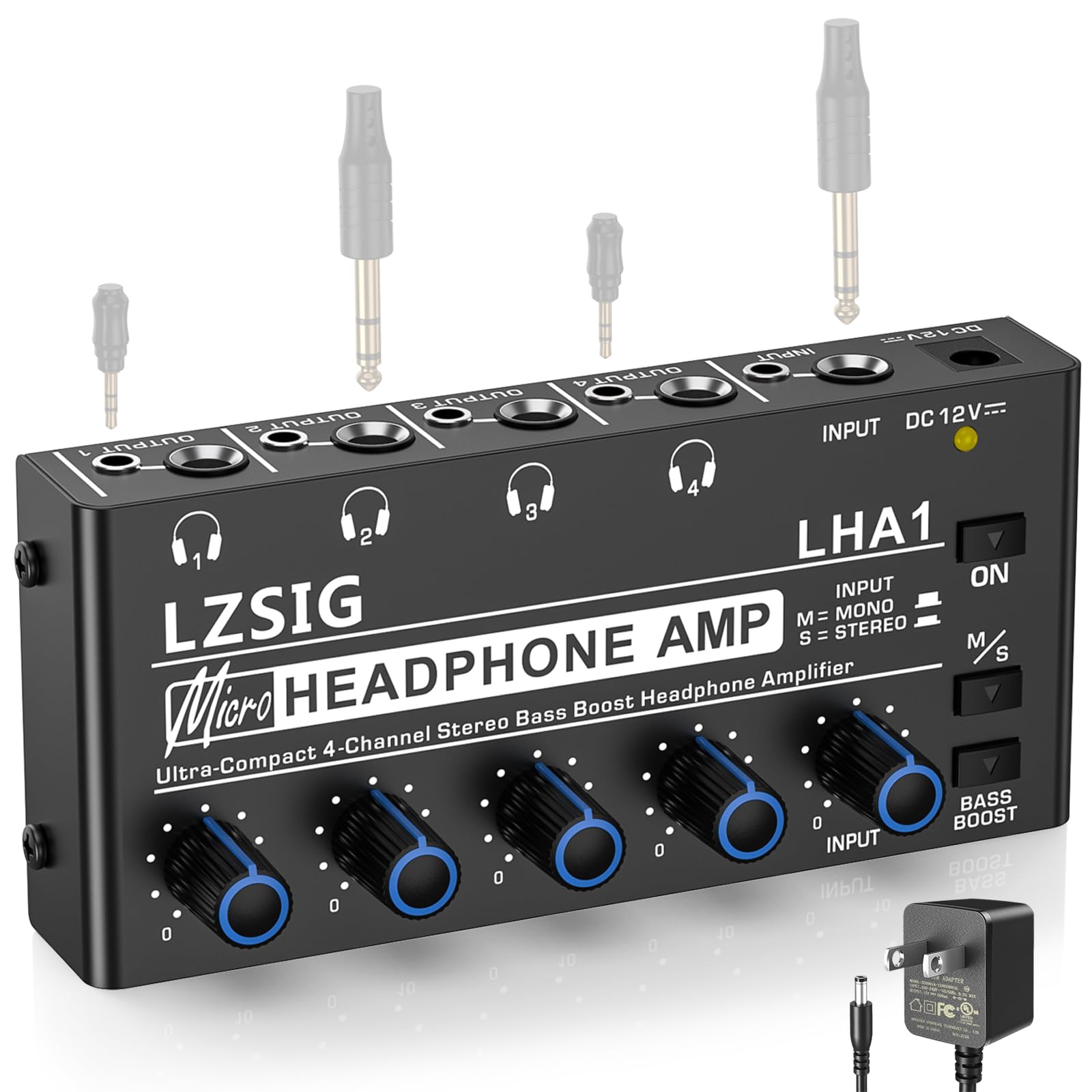
Every output on the LZSIG carries both a 1/4-inch and a 1/8-inch jack. That sounds like a small thing until you have spent a session hunting for the one 3.5mm-to-6.35mm adapter that isn't cracked, and it is the reason this is the four-channel amp we suggest first to a home studio on a tight budget.

Four knobs, four headphone outs from one input, a stereo/mono switch, and a 12V adapter in the box. The mono switch earns its place in a tracking room: a player monitoring a single channel can flip it and hear both ears instead of one. The case is metal and measures 4.13 by 2.95 by 0.98 inches at 12 ounces, so it stays where you put it.

Where it asks for patience is noise. We noticed it with sensitive in-ears and the channel knobs pushed high; run the source level up, keep the knobs lower, and it recedes to something you stop hearing between takes. For dynamic headphones at sensible levels — the actual job in most home studios — that is a fair trade for the money saved, and it is the cheapest route here to four independent levels.

Pros

  • 1/4-inch and 1/8-inch jacks on all four outputs
  • Independent volume for each listener
  • Sturdy metal case that stays put

Cons

  • Bass boost lifts upper bass and presence, not deep low end
Our verdict

The LZSIG is the one we recommend to a home studio that needs four headphone mixes cheaply — both jack sizes on every channel save a drawer full of adapters.

Check Latest Price
4

Best Budget Desktop Amp

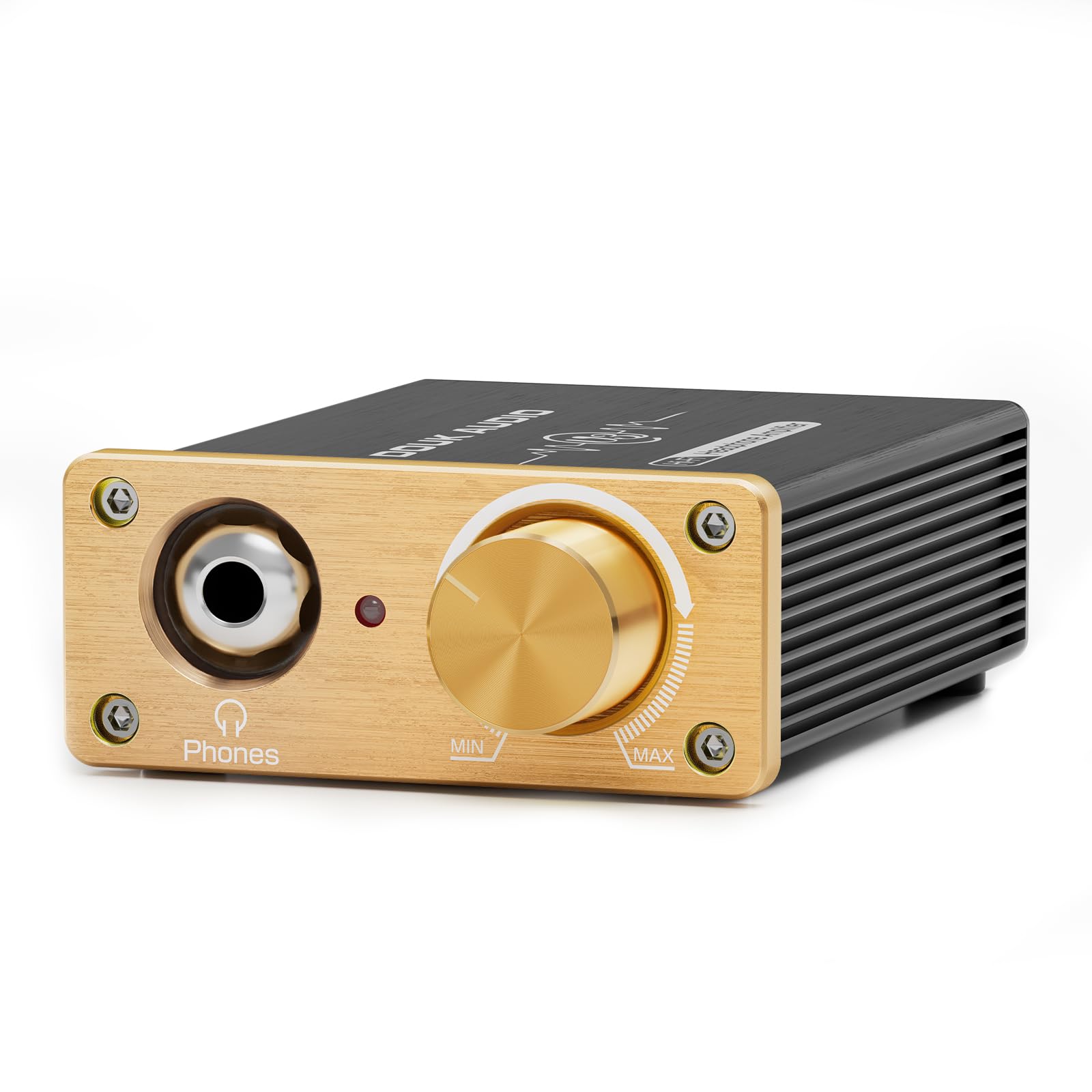
Douk Audio U3

87 /100
Keeper Score Excellent

Key details

Input
RCA line in
Power
DC 5-20V input
Op-amp
Socketed NE5532
Output Power
1300mW maximum
Check Price on Amazon

The U3 is the amp we point at headphones that are hard to drive. Its Class A output stage runs off a 26V rail generated from a 5-20V input, and it is rated for the 300- and 600-ohm staples — HD 600s, DT 880s, K701s — the pairs that make a laptop's headphone jack sound thin. It weighs 5.92 ounces, takes line-level RCA in, and offers both 6.35mm and 3.5mm outputs.

The detail that makes it more fun than it has any right to be is the op-amp socket. The NE5532 sits in a socket rather than soldered to the board, so a different chip is a swap rather than a soldering job — a rare thing at this price, and a genuine invitation to tinker with the sound signature.

One practical note that matters more than any of it: the noise floor depends on what feeds the amp. The same box on a clean 5V phone charger and on a busy computer USB port can sound like two different amplifiers. If you hear hiss, change the power source before you blame the amp — and keep the volume low when you first plug in, because it has gain to spare.

Pros

  • Class A output stage with real voltage swing
  • Rated to drive 300- and 600-ohm headphones
  • Socketed op-amp for easy swapping
  • Small enough to sit beside a laptop

Cons

  • No DAC
Our verdict

We hand the U3 to anyone with 300-ohm headphones and a line out: it is the least expensive way here to give those pairs real current, with a socket for op-amp swaps.

Check Latest Price
5

Best Value High-Power Amp

FiiO JadeAudio GIGAS 1

83 /100
Keeper Score Excellent

Key details

Power
5V USB or 12V USB-C PD
Inputs
RCA and 3.5mm
Outputs
4.4mm balanced, 3.5mm
Balanced Output
4600mW + 4600mW @32Ω
Check Price on Amazon

4,600mW into 32 ohms, twice over, from a 4.4mm balanced jack. That is a figure you expect from a desktop brick rather than a 7.4-ounce box sitting beside a keyboard, and FiiO is straightforward about how it gets there: a Class AB discrete output stage built on ON Semiconductor transistor pairs, with a USB-C PD input that accepts 12V when you supply it.

We like it best as the last link in a chain you already trust. RCA and 3.5mm inputs take a line out from a DAC, a streamer, or a mixer, and the balanced output has the current for planar headphones that make lesser amps sound strained. The 3.5mm output also passes a headset microphone through, which quietly makes this a good gaming and call amp as well as a music one.

It has no DAC of its own, so if your only source is a laptop's headphone jack, spend elsewhere — the ZH3 covers both jobs. Fed from a proper DAC, this is the most power you can buy here for the money, and the 4.4mm jack is where that advantage actually shows up.

Pros

  • 4600mW per channel from the balanced output
  • Class AB discrete output stage
  • 3.5mm output passes a headset mic through
  • Runs from 5V USB or 12V USB-C PD

Cons

  • Reaches full output only on 12V USB-C PD
  • No DAC inside
Our verdict

If you already own a DAC you like, the GIGAS 1 is the power upgrade we recommend: 4.6W a side, balanced and single-ended outs, and a footprint that disappears.

Check Latest Price
6

Best for Tone Control

Fosi Audio SK01

86 /100
Keeper Score Excellent

Key details

Battery
2500mAh, up to 6 hours
Outputs
3.5mm and 6.35mm
Enclosure
Aluminum alloy
Tone Control
3-band bass/mid/treble
Check Price on Amazon

Three knobs — bass, mid, treble — a volume dial, and a button marked Tone that takes all of it back out of the circuit. The SK01 is a small aluminum desktop amp built around the idea that most headphones don't need more power, they need a nudge in one direction.

The knobs have center detents, so flat is a place you can find by feel instead of by eye, and the tone-defeat button turns an A/B test into one click rather than a settings menu. That is the feature we didn't expect to use half as much as we do: add a little 200Hz to fatten a thin pair, hit Tone, and hear exactly what you added.

A loudness button compensates for quiet late-night listening, and the aluminum case is 4.76 inches deep — small enough to live under a monitor. There is a 2,500mAh battery inside as well, which makes it easy to move to the couch without unplugging anything.

What the SK01 cannot do is turn a headphone you don't like into one you do — a bass knob adds quantity, not texture, and no treble shelf rescues a muddy pair. What it does do is help you live with the pair you already own, on a desk, for less than the balanced amps here. That is a narrower promise than a DAC/amp makes, and for plenty of listeners it is the more useful one.

Pros

  • Three-band EQ with center detents
  • One-click tone bypass for A/B comparison
  • Loudness button for quiet listening
  • Aluminum case that fits under a monitor

Cons

  • Battery runtime can fall short of the six-hour claim
Our verdict

We recommend the SK01 to anyone whose headphones are almost right: three bands of tone control and a one-click bypass do more for a bright or thin pair than another 500mW would.

Check Latest Price
7

Pocket Volume Boost

LVY Portable Headphone Amplifier

86 /100
Keeper Score Excellent

Key details

Battery
More than 5 hours
Dimensions
3.6 x 0.5 x 1.9 inches
Connections
3.5mm in and out
Impedance Range
16-300Ω
Check Price on Amazon

The LVY is the size of a small phone, costs about as little as anything here, and runs for more than five hours a charge. It takes a 3.5mm input, gives you a 3.5mm output, and puts a two-stage gain switch and a volume knob between them — the simplest possible answer to a quiet laptop or a phone that never quite gets there.

Where it earns its keep is easy-to-drive headphones at moderate volume. It lifts a phone's output cleanly, and the two-stage switch gives you a sensible starting point whether the source is a handset or a mixer feed. Where it runs out is the hard stuff: 300-ohm dynamics and planars want more than a battery-powered pocket box can give, and turning the knob up mostly makes the noise louder.

So we treat it as a cheap fix rather than a hi-fi component. It is well built for the money, the jacks sit on top where they're easy to reach, and the two-year warranty is longer than most at this price. If you hear a whine with sensitive in-ears, try a shorter cable, a lower gain setting, and a different source before writing it off.

Pros

  • Two-stage gain switch for phone or mixer sources
  • More than five hours per charge
  • Small enough for a jacket pocket
  • Two-year warranty

Cons

  • Modest gain
Our verdict

We recommend the LVY as a cheap, pocketable lift for a phone or laptop with easy-to-drive headphones — just don't ask it to drive a 300-ohm pair.

Check Latest Price

How We Tested These Headphone Amps

We began by researching the category—reading specs, checking input and output types, and filtering out amps that lacked the connections most people need for a desktop or multi-headphone setup. From that pool, we pulled 12 units: desktop DAC/amps, compact four-output splitters, and a battery-powered portable. Testing ran for six months.

Most of that time happened at my desk, where I plugged each amp into the same laptop and DAC and listened to a handful of familiar tracks with both demanding planar headphones and sensitive in-ears. With the music paused, I turned the volume up to hear whether the amp added hiss or hum. I also pushed the gain on hard-to-drive tracks to see whether bass notes kept their shape or turned soft. Where an amp had balanced outputs, I compared them with the single-ended jacks using the same song.

In the rehearsal room, we ran four pairs of headphones from the multi-output units during a tracking session, with each listener changing their own volume while we listened for bleed between channels and for knobs that felt scratchy. The portable came on commutes and weekend trips, where I noted how long it ran, whether it made my phone stack awkward, and how much clean volume it added. We also tried bass boost and tone controls to see if they helped or muddied the mids, and used the few remotes from across the room to check volume and input changes. Build got the same attention—plugging and unplugging cables, wiggling jacks, and carrying each unit between rooms—and at the end we compared what each amp offered for the money: connections, gain flexibility, and controls before settling on the final list.

How to Choose a Headphone Amplifier

Start With What's on Your Head

Impedance and sensitivity decide the rest. A low-impedance pair with high sensitivity needs almost no power — it needs a quiet amp that won't hiss into it. A 300- or 600-ohm dynamic headphone, or a planar, wants voltage and current, and that is where a desktop box with real gain earns its keep. Look up both numbers before you shop rather than after.

A gain switch matters more than a big wattage number. The ZH3's three positions let sensitive in-ears and power-hungry planars share one amplifier without either of them living at the extreme ends of the dial, which is exactly the flexibility a single-amp household needs.

Watts, Balanced Outputs, and Headroom

Power figures are quoted into a load, usually 32 ohms, and they describe headroom rather than loudness. The ZH3's 4.4mm balanced jack delivers roughly four times the power of its 6.35mm jack, and the GIGAS 1 quotes 4.6W a side; neither number does anything for you unless your headphones need it and you own a balanced cable to plug in.

Our advice is to buy for the hardest pair you own or plan to own. Spending on a balanced output to drive easy 32-ohm closed-backs from a 3.5mm cable gets you nothing but a heavier box.

One Listener or Four

A four-channel amp is a different product wearing the same name. If two to four people need the same source at their own levels — a tracking room, a podcast setup, a shared desk — per-channel knobs are the feature that matters. Then decide whether you need gain: the Mackie HM-4 is passive, splitting whatever your interface gives it, while the LZSIG adds its own powered stage and both jack sizes on every output.

The trap is reading four outputs as four times the level. A passive splitter can leave each listener quieter than one direct connection, so a band that is already running an interface hard needs a powered unit, not a passive one.

Analog Amp, or DAC and Amp Together

Check what your source actually outputs. An analog amp like the Douk U3 takes a line-level signal and makes it bigger — feed it a noisy laptop headphone jack and you make the noise bigger too. A DAC/amp like the ZH3 takes USB, optical, or coaxial digital straight from the computer and converts it itself, which is the cleaner route if your onboard audio is the weak link.

If your source is a phone with no headphone jack, budget for the dongle that gets you a line out; the amp only amplifies what arrives.

Desktop or Pocket

Portable amps trade power and a low noise floor for size and a battery. That's the right trade for a commute, a phone, or a plane, and the wrong one for a 300-ohm pair at a desk. Battery claims are optimistic when the cell is new and worse a year in, so treat runtime as the least reliable number on the box.

Desktop units can afford proper power supplies and usually run quieter because of it — and they never need charging the night before you want to listen.

Frequently Asked Questions

Final Verdict

The Fosi Audio ZH3 is the amp we point to when someone wants to stop thinking about the chain: balanced power for hard headphones, digital and analog inputs for everything on the desk, and line outputs for a pair of powered speakers. It is the most expensive box here and the only one that replaces three.

If you already own a DAC you trust, that arithmetic changes. The FiiO JadeAudio GIGAS 1 puts most of the same balanced power behind your existing source for a fraction of the outlay, and the Douk U3 does something similar for high-impedance dynamics on an even smaller budget.