Best Godox Flashes of 2026

A flash never fails at a convenient moment. Mine have died at the end of a first dance, misfired on the one frame where the couple was looking at each other, and overheated as a reception hall hit its darkest point. A dependable flash buys you the freedom to shoot rooms you'd otherwise avoid — dim venues, basements, a backyard after sunset — without pushing your ISO into mush.

Over the past seven months, my team and I put 10 flashes through the shoots where they get judged for real: wedding receptions, evening portraits, and a lot of chasing kids and dogs at dusk. Some ran hot and stayed consistent; others drained a battery in under an hour, and one arrived dead in the box, which is a reminder that no spec sheet covers reliability.

Buyers fixate on guide number, but recycle time is what decides whether you catch the second look or miss it. The picks below run from on-camera speedlights to pocket flashes to a studio strobe, so there's a fit whether you shoot weddings solo, travel light, or build a corner studio.

Keeper Score summarizes customer ratings and review volume. Read it alongside the product details and trade-offs. How the score works.

1

Best Overall

Godox AD200 Pro II

93 /100
Keeper Score Outstanding

Key details

Heads
Two swappable
Output
200Ws
Color Stability
±100K in stable mode
Flashes Per Charge
500 at full power
Check Price on Amazon

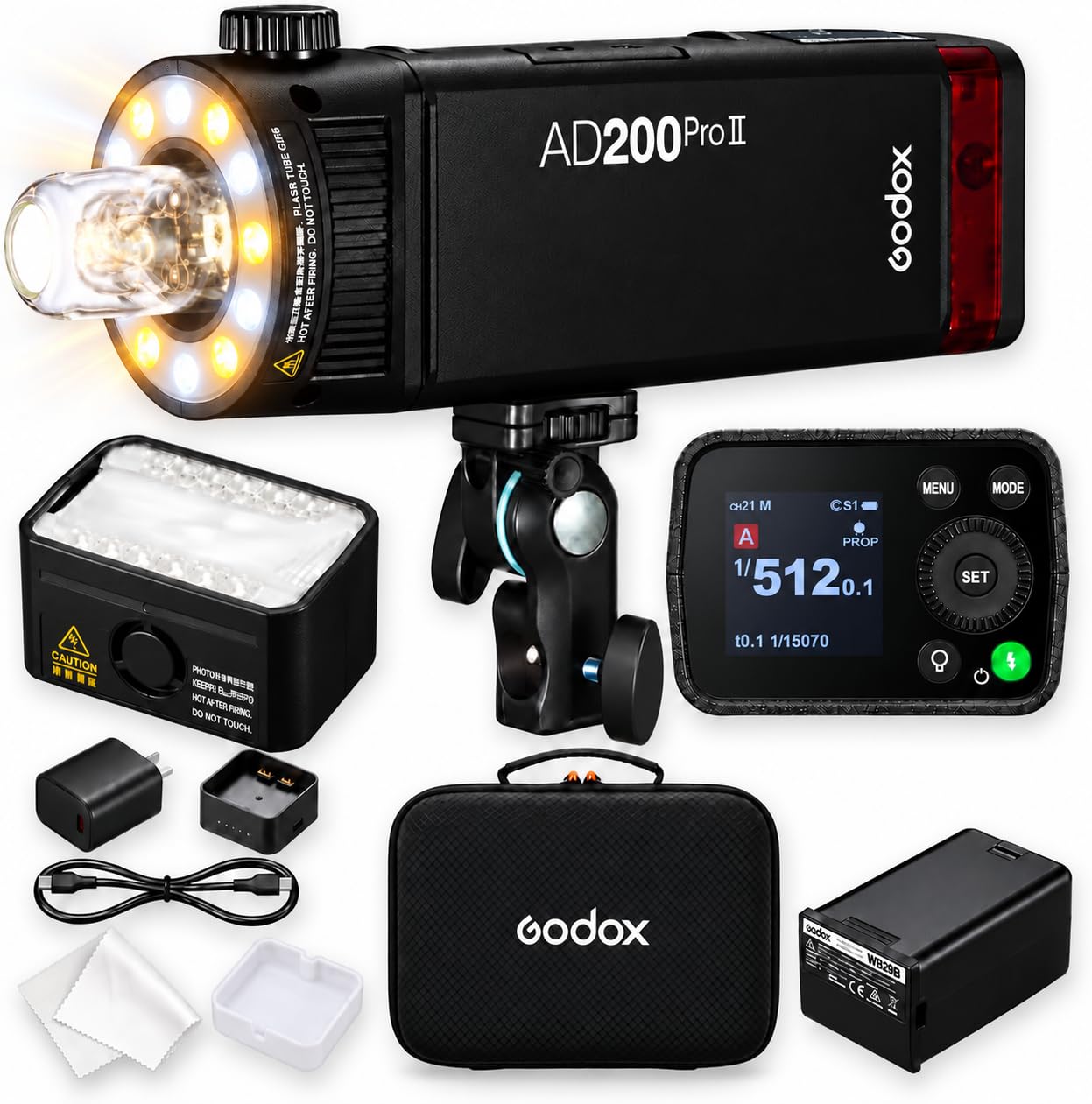
Two hundred watt-seconds is normally a monolight figure — a box that wants a stand, a mains cable and someone to carry it. The AD200 Pro II puts that output in something you can drop in a jacket pocket, and the distance between the number and the object is the whole reason it leads this list. It's the light we reach for when a speedlight has run out of headroom but a studio strobe is more than the job needs.

The kit ships with two swappable heads, and the difference between them isn't cosmetic. The bare-bulb H200J II spreads light wide, which is what you want inside a softbox or bounced off a ceiling; the fresnel H200 II throws it further and tighter for a subject across a room. Swapping is a twist and a click. Godox's reworked cooling is there to keep the head firing instead of throttling through a long sequence, and the 40W modeling lamp — adjustable in brightness and color temperature — shows you the shape of the light before you commit to it.

Everything else is the modern Godox package: TTL, HSS to 1/8000s, power in 0.1 steps from full down to 1/512, 500 full-power flashes per charge, and one-tap pairing with the X3 trigger. That last one sounds trivial until you've spent ten minutes in a menu on a cold morning. There's also a stable color mode that holds within ±100K across the power range, which is the setting to switch on the moment you're matching two or three of these rather than shooting one alone.

The practical note is that this is a light you set up, not one you carry on the camera through a reception — plan on a trigger and a bracket or stand. For portraits, real estate and location work where a speedlight keeps coming up short, nothing else here does as much in as little space.

Pros

  • 200Ws in a body you can pocket
  • Two swappable heads for soft or long throw
  • Modeling light adjustable in color and brightness
  • 500 full-power flashes per charge

Cons

  • Some units have stopped working entirely
Our verdict

If you can only own one Godox light, we think this is the one: 200Ws, two heads and TTL in something you can carry, as long as you're shooting off-camera.
Check Latest Price
2

Best Compact On-Camera Flash

Godox iT32

92 /100
Keeper Score Outstanding

Key details

Sync
HSS to 1/8000s
Weight
5.96 oz
Guide Number
GN18
Included Trigger
X5S module
Check Price on Amazon

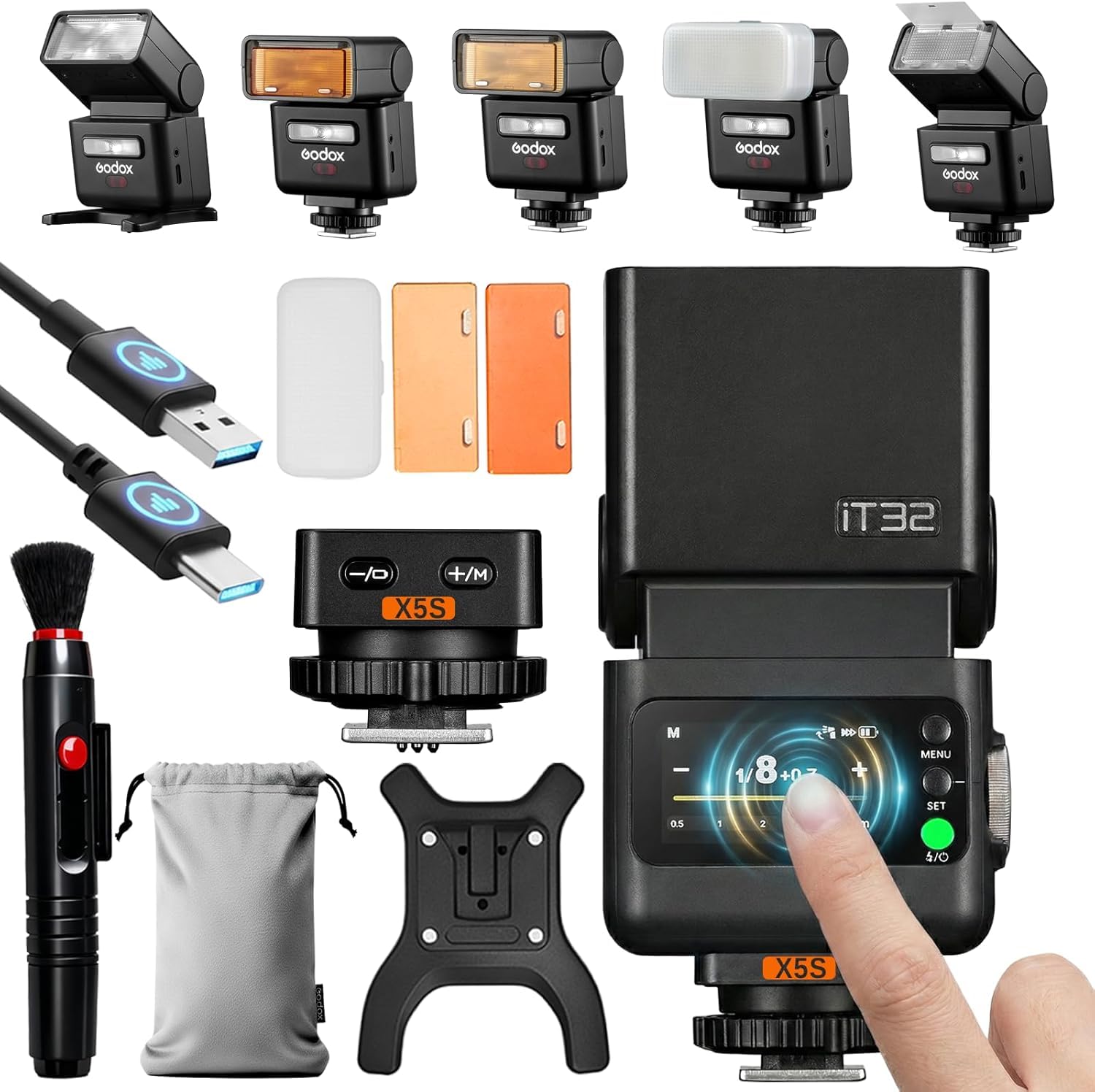
The iT32's trick is a magnetic hot shoe. Clip the X5S module on and the assembly slides onto a Sony body as an ordinary on-camera flash; pull the flash off the shoe and the module stays put, switching itself into a wireless transmitter for the light in your other hand. It's a two-piece kit doing the job of a speedlight and a trigger, and that's the reason it comes out of the bag on trips where we're counting grams.

At 169g and roughly the size of a deck of cards, it disappears — the sort of flash you carry two of without noticing. TTL and HSS to 1/8000s are both on board, the color touchscreen and select dial are quicker to work than the price suggests, and the head adjusts for bounce. We were changing power between frames without hunting for the right button by the second afternoon.

The mount lives in the X5 module, so moving to another camera system means buying a module rather than a whole new flash. And in practice we use it off-camera most: the flash sits on its magnetic mini stand on a desk or a windowsill, the module stays on the camera, and the whole rig is a two-light setup that fits in a coat pocket. That's a strange thing to get from a unit this small, and it's why it stays in the bag.

Pros

  • Hot-shoe module detaches into a transmitter
  • 169 g, small enough to carry two
  • TTL and 1/8000s high-speed sync
  • USB-C charging, no charger to pack

Cons

  • GN18 reach is modest in large rooms
Our verdict

For travel we take this over a full-size speedlight: it's a TTL flash and a wireless trigger in one tiny body.

Check Latest Price
3

Best Value Round Head

Godox V1 MID C

88 /100
Keeper Score Excellent

Key details

Output
55Ws
Zoom Range
24-105mm
Recycle Time
1.7s
Flashes Per Charge
650+
Check Price on Amazon

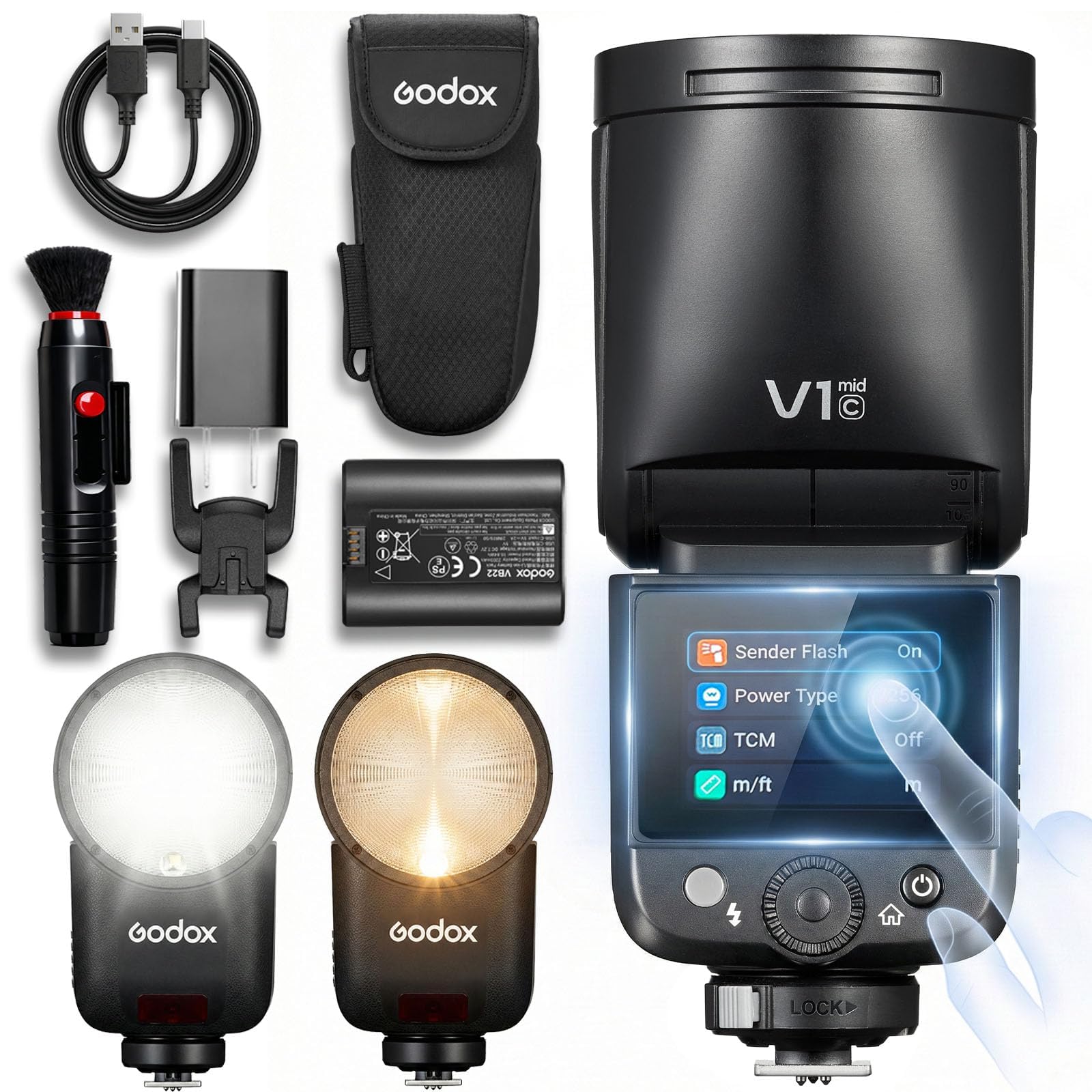
Twenty-four millimeters is where the V1 MID starts its zoom range, and if you shoot wide that figure is the entire argument. The original V1 stops at 28mm, so a 24mm lens gets a beam that doesn't quite cover the frame and you're left with dark corners to crop or retouch. Godox widened the optics here instead, and for a round head used with a wide zoom that's the difference between usable and irritating.

Round heads are why people pay for the V1 family at all: the circular beam falls off evenly instead of throwing a hot rectangle with a hard edge, so the light looks softer straight out of the flash, before any modifier. The V1 MID keeps the same head diameter as its bigger siblings, which means the magnetic AK-R1 accessories click straight on. We think this is the smart buy of the round-head group — you give up most of a stop against the V100 and keep the light quality for a good deal less.

The VB22 pack is rated for 650 full-power pops with 1.7-second recycling and charges over USB-C; on a portrait day we finished with charge left and never opened the spare. Full E-TTL II, 1/8000s HSS and the 2.4G X system are all there, so it works as a master for a bag of AD200s or as a slave behind one. It's a lot of flash for a small camera bag, and the round head is the reason it's the one we leave on the camera at a family thing.

Pros

  • Round head gives softer, even falloff
  • Zoom starts at 24mm for wide lenses
  • 650 full-power flashes per charge
  • 1.7s recycle and USB-C charging

Cons

  • Canon R50 needs the separately sold adapter
Our verdict

The round-head flash we point most people to: 24mm coverage, a full day of battery, and enough left over for a modifier.

Check Latest Price
4

Best for Weddings and Events

Godox V100 C

90 /100
Keeper Score Outstanding

Key details

Output
100Ws
Recycle Time
1.7s
Continuous Firing
70-100 full power
Flashes Per Charge
400
Check Price on Amazon

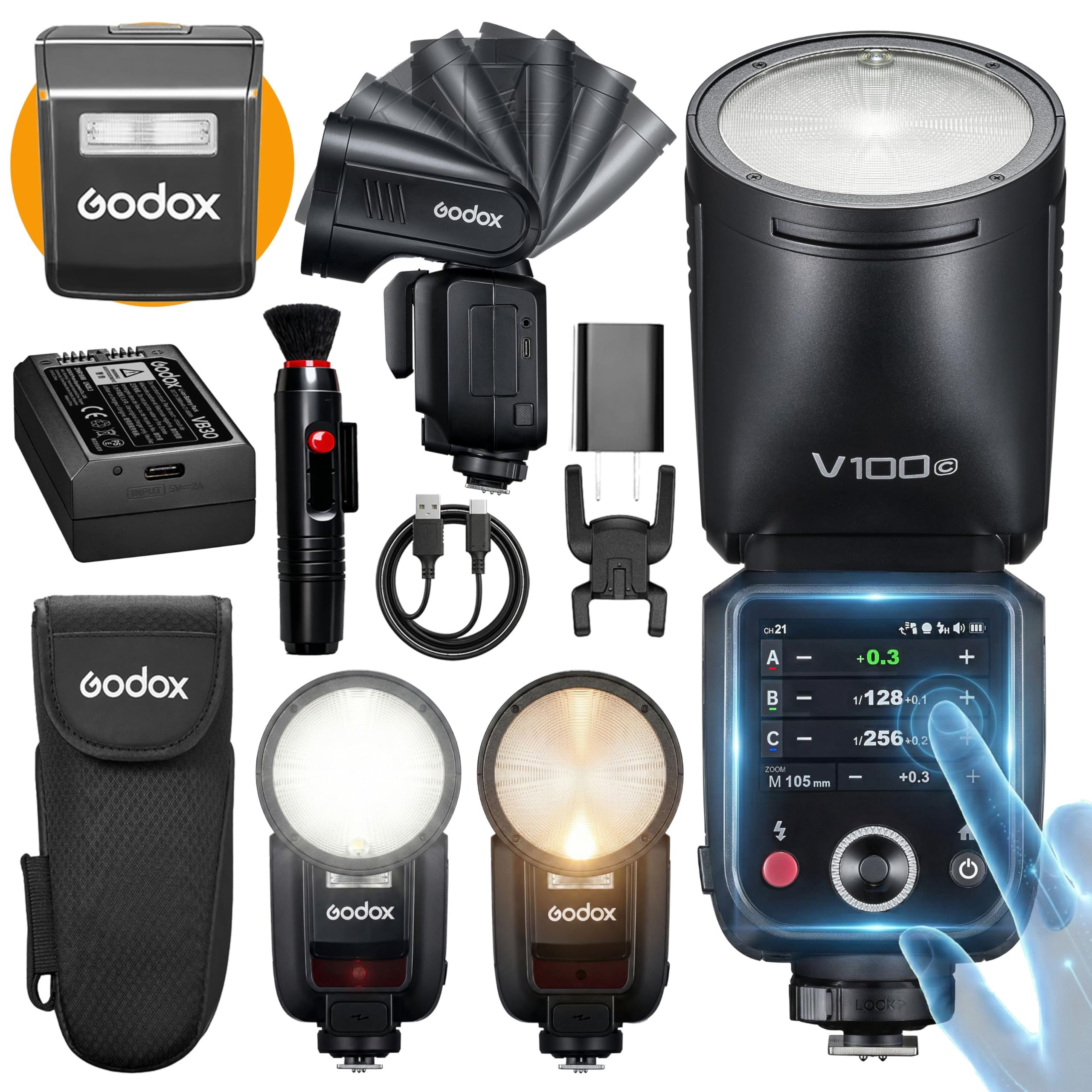
A wedding reception is a stress test. A flash that manages a handful of full-power pops before it throttles is a flash you fight with at the worst possible moment, and the V100 is built for the opposite problem: 70 to 100 consecutive full-power flashes, thanks to a reworked cooling system, so the twentieth frame in a sequence looks like the first.

At 100Ws it's the most powerful hot-shoe unit here, close to a stop up on the V1 MID, and it puts that through a round head. The detachable SU-1 sub-flash is the more interesting piece: it clips to the front and fires forward while the main head bounces off a ceiling, which fixes the flat, shadowless look of straight bounce without adding a second light. We expected a gimmick and got something we reach for on almost every indoor frame.

The VB30 pack is removable, and that's the point of it — a charged spare goes in a pocket and the swap takes seconds, instead of hunting for a socket between speeches. 400 full-power flashes per charge, 1.7-second recycling, and a 2.3-inch touchscreen that turns a move from TTL to manual into a tap rather than a scroll.

Compare it with the AD200 Pro II, which costs about the same. The AD200 gives you 200Ws and a bare bulb off-camera; the V100 gives you TTL on the camera and a sub-flash. If your work is fast, on-camera and indoors, this is the more useful of the two. If you're building a kit around stands and modifiers, the AD200 buys more for the same money.

Pros

  • 100Ws through a round head
  • Detachable SU-1 fill while the head bounces
  • Replaceable VB30 pack with 400 flashes per charge
  • 70-100 consecutive full-power pops

Cons

  • 616 g on a hot shoe wears on you
Our verdict

Event shooters who can't miss a frame should start here; the 100Ws output and the cooling to keep using it are worth the carry.

Check Latest Price
5

Best Budget Off-Camera Light

Godox TT600

92 /100
Keeper Score Outstanding

Key details

Batteries
4 AA
Guide Number
GN60
Recycle Time
0.1-2.6s
Flashes Per Charge
230 at full power
Check Price on Amazon

There's no TTL here, no automatic metering, no exposure magic — you set the power yourself, and that is exactly why the TT600 is the flash we tell people to buy in multiples. GN60 is serious output, the Godox 2.4G receiver is built in, and any X-system trigger on the camera will fire a bag full of these at once.

Off-camera, manual is no hardship: you're already metering and adjusting, and one power setting usually does for a whole setup. On-camera at a moving event it's another story, because you'll be dialing power between frames while the moment walks past. That's the trade, and it's the right one for a light that spends its life on a stand.

Recycling runs 0.1 to 2.6 seconds and four AA cells are good for around 230 full-power pops. AA is a feature when there's no socket for miles and a nuisance when you're changing cells mid-shoot, so we pack a spare set and swap all four together. Ours do the jobs nobody photographs: rim, background, a hair light. Two of these cost less than one of the round-head flashes here, which is the whole argument.

Pros

  • Cheapest way to add real off-camera light
  • Built-in 2.4G receiver works with any X trigger
  • 230 full-power flashes on four AA cells
  • 0.1-2.6s recycling

Cons

  • Manual only: no TTL metering
  • No battery level indicator
Our verdict

Buy two. This is the cheapest way into a real off-camera kit, provided you're happy setting power by hand.

Check Latest Price
6

Best Studio Strobe

Godox MS300V

91 /100
Keeper Score Outstanding

Key details

Mount
Bowens
Output
300W
Guide Number
GN58
Modeling Lamp
150W LED
Check Price on Amazon

Everything else on this page runs on a battery and goes in a bag. The MS300V plugs into a wall, weighs about 1.3kg net, and expects to live on a stand in one room — and that's the point. 300W through a Bowens mount is a different order of light from any speedlight here, and it costs less than every round-head unit on this list.

It's manual. You set power on the unit or from an X2, XT16, XPro or X1 trigger, and you shoot at or below your sync speed. Output holds within 2% across a long session, which is the figure that matters when you're matching three of these over a day of portraits and can't have the key light drifting. The 150W LED modeling lamp is bright enough to focus by with the room lights down, and the Bowens mount opens up every softbox, beauty dish and grid you already own.

One thing to check before you load a big modifier: the umbrella clamp's top screw is the part that has let people down, so give it a look and don't hang a large box off it without thinking. Otherwise this is the most straightforward recommendation in the article — a photo booth, a spare-room studio, or a second light for a setup you don't want to rent for, at a price that makes buying a pair reasonable.

Pros

  • 300W through a Bowens mount
  • 150W LED modeling lamp
  • Output holds within 2% over long sessions
  • Remote power control from X-system triggers

Cons

  • No HSS, so outdoor fill is out
Our verdict

A home studio or a photo booth makes obvious sense of this one: 300W through a Bowens mount for less than the round-head speedlights here.

Check Latest Price
7

Travel and Macro

Godox iM20

86 /100
Keeper Score Excellent

Key details

Weight
1.09 oz
Charging
USB-C
Max Sync
1/200 or slower
Flashes Per Charge
440 at full power
Check Price on Amazon

Thirty-one grams. That's the pitch: a flash light enough that you forget it's in the bag until you want it. It slides into a hot shoe, charges over USB-C like a phone, and the built-in battery is rated for 440 full-power pops, which is a lot of fill from something that disappears into a jacket pocket.

Macro is where it earns its place for us. A bare on-axis pop a few inches from a flower or a coin is exactly the light a full-size speedlight makes awkward — the iM20 sits low, throws a small circle, and you can hold it in your left hand while your right hand shoots. It's also the flash that goes on the trip that isn't about photography: a bit of fill on a face at dusk, a record of a plate at a table.

The rest is honest arithmetic. It's manual, with five levels and a shutter speed of 1/200 or slower, so you set output by eye and check the back of the camera. That's not a compromise at close range; it's just how the light works. It fills a frame — it doesn't light a room — and nothing else here does the first job while weighing nothing.

Pros

  • 31 g, disappears in a pocket
  • 440 full-power pops from a built-in battery
  • USB-C charging, no dedicated charger
  • Small beam suits macro and close fill

Cons

  • Single-contact shoe, and several popular bodies are excluded
Our verdict

Keep one in a jacket pocket for macro and travel fill: tiny, USB-C charged, and manual enough that you set it by eye.

Check Latest Price
8

Retro-Style Bodies

Godox Lux Master

88 /100
Keeper Score Excellent

Key details

Weight
1.04 lb
Battery
Built-in 2980mAh
Guide Number
GN25
Flashes Per Charge
460
Check Price on Amazon

The Lux Master is built around a crinkled metal reflector, fan-shaped, and it looks like it came off a press camera from 1955. The light matches the styling: broad, slightly imperfect, with a falloff a fresnel speedlight can't imitate. You buy this one partly because of how it looks on a retro body, and there's no point pretending otherwise.

Underneath the styling it's a proper flash. TTL, HSS, a built-in 2.4G receiver so an X3 or XproII fires it off-camera, a 7.2V 2980mAh pack rated at 460 full-power pops, and USB-C charging. It also works as a stand-alone strobe on a light stand, triggered from the X system, which is more than the look implies.

Handling is the compromise. At 470g it sits high on a hot shoe and changes the balance of a small body, and the reflector makes it fussier to pack than a compact speedlight. It's also the flash people notice, which at a wedding is either the point or the problem.

Set it beside the V1 MID and the arithmetic gets awkward: the V1 MID is a more capable flash in almost every measurable way, for less. What the Lux Master has is character and a quality of light you can't dial in on a touchscreen. Buy it because you want that, not because you need the specification. We're glad Godox made it.

Pros

  • Reflector gives a soft, distinctive falloff
  • TTL, HSS and a 2.4G receiver built in
  • 460 full-power flashes from a built-in pack

Cons

  • GN25 limits it to close-range fill
  • A few have stopped working or refused to charge
Our verdict

Nobody needs this one, and we're glad it exists: it turns a retro body into a rig people stop and ask about, and it's a competent TTL flash underneath.

Check Latest Price

How We Tested: Ten Flashes, Seven Months, Real Rooms

We shortlisted every flash in this category that offers TTL, high-speed sync, and wireless triggering, then cut anything that couldn't justify its price against the rest. Customer reviews steered the process as much as specs did — repeated complaints about dead-on-arrival units and battery doors that quit after a season pushed reliability to the top, ahead of guide number. Ten units made the cut, and we've lived with them for seven months.

Testing happened where flashes actually work: a rented hall with 20-foot ceilings and almost no ambient light, an evening portrait session in a park, a home studio with one softbox, and the bottom of a camera bag on a travel day, where weight and footprint started to matter by hour four. Two of the on-camera units went to a wedding reception and a family birthday, where I handed them to a second shooter with no instructions and watched how long it took to change power in the dark.

In the studio we fired 20-frame bursts at full power and timed the gaps with a stopwatch until each unit throttled, and we counted full-power pops on a single charge until the head got too hot to hold. For high-speed sync we shot a subject in open sun at a wide aperture and checked for banding across the frame; for TTL we metered a white shirt and a dark jacket in the same shot to see which one blew out. Wireless range got tested by walking a trigger down a hallway and behind a wall until the flash stopped firing, and build quality meant a dozen mounts on and off a hot shoe plus battery doors worked until they felt loose. Two units misfired or arrived faulty in the first week and were cut.

How to Choose a Godox Flash

On-camera or off-camera comes first

An on-camera flash has to keep up with you: TTL metering, fast recycling, a head that tilts for bounce, and enough capacity to finish an event. An off-camera light can be simpler and more powerful, because you set it once and leave it. Event photographers who move constantly should put the budget into a round-head TTL unit like the V100 or the V1 MID. If you build a look with stands and modifiers instead, the AD200 Pro II will do more for you than any speedlight here.

The mistake is buying the most powerful light you can afford and then discovering it only does half the job you needed. Two modest lights on stands usually beat one expensive one on the camera.

Match the version to your camera

Godox sells the same flash in Canon, Sony, Nikon and Fuji mounts, and the suffix is the only thing that changes — the V1 MID C is the Canon version, while the iT32 kit ships with the Sony X5S module. Fit the wrong one and the flash still fires, but TTL and HSS misbehave. The trap is a camera with a new-style hot shoe: the Canon R50 and similar bodies need an adapter before a standard Godox foot will talk to them. If you shoot two systems, put a Godox trigger on each camera and let the flash stay brand-agnostic.

Read output in the right currency

Guide numbers and watt-seconds measure different things and don't convert into each other. A GN60 speedlight hits that figure at its longest zoom setting, so at 24mm it throws a good deal less than the box suggests — which is why the round heads here quote a zoom range alongside their output. Watt-seconds describe stored energy in a strobe, and the 200Ws of the AD200 Pro II or the 300W of the MS300V are a different class of light from any hot-shoe unit on this page.

Head shape matters as much as the number. A round head falls off evenly and looks softer with no modifier; a fresnel throws further for the same output but gives you a harder circle to control.

Recycle, heat, and the number that matters

Lithium packs changed speedlights: 400 to 650 full-power flashes per charge and recycling around 1.5 seconds, with a pack you can swap in seconds. AA flashes like the TT600 cost less and are easy to feed far from a socket, but you'll change cells more often. The figure that separates a good event flash from a frustrating one is consecutive full-power firing — a head that throttles after twenty pops will let you down at the end of a first dance. Cooling and a replaceable pack are worth paying for.

Budget for what holds the light

The flash is rarely the last thing you buy. A pocket flash like the AD200 Pro II wants a bracket or a stand and a trigger; a round head wants a modifier, and the magnetic Godox accessories are usually sold separately. A studio strobe like the MS300V needs a stand rated for its weight and a Bowens-fit softbox. Add that lot to the total before you compare two flashes on price, because a cheaper light that needs a bracket you don't own isn't cheaper.

Frequently Asked Questions

Final Verdict

The AD200 Pro II is the one we point most people to, because it covers the widest range of jobs: small enough to carry to a location, powerful enough to fill a softbox, and supplied with two heads that do different things. The trade is that it's a light you set up rather than one that rides the camera through a reception.

If that's your job, the V100 C is the event flash and the V1 MID C is the smarter buy for portraits and family work. Decide which of those photographers you are and the rest of the list sorts itself out.