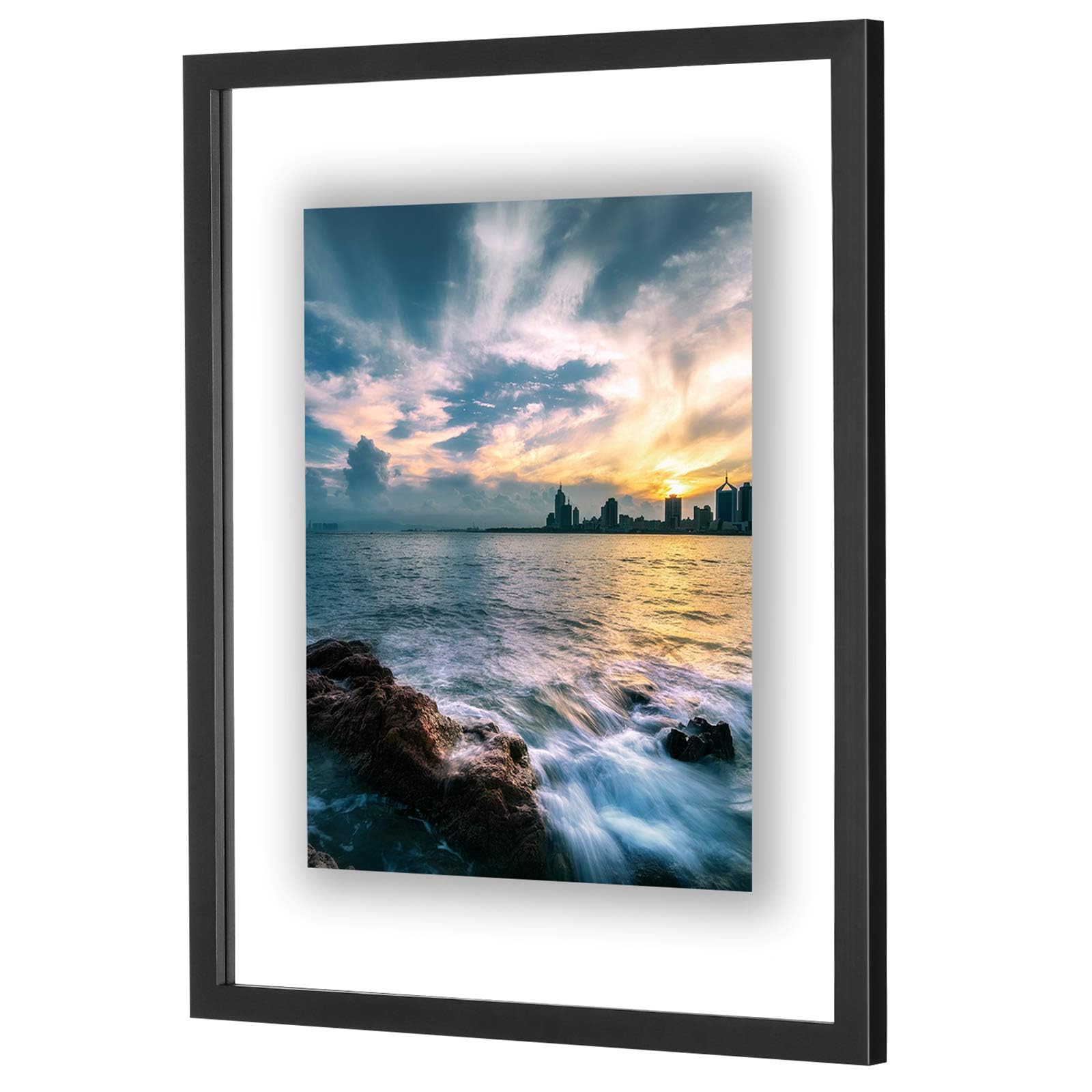
Best Floating Picture Frames of 2026

A floating frame pulls off a quiet trick: two panes of glass or acrylic with a gap between them, holding a photo smaller than the opening so it seems to hover in midair. Done well, an ordinary snapshot suddenly looks like it belongs on a gallery wall. Done badly, the print slides sideways the first time someone bumps the hallway.

I've reframed the same six photos more times than I care to admit, and the frames that survive are the ones that went up in one afternoon and never needed adjusting again. Over the past six months my team and I have lived with 12 of them — hung on walls, propped on dressers, standing on a desk — and the good ones share a few traits.

One thing first-time buyers rarely expect: most floating frames hold a range of photo sizes, so an 8x10 opening might float a 5x7 or a 4x6. Pick your print after you understand the gap, because a photo that sits too close to the inner edge stops reading as floating at all. What follows is what held up.

Keeper Score summarizes customer ratings and review volume. Read it alongside the product details and trade-offs. How the score works.

1

Best Overall

Americanflat 8x10 Floating Frame

93 /100
Keeper Score Outstanding

Key details

Cover
Glass
Display
Wall or tabletop
Frame Size
8x10
Floated Photo Sizes
5x7 or 4x6
Check Price on Amazon

An 8x10 frame holding a 5x7 print leaves a border of empty space on all four sides, and that gap is the entire effect — the photo reads as suspended rather than matted. Americanflat does it with a slim black engineered-wood molding and a glass front, and it costs less than anything else here. We recommend it first because it is the only frame in this set that gives you a detachable easel and wall hardware in the same box, so the same frame can sit on a mantel this month and hang in a hallway the next.

The panes fit snugly in the molding, which is why the frame feels solid rather than flimsy in the hand, but it also means loading a print takes a minute of care: the glass binds slightly as you lift it out, and you want the photo centered before you set it back down. Two pounds is light enough for the supplied hanger, though a stud or a rated anchor is the safer choice if the wall gets knocked.

The number that catches people out is the size. This is an 8x10 frame that takes 5x7 and 4x6 prints, not a full 8x10 photo, so the print you already own needs to be a size smaller than the frame you order. Chips and fine scratches on the pane are the weak point of the design in transit, so open the box over a table and look at the glass before the return window closes.

For a first floating frame, or a row of them down a hallway, that is an easy trade. Black molding disappears against most walls, the float gap suits a landscape print as well as a portrait one, and the included hardware means you are not buying an easel separately.

Pros

  • Floats a 5x7 or 4x6 inside an 8x10
  • Easel and hanging hardware both included
  • Real glass at the lowest price in this set
  • Slim black molding suits almost any room

Cons

  • Print must be smaller than the frame size
  • Glass can arrive chipped or scratched
Our verdict

Our default pick: the least expensive frame here, and the only one that floats a 5x7 in an 8x10 with both an easel and hanging hardware included.

Check Latest Price
2

Best for Desks and Shelves

AhaGo Gold Floating Frame

92 /100
Keeper Score Outstanding

Key details

Cover
Double-sided glass
Display
Tabletop only
Frame Size
8x10
Floated Photo Sizes
7x9, 6x8, or 5x7
Check Price on Amazon

Gold frames are usually where a room starts looking cheap, and this one does not. The finish is a high-gloss metal, the molding is thin, and a small print inside it reads as something a framer put together. It floats a 7x9, 6x8, or 5x7 print inside an 8x10, so the border is generous rather than hairline, and the double-sided glass means the reverse of whatever you framed is visible too.

We like it best on a console table or a shelf people walk past rather than a wall, because a wall placement wastes that second pane and shows the back of your print to the room. Put a two-sided card or a print with a finished reverse in it and the design finally makes sense.

There is no hanging hardware in the box, and the frame is set up for portrait orientation, so it is not the one for a wide landscape shot or a gallery wall. What the box does include is better than we expected at this price: cotton gloves, a cleaning cloth, and a small tool for opening the frame, which is the difference between a first print that goes in clean and one with fingerprints behind the glass.

Set it somewhere with a little air around it and the thin gold profile does its best work, reflecting a window or a lamp. Crowd it against a wall and you have paid for a second pane you will never see.

Pros

  • Gold finish looks far more expensive than it is
  • Double glass suits a two-sided card or print
  • Floats a 7x9, 6x8, or 5x7 print
  • Gloves, cloth, and opening tool included

Cons

  • No hanging hardware; tabletop use only
  • Portrait orientation only
Our verdict

A gold metal frame that makes a small print look like a gallery piece, as long as it lives on a shelf or console, because there is no hanger.

Check Latest Price
3

Best Set for Gifting

MUYE 5x7 Floating Frame Set

89 /100
Keeper Score Excellent

Key details

Cover
Double glass
Frame Size
5x7
Pack Count
Set of 2
Floated Photo Sizes
3x5, 4x6, or full 5x7
Check Price on Amazon

Two frames, two pairs of cotton gloves, a mini level, a glass wipe, hanging brackets, and a tape measure: the box reads like someone actually thought about what hanging a frame involves. The frames themselves are a natural, lightly textured wood with glass on both faces, each holding a 5x7, 4x6, or 3x5 print, and each with an easel back for a shelf.

We rate the kit above the frames themselves. A level and a tape measure turn hanging a pair into one job instead of three, and the gloves mean you are not chasing fingerprints off the inside of the glass afterwards. It is the rare case where the accessories are the reason to buy.

The compromise is in how the panes sit. The glass slides into the frame rather than being clamped, so a print can drift off center while you set the second pane in place. Position it, close the frame, and check the gap on all four sides before it goes anywhere near a nail. Thin glass is the fragile part of the design, so unwrap and inspect both frames before you wrap one as a gift.

Two framed 5x7s for close to the price of one of the single frames here is the other argument, and it is a good one if you have a pair of photographs in mind rather than a single hero print.

Pros

  • Two frames plus gloves, level, wipe, and hardware
  • Double glass floats 3x5 and 4x6 prints
  • Hangs on a wall or stands on an easel
  • Warm natural wood finish

Cons

  • Loose panes let the print drift while loading
  • Thin glass is the fragile part
Our verdict

Two double-glass 5x7 frames with a hanging kit complete enough to use straight from the box, which makes them the pair to give as a gift.

Check Latest Price
4

Best for Gallery Walls

AITEE Acrylic Frames 4-Pack

90 /100
Keeper Score Outstanding

Key details

Cover
Clear acrylic
Mounting
Wall, stainless hardware
Frame Size
8.5x11
Pack Count
Set of 4
Check Price on Amazon

Clear acrylic does something glass cannot: with no molding at all, four of these on a wall read as prints pinned in mid-air rather than framed pictures. Each 8.5x11 panel is held off the wall on stainless standoffs, and the print sits suspended with nothing but clear edge around it.

The catch is the film. Every face ships with a protective sheet, and peeling it is the slowest part of the job. Start at a corner, work slowly, and do not reach for a blade, because a scratch in acrylic is permanent. Budget the film for all four frames before you start mounting anything, or you will be doing it at the end with the hardware already on the wall.

That is the trade for a grid. With no visible frame, the spacing between panels becomes the only design decision, and matching spacing across four frames is far easier when the frames are identical. The clear edges almost vanish at the end of a hallway or above a low sofa, where the wall color runs behind them.

It is the priciest option here by a wide margin and it only comes as a four-pack, so we hold it back for anyone hanging one or two prints. Hanging four, though, the per-frame cost stops being the story, and the consistent spacing is what you are actually paying for. Stainless mounting hardware comes in the box, which is worth having if the wall in question is in a bathroom or a covered porch.

Pros

  • Four 8.5x11 panels in one box
  • Frameless acrylic leaves the print edges clear
  • Consistent spacing for a gallery wall
  • Stainless mounting hardware included

Cons

  • Protective film is slow to peel off
  • Acrylic scratches and cannot be polished out
Our verdict

Four frameless acrylic panels that turn a blank wall into a clean grid of prints, and the pick when a single frame is not the point.

Check Latest Price
5

Best Oversize

ONE WALL 16x20 Floating Frame

87 /100
Keeper Score Excellent

Key details

Cover
Double tempered glass
Frame Size
16x20
Frame Material
Solid wood
Floated Photo Sizes
11x14 or full 16x20
Check Price on Amazon

Sixteen by twenty is a different job from the 8x10s that make up most of this list. At that size a frame stops being an object hung on a wall and becomes part of the wall, which is why the material starts to matter more than the styling. This one is solid wood with tempered glass on both faces, and it floats an 11x14 inside the opening or holds a full 16x20 edge to edge if you want it filled.

Tempered glass is the detail we care about most. A standard pane at this size is heavy and breaks into dangerous shards; tempered glass takes a knock better and breaks more safely, which is what makes a big frame something you can hang at eye level in a hallway without worrying about who walks past it.

A 3 kg frame wants a stud or a rated anchor, and the box gives you options: a bubble level, seamless nails, steel nails, and wire support. The level is the part we appreciate most, because at 16x20 a slight tilt is visible from across the room in a way it never is on a small frame. There is an easel back as well, so the same frame can lean on a sideboard instead of being hung, which is the friendlier choice in a rental.

An 11x14 print floating in that much empty space is a lot of air, and that is the point: the print reads as an object rather than a picture. A full-bleed 16x20 inside it does the opposite job and looks like a poster, which is fine if a poster is what you want.

Pros

  • Floats an 11x14 inside a 16x20
  • Tempered glass front and back
  • Solid wood molding
  • Level, nails, and wire support included

Cons

  • At 3 kg it needs a stud or rated anchor
Our verdict

The pick when the wall needs something big: solid wood, tempered glass on both faces, and an 11x14 floating inside a 16x20.

Check Latest Price
6

Double-Sided Desk Display

B&NN Acrylic Desktop Frame

90 /100
Keeper Score Outstanding

Key details

Cover
Two 3mm acrylic blocks
Display
Tabletop only
Frame Size
8.5x11
Check Price on Amazon

A certificate, a menu, a print you want to see from either side of a desk: the two-panel acrylic block is the cheapest way here to stand something up and have it visible from both faces. Two 3mm acrylic blocks join at the corners, holding an 8.5x11 sheet between them with nothing but clear edge around it.

Two things to know before ordering. The panels touch the print, so anything with texture or a curl shows a ripple through the acrylic, and a sheet printed on thin paper will look it. And the protective film on each face is genuinely tedious. It comes off in fragments; work at a corner with a fingernail, give it time, and never use a blade, because scratching the acrylic while you peel is the one mistake you cannot undo.

Assembly is a handful of posts and a few minutes with a screwdriver, and the result is a frame that disappears. On a shelf of books or a desk with a monitor on it, that is the point: a black or gold molding would be the loudest thing in the arrangement.

It is a desktop object, full stop. Nothing to hang it with, no easel to fold away, and no provision for a wall. For a desk that is exactly right; for a hallway it is the wrong purchase entirely.

Pros

  • Two 3mm acrylic panels hold an 8.5x11 sheet
  • Print is visible from both sides
  • Clear edges almost disappear on a shelf
  • Cheapest pick in this set

Cons

  • Protective film takes patience to remove
Our verdict

The least expensive way here to stand a print on a desk and see it from both sides, as long as you have patience for the film.

Check Latest Price
7

Pressed Flowers

Frametory 11x14 Floating Frame

87 /100
Keeper Score Excellent

Key details

Cover
Glass front, plexiglass back
Display
Wall or tabletop
Frame Size
11x14
Floated Photo Sizes
8x10, 5x7, or 4x6
Check Price on Amazon

Real glass in front, plexiglass behind, and a small tube of dot glue in the box: that combination tells you what this frame is for. Pressed flowers, a dried leaf, a thin print that will not stay put. You glue the item to the back panel, the glass front holds the float gap, and nothing slides down the pane.

The 11x14 opening takes an 11x14 print edge to edge with no float, or an 8x10, 5x7, or 4x6 with a generous border, which makes it the most flexible single frame here on print size. Gold aluminum keeps the profile slim, and it hangs on a wall or stands on a tabletop with the easel back.

The limit is thickness. Anything that stands proud of the back panel presses against the glass or bows the frame, so tickets, thick card stock, and anything dimensional belong in a shadow box instead. The glass itself measures 10.7x13.7 inches, so a full-size print sits under a narrow band of aluminum — a detail you will either like or object to.

For pressed botanicals this is the frame we point people to first: the plexiglass back accepts glue, the glass front protects the petals, and the included glue means you are not fighting a flower that wants to travel. Just plan the arrangement on the backing before anything sticks, because dot glue does not offer second chances.

Pros

  • Real glass front with a plexiglass back
  • Dot glue included for pressed botanicals
  • Floats an 8x10, 5x7, or 4x6 print
  • Slim gold aluminum profile

Cons

  • Flat, thin items only
  • Back panel is plexiglass, not glass
Our verdict

The frame for pressed flowers and thin artwork: real glass in front, a plexiglass back you can glue to, and the glue in the box.

Check Latest Price
8

Kids' Art Walls

Ludery Acrylic Frames 6-Pack

87 /100
Keeper Score Excellent

Key details

Cover
Acrylic
Mounting
Self-adhesive, no drilling
Frame Size
8x10
Pack Count
Set of 6
Check Price on Amazon

Six 8x10 acrylic panels that stick to the wall with 3M tape, no drill, no screws, no tools. For a wall of kids' artwork, a classroom, or an office where you cannot put holes in anything, that is a different product from everything else on this list. Each panel is a clear sheet with a photo slid in behind it, so nothing frames the print but a clear edge.

The tape is the whole design and also the thing to think about. It holds firmly, firmly enough that you want to decide the layout on the floor first, because once a panel is pressed on, moving it is a job. Warm the adhesive with a hair dryer and work a length of dental floss behind the panel if you need to relocate one.

Acrylic rather than glass is the right call here. The panels weigh almost nothing, they do not shatter if a child pulls one down, and they are clear enough that a crayon drawing looks better in them than it has any right to. The trade is that acrylic marks: wipe with a soft damp cloth and never a dry paper towel.

Six frames for the money of a couple of the framed options here makes this the volume choice — a nursery wall, a stairwell of family photos, a classroom display. Buy them for a wall you plan to keep, put them up in an afternoon, and they will do the job that a shelf of unframed prints will not.

Pros

  • Six 8x10 frames in one set
  • 3M tape means no drilling or tools
  • Light acrylic is safer around children
  • Sticks to doors, glass, tile, and painted walls

Cons

  • Adhesive can lift paint on removal
  • Vertical orientation only
Our verdict

Six frameless acrylic 8x10s that stick to almost anything without a drill, which makes them the practical pick for a wall of kids' art or a rental.

Check Latest Price

How We Tested the Best Floating Frames

We started with a list of roughly 40 frames from brands we'd bought before and ones that kept turning up in customer reviews, then narrowed it to 12. The cuts came down to the sizes people actually print (8x10, 8.5x11, 11x14, 16x20), whether the frame could hold more than one photo size, the panel material, and whether mounting hardware came in the box or had to be bought separately.

Those 12 frames spent six months in a real house: a hallway wall, a bedroom dresser, an entryway console, a desk in my office, and one large frame hung over a sofa. Each one got loaded with a print two sizes smaller than the opening, and I timed assembly from opening the box to hanging or standing the frame up, solo and without extra tools where possible.

Centering was the first thing I checked and the thing I rechecked most — whether the photo stayed where I placed it after a week of doors closing and a monthly dusting, and whether it drifted behind the panels. I hung each frame on drywall using whatever hardware came with it, noting whether the frame sat flush, whether it needed a second pair of hands, and whether the included anchors matched a standard wall. For the tabletop styles, I nudged each one on the shelf and watched for wobble.

Appearance got its own pass: I handled the panels with bare hands to see how badly acrylic and glass held fingerprints, checked for glare near a window, looked for scratches and sagging corners at the end of six months, and pressed gently on each frame's edges to gauge flex. At the end, I counted what came in the box against what I had to supply myself, since a cheap frame with no hardware isn't actually cheap.

How to Choose a Floating Picture Frame

Match the frame to the float, not the print

Every floating frame here displays a smaller print than its stated size, because the float is the empty border between the print and the molding. An 8x10 frame takes a 5x7 or a 4x6; a 16x20 takes an 11x14. If you want the print to fill the frame edge to edge, you are shopping for a standard frame in the print's own size, not a floating one.

Measure the print first, then go one size up on the frame, and read the sizes listed inside the product details rather than the title. Decide how wide a border you want, too: a generous float looks deliberate, and a hairline float looks like a measuring mistake.

Glass, acrylic, or a double-pane sandwich

Glass is clearer and heavier, and it breaks into shards if it comes off the wall. Acrylic is light, survives a knock, and scratches permanently if you wipe it with anything dry. In a hallway or above a sofa we prefer glass; in a kid's room or on a door, acrylic is the sensible material.

Double-pane frames, with the print held between two sheets, are what you want for anything that needs to stay flat or be seen from both faces. A frame that pairs a real glass front with a plexiglass back, like the Frametory, is also the one that accepts glue for pressed botanicals.

Check what it hangs with, and where it stands

Wall hardware, adhesive tape, or an easel: the mounting type decides where the frame can live before the finish does. A tabletop-only frame such as the AhaGo has no hanger, so it belongs on a console or shelf, not in a hallway. An adhesive-mounted panel is the wrong thing to hang above a bed.

Size changes the hardware question. At 11x14 and up, a glass frame wants a stud or a rated anchor rather than the small nail in the kit, and the 16x20 ONE WALL at 3 kg is a two-person job on a step stool.

Plan the loading, not just the hanging

The pane is the fiddly part. Panes that slide into the molding rather than clamping let a print drift while you close the frame, and a print a quarter inch off center is obvious through clear glass. Center it, close the frame, check the gap at all four corners, and open it again if the border is uneven.

On acrylic, peel the protective film slowly from a corner with a fingernail before the frame goes anywhere near a wall. A blade leaves a scratch you cannot polish out, and the film comes off in pieces if you rush it.

Frequently Asked Questions

Final Verdict

The Americanflat 8x10 is the one to start with: it floats a 5x7 in real glass, hangs on a wall or stands on a shelf with the hardware already in the box, and costs less than every other frame here.

Change the requirement and the answer changes. A console or a desk calls for the AhaGo gold frame, which has no hanger and does not need one. If the wall needs something wide at eye level, the ONE WALL 16x20 earns its extra weight with tempered glass on both faces and an 11x14 floating inside it.