Best Extension Tubes of 2026

An extension tube is the least glamorous thing in a camera bag: an empty metal barrel that pushes your lens farther from the sensor so it can focus closer. That's the whole trick, and it's why a tube can turn a lens you own into a macro lens. What separates one set from another is the boring stuff — whether the contacts pass autofocus and aperture commands cleanly, whether the mount seats without a wobble, and how much working distance you give up when you stack two rings.

I shoot with tubes constantly, mostly because I'd rather carry a 20mm ring than a second lens. Over the past four months we've mounted 14 sets on Sony, Canon, Nikon, and Micro Four Thirds bodies, and the difference between a set you forget about and one that fights you shows up within minutes.

One thing first-timers get wrong: more extension isn't better. Push too far and you lose infinity focus entirely, and the front of the lens ends up so close that it shadows its own light. The sets below survived all of that.

Keeper Score summarizes customer ratings and review volume. Read it alongside the product details and trade-offs. How the score works.

1

Best Overall

Meike MK-S-AF3A

88 /100
Keeper Score Excellent

Key details

Build
Metal bayonet, plastic body
Mount
Sony E / FE
Autofocus
Supported
Tube Lengths
10mm, 16mm (26mm stacked)
Check Price on Amazon

Three magnification steps, no glass anywhere in the light path, and a price that makes the experiment easy to justify: that is the case for the Meike set, and it is why this is the one we tell Sony shooters to start with. The 10mm and 16mm tubes mount on their own or thread together for 26mm of extension, and the metal bayonet passes autofocus and exposure through to the body.

The 10mm tube is the one that stays mounted. It is enough to pull a 50mm lens into flower-and-insect range while leaving a working distance you can live with, and autofocus still behaves. The 16mm gets you closer, and stacking both is where the set earns its keep and loses its manners: the front element ends up almost on top of the subject, and autofocus starts hunting through a sliver of sharpness too thin to find. That is when we switch to manual, turn on peaking, and focus by moving the camera.

Two things worth knowing before you order. The barrel is plastic with metal mounts, which keeps the pair light in a bag but leaves the fit a touch looser than a native lens; seat it firmly, because a tube that is not square shows up as softness along the edges. And it is a spacer, not a lens, so infinity focus goes away while it is mounted and it comes off when the walk is over.

What you get back is range. Extension multiplies with focal length, so a short telephoto or a fast 50 gains far more than a wide lens does, and an 85mm behind this set is a different world of subject size. Keep a blower in the bag too — every change of tube exposes the sensor.

Pros

  • Two tubes give three magnification steps
  • Autofocus and exposure pass through the contacts
  • Light enough to leave in the bag
  • Costs far less than a macro lens

Cons

  • Bayonet fit can feel looser than a native lens
Our verdict

The set we recommend to Sony shooters first: three magnification steps, working autofocus and a metal mount, for a fraction of what a macro lens costs.

Check Latest Price
2

Best for Canon DSLRs

Viltrox DG-C

81 /100
Keeper Score Excellent

Key details

Mount
Canon EF / EF-S
Autofocus
Supported
Tube Lengths
12mm, 20mm, 36mm
Tube Diameter
68mm
Check Price on Amazon

Three tubes rather than two is the first thing that separates the Viltrox kit: 12mm, 20mm and 36mm in a 68mm barrel built for Canon's EF mount. That long tube is the real difference. Where a 10/16mm pair tops out at 26mm of extension, 36mm will push a 100mm lens into genuinely tight close-ups, and the shorter rings give you a graduated set of magnifications to work through instead of one big jump.

The contacts are the second thing. On an EF body they keep autofocus and automatic exposure working, which is more than a passive metal ring can offer and a real convenience when you are chasing a moving subject with one hand.

Our advice is to start with a single ring. Viltrox's own note is the most useful line in the listing: one ring, and autofocus is easy; two or three stacked behind a lens shorter than 70mm, and you are fighting the camera for a lock. That matches how the set behaves — the long tube on a 100mm is a pleasure, the same tube on a 35mm is an exercise in frustration. There is also a jump in price over the manual EF sets, and what you are buying with it is electronics and the 36mm, nothing else.

Where it makes least sense is on a crop body with a slow kit zoom. EF-S lenses mount fine, but an 18-55 has little light to spare once you have added extension, and no tube can put back what the aperture takes away. Pair it with a fast prime or a macro-ish telephoto and it does everything the spec sheet promises.

Pros

  • Three tubes open four stacking combinations
  • 36mm tube reaches higher magnification than two-tube kits
  • Autofocus stays available with a single ring
  • Covers both EF and EF-S lenses

Cons

  • Stacked rings are unreliable behind lenses under 70mm
Our verdict

For Canon DSLR shooters who want autofocus and the extra reach of a 36mm tube, this is the set to buy — just do not stack it behind a short lens.

Check Latest Price
3

Best for Canon RF

Meike MK-RF-AF1

82 /100
Keeper Score Excellent

Key details

Mount
Canon RF
Coverage
Full frame
Autofocus
Supported
Tube Lengths
13mm, 18mm (31mm stacked)
Check Price on Amazon

Buy this one for the mount as much as for the tubes. Canon's RF system is still short of cheap third-party macro hardware, and a 13mm-plus-18mm set that keeps autofocus and exposure talking to an R-series body is the shortest route from the camera you own to a real close-up.

Both tubes are metal at the mount and sit flush against the body, so a single ring reads as a slightly deeper lens rather than a stack of spacers. Used alone or together they give you 13mm, 18mm or 31mm of extension, and the full-frame coverage means an RF 50mm or 85mm behaves the way you expect it to. Macro capability is the point, and it delivers without an adapter in the way.

The lock is the thing to check. On some copies the mount stops short of its locking point, which leaves the lens loose and can cost you digital control and autofocus along with it. Click every ring home with the lens in your hand before you hang the camera off a strap, and give a heavy zoom a hand underneath while you are at it.

Adapted glass is the quiet bonus. EF lenses on an EF-EOS R adapter pass straight through the same contacts, so the tube behaves as if it were behind a native lens — useful if you are mid-migration and half your bag is still EF. RF owners pay a premium here for the mount rather than for the tubes, and that is the cost of being early to a system.

Pros

  • Native RF fit with electronic contacts
  • Metal mounts feel solid against the body
  • Works with EF lenses via the EF-EOS R adapter
  • 13mm and 18mm stack to 31mm

Cons

  • Priciest set in this group
Our verdict

RF shooters finally have a cheap macro route: metal mounts, two tube lengths and autofocus passthrough, provided the lock clicks home before you trust it.

Check Latest Price
4

Best Budget Manual

Fotodiox Macro Tube Set

81 /100
Keeper Score Excellent

Key details

Build
All metal
Focus
Manual only
Mount
Canon EF / EF-S
Design
Glass-free spacer
Check Price on Amazon

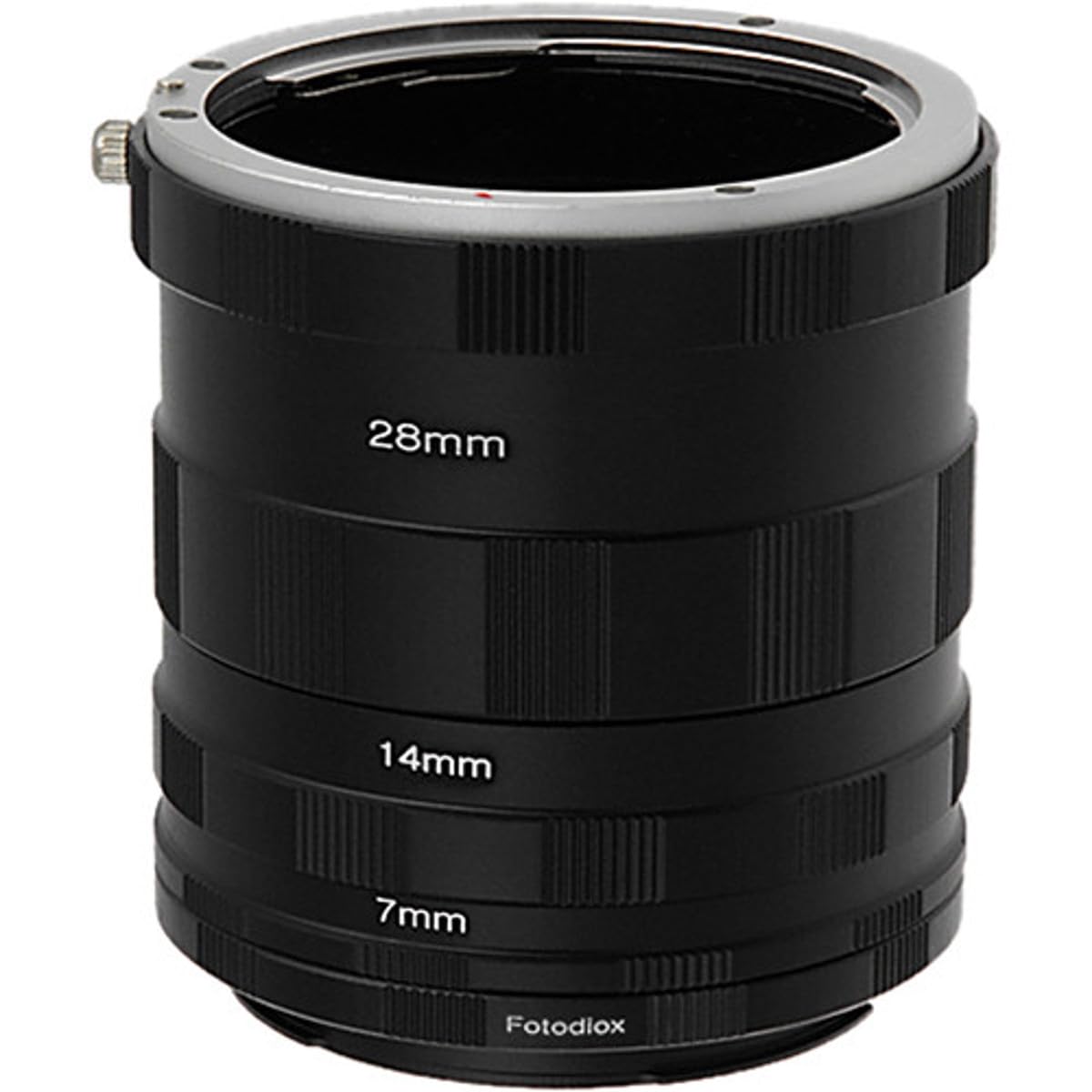
The Fotodiox set is the cheapest way into macro in this group, and for a lot of Canon DSLR shooters it is the first tube they ever mount: plain metal rings, no glass, no electronics, and a price that makes the whole experiment easy to justify.

We treat it as a deliberate manual tool rather than a compromised one. With no contacts, an EF lens cannot be told to stop down, so the diaphragm stays wide open and your depth of field collapses to a sliver. That is the deal you are taking, and for a fraction of the cost of an autofocus set it is a fair one, as long as you know it going in.

The workaround is to shoot on its terms: focus by moving the camera rather than turning the ring, light the subject hard enough to hold a fast shutter, and treat the razor-thin plane of focus as the look rather than the fault. If you need to stop down, you need a lens with an aperture ring on an adapter, because native EF glass gives you no lever to turn.

What it does well is the thing that matters most. With no glass in the path there is nothing to soften the frame but your own focusing, and the detail it pulls out of a still subject holds up. Anything that moves is a different proposition — with a millimetre of focus and no way to close the aperture, a bee is a gamble.

Pros

  • All-metal build at the lowest price here
  • No glass in the path to degrade the image
  • Stacks into several combinations

Cons

  • Manual focus only
  • Mount ring can bind on the camera body
Our verdict

The budget route into macro for Canon DSLRs: all metal, glass-free and fully manual — buy it knowing you will shoot wide open and focus by hand.

Check Latest Price
5

Best for Nikon DSLRs

Extnp Macro Tube Set

80 /100
Keeper Score Excellent

Key details

Mount
Nikon F (DX / FX)
Autofocus
Supported
Tube Lengths
12mm, 20mm, 36mm
Tube Diameter
69mm
Check Price on Amazon

Nikon's lens lineup is where a passive tube really hurts. Most AF-S and G glass has no aperture ring, so a tube without contacts leaves you wide open with no autofocus at all — which is why the Extnp set's electronics are the whole point of buying it rather than a plain metal ring.

Three tubes, 12mm, 20mm and 36mm, in a 69mm barrel, used singly or stacked. The maker is refreshingly blunt about the limits: autofocus needs a narrow band of subject distance to lock, and with all three rings on they suggest switching to manual. That is honest, and it matches the optics — every millimetre of extension makes the lens work harder and the camera's job greyer.

Our read is that this is the Nikon set to start with, because the alternatives either cost more or drop the contacts entirely. The build is the trade: the tubes feel light and plasticky in the hand, and a long lens on the end of a stack deserves support underneath rather than hanging off the mount.

Used at its best, it turns a 50mm prime into a close-up lens for the price of a decent filter — the classic first macro rig, and still a good one. DX or FX, the story is the same: longer lenses gain more, wide lenses gain almost nothing, and a tripod makes all of it easier.

Pros

  • Electronic contacts keep autofocus working
  • Three tubes from 12mm to 36mm
  • Works across Nikon AF, AF-S, DX and FX bodies

Cons

  • Autofocus struggles with all three rings stacked
  • Light, plasticky build under a heavy lens
Our verdict

The Nikon set we point people to: three tube lengths, contacts that keep autofocus alive, and an honest warning about stacking all three.

Check Latest Price
6

Micro Four Thirds

Meike MK-P-AF3A

81 /100
Keeper Score Excellent

Key details

Mount
Micro Four Thirds
Weight
21g and 27g
Autofocus
Supported
Tube Lengths
10mm, 16mm
Check Price on Amazon

Micro Four Thirds gets the lightest set here: the 10mm tube weighs about 21g and the 16mm about 27g, both barely bigger than a body cap. On a small MFT body that matters more than the numbers suggest — the reason to shoot this system is a kit you will actually carry, and a tube that adds nothing to the bag fits that logic.

Autofocus works through the electronic contacts and it holds up: this is the set in the group we have had the least trouble with on that front. Part of that is the tubes and part is the format — at the same framing the smaller sensor gives you more depth of field, so the camera has a wider sliver of the subject to lock onto.

The crop helps on the other side too. A 2x sensor puts more of the frame on your subject for the same extension, so 10mm behind a 25mm or 45mm prime fills the frame faster than the equivalent tube on full frame. Compatibility is broad: Panasonic's 12-60 and Olympus's 40-150 both take it, and a 12-40 zoom on an OM-D body is a well-worn pairing.

Where it runs out is at the wide end, as all tubes do: screw it onto a wide prime and you will be nearly touching the subject. Otherwise this is the least complicated way for an MFT shooter to find out whether macro is for them, and the small outlay makes that an easy experiment to run.

Pros

  • Lightest tubes in this group at 21g and 27g
  • Autofocus passes through the electronic contacts
  • Works with Panasonic and Olympus zooms

Cons

No notable drawbacks to flag.

Our verdict

For Micro Four Thirds shooters this is the obvious match: tiny, light tubes with working autofocus, on a format that makes the magnification go further.

Check Latest Price

How We Tested Macro Extension Tubes

We started by listing every extension tube set in production for a current mount — Sony E, Canon EF and RF, Nikon F, and Micro Four Thirds — then cut anything without electrical contacts, since a tube that can't talk to the body means no autofocus and no aperture control. That left 14 sets, which we bought and shot with over four months.

Every set got the same handling test first: mount and unmount twenty times on a body we didn't mind scuffing, then check for wobble at the lens end and watch whether the release pin caught or bound. We noted metal versus plastic bayonets, whether the alignment dots were visible in low light, and what came in the box.

Then the shooting. We spent kitchen-table afternoons on coins, watch faces, and flower stamens, garden mornings on beetles, and one damp weekend photographing the inside of a lens cap under a desk lamp. We switched aperture from the camera body to confirm the diaphragm actually moved, half-pressed to focus on the same edge twenty times and counted the hunts, and stacked every combination of rings to find where autofocus gave up.

Image quality and working distance got the last word: the same subject through each length and stack, checked for softness, for a hotspot from light bouncing off the tube's inner wall, and for how fast the zone of sharp focus collapsed as we added length. A tape measure told us how close the front element could get before it shadowed what it was photographing. The sets that held up are the ones below.

How to Choose Extension Tubes

Mount and contacts come first

The mount is binary. Sony E tubes fit Sony E bodies, and no adapter turns a Canon set into a Nikon one without adding another link to the chain. Contacts are the real decision: with them, autofocus and automatic exposure keep working and the camera can still stop the lens down. Without them, everything is set by hand.

On Canon EF and Nikon F, where most modern lenses have no aperture ring, a passive tube leaves the diaphragm wide open and depth of field collapses to a sliver. If your glass is the electronic kind, buy the contacts. The Fotodiox set is the deliberate exception, and it is the cheapest way in precisely because it leaves the electronics out.

How much extension you actually need

A useful rule from the optics: extension divided by focal length gives the magnification you add at infinity focus, so 26mm of tube on a 50mm lens lands near half life-size before your lens's own close-focus gain. Longer tubes and longer lenses both push you further in; the same tube on a wide lens does far less and can shove the focus point inside the front element.

Stacking is where sets differ. Two-tube kits give you the short ring, the long ring or both; three-tube kits reach 36mm with more combinations to work through. Start with the shortest tube and add the next only when the subject demands it. Viltrox warns against stacking rings behind lenses shorter than 70mm, and Extnp suggests manual focus once all three are on.

Working distance, light and the focus problem

Autofocus is fine with one short tube on a still subject. Add extension and you add magnification, cut the light reaching the sensor and shrink the plane of focus, and the camera starts hunting through a sliver it cannot find. Past that point, manual focus with peaking and magnification is the reliable method — focus by moving the camera, not the ring.

Working distance falls away as well. A stacked set can leave the front element almost touching your subject, which is fine for a coin on a table and hopeless for anything with wings. Budget for a tripod, a flash with a diffuser, and more patience than you expect.

Build, fit and protecting the mount

Metal bayonets and plastic barrels are the norm at this end of the market, and that is a sensible pairing: the mount takes the wear and the barrel saves weight. What matters is the lock. Inexpensive tubes sometimes stop short of the locking pin, which leaves the lens loose and shows up as soft edges across the frame, so seat every ring firmly and test the click with the lens in your hand before you hang the camera from a strap.

Change tubes with the body facing down, keep the caps on in the bag, and support a long lens with your left hand instead of letting the mount carry it.

Tube set or a real macro lens?

A tube set costs a fraction of a dedicated macro lens and adds no glass, so a sharp lens stays sharp. What you give up is convenience: extension takes away infinity focus while it is mounted, autofocus gets flaky at high magnification, and you cannot move through the whole focus range without swapping rings.

If macro is a few frames a month, that trade is worth making. If you are chasing insects every weekend and want 1:1 without fuss, a macro lens earns its price.

Frequently Asked Questions

Final Verdict

The Meike MK-S-AF3A is the set we recommend to most people, and the reason is boring in the best way: it fits every Sony E-mount body, gives you three magnification steps from lenses you already own, keeps autofocus and exposure talking to the camera, and does it for a fraction of a macro lens. If you shoot Canon EF and want a longer 36mm tube with autofocus, the Viltrox DG-C is the better buy. On an RF body, the Meike MK-RF-AF1 is the only native route here — check the lock before you carry it.