Best Drone Polarizing Filters of 2026

A polarizing filter does one job: it strips the glare bouncing off water, wet sand, car roofs, and windows so the color underneath comes back. From the air that matters more than it does from the ground, because so much of what a drone flies over is reflective — a reservoir, a glass tower, a parking lot full of cars. What surprised me was how much the filters themselves vary. Same scene, same light, two filters, and one comes home crisp while the other softens the corners and leaves a pale cast over everything.

Over the past four months my team and I have flown 16 of them, from single CPLs to six-piece ND-and-polarizer kits. One lesson you only learn in the air: you can't rotate a polarizer mid-flight, so you set your angle on the ground and live with it, or you land and twist again. A filter that's fiddly to index on a kitchen table is infuriating at altitude. The picks below are the ones that cut glare without charging you sharpness for it, and whose mounts stayed put through a full battery.

Keeper Score summarizes customer ratings and review volume. Read it alongside the product details and trade-offs. How the score works.

1

Best Overall

K&F Concept CPL for Mini 3

85 /100
Keeper Score Excellent

Key details

Coatings
28-layer multi-coating
Filter Type
Circular polarizer
Compatibility
DJI Mini 3 / Mini 3 Pro
Filter Weight
0.04 oz
Check Price on Amazon

The number we keep coming back to is 1.1 grams. That is the listed weight of the K&F Concept CPL for the Mini 3 and Mini 3 Pro, and it is the kind of figure that matters on a gimbal-stabilized drone. We like that K&F keeps the frame light and uses AGC optical glass rather than adding bulk. The 28-layer coating is there to suppress flare and reflections, and the filter is water-, dust-, and oil-resistant, which is useful when the drone is working low over water or wet foliage. It is a single CPL, not a filter set, and that simplicity is part of the appeal.

A circular polarizer earns its keep over non-metallic surfaces—water, glass, foliage—where reflections wash out color and contrast. This one is built for that job, with a 28mm mount specific to the Mini 3 and Mini 3 Pro. We prefer a single filter when the goal is cleaner color rather than exposure control; there is nothing to swap, nothing to sort, and one less decision in the field. The 28-layer coating is also the detail that helps in flare-prone aerial light, where a cheap filter can turn a bright sky into a smear.

That simplicity is the point. For stills and general aerial color, this is the filter that stays on the camera. The included hard case is a small thing, but it matters: these filters are easy to lose and easy to scratch when they ride loose in a bag. The light frame and the coating are the two details that make it easy to trust on the gimbal, and neither asks you to relearn how you fly.

Pros

  • 1.1 g frame keeps gimbal load low
  • 28-layer coating fights flare and reflections
  • Water-, dust-, and oil-resistant glass
  • Includes a protective filter case

Cons

  • No ND filters included
Our verdict

This is the CPL we recommend first for Mini 3 and Mini 3 Pro pilots: light, well coated, and simple enough to leave on for cleaner aerial color.
Check Latest Price
2

Best Full Kit for Mini 5 Pro

K&F Concept 6-Pack for Mini 5 Pro

90 /100
Keeper Score Outstanding

Key details

Coatings
28-layer nano-coating
Set Contents
CPL plus five ND filters
Compatibility
DJI Mini 5 Pro
Filter Weight
1 g each
Check Price on Amazon

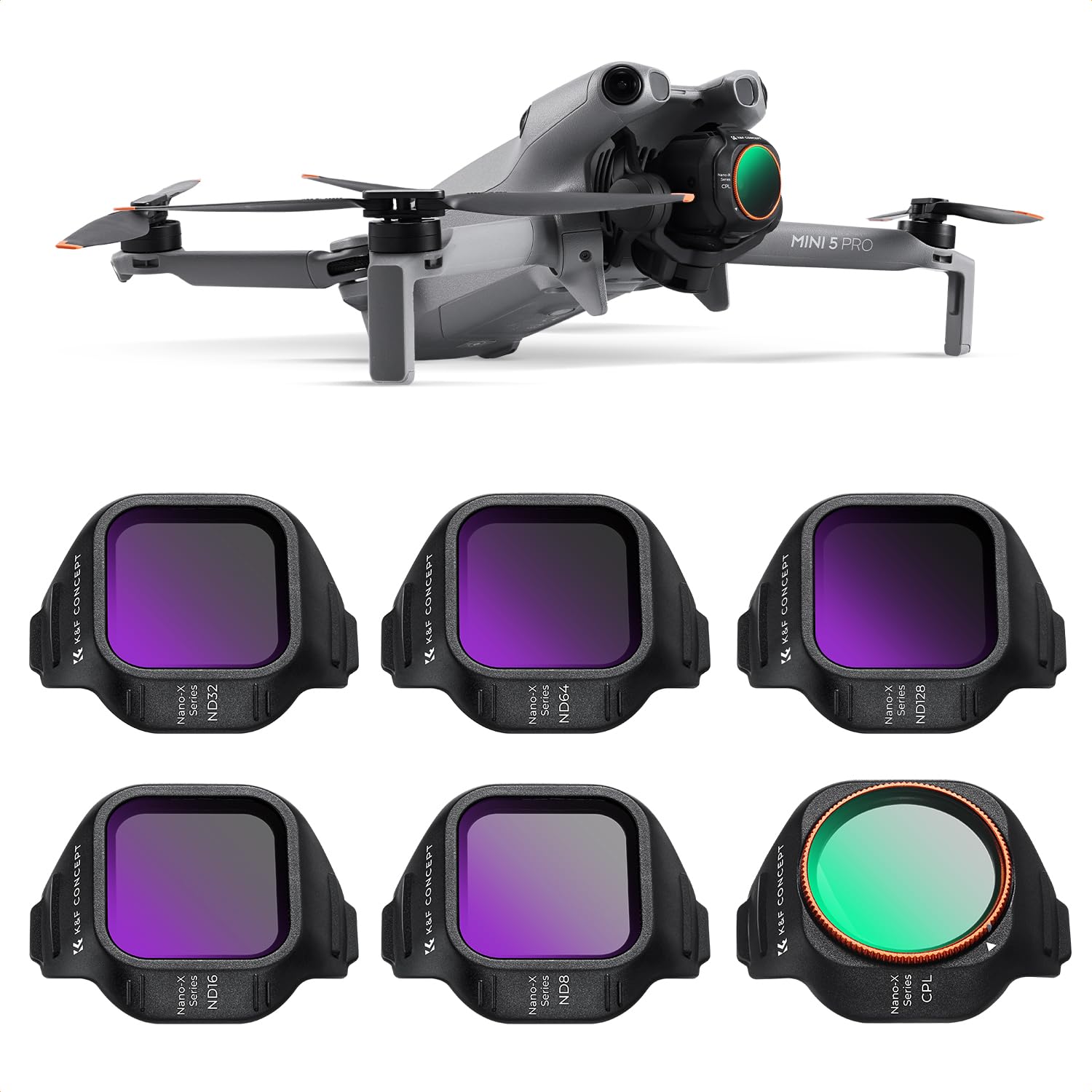
Six filters in one kit is the reason to consider this K&F set for the Mini 5 Pro. You get a CPL plus ND8, ND16, ND32, ND64, and ND128, which covers everything from a bright afternoon to the kind of glare that flattens a coastline. Each filter is listed at about a gram, and the snap-fit frame is designed to sit flush without asking the gimbal to compensate. The 28-layer nano-coating and water-resistant glass are the right baseline for filters that live outdoors.

We think the CPL is the sleeper here. It is the filter that removes reflections from water and glass and puts color back into foliage, while the NDs handle exposure and motion blur. Having both in one set means you can choose the tool for the shot instead of wishing you had packed the other kit. The plastic frame is also a sensible choice on a small drone: it keeps the mass down and is less likely to mark the lens barrel than a metal frame.

For a complete bright-light kit, the range is the point. The six filters cover the usual bright-day ladder, and the CPL is the one that stays on the camera when the light is contrasty but not so bright that you need an ND. The set is a practical way to stop guessing which strength to pack, and the low weight means you can carry all six without thinking about the gimbal.

Pros

  • CPL plus five ND strengths
  • About 1 g per filter
  • 28-layer nano-coating
  • Gap-free snap-fit frame

Cons

  • Fits only DJI Mini 5 Pro
Our verdict

For Mini 5 Pro pilots who want one kit for bright-light stills and video, this six-filter set is the practical pick.

Check Latest Price
3

Best Single CPL for Mini 4 Pro

Freewell CPL for Mini 4 Pro

87 /100
Keeper Score Excellent

Key details

Coatings
Dust, scratch, oil resistant
In The Box
Filter, storage box, cleaning cloth
Filter Type
Circular polarizer
Compatibility
DJI Mini 4 Pro
Check Price on Amazon

Freewell's CPL for the Mini 4 Pro is the simplest way to add a polarizer to that drone: one filter, one storage box, and a cleaning cloth. The frame is built around Freewell's GimbalSafe approach, which is the company's way of saying the filter has been kept light enough not to upset the gimbal. The coating is dust-, scratch-, and oil-resistant, and the glass is color-neutral, so the filter is meant to remove glare without tinting the scene.

We like that Freewell treats this as a single-purpose tool. There is one filter, one case, and no decision to make in the field beyond whether the light calls for polarization. For a Mini 4 Pro pilot who mostly shoots stills or wants a cleaner sky and water without changing exposure, that is appealing. The storage box is compact enough to keep in the fly-more bag.

The filter is at its best in high-contrast landscape work, where a polarizer can deepen a sky, clean up water, and separate foliage from the background. The single-filter approach also means less weight and less fuss on the gimbal, which is the right trade for a drone that is often packed light. It is a focused accessory, and that focus is why it earns a place here.

Pros

  • Color-neutral CPL coating
  • GimbalSafe lightweight frame
  • Storage box and cleaning cloth included
  • Simple single-filter setup

Cons

  • No ND filters included
  • Not water resistant
Our verdict

We like this as the no-fuss CPL for Mini 4 Pro pilots who want cleaner color and a compact case.

Check Latest Price
4

Best Value Set for Mini 4 Pro

REYGEAK 6-Pack for Mini 4 Pro

83 /100
Keeper Score Excellent

Key details

Coatings
30-layer multi-coating
Set Contents
CPL plus five ND filters
Compatibility
DJI Mini 4 Pro
Filter Weight
0.04 oz
Check Price on Amazon

REYGEAK's Mini 4 Pro kit takes a different approach from the plastic-frame filters here: the frame is aviation aluminum alloy, and the glass gets 30 layers of coating on both sides. The set includes a CPL plus ND8, ND16, ND32, ND64, and ND128, so it covers the bright-light range most people actually shoot. At 1.2 grams per filter, it is still light enough for the Mini 4 Pro's gimbal.

The aluminum frame is the interesting choice. It gives the filter a more substantial feel than the all-plastic frames here, and the double-sided coating is specified to resist water, oil, and scratches. The ND range covers bright sun, snow, and water, and the CPL handles reflections. For a Mini 4 Pro pilot who wants options without building a kit one filter at a time, it is a sensible one-and-done set.

The set does ask more of you in the field. Six filters mean more swapping and more cleaning. If you only want a polarizer, the Freewell single CPL is simpler. If you want the full ND ladder and do not mind a little more handling, this set earns its place.

The aluminum frame and 30-layer coating are the details that make it feel more substantial than a basic set, and the six-filter range is the reason to choose it over a single CPL. The included filters case keeps the whole ladder together, which is the practical advantage over buying a filter now and an ND later. For a Mini 4 Pro kit that has to cover a full day of changing light, that completeness is the appeal.

Pros

  • CPL plus five ND strengths
  • Aluminum alloy frame
  • 30-layer double-sided coating
  • 1.2 g per filter

Cons

  • Heavier than 1 g filters here
Our verdict

We recommend this set for Mini 4 Pro pilots who want a full ND ladder and a CPL in one case.

Check Latest Price
5

Best for Older Mini Drones

NEEWER 6-Pack for Mini/Mavic

84 /100
Keeper Score Excellent

Key details

Thread Size
20 mm
Set Contents
CPL plus five ND filters
Compatibility
DJI Mini 4K / Mini 2 / Mavic Mini / Mini SE / Mini 2 SE
Light Reduction
3 to 8 stops
Check Price on Amazon

NEEWER's six-pack is the one set here that covers a family of older DJI drones rather than a single current model. It fits the Mini 4K, Mini 2, Mavic Mini, Mini SE, and Mini 2 SE, which makes it unusually practical if your fleet includes a hand-me-down or a backup. The set pairs a CPL with ND8, ND16, ND32, ND64, and ND256 filters—five ND strengths plus the polarizer—and the 20mm snap-on mount is designed to stay put in flight.

We like the range: three to eight stops is enough to tame everything from a bright overcast day to full sun, and the ND256 is the one that lets you stretch shutter speed when you want motion blur. The CPL does the reflection-cutting job over water and glass. Multi-coated optical glass and water resistance are the right baseline for filters that live outdoors, and having the whole ladder in one set keeps you from buying the stops one at a time.

The ND256 is a specialist strength, and most people will use the lower stops far more often; it is there for long-exposure ideas rather than everyday flying. That is a fair trade for the breadth. The 20mm mount keeps the filter close to the lens, which is exactly what you want on a small gimbal, and the broad fit is what earns it a place over a single-model filter.

Pros

  • CPL plus five ND filters
  • Fits several older DJI models
  • 3 to 8 stops of light reduction
  • Multi-coated water-resistant glass

Cons

  • Fits older Mini and Mavic models only
Our verdict

We recommend this six-pack for older Mini and Mavic pilots who need both glare control and a wide ND range in one set.

Check Latest Price
6

Best Budget Set for DJI Neo

NEEWER 3-Pack for DJI Neo

81 /100
Keeper Score Excellent

Key details

Thread Size
27 mm
Set Contents
CPL plus two ND filters
Compatibility
DJI Neo
Light Reduction
3 and 5 stops
Check Price on Amazon

The NEEWER set for the DJI Neo is the smallest filter kit in this group: one CPL, one ND8, and one ND32, all on a 27mm snap-on mount. It is aimed at pilots who fly the Neo in bright daylight and want to cut glare without filling a bag. The metal frame and locking hook are the details that matter most; a small drone generates small vibrations, and a filter that shifts is worse than no filter.

The two NDs cover three and five stops, which is enough to keep the Neo's shutter speed in a sensible range for smooth footage in strong sun. The CPL is adjustable and aimed at non-metallic reflections like water and glass, and the multi-coated glass is water- and fingerprint-resistant. The whole set weighs about 0.02 kg, so it is not going to be the thing that pulls the gimbal off balance.

For a casual Neo pilot, the kit is easy to manage and easy to pack. We think it is the easy first filter set for the Neo, and the locking hook is the detail that makes it feel secure in the air. The three filters are easy to tell apart when you are swapping quickly, which matters more on a small drone than a long feature list.

Pros

  • Very light 0.02 kg set
  • Adjustable CPL reduces reflections
  • Metal frame with locking hook
  • Covers 3 and 5 stops

Cons

  • No ND16 or ND64 options
Our verdict

The Neo kit is the one we choose for casual bright-day flying: tiny, secure, and simple, with just enough filtration.

Check Latest Price
7

Best for DJI Air 3S

Freewell PL for Air 3S

89 /100
Keeper Score Excellent

Key details

Coatings
Multi-coated
Filter Type
PL polarizer
Compatibility
DJI Air 3S
Water Resistance
Not water resistant
Check Price on Amazon

Freewell's Air 3S polarizer is the dedicated single-filter answer for that drone. It is a PL filter, not part of an ND set, and it is aimed squarely at the glare that comes off water, glass, and snow. The multi-coating is there to keep reflections and flare under control, and Freewell's GimbalSafe language is a reminder that the frame has been kept light enough for the camera's stabilization.

A polarizer is most useful when the sun is doing too much—washing out a sky, flattening a lake, or turning a window into a mirror. This filter is designed for exactly that. It will not change your exposure the way an ND does, so you can leave it on and keep your shutter and ISO where you set them, within reason. The single-filter approach also means less to carry and less to swap when the light changes.

We think the focus is the appeal here. The multi-coated glass and the dedicated mount are the two details that matter, and the filter is simple enough to leave in your bag until the scene calls for it. For high-contrast aerial work, it is the straightforward way to cut glare on this drone.

Pros

  • Cuts glare from water, glass, snow
  • Multi-coated optical glass
  • GimbalSafe frame
  • Dedicated Air 3S fit

Cons

  • Not water resistant
  • Fits only DJI Air 3S
Our verdict

For Air 3S pilots, this dedicated polarizer is the straightforward way to cut glare without adding an ND ladder.

Check Latest Price

How We Tested These Drone Filters

I built the shortlist by starting with the lens bodies people actually fly — the small folding drones and the sub-250-gram models — and pulling every polarizer and ND/CPL kit sold for them. From there I filtered out anything without multicoated optical glass, anything whose mount looked like it would need a tool on a windy beach, and sets that repeated the same ND strength instead of covering the range you'd use. Sixteen filters survived, and we flew them for four months.

The bench work came first. Each filter got mounted and pulled off a dozen times to see whether the snap or the thread seated cleanly in one motion and whether the frame sat flush against the lens barrel, then weighed against the stock lens cover — a heavy filter announces itself as a gimbal that sags or hunts for level on startup. We turned every rotation ring through its full travel and noted whether there was a marked index point, since with a CPL that's the only thing telling you where you set your polarization before takeoff. Coated glass got handled with sunscreen-y fingers to see how badly it smudged and whether a microfiber actually cleared it.

In the air, the routine was the same every time: shoot a scene bare, land, mount the filter, set the ring, and shoot it again from the same spot. We did that over a reservoir in mid-morning light, over wet sand with the sun low, and over downtown glass and parked cars at golden hour — the three situations where glare ruins an otherwise good clip. Back home we compared frames at 100 percent for corner softness, color cast, and whether the water actually went clear or just a little less white.

The filters that scored best did the boring things right: they seated in one motion, held their setting through a full battery, and left the corners alone.

How to Choose Drone Polarizing Filters

Match the Mount to Your Drone

Drone filters are model-specific, and the mount is the hard boundary. A CPL made for the Mini 3 and Mini 3 Pro will not fit a Mini 4 Pro or Mini 5 Pro, even though all three are small DJI drones. Snap-on frames also need to seat flush; a filter that sits proud can interfere with the gimbal or come off in flight. Check the exact model and camera, not just the family name.

If you fly more than one drone, buy for the body you use most. The NEEWER six-pack for older Mini and Mavic models covers several generations in one set, but it stops there; current Mini 4 Pro and Mini 5 Pro pilots need their own mount. That is why our picks are organized by drone first.

Pick a Polarizer Alone or a Polarizer-and-ND Set

A CPL is the filter for glare: it removes non-metallic reflections from water, glass, and foliage and can deepen color and contrast. An ND filter does a different job, cutting light so you can use a slower shutter in bright sun. If you mostly shoot stills and want cleaner water or sky, a single CPL is enough. If you shoot video and want motion blur at midday, a set with ND8 through ND128 is more useful.

We prefer to buy the smallest kit that covers the light you actually shoot in. A three-filter set like the NEEWER Neo kit is easier to manage than a six-filter set, while the K&F Mini 5 Pro kit gives you a full ND ladder plus a CPL. More filters are not automatically better; they are more to swap, clean, and lose.

Watch the Weight and the Gimbal

A drone filter is a small accessory with an outsized effect on the gimbal. The lightest filters here are around 1 gram, and the heaviest is 1.2 grams; that difference is small, but a lopsided or poorly seated filter can still make the camera work harder. Aluminum frames feel more substantial, while plastic snap-on frames are built to keep mass down.

Before flight, check that the filter is fully seated and that the gimbal moves freely through its range. Do not stack a CPL and an ND unless the maker lists the combination as safe; the added mass and thickness are exactly what gimbal-safe designs are trying to avoid. If the drone complains or the horizon drifts, remove the filter and recheck.

Coatings, Rotation, and Real-World Color

Multi-coating is worth having. It reduces flare, makes water and fingerprints easier to clear, and helps the glass resist scratches. But coating does not make a filter waterproof, and not every polarizer here is water-resistant. If you fly near spray or in damp air, check that specification before you commit.

A polarizer also needs to be aimed. The effect is strongest when the camera is at roughly a right angle to the sun, and it can make a wide sky look uneven if you overdo it. Rotate the filter while watching the water or foliage, not just the sky, and test the angle you plan to fly. The best coating in the world won't fix a polarizer set for the wrong light.

Frequently Asked Questions

Final Verdict

If you fly a DJI Mini 3 or Mini 3 Pro, the K&F Concept CPL is the filter we point to first. It is light enough to leave the gimbal alone, the 28-layer coating is built for flare-prone aerial light, and it does the one job a polarizer is for without making you buy a full ND kit.

Flying a different drone? Match the mount before anything else. The K&F six-pack is the better all-day kit for the Mini 5 Pro, while Freewell's Mini 4 Pro CPL is the simpler choice if you only want glare control. The right filter is the one that fits your camera and the light you actually shoot in.