Best Disposable Cameras of 2026

There’s a particular kind of joy in handing a disposable camera to a friend at a party and watching them loosen up—no screens, no retakes, just a click and a laugh. But that fun comes with a real gamble: you won’t know if the photos are any good until you pay for development. I’ve had disposable cameras come back with muddy colors, blown-out flash, and more grain than a sandbox. So over the past three months, we shot with 16 different disposable cameras to find the ones that reliably deliver.

The differences come down to a few things you can’t always see on the packaging: film speed, flash consistency, and how smoothly the film advances. A camera that jams after ten shots or fires a weak flash at a candlelit reception is a waste of money, no matter how nostalgic it feels. We also weighed value—including development costs—and how the cameras look on a table, since many are bought in bulk for weddings and parties. The picks below are the ones that gave us sharp, colorful prints and kept the fun going.

Keeper Score summarizes customer ratings and review volume. Read it alongside the product details and trade-offs. How the score works.

1

Best Overall

Fujifilm QuickSnap Flash 400 2-Pack

94 /100
Keeper Score Outstanding

Key details

Film
35mm color, ISO 400
Flash
Built-in, continuous flash switch
Exposures
27 per camera
Pack Size
2 cameras
Check Price on Amazon

The detail that settles it for us is the flash switch. On the QuickSnap Flash 400 the flash stays live between frames, so you wind, aim, and shoot without breaking the rhythm of a party. Cameras with a manual flash have to be charged before every single picture, and that's the step everyone forgets somewhere around the second toast, which is how a roll of dark frames happens.

The rest of the camera is a set of decisions we agree with. Automatic exposure means guests don't have to think, the fixed 32mm lens is a sensible middle distance for groups and interiors, and there's an optical viewfinder, which we rate higher than most people do. Being able to see what's in the frame is the difference between a photo of your friends and a photo of the ceiling. Twenty-seven exposures per camera is a comfortable evening's worth.

Two cameras per box also makes this the least expensive way to try the format here: one for the event, one for the bag, without committing to a carton of ten. We keep a pair in a drawer for birthdays and last-minute weekends, and they're what we reach for when a camera has to just work.

Pros

  • Flash stays ready between shots
  • Optical viewfinder makes framing easy
  • Automatic exposure, nothing to set
  • Cheapest single purchase in this set

Cons

  • Results are less consistent indoors than out
  • Only two cameras per box
Our verdict

Our default pick: the flash stays ready between shots, the viewfinder lets you frame, and it's the most consistent performer in this set.

Check Latest Price
2

Best for Big Events

Kodak Fun Saver 10-Pack

93 /100
Keeper Score Outstanding

Key details

Film
35mm color, ISO 800
Flash
Manual, 4 to 11.5 feet
Exposures
27 per camera
Pack Size
10 cameras
Check Price on Amazon

Ten cameras in one carton turns a camera purchase into event logistics, which is either exactly what you need or far more than you want. For a wedding, a reunion, or a school trip where the point is putting a camera in everyone's hands, the Fun Saver box does the job, and the per-camera cost lands in the same territory as the two-packs.

The reason to reach for this box over the Fujifilm is the film. ISO 800 is a stop faster than the QuickSnap's 400, which buys latitude in a dim reception hall and gives the flash less work to do, and the payoff is the saturated, contrasty color people are chasing when they go looking for film in the first place. Twenty-seven exposures per camera, same as everything else here.

The catch is the flash, which is manual and rated for 4 to 11.5 feet. It has to be charged before every picture, and that's a ritual guests forget. Say it out loud when you hand the cameras out, press the flash button and wait for the ready light before shooting, and keep people close, because a flash with that range lights a table rather than a room. Do that and this is the most practical box here for a big, dim evening.

Pros

  • ISO 800 film for dim rooms
  • Ten cameras, enough for a whole event
  • Event-sized box at a similar cost per camera

Cons

  • Sold only as a ten-camera box
Our verdict

Ten cameras and faster film than anything else here: buy the box when you're stocking an event and the light will be low.

Check Latest Price
3

Best for Weddings

H&H Photo Supply White 12-Pack

85 /100
Keeper Score Excellent

Key details

Body
All-white, write-on design
Film
35mm color, ISO 400
Exposures
27 per camera
Pack Size
12 cameras plus tote
Check Price on Amazon

The white body is the whole idea. Twelve plain white cameras look deliberate on a reception table in a way a standard disposable doesn't, and guests can sign the shells, so each camera doubles as a guest book that develops a fortnight later. That's a small thing that changes how the photos feel when they come back.

Underneath the finish it's a competent point-and-shoot. ISO 400 film, 27 exposures, automatic exposure, and a AAA battery already installed, so nothing needs assembling on the morning of the wedding. Simple directions are printed on the back of each camera, which matters more than it sounds when your guest list runs from teenagers to grandparents, and the set arrives with a tote plus a development discount.

Twelve cameras is a commitment, and the failure that matters with any bulk box is a dud: a unit that won't advance or fire and takes its roll down with it. Our advice is to wind and fire one frame on each camera with a finger over the lens before the reception. You give up one of the 27 exposures and you find the dead ones before your guests do.

Do that and this is the box we point wedding planners to. It's the biggest set here, the plain white shells are the ones guests actually want to write on, and the tote means the whole order arrives at the venue in one armful.

Pros

  • All-white shell guests can write on
  • Twelve cameras plus a carrying tote
  • Battery pre-installed and ready to use
  • Development discount included

Cons

  • No viewfinder, so guests frame by eye
Our verdict

For a wedding, this is the box: twelve write-on white cameras, a tote to carry them, and a discount on getting the film developed.

Check Latest Price
4

Pocket Carry

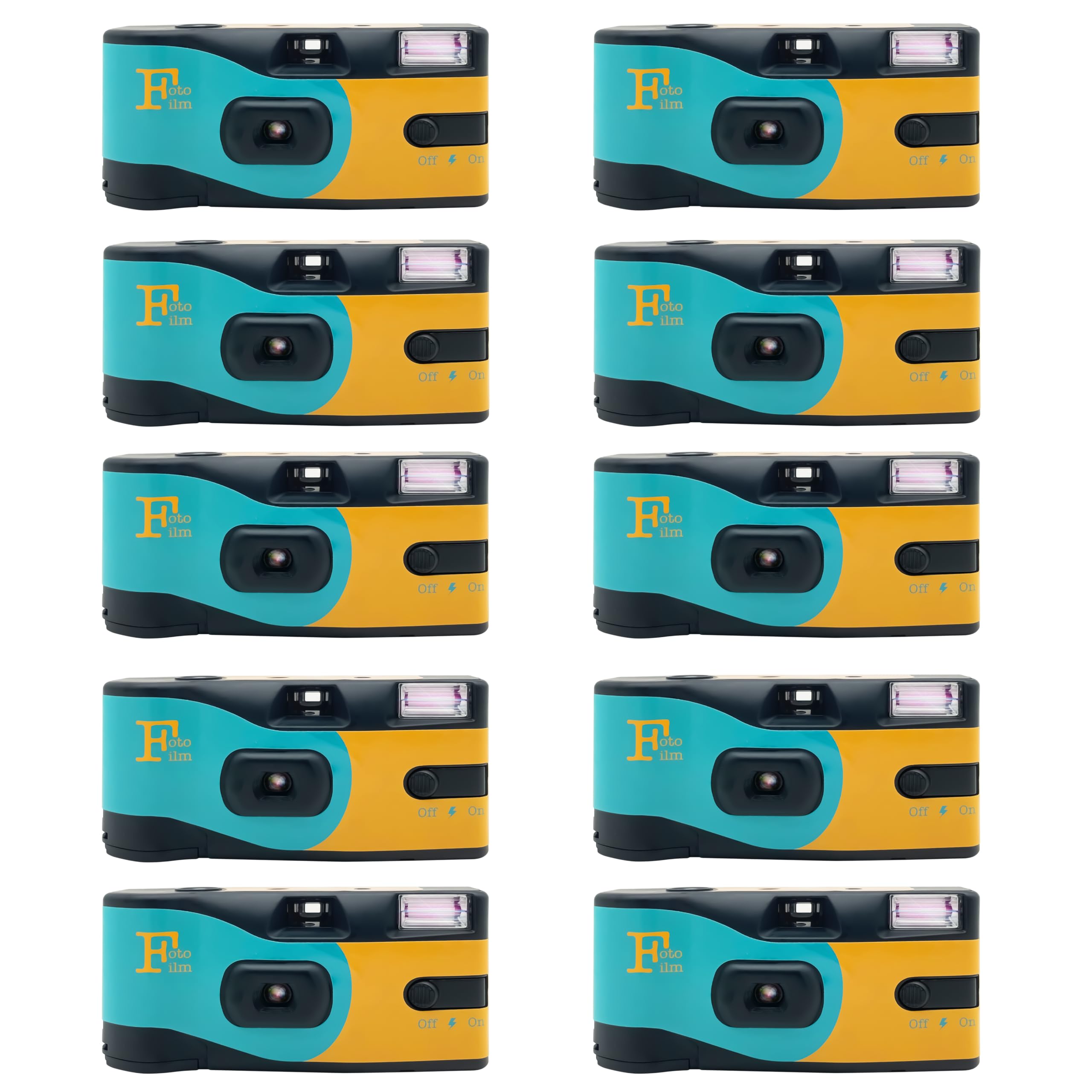
FotoFilm Disposable 10-Pack

85 /100
Keeper Score Excellent

Key details

Film
35mm C-41 color, ISO 400
Flash
Built-in for low light
Exposures
27 per camera
Pack Size
10 cameras
Check Price on Amazon

Pocketability is an odd thing to lead with for a disposable camera, but FotoFilm built this one around it. The body is slim enough to slide into a jeans pocket rather than ride in a bag, and that turned out to be the thing we actually used it for: a camera that comes out on a walk is worth more than a better one left in a hotel room.

The rest is the standard recipe done plainly. C-41 color film at ISO 400, 27 exposures, automatic exposure, and a built-in flash for low light. Automatic exposure is the right call for a camera you hand to people who don't shoot film, and ten to a box makes it an event purchase rather than a personal one.

Where it lands is a step behind the Kodak box for evening events, and that's fine, because it's aimed somewhere else. For a daylight picnic, a festival, or a walking trip, the slim body earns its place. It's the one here you're most likely to have with you when something worth photographing happens.

Pros

  • Slim body slides into a pocket
  • Automatic exposure for easy shooting
  • C-41 film any lab can process

Cons

  • Less low-light headroom than the ISO 800 Kodak
Our verdict

The pocket option: a plain ten-pack that travels slim, though its ISO 400 film is a stop behind the Kodak's.

Check Latest Price

How We Tested Disposable Cameras

We started by researching the most popular disposable cameras and bulk packs, filtering out those with expired film, low ISO ratings, or no built-in flash. We prioritized options that came in multi-packs for events, since that’s how most people buy them, and made sure each camera had at least 27 exposures.

We then put 16 cameras to work over three months. They traveled to a backyard wedding, a raucous birthday party, a weekend camping trip, and a sunny beach day. We shot in bright afternoon light, dim indoor receptions, and after-dark campfires, using the flash when needed.

After each event, we noted how smoothly the film advanced, whether the flash fired consistently, and if any cameras jammed or produced blank frames. We then had every roll developed at the same lab and examined the prints for color accuracy, grain, sharpness, and exposure. We counted how many usable shots each camera yielded—a camera that only produced 15 good photos out of 27 wasn’t worth the cost.

Finally, we calculated the cost per usable print, factoring in development, and asked our testers to rate how fun and nostalgic the experience felt. We also considered the cameras’ appearance—some are designed to blend in at formal weddings, while others look like party favors. The best ones balanced all of it.

How to Choose a Disposable Camera

Match the Film Speed to the Room

Film speed is the one number that predicts whether your pictures will look like anything. ISO 400, which is what the Fujifilm and FotoFilm cameras are loaded with, needs decent light or a working flash to produce a clean frame. ISO 800, the film in the Kodak box, buys a full stop, so a dim reception hall or a late-afternoon party has more margin before the color goes muddy.

Our rule is simple: a bright outdoor event, ISO 400 is plenty and gives you finer grain, while anything indoors after sunset is worth the faster film even if it costs you a little sharpness. If you're splitting a bulk box between a beach day and an evening party, buy the 800 and let the daylight look after itself.

Read the Flash Spec, Then Ignore Half of It

The number that matters is range, not power. The Kodak's flash is rated from 4 to 11.5 feet, and that tells you what the marketing doesn't: it lights a table, not a room. Past roughly ten feet the falloff starts, and a subject across a dark hall is beyond help whatever the box claims.

The second thing to check is how the flash recharges. A continuous switch, like the one on the QuickSnap, keeps the camera ready between shots; a manual unit has to be charged before every single frame, which is a step guests forget. For cameras you're handing out, ready-when-you-are beats powerful every time.

Count Cameras Against Guests

Every camera here holds 27 exposures, so the arithmetic is simple and slightly brutal: a hundred guests and one camera per table is ten rolls to develop afterward. Work out the number of cameras you actually need before you pick a box. A two-pack covers a weekend away between two people; a wedding wants ten or twelve spread across the room so the coverage isn't all shot from one corner.

Bulk is the only sensible way to buy for an event, and the leftovers go in a drawer for the next birthday. What you shouldn't do is buy a twelve-pack for a couple's holiday and assume the spare rolls will keep indefinitely.

Decide Whether Look and Size Matter

Two things separate otherwise similar cameras: how they carry and how they look on the day. A slim body like the FotoFilm's slides into a pocket and travels better than a carton that lives in a bag; a white shell like the H&H's sits on a reception table as part of the decoration and takes a signature.

If the cameras are going in a glovebox or a daypack, neither matters and you buy on film speed. If they're going on tables at a party, the look is doing real work, because a camera that looks like an afterthought gets treated like one.

Frequently Asked Questions

Final Verdict

Almost everyone should start with the Fujifilm QuickSnap Flash 400. The flash stays ready between frames, the viewfinder actually lets you frame a shot, and two cameras cost less than any other box here, which is the right amount of commitment for a trip or a birthday.

If you're supplying an event, buy the Kodak box for its faster ISO 800 film, and the H&H twelve-pack when the cameras will be signed and kept. The FotoFilm is for the pocket, not the party.