Best Compact Binoculars of 2026

Compact binoculars are a lesson in compromise: shrink the tubes enough to fit a jacket pocket and you risk dim images, fiddly focus, and a view like looking through a straw. The good ones make that trade worth it—they snap into focus, sit comfortably against your eyes, and survive a daypack. I keep a pair by the back door and another in my travel bag, so I notice the small stuff.

Over eight months, my team and I put 12 compact binoculars through backyard birdwatching, a ballgame, a dark theater, and damp hikes. We checked clarity first—whether feather markings stayed crisp at the edge—then focus, eye adjustment, and how much bulk we would carry for the image. The priciest pair was not automatically the most pleasant; a smooth focus wheel and comfortable eyecups mattered as much as glass.

Some are built for a glovebox, others for a dedicated bird walk; the picks below cover that range without asking you to baby them.

Keeper Score summarizes customer ratings and review volume. Read it alongside the product details and trade-offs. How the score works.

1

Best Overall

Hontry 10x25 Compact Binoculars

91 /100
Keeper Score Outstanding

Key details

Weight
9.6 oz
Field Of View
362 feet
Magnification
10x
Objective Lens
25 mm
Check Price on Amazon

Ten power in a 25 mm barrel is the compact formula most people land on, and the Hontry 8111 is the version of it we hand to anyone who asks what to buy. The figure that settles it is the field of view: 362 feet at 1,000 yards, wide enough to pick a warbler out of a hedge and stay with it as it moves. Fully multi-coated lenses over Bak-4 prisms are the other half of that, and the view keeps its color as the light goes, which is when a compact either earns its place in a daypack or does not.

The 60 mm to 75 mm interpupillary range is the detail we paid closest attention to, because it decides whether one pair can serve a household. A child's face and a broad adult's face both fall inside it, and the hinge holds where you set it. At 9.6 ounces it hangs on a strap through a long afternoon without becoming a nuisance, and the waterproof sealing is there for the shower nobody forecast.

What we wish were different is the body shape. The porro prism does good things for the image, but at just under four inches across the barrels it will not fold into a shirt pocket the way a slim roof prism does; this is a jacket-pocket pair. The case and strap are plain enough that you will forget them, which is roughly the point.

For a kitchen window, a week of hiking, and a concert in the same month, this is what we point people toward. Ten power is enough to be worth the carry and low enough to hold without a rest, the three-year warranty covers the mechanical parts, and nothing else here asks so little of you. Spend more only when you want something specific, like the Nikon's wider view or the Vortex's armor.

Pros

  • Wide 362-foot field for a 10x compact
  • Hinge spans 60-75 mm so kids and adults share it
  • Waterproof body with a three-year warranty
  • 9.6 ounces rides a neck strap easily

Cons

  • Too wide through the barrels for a shirt pocket
Our verdict

The pair we recommend to almost everyone: a steady 10x view, a hinge that fits kids and adults, and full waterproofing at a midrange price.

Check Latest Price
2

Best for Eyeglass Wearers

Occer 12x25 Compact Binoculars

89 /100
Keeper Score Excellent

Key details

Weight
13.8 oz
Eye Relief
20 mm
Magnification
12x
Objective Lens
25 mm
Check Price on Amazon

If you wear glasses and have quietly given up on folding eyecups, start here. The Occer's eyepiece is the largest of the compacts we looked at, the rubber cups pull flat against the body, and the eye relief is listed at 20 mm, enough that you keep your glasses on and still see the whole field instead of a keyhole.

The trade for that is what 12x costs you. Field of view is 273 feet at 1,000 yards, the narrowest of these, so getting onto a bird and staying with it takes more hunting around than it does with the Hontry or the Nikon. Power magnifies your own hands too: we noticed the tremor most at the end of a long walk, when a rested 8x view is simply calmer.

In the hand it feels like a small full-size rather than a toy, with a boxy, solid body, a smooth center-focus knob, and a diopter that holds its setting. Bak-4 prisms and fully multi-coated lenses are listed, and the body is sealed against rain, so a wet afternoon is not the end of it.

So it is not the pair for a fourteen-mile hike, and it is not the pair for a dusk stakeout. It is the one we pass to glasses wearers who want more reach than 10x gives and who watch from a deck, a cruise railing, or a backyard feeder, settings where the extra power and the big eyepiece do more good than the bulk costs.

Pros

  • 20 mm eye relief works with glasses on
  • More magnification than the 10x picks here
  • Feels substantial, with a smooth center focus
  • Sealed against rain

Cons

  • Narrowest field here at 273 feet
  • Heaviest of the group at 0.39 kg
Our verdict

This is the compact we hand to glasses wearers who want extra reach: a 20 mm eyepiece, fold-down cups, and 12x power in a sealed body.

Check Latest Price
3

Best for Wide, Steady Views

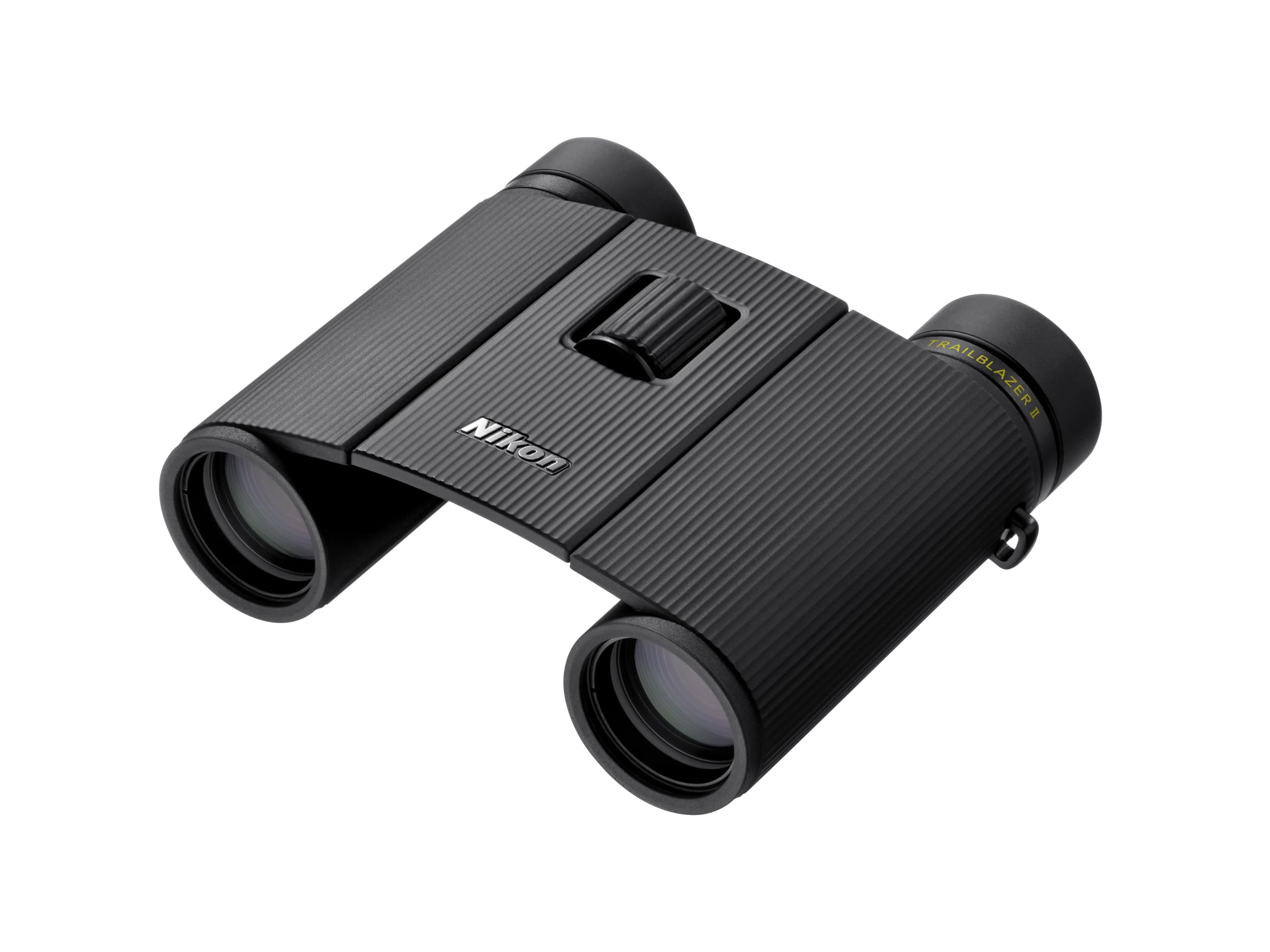
Nikon Trailblazer II 8x25

80 /100
Keeper Score Excellent

Key details

Weight
10.9 oz
Field Of View
435 feet
Magnification
8x
Objective Lens
25 mm
Check Price on Amazon

Stepping down to 8x sounds like a compromise until you actually use one. The Trailblazer's view is the widest of anything here, 435 feet at 1,000 yards, so you put the barrels roughly on a bird and it is simply there, with no sweeping around to find it, and the lower power keeps the image calm while you watch.

The rest of the package is what the money buys. Turn-and-slide eyecups click into position, the rubber-armored barrels shrug off life in a pack, and the body is sealed against water and internal fogging. At 10.9 ounces it hangs on a strap without complaint, and Nikon's coverage runs for life on the optics and seven years on the rest.

Two things to know before you commit. The protective lens caps are fiddly little pieces that we gave up on and left in the case, so budget for a lens cloth instead. And the eye relief is stated at 10 mm, which is not generous for glasses however the marketing phrases it. For a calm, wide view of a big sky, though, this is the pair we reach for.

Pros

  • Widest field here at 435 feet
  • Turn-and-slide eyecups hold their position
  • Waterproof and fogproof with long warranty cover
  • 10.9 ounces carries without complaint

Cons

  • Stated 10 mm eye relief is tight for glasses
  • Protective lens caps are fiddly to keep track of
Our verdict

The pick we reach for when seeing more matters more than seeing closer: the widest field here, proper sealing, and a lifetime optical warranty.

Check Latest Price
4

Best Rugged Build

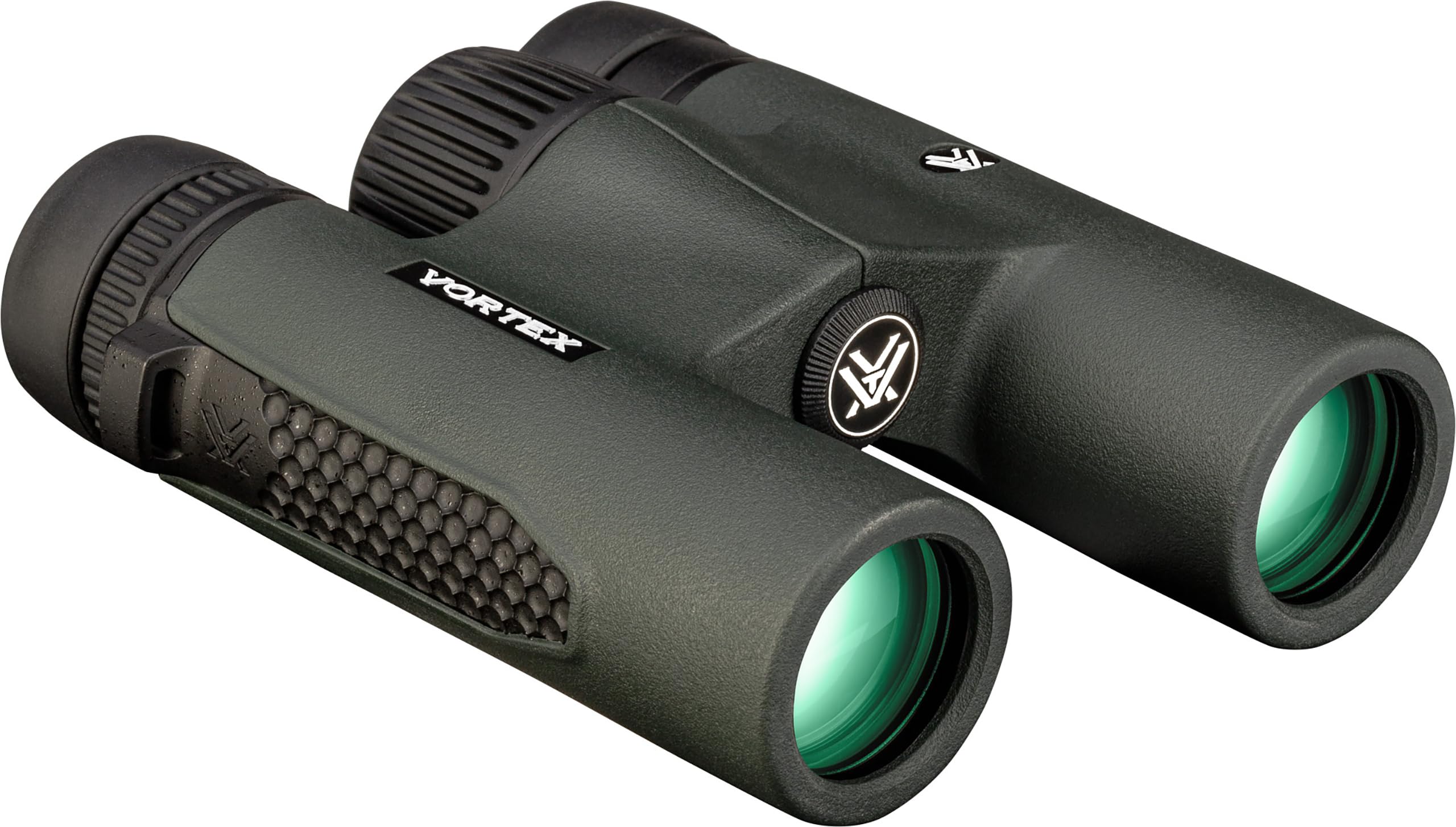
Vortex Triumph HD 10x28

81 /100
Keeper Score Excellent

Key details

Weight
12.8 oz
Magnification
10x
Waterproofing
Waterproof and fogproof
Objective Lens
28 mm
Check Price on Amazon

The Triumph is the compact here that is built to be dropped. A polycarbonate chassis, full rubber armor, nitrogen purging, and sealed optics add up to something that reads like a hunting glass shrunk into a 12.8-ounce body, and that is roughly what it is. You are paying for the shell and the sealing rather than for extra magnification.

What we were also impressed by is the 28 mm objective. Those extra three millimeters over the 25 mm picks give a larger exit pupil, so the image hangs on a little longer as the light goes, and the HD glass keeps edges clean in harsh side light. The 15 mm eye relief is comfortable, the focus knob has a firm geared feel, and the tripod socket earns its place: thread it onto a monopod at a hawk watch and stop holding it altogether. Vortex's unlimited, unconditional warranty is the rest of the argument.

The rubber eyecups are the one place the finish feels a step behind, soft and adjustable in a way that has glasses wearers hunting for the right position. Everything else about the handling is deliberate. On a wet, cold morning with the wind up, this is the one we want in the bag.

Pros

  • Waterproof, fogproof, and shockproof
  • Tripod socket for steady long watches
  • Unlimited, unconditional warranty
  • 28 mm objective holds light a little longer

Cons

  • Heaviest pick here at 12.8 ounces
Our verdict

The one we tell people to buy if their binoculars live in a pack, a boat, or a truck bed: sealed, armored, tripod-ready, and covered without a time limit.

Check Latest Price
5

Best Image Quality

Leupold BX-1 Rogue 10x25

92 /100
Keeper Score Outstanding

Key details

Prism
Inverted Porro
Weight
12.6 oz
Magnification
10x
Objective Lens
25 mm
Check Price on Amazon

Inverted porro prisms are why the BX-1 Rogue is small without being dim: the light path folds back on itself, so Leupold fits full-size optical behavior into a body you can close one hand around. It produces the sharpest view of this set. Edges hold up, glare control keeps a pale sky from washing out a bird against it, and the focus snaps rather than slides. That combination is what earns it a place here even at the top of the price range.

It is a working binocular rather than a pretty one. The rubber armor is grippy and slightly hard, the diopter clicks positively, and the 15 mm eye relief is comfortable with glasses on. At 12.64 ounces it is heavier than the 25 mm roof-prism compacts here, which you notice on a long walk and forget on a short one. Give the strap lugs a tug now and then, since that is the part that takes the strain when you sling it over a shoulder.

Pros

  • Sharpest image in this set
  • Inverted porro keeps the body small
  • Waterproof and fogproof with a full lifetime guarantee
  • 15 mm eye relief suits glasses

Cons

  • Heavier than the roof-prism 25s here
Our verdict

The sharpest view in this group, and the one we choose when image quality matters more than an ounce or two on a strap.

Check Latest Price
6

Featherweight 12x

POLDR 12x25 Pocket Binoculars

88 /100
Keeper Score Excellent

Key details

Weight
5.82 oz
Coating
Fully multi-coated
Magnification
12x
Objective Lens
25 mm
Check Price on Amazon

At 165 grams the POLDR is one of the two lightest binoculars here and the only 12x that disappears on a strap. A magnesium body, Bak-4 prisms, fully multi-coated lenses, and sealing against water make a specification list that reads like a much more expensive pair, which is the whole appeal at the budget end.

Where it gets harder is the focusing. The center knob turns smoothly, but the range where the image is genuinely sharp is narrow, so you nudge and re-nudge as a bird moves between a feeder and a hedge. Set the right-eye diopter carefully on the first day, with the center focus already crisp on your left eye, and the two barrels agree. Skip that step and the view stays soft, which is where most of the disappointment with this one starts.

Judged against the rest of the group, it is the pair for someone who wants 12x reach without carrying the Occer's weight to get it, and who will spend five minutes learning its focus rather than fighting it. Everything else about it behaves like a binocular costing more: the finish, the armor on the barrels, the little case that goes on a belt.

Pros

  • 165 g, the lightest 12x here
  • Magnesium body with Bak-4 prisms
  • Fully multi-coated and sealed against water

Cons

  • Narrow sharp-focus range needs frequent nudging
Our verdict

Our pick for the lightest 12x carry: a magnesium body and good coatings, provided you set the diopter and learn its focus.

Check Latest Price
7

Folding and Packable

Bushnell Powerview 10x25

86 /100
Keeper Score Excellent

Key details

Prism
Folding roof prism
Magnification
10x
Objective Lens
25 mm
Check Price on Amazon

The Powerview is a folding roof prism, which is the shape that makes a 10x25 genuinely pocketable: the barrels close on the hinge and the whole thing disappears into a day pack or a coat pocket. Ten power and a 25 mm objective put it in the same territory as the Hontry and the Nikon, and the rubberized body stays put in a wet hand.

Where it gives ground is focus. The knob is fast but coarse, and the last part of the turn is where the sharpness lives, so we found ourselves overshooting and coming back, particularly on birds at distance. Up close, at a feeder twenty feet away or a stage, it is quick and pleasant and you stop noticing.

So this is the one we suggest for a glovebox, a boat locker, or the coat you grab on the way out, places where a binocular mostly needs to be present and working. If most of your viewing is long range and you want the image to snap, the Hontry does that better and costs less. If you want a spare that folds flat and takes a knock, this is it.

Pros

  • Folding roof-prism body packs flat
  • 10x magnification in a small package
  • Grippy rubberized body

Cons

  • Coarse focus needs overshooting at distance
Our verdict

A folding 10x25 we keep for gloveboxes and day packs: buy it for convenience and as a spare, not for a crisp long-range focus.

Check Latest Price
8

Kids and Pockets

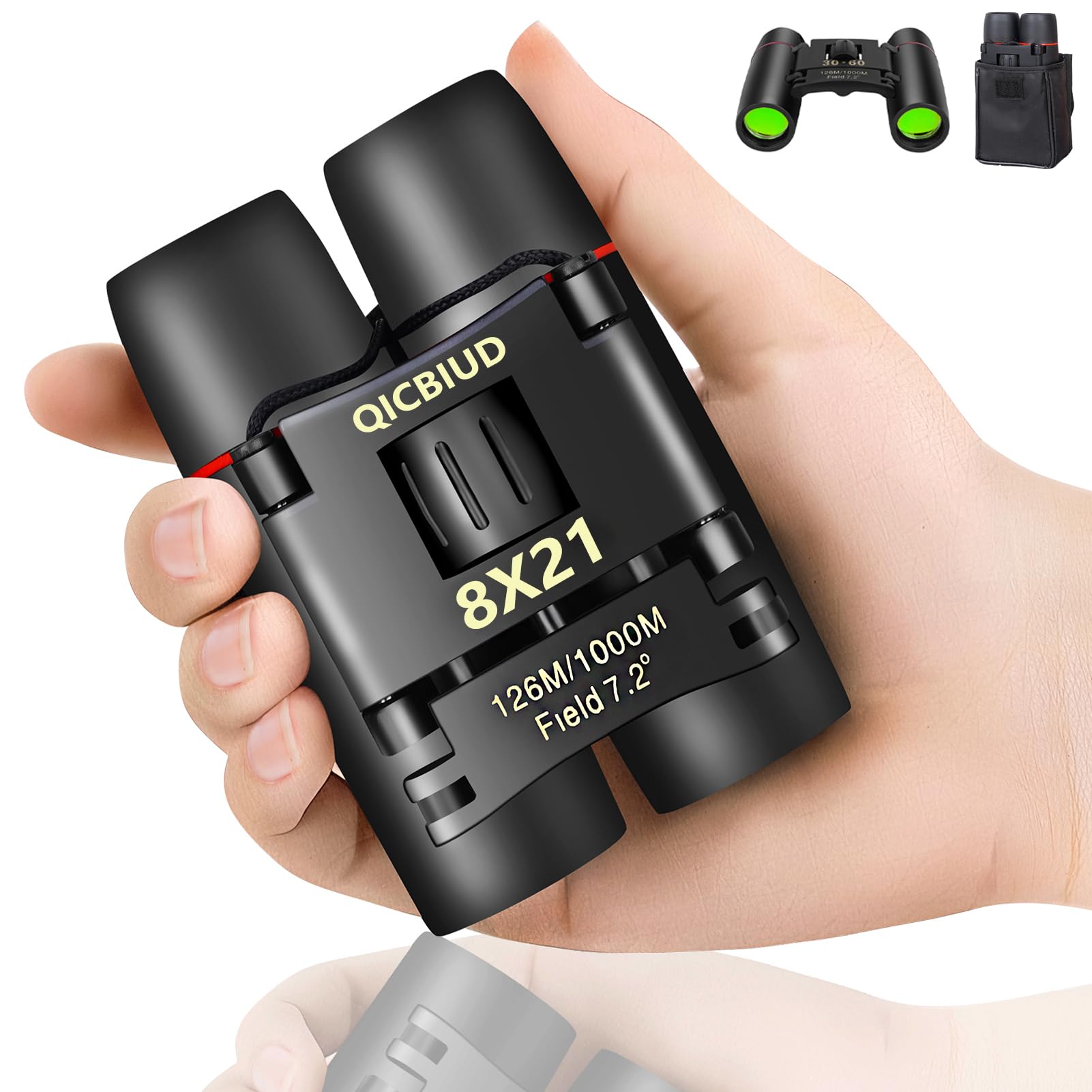
QICBIUD 8x21 Mini Binoculars

86 /100
Keeper Score Excellent

Key details

Weight
5.82 oz
Field Of View
415 feet
Magnification
8x
Objective Lens
21 mm
Check Price on Amazon

For a child's hands or a shirt pocket, 8x21 is the size that actually gets carried, and the QICBIUD is the least expensive way into it here. It weighs 5.82 ounces, wraps an aluminum frame in rubber armor, folds to 3.9 inches, and the 8x view is easy for a beginner to hold steady. The 415-foot field at 1,000 yards is generous for a lens this small, and that is what makes it usable at a ball game or a school play. For a first pair or a forgotten-in-a-drawer pair, it is the one we hand over without a second thought.

It is a fair-weather tool, though: the sealing is described as water repellent, so rain and spray are where it stops. The view is the compromise you would expect at this size, clear enough at fifty yards and softer out past a few hundred, and the focus wants a gentle touch to land cleanly. For something this small and this affordable, that is a fair trade rather than a fault.

Pros

  • Folds to 3.9 inches, weighs 5.82 ounces
  • 8x view is steady for beginners
  • Generous 415-foot field for the size

Cons

  • Water repellent only, not waterproof
  • Softer past a few hundred yards
Our verdict

The 8x21 we pass to a kid or drop in a shirt pocket: light, steady for beginners, and honest about its fair-weather limits.

Check Latest Price

How We Tested Compact Binoculars

We started by researching the compact binoculars shoppers actually compare—folding roof-prism models in the 8x to 12x range, with objective lenses small enough to fit a coat pocket—then filtered by price, listed weight and size, warranty, and whether they came with a case or strap. From that pool we bought 12 pairs and used them for eight months, rotating them through the same situations rather than handling each one once.

At a local wetland, I followed swallows over the water and refocused from a feeder to a branch, noting whether the focus wheel moved smoothly with one finger and stayed put afterward. At a ballgame, we passed pairs among three people with different eye spacing and glasses, resetting the diopter and folding the barrels to see how quickly each settled into a comfortable view. In a dark theater, we checked edge sharpness on stage details and whether the image dimmed before the show did.

Portability got the pocket test: each pair went into a jacket pocket, a daypack lid, and its own case, and we weighed the bulk against the image it delivered. Durability meant a dusty trail, a light drizzle, a cold windowsill overnight, and a few knocks inside a bag; we looked for fogging, grit in the focus mechanism, and rubber armor that stayed put. Value was the last call—not the cheapest pair, but the one that gave a clear, comfortable view without making us fuss.

How to Choose Compact Binoculars

Magnification: Why 8x and 10x Do Most of the Work

Twelve power looks like more binocular for the money, and it is also the hardest to hold still, because the tremor in your hands is magnified along with the bird. Brightness works the same way: divide the objective lens by the magnification and you get the exit pupil, the small disc of light your eye actually receives. An 8x25 gives you about 3.1 mm, a 10x25 about 2.5 mm, and a 12x25 about 2.1 mm, which is why the 12s fade first at dusk.

Our order of preference for a general-purpose pair is 10x, then 8x, then 12x. Choose 8x for a child, a windy headland, or a boat, and choose 12x only when reach matters more than steadiness and you will have something to lean on.

Field of View Decides Whether You Find It

Field of view is quoted in feet at 1,000 yards, and it is the specification that separates a binocular that is pleasant to use from one that is not. Wide is easier: the Nikon's 435 feet makes getting onto a moving bird almost automatic, while the Occer's 273 feet at 12x has you sweeping around for a target you could see with your naked eye a second earlier.

As a rule, wider is better up to around 400 feet, and anything under about 300 feet wants a still subject or a rest. The trade is genuine, though: part of what makes an 8x view feel calm is that same wide window.

Eye Relief and Eyecups for Glasses Wearers

Looking through binoculars in glasses costs you field of view unless the eyecups bring your eye close to the lens. Eye relief around 15 mm is comfortable, 20 mm is generous, and anything near 10 mm is a squeeze. The Occer lists 20 mm, the Vortex and Leupold 15 mm, and the Nikon's 10 mm figure sits oddly against its long-relief marketing.

Twist-down and fold-down rubber cups both work, but the twist type holds its position and is easier to set once. If the binocular is shared with someone who does not wear glasses, check that the cups go back up firmly, or that viewer gets a tunnel.

Weight, Folded Size, and the Pocket Test

Compact covers a wide spread, from a folding 8x21 that weighs about as much as a phone to a rubber-armored 10x28 that is serious field gear. Both are legitimately compact, and only one goes in a shirt pocket. A 25 mm roof prism folds into a jacket; a porro prism of the same magnification is wider through the middle and does not.

Decide where the binocular will live before you decide anything else. If it is a coat pocket, weight and folded length matter most. If it is a pack, an extra few ounces buys armor and better sealing, and you will be glad of it in November.

Sealing, Armor, and What More Money Buys

Read the sealing language closely, because it is graded. Water repellent means a shower is a gamble, waterproof means rain is fine but a dunking is not, and nitrogen purging is what keeps the inside clear when you come in from the cold. Rubber armor is there for the knock you do not see coming.

Above the budget tier, money buys armor, sealing, and better coatings rather than more magnification; the Vortex and Leupold do not out-power the cheap 10x25s, they out-last and out-resolve them. A long warranty is worth more on a compact than on a full-size, because these live loose in bags and get lent out.

Frequently Asked Questions

Final Verdict

The Hontry 10x25 is the pair we point most people to, because it makes the fewest compromises: 10x is enough magnification to be worth carrying, the 362-foot field is wide enough to find what you are looking at, and the 60 to 75 mm hinge means one binocular serves the whole household. It is also sealed, which the cheapest compacts here are not.

Spend more only for a specific reason. The Nikon Trailblazer II is the better buy if a wide, calm 8x view is what you are after, and the Vortex Triumph HD is the one to take if these will live in a pack, a boat, or a truck bed and get rained on.