Best Canon Flashes of 2026

A flash has to be two contradictory things at once: strong enough to light a whole room and small enough that you forget it's sitting on the hot shoe. Most disappointments come from one of those two sides getting sacrificed — a powerful brick you leave at home, or a palm-sized unit that wheezes through a reception. And there's a third thing that quietly ruins shoots: whether the flash actually speaks your camera's language.

I've shot nine Canon-compatible flashes over the past seven months — palm-sized travel units, full-size round-head speedlites, and a couple of flash-and-trigger hybrids — at weddings, in dim restaurants, and at a lot of backyard birthdays. The round head has earned its following, since the falloff is softer than a rectangular fresnel, but a pretty beam means nothing if the shoe wobbles or the unit overheats mid-reception. What I want from any of them is boring: light where I point it, the same exposure frame after frame, and a battery that lasts the day. The ones that cleared that bar are below.

Keeper Score summarizes customer ratings and review volume. Read it alongside the product details and trade-offs. How the score works.

1

Best Overall

Godox V1-C

89 /100
Keeper Score Excellent

Key details

Wireless
2.4G X system, master or slave
Light Output
76Ws round head
Recycle Time
About 1.5 sec
High-speed Sync
Up to 1/8000 sec
Check Price on Amazon

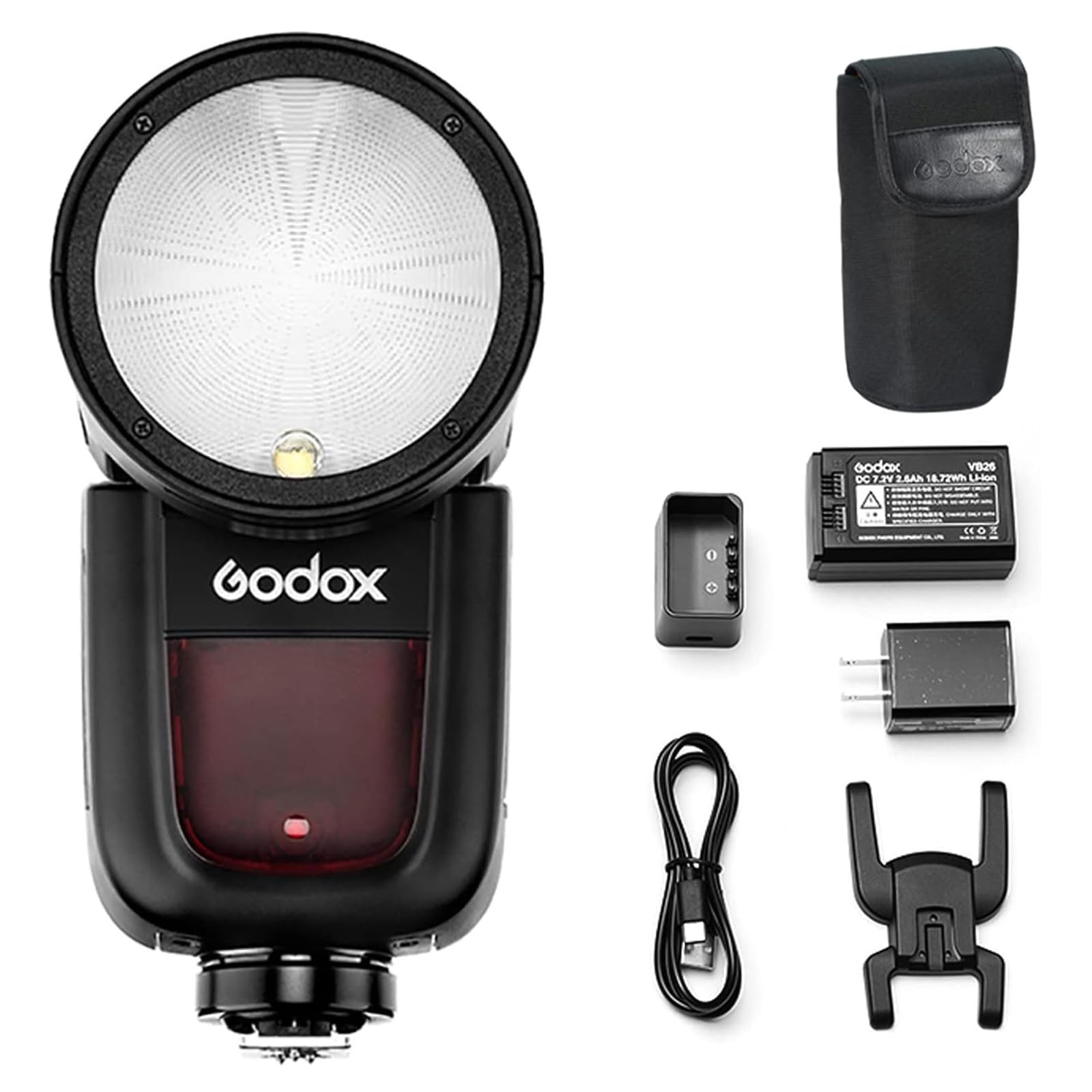
Round heads earn their keep in the files rather than on the spec sheet. The V1-C's circular emitter spreads light so the falloff from the center of the frame to the edges is gentler, and a face lit by it looks less like it was hit by a flash and more like it was lit by something larger. The magnetic ring around the head takes Godox's domes and gels, which snap on in a second — we kept reaching for that when a room needed a warm gel in a hurry.

That light is why it's our top pick, but the practical case is broader than the head shape. TTL metering behaves on Canon bodies from a 5D Mark IV through the R5 and R6 Mark II, high-speed sync runs to 1/8000 sec for wide-aperture work in daylight, and the 76Ws head has the reach to bounce off a ceiling across a room. The lithium pack is rated for hundreds of full-power pops and recycles in about 1.5 seconds, which in practice is the difference between shooting a reception and waiting for one. It does all of that for less than Canon's own mid-range Speedlite.

We noticed the size the first time we mounted it on a small body: this is a full-size flash, and on something like an R50 the rig goes nose-heavy, so a hand under the lens helps. On an R6 or a 5D it balances fine, and the 2.4G radio means you can take it off-camera later without buying into a second system. As a first serious flash, or a second one for a working kit, this is the one we reach for.

Pros

  • Round head softens and evens the light
  • Recycles in about 1.5 sec on lithium power
  • 2.4G X system works as master or slave
  • Fits a long list of Canon DSLR and mirrorless bodies

Cons

  • Magnetic modifiers and gels sold separately
Our verdict

The flash we point most Canon owners toward: a round head that flatters faces, TTL that behaves, and a battery that survives a whole event.

Check Latest Price
2

Best Canon-Branded

Canon Speedlite EL-10

86 /100
Keeper Score Excellent

Key details

Power Source
4 AA batteries
High-speed Sync
Up to 1/4000 sec
Wireless Control
Commands up to 15 units
Bounce And Swivel
90° up; 150° left, 180° right
Check Price on Amazon

Canon's multi-function shoe is the whole idea behind the EL-10: on a compatible R-series body the flash's settings live in the camera's own menu, so there's no second interface to learn and no second set of button logic to remember under pressure. For a Canon owner who wants the flash to behave like a camera accessory rather than a separate gadget, that integration is worth real money, and it makes this the simplest flash here to hand to someone who has never used one.

The rest is sensible rather than spectacular, and we're fine with that. The head pulls back to 90° for ceiling bounce and swivels 150° left and 180° right, which covers portrait bounce in either orientation without a bracket. High-speed sync tops out at 1/4000 sec, a stop below the Godox and Neewer options, so an f/1.4 portrait in bright sun will bump into the ceiling sooner. It also commands up to 15 additional Speedlites in a multi-flash setup, more headroom than most people shooting a single flash will need.

The four AA cells are the thing to plan around. Fresh batteries are fine; recycle stretches as they fade, so carry a spare set and a charger and the flash stops being the reason a shot is late. Get that right and the EL-10 quietly disappears into the camera, which is the highest compliment you can pay a flash.

Pros

  • Flash settings run from the camera's menu
  • Head tilts 90° and swivels 150°/180°
  • Commands up to 15 Speedlites in a multi-flash setup
  • Runs on four AA batteries

Cons

  • Fits select R-series bodies only
Our verdict

For Canon R-series owners who want the camera's own menus running the flash, this is the simplest Speedlite here to live with.

Check Latest Price
3

Best Compact

Godox iT32 + X5C

92 /100
Keeper Score Outstanding

Key details

Weight
5.96 oz
Trigger
X5C module, hot shoe and transmitter
Guide Number
18
High-speed Sync
Up to 1/8000 sec
Check Price on Amazon

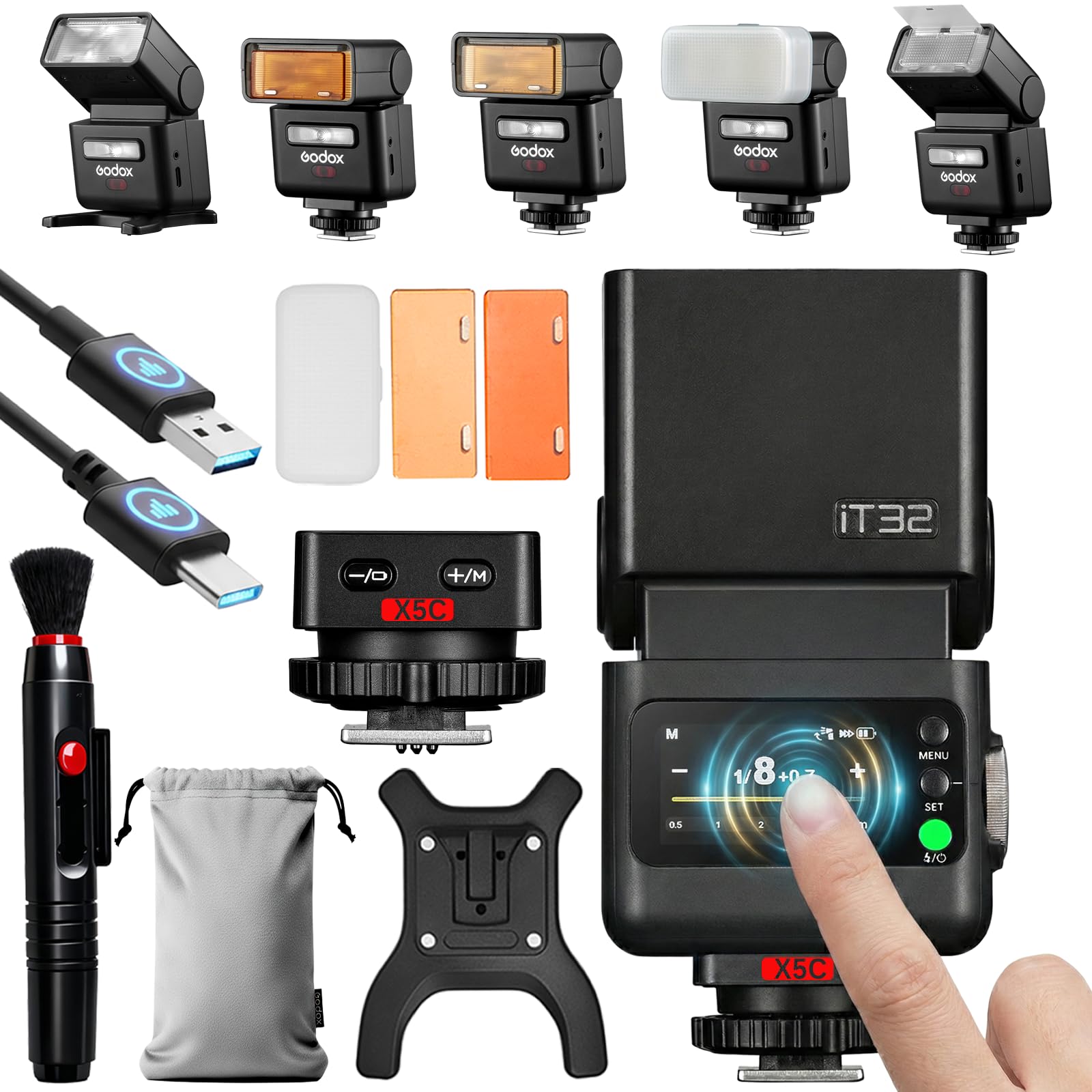
At 169 grams the iT32 barely registers on a small mirrorless body, and that's the point: it's the flash you leave mounted because it doesn't turn an R50 into a rig. The X5 module is the clever part — it works as the hot-shoe connection when mounted and switches to wireless transmitter mode when you separate it, so the two pieces together cover on-camera and off-camera without a second trigger.

We think it's the best small flash here, and the reason isn't the spec sheet. TTL, high-speed sync to 1/8000 sec and a color touchscreen all fit in something you can drop in a jacket pocket, and USB-C charging means one cable covers the flash and the rest of the kit. Godox also includes a diffuser, two magnetic color filters and a mini stand, which is more in the box than the price implies. The guide number of 18 is the honest limit: this is a fill light and a small-room light, not the main source across a big hall.

Expect an hour with the menus before the controls feel natural, and don't expect it to sit as steadily on a light stand as a full-size unit when there's a breeze. It's also small enough that a subject notices it less, which for candid work is worth more than output. When the bag is tight, this is the one we pack.

Pros

  • 169 g body disappears in a small bag
  • TTL and 1/8000 sec high-speed sync
  • X5 module covers on-camera and off-camera triggering
  • Charges over USB-C

Cons

  • Some Canon bodies need the AD-E1 adapter
Our verdict

The flash that rides along: 169 grams of TTL and high-speed sync that turns into an off-camera light when you split the module off.

Check Latest Price
4

Best Round-Head Value

NEEWER Z2PRO-C

88 /100
Keeper Score Excellent

Key details

Battery
7.2V/3000mAh lithium-ion
Light Output
76Ws round head
Modeling Light
Dual 2W LED, 10 levels
High-speed Sync
Up to 1/8000 sec
Check Price on Amazon

Set it beside our top pick and the shape of the deal is obvious: the same 76Ws round head, the same high-speed sync to 1/8000 sec and a 3000mAh battery rated for 600 full-power flashes, for less money. What the Neewer adds is a pair of 2W LED modeling lights with ten brightness steps, and that's the feature we didn't expect to lean on as much as we did: in a dark room they show you where the head is pointed before you fire, which saves a test frame every time you move.

The controls are the other pleasant surprise. A dedicated TCM key flips between TTL and manual in one press, which matches how you actually shoot — TTL to get close, manual to lock it in. The head zooms from 28-105mm, the 2.4G radio reaches 100m and covers four groups as a master and five as a slave, and the wireless is built to work alongside Godox triggers, so it slots into a system you may already own.

At 1.3 lb it's a flash that suits a larger body or a bracket better than a compact camera, and the menu is deeper than it needs to be, with shortcuts that take a couple of sessions to become muscle memory. Given how much of our top pick's job it does for noticeably less, neither is hard to live with.

Pros

  • Two modeling LEDs preview the light
  • 600 full-power flashes from a 3000mAh pack
  • One-press TCM switch between TTL and manual
  • Wireless works alongside Godox triggers

Cons

  • Not listed as compatible with the RP
  • R50 support requires Canon's AD-E1 adapter
Our verdict

A round-head TTL flash with two modeling lamps and a big battery, doing most of what our top pick does for less money.

Check Latest Price
5

Best for High-Volume Work

Canon Speedlite EL-5

81 /100
Keeper Score Excellent

Key details

Battery
LP-EL lithium-ion, included
Guide Number
58
Modeling Lamp
Built-in LED
Continuous Full Power
About 95 flashes
Check Price on Amazon

Ninety-five full-power flashes back to back, with no fan inside to slow it down — that number is the argument for the EL-5 at a reception or a press call, where the shot you miss is the one taken while the flash is recycling. Canon gets there by putting the power a fan would have used into charging and firing instead, and by feeding the flash from an LP-EL lithium pack rather than four AAs.

It's also the flash here that feels most like a system component. The joystick and high-definition LCD come straight from the flagship EL-1, the modeling lamp previews where the light will land in a dark room, and the body is moisture resistant — a small thing until you're working in drizzle. Guide number 58 gives it the reach for big rooms and bounced light, and the lithium pack holds its recycle speed through a long day. For a working Canon shooter, that combination is why we rate it for volume work despite its price.

Check the body list before you order. It names the R6 Mark II, the R and the R3 rather than the whole R range, and a flash at this price is the wrong place to discover a compatibility gap. If your camera isn't on it, the EL-10 does much of the same work on AA cells, and the V1-C does it with more flexibility for less.

Pros

  • About 95 consecutive full-power flashes
  • Lithium pack and modeling lamp borrowed from the EL-1
  • Joystick and LCD from the flagship model
  • Moisture-resistant body

Cons

  • Ships without a charger for its battery pack
Our verdict

Canon's event flash: a lithium pack, a modeling lamp and 95 full-power pops back to back, provided your body is on its list.

Check Latest Price
6

Manual off-Camera Work

PHOTOOLEX FK300

0 /100
Keeper Score Fair

Key details

Modes
Manual, S1, S2
In The Box
Flash, pouch, stand, 12 filters
Power Range
1/128 to 1/1, 8 levels
Guide Number
33
Check Price on Amazon

The FK300 is the least expensive way into a real flash here, and what it leaves out is everything automatic: it fires at the power you set and at nothing else. There's no metering conversation with the camera and no high-speed sync, and a single center contact on a metal shoe carries a trigger signal and nothing more. That sounds like a limitation until you remember what a manual flash is for.

What you get is a guide number of 33, eight power steps from full down to 1/128, and S1 and S2 optical modes that fire it as a slave when another flash goes off — which means a two-light setup without buying a trigger. The color temperature is listed at 5600K ±200K, close enough to daylight not to fight it, and the box includes twelve color filters, a stand and a pouch. For learning off-camera light, this is the most honest teacher in this group: every result is yours.

What it teaches transfers. With no metering to hide behind, you learn what a power setting does at a given distance, and that knowledge carries over to any flash you buy later. As a second or third light in a bag, or a first step into off-camera work, it earns its place.

Pros

  • Guide number 33 with eight power steps
  • S1/S2 modes fire it as an optical slave
  • Twelve color filters, stand and pouch included
  • 5600K output close to daylight

Cons

  • No TTL metering
  • No high-speed sync; 1/250 sec ceiling
Our verdict

A manual flash with real power and eight steps of control, for anyone who wants to learn light without paying for automation.

Check Latest Price

How We Tested the Best Canon Flashes

We built the shortlist from spec sheets before we touched a single flash: every Canon-compatible TTL speedlite we could find, minus the ones with no firmware history for the newer EOS R bodies, held to a spread of sizes and prices. Nine units made the cut, and each spent seven months on two bodies — a full-frame mirrorless and an older DSLR.

That meant a dim restaurant dinner at ISO 3200, a birthday party in a low-ceilinged living room where the only bounce surface was the ceiling, portraits at dusk on a rooftop, and a reception where I fired ten frames back to back to see if the flash kept pace. Each unit went on the camera and off it, on its own trigger atop a light stand. Packing it into a small shoulder bag alongside two lenses taught us more about portability than any spec sheet did.

We wrote down what happened rather than how it scored: whether the ready light came back before the next frame at full power, whether TTL metered a white shirt correctly, how many pops it managed before recycle times started to stretch, and whether the head swiveled far enough to bounce off a side wall instead of the ceiling. We also noted whether the shoe locked down tight when the camera swung at the hip, and whether the unit went to sleep at the wrong moment and cost us the shot.

Battery life got judged the blunt way — a full day of shooting without a swap, and a count of full-power pops before the pack quit. We checked compatibility just as plainly, mounting each flash on every compatible body we had and firing in TTL, manual, and high-speed sync to see whether the exposure drifted. Anything that needed a firmware dance to behave was marked down, and we weighed what each one cost against what it actually delivered. We're still shooting with these, so this list will keep changing.

How to Choose a Canon Flash

Start with TTL or manual

TTL lets the camera meter the flash for you, which is what you want when the distance to your subject keeps changing: a first dance, a crowded room, a kid who won't stand still. Manual flashes such as the PhotooLex FK300 cost far less and give repeatable output, which is exactly right when the camera and lights stay put.

The trap is buying manual to save money and then shooting a moving event with it, adjusting power between every frame while the moment goes. Shoot people on the move and TTL earns its price; build a fixed two-light setup in a spare room and manual is a feature rather than a compromise.

Output and head shape

The output figures here don't share a scale, so don't rank them side by side. The Canon EL-5 is rated at guide number 58, the Godox V1-C and Neewer Z2PRO-C at 76Ws, the iT32 at guide number 18. A larger figure means more reach for bouncing off a high ceiling or lighting a group; the iT32's 18 tells you it's built for subjects a few feet away.

Head shape matters as much. Round heads spread light more evenly and take magnetic domes and gels; rectangular heads are more directional and use clip-on diffusers. If you shoot portraits in rooms with white ceilings, either works, but the round head needs less correction afterwards.

AA or lithium-ion

AA flashes are cheap to feed and easy to rescue at a convenience store, but recycle times stretch as the cells drop, and you'll want NiMH rechargeables and a charger. Lithium packs hold their recycle speed and are rated in the hundreds of full-power pops, at the cost of proprietary spares.

For one flash that has to work all day, lithium is worth the premium. For a flash that lives in a bag and comes out a few times a year, AAs are the lower-commitment choice. Either way, price a spare before you decide, because the second battery is part of the real cost.

Check the shoe, then check the list

Canon's newer bodies use the multi-function shoe, and flashes built for it, like the EL-10 and EL-5, run their settings from the camera's menu. Older and third-party flashes may need Canon's AD-E1 adapter, and some listings contradict themselves about which cameras work.

The trap is assuming that a flash which mounts is a flash which works: the shoe connects mechanically long before the electronics agree. Match the compatibility list against your exact model, and be extra careful with entry-level R bodies such as the R50 and RP.

Pick your wireless system early

Off-camera flash is where the money quietly goes, and triggers and receivers tie you to one maker. Godox's 2.4G X system is the widest here: the V1-C works as master or slave, the iT32's X5 module transmits, and the Neewer Z2PRO-C is built to work alongside Godox triggers.

Canon's own system keeps everything inside the camera's menus, with the EL-10 able to command up to 15 Speedlites, but it lives entirely in Canon's ecosystem and at Canon's prices. If you already own a Godox trigger, buy a flash that speaks its language and skip the second system.

Frequently Asked Questions

Final Verdict

The Godox V1-C is the flash we recommend to most Canon owners. It produces the kind of light that flatters people, it works on nearly every EOS body from an older 5D Mark IV to an R6 Mark II, and the lithium pack outlasts a long day of shooting.

Choose the Canon EL-10 if you want the camera's own menus running the flash and never shoot past 1/4000 sec, or the Godox iT32 if the bag has to stay small.