Best Camera Top Handles of 2026

A top handle looks like a simple grab bar until you hang a monitor, a mic, and a light off it and try to carry the rig one-handed through a crowded room. The wrong one twists on its mount, digs into your palm, or flexes when you lift. I look at the mount first: ARRI locating pins resist rotation, while NATO clamps let you pop the handle off between setups. Cold shoes and threaded holes matter too, but only if they sit where your accessories actually need them—that's the kind of thing you learn after a few shoots, not from a spec sheet.

Over the past three months, we tested 12 top handles on cages with everything from compact mirrorless bodies to heavier video builds. We carried them by the grip, tightened and loosened each mount repeatedly, and loaded the cold shoes with mics, monitors, and small lights. The best ones felt solid without adding unnecessary bulk, and the differences came down to machining, grip material, and how thoughtfully the mounting points were placed. The picks below are the ones I'd leave on a rig.

Keeper Score summarizes customer ratings and review volume. Read it alongside the product details and trade-offs. How the score works.

1

Best Overall

SmallRig Top Handle 3765

95 /100
Keeper Score Outstanding

Key details

Mount
3/8"-16 screw with ARRI locating pins
Weight
4.37 oz
Max Load
22 lb
Cold Shoes
5
Check Price on Amazon

Two locating pins either side of the 3/8"-16 screw are what earn this handle the top spot. They drop into the ARRI holes on a cage's top plate and resist the rotation that makes a rig feel loose when it is hanging off your fingers at hip height. We paid close attention to that joint, because it decides whether a top handle feels bolted on or merely attached.

The rest of the design serves the same idea. The body is hollowed-out aluminum at 124 grams, light enough to leave on the cage between shoots, and the silicone wrap gives your fingers a consistent place to sit when you are carrying rather than shooting. The 10 kg load rating is the same ceiling the Neewer handles work to, which sits comfortably beyond a mirrorless rig with a monitor and a mic.

Five cold shoes, three across the front and two at the back, plus 1/4"-20 and 3/8"-16 threads mean your accessories stop queuing for one socket. The rear pair is the part we appreciated most: a monitor arm can sit behind the grip while a shotgun mic stays at the front, and neither crowds your knuckles.

One thing to settle before you order is the cage itself. This is an ARRI handle, so your top plate needs the locating holes; a cage with a NATO rail takes the 3766, which is the same grip on a different clamp.

Pros

  • Locating pins resist rotation on the cage
  • Five cold shoes split front and rear
  • 124 g hollowed aluminum with silicone grip
  • 10 kg rating covers a fully rigged camera

Cons

  • Tightening needs the included Allen wrench
Our verdict

We recommend it as the default for a caged rig: rigid ARRI mounting, five cold shoes, and 124 grams that won't weigh on a long shoot.

Check Latest Price
2

Best NATO Quick Release

SmallRig Top Handle 3766

92 /100
Keeper Score Outstanding

Key details

Mount
NATO rail clamp
Weight
4.37 oz
Cold Shoes
5
Threaded Holes
Ten 1/4"-20, two 3/8"-16
Check Price on Amazon

Same grip, different clamp: the 3766 is the NATO version of the handle we recommend first, and on a rig you break down and rebuild between shoots the clamp earns its keep. One knob tightens it to a NATO rail and it comes off again in seconds. That matters more than it sounds if your week moves between a cage on a tripod and the same cage on a gimbal.

Everything around the clamp follows the top pick closely: 124 grams of hollowed aluminum, a silicone grip with a four-finger texture, and five cold shoes split three front and two rear. The threaded holes go further here, with ten 1/4"-20 and two 3/8"-16 for arms, clamps, and monitor mounts.

The detail we noticed in use is where the shoes sit. Because the three cold shoes run along the front of the handle, a shotgun mic rides ahead of your hand rather than above it, so it stays out of the way of the screen and out of your eyeline when you are shooting low.

Pros

  • NATO clamp comes off without a tool
  • Five cold shoes plus twelve threaded holes
  • 124 g aluminum body with textured silicone grip

Cons

  • Needs a NATO rail on the cage
Our verdict

Buy this one if your cage has a NATO rail; we think the tool-free clamp is worth a little more than the ARRI version.

Check Latest Price
3

Best Value

Neewer CA007 Top Handle

94 /100
Keeper Score Outstanding

Key details

Mount
3/8" screw with ARRI locating pins
Weight
6.49 oz
Max Load
10 kg (22 lb)
Cold Shoes
3
Check Price on Amazon

The CA007 is the least expensive machined-aluminum handle in this group, and the savings don't show up where it counts. The body is CNC-machined alloy with cutouts to keep the weight down, the grip is a contoured silicone wrap, and the ARRI locating pins are there beside the 3/8" screw rather than being the thing that got cut.

Around that you get three cold shoes and six threaded holes, four in 1/4"-20 and two in 3/8"-16, plus a 10 kg load rating that is identical to the SmallRig pair's. That ceiling is well past a mirrorless camera with a monitor and a mic hanging off it, so the number on the spec sheet is unlikely to be the thing that limits your build.

The contoured silicone grip is what we appreciated most. It swells and tapers instead of running straight, so your fingers land in the same place every time you pick the rig up, and that consistency is worth more on a long day than a couple of extra mounting holes would be. It is the handle we kept on the plainer cage when the better-stocked ones were packed away.

Pros

  • Machined aluminum body at the lowest metal price
  • ARRI locating pins plus three cold shoes
  • Contoured silicone grip fits the palm

Cons

  • Three cold shoes against five on the SmallRig picks
  • Heavier than the small aluminum handles
Our verdict

We think it's the smart buy for a first cage build, with machined aluminum and ARRI pins at the lowest metal-handle price here.

Check Latest Price
4

Best for Mixed Mounts

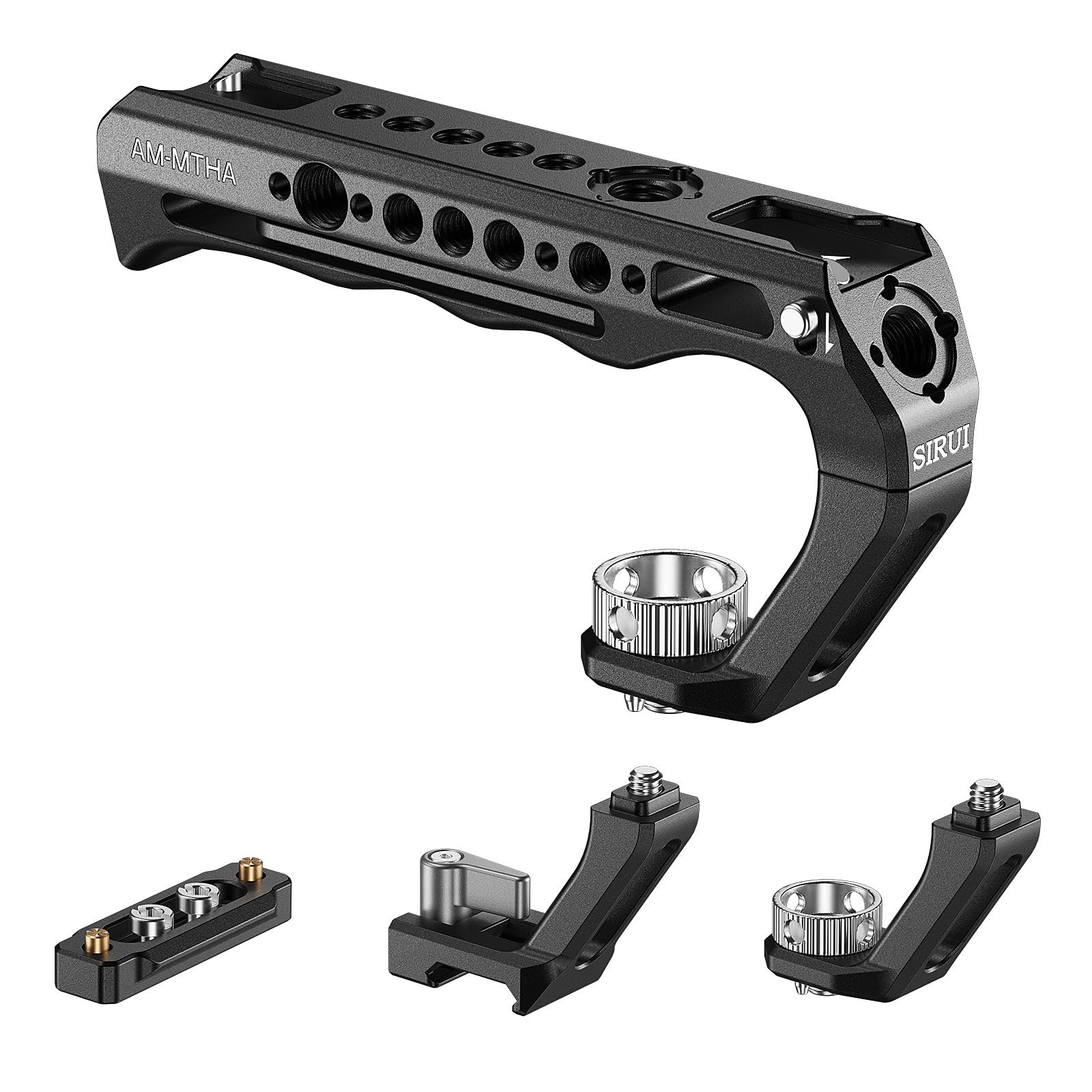
Sirui AM-MTHA Top Handle

87 /100
Keeper Score Excellent

Key details

Mount
ARRI locating mount and NATO clamp
Weight
8.47 oz
Max Load
44.1 lb
Cold Shoes
3
Check Price on Amazon

One handle, two cage standards. The AM-MTHA's mounting head carries an ARRI locating mount and a NATO clamp, and the head is detachable so it can be reversed or swapped to suit the cage in front of you. If you keep one large cage and one small one and they don't share an interface, this is the shortest route to a single handle that works on both.

That flexibility is the reason to buy it, and the reason we kept it on the list despite the weight. At 240 grams it is the heaviest handle here, roughly double the hollowed-out SmallRigs, and on a compact mirrorless cage you feel that when the rig is balanced on a gimbal or hanging from one hand on a long walk.

What the extra metal buys is headroom. The 20 kg load rating is the highest in this group, and it is the figure that matters once your rig grows a follow focus, a cine lens, and a heavier monitor. Three cold shoes and a spread of 1/4"-20 and 3/8"-16 threads handle the accessories, and the all-aluminum body takes the knocks a working rig takes.

Pros

  • Fits ARRI and NATO cages with one handle
  • 20 kg rating suits cine-style builds
  • Three cold shoes plus threaded holes

Cons

  • Heaviest handle here at 240 g
Our verdict

For a kit that mixes ARRI and NATO cages, this is the one we hand over, extra weight and all.

Check Latest Price
5

Light, Low-Cost Rigs

Neewer CA142 Top Handle

94 /100
Keeper Score Outstanding

Key details

Mount
3/8" locating pin for ARRI
Weight
3.88 oz
Max Load
22 lb
Cold Shoes
2
Check Price on Amazon

At 3.88 ounces, the CA142 is the lightest handle here, and on a small rig that is the whole argument: you stop noticing it is fitted. It is also the least expensive of the five, and you can see where the money went. The body is aluminum alloy and ABS rather than a single machined billet, so the grip side has a slightly warmer, more plastic feel than the metal handles. For a camera that never grows past a lens and a mic, we think that is the right trade.

The mount is not where it economized. There is a 3/8" locating pin for ARRI, several 3/8" locating interfaces, and a 1/4" locating hole, with a 22 lb rating that sits in the same territory as the all-metal handles. What you give up is accessory real estate: two cold shoes means a mic and a light, and nothing left over for a monitor. For a single-camera interview setup that is plenty, and for anything bigger the five-shoe handles are the ones to look at.

Pros

  • Lightest handle here at 3.88 ounces
  • ARRI locating pin at the lowest price
  • 22 lb rating matches the metal handles

Cons

  • ABS and alloy body feels less solid than billet
Our verdict

We like it as a second handle for a compact rig, where its low weight and ARRI locating pin matter more than an all-metal body.

Check Latest Price

How We Tested These Camera Top Handles

We started by researching the cages and rigs people actually use, then filtered for handles that fit the two common standards: ARRI-style locating pins and NATO clamps. We also required at least two useful accessory mounts, whether cold shoes or 1/4- and 3/8-inch threads, and mixed aluminum and plastic designs so we could compare weight against rigidity. That left us with 12 handles, which we used for three months.

Each handle was mounted to a camera cage, tightened by hand, then pushed and twisted to see if it shifted. We carried the assembled rig by the grip, sometimes one-handed, and noted where the handle met our knuckles, whether the grip felt tacky or slick with bare hands and light gloves, and whether the shape created pressure points after a few minutes of low-angle shooting. We also hung a small sandbag from the handle to check for flex and listened for creaks at the mounting joint.

We attached a microphone, monitor, and compact light to the cold shoes and threaded holes, then checked whether the accessories blocked each other or sat too close to the camera. To test durability and build quality, we repeated mount-and-release cycles, inspected the threads, pins, and locking levers for wear, and looked for sharp edges, loose seams, or cheap-feeling plastic. The handles that survived without wobble, cracking, or stripped threads earned a place on the list.

How to Choose a Camera Top Handle

Start With the Mount, Not the Grip

Cages give you one of two interfaces on the top plate: a 3/8"-16 screw ringed by ARRI locating holes, or a NATO rail that takes a clamp. A handle built for one will not seat properly on the other, so look at your cage before you look at anything else.

An ARRI handle uses locating pins that drop into the holes either side of the screw, which is what keeps the grip from rotating as you lift. A NATO handle slides onto the rail and locks with a knob, so it comes off in seconds when the rig moves to a gimbal. If you run cages of both kinds, the Sirui AM-MTHA carries both connectors on one detachable head.

Match the Load Rating to the Rig You'll Build

Every handle here is rated for at least 10 kg, which is far more than a mirrorless body, a monitor, a mic, and a light will ever add up to. The rating stops being academic when you move to a cine-style build with a follow focus and a heavy lens; that is where the Sirui's 20 kg ceiling earns its place.

The other half of the equation is the handle's own weight, which runs from under four ounces to well over eight. On a gimbal, extra ounces up top change how much balancing you do; on a shoulder rig they are simply more to carry, so pick the lightest handle that still does the mounting job you need.

Count the Mounting Points You'll Actually Fill

Cold shoes are the sockets for a shotgun mic, a small LED panel, or a monitor, and these handles carry between two and five. Five sounds excessive until you're running a mic, a light, and a monitor at once; with three you are choosing, and with two you are choosing twice.

Placement matters as much as the count. Front shoes suit a mic that should sit ahead of your hand, rear shoes suit a monitor you want behind the grip and out of your eyeline. The 3/8"-16 locating holes are the interfaces monitor mounts are built around, so a heavier display belongs there rather than on a cold shoe.

Grip Shape, Hand Size, and Cold Mornings

A top handle is a handle before it is a bracket. Silicone wraps with a four-finger texture give your hand the same landing spot every time you pick the rig up; a plain aluminum bar does not, and it also pulls heat out of your palm on a cold shoot.

Compact handles can be a tight fit if you have large hands, and the same compactness that makes them easy to pack is what crowds your knuckles against the cage. Think about how you actually hold a rig, choked up for a small camera or a full fist for a heavier build, and buy for that rather than for the smallest footprint.

Frequently Asked Questions

Final Verdict

The SmallRig 3765 is the handle we point most people toward. The ARRI locating pins seat it rigidly on a cage, five cold shoes give a mic, a light, and a monitor somewhere to live, and at 124 grams it can stay on the rig permanently without you noticing it.

If your cage runs a NATO rail, the 3766 is the same grip on a clamp that comes off without a wrench. Building a two-camera kit on a budget, the Neewer CA007 covers the same ground in machined aluminum for less.