Best Camera Cages of 2026

A camera cage should make a camera easier to hold, not turn it into a puzzle you solve on location. The first time I bolted a top handle and monitor mount to a bare body, I learned that the cage’s job is mostly boring and entirely crucial: keep the camera secure, leave the buttons and ports reachable, and give every accessory a solid place to land. A flexy frame or a stripped screw can derail a shoot faster than a dead battery.

Over seven months, my team and I tested a dozen cages, from simple universal frames to fitted models with quick-release plates and rod-ready bases. We checked how each one gripped the camera, whether the top handle and side grips felt secure in one hand, and how easily the mounting points accepted a monitor, mic, or light without crowding the lens. A wobbly cold shoe or an Arca plate that binds in a tripod head will wear you down before the shoot ends. The picks below reflect that range, with notes on where each one earns its place.

Keeper Score summarizes customer ratings and review volume. Read it alongside the product details and trade-offs. How the score works.

1

Best Overall

CAMVATE Basic Camera Cage Rig

85 /100
Keeper Score Excellent

Key details

Weight
1.1 lb
Material
CNC-milled aluminum alloy
Compatibility
Cameras up to 124 mm tall
Mounting Points
1/4"-20 and 3/8"-16 threads
Check Price on Amazon

A top handle is the least glamorous thing you can bolt to a camera and the part we reach for most. It turns a body you would normally hold at eye level into something you can carry at waist height, which is where low tracking shots and crowded-room footage come from, and it gives you a second place to grab when you are moving between setups. On this CAMVATE cage it is the whole idea: a simple aluminum frame with a handle on top, threads across the cage, and nothing else to configure.

The frame is CNC-milled aluminum, and the thread array runs to both 1/4"-20 and 3/8"-16, which is enough for a monitor arm, a microphone, and a light without stacking adapters. At 1.1 lb the cage adds a useful amount of heft without turning a mirrorless body into a two-handed project. What we like most is how little there is to learn: the camera drops into the frame, one thumbscrew tightens it, and you start attaching things. Nothing here asks you to read a manual first.

The limit is fit, and it is a hard number: cameras up to 124 mm tall. Most DSLRs and mirrorless bodies clear it; a pro body with a battery grip attached will not, and neither will a tall camcorder. Measure your camera before you order, especially if you shoot with a grip. Inside that envelope this is the cage we hand to someone buying their first one, because it leaves the budget for the arm or the monitor that actually changes your footage.

Pros

  • Top handle included for carrying and low shots
  • CNC-milled aluminum frame at about a pound
  • 1/4"-20 and 3/8"-16 threads across the cage

Cons

No notable drawbacks to flag.

Our verdict

Our default for a first cage: an aluminum frame, a top handle, and threads for a mic and monitor, at the lowest price in this guide.
Check Latest Price
2

Best for Sony A7 Bodies

SmallRig HawkLock Cage 3667

92 /100
Keeper Score Outstanding

Key details

Base
Built-in Arca-Swiss plate
Weight
6.35 oz
Mounting
1/4"-20, 3/8"-16 ARRI, NATO rail
Compatibility
Sony A7R V, A7 IV, A7S III, A1
Check Price on Amazon

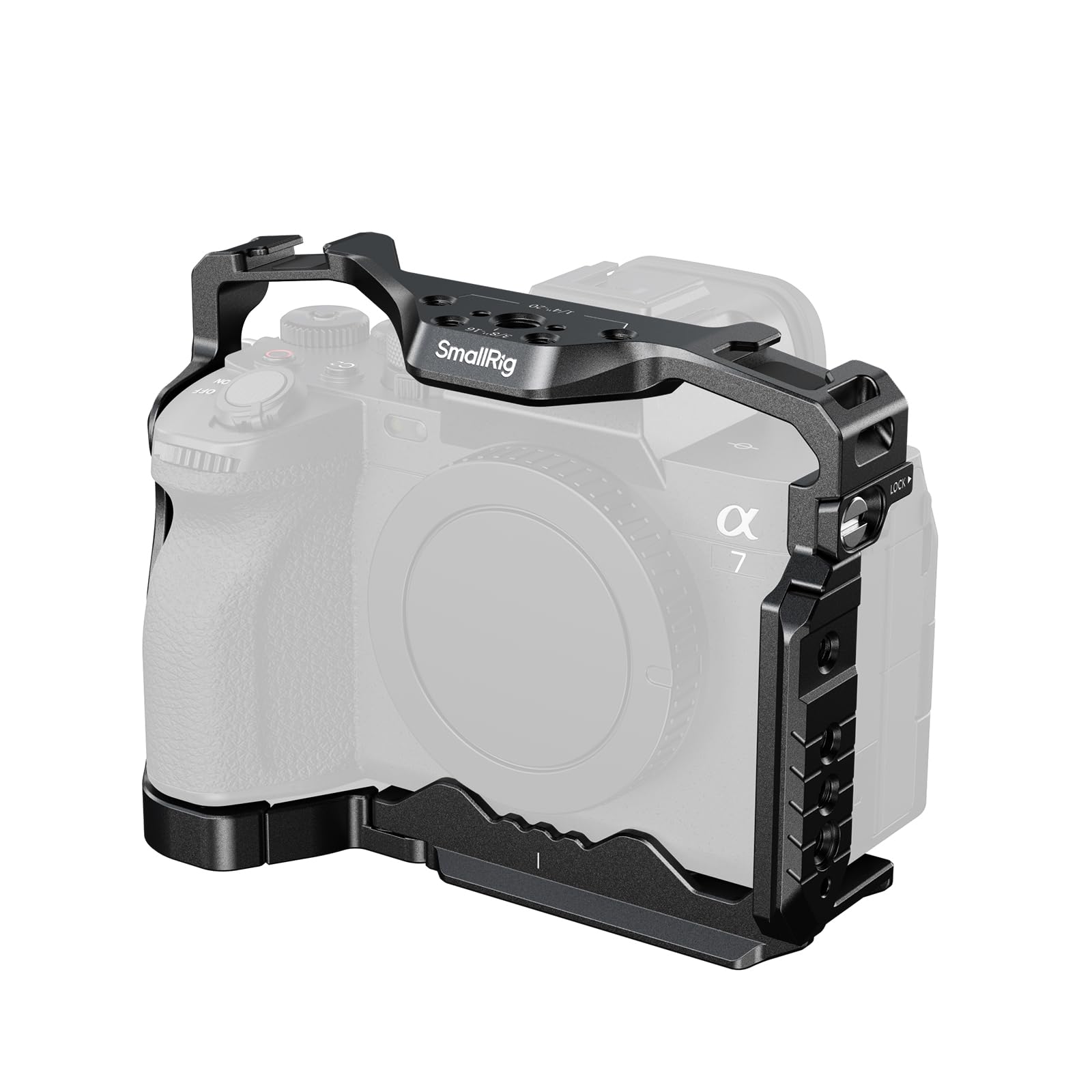
The bottom of this cage is an Arca-Swiss plate. That sounds like a small thing until you have spent a shoot unbolting a quick-release plate from a rig to move the camera between a tripod and a gimbal: here the plate is built into the cage, so the whole thing clicks into an Arca-style head and comes out again in one motion. It is the detail that decides our recommendation for Sony's A7 bodies.

Locking is where SmallRig earns the money. The camera is held by a 1/4"-20 screw, a side locating block, and a positioning pin, so three points share the load instead of one. A single screw lets a body twist when a long lens cantilevers off the front, and three points stop it. Pads sit between the frame and the camera, and the battery door, card slot, and ports stay clear once it is mounted.

At 180 g it disappears on a mirrorless body, which is the point of a cage you leave on all day. A cold shoe sits at the upper right of the frame where a mounted mic will not foul your hand, and a HawkLock NATO rail runs along the side for a handle or a monitor arm; the threaded holes cover 1/4"-20 and 3/8"-16 ARRI. The catch is scope: this cage is cut for the A7R V, A7 IV, A7S III, A1, A7R IV, and A7 V, and nothing else. If you shoot something different, the cage for your body is a different product altogether.

Pros

  • Built-in Arca plate skips the separate quick-release
  • Three-point locking resists twisting under a long lens
  • 180 g with pads and full port access

Cons

  • Fits only the listed Sony A7 bodies
Our verdict

For Sony A7 bodies, buy this one: the Arca plate and three-point locking make a heavy lens feel secure, and 180 g barely changes the camera.

Check Latest Price
3

Best for Sony ZV-E10

SmallRig ZV-E10 Cage 3538

95 /100
Keeper Score Outstanding

Key details

Base
Arca-Swiss quick release plate
Grip
Detachable silicone handle
Mounting
1/4"-20 and 3/8"-16 ARRI holes
Compatibility
Sony ZV-E10
Check Price on Amazon

The ZV-E10 is a small camera with a shallow grip, and the silicone handle on the right side of this cage fixes exactly that. It is contoured, detachable, and sits where your fingers already land, so the camera stops feeling like it is about to rotate out of your hand midway through a long handheld take. Of everything in this guide, it is the change we noticed first.

The current version was revised around two annoyances specific to this body. The space around the hot shoe is enlarged so a Sony ECM-W2BT mic or a flash sits properly instead of fouling the frame, and the battery compartment opening is bigger, which makes swapping cards and batteries less of a fumble in the field. The cage itself is a close-fitting half frame with 1/4"-20 and 3/8"-16 ARRI holes, an Arca-Swiss quick-release plate underneath, and a side lock plus M2.5 screw so the camera cannot rotate.

The trade-off is scope. This fits one camera, and if you change bodies it goes in a drawer. There is also no top handle in the box; SmallRig sells one that threads straight into the frame, and if you shoot a lot at waist height it belongs in the budget. For vlogging with the camera at chest height, the grip is the more useful of the two anyway.

Pros

  • Silicone right-hand grip transforms handheld comfort
  • Enlarged hot shoe and battery door clearance
  • Arca-Swiss base plus side lock and M2.5 screw

Cons

  • Top handle sold separately
  • Fits only the Sony ZV-E10
Our verdict

ZV-E10 owners should start here: the silicone grip is a genuine handling fix, and the cage stays clear of the hot shoe and battery door.

Check Latest Price
4

Best for Handheld Shooting

NEEWER CA016 Camera Cage

82 /100
Keeper Score Excellent

Key details

Base
Slim Arca-type plate
Grips
Dual contoured handgrips
Weight
8.11 oz
Compatibility
Universal DSLR and mirrorless
Check Price on Amazon

Two side grips change handheld shooting more than a top handle does. Instead of one hand under the camera and one on the lens, you get a handle in each palm, elbows in, and a rig you can hold steady for longer than a minute. That is the case for this NEEWER cage: contoured grips with a synthetic leather texture and finger ridges, shaped so a large hand wraps rather than pinches.

We like the base as much as the grips. Where a rod-based rig such as the Zeadio puts two rails under the lens, this one uses a slim Arca-type plate, and the space that frees up behind the camera is where your cables and your fore-and-aft balance adjustment live. The camera mounts on a single 1/4"-20 screw with a countersunk slot, so a flat screwdriver, or a coin in a pinch, gets it tight without hunting for an Allen key.

Mounting provision runs from 1/4"-20 and 3/8"-16 threads to cold shoes and ARRI locating holes on the top and bottom plates, and at 0.23 kg it is light enough to stay on the camera between shoots. The thing to know before ordering is the footprint: with both grips fitted the rig measures nearly a foot across, which is fine on set and awkward in a small bag. That width is the price of two-handed stability, and if you mostly shoot on a gimbal, a bare cage like the SmallRig 3667 is the easier carry.

Pros

  • Dual contoured grips for two-handed handheld work
  • Slim Arca base leaves room for cable routing
  • Light enough to leave on the camera

Cons

  • Nearly a foot wide with both grips on
Our verdict

The pick for two-handed handheld work: contoured side grips, a slim Arca base with room for cables, and a rig light enough to leave mounted.

Check Latest Price
5

Best for Heavy Rigs

Zeadio Camera Cage Rig

81 /100
Keeper Score Excellent

Key details

Base
Arca-type base
Weight
1.1 lb
Cold Shoes
Three cold shoe mounts
Load Capacity
44 lb (20 kg)
Check Price on Amazon

Forty-four pounds, or 20 kg, is the load this cage is rated to carry, and no camera you would put in it comes close. The number is still worth reading, because what it really describes is how much accessory weight the frame is built to hold without flexing: a monitor, a mic, a follow focus, and a matte box all hanging off one cage, with a long lens pulling at the front.

The mounting provision backs that up. Three cold shoes mean a light, a mic, and a receiver can each have their own without adapters, and there are ARRI locating holes plus 1/4"-20 and 3/8"-16 threads for arms. Two 15 mm rod guides run under the front for a follow focus or a lens support, and the base is Arca-type so it goes onto a standard head. At 500 g it is a substantial piece of aluminum, but it is holding the rest of the rig up rather than adding to what you carry in your hand.

This is the one we point at when a rig is going to grow. It is the most capable mounting platform in this guide, and the one to build a follow-focus setup around. What it is not is discreet: 40 cm folded, 500 g before a single accessory, and a frame that is universal rather than cut to your camera, so the body sits in a box instead of nesting into it. Shoot stripped down and most of what you paid for stays in the bag.

Pros

  • Three cold shoes for light, mic, and receiver
  • Twin 15 mm rod guides for follow focus
  • 44 lb load rating leaves headroom

Cons

  • Bulky at 500 g and 40 cm folded
Our verdict

Buy it if your rig keeps growing: three cold shoes, rod guides, and a load rating with real headroom, and accept the bulk that comes with it.

Check Latest Price
6

Cinema Light Control

FILMCITY FC-CTH-01 Cage Kit

81 /100
Keeper Score Excellent

Key details

Masks
4:3 and 16:9
Weight
5.07 lb
Matte Box
Lenses up to 95 mm
Rod Support
15 mm LWS, 60 mm spacing
Check Price on Amazon

Most cages in this guide are frames with threads. This one is a light-control kit that happens to include a full cage. The MB-600 matte box takes lenses up to 95 mm across, ships with 4:3 and 16:9 masks you swap for wide or standard framing, and adds 360° rotating filter holders plus a fold-down flag. A fabric donut seals against the lens so stray light does not sneak in behind the box.

The cage underneath follows the pattern FILMCITY uses elsewhere: a top handle, two anti-slip rubber side grips with vertical adjustment, a quick-release baseplate, 1/4"-20 and 3/8"-16 threads, a cold shoe, and 15 mm LWS rod support at 60 mm spacing. The handle and grips are what make a rig this size usable by hand, and the rods are what let the matte box and a follow focus sit in front of the lens where they belong.

Our reservation is weight and commitment. It is 2.3 kg before the camera goes on, which means a tripod or a strong pair of arms, and the 95 mm limit rules out the biggest front elements. What we appreciate is the arithmetic: buying the cage and the matte box as one kit saves you matching rod spacing and lens diameter yourself, and if you are building a first cinema rig around a mirrorless body with modest glass, this covers both jobs in one order.

Pros

  • Matte box for lenses up to 95 mm
  • Interchangeable 4:3 and 16:9 masks
  • Full cage with top handle and adjustable side grips

Cons

  • 2.3 kg before you add a camera
Our verdict

A sensible single purchase for a first cinema build: a full cage and a 95 mm matte box that already share the same rod spacing.

Check Latest Price

How We Tested Camera Cages

We built the shortlist by researching cages for popular mirrorless bodies and universal rigs, then filtering for camera fit, port and control access, accessory standards, and budget. We ended with 12 cages and spent seven months using them the way they actually get used: building rigs at a desk, carrying them handheld through a park, shooting low-angle in a hallway, and swapping between tripod and handheld setups. Each cage was fitted to a camera body, loaded with a top handle, monitor, mic, and small light, then carried one-handed by the top handle and side grip while we noted flex, balance, and hot spots.

Fit came first. I opened every port door, pulled the battery and card, tilted the screen, and checked lens clearance with a wide zoom attached. Sturdiness and build quality were judged by twisting the cage at its corners, looking for paint rub and rattles, and repeatedly installing and removing each mounting screw to see whether the threads held or the heads cammed out. We also slid every Arca-type base into a tripod head and mounted a cold-shoe mic to catch wobble.

Mounting options got a practical workout: we attached a monitor arm, microphone, light, and where the cage allowed it, 15mm rods, then checked whether the added gear crowded the lens or blocked controls. Quick-release plates were judged by how cleanly they locked and released, and grips by whether a full rig still felt controllable after ten minutes in hand. The cages that survived the rotation were the ones that stayed tight, left the camera usable, and made accessories feel like part of the rig rather than an afterthought.

How to Choose a Camera Cage

Fit comes before features

Almost every cage here is either universal or cut for one body. Universal frames work from a size range: the CAMVATE basic rig takes cameras up to 124 mm tall, about 4.9 inches, which covers most DSLRs and mirrorless bodies. A body-specific cage such as the SmallRig 3667 for Sony's A7 line fits one family and nothing else. Measure your camera's height and compare it with the stated range before anything else.

A snug fit buys more than tidiness. A cage cut for your camera wraps its edges and stays put when you tighten an arm onto it, while a universal frame leaves gaps that a long lens can exploit. If you shoot one body and plan to keep it, the specific cage is usually worth the extra.

Count the threads, then look at the spacing

Mounting points are the reason to buy a cage, and they are not interchangeable. A cold shoe holds a mic, a light, or a wireless receiver and nothing heavier. A 1/4"-20 thread carries an articulating arm or a monitor. The 3/8"-16 and ARRI locating holes are the sturdier standard for arms and handles on bigger builds. The Zeadio's three cold shoes exist so a light, a mic, and a receiver can each have their own.

Spacing matters as much as the count. An arm needs two holes close enough together to reach, so check that the holes you plan to use sit near each other rather than scattered around the frame.

Decide how you'll actually hold it

Top handles, side grips, and built-in grips do different jobs. A top handle is for carrying the rig, framing at waist height, and handing the camera to someone else, and the CAMVATE cage is built around one. A pair of side grips, as on the NEEWER CA016, is for two-handed handheld work at chest height. A built-in silicone grip such as the one on the ZV-E10 cage is for one-handed work with a small body.

If the camera lives on a gimbal, buy the smallest cage that still carries your accessories. Every handle you add has to be balanced, and a bare half cage is far easier to trim than a full rig with three grips.

The base decides how fast you can move

Two base styles cover this category. A built-in Arca-Swiss plate, on the SmallRig cages and the NEEWER, lets the whole rig click into an Arca-style head or gimbal plate without a separate quick-release, which is the difference between a quick swap and a slow one. A rod-based baseplate, as on the Zeadio and the FILMCITY kit, adds 15 mm LWS rails for a follow focus, matte box, or lens support.

Choose the base from your accessories rather than the other way round. If you have no plans for rails, a rod base is weight you carry for nothing.

Weight, material, and access

An aluminum frame is what most of these picks share: it holds a thread cleanly and does not flex when you crank an arm down onto it. Weight is the trade, and it adds up faster than the number suggests once a monitor and a mic are hanging off the front.

Then look at the cutouts. Battery door, card slot, ports, and hot shoe all need clearance, and the cage revisions that matter are usually here rather than in the frame. SmallRig widened the hot shoe and battery openings on the ZV-E10 cage precisely so a Sony mic and quick card changes stay possible.

Frequently Asked Questions

Final Verdict

Buy the CAMVATE Basic Camera Cage Rig if you want one cage for the camera you own right now: an aluminum frame, a top handle, and enough threads for a mic and a monitor, at the lowest price in this guide. It stops being the answer the moment your body measures more than 124 mm tall or you want two-handed side grips.

Sony A7 shooters should go straight to the SmallRig 3667, which adds three-point locking and a built-in Arca plate. ZV-E10 owners get more from the silicone grip on their own SmallRig cage than from any add-on handle.