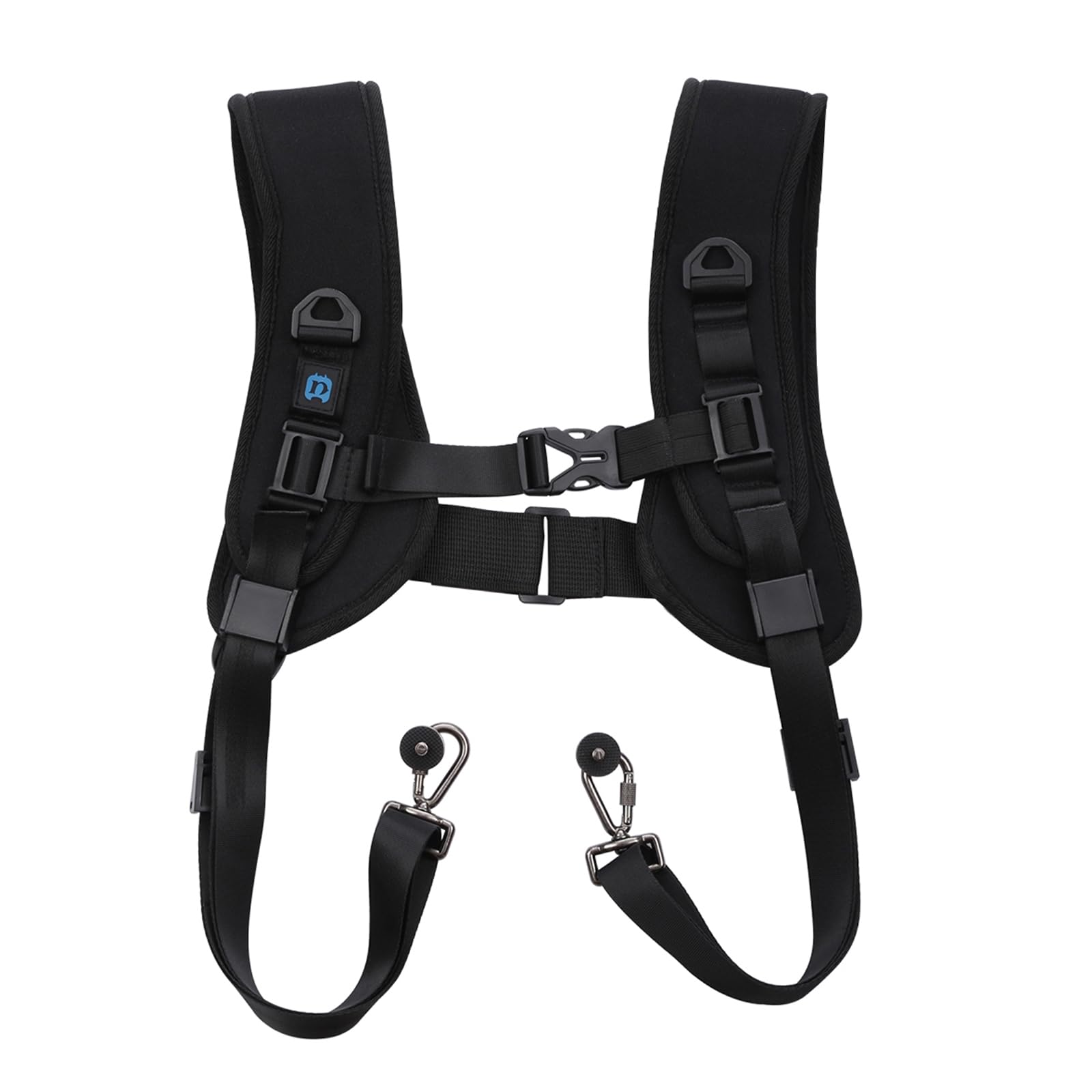
Best Camera Harnesses of 2026

A camera hanging from a neck strap is fine for about twenty minutes. After that you're lifting the body with one hand between shots, or leaving it in the bag and shooting with your phone instead. A harness moves that weight onto your shoulders and across your back, which is why photographers who work six-hour days switch to one and never go back.

My team wore 12 different harnesses over six months — portrait sessions, hikes, crowded events — and price turned out to be a poor predictor of comfort. What separated them was where the load actually landed, whether the camera stayed put when you bent over, and whether the hardware got it to your eye without a fumble. Leather or webbing, one camera or two: the wrong format is uncomfortable no matter how well it's made.

Fit is the part nobody warns you about — a harness adjusted for a tall frame can hang wrong on a shorter one, and you feel it in your collarbone by lunchtime. The picks below span single and dual setups, leather and technical materials, and plenty of adjustment.

Keeper Score summarizes customer ratings and review volume. Read it alongside the product details and trade-offs. How the score works.

1

Best Overall

Cotton Carrier CCS G3

92 /100
Keeper Score Outstanding

Key details

Mount
Twist & Lock hub
Weight
1.46 lb
Safety Tether
Included
Cameras Carried
One
Check Price on Amazon

A small aluminum hub screws into your camera's tripod socket, the camera twists into a mount on the chest panel, and it rides flat against your sternum with the lens pointing at the ground. That's the whole idea behind the CCS G3, and it's the one harness here that made a heavy zoom feel like something we could carry all day rather than nurse from hand to hand.

What we didn't expect was how much the mount changes the feel. There's nothing to swing: the camera stays put when you bend over, climb a gate, or scramble up a slope, and the lens hold-down strap stops a long barrel from levering away from your body. After a couple of hours we stopped checking whether it was still attached, which is not something we can say about a neck strap.

It is a vest, and it feels like one. The panel and webbing are substantial, the harness alone weighs 0.66 kg, and on a warm day you'll be aware of it across your back. That's the trade for the stability, and the reason it suits a hike or a climb better than a city walk.

Cotton Carrier also includes a rain cover and a backup tether, both of which earn their place in a bag. Add up the mount, the load path, and the hardware, and this is the harness we hand people who shoot wildlife, climb with a camera, or simply can't face another day of neck ache.

Pros

  • Twist-lock hub holds a heavy body flat
  • Load carried by back and shoulders, not the neck
  • Backup tether and rain cover included
  • Fast, one-handed camera release

Cons

  • Single-camera mount only in this version
Our verdict

The harness we recommend for heavy bodies and long lenses: the twist-lock hub holds the camera flat and moves the load off your neck.

Check Latest Price
2

Best Budget

USA Gear Chest Harness

92 /100
Keeper Score Outstanding

Key details

Weight
6.4 oz
Storage
Accessory pockets
Material
Neoprene
Cameras Carried
One
Check Price on Amazon

The least expensive harness here, and for a light camera it does most of what the expensive ones do. A neoprene chest panel carries the camera on two sliding brackets, four quick-release buckles get it on and off, and the whole harness weighs 6.4 ounces.

On a hike it disappears. The camera sits at chest height, the weight goes to your shoulders instead of the back of your neck, and you can pop the front buckles and lift the harness off over your head with the camera still attached, which is useful when you're getting into a car or ducking out of the rain. The little accessory pockets turned out to be the detail we used most: a lens cap, a spare card, a battery, all reachable without a bag.

Weight is where it gives ground. The sliding brackets let the camera sit further from your chest than a locking hub, so a long lens swings as you walk; shortening the shoulder straps so the camera rides high fixes most of it. It's also the harness we reach for with a compact or a kit lens, not with a pro body and fast glass.

Anyone carrying two bodies or a long telephoto should look further up this list. For everything lighter, it's the sensible place to start, and it packs flat enough to live in a daypack between trips.

Pros

  • Takes the camera's weight off the neck
  • Quick-release buckles come off over your head
  • Pockets for caps, cards, and batteries
  • Packs flat and weighs 6.4 ounces

Cons

  • Straps run long on smaller frames
Our verdict

Our budget pick: a light, packable chest harness that takes a mirrorless kit off your neck and keeps cards and caps within reach.

Check Latest Price
3

Best for Two Cameras

C Coiro Dual Leather Harness

92 /100
Keeper Score Outstanding

Key details

Material
Leather
Harness Style
Dual shoulder
Cameras Carried
Two
Check Price on Amazon

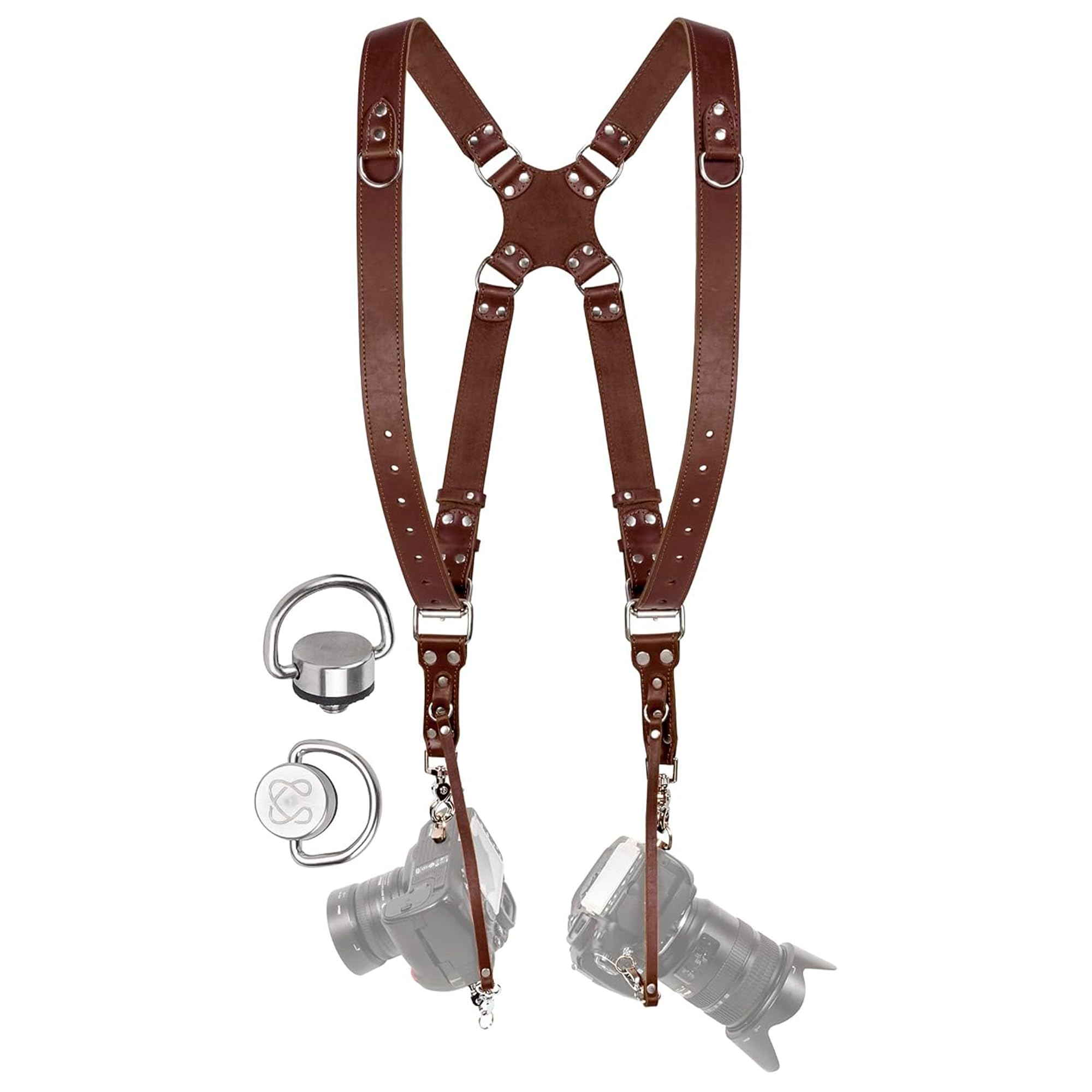
Two harnesses here are built for serious loads, and they solve the problem in opposite directions. The Cotton Carrier hangs one camera from a rigid chest hub; this C Coiro harness hangs two from leather straps over both shoulders, one body at each hip. Shoot events and swap cameras every few minutes, and the second arrangement is the one that keeps both within reach.

The leather is what people notice first: thick, soft, closer to a good bag strap than to webbing, with metal buckles and a finish that looks deliberate at a wedding rather than like camera gear. Two bodies with battery grips and 70-200s hang balanced, and the weight lands across the tops of both shoulders.

Across a long day the leather softens and the balance holds. Two cameras stay put across your shoulders instead of dragging to one side, and neither swings into your ribs the way a single strap lets it. That even distribution is the reason to choose this over a pair of separate slings.

For two-camera event work this is the harness we recommend. The leather, the balance, and the speed of access make a long wedding day easier on your shoulders than any pair of separate straps.

Pros

  • Two bodies balanced across both shoulders
  • Thick leather that looks the part at events
  • Quick access to either camera

Cons

  • Clasps can work loose under heavy bodies
  • Runs long on shorter torsos
Our verdict

Our pick for two-camera event work: thick leather that balances two bodies comfortably and keeps both cameras within reach.

Check Latest Price
4

Best Two-Camera Vest

Nicama Two-Camera Vest

86 /100
Keeper Score Excellent

Key details

Weight
1.41 lb
Material
ABS
Screw Adapters
Two 1/4-inch
Cameras Carried
One or two
Check Price on Amazon

Nicama's vest is the two-camera workhorse of this group: two screw plates lock into chest slots, a backup safety strap catches a camera if the lock lets go, and the whole rig costs a fraction of the leather or hub systems. It carries one camera as happily as two.

What we like is how little fuss there is once it's set up. Cameras drop into the slots and lock, a quick pull frees them, and you can swap between bodies without lifting a strap over your head. The load sits across the shoulders and back, which is the whole point when you're carrying two bodies up a trail.

Setup is the catch. The shoulder straps and Velcro anchors need to be set before you go, and it's worth having someone help with the first fitting, because doing it alone in a parking lot is a wrestling match. Set wrong, the straps sit on your neck instead of your shoulders. A squeak can also develop on a long hike.

For regular event work, hiking, and anything where two bodies need to be out of your hands, it earns its keep. The two-camera workflow it enables is worth far more than the harness costs, and the mesh carry bag it ships with is a small bonus.

Pros

  • Two cameras locked to the chest
  • Backup safety strap on the mounts
  • Quick swap between bodies
  • Load off the neck on long hikes

Cons

  • Plastic camera plates can crack
Our verdict

The value two-camera vest: screw-plate locks and backup straps for a fraction of the premium harnesses, once you've set the fit.

Check Latest Price
5

Best Leather for One Camera

Padwa Leather Harness

88 /100
Keeper Score Excellent

Key details

Material
Full grain leather
Strap Width
1 inch
Shoulder Pad
2 inches
Cameras Carried
One
Check Price on Amazon

This is not a vest and it doesn't carry two cameras. It's a single strap of full-grain leather that crosses your back, sits on a two-inch shoulder pad, and holds one camera at your hip. If you want a body on each side, look at the dual harnesses here; if you want one camera off your neck without wearing a piece of equipment, this is the one.

The leather is genuinely nice: thick, glossy, dark brown, and it softens with use. A camera at the hip doesn't swing into your stomach the way a chest-hung body can, and the wide pad keeps the strap from cutting into your shoulder. It also looks like a camera strap rather than a harness, which matters if you'd rather not look like a walking accessory rack.

Two practical notes. The bottom anchor screws into the camera's tripod socket, so once it's attached you can't set the camera down flat on a table without unscrewing it, which is mildly annoying at a cafe. And the length adjusts, but not endlessly: on a shorter frame the camera ends up lower than is comfortable.

What keeps it in the bag is how little harness there is. It goes on over a jacket, folds into a daypack, and the leather molds to your shoulder with use. For one camera, one lens, and a day of walking, that's a nicer carry than any vest here.

Pros

  • Full-grain leather that looks like a strap, not gear
  • Two-inch shoulder pad spreads the load
  • Camera rides at the hip without swinging

Cons

  • O-rings are the lightest hardware on it
Our verdict

For one camera and a light lens, this leather harness moves the weight to your hip without putting a vest on your body.

Check Latest Price
6

Mirrorless Pairs

PULUZ Dual Camera Harness

86 /100
Keeper Score Excellent

Key details

Mount
1/4-inch screw
Padding
Soft shoulder pads
Release
Quick release
Cameras Carried
Two
Check Price on Amazon

Two cameras for less than most of the single-camera harnesses here, and the surprise is that the hardware doesn't feel like a compromise. Metal latches, 1/4-inch screws, padded shoulder sections, and a quick release on each side.

In use, two bodies sit at chest height within a hand's reach of each other, so swapping from a wide to a long lens is a two-second move rather than a strap shuffle. The pads keep the webbing off your collarbones, the screws thread straight into the tripod sockets, and the whole thing folds into a bag when you're done. For a pair of mirrorless bodies with mid-size lenses it's stable and quick.

The value case is strongest for mirrorless pairs. Two gripped DSLRs with long glass are better served by the leather or hub harnesses here, which put more structure under the load, and the padding on this one is there to soften the straps rather than to carry serious weight. For compact bodies, it's plenty of harness for the money.

Pros

  • Two cameras for a budget price
  • Sturdy metal latches
  • Comfortable, secure, easy to adjust

Cons

No notable drawbacks to flag.

Our verdict

Two cameras for less than most single-camera harnesses here, with metal latches and a padded carry that suits a mirrorless pair.

Check Latest Price
7

Wedding Days

Ruby+Rae The Duo

85 /100
Keeper Score Excellent

Key details

Bag
Removable crossbody
Interior
Suede
Material
Vegan leather
Cameras Carried
Two
Check Price on Amazon

The middle of this harness carries a small crossbody bag, with card slots and room for batteries and a phone. For a wedding or a portrait session, that's the difference between bringing a shoulder bag and not, and the pouch unclips when you don't want it.

What sells it is the finish: vegan leather, a suede lining, and gold hardware, so it reads as a nice bag with a harness built in rather than camera equipment. It suits a wedding or an engagement shoot where you're in the photographs as well as taking them, and the two mounts sit at the hips where both hands can reach them.

Two things to expect. The straps run long on a small frame, so check the fit over the clothes you'll actually shoot in, and with only one camera clipped on, the empty second mount feels a bit odd. Neither is a deal-breaker for the wedding shooter it's built for.

For a two-body shooter who wants to leave the backpack in the car, it's the only harness here that carries the small kit too, and it does it in something you won't mind being photographed in.

Pros

  • Built-in crossbody bag for cards, batteries, phone
  • Vegan leather and suede lining look the part
  • Removable bag when you don't need it

Cons

  • Bag is too small for a spare lens
Our verdict

For two-camera weddings, this is the harness that doubles as a bag, and it looks like it belongs at the reception.

Check Latest Price
8

Light Travel Kit

Vigorport X Harness

85 /100
Keeper Score Excellent

Key details

Buckle
Quick release
Weight
4.59 oz
Material
Elastic nylon
Cameras Carried
One
Check Price on Amazon

At 0.13 kg it folds into a jacket pocket, and that's the reason it ends up in the bag on days when we're not sure we'll want a camera. An X of elastic webbing goes over both shoulders, a quick-release buckle closes at the chest, and the camera hangs at belly height.

What it does well is the light-camera day. A mirrorless body or a point-and-shoot stops swinging, the weight comes off your neck, and the stretch lets you lift the camera to your eye without unclipping anything. On a long walk with a small kit we stopped noticing we were wearing it.

It's a fit-sensitive design. The X crosses high on the chest, and larger-chested wearers find it tight; the side straps also run short on some frames. If that describes you, one of the vest-style harnesses here avoids the problem entirely.

For travel, a hike with a compact, or a second camera you want out of the way, it's the least fuss and the least money here. Ours lives at the bottom of a daypack for exactly that.

Pros

  • Elastic X spreads weight across both shoulders
  • Stretch lets you raise the camera without unclipping
  • Packs down to almost nothing

Cons

  • Elastic bounces under a heavy zoom
Our verdict

For a light camera and a long walk, this stretchy harness is the simplest, cheapest way to get the weight off your neck.

Check Latest Price

How We Chose and Tested These Camera Harnesses

We started with research — pulling every harness we could find, sorting by single- versus dual-camera configuration, strap material, buckle type, and price — then narrowed that field down to 12. Each one was worn by at least three people on my team, from about 5-foot-3 to 6-foot-4, because a harness that rides well on one frame can sit badly on another.

Every harness went through a full-day portrait shoot, a sunrise hike with a camera body and zoom lens aboard, and a crowded indoor event where the camera came up and down constantly. We noted where the weight actually landed — shoulder blades versus the base of the neck — and checked for red marks at the end of the day. We bent over to tie a shoe, jogged up a flight of stairs, and leaned over a railing to see whether the camera stayed pinned or swung out. We also wore each one over a plain T-shirt and over a jacket to judge whether it read as camera gear or as something you'd wear on a trail anyway.

Every buckle got opened and closed one-handed with the camera at eye level, since that's where a quick release either earns its keep or fumbles. We ran each harness from its shortest setting to its longest and counted how many adjustments that took, then repeated the fit over a tee, a rain shell, and a winter coat; on the dual rigs, we checked whether one side could be run empty without the whole thing pulling sideways. Over six months we watched stitching, webbing, and leather for fraying, stretching, and hardware that rattled loose, and weighed the pads, pockets, and extras in the box against the price. Value here isn't the cheapest harness — it's the one you forget you're wearing by hour six.

How to Choose a Camera Harness

Match the harness to the load

Two questions settle more than any feature list: how many bodies you carry, and what each one weighs with its lens mounted. A compact mirrorless and a kit zoom ride happily on a light elastic harness; a full-frame body with a 70-200 needs a mount that holds the lens flat against your chest and a strap layout that spreads the load across your back. Dual harnesses roughly double both the weight and the strap count, so go that way only if you genuinely shoot two bodies. Weigh your heaviest working combination before you shop, then read the harness against that number.

Where you want the weight to land

Neck strain is the problem every harness here solves, but they solve it three ways. Vest-style systems put the camera on a rigid chest mount and drive the load into your shoulders and back, which is the steadiest arrangement for long glass and the hottest to wear. Leather or webbing double-strap harnesses hang a camera at each hip and balance across both shoulders. Elastic X-harnesses weigh almost nothing and support almost nothing. Whichever you pick, the shoulder sections have to clear your neck rather than sit on it; if a harness only feels right when you hold your shoulders up, it doesn't fit.

How the camera locks on

Fixation matters more than it sounds. A screw-and-slot plate takes a 1/4-inch screw into the tripod socket and drops into a chest slot; a twist-lock hub holds the camera on a dedicated mount that twists into place; clips and brackets at the strap ends are the lightest and quickest option. Plates and hubs hold a heavy lens flatter and let you release one-handed, which is why the harnesses built for big glass use them. Clips suit light bodies but can work loose over a day of walking. Use the backup tether, and check screws and clasps before you head out.

Fit is mostly about torso length

One size rarely fits all, and the measurement that matters isn't your height, it's where the mount lands on your torso. Set the harness so the camera sits between your sternum and your navel. Lower and it swings against your thighs; higher and it fights your arms. Short torsos run out of strap adjustment, and large chests can find an X-harness tight across the front, which is where a vest-style harness wins. Adjust everything at home, over the layers you really shoot in, before you commit to it.

Pockets, bags, and long days

Once load and fit are settled, the extras decide which harness you enjoy wearing. Pockets take a lens cap, a spare card, and a battery, which are exactly the things you otherwise dig through a bag for. A built-in pouch can stand in for a shoulder bag at a wedding. Then think about heat and layering: neoprene and close-fitting vests get warm, leather doesn't breathe much either, and a backpack worn over a harness can bunch at the shoulders. Put the harness on first, the pack over it, and check that the back panel lies flat.

Frequently Asked Questions

Final Verdict

Most people carrying real glass should start with the Cotton Carrier CCS G3. The twist-lock hub holds a heavy body flat against your chest, the load lands on your shoulders and back rather than your neck, and the included tether gives you a second line of defence when the ground gets rough.

Carrying a lighter kit, or working to a tighter budget? The USA Gear chest harness does the essential job and packs flat in a daypack. For two bodies at a wedding, the C Coiro leather harness balances both cameras and looks the part, and we'd tell anyone shooting events to add a safety tether to each camera.