Best Waterproof Camera Bags of 2026

The worst camera bag failure isn't a torn strap—it's opening it after a downpour and finding water beside your lens. A truly waterproof bag needs sealed zippers or a hardshell, enough structure to protect a body and a couple of lenses, and a harness that still feels fine after a long walk. Over eight months, I carried 12 camera bags through wet hikes, crowded commutes, and airports; by the end of a day, the differences are obvious.

Storage is the other half: a bag can be the right size on paper and still fit badly once you add a tripod, laptop, or spare lens. I also watched value—whether the materials, padding, and rain protection justify the cost—and strap quality, since a flimsy shoulder pad makes a loaded bag miserable.

The picks below run from hardshell backpacks to compact slings and crossbody cases, so the right one depends on how much gear you carry and how far you walk. Each earned its place by keeping gear dry and accessible, not just looking rugged.

Keeper Score summarizes customer ratings and review volume. Read it alongside the product details and trade-offs. How the score works.

1

Best Overall

K&F Concept Hardshell Backpack

93 /100
Keeper Score Outstanding

Key details

Weight
1,270 g
Capacity
22 liters
Water Protection
Waterproof EVA hard shell
Laptop Compartment
15–15.6 in
Check Price on Amazon

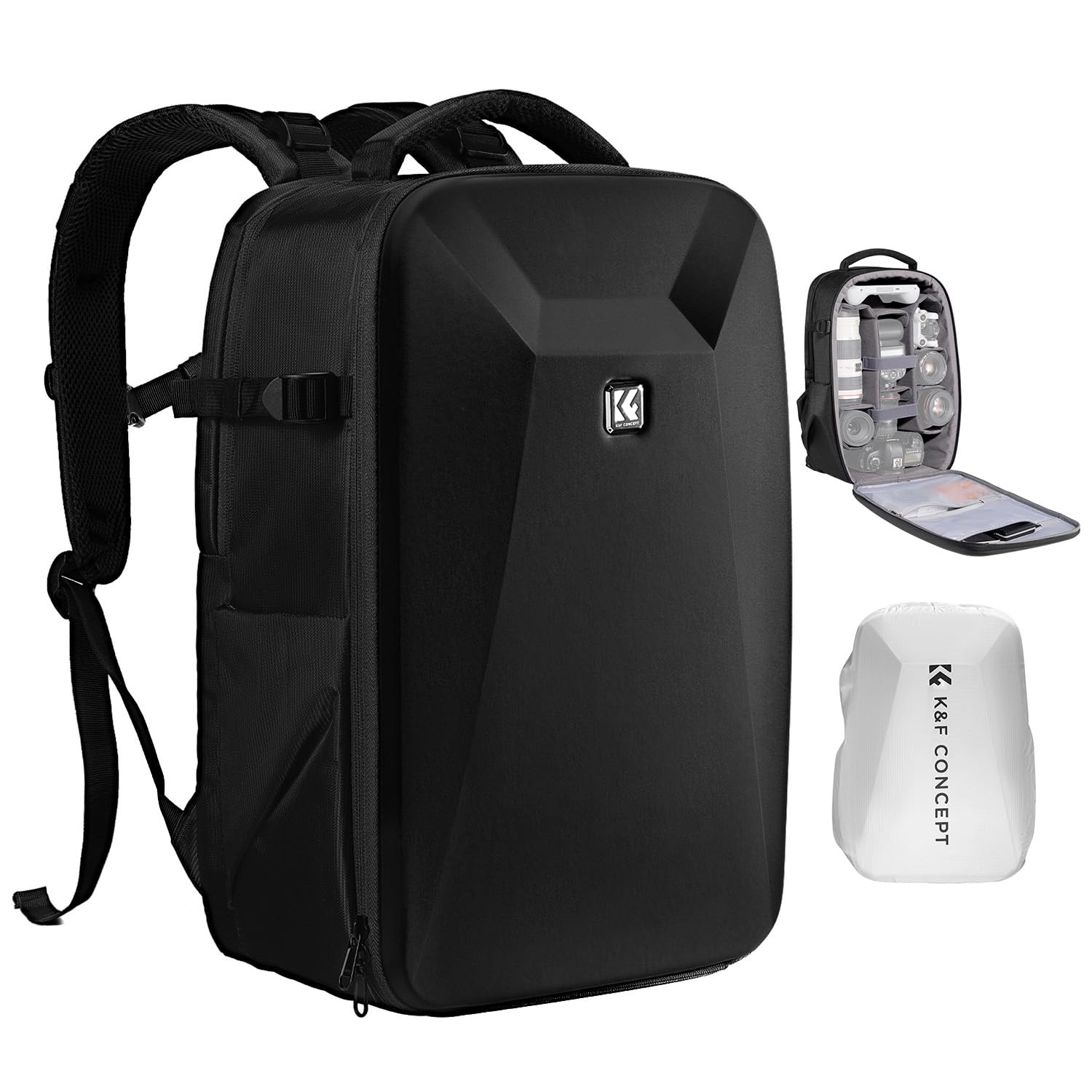
The front of this pack is a single molded EVA shell, and that's the detail that separates it from everything else here. A fabric front panel is where a camera bag usually loses its fight with weather: water beads on the coating, then works at the seam. One molded piece has far fewer places to get in, and it spreads a knock across the whole panel instead of driving it into one pocket.

At 22 liters it's also the size we keep coming back to as the most useful compromise in this group — big enough for a body with a long zoom mounted plus two or three more lenses, small enough that you'll still pick it up for a four-mile walk. The 15 to 15.6-inch laptop sleeve and the trolley belt on the back make it the easiest of these bags to fold into a trip that involves a flight.

The front flap opens all the way down, so the interior lies flat and the stiff, repositionable dividers give a 70-200 and two primes a wall each. It takes a mirrorless body with a 180-600 attached, which is more than 22 liters usually suggests, and it stands up on its own when you set it down to change a lens — a small thing that matters on wet ground.

Two things to know before you commit. Everything comes out through that front flap, which is fine at a trailhead and awkward in a crowd, since opening the bag means showing your whole kit. And the shell keeps its shape whether or not you've filled it, so it holds its bulk on the days you're carrying less.

Pros

  • Molded hard shell over the whole front
  • 22 liters takes a body with a long zoom mounted
  • Laptop sleeve and trolley belt for travel
  • Stands upright when set down

Cons

  • Six-month warranty is short for the money
Our verdict

Our pick for most photographers: a molded hard front, 22 liters, a laptop sleeve and a trolley strap, at a price that still counts as midrange.

Check Latest Price
2

Best for Large Kits

Mosiso Camera Backpack

95 /100
Keeper Score Outstanding

Key details

Weight
3.2 lb
Capacity
35 liters
Water Protection
Waterproof PU hardshell front
Laptop Compartment
Up to 15.6 in
Check Price on Amazon

Two compartments, stacked the long way: a camera insert in the upper half behind the hardshell front, and the laptop and accessory pockets flat against your back. That split does real work. The camera comes out of the top without the laptop being exposed to the weather, and the flat, protected things end up where your back can look after them.

What earns it a place is capacity. At 35 liters and 17.32 by 11.8 by 7.5 inches it takes two bodies, a long zoom mounted, and still has room for a laptop, a tripod strapped to the side and a layer. We think of it as the bag for the trip where you can't decide what to leave at home — and at 3.2 pounds empty, the one that asks you to be honest about what you actually shoot.

It's a travel bag first. Nine pockets and three compartments mean there's a place for cables, cards and a power bank, and the hardshell front wipes clean with a damp cloth — useful after the bag has spent an hour on an airport floor. Measure before you commit, though: 17.32 inches tall and 7.5 inches deep is a large pack, and it doesn't compress the way a soft bag does.

Pros

  • 35 liters takes two bodies and a long zoom
  • Hardshell front over the camera compartment
  • Separate laptop sleeve up to 15.6 inches
  • Tripod holder and wipe-clean shell

Cons

  • Harness is the weak point under a heavy load
Our verdict

Buy it when the kit keeps growing — 35 liters takes two bodies and a long zoom, with room left for a laptop.

Check Latest Price
3

Best Budget

CADeN D6 Camera Backpack

95 /100
Keeper Score Outstanding

Key details

Weight
1.7 lb
Kit Fit
1 body + 4 lenses
Capacity
17 liters
Water Protection
Waterproof coated fabric
Check Price on Amazon

1.7 pounds. That number is the whole argument for this bag. It holds a camera body, four lenses, a flash and a tablet in 17 liters, and it's the lightest backpack here by a wide margin — you'll notice the difference at the end of a day, not on the first mile.

The D6 does the simple things properly. The shell is waterproof and scratch resistant, the dividers hold their position so lenses don't knock together, there's a hidden zip pocket on the front and a tripod strap on the side. Inside, 11 by 5.9 by 15 inches takes a 13-inch laptop or an iPad Pro 12.9 in its own sleeve, and one body plus four lenses is a realistic load rather than an optimistic one.

Where it gives ground is at the edges: the tripod holder wants a compact set of legs rather than a full-size set. For a first camera bag, a second bag that lives in the car, or anyone on a strict budget, that limit never comes up. It's the least expensive backpack here, it carries a one-year replacement promise, and it does the basic job without asking you to think about it.

Pros

  • 1.7 pounds empty
  • 17 liters for a body and four lenses
  • Waterproof, scratch-resistant fabric
  • Cheapest backpack in this group

Cons

  • Coated fabric, not a hard shell or sealed zip
  • Tripod holder suits only a compact tripod
Our verdict

The bag we point at when the budget is tight and the kit is small: 1.7 pounds, 17 liters and a year's replacement cover.

Check Latest Price
4

Best Shoulder Bag

Lowepro Nova 180 AW II

90 /100
Keeper Score Outstanding

Key details

Weight
1.48 lb
Kit Fit
Pro DSLR + 3–4 lenses
Capacity
6.6 liters
Water Protection
All-Weather AW cover + waterproof zip
Check Price on Amazon

The rain cover on this Lowepro is stitched into the base of the bag, so it's always with you. Pull it out and stretch it over the top and the whole bag is covered — no separate pouch to remember and nothing left behind in the car when the sky turns.

That's the right way to solve weather on a shoulder bag, and Lowepro backs it up with a waterproof main zip, so the opening stops being the weak point once the cover is on. Full padding throughout, flexible dividers you can build walls with, and a front pouch that keeps filters and a sensor cleaner within reach without opening the main compartment.

6.6 liters is shaped for a working kit: a pro-depth DSLR with a lens mounted, three or four more lenses, a flash and the small stuff. It carries a Nikon D750 with a 70-300 attached and room to spare, and the adjustable shoulder strap and cushioned grab handle move it between car, venue and hotel without fuss.

This is the bag for a photographer who works out of a shoulder bag — lens changes at hip height, nothing swung around on a crowded street, and a cover that's already attached when the weather breaks. It carries less than the backpacks here, and the format, not the build, is the reason. If that format suits how you shoot, the cover and the padding make it the nicest bag here to actually use.

Pros

  • All-weather cover stitched into the bag
  • Waterproof main zip backs up the cover
  • Fits a pro DSLR with lens plus three or four more
  • Two-year warranty

Cons

  • Premium price for a compact 6.6-liter bag
Our verdict

For photographers who work with lenses at hip height, this is the nicest shoulder bag here, with a cover stitched into the base.

Check Latest Price
5

Best Everyday Sling

K&F Concept 2-in-1 Sling

92 /100
Keeper Score Outstanding

Key details

Weight
1.32 lb
Capacity
10 liters
Interior
10.6 x 6.7 x 4.1 in
Water Protection
Water-resistant PU-coated nylon
Check Price on Amazon

Nobody looks at this bag and sees a camera bag. The shell is recycled nylon canvas, double-coated with PU, in a plain shoulder-bag shape with no logo announcing what's inside — which is the point when you're carrying a body and two lenses through a city.

It's the sling we take when the plan is one camera, a couple of lenses and a lot of walking. Ten liters, 600 grams, a strap that runs from 34.25 to 55.1 inches so it sits where you want it across the body, and a flexfold divider that bends around a body with a lens mounted. The straps underneath hold a small tripod by the legs and keep it out of your hands.

The thing to check is the interior: 10.6 by 6.7 by 4.1 inches is generous for a mirrorless body and two primes, and tight for a full-frame body with a grip. If that's your camera, you want a backpack here or a bench to swap lenses on. For everyone else it's the bag that leaves the house without a decision.

Pros

  • Looks like a plain shoulder bag, not camera gear
  • 10 liters for a body and two or three lenses
  • Tripod straps underneath the bag
  • 600 grams with a wide adjustable strap

Cons

  • Water resistant only, not sealed for steady rain
Our verdict

The discreet choice for everyday shooting: a body, two lenses and a tripod underneath, without announcing itself as camera gear.

Check Latest Price
6

Best Expandable

Besnfoto Roll-Top Backpack

90 /100
Keeper Score Outstanding

Key details

Weight
4.08 lb
Capacity
23 liters
Dividers
7 removable padded
Water Protection
Water-resistant TPU shell
Check Price on Amazon

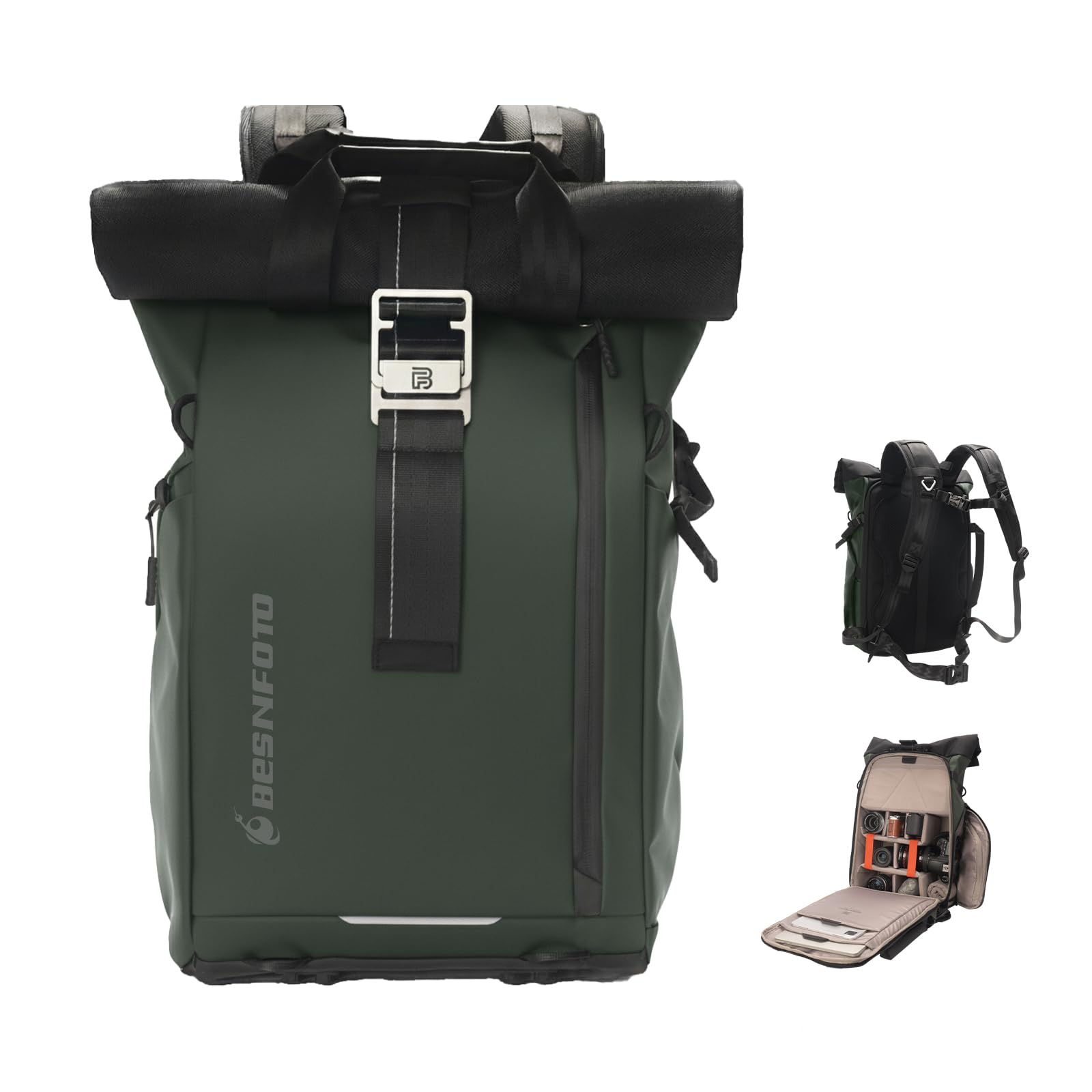
The top of this pack rolls down and buckles the way a dry bag does, and that's what makes it useful on a real trip: it's a 23-liter camera bag on the flight out, and on the way home you unroll the top and it takes the jacket and the things you didn't plan to buy.

Under the roll-top it's a proper camera pack — seven removable padded dividers, a side panel that opens onto the camera compartment, a laptop sleeve and a rain cover in the box. The TPU-coated shell feels soft and slightly rubbery, sheds water and wipes clean, and we think it's the best-looking bag in this group.

The trade is weight. At 1.85 kg empty it's the heaviest bag here for its capacity, and the roll-top and padded structure that make the expansion work are most of the reason. Between airports and hotels that's a fair swap for the flexibility. On a long hike you feel every gram of it, and the extra capacity buys you nothing you need.

Pros

  • Roll-top grows the bag when you need it
  • Seven removable padded dividers
  • Rain cover included over a TPU shell
  • Best-looking pack in this group

Cons

  • Strap clips and elastic loops wear before the shell
Our verdict

Worth it if one bag has to cover a long trip — roll it down for the flight, unroll it for whatever you bring home.

Check Latest Price
7

Compact Cameras

FOSOTO Crossbody Camera Bag

93 /100
Keeper Score Outstanding

Key details

Weight
9.9 oz
Interior
7 x 5.1 x 3.9 in
External Size
7.8 x 5.9 x 4.3 in
Water Protection
Sealed main zip + rain cover
Check Price on Amazon

The cheapest bag in this group comes with a rain cover in the box, and we like that combination: the money went into padding, a sealed main zip and a movable divider rather than into a brand name. At 7.8 by 5.9 by 4.3 inches outside and 9.9 ounces, it's the bag you grab when you're taking one camera and nothing else.

The maker is clear that it isn't submersible and isn't for heavy rain, so the included cover is protection for a shower on the walk back to the car rather than a licence to shoot through a storm. Inside, padding on all sides and a movable divider keep a body and a lens apart, and the outer pocket swallows a spare battery, cards and a cloth. It swallows a compact mirrorless or bridge camera with the lens on — that's the ceiling, not the starting point.

Pros

  • Rain cover included in the box
  • 9.9 ounces with padding on all sides
  • Adjustable divider inside
  • Least expensive bag in this group

Cons

  • Tight once a second lens goes in
Our verdict

A small, padded, weather-ready case for a compact camera, and the least expensive way into this list.

Check Latest Price
8

Gear-Heavy Hikes

Rainsmore Camera Backpack

90 /100
Keeper Score Outstanding

Key details

Weight
3.64 lb
Capacity
28 liters
Water Protection
Waterproof fabric + rain cover
Laptop Compartment
Up to 15.6 in
Check Price on Amazon

There's a MOLLE grid across the front of this pack, which is either the most useful thing about it or a reason to look elsewhere. If you carry a tripod, a light stand or a bottle pouch, webbing to lash it to beats another interior pocket every time.

Under the webbing it's laid out for outdoor work: 28 liters, a side zip that opens straight into the camera compartment, a 15.6-inch laptop sleeve, thick padded dividers and a full rain cover included on top of the waterproof fabric. It takes an R7 with a 100-500 mounted, and the side opening means you can pull the body out without unloading everything else.

The rain cover is the detail that earns it a place in a weather-focused roundup. A cover over a waterproof shell is belt and braces, and it's the combination we trust when the forecast is genuinely bad: you stop once, pull the cover over, and the zips stop being the weak point.

One practical note: 28 liters of soft bag holds its shape when it's full and slumps when it isn't, so pack it for the day rather than the week. For hiking and for shooting out of a car, that's the right compromise — and it's why this one sits behind the hardshell for a trip where the bag gets set down on wet ground.

Pros

  • Rain cover included over waterproof fabric
  • Side zip reaches the camera without unloading
  • 28 liters with a 15.6-inch laptop sleeve
  • MOLLE panel takes extra pouches

Cons

  • Soft shell relies on padding, not a hard front
Our verdict

The pick for a wet day on the trail: side access, 28 liters and a rain cover over a waterproof shell.

Check Latest Price

How We Tested Waterproof Camera Bags in Real Weather

We built the shortlist from backpacks, slings, crossbody cases, and roll-top designs, then filtered by interior dimensions, laptop sleeve size, tripod attachment, rain cover or hardshell construction, and price. That left 12 bags, which we rotated through eight months of wet weekend hikes, daily commutes, airport travel, and long photo walks with a camera body, two lenses, and a tripod.

To check waterproofing, we ran each bag under a shower for five minutes, then opened every compartment and pressed a paper towel along the seams, zippers, and bottom panel; we also deployed each integrated rain cover and roll-top closure in a steady drizzle. For durability and build quality, we loaded and unloaded each bag repeatedly, set it down on wet pavement, and watched for fraying straps, crushed padding, bent zipper pulls, and scuffed hardshells.

For storage capacity and fit, we packed a DSLR body, three lenses, a flash, a 15-inch laptop where the bag allowed, and a compact tripod, then noted whether the dividers could be moved to make room or whether the bag only worked one way. We carried each loaded bag for at least an hour on a commute and a longer weekend walk, checking where the straps dug in, whether the shoulder pad stayed put, and if the bag felt balanced when swung around for a lens. Value came down to whether the zippers, seams, padding, and rain protection still felt solid after eight months of that routine.

How to Choose a Waterproof Camera Bag

What Waterproof Actually Means Here

There are four separate defences and they don't come as a set. A water-resistant fabric sheds drizzle and wipes dry. A waterproof shell — coated nylon, TPU or a molded EVA front — keeps rain out of the panels. A sealed or waterproof zip closes the opening, which is where water actually gets in. A rain cover is a separate layer you deploy when the sky turns. The strongest bags pair two of these: the K&F backpack's molded front, the Lowepro's cover plus waterproof zip. A bag with a waterproof shell and an ordinary zip still has an ordinary zip.

Measure Your Kit With the Lens On

Internal dimensions decide more than the liter figure does. Measure your body with the longest lens you actually mount, add an inch on each side for padding, and compare that with the stated interior rather than the outside of the bag. Slings and crossbody bags go from roomy to tight the moment a second zoom or a battery grip goes in — the 10-liter K&F sling is a two-lens bag, while the 22-liter backpack takes a body with a 150-600 attached. If you shoot gripped, add that depth to your measurement too.

Backpack, Sling or Shoulder Bag

The format follows how you shoot. A shoulder bag such as the Lowepro keeps every lens at hip height, so you change glass without setting anything down — ideal at events and on streets, tiring over a long day. A sling holds one body and a couple of lenses and swings round to the front when you need it. A backpack carries the weight, keeps your hands free and is the only one of the three that makes sense with a tripod, a laptop and a full day outdoors.

Check the Parts That Fail First

Zips, strap anchors and the harness end a camera bag's life, not the fabric. Look at the stitching where the shoulder straps meet the body, whether the main zip is a chunky coil or a fine-tooth one, and how the dividers attach — hook-and-loop that has stopped gripping lets lenses knock together in the bag. Warranty length is a rough proxy for how much faith the maker has in those parts: it runs from six months on the K&F backpack to two years on the Lowepro.

Weight, and What It Costs You

Empty weight is the specification people skip and then feel all day. A 1.7-pound pack like the CADeN disappears on your shoulder; a 1.85 kg roll-top is a different afternoon. Then add the kit, because a body, three lenses and a laptop is easily another five pounds. Hard shells protect better but don't squash, so a rigid 35-liter bag holds its bulk even when you're carrying less — decide whether you want protection or packability before you decide on capacity.

Frequently Asked Questions

Final Verdict

For most photographers we recommend the K&F Concept hardshell: 22 liters, a molded front that shrugs off rain and knocks, a laptop sleeve and a trolley strap, at a midrange price that doesn't feel like a penalty.

Choose the Lowepro Nova 180 AW II instead if you work with your lenses at hip height and want a cover that's always attached, or the CADeN D6 if the budget is tight and the kit is small. Between those three, most people who shoot in weather are covered.