Best Camera Cube Inserts of 2026

Camera bags are expensive, they look like camera bags, and they're rarely the bag you actually want to carry. A cube insert fixes that: a padded box with movable dividers that drops into the backpack, tote, or duffel you already own, so you can shoot out of a bag you already like. Simple idea, uneven execution.

I've spent years hauling gear into hiking packs and carry-ons, and I've learned that "padded" on a product page tells you almost nothing. Over the past six months, my team and I loaded, carried, and re-packed 14 inserts to find the ones that keep a lens safe without turning your bag into a brick.

The surprise was how much fit beats padding depth. An insert half an inch too wide makes a comfortable pack lopsided, and one that's slightly too tall will stop your bag's lid from closing. A removable or dual-opening lid sounds like a small detail until you're digging for a spare battery and end up emptying the whole cube onto a hotel bed. Everything below was picked with those everyday realities in mind.

Keeper Score summarizes customer ratings and review volume. Read it alongside the product details and trade-offs. How the score works.

1

Best Overall

Svatin Camera Insert Bag (M)

86 /100
Keeper Score Excellent

Key details

Access
Dual opening, top and side
Capacity
7800 cubic centimeters
Exterior Dimensions
13.77 x 9 x 5.7 inches
Interior Dimensions
12.2 x 7.87 x 4.92 inches
Check Price on Amazon

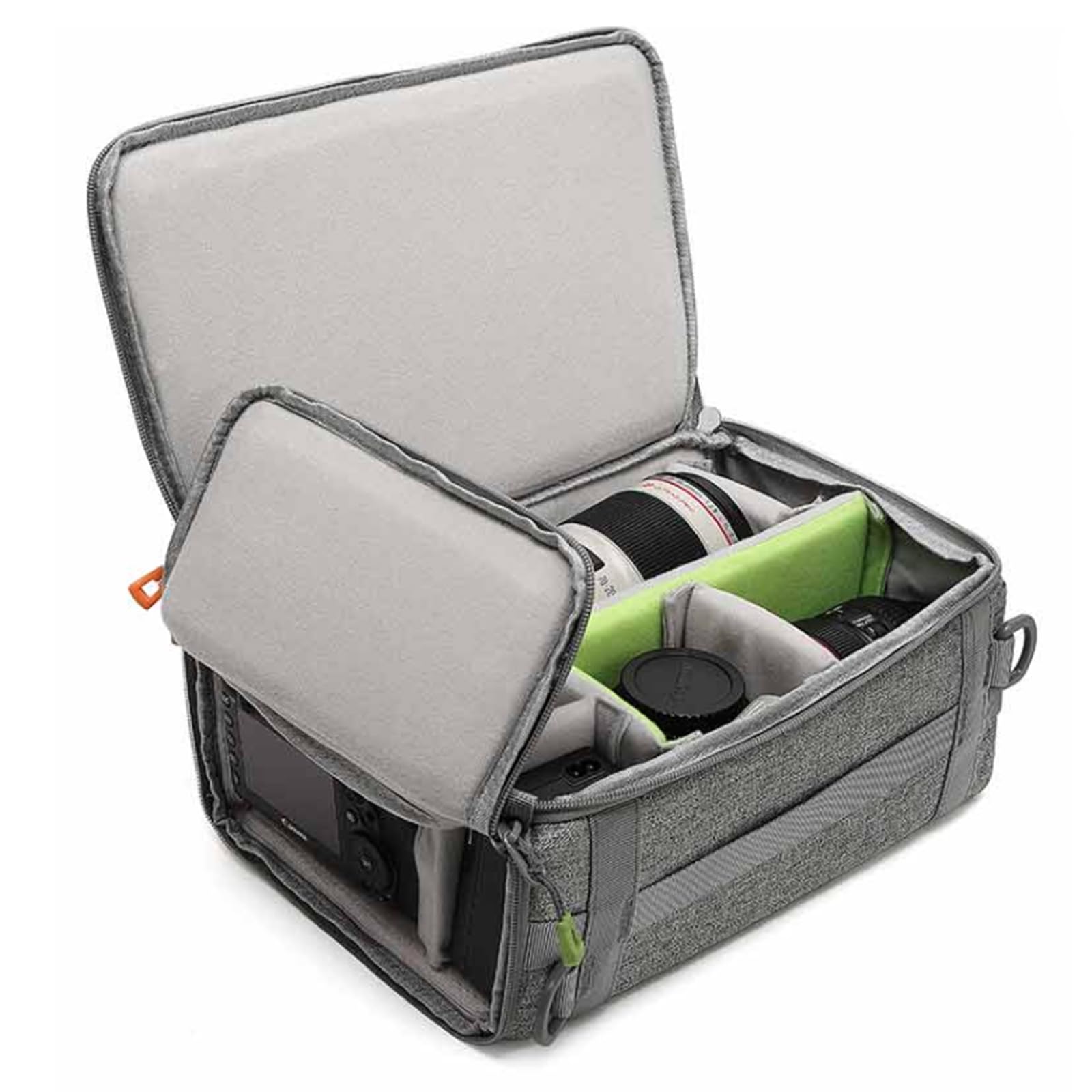
The walls of this cube hide a hard polypropylene plate between layers of foam, and that sandwich is the reason it sits at the top of this list. Set a loaded daypack down on a trailhead or wedge it under a seat, and the sides do not fold in toward your lens the way a plain foam insert's do. The jacquard polyester outside is described as raindrop-proof, which is about the right level of weather protection for something that lives inside another bag.

What kept us coming back is the two-way opening. The top hatch is the one you use with the pack still on your shoulders: unzip, lift the camera out, close it up. The side panel opens like a suitcase when you are repacking at the end of the day. Of the cubes here, it is the best combination of structure and access, which is why it is the one we point most buyers toward first.

Inside, the listed 12.2 x 7.87 x 4.92 inches take a 70-200mm f/2.8 standing upright with two more lenses beside it, and the 7800-cubic-centimeter volume gives the dividers somewhere to go when you reconfigure. The 13.77 x 9 x 5.7-inch exterior is honest about what it needs: a pack of 20 liters or more, measured across the back panel, or it will not sit flat. Wrap a soft jacket around it in a smaller bag and it still works, just less neatly.

Four strap attachments, one at each corner, are the detail we did not expect to use. Clip a shoulder strap on and the cube becomes a small bag for a day out of base camp while the pack stays behind. The webbing handle covers shorter carries, and the grey geometric shell hides the scuffs that come with either.

Pros

  • Hard plate between foam resists crushing
  • Top hatch plus a full side panel
  • Takes a 70-200mm and two lenses
  • Corner loops for shoulder carry

Cons

  • 2.2 pounds before you pack anything
Our verdict

Our pick for most people: the hard plate and the two openings make it the cube we trust inside a soft backpack, and it swallows a 70-200 without complaint.

Check Latest Price
2

Best Budget

Koolertron Shockproof Camera Insert

90 /100
Keeper Score Outstanding

Key details

Weight
5.64 oz
Interior
Velvet liner
Compartments
Three
External Dimensions
10.2 x 5.1 x 6.1 inches
Check Price on Amazon

At 160 grams, this is the cube we hand to anyone who wants to stop buying camera bags. It is a velvet-lined box with a drawstring top that drops into whatever you already carry, whether that is a tote, a bucket bag, or a cheap daypack, and makes it usable for a camera. On value, it is the strongest case in this group.

The 10.2 x 5.1 x 6.1-inch footprint holds a body with a lens mounted plus one more lens, split by two Velcro dividers into three bays. Ours has the orange lining, which sounds like a gimmick until you are hunting a black lens cap on a dark hotel carpet. The velvet is genuinely soft against a rear screen, and nothing about it feels like a compromise at this end of the market.

What you give up is armor. The sides flex if something heavy lands on the bag, so treat it as a liner for bags that get carried rather than stacked in a van; packed in the middle of a duffel with clothes around it, it has been fine on every trip we have taken it on. For a camera that lives in a handbag that is the right trade, since the alternative is a framed cube weighing twice as much or more.

Pros

  • Turns any bag into a camera bag
  • 160 g, barely noticeable in a tote
  • Bright orange interior for small parts
  • Two dividers make three bays

Cons

  • Drawstring closure rather than a zip
Our verdict

For the money, this is the cube we hand anyone who wants to stop buying camera bags: light, soft, and easy to live with.

Check Latest Price
3

Best Build Quality

PGYTECH Camera Insert Bag (M)

83 /100
Keeper Score Excellent

Key details

Carry
Shoulder strap included
Frame
Embedded steel frame
Zippers
YKK splash-proof
Dividers
Molded DIY compartments
Check Price on Amazon

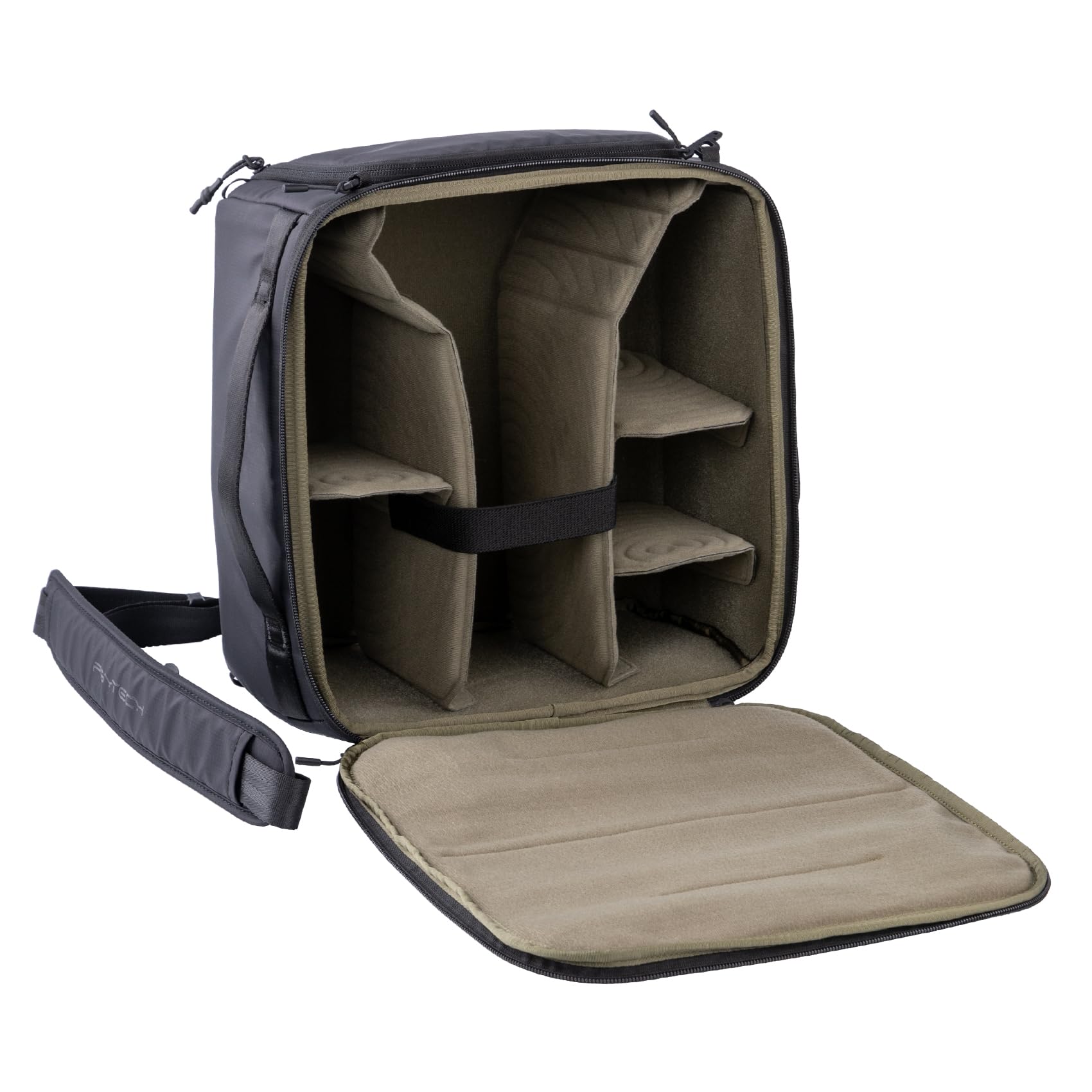
Pull a camera out of most inserts and the opening sags shut behind your hand. This one holds its mouth open, because there is a steel frame sewn into the rim, and that changes the way you work out of a slung pack: one hand in, one hand out, no lid to hold back.

The rest is built to match. High-density foam in the body and in the dividers, a molded interior you can reconfigure, YKK splash-proof zips, and a water-resistant finish outside. A full-size body goes in with lenses packed vertically, which keeps the footprint narrow enough to drop into a mid-size daypack.

We did not baby this one: it went in and out of vehicles, got set down on gravel, and the frame never took a set. On build, this is the best-made insert in the group. Zips decide how a cube feels in year two, and YKK coils with splash-proof tape are the ones to want. The molded dividers are the quieter advantage, holding a lens shape instead of letting two of them knock together the way flat pads do.

Pros

  • Steel frame holds the opening open
  • YKK splash-proof zippers
  • Dense foam body and dividers

Cons

  • Shoulder strap is awkward to use
Our verdict

Buy this one if your cube rides in a pack that gets thrown around: the frame and the zips are what you are paying for, and they hold up.

Check Latest Price
4

Best for Small Kits

TARION ShellCore XS Insert

85 /100
Keeper Score Excellent

Key details

Lid
Removable top lid
Weight
0.7 lb
Capacity
4.4 liters
External Dimensions
10.2 × 4.9 × 6.3 inches
Check Price on Amazon

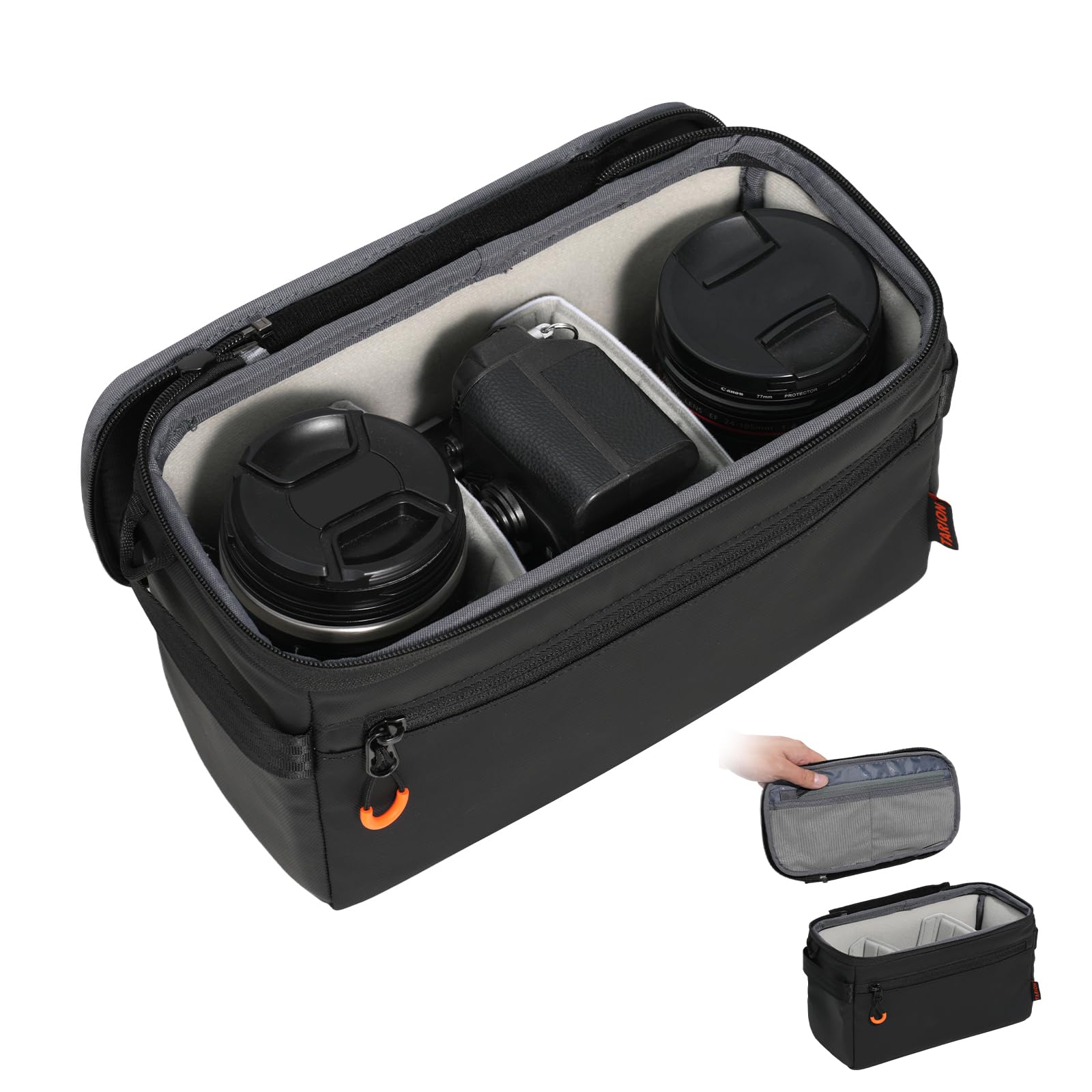
At 0.7 pounds and 4.4 liters, the ShellCore XS is the smallest framed cube here and the one that disappears most completely into a bag you already like. The 10.2 x 4.9 x 6.3-inch body is built around one camera and two lenses, which is the kit most of us actually carry on a day out.

The lid comes off completely, and that turned out to be the best thing about it. Leave the lid behind and the cube becomes an open tray inside your bag: camera out, camera in, no flap to fight. With the lid on, the 3mm steel frame in the top edge keeps the opening rigid and the pearl cotton padding does the cushioning.

It is a liner rather than a bag, and the two-year warranty is longer than most here. Volume is the real limit. A body with a long zoom mounted will not ride with the lid on, and that is a job for a larger cube.

Pros

  • Removable lid gives open-tray access
  • 0.7 lb with a rigid top frame
  • Two dividers for a body and two lenses
  • Two-year warranty

Cons

  • No shoulder strap in the box
Our verdict

A smart choice for a compact kit: 0.7 pounds, a lid you can take off, and enough structure to keep a small camera safe in a tote.

Check Latest Price
5

Best for Osprey Packs

Osprey Camera Storage Cube

85 /100
Keeper Score Excellent

Key details

Foam
Molded EVA
Weight
12.8 oz
Dividers
Adjustable molded EVA
Water Resistance
Not water resistant
Check Price on Amazon

If your backpack says Osprey on the label, this is the cube that fits it without a fight, and it is the one we take up a hill. The shape follows the packs, the carry handle sits where your hand expects it, and the case stands on its own whether you set it down long side or short side, so packing around it is easy.

Molded EVA makes up the body and the dividers, which is why a two-body kit stays where you put it; two bodies and four small-to-medium lenses is realistic. The front lid folds open with the cube still in the pack, and that is the difference between grabbing a camera on a ridge and unpacking everything at the bottom of it.

Weather is the catch. This one is listed as not water resistant, which is an odd thing to find on a hiking accessory, so plan on a rain cover over the pack and keep the front opening brief. Pack a dry bag for the body if you are out in real rain.

Pros

  • Cut to fit Osprey packs
  • Molded EVA body and dividers
  • Front lid opens inside the pack
  • Stands upright on its own

Cons

  • The priciest cube in this group
Our verdict

If you already carry an Osprey pack, this is the cube that fits it properly, and the molded foam keeps a two-body kit exactly where you packed it.

Check Latest Price
6

Best for Storing Gear at Home

NEEWER Flexible Partition Insert

89 /100
Keeper Score Excellent

Key details

Weight
12.8 oz
Dividers
Adjustable taped cushions
Material
Nylon
Compartments
Seven
Check Price on Amazon

Seven compartments in one zip-up box: this is less a cube than a filing cabinet for glass. Fastening-taped cushions move anywhere on the interior, so you can wall off a body from a lens hood or merge two bays into one for a long zoom.

In practice it swallows a lot, six lenses and a flash in a single case, with a web handle to lift the whole thing off a shelf, which is where we have kept it. The nylon shell wipes clean, and the layout means you can see what is missing without lifting anything out.

Where it belongs is a shelf, a studio drawer, or a hard case in the back of a car; it is the insert for the kit you keep rather than the kit you hike with. Packed flat, it also slides into a suitcase with room around it for clothes.

The counting is what sells it. Seven bays tell you at a glance whether the 85mm is in the case or on a camera, and that daily clarity is worth more than another inch of foam padding.

Pros

  • Seven adjustable compartments
  • Holds six lenses and a flash
  • Taped dividers split or merge bays
  • 12.8 oz with a web handle

Cons

  • Panels flex under a full load
Our verdict

Seven compartments make this the storage answer for a working kit, as long as it stays on a shelf or inside a hard case.

Check Latest Price
7

Tiny Everyday Bags

BAIGIO Foldable Camera Insert

83 /100
Keeper Score Excellent

Key details

Handle
Web handle
Weight
10.9 oz
Material
Water-resistant nylon
External Dimensions
8.3 x 3.9 x 5.9 inches
Check Price on Amazon

Empty, this one folds down to almost nothing. The shell is soft enough to collapse and stiff enough to hold a shape once there is a camera inside. At 8.3 x 3.9 x 5.9 inches it is the smallest cube here, sized for an 8-liter daypack or the tote you already carry.

Inside there is one removable divider splitting two compartments, a back pocket, a pocket in the cover, and a soft cotton lining. A mirrorless body with a lens mounted goes in one half, a second lens and a charger in the other, and the pockets take cards and a spare battery.

The top closes with a flap rather than a zip, and the web handle sits right where that flap wants to lie, so it works best dropped into a bag rather than swinging from a hand. What it does well is make a small bag usable: the camera stops rolling around next to your keys, and the whole insert lifts out in one motion. We liked it most for exactly that, a camera bag that does not look like one.

Pros

  • Folds flat when empty
  • Fits an 8-liter pack
  • Pockets in the cover and back

Cons

  • Lighter padding than the framed cubes here
Our verdict

An easy yes for a small mirrorless kit in a small bag: it folds away when empty and costs about as little as a cube can.

Check Latest Price
8

Compact Travel Kits

S-ZONE Camera Insert Bag

91 /100
Keeper Score Outstanding

Key details

Access
Top and back openings
Interior Pockets
Front and top pockets
Water Resistance
Waterproof
Check Price on Amazon

Two openings make this small case more useful than its size suggests. The top zip gets you to the camera, and the back panel opens flat so you can see the whole interior without unpacking it. The shell is described as waterproof, which matters more for a case that leaves your bag than for one that never does.

It is built around a compact mirrorless kit: an a6000-sized body with a lens mounted, another lens or two, batteries in the top mesh pocket, cards in the front one. The padding is thick enough that nothing rattles around, and the inner dividers can be reorganized to suit the kit.

The strap is the part we did not expect much from. Clip it on and the case rides crossbody, or run a belt through it and it hangs at your hip, which means the camera comes with you and the backpack stays in the overhead bin.

Watch the zips. Water-resistant closures want a straight pull and they stiffen when grit works into the tape, so clean them out and do not haul them around a corner. Treated that way, it does the one thing a small insert should: it lets you carry a real camera in the bag you were taking anyway.

Pros

  • Opens from the top and the back
  • Waterproof shell
  • Thick padding in a small case
  • Wears crossbody or on a belt

Cons

  • Fits a compact mirrorless kit only
Our verdict

It is the one we hand to a traveler with a compact kit: it zips shut, shrugs off rain, and works as its own small bag once it is out of the carry-on.

Check Latest Price

How We Tested 14 Camera Cube Inserts

We started by collecting every insert we could find that claimed to suit a standard daypack, then cut the field to 14 based on listed interior dimensions, how the dividers were built, whether the lid came off or opened flat, and price. Before any gear went in, I measured each one with a tape and checked the numbers against the listing; several were off by half an inch or more, which matters when your bag already has a padded laptop sleeve.

Testing ran six months. Each insert spent weekdays in a 20-liter daypack on commutes, rode in a 40-liter travel backpack on two weekend trips and a flight, and lived in a canvas tote through a handful of portrait shoots. We loaded them the way people actually do — a mirrorless body, two primes, a zoom, batteries, cards, a charger — and left the gear sitting in place between outings rather than repacking for each test.

Picking each one up by its handle with a full load showed us which shells held their shape and which bowed at the seams. We pressed a lens against every wall to see whether the padding bottomed out against the outer fabric, and ran each zipper around all four corners 25 times to catch the ones that snag or jump track. The lid test was closing each cube one-handed while it was packed full: some sat flush, others buckled and left a gap. We also reconfigured the dividers three times per insert, then checked a few weeks later whether the hook-and-loop still gripped. The inserts that made the list are the ones that still closed properly in month five.

How to Choose a Camera Cube Insert

Start with the panel, not the liter rating

Bag capacity in liters says almost nothing about whether a cube sits flat inside. A 13.77 x 9 x 5.7-inch insert needs a pack of roughly 20 liters or more with a wide back panel; an 8.3-inch cube disappears into an 8-liter daypack. Measure the flat panel of the bag you plan to use, subtract an inch for fabric and seams, and compare that with the cube's exterior. Then check interior height against your tallest setup, because a body with a zoom mounted needs more room than the same body with a prime.

Decide how much structure you need

Foam cubes cushion; framed ones resist. If the insert lives in a tote that rides on your shoulder, a soft velvet box is plenty and saves weight, which is why the Koolertron comes in at 160 grams. If the pack gets set down on rocks, stacked in a van, or checked inside a duffel, pay for structure: a steel rim at the opening, a polypropylene plate in the walls, or molded EVA foam. None of that is free. These cubes run from about 0.7 pounds to 2.2 pounds, and the heaviest is the one with the hard plate.

Think about how you get the camera out

A single top zip is fine in a bag you set down on a bench. In a pack that stays on your shoulders, the useful design is an opening that does not need holding: a framed rim that keeps its shape, a lid you can lift off, or a front flap that folds clear. A second opening, usually a full side or back panel, is what makes repacking at the end of the day bearable. It is also what lets a cube work as a standalone bag once you clip a strap to its corner loops.

Count the bays before you count the padding

Dividers are the point of an insert. Velcro-taped pads let you build compartments that match your kit, and a molded interior keeps the shape you set. Two dividers give three bays, which suits a body plus two lenses; seven compartments is a storage unit for a working set of glass rather than a travel cube. Buy for the kit you own now and leave one bay empty, because the lens you add next month will need somewhere to live.

Weigh the weather and the carrying hardware

A rain-shedding finish, splash-proof zips, and a listed waterproof rating are three different things, and the zip is usually the weak point: coils stiffen when grit gets into the tape and want a straight pull. A cube that leaves your bag in bad weather needs more than one that never does. Carry hardware matters too. A webbing handle covers short moves, four corner loops let you add a shoulder strap, and an included strap is only worth having if it is comfortable.

Frequently Asked Questions

Final Verdict

Start with the svatin insert unless something specific rules it out. It handles a soft backpack, a borrowed duffel, and a 70-200 without asking you to think about it, and the two openings mean you are not unpacking it on a wet hillside.

If your camera lives in a tote and your kit is one body plus two primes, the Koolertron does the same job for less money and 160 grams. And if the pack on your back already says Osprey, buy the Osprey cube and stop reading.