Best Camera Bags of 2026

Camera bags are asked to do two jobs that pull against each other. One is protection — enough foam, structure, and water resistance to survive a dropped pack on a rocky trail or a downpour at a kid's soccer game. The other is speed and comfort: a bag you can wear for six hours and reach into without taking it off. The good ones get close enough that you stop thinking about the bag at all.

Over the past six months, my team and I have carried 12 of them — full-size backpacks, hard-shell cases, a sling, and one small pack cut for a shorter torso — through airport terminals, onto muddy trails, and into more than a few rainy parking lots. Along the way we learned that the dividers decide more than the capacity number does: a bag with 2 liters more room but fixed panels can hold less than a smaller one with movable ones.

What follows are the ones we'd carry again, sorted by the kind of shooter and the kind of day each one suits.

Keeper Score summarizes customer ratings and review volume. Read it alongside the product details and trade-offs. How the score works.

1

Best Overall

CADeN D6 Camera Backpack

95 /100
Keeper Score Outstanding

Key details

Weight
1.7 lb
Capacity
17 liters
Camera Fit
1 body + 4 lenses
Device Sleeve
iPad
Check Price on Amazon

Seventeen liters doesn't sound like much until you start filling it. A body with a lens mounted, four more lenses, a flash, a tablet and a tripod all have a place in the CADeN D6, and the velcro dividers shift to take a different kit on a different day. Empty, it weighs 1.7 pounds — light enough that deciding to bring the backpack stops being a morning negotiation. That mix of real capacity and low weight is why it is the one we recommend first.

The details are the kind you notice after a few trips. The front pocket zips against your back, so cards and a wallet aren't on display in a crowd, and the deep side pockets hold a water bottle or a tripod foot. The fabric is rated waterproof rather than merely water-resistant, and the back panel is padded well enough to carry a loaded bag through a long day.

What you give up is the laptop compartment. The device sleeve is built for a tablet, and a 13-inch MacBook slides in snugly, but a 15- or 16-inch machine means stepping up to one of the bigger bags here. If you edit at home and carry a tablet on location, that is a fair swap for everything else this bag does.

Pros

  • Holds a body, four lenses and a tripod
  • 1.7 pounds empty
  • Waterproof fabric and a hidden front pocket
  • Best value among the backpacks here

Cons

  • Tripod straps take compact tripods only
Our verdict

A body, four lenses and a tripod in a bag that weighs 1.7 pounds: this is the camera backpack we recommend to most photographers.
Check Latest Price
2

Best Protection

K&F Concept B07 Hardshell Backpack

93 /100
Keeper Score Outstanding

Key details

Weight
1,270 grams
Capacity
22 liters
Front Shell
EVA hard shell
Laptop Compartment
15 to 15.6 inches
Check Price on Amazon

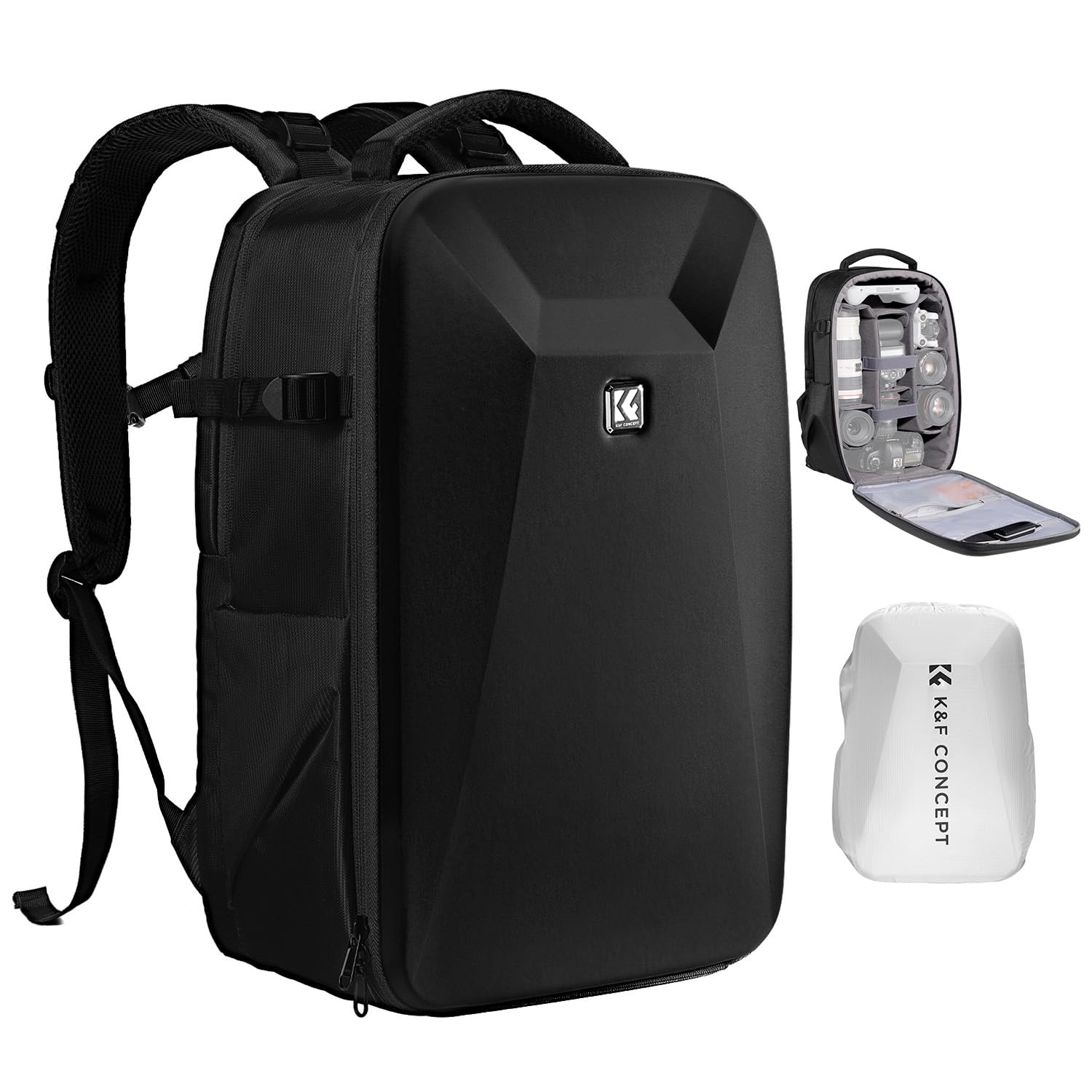
Set the K&F B07 down on a bench and it stays upright. That is the front panel doing its job: a one-piece molded EVA shell that doesn't fold in on itself, so the bag keeps its shape when it is wedged under an airplane seat or stacked in the back of a car.

That shell is why we think of this as the protection pick of the group. Twenty-two liters takes a body, three or four lenses and a flash, and the hard front absorbs the knocks that would otherwise land on a lens hood. The dividers are padded and repositionable, and the front flap opens fully, so packing is a matter of laying gear into a tray rather than posting it into a slot.

A padded compartment against your back takes a 15- to 15.6-inch laptop, and a trolley belt slides over the handle of a rolling case for airport days. It is a travel bag more than a hiking one — the kind you carry from a car to a hotel room and then out for the day — and it is happiest when the kit inside is worth protecting.

Pros

  • Molded EVA front protects lenses
  • Stands upright when set down
  • Fits a 15.6-inch laptop
  • Trolley sleeve for rolling luggage

Cons

  • 1,270 grams empty, heavy for long walks
Our verdict

If your gear rides in car trunks, boats or crowded overhead bins, the molded front panel here is the protection we trust most in this group.

Check Latest Price
3

Best Sling

K&F Concept BS01 Sling Bag

92 /100
Keeper Score Outstanding

Key details

Weight
1.32 lb
Strap Range
34.25 to 55.1 inches
Tripod Strap Limit
2.99 inch diameter
External Dimensions
13 x 8.6 x 5.9 inches
Check Price on Amazon

A sling earns its keep in the two seconds between seeing a shot and taking it. Swing the K&F BS01 around to your chest, pull the main zip and the camera is in your hands, with no bag on the ground and no harness to unclip.

The shell is a double-coated nylon canvas that feels softer than the hardshell packs here and handles drizzle without a cover. There are pockets on the front, against your back and inside for cards and batteries, and two straps underneath for a small tripod; K&F lists a maximum leg diameter of 2.99 inches, so measure yours before you count on it.

Small is the whole idea. It rides tight against your back, the strap adjusts from 34.25 to 55.1 inches so it works over a jacket or high across the chest on a crowded train, and there is enough structure in the shell that it holds its shape when empty. What we appreciate most, though, is the look — plain black, no logo shouting camera, nothing that changes how you are treated walking through a city.

Pros

  • Swings around for quick camera access
  • Weatherproof coated nylon canvas
  • Tripod straps underneath
  • Discreet, unbranded look

Cons

  • Sized for one body and two or three lenses
  • Strap is not detachable
Our verdict

For one body, a couple of lenses and a walk across a city, this is the sling we reach for: quick to open, weatherproof and quiet about what's inside.

Check Latest Price
4

Best Shoulder Bag

Lowepro Nova 180 AW II

90 /100
Keeper Score Outstanding

Key details

Weight
1.48 lb
Capacity
6.6 liters
Weather Cover
All-Weather AW cover
Exterior Dimensions
11.42 x 10.04 x 9.45 inches
Check Price on Amazon

The Nova 180 AW II looks like camera bags used to look: a top-loading shoulder bag with a wide lid, a padded interior and 6.6 liters of space. A full-frame body with a 70-300 mounted drops in nose-down, which is the sensible way to carry a long lens.

Everything about it is aimed at one camera and one outing. The All-Weather cover lives in the base of the bag rather than in a pocket you have to remember to pack, the zipper is a waterproof type, and the interior is fully padded with dividers you can move. Outside there is a cushioned grab handle, a belt loop and zippered compartments for filters and cards.

This is the bag we take when the plan is one subject — a portrait session, a school concert, a walk where you know what you are shooting. It sits at your hip, the lid opens toward you, and nothing needs unpacking to change a lens. At 0.67 kg empty it disappears on your shoulder in a way the backpacks here never do.

Pros

  • Rain cover stored in the base
  • Top-loading access for a long lens
  • Waterproof zipper and full padding
  • Weighs 0.67 kg empty

Cons

  • All the weight rides on one shoulder
  • 6.6 liters fills fast with a second body
Our verdict

For one camera with a long lens and nothing else on your back, this is the shoulder bag we recommend: light, padded and ready for rain.

Check Latest Price
5

Best for Large Kits

MOSISO 35L Camera Backpack

95 /100
Keeper Score Outstanding

Key details

Weight
3.2 lb
Capacity
35 liters
Front Panel
Waterproof PU hard shell
Laptop Compartment
15.6 inches
Check Price on Amazon

Thirty-five liters is a different kind of bag. The MOSISO has a compartment that takes a laptop up to 15.6 inches, a padded insert with movable dividers for the camera kit, a tripod strap on the side and nine pockets in total, which is enough that small items stop migrating to the bottom.

Where it earns its place is on a trip: the camera is part of the packing list rather than the reason for it, and this is the bag that handles both. The hardshell front — waterproof PU over foam — holds its shape when the pack is crammed into an overhead bin and wipes clean with a damp cloth, which matters more on a wet week away than any internal pocket.

Nothing about 35 liters is subtle. At 3.2 pounds empty and with a stiff front, it is a bag you pack for a trip rather than sling on for an hour, and the insert lifts out so it can work as a plain travel backpack once the camera gear stays home. Check the harness range — the shoulder straps adjust from 17.72 to 39.4 inches — if you are broad-shouldered.

Pros

  • Fits a 15.6-inch laptop and a full kit
  • Waterproof hardshell front panel
  • 35 liters, the largest capacity here
  • Insert lifts out for use as a travel pack

Cons

  • Strap and zipper wear is the weak spot
Our verdict

When the trip needs a 15.6-inch laptop, a full camera kit and a change of clothes, this is the bag here with room for all of it.

Check Latest Price
6

Pro Photo Work

Lowepro ProTactic BP 450 AW III

83 /100
Keeper Score Excellent

Key details

Capacity
28 liters
Access Points
4
Laptop Compartment
Up to 16 inches
Exterior Dimensions
19.69 x 15.75 x 11.81 inches
Check Price on Amazon

Four ways into one bag: dual side doors, a top hatch for a long lens, and a back panel that opens flat like a case. That is the ProTactic's argument, and for a working kit it is a good one — you can pull a body out of the side without setting the pack down.

The modular side of it is unusual. There is a removable utility belt, two drawstring pouches for a bottle or tripod feet, quick straps, and a rain cover included rather than sold separately. The dividers are molded MaxFit pieces that connect in different configurations, and the fabric is 86% recycled.

Twenty-eight liters holds two bodies and a telephoto, with a padded sleeve that takes a laptop up to 16 inches. The external dimensions — 19.69 by 15.75 by 11.81 inches — tell you it is a big pack, and the harness is built for it: an ActivZone back panel, a hip belt, and side doors with stretch pockets deep enough for a bottle.

We think it is the bag for someone whose camera gear is the job. It is the most expensive pack here by a wide margin, and what that buys is the only four-point access system in this roundup, plus a harness designed to carry a loaded pack for a full day.

Pros

  • Four access points, including a flat-opening back
  • Removable belt and modular pouches
  • Fits a laptop up to 16 inches
  • Rain cover included

Cons

  • The most expensive pack here
  • Gets heavy once fully loaded
Our verdict

For a working photographer who carries two bodies and a telephoto, this is the most capable pack here, with access from four sides.

Check Latest Price
7

Outdoor Day Trips

RAINSMORE Camera Backpack

90 /100
Keeper Score Outstanding

Key details

Weight
3.64 lb
Capacity
28 liters
Rain Cover
Included
Laptop Compartment
15.6 inches
Check Price on Amazon

The top of this pack holds a sweatshirt. That isn't a camera feature, and it is exactly why the RAINSMORE works on a day outdoors: the padded camera compartment sits low, and the upper section swallows a layer, a lunch or a rain shell. We liked that split more than we expected to — it lets one bag do the hike and the drive home.

The rest is built for outdoor use. MOLLE webbing on the outside takes clipped-on pouches, a side opening lets you pull the camera out without unloading, a rain cover backs up the waterproof fabric, and the back panel is padded. A 15.6-inch laptop goes in its own sleeve, so it doubles as a work bag.

Build quality is the part that surprised us: the fabric is heavy, the stitching is even, and the padded back doesn't collapse when the bag is empty. Where it doesn't suit is the short trip. This is a bag you fill deliberately, not one you grab for a walk around the block.

Pros

  • Separate top compartment for layers
  • MOLLE webbing for extra pouches
  • Rain cover plus waterproof fabric
  • Side opening for quick camera access

Cons

  • 1.65 kg empty before you pack it
Our verdict

For a day outdoors where the camera shares the load with a jacket and a lunch, this is the pack we take rather than a camera-only bag.

Check Latest Price
8

Light, Stylish Carry

BAGSMART Small Camera Backpack

84 /100
Keeper Score Excellent

Key details

Weight
1.2 lb
Capacity
11 liters
Laptop Compartment
13.6 inches
Exterior Dimensions
10 x 5.5 x 13.8 inches
Check Price on Amazon

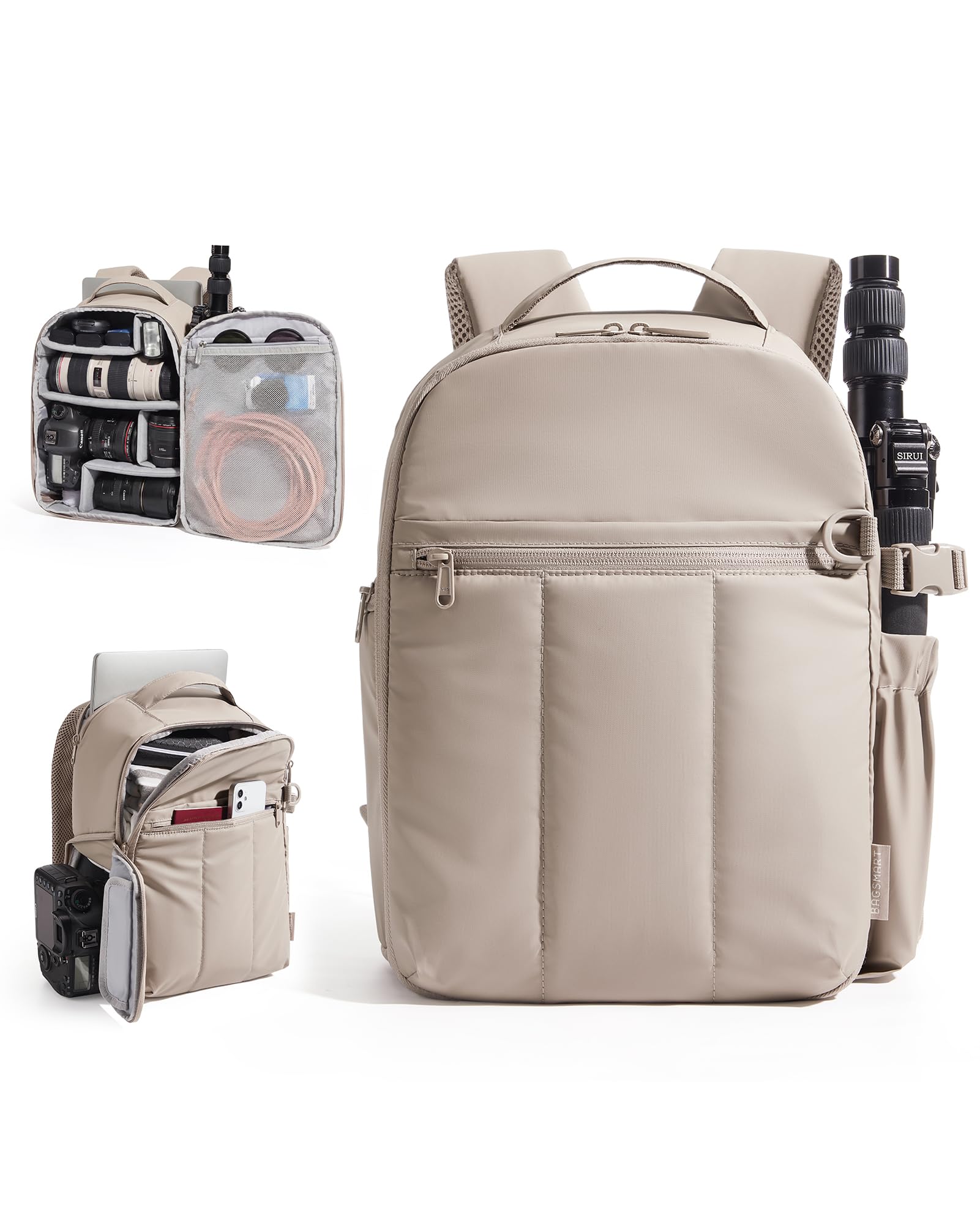
Most camera bags look like camera bags. This one reads as a small puffy daypack — brown, soft-sided, 10 by 5.5 by 13.8 inches — and that is the point: it goes to dinner, to class or to a family party without announcing a body and two lenses inside.

Inside, the main compartment has removable dividers, enough for a camera with a lens attached plus a second small lens, with mesh pockets for batteries and cards. There is a front zip pocket, a side pocket you can reach into without opening the main compartment, and a padded sleeve that takes a laptop up to 13.6 inches.

Eleven liters and 1.2 pounds is the whole story. It is a light-kit bag: a compact mirrorless body and a couple of small lenses, or a DSLR with one lens and nothing else. Pack a full-frame body with a 24-70 and the second lens becomes a maybe.

We see it doing a different job from the rest of this page — the bag that goes out when the camera is an accessory to the evening. What it does better than any other bag here is not look like what it is.

Pros

  • Looks like a daypack, not a camera bag
  • Fits a 13.6-inch laptop
  • 1.2 pounds empty
  • Side pocket for quick camera access

Cons

  • Soft shell gives less protection than the backpacks here
Our verdict

For a small mirrorless kit and evenings where you would rather not look like a photographer, this is the bag that blends in.

Check Latest Price

How We Tested These Camera Bags

We started on paper, pulling roughly 40 bags across backpacks, hard-shell cases, slings, and small travel packs, screening for adjustable dividers, a laptop sleeve sized for 15- and 16-inch machines, and some form of rain protection. Bags that failed those basic checks got cut before we ever picked them up. That left 12, which we used as our own for six months — on commutes, on weekend hikes, through two airports, and on several paid shoots where the gear had to come home in one piece.

For capacity, we packed the same kit into every bag: a body with a 24-70 attached, two primes, a flash, spare batteries, and a 15-inch laptop, then noted how much room was actually left and whether a tripod could ride along. We rearranged the dividers repeatedly — pulled them out, moved them, and checked whether they stayed put once the bag was loaded — because a soft panel that collapses under a lens is worse than no panel.

For straps, we wore each bag for full days, loaded, and paid attention to where the weight landed at hour six and whether the sternum strap and hip belt did anything useful. Every bag was weighed empty and packed. Rain covers got deployed in an actual shower, and we checked zippers, seams, and reinforced corners afterward. Fit meant two things: how the bag sat on shorter and taller torsos, and whether the laptop sleeve matched its label. Value came down to what shipped in the box — cover, tripod straps, extra dividers — at each price point.

How to Choose a Camera Bag

Fit the bag to your kit, not the liter count

A liter figure tells you less than the internal dimensions and the dividers do. A body with a lens mounted eats more room than the same body and lens stored separately, and a 70-200 takes a compartment of its own. Before you buy, lay your kit out and measure the longest lens with the hood reversed; that number decides whether you need 11 liters or 28. Removable dividers are worth insisting on — every bag here has them — because they let a camera pack double as a travel bag when the gear stays home.

Decide how you want to reach the camera

Access shapes the rest of the bag. A back panel that opens flat is the most secure and the slowest, because you set the pack down to work. Side doors and top hatches let you pull a body out with the bag still on your shoulder, and a sling swings to your chest in one movement. If you photograph people or moving subjects, spend the budget on access before capacity: a small bag you can open quickly beats a big one you have to unpack.

Weigh protection against what you carry

Padding, a hard front panel and weatherproofing all add grams, so decide what your gear actually faces. A molded shell like the one on the K&F B07 is reassuring in a car trunk and less welcome at the end of a long walk; a coated nylon sling handles drizzle without one. If you shoot in rain, look for a cover that lives in the bag rather than in a drawer — the Lowepro Nova stows its cover in the base.

Check the sleeve, the tripod mount and the empty weight

Three details trip people up. Laptop sleeves are cut for one machine — 13.6, 15.6 or 16 inches — and a padded sleeve adds structure you feel on your back. Tripod straps underneath most bags take compact legs only; the K&F sling lists a 2.99-inch maximum diameter, which is typical of the group. And compare empty weight, because that is the part you carry on every trip no matter what is inside.

Frequently Asked Questions

Final Verdict

The CADeN D6 is the bag we point most people to: a body, four lenses, a flash and a tripod in something that weighs 1.7 pounds and costs less than the other backpacks here. It is the safest default in this group because it gets the capacity and the carry right without asking you to pay for features you may never use.

Two requirements change the answer. If you travel with a 15.6-inch laptop, the MOSISO's extra volume and dedicated compartment make it the better buy. If your gear rides in trunks and overhead bins, the K&F B07's molded front is the one we trust to take the hit.