Best Camera Bags for Travel of 2026

The worst thing a camera bag can do is fail quietly. A strap that digs in by hour three, a divider that lets a lens knock against the body, a zipper that gives out in a drizzle — none of it shows up in a product photo, and all of it can wreck a shooting day. A good one just lets you bring the lens you actually want and then disappears. I've carried 12 of them over the past eight months — through airports, onto trains, up a few muddy trails.

Format comes first: a backpack swallows a camera body, a couple of lenses, and a 15-inch laptop for a week away, while a sling keeps one camera within reach and stays out of the way the rest of the time. But the interior layout matters more than I expected — a hardshell or a rain cover is easy to advertise, while the dividers you rearrange a dozen times decide whether your kit actually fits.

Comfort is the quiet decider; a bag that feels fine in the hallway can be a punishment two hours in. Below are the ones that earned their place, split between travel-day backpacks and everyday slings.

Keeper Score summarizes customer ratings and review volume. Read it alongside the product details and trade-offs. How the score works.

1

Best Overall

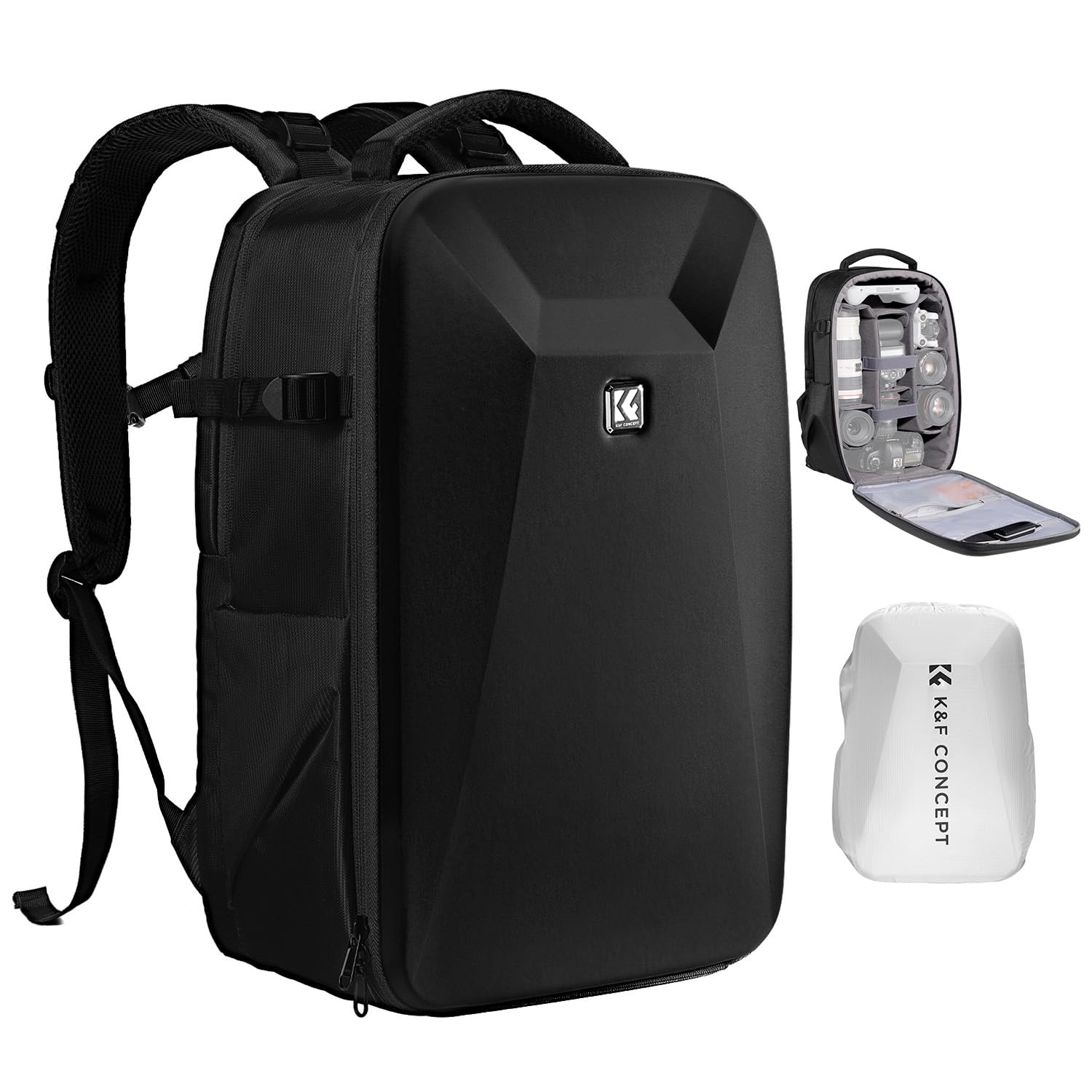
K&F Concept B07 Hardshell Backpack

93 /100
Keeper Score Outstanding

Key details

Weight
1,270 g
Capacity
22 liters
External Size
17.3 x 11 x 7 inches
Laptop Sleeve
Fits 15 to 15.6 inches
Check Price on Amazon

Two details decide this one for travel: a one-piece hard shell across the front and a trolley belt on the back. The shell is molded EVA, so a knock in a train aisle or a bag shoved into an overhead bin lands on plastic rather than on a lens, and the belt slides over a rolling suitcase handle so the pack rides on your luggage instead of your shoulders. Of everything here, this is the bag we hand to someone packing for a mixed trip of flights, trains and four days of walking.

At 22 liters it holds a working kit and not much more, which is the point. The main compartment opens flat from the front, and the dividers rearrange around a body with a long lens left mounted. There is a padded sleeve for a 15- to 15.6-inch laptop against the back, two internal accessory pockets, and a rain cover that ships in the bag rather than as an extra. We loaded it for a long weekend: body, two lenses, laptop, chargers and a shell.

The carry side is where hard-shell packs usually go wrong, and this one stays comfortable: mesh over the back panel, straps that adjust from 20 to 38.9 inches, and enough structure that the bag stands upright on its own while you dig through it. That sounds trivial until you are doing it on a wet platform. At 17.3 by 11 by 7 inches it is shaped for the overhead rather than under the seat, so check the smaller allowance if you fly a carrier that measures personal items.

Pros

  • One-piece hard shell takes the knocks
  • Trolley belt slots over a suitcase handle
  • 15.6-inch laptop sleeve against the back
  • Rain cover included rather than sold separately

Cons

  • 22 liters leaves little room for clothes
Our verdict

For most trips this is the bag we recommend: hard-shell protection, a luggage sleeve and a laptop pocket in a pack that still fits the overhead.

Check Latest Price
2

Best for Long Trips

MOSISO 35L Camera Backpack

95 /100
Keeper Score Outstanding

Key details

Weight
3.2 lb
Capacity
35 liters
External Size
17.32 x 11.8 x 7.5 inches
Laptop Sleeve
Fits up to 15.6 inches
Check Price on Amazon

Thirty-five liters is the number that separates this from the pack we recommend first, and it changes the job. The camera dividers sit in a removable insert measuring 16.54 by 11.42 by 5.5 inches, so the whole cage lifts out and that compartment becomes plain space for clothes on the way home. That is the trick that makes a 35-liter bag useful for a week rather than a long weekend.

Our take is that this is the pick when the camera bag has to be the only bag. The front panel is a waterproof PU-leather shell over foam, which is the protection you want on the side that faces the world, and behind it are nine pockets across three compartments, a tripod holder with its own strap, and a sleeve that takes a 15.6-inch laptop; a 16-inch machine fills it and nothing more. Cables and cards live in two zipped pockets on the back face, hard to reach without taking the bag off, which is exactly right for things you do not need mid-walk.

The harness is the compromise, and it is the thing to weigh before you fill all 35 liters. The shoulder strap can give way after a couple of months of loaded use, and the padding is happiest with a camera kit and clothes rather than two bodies and a long zoom. Pack it for a week away with one body and two lenses and it behaves like a suitcase you can wear.

Pros

  • Removable insert turns into clothing space
  • 35 liters covers a week away
  • Waterproof hard-shell front panel
  • Tripod holder with its own strap

Cons

  • 3.2 pounds before you put anything in it
Our verdict

If the camera bag has to be your only bag, buy this one: 35 liters, a removable camera insert and a waterproof front panel.

Check Latest Price
3

Best Budget

CADeN D6 Camera Backpack

95 /100
Keeper Score Outstanding

Key details

Weight
1.74 lb
Capacity
17 liters
Kit It Holds
One body, four lenses, a flash, a tablet
External Size
11 x 5.9 x 15 inches
Check Price on Amazon

The D6 is the pack we point to when someone wants to travel with a real kit and spend as little as possible doing it. It weighs 1.74 pounds and measures 11 by 5.9 by 15 inches, small enough to sit under an airplane seat, and it takes a body plus four lenses, a flash, a tablet and a tripod. The layout is one padded box of adjustable dividers, a tablet sleeve on one side, and a deep pocket on the other that is meant for a tripod and works just as well for a water bottle.

What surprised us is how much camera goes in before it complains. A full-frame body with a battery grip and three lenses still leaves room for cables and chargers, and a 13-inch laptop slides into the tablet sleeve at a pinch. The fabric is scratch- and water-resistant nylon that shrugs off drizzle, so a real downpour is the one condition it is not built for; the alloy zips feel better than the rest of the bag does.

The trade is materials. The nylon is thinner than the K&F's, the padding is simpler, and the tripod pocket only takes a compact tripod, so a full-size one has nothing to sit in. For a first travel bag, or a bag you do not mind banging around in the back of a car, that is a fair trade: the money went into dividers and capacity instead of fabric.

Pros

  • Holds a body, four lenses and a flash
  • Light at 1.74 pounds empty
  • Tripod pocket doubles as a bottle holder

Cons

  • Tripod pocket only fits a compact tripod
  • Thinner fabric and simpler padding
Our verdict

Our budget pick: a light 17-liter pack that carries a body, four lenses, a flash and a tablet without asking much money.

Check Latest Price
4

Best Organization

RAINSMORE 28L Tactical Backpack

90 /100
Keeper Score Outstanding

Key details

Weight
3.64 lb
Capacity
28 liters
Rain Cover
Included
Laptop Sleeve
Fits up to 15.6 inches
Check Price on Amazon

At 1.65 kilograms this is the heaviest bag here, and you feel it before you notice anything else about it. Set it down and the case for it gets clearer: eight compartments and seven pockets, MOLLE webbing across the outside for clipping on extra pouches, a padded sleeve for a 15.6-inch laptop, and a rain cover that wraps the whole pack rather than one panel of it.

What we like is how deliberately the storage is laid out for a photographer rather than a hiker. A side opening unzips far enough to pull out a body with a long lens still attached, which is the access you want on a moving day, and the thick dividers hold their shape so lenses stop migrating into each other. The top pocket takes a sweatshirt or a spare layer, the small thing that turns a camera bag into a travel bag.

It is also the pick to look at when the kit keeps growing. The MOLLE loops take extra pouches, the dividers move, and the heavyweight polyester feels substantial in the hand. The weight is the price of all that structure, and it is one you notice at the end of a long day; if the trip is airports and stations rather than trails, the padded back panel and straps make it easier to live with.

Pros

  • Side opening reaches a mounted long lens
  • Top pocket takes a spare layer
  • MOLLE webbing takes extra pouches
  • 15.6-inch laptop sleeve built in

Cons

  • Rain cover is a separate piece to keep track of
Our verdict

Pick this one when the kit keeps growing and every piece needs its own pocket, and accept the extra weight in exchange.

Check Latest Price
5

Best Sling

K&F Concept BS01 Sling Bag

92 /100
Keeper Score Outstanding

Key details

Weight
1.32 lb
External Size
13 x 8.6 x 5.9 inches
Internal Size
10.6 x 6.7 x 4.1 inches
Tripod Straps
Up to 2.99 inches in diameter
Check Price on Amazon

Some travel days do not need a backpack. A city morning with one body and two lenses is faster with something that swings from your back to your chest, and this is the sling that earns its place: 13 by 8.6 by 5.9 inches outside, a wide double-zipper opening, and a single flexfold divider that splits the interior into two adjustable bays.

The inside measures 10.6 by 6.7 by 4.1 inches, which is the number that decides what it is for. A mirrorless body with a compact zoom mounted plus two primes fits with the divider doing its job; add a 70-200 and you are rearranging rather than shooting. Outside there are zip pockets front and back, a strap running from 34.25 to 55.1 inches, and two straps underneath that take a small tripod up to 2.99 inches in diameter.

We like how little it looks like camera gear. The shell is a recycled nylon canvas with a double PU coating, soft enough to sit against your back and plain enough that nobody on a platform marks you as worth following. A shower beads off it, and at six hundred grams it disappears on a long walk. If your kit is two bodies and a bag of primes this is not your bag; for a one-body day it is the one we take.

Pros

  • Swings to the chest for quick access
  • Padded interior takes a body and two primes
  • Bottom straps carry a small tripod
  • 600 grams on a long walking day

Cons

  • Only one divider included
Our verdict

For a one-body day in a city, this sling is the bag we take: quick to swing around, padded where it counts and plain enough to blend in.

Check Latest Price
6

Best Ultra-Compact

BAGSMART Puffy Camera Sling

84 /100
Keeper Score Excellent

Key details

Fabric
Water-repellent nylon
Weight
0.42 lb
Divider
One removable padded divider
Capacity
3.6 liters
Check Price on Amazon

Start with what it will not do: this is not a DSLR bag. The BAGSMART is 3.6 liters, sized around a mirrorless body with a lens mounted, and a DSLR with anything but a pancake will not let the zip close. Read that as a limitation or as the whole point, because for a walk-around kit it is the smallest genuinely useful thing here.

At 0.42 pounds it barely registers on a shoulder, and the puffy nylon has a soft, anti-scratch lining that treats a screen and a front element kindly. A removable padded divider splits the main compartment, and there are enough small pockets beyond it for cards, a battery and a phone. Take the divider out and it is an ordinary crossbody bag, which is the second life most camera bags never get.

It earns its keep on the trip where the camera is an accessory rather than the reason for going: a weekend with one lens, an afternoon in a city where a small bag beats a pack. The water-repellent shell and structured padding make it feel better made than its size suggests, and the camel color reads as a handbag rather than camera equipment. What it will not do is grow with the kit.

Pros

  • 0.42 pounds on the shoulder
  • Soft anti-scratch lining protects screens
  • Divider comes out for everyday use

Cons

  • Will not close around a DSLR with a lens
Our verdict

If your travel kit is one mirrorless body and one lens, this little sling is all you need and you will forget you are wearing it.

Check Latest Price
7

Short Outings

MOSISO Camera Sling Bag

93 /100
Keeper Score Outstanding

Key details

Compartments
5
Strap Length
19.3 to 38.7 inches
External Size
15.7 x 9.06 x 4.8 inches
Tripod Holder
Included
Check Price on Amazon

The swing is the whole idea. This sling sits on your back and rotates to your chest in one movement, so the camera comes out without the bag coming off, and it is cut long and flat at 15.7 by 9.06 by 4.8 inches with a strap that runs from 19.3 to 38.7 inches.

The interior is split into two parts: a larger lower bay for a body with a lens mounted and a separate upper compartment, plus zip pockets front and outside for cards, batteries and a phone. There is a tripod holder and the foam padding is generous for the size. A DSLR with a 28-300 attached fits, and so does a smaller mirrorless body with three lenses.

Where it loses ground is fit and comfort. Fifteen inches of exterior does not translate into room for a full-frame body plus a couple of zooms, and on a full day of walking the single shoulder strap makes itself known. It is a bag for evenings and short outings rather than for the whole trip.

That is still a useful thing to own. As a second bag that lives in the hotel room and comes out for dinner and a walk, it does what the big packs cannot, and the padding is better than the price suggests. Buy it as a companion, not as the only camera bag you take on a two-week trip.

Pros

  • Two-part interior separates body and lenses
  • Tripod holder built into the sling
  • Well padded for a small sling

Cons

  • Shoulder strap can fail under a heavy load
  • Interior runs smaller than the exterior suggests
Our verdict

A cheerful, inexpensive sling for evenings and short outings; just do not expect it to carry a full-frame kit all day.

Check Latest Price

How We Tested 12 Camera Bags Over Eight Months

We started with roughly 40 bags pulled from retailer listings, photographer forums, and the gear closets of people on staff, then filtered by price, capacity, and format. Anything that couldn't hold a camera body plus two lenses got cut, as did laptop sleeves too shallow for a 15-inch machine and straps with no padding. That left 12 — a mix of full backpacks and slings — which we carried for eight months.

They went where bags actually go: a week-long trip with a body, three lenses, and a laptop; a daily commute; a couple of day hikes with a tripod strapped on; and one long layover spent checking whether each pack slid under the seat in front of us. With the slings, we wore one across the chest for a full afternoon of walking to see where it started to bite. On every bag we pulled the dividers out and rebuilt the layout around the same kit, timing how long it took to get the camera out one-handed.

Durability and weatherproofing got their own afternoon. We sprayed each bag from a faucet for five minutes, then pressed a paper towel against the interior seams to see what got through, and ran the check again with the rain covers on. We also loaded every bag with identical gear and walked a mile, noting where the straps or back panel started to complain. Value came last, and it wasn't about the number on the tag — it was whether a higher price bought anything you could feel, like denser foam or sturdier zips, or just a label.

What separated the winners wasn't pocket count. It was the bags we stopped noticing by the end of a long day.

How to Choose a Travel Camera Bag

Backpack or sling comes first

The format decides the trip more than any feature list does. A backpack puts the load on both shoulders with a chest or waist strap, which is what you want for airports, trains and any day over four hours. A sling crosses one strap over your body and swings the bag to your chest for a shot: faster to use, and far more tiring. We put carry comfort above pocket count every time, because the best-organized bag in the world stops being useful at hour five.

The split falls roughly by kit. One body and one lens belongs in a sling of around 3 to 5 liters. A body with two or three lenses and a laptop belongs on your back, in something between 17 and 28 liters.

Liters tell you less than the mounted lens does

Capacity figures are a rough guide, because dividers, padding and a laptop sleeve all eat into the space a listing quotes. The practical measure is your biggest likely combination: a body with a 70-200 mounted takes more room than the same two pieces separated, and it is the combination you will actually travel with. Lay the kit out and pack it the way you shoot.

As a rough map: 17 liters carries a body, four lenses and a tablet; 22 to 28 liters adds a laptop and a layer; 35 liters adds clothes for a week. Under 5 liters you are carrying one body and one lens, and nothing else.

Check protection where the bag meets the ground

Padding is easy to advertise and hard to judge from a photo. Press the base panel, the part that hits pavement every time you set the bag down, and check that each divider grips the walls on all four sides. A divider held by two tabs will fold under a heavy lens. A molded front shell is worth its weight if you will be on crowded transport where bags get knocked.

Ask what you are protecting against. A soft pack with thick dividers handles knocks and the occasional drop; a hard shell handles impact and standing water. Neither saves a lens from a two-meter fall onto concrete, so a strap on your shoulder matters as much as foam.

Access decides whether you use it

A bag that opens flat at the front lets you see the whole kit and repack on a hotel bed, which is why travel packs are built that way. A side opening is for pulling out a camera with a long lens still attached. A back-panel opening cannot be reached while the bag is on, which makes it the anti-theft choice on a crowded train and the slowest option at a viewpoint.

There is a trap here: a quick-access pocket only works if it sits on the side you naturally swing the bag toward. Check the zip side before you buy, because a left-side opening on a bag you swing right is a pocket you will never use.

Weather, empty weight and the cabin

Water-resistant fabric handles a shower; a full rain cover handles an hour of rain, and the cover is usually a separate piece you have to remember. In a wet season, a bag with a cover in the box beats one with a better coating and no cover. Then weigh it empty: ours run from well under a pound to 1.65 kilograms, before a camera goes in.

For the cabin, a personal item is commonly capped near 18 by 14 by 8 inches and a carry-on near 22 by 14 by 9. Compare the bag's listed external dimensions against your airline's number. Compact in a listing means it fits in a car trunk, not that it fits under a seat.

Frequently Asked Questions

Final Verdict

Most travelers should start with the K&F Concept B07. It is the only bag here that pairs a molded hard front with a luggage sleeve and a 15.6-inch laptop compartment in a pack that still fits an overhead bin, and 22 liters is a realistic kit-and-a-layer size.

If the camera bag has to be your only bag, the MOSISO 35L carries clothes as well as gear. If the budget decides, the CADeN D6 takes a body and four lenses for less than either. Match the bag to the trip and you will not need a second one.