Best Camera Bags for Hiking of 2026

Most camera bags are built for one job: getting a body and two lenses from the car to the trailhead. Hike four miles with one and the tradeoff shows up in your shoulders — a pack that cushions gear well is often stiff exactly where you want it to flex, and the weatherproof ones tend to be the heaviest. What you want is the bag where that tradeoff mostly disappears.

I've hauled enough packs up ridgelines to know a padded strap isn't the same thing as a load-bearing one. Over the past six months, my team and I hiked with 10 camera backpacks — small ones sized for a mirrorless and a snack, rolltops built to swallow a tripod and a laptop — through drizzle, mud, and one memorably wet weekend.

What separated them wasn't capacity on paper. It was whether I could swing the bag around and get the camera out without unclipping everything, and whether the zippers still ran smooth after a month of grit in the teeth. The picks below are the ones I'd carry again, and a couple that suit a very different kind of hike.

Keeper Score summarizes customer ratings and review volume. Read it alongside the product details and trade-offs. How the score works.

1

Best Overall

RAINSMORE Camera Backpack 28L

90 /100
Keeper Score Outstanding

Key details

Capacity
28 liters
Empty Weight
3.64 lb
Laptop Sleeve
Fits 15.6 in
Rain Protection
Waterproof fabric plus full rain cover
Check Price on Amazon

Only the MOSISO carries more than this, and the RAINSMORE spends its 28 liters better for a hike. The padded camera compartment sits in the lower half with adjustable dividers; the space above it belongs to a shell, a hat and lunch. That split is why it's our top pick. A day out asks one bag to do two jobs at once — gear and layers — and most camera packs make you choose between them.

Protection is where it pulls away from the cheaper bags here. The polyester shell is rated waterproof and a full-coverage rain cover comes in the box, which matters when a squall arrives over a ridge and you don't want to be rearranging dividers with wet hands. A tripod straps to the outside, and the MOLLE webbing takes a bottle or a shell where you can reach it without opening the main compartment. It looks tactical on the product page; on a trail it's simply useful.

The harness is a padded, breathable back panel with shoulder straps, comfortable enough for a full day at this load. If you want weight shifted onto your hips on a long climb, the Besnfoto is the one here that lists a chest and waist belt. And 1.65 kg empty is real weight before anything goes in. For a body, two lenses, a tripod and a jacket, that's the balance most hikers want.

Pros

  • 28 L splits camera gear from layers and lunch
  • Rain cover included plus a waterproof-rated shell
  • MOLLE webbing and a tripod holder on the outside
  • Padded adjustable dividers protect the gear

Cons

  • 1.65 kg empty before any gear goes in
Our verdict

For most hikers this is the camera bag to buy: 28 liters, a rain cover in the box, and a camera compartment that leaves room for layers.

Check Latest Price
2

Best Side Access

K&F CONCEPT 20L Camera Backpack

91 /100
Keeper Score Outstanding

Key details

Capacity
20 liters
Rain Cover
Included
Camera Access
Side panel plus full rear opening
Laptop Sleeve
Fits 15.6 in
Check Price on Amazon

Unzip the side panel, pull the body, shoot, zip it back. No pack off, no setting it down in the mud. On a trail where the light changes every ten minutes, that's the difference between coming home with the shot and coming home with a story about the one that got away.

Twenty liters is the sweet spot of this whole group: enough for a body, three or four lenses, a tripod on the outside straps and a 15.6-inch laptop if you're traveling with it, without the bulk of the 28- and 35-liter packs. The back unzips flat, so repacking at the trailhead takes a minute rather than a kneeling session, and the rain cover stows in its own compartment. The high-density nylon and reinforced stitching read as more expensive than this bag is.

Two things to know. It's 1.55 kg empty, noticeably more than the TARION, and you feel that on a climb. And the flap around the rear opening gets in the way when you unzip the back panel all the way, which makes the zips the part of this bag we trust least — keep the pulls clear of grit and don't overstuff the main compartment and both behave.

Pros

  • Side access with the pack still on your back
  • Back panel opens flat for fast repacking
  • 20 L holds a body, several lenses and a tripod
  • Rain cover and reinforced stitching included

Cons

  • 1.55 kg empty, heavier than the TARION
  • Rear flap obstructs the full back opening
Our verdict

If you want the camera out without stopping, this is the pack we point you to — 20 liters, a side panel that works with the bag on, and a rain cover.

Check Latest Price
3

Best Lightweight

TARION TB04 15L Camera Backpack

95 /100
Keeper Score Outstanding

Key details

Capacity
15 liters
Rain Cover
Included
Empty Weight
1.87 lb
Camera Access
Side opening
Check Price on Amazon

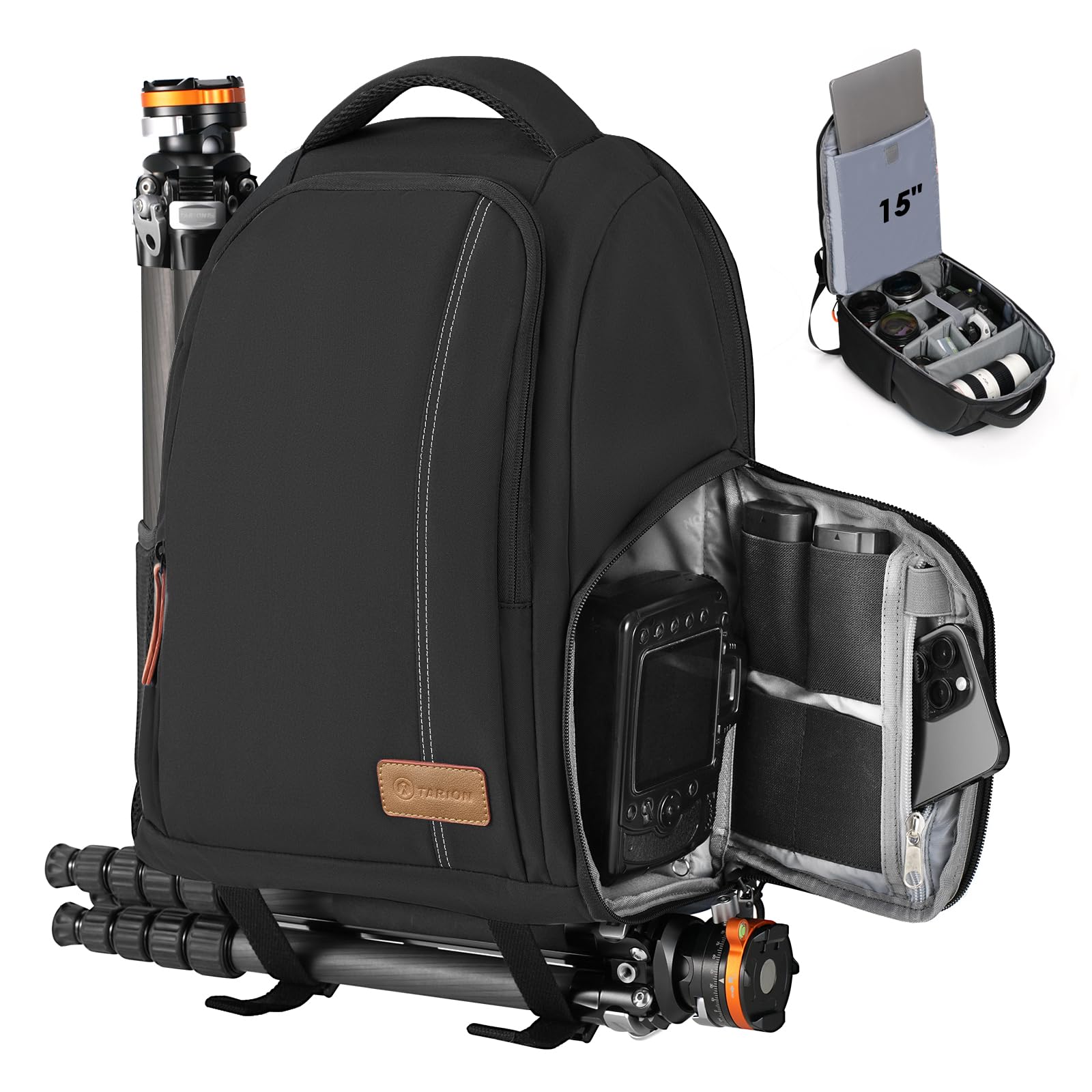
At 1.87 pounds empty, the TB04 is a pack you forget you're wearing. TARION kept the structure — padded back panel, padded straps, a full set of adjustable dividers inside — and stripped the bulk out of it. That's the right trade for a day hike where the camera is only one of several things on your back.

Fifteen liters takes a body and two or three lenses, with a side opening for the camera and a rain cover in its own pocket. There's a 15-inch laptop sleeve and a trolley pass-through for getting to the trailhead. Comfort is where it surprised us: the padding sits where it should, and the pack stays put when you're using your hands on a scramble.

Capacity is the compromise, and it's a real one. Once a shell, a liter of water and lunch go in, the camera compartment starts to squeeze, and a body with a long zoom mounted eats most of it. If your hikes run three or four hours with one spare lens, that's a fair trade for how little the bag costs you in effort. If you're out all day, step up to the K&F or the RAINSMORE.

One detail we appreciated: pull the divider insert and it's an ordinary daypack for the flight home, which is more than most of the packs here manage on the six days a week you're not shooting.

Pros

  • 1.87 lb empty
  • Side access plus an included rain cover
  • Comfortable padded harness for a day pack
  • Divider insert lifts out for everyday use

Cons

  • 15 L fills fast once layers and water go in
  • Tight for a body with a long zoom attached
Our verdict

The lightest full backpack here, and the one we reach for on short hikes where the camera is along for the walk rather than the point of it.

Check Latest Price
4

Best Weather Protection

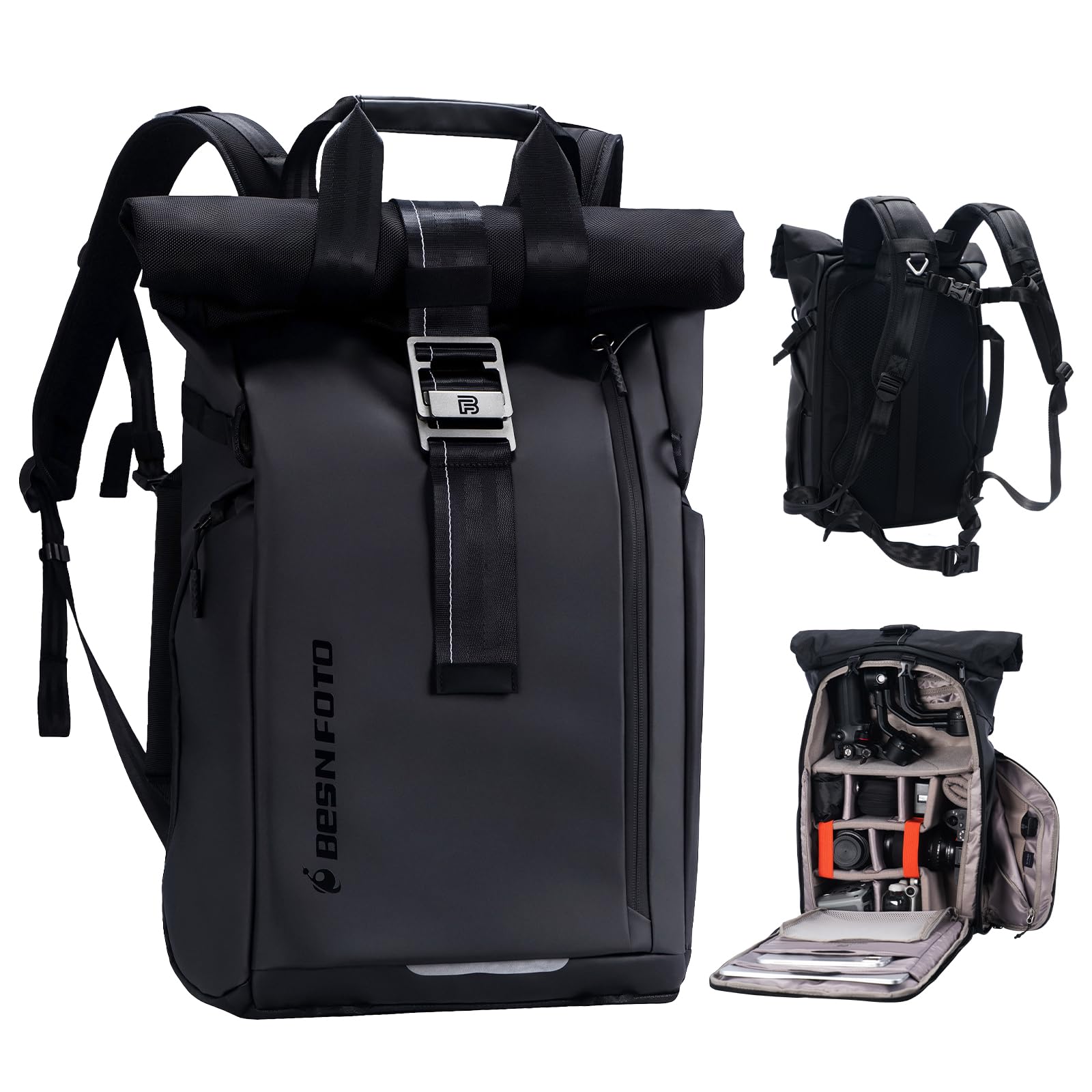
Besnfoto Rolltop Camera Backpack

90 /100
Keeper Score Outstanding

Key details

Harness
Chest and waist belt
Listed Volume
23 liters
Waterproofing
Tarpaulin shell, YKK water-resistant zips
Rolltop Expansion
5-7 liters
Check Price on Amazon

The rolltop is the reason to look here. Rolled down it's a tidy 23-liter daypack; unrolled it takes another five to seven liters of jacket, food or a gimbal. That's the flexibility that matters when the weather decides your layering for you at the top of a climb rather than at the car.

Protection earns it the place. The body is high-density waterproof tarpaulin with YKK water-resistant zips, so the fabric itself is the barrier rather than a cover you wrestle on in the wind. That's a different category of confidence from a nylon bag with a rain cover in the base pocket, and it's the pack we hand to anyone whose hikes happen in weather that ignores the forecast. It also carries weight better than anything else in this group, with a chest and waist belt that puts the load on your hips.

Straps are the weak point: the clips and elastic don't match the standard of the shell, and the hip belt is where wear shows first. It's also the priciest bag here, which you're paying for fabric and closure rather than hardware. Worth it if you hike wet; overkill if you don't.

Pros

  • Waterproof tarpaulin shell with YKK water-resistant zips
  • Rolltop adds 5-7 L when a layer comes off
  • Chest and waist belt distribute the load
  • Side access plus a fully opening rear panel

Cons

  • Strap clips and elastic feel weaker than the shell
  • The most expensive bag in this group
Our verdict

Buy this one if wet weather decides the purchase — the tarpaulin shell and sealed zips are the most protection here, and the rolltop swallows a layer.

Check Latest Price
5

Best Budget

CADeN D6 Camera Backpack

95 /100
Keeper Score Outstanding

Key details

Weight
1.74 lb
Capacity
17 liters
Dividers
Adjustable
Camera Fit
One body, four lenses, flash and a tablet
Check Price on Amazon

Seventeen liters, 1.74 pounds, and the lowest price here by a wide margin — the D6 has no business being as good as it is. It swallows a body with four lenses, a flash, a tablet and a tripod on the side, and the dividers reposition far enough that you build the layout around your kit rather than the other way round. That last part is why it's our budget pick: cheap bags usually make you fit the bag.

Nothing about the build reads as a compromise at this price. The stitching is dense, the padding is thick enough to trust, and the adjustable compartments hold their shape once you've set them. It's the pack we suggest to someone who wants to start hiking with a camera without committing to a pricier bag first.

The trade-offs are the obvious ones. Seventeen liters goes quickly once a shell and water come out of the top, and the tripod holder wants a compact tripod — a full-size one sits awkwardly and pulls the bag off balance. For a half day with two lenses, neither matters.

Pros

  • Full camera kit plus tablet in 17 L
  • Dense stitching and thick padding for the money
  • Adjustable dividers build around your kit

Cons

  • 17 L runs out of room on a full day
  • Tripod holder suits a compact tripod only
Our verdict

The best value here: a genuinely well-built 17-liter pack that carries a full camera kit on half-day hikes, at the lowest price in this group.

Check Latest Price
6

Large Kits

MOSISO Hardshell Camera Backpack

95 /100
Keeper Score Outstanding

Key details

Weight
3.2 lb
Capacity
35 liters
Laptop Sleeve
Fits 15.6 in
Front Protection
Waterproof PU hardshell
Check Price on Amazon

The front of this MOSISO is a waterproof PU hardshell, and that rigid panel is the feature that sells it. It takes a knock from a rock, a car door or a drop off a tailgate and spreads the impact across the shell instead of passing it through to the glass.

At 35 liters and 3.2 pounds it's the biggest and heaviest pack here, and the weight is the honest cost of that shell. What you get for it is room — a body or two, several lenses, a separate 15.6-inch laptop compartment, nine pockets and a tripod strap on the side. The interior dividers are removable, so the bag converts to luggage when the shoot is over.

Durability decides this one. The shell holds up; the straps and zips are less consistent, and a strap letting go with a loaded pack on your back is a bad moment on a trail. Check the strap anchors and the zip stitching when it arrives, and keep the load inside what a 3.2-pound harness can actually carry.

It's a pack for the photographer who hikes to a place and stays there — a landscape or astro session with a full kit — rather than the one logging ten miles with two lenses and a jacket.

Pros

  • Rigid waterproof hardshell over the camera end
  • 35 L takes a large kit plus a laptop
  • Removable dividers convert it to luggage

Cons

  • 3.2 lb empty
  • More bag than a day hike needs
Our verdict

Worth it for hard-shell protection around a large kit if you don't mind the weight; for a lightweight day hike, the TARION is the better call.

Check Latest Price
7

Osprey Owners

Osprey Camera Chest Rig

78 /100
Keeper Score Very Good

Key details

Padding
Molded EVA foam
Mounting
Osprey packs with load lifters
Rain Cover
Included
Side Pockets
Yes
Check Price on Amazon

This isn't a standalone bag. The Chest Rig mounts to an Osprey pack's harness through the load lifters, so it only makes sense if you already carry an Osprey with those attachment points. Read that as the price of admission rather than a flaw — but do read it before you order.

What it does is put the camera on your chest, which is where you want it when you're using your hands and don't want a pack swinging off one shoulder. Molded EVA foam holds the body steady, the dividers adjust to the lens you have mounted, and there are side pockets for a battery or a filter. A rain cover comes with it.

The appeal is what it leaves behind. Your Osprey keeps its full capacity for layers, water and a tent, and you stop taking the pack off every time something catches your eye. Weight rides on the pack's harness instead of your neck, which is the difference between this and a camera sling over a long day.

For an Osprey owner doing long days, this is the best camera-carry setup in this roundup. For everyone else it's a doorstop — and at a premium price, that's a lot to spend on an accessory that works with one family of packs.

Pros

  • Camera sits on your chest, hands free
  • Molded EVA foam with adjustable dividers
  • Leaves your pack's capacity for everything else
  • Rain cover and side pockets included

Cons

  • Only mounts to Osprey packs with load lifters
  • Premium price for an add-on
Our verdict

The best way to carry a camera on a long hike if you already own an Osprey pack — and no use at all if you don't.

Check Latest Price
8

Quick Access

CADeN Camera Sling Bag

89 /100
Keeper Score Excellent

Key details

Weight
1.5 lb
Dimensions
12.5 x 4.5 x 9.4 in
Rain Cover
Included
Carry Modes
Chest bag or sling backpack
Check Price on Amazon

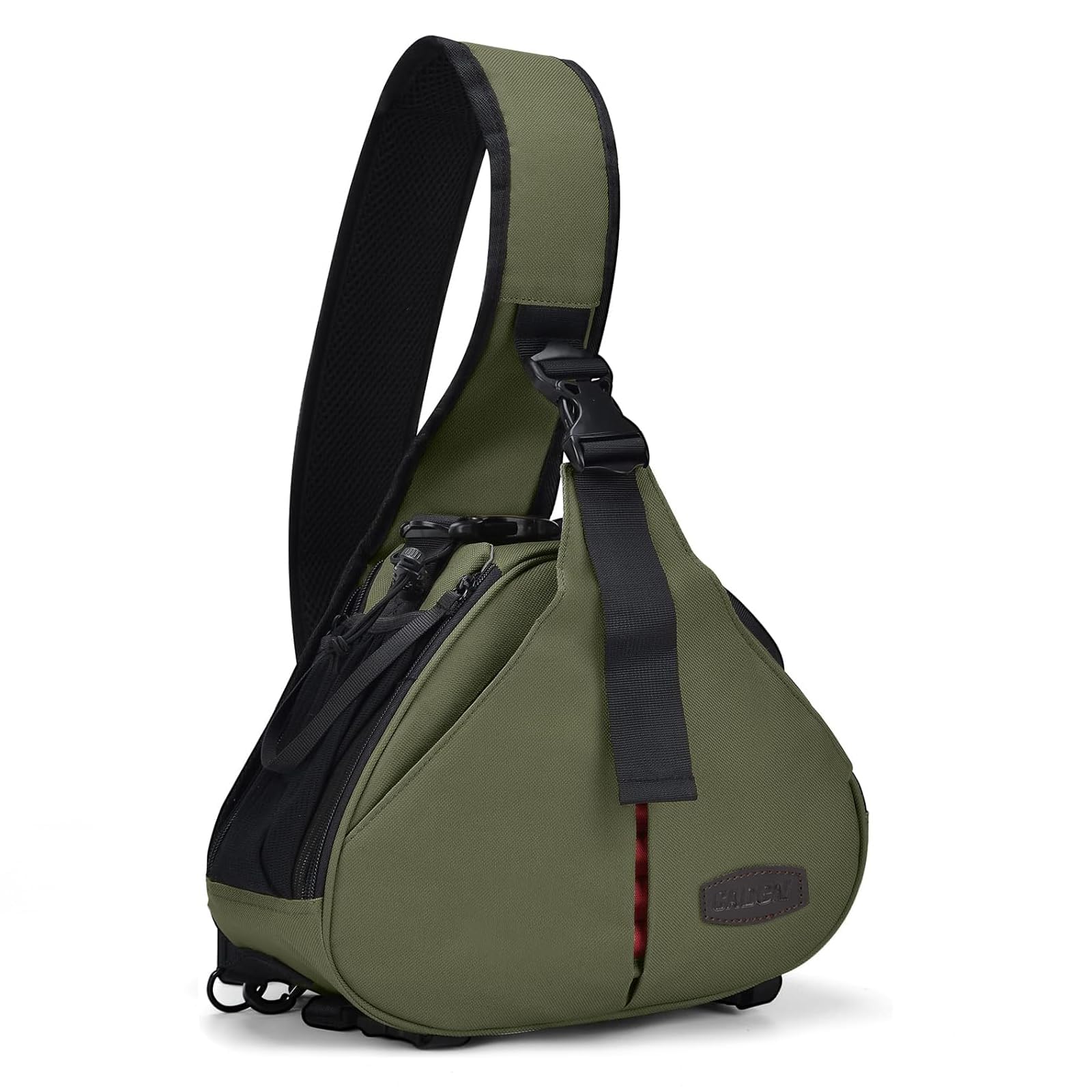
The swing-around is the trick. Worn as a sling, the bag rotates from your back to your chest in one motion and the camera comes out through a drawstring side pocket in about two seconds. On a hike where you're shooting as you walk, that's quicker than any backpack here.

It's small — 12.5 by 4.5 by 9.4 inches and 1.5 pounds — and it carries one body, a lens or two, a tripod strapped underneath and a rain cover in the base. Worn on the chest it works as a chest bag, which is the configuration we ended up using on steep ground where a swinging bag is a nuisance.

Comfort is the limit. A sling puts everything on one shoulder and across your chest, and after three or four hours with a body and two lenses it starts to tell. The compartment is also tight for a pro-sized DSLR with a zoom mounted; a smaller mirrorless body and a prime or two fit far more happily.

Where it wins is the short hike with limited gear: a walk, a sunrise, two lenses and no ambition to carry a jacket. It's also the least expensive way into wearable camera carry here, and the build — zips, buckles, stitching — doesn't feel like the cheap option.

Pros

  • Swings from back to chest for two-second access
  • Doubles as a chest bag on steep ground
  • Tripod holder and rain cover included
  • Light 1.5 lb with solid hardware

Cons

  • One-shoulder carry tires after a few hours
  • Tight fit for a pro body with a zoom mounted
Our verdict

For quick-access carry on short hikes with a mirrorless body and a couple of lenses, this sling is the one we grab; pack a bigger bag if layers are coming.

Check Latest Price

How We Tested These Camera Backpacks on the Trail

We started by gathering the bags photographers actually take into the field, then narrowed by what matters on a hike: listed capacity in liters, whether a rain cover came included or cost extra, how the tripod attached, and whether the camera was reachable without setting the pack down. Bags that opened only flat from the back didn't make it — fine in a studio, miserable on a windy ridge. Ten packs went into testing.

Each one was loaded with the same kit — a body, two lenses, spare batteries, a shell, a liter of water — and weighed before we walked out the door. We hiked five- to ten-mile days with them, added a few overnights, and took them through airport days where the bag had to fit under a seat. Capacity got tested the honest way: pack for a day, then try to wedge a jacket in on top.

Around the six-week mark we started pulling on the parts that fail first. We hung each bag by a single shoulder strap, loaded the hip belt, and noted which harnesses kept weight off our collarbones on descents. Zippers were run open and shut with sandy hands and after a week of grit; the ones that caught or needed two hands got marked down. Then we hosed every bag down and carried them through a wet weekend, watching whether water beaded off the lid and whether the rain cover stayed put in wind.

Versatility was the last filter. We pulled the camera inserts out to see if a bag doubled as a daypack, strapped a tripod on and off, and reached for the camera through side access while walking. Value came down to what was included — rain cover, tripod straps, laptop sleeve — against what we'd have to buy separately.

How to Choose a Camera Bag for Hiking

Start with the harness

On a hike the bag is on your back for hours, so the first question isn't how many lenses it holds but how it carries them. Padded shoulder straps and a ventilated back panel are the minimum. A chest and waist belt is what moves weight onto your hips once the load passes about ten pounds, which is why the Besnfoto's belt matters more on a long climb than any extra pocket.

Empty weight counts double. A pack that's three pounds before you put anything in it is three pounds you lift up every switchback, and most camera bags here sit between 0.85 and 1.65 kg. Keep the empty bag light unless the capacity genuinely earns the weight.

Match volume to the hike, not to your whole kit

Liters on a camera pack cover the entire bag, not just the camera compartment, and the padded cube usually eats a third to half of it. A 15-liter pack is a three- or four-hour walk with one spare lens. Twenty to 25 liters covers a full day with a shell, water and lunch. Thirty-five liters is a long day or an overnight.

If you're torn between two sizes, take the larger. You can cinch empty space down with a compression strap; you can't add room at the trailhead, and the layers come off halfway up.

Decide what rain protection you're buying

There are two approaches and they behave differently. A rain cover in a base pocket is light and effective once you stop to put it on, but it's a job you do in bad weather with cold hands. A waterproof shell — tarpaulin or coated nylon with water-resistant zips — is protection you never deploy.

If you hike somewhere wet, pay for the shell. If your rain comes as summer squalls, a cover plus a dry bag inside will do, and you save money and weight.

Get the camera out without stopping

Access is the feature you'll use most and the easiest to get wrong. A side panel only helps if it sits on the shoulder you reach with and the compartment isn't packed so tight that the camera snags a divider on the way out. A full rear opening is better for repacking at the car and useless on the move.

A sling or a chest rig beats both on speed and loses on capacity and all-day comfort. Decide which of those you're willing to trade before you shop.

Plan how the tripod rides

A tripod strapped to the side pulls the bag off balance on a scramble; one carried underneath keeps the load centered but knocks your calves on the descent. Cinch it against a compression strap so it can't swing, and pack the heavy glass low and close to your spine.

A compact travel tripod solves most of this. Several holders here take a folded travel tripod comfortably and struggle with a full-size one, so match the holder to the tripod you actually own.

Frequently Asked Questions

Final Verdict

For most hikers the RAINSMORE is the bag to buy: 28 liters splits cleanly between camera gear and layers, the rain cover lives in the bag, and nothing else here balances the two jobs as well without costing much. If your hikes are short and the camera is along for the walk, the TARION TB04 is the lighter, simpler answer.

And if you already carry an Osprey pack, the Chest Rig beats every backpack here for getting the shot — provided you accept that it's useless without one.