Best Camera Backpacks of 2026

A camera bag earns its keep on the days that don't go to plan: the trail that runs longer than the map promised, the drizzle that turns into actual rain, the second lens you swore you'd leave behind. I've carried gear in padded shoulder bags and in hard cases with a handle, and the backpacks that work are the ones that haul a full kit without turning a two-mile walk into a chore — weight sitting on your hips instead of your shoulders, a lens within reach without unbuckling everything.

Over the past six months, my team and I loaded 12 camera backpacks with the same kit — a mirrorless body, two zooms, a prime, a laptop, a tripod — and carried them on shoots, through airports, and into a wet week of outdoor sessions. Liter counts on a listing tell you almost nothing. What matters is how the dividers divide, whether the zippers still run smoothly when the bag is packed full, and whether the harness holds the load an hour in.

One thing I'd tell any first-time buyer: a rain cover you actually keep in the bag beats another five liters of space, and quick side access beats a dozen extra pockets. The picks below are the ones we'd carry again.

Keeper Score summarizes customer ratings and review volume. Read it alongside the product details and trade-offs. How the score works.

1

Best Overall

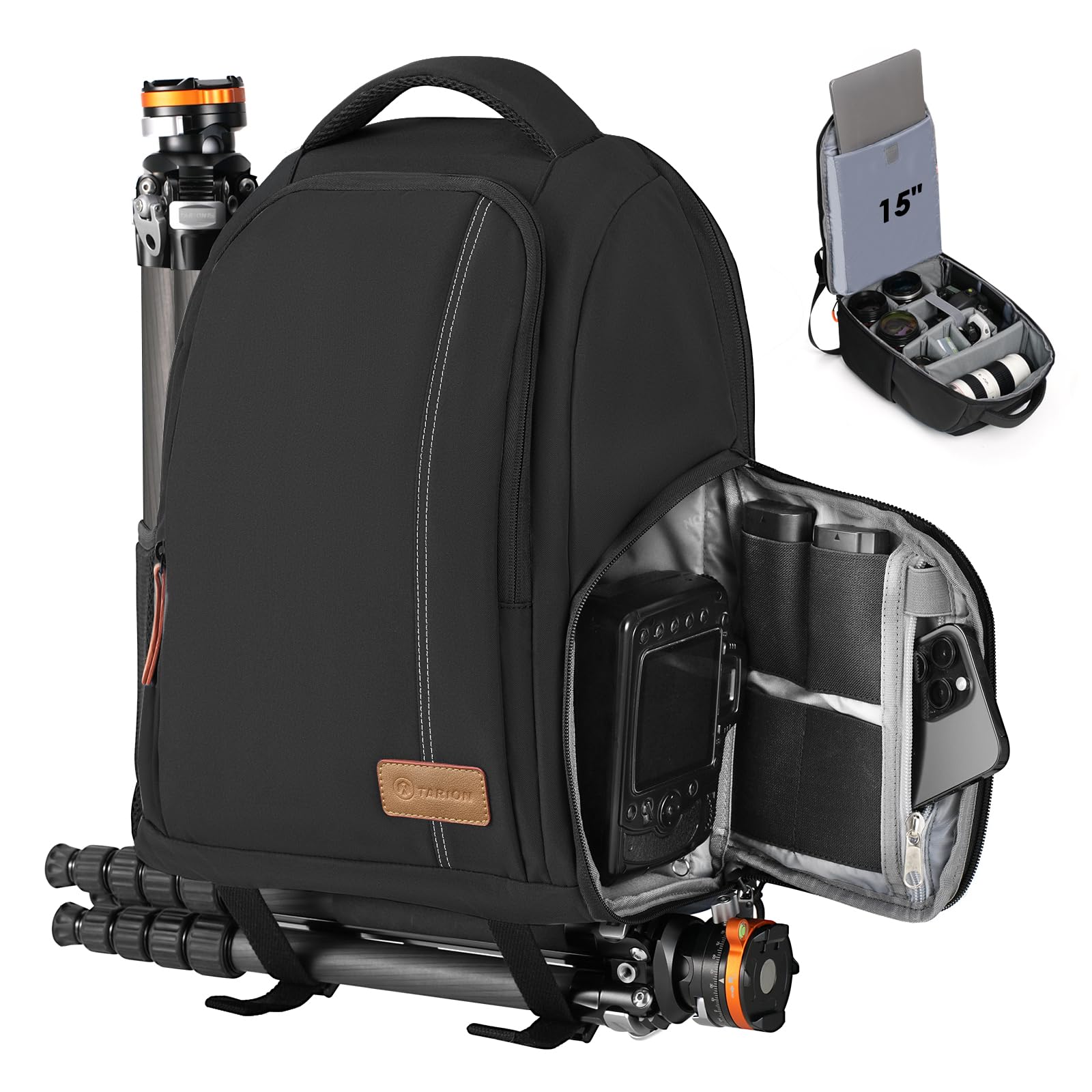
TARION TB04 15L Camera Backpack

95 /100
Keeper Score Outstanding

Key details

Laptop Fit
15 inches
Load Limit
22 lb
Storage Volume
15 liters
Weather Protection
Water-repellent nylon, rain cover included
Check Price on Amazon

Fifteen liters sounds small until you pack it. A mirrorless body with a mid-range zoom mounted, two more lenses, a flash, a card case, and a 15-inch laptop went in without the bag looking strained, and the dividers still had room to wall each piece off from the next. That's why this TARION is our top pick: it behaves like a bigger pack without making you carry one.

The side panel is what sells it on a walk. It opens wide enough to bring out a body with a compact zoom attached, so you can swing the bag off one shoulder, take the shot, and put it back without setting anything on the ground. The travel kit is unusually complete for the size: a trolley sleeve that slides over a suitcase handle, a flat hidden pocket against your back for a passport or a card, a rain cover in its own pouch, and a tripod strap on the side.

At 1.87 pounds empty it's the lightest pack here after the CADeN, and the 22-pound load rating is honest about what the seams will take. The trade is exterior storage. Two zip pockets and a mesh bottle holder are the whole list, so chargers, a jacket, and a snack end up in the main compartment, which means unpacking gear to reach a cable. Pack for a laptop, a body, and three lenses and that trade costs you nothing.

Pros

  • Fits a body, three lenses, and a laptop
  • Side access without taking the bag off
  • Trolley sleeve, hidden pocket, rain cover included
  • 1.87 pounds empty

Cons

  • Slim exterior pockets push cables into the main cavity
Our verdict

Our pick for most photographers: light enough to carry all day, quick to open on the move, and fitted out for travel rather than just storage.

Check Latest Price
2

Best Budget

CADeN D6 Camera Backpack

95 /100
Keeper Score Outstanding

Key details

Weight
1.7 lb
Capacity
17 liters
Camera Fit
1 body, 4 lenses, flash, tripod
Tablet Sleeve
iPad
Check Price on Amazon

This is the least expensive pack we're recommending, and it reset what we expect from a budget camera bag. Seventeen liters, 1.7 pounds, and a listed layout of one body plus four lenses, a flash, a tripod, and a tablet: a full DSLR kit in a bag that costs less than most of the lenses that go inside it.

What impressed us is how little the interior feels like a compromise. The dividers are thick enough to act as structure rather than padding, the nylon has a slight sheen that wipes clean, and the bag stands open on a table while you load it. The alloy zips and a one-year replacement warranty are the sort of things budget packs usually skip, and here they're included.

Two things it doesn't have. There's no quick-access side door, so the camera comes out through the front panel, which is fine at a table and slow on a moving street. And the sleeve on the side is sized for a tablet rather than a padded laptop compartment, so a laptop rides less protected than in the packs above. If the laptop stays home and you shoot in places where you set up and stay a while, neither gap matters much.

Pros

  • Holds a body, four lenses, flash, and tripod
  • 1.7 pounds with real interior structure
  • One-year replacement warranty
  • Lowest-priced pack in this group

Cons

  • No side access; camera comes out the front panel
  • Tablet sleeve instead of a padded laptop compartment
Our verdict

The budget pick that still swallows a full DSLR kit, as long as you don't need the camera out without setting the pack down.

Check Latest Price
3

Best Mid-Size Kit Bag

K&F Concept B01 20L Camera Backpack

91 /100
Keeper Score Outstanding

Key details

Capacity
20 liters
Camera Fit
1 camera, 4 lenses, tripod
Dimensions
17.32 x 11.81 x 6.69 inches
Laptop Fit
15.6 inches
Check Price on Amazon

Two ways into the same bag is the whole idea here. The back panel unzips around three sides and folds down, turning the interior into a tray you can lay out on a bed or a tailgate; the side door lets you pull the camera out with the pack still on one shoulder. Of the packs in this group, this is the one whose interior we most enjoyed loading.

Twenty liters, a listed capacity of one camera with four lenses and a tripod, a 15.6-inch laptop sleeve, and a full spread of pockets and compartments. The two-tone colorway is the best-looking exterior here, and it reads as a designed bag rather than a black box with straps, which counts if the pack is going to sit in a café or an office as often as on a trail.

The back flap does fold into the compartment you're working in unless you hold it back with one hand, which is the one part of the design that feels unresolved. Everything else about the layout argues for itself, particularly if you repack at the end of a day rather than in the middle of one.

Pros

  • Back panel folds flat for loading
  • Side door for quick draws
  • Holds a body, four lenses, and a tripod
  • Best-looking exterior in this group

Cons

  • 1.55 kg empty, roughly double the CADeN
Our verdict

Choose this when 15 liters is a squeeze and 30 is overkill, and you want to lay the whole kit out flat at the end of a shoot.

Check Latest Price
4

Best Hardshell Protection

MOSISO Hardshell Camera Backpack 35L

95 /100
Keeper Score Outstanding

Key details

Shell
Hard-shell front panel
Capacity
35 liters
Dimensions
17.32 x 11.8 x 7.5 inches
Laptop Fit
15.6 inches
Check Price on Amazon

The front of this pack is one rigid panel, and it changes how you treat the bag. Set it down on wet pavement or a truck bed and the armored side is the side touching the ground. The shell is waterproof PU leather over foam, so it sheds a shower and takes a knock where a soft bag lets both through to the dividers.

Thirty-five liters is the biggest capacity here, split into two compartments with removable modular inserts in the upper one, plus a 15.6-inch laptop sleeve and a tripod strap. The main cavity is deep enough for a body with a long zoom attached, and the shape holds itself open while you load, with no collapsing canvas to fight while you rearrange dividers.

It is a big bag and it looks like one: 35 liters of structured rectangle on your back. That's the honest cost of the capacity, and it makes this a pack for a purpose-built trip rather than the bag you sling on for a walk with one camera. Load it full and the shell earns its keep; carry it half empty and you're hauling a suitcase with straps.

Pros

  • Hard front panel protects the business end
  • 35 liters, the largest capacity here
  • Water resistance and padded modular inserts

Cons

  • Straps and zippers are the wear points
  • 3.2 pounds empty before any gear
Our verdict

Maximum protection for the money: a rigid front panel, 35 liters of padded storage, and a shell that shrugs off wet pavement.

Check Latest Price
5

Best for Long Lenses

K&F Concept B12 30L Camera Backpack

89 /100
Keeper Score Excellent

Key details

Capacity
30 liters
Interior
Three-tier compartments
Dimensions
11.42 x 8.66 x 21.26 inches
Laptop Fit
16 inches
Check Price on Amazon

Twenty-one inches of exterior height is the number that matters here. Inside, the compartment runs close to 21 inches tall, so a body with a 150-600 or a 180-600 stays mounted and stands upright instead of lying diagonally across the pack. If you've been laying a long zoom down and hoping the lid closes, this is the bag that ends the compromise.

The interior splits into three tiers, which we found more useful than one deep cavity. Camera gear sits in the main section, a laptop and flat items ride against the back, and smaller accessories go up top where you can reach them without opening the whole bag. Side access reaches the camera section, the laptop sleeve takes a 16-inch machine, and a rain cover plus a side strap and buckle handle the weather and the tripod.

The weak point is how the dividers attach. The hook-and-loop strips grip the lining loosely, so a heavy lens can shift a boundary you set carefully the night before. Press every divider down hard and re-check the layout after the first trip, and the interior holds. At 30 liters and 1.5 kg empty, it also asks for more kit than a single-body shooter owns.

Pros

  • 20.9-inch interior height takes long zooms mounted
  • Three tiers separate camera, laptop, and accessories
  • 16-inch laptop sleeve, rain cover, and tripod strap

Cons

  • Divider hook-and-loop strips grip loosely
Our verdict

For long glass and two bodies, this is the pack that gives a 150-600 somewhere to stand up; small kits will rattle around inside it.

Check Latest Price
6

Best Premium

Lowepro ProTactic BP 450 AW III

83 /100
Keeper Score Excellent

Key details

Volume
28 liters
Warranty
2 years
Laptop Fit
16 inches
Access Points
4
Check Price on Amazon

The harness is where the money went. The ActivZone back panel is shaped to leave a channel along the spine, the shoulder straps are contoured rather than flat webbing, and the removable utility belt is built to move load off your shoulders, which is the part that decides whether a heavy kit is bearable by the end of a long day.

Four ways in: dual side doors, a top opening sized for a long lens, and a full back panel that folds down. The top access is the one we kept coming back to, because a body with a 70-200 goes in and out without unzipping the whole back. The side doors have stretch pockets outside them, reinforced at the bottom, that will hold a tripod's feet.

The rest is modular. Molded MaxFit dividers connect to one another in multiple configurations, and the pack arrives with two pouches, two quick straps, and an all-weather cover. The shell fabric is 86 percent recycled, there's a two-year warranty, and a 16-inch laptop sleeve sits against the back panel.

None of this is cheap. It's the most expensive pack in this group by a wide margin, several times the price of the K&F or the MOSISO, and what you're buying is access and a harness a working photographer uses daily, plus a belt-and-pouch system that turns the bag into a mobile workstation. If your kit rides in the car and comes out at a location, the mid-range packs do the same job for a fraction.

Pros

  • Four access points including top and full back
  • Removable utility belt carries the load
  • Molded MaxFit dividers hold their shape
  • Two-year warranty and all-weather cover

Cons

  • Most expensive pack here by a wide margin
Our verdict

The pro choice: four ways in, a belt that carries the load, and a warranty to match, which is overkill unless you work out of your pack.

Check Latest Price
7

Pouch Expansion

RAINSMORE 28L Tactical Camera Backpack

90 /100
Keeper Score Outstanding

Key details

Weight
3.64 lb
Capacity
28 liters
Expansion
MOLLE webbing
Laptop Fit
15.6 inches
Check Price on Amazon

The outside is webbing, patch panels, and buckle straps. This is a pack that looks like it belongs on a range day, and that's either the reason you want it or the reason you don't. Underneath the styling it's a straightforward 28-liter camera bag with a quick-access opening to the main compartment, thick padded dividers, and a full rain cover.

Twenty-eight liters, eight compartments, a 15.6-inch laptop sleeve, and 1.65 kg empty. The quick-access opening gets a camera out in one motion without undoing the whole bag, and the top pocket swallows a sweatshirt or a spare layer, which keeps clothing out of the camera section. The MOLLE webbing takes add-on pouches, so a battery case or a bottle can live outside the main bag.

Our reservation is the look. Tactical webbing and a patch panel are a statement, and this pack will read as out of place at a wedding or a corporate shoot in a way a plain black bag doesn't. Everything else about it argues for the outdoor job it was built for: a pocket for batteries, a card case, a filter pouch, a cover for weather, and a padded back panel that keeps a day's kit where it should be.

Pros

  • MOLLE webbing takes add-on pouches
  • Quick-access opening to the camera section
  • Rain cover and waterproof fabric included

Cons

  • Tactical styling limits where it looks at home
  • 1.65 kg empty is heavy for the volume
Our verdict

A well-organized 28-liter pack with webbing for add-on pouches; buy it if the tactical look suits you and you want a pocket for everything.

Check Latest Price

How We Tested 12 Camera Backpacks

We started with roughly 30 backpacks and cut the list by reading listings closely: stated capacity, laptop sleeve size, whether a rain cover came included, and whether the exterior dimensions cleared carry-on limits. That left 12 we bought and used ourselves over six months rather than handling in a showroom.

Each was packed to the same list — body, two zooms, a prime, a 15-inch laptop, a tripod strapped outside, batteries and a rain layer — then carried on assignments, through two airports, on a commuter train, and across six miles of wet trail on a drizzly weekend. We weighed every bag loaded and noted where the weight sat: high and tight against the back, or sagging off the shoulders.

Zippers got the most scrutiny, because that's where cheap bags fail first. We worked the main compartments one-handed with a camera in the other hand, checked whether the pulls snagged on the storm flap, and slid the side-access panel open to see if it lined up with where the camera actually sat. Dividers were judged after a week of repacking, not on day one. We also stripped each bag down to one body and one lens to see whether it collapsed into something worth carrying on a light day.

Fit and straps came next: two testers of different heights adjusted each harness and walked an hour with a full load to find where it rubbed. Durability announced itself — scuffed corners, stretched seams, a buckle that slipped under weight. At the end we tallied what came in the box against what we had to buy separately.

How to Choose a Camera Backpack

Liters Are a Rough Guide

Camera packs measure volume the way suitcases do, and the padding, dividers, and laptop sleeve all take a bite out of the number. The listed camera capacity tells you more: a 15-liter pack carries a body, two or three lenses, and a laptop; 17 to 20 liters gets you a body, four lenses, and a flash; 28 to 35 liters is where a second body, a long zoom, or a drone starts to fit.

If your kit lands between two sizes, take the bigger one. Two spare liters weigh almost nothing, while a bag that won't close is useless on day one of a trip.

Choose the Opening You'll Use Most

Side access is for people who walk and shoot: the pack swings off one shoulder and the camera is in your hand. A full back panel is for people who arrive somewhere and unpack, because the whole bag opens flat and nothing can be reached while you're wearing it. Top openings are the long-lens route.

Two things to check before you commit. A side door sits on the outside of the bag, where a crowd can reach it, and it is built on one side only, so make sure it's the shoulder you shoot over or every draw becomes a reach across your chest.

Divider Grip Beats Shell Thickness

Most of the protection in a camera backpack comes from the dividers holding their position, not from the fabric. Molded systems interlock and keep their shape; hook-and-loop panels are more flexible but depend on the strips gripping the lining. When a strip lets go, a boundary shifts and two lenses end up sharing a compartment.

Before you load a new pack, press each divider down and try to slide it sideways with your palm. Anything that moves is the compartment that will open up three days into a trip, when you least want to be rebuilding the interior on a hotel bed.

Weigh the Empty Bag, Then the Load

An empty pack that's heavy stays heavy all day, and the difference compounds once glass goes in. The packs here run from under a pound and a half to over three, a bigger spread than most shoppers expect. The stated load limit is worth reading too, since a 15-liter pack with a 22-pound ceiling is telling you something honest about its seams.

After that, look at the harness. A contoured back panel and a hip belt move weight off your shoulders, and on a pack carrying more than a body and two lenses they matter more than an extra pocket.

Waterproof Fabric Isn't Rain Protection

"Waterproof" on a listing usually describes the shell fabric. Water actually gets in through a zipper, a seam, or the gap between the lid and the body. A rain cover is what keeps a kit dry in weather you have to walk through, and it needs fitting before you're already wet, which is why packs that stow one in an outside pocket get used more.

A hardshell front panel sheds water off the face of the bag and takes knocks, but it doesn't seal the seams. Match the feature to the weather you actually shoot in rather than the one on the spec sheet.

Frequently Asked Questions

Final Verdict

For most photographers, the TARION TB04 is the pack to buy: it holds a body, three lenses, and a laptop, opens from the side without coming off your shoulder, and weighs under two pounds before you fill it.

If your kit is bigger — a second body, a 150-600, a drone — the K&F B12's 21-inch interior is the better shape for it. If you carry that gear for a living, the Lowepro's four access points and load belt justify the jump, and if the budget is tight, the CADeN still swallows a full DSLR kit.