Best Borescopes of 2026

The bolt that started this was a 10mm that vanished down a truck intake. I could see the hole. I couldn't see the bolt, and the alternative was pulling the manifold. That's the moment a borescope earns its place in a toolbox: the dropped fastener, the ceiling stain with no visible source, the rattle you can hear but can't place. A good one turns a guess into a look, and a bad one shows you a blurry orange blob and leaves you exactly where you started.

The loudest spec on the box is rarely the one that decides it. A resolution number is easy to print and useless when one LED blows out the surface two inches from the lens. I've spent six months with 12 of these — articulating heads, dual-lens models, on-board screens and phone-tethered ones — and the same things kept mattering: brightness control, field of view, and a lens you can aim. The picks below are sorted by the job you're buying for, from under the hood to inside the wall.

Keeper Score summarizes customer ratings and review volume. Read it alongside the product details and trade-offs. How the score works.

1

Best Overall

Teslong TD450S

92 /100
Keeper Score Outstanding

Key details

Screen
4.5-inch IPS
Battery
Up to 5 hours
Articulation
Two-way, 210°
Probe Length
5 ft semi-rigid
Check Price on Amazon

A fixed-lens borescope shows you what sits directly in front of the tip, which is fine for a drain and close to useless for the wall of a cylinder. The TD450S steers its head 210 degrees in two directions, and we rate that above another million pixels. Just as important is where the joystick sits: centered on the handle under your thumb, so one hand can steer while the other feeds cable.

The 4.5-inch IPS screen is the largest on any articulating scope here, and the gap between it and a 4.3-inch panel is real when you are reading the carbon ring on a piston top in daylight. Focus is fixed between roughly 0.6 and 4 inches, so the tip has to get close to the surface you care about. The eight LEDs dim, and dimming is the part that counts, because full power on a polished piston just bounces glare back at you.

Five feet of semi-rigid gooseneck covers an engine bay, a wall cavity, or a short drain run, and the 32GB card comes in the box, which saves a trip out for one before the first job. Battery is rated at five hours. Longer runs belong to the scopes with 16-foot cables, and that is a limit worth taking seriously if your work is mostly drains.

The caveat is durability. A probe that quits after a handful of jobs is the failure to watch for here, so coil the cable in a loose loop, do not pull it out by the camera head, and keep the two-year warranty where you can find it. Handled that way, it is the scope that covers the widest spread of jobs with the fewest extra purchases.

Pros

  • Steerable head reaches around corners and bends
  • 4.5-inch IPS screen is the largest here
  • 32GB card and carrying case in the box
  • Five-hour battery rating

Cons

  • Probes have quit after a handful of jobs
Our verdict

If you want one borescope for engines, walls, and drains without a phone in the loop, buy the TD450S: the articulating head earns its keep the first time you need to look sideways.
Check Latest Price
2

Best for Tight Spaces

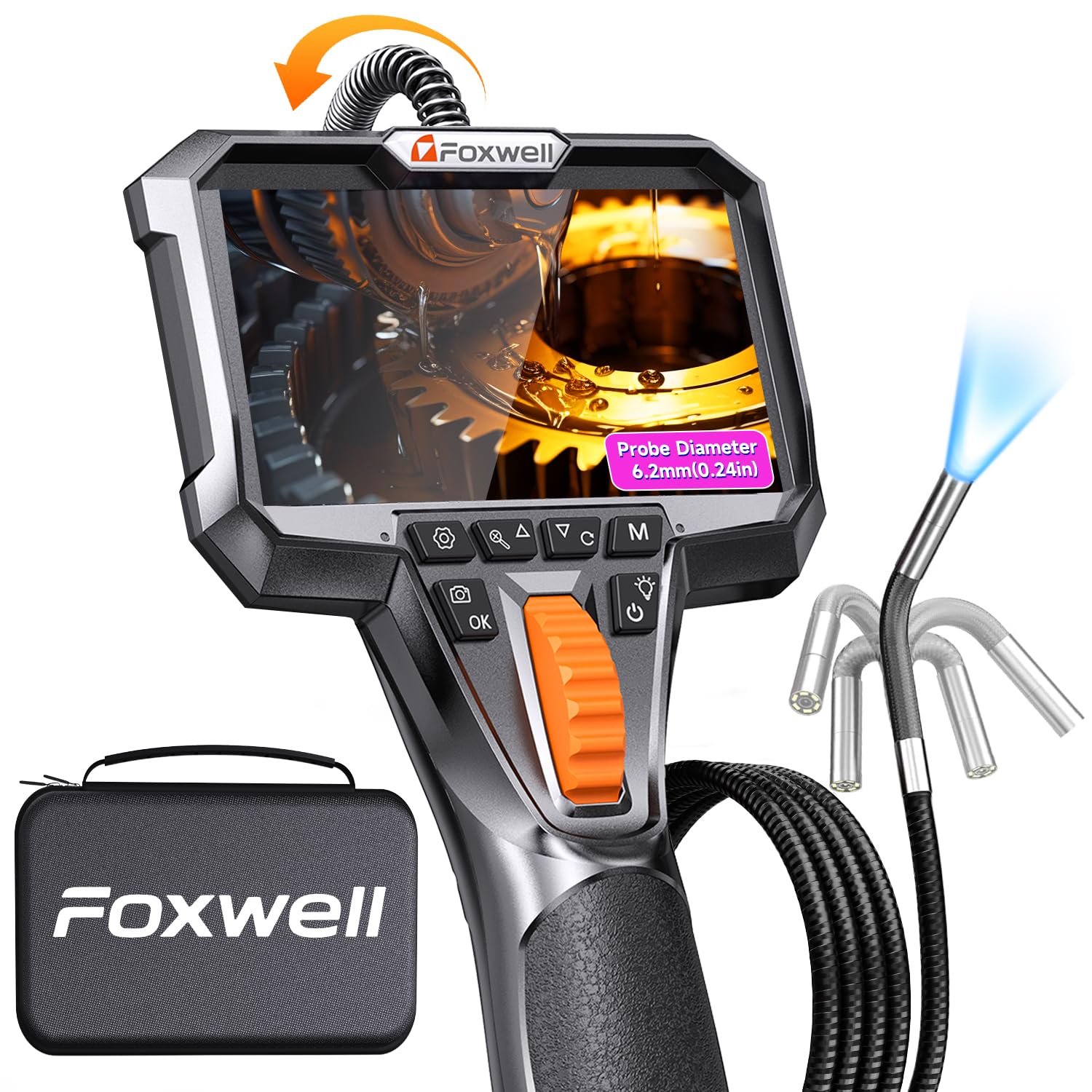
FOXWELL Y400

89 /100
Keeper Score Excellent

Key details

Screen
4.3-inch IPS
Articulation
Two-way, 220°
Probe Length
5.3 ft
Probe Diameter
6.2mm (0.24 in)
Check Price on Amazon

Six point two millimeters is the whole argument for the Y400. Most probes here run 7.9 to 8mm, which handles a spark plug hole or a drain and refuses an injector bore, a small vacuum port, or the gap behind a dash. The 0.24-inch head slides into openings the others will not take, and the two-way steering still works at that size, with 220 degrees of travel.

That is why it holds a place in a group this size: it is the one we choose when the hole has already been measured and it is tight. The 4.3-inch IPS screen holds up, the 4x zoom is genuinely useful for reading a casting number or following a crack without pushing the tip closer, and the 5.3-foot gooseneck is long enough for an engine bay or a short wall cavity.

Two things to accept. The smaller head gathers less light, so the LEDs work harder and reflective surfaces wash out sooner; back the brightness down before you decide the picture is poor. The thumb wheel and menu also take a session to learn. Neither is a reason to skip it, and both are reasons not to open the box for the first time under a hood.

Pros

  • 6.2mm probe fits ports the 8mm scopes cannot
  • Still articulates 220 degrees at that size
  • 4x zoom helps read small markings
  • 5.3-foot gooseneck with 32GB storage

Cons

  • Menu navigation takes some learning
  • Video capture is listed at only 720p
Our verdict

Buy the Y400 when the opening is smaller than a standard probe: its 6.2mm head articulates into places the 8mm picks cannot reach.

Check Latest Price
3

Best for Long Reach

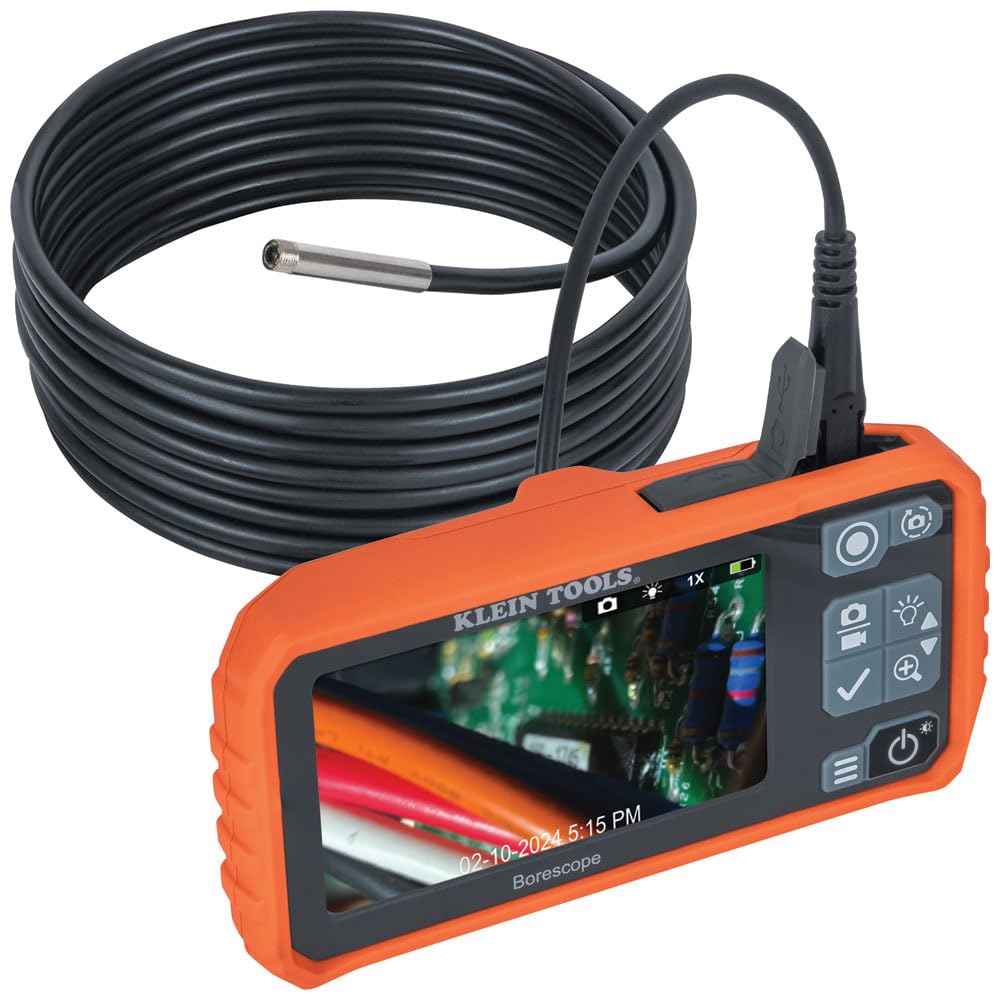
Klein Tools ET17

86 /100
Keeper Score Excellent

Key details

Screen
4.3-inch LCD
Weight
8.64 oz
Probe Length
9.8 ft gooseneck
Probe Diameter
5.5mm
Check Price on Amazon

The job the short scopes cannot finish is a duct, a chase, or a drain where the problem sits four feet past the opening. The ET17 is built for exactly that: 9.8 feet of gooseneck, 8.6 ounces in the hand, and the slimmest probe in this group. It is the one we reach for when reach is the whole problem.

The 5.5mm probe slips through openings the 8mm heads balk at, and the 4.3-inch LCD is bright enough to read in a dim basement. Stills and 1080p video save to a card, and the hook, magnet, and mirror attach the same way as everything else in this category. In a straight run, reach beats steering.

The included mirror is a partial substitute for a steerable head at best. It is a smaller diameter than the probe body, so it gives you a glance around a corner rather than a proper look, and it snags on joints. Where that matters less is a pipe, a duct, or a conduit, where what you are hunting sits straight ahead of the tip. That is the trade, and for a lot of jobs we take it.

Pros

  • 9.8-foot gooseneck reaches deep into runs
  • Slimmest probe in this group at 5.5mm
  • 8.6 ounces, light enough to hold overhead
  • 1080p recording plus hook, magnet, and mirror

Cons

  • Fixed tip: no steering around a bend
Our verdict

For long, straight runs through ducts, chases, and drains, the ET17's 9.8-foot gooseneck reaches what the short articulating scopes cannot, with the slimmest probe here.

Check Latest Price
4

Best Budget with a Screen

TGJOR Dual-Lens Borescope

91 /100
Keeper Score Outstanding

Key details

Lenses
Front and side
Screen
5 inches
Probe Length
16.4 ft semi-rigid
Water Resistance
IP67
Check Price on Amazon

A screen in the handle and a second lens on the tip usually come from different scopes at different prices. The G50 puts both in one unit for budget money, and that pair of features is the entire case for it: a 5-inch display that is bigger than anything else here, and a way to look sideways without a steering mechanism to pay for.

The side lens is the budget answer to articulation, and on a pipe or a wall cavity it does most of the same work, because flipping the view puts you on the wall of the bore instead of looking straight down it. We take it over a fixed-lens scope at twice the money. The 16.4-foot cable covers a drain run or a duct, and nothing about it needs your phone.

Two limits. There is no steering, so the side lens is a workaround rather than a replacement for a head you can aim, and the semi-rigid cable holds a set, which is helpful in a drain and irritating when you want it straight. It also ships with the hook, magnet, and mirror, which is the difference between spotting a dropped socket in a wall and getting it back.

Pros

  • 5-inch screen, the largest in this group
  • Side lens gives a sideways view
  • No app or phone required
  • 16.4-foot semi-rigid cable with IP67 probe

Cons

  • No articulation: the tip only looks ahead
  • Zoom is digital, so it adds no detail
Our verdict

A first borescope should be simple, and the G50 keeps it that way: the biggest screen here, a side lens, and no app at all.

Check Latest Price
5

Best Phone-Connected

Kinpthy W400-B

88 /100
Keeper Score Excellent

Key details

Probe Length
16.4 ft semi-rigid
Phone Adapters
Lightning, USB-C, Android
Probe Diameter
7.9mm
Max Still Resolution
1920 x 1440
Check Price on Amazon

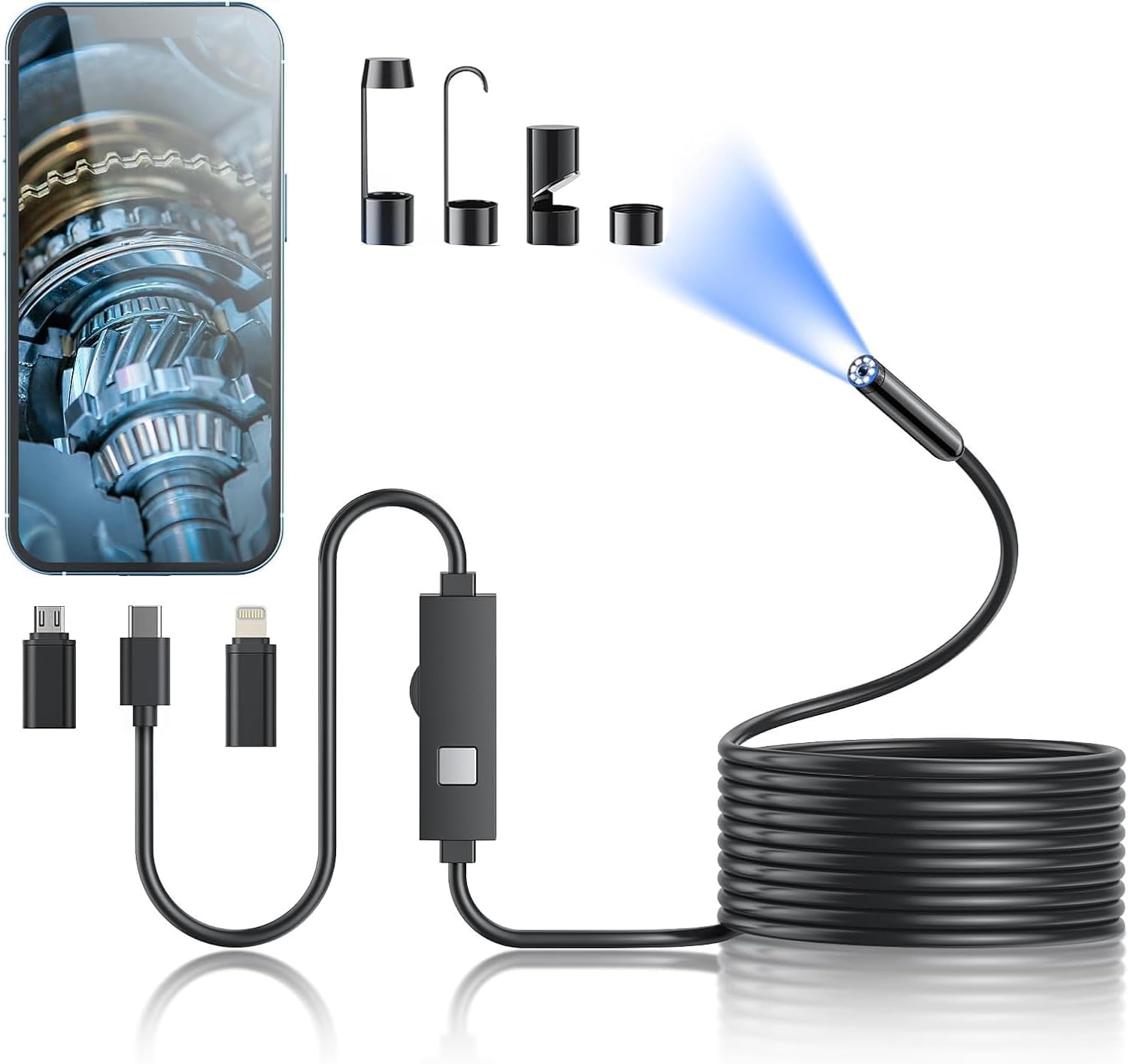
No screen, no battery, no case: just a 16-foot probe that plugs into the phone already in your pocket. That is the whole pitch, and it is a good one, because it is the least bulky way to carry a borescope and the version you can leave in a glovebox without noticing.

What you get is real. There are 1920x1440 stills, a 7.9mm probe that fits a spark plug hole or a half-inch line, and a semi-rigid cable that holds the bend you put in it, which is what lets you aim down a drain without a second pair of hands. Eight LEDs adjust, the probe is IP67 once the connector is seated, and the adapters cover Lightning, USB-C, and older Android ports, which is more than we expect at the budget end.

The catch is the phone. Plug-in scopes live or die by their app, and this one connects instantly on some handsets and not at all on others, with the trouble concentrated on Android. Install the app and confirm a live image the day it arrives, keep the adapters in the same bag as the cable, and the rest is a very cheap way to see inside things.

Pros

  • 16.4-foot semi-rigid cable holds its shape
  • 1920x1440 stills from a 7.9mm probe
  • Adapters for Lightning, USB-C, and Android

Cons

  • App connection fails on some Android phones
Our verdict

If you would rather not carry another screen and battery, the Kinpthy is the phone-tethered scope to get, as long as you test the app on your own phone first.

Check Latest Price
6

Best Articulating on a Budget

Acoath Articulating Borescope

84 /100
Keeper Score Excellent

Key details

Lenses
Front and side
Articulation
Two-way, 210°
Probe Diameter
0.33 in
Included Storage
32GB card
Check Price on Amazon

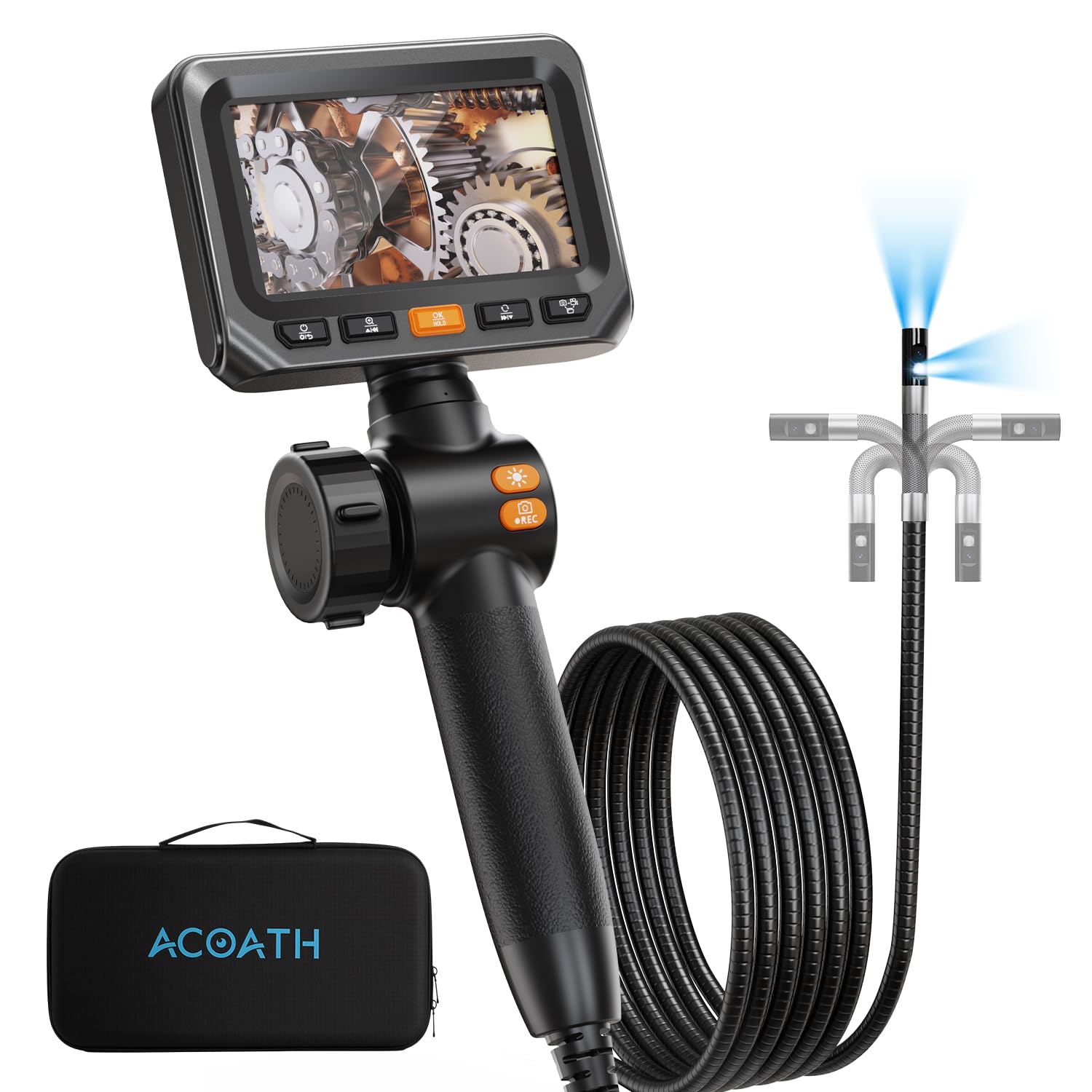
Two features that normally cost more: a head that steers 210 degrees in both directions, and a second camera set into the side of the tip. The Acoath has both, plus a 4.3-inch IPS screen and a 32GB card in the box, which is why it is the articulating scope we point to when the top pick is more than someone wants to spend.

The side lens is the part we underrated going in. On a cylinder wall or the inside of a pipe you can switch views instead of wrestling the head into position, and on a straight run where the cable will not turn it is the only way to see the bore rather than the end of it. The 8mm probe is standard size, so a spark plug hole and a normal drain both take it.

Against the top pick you give up polish rather than capability. The screen is smaller, the menus are plainer, and the whole thing reads as the value version of a premium tool, but the articulation works, the picture is clean in ordinary light, and 570 grams is manageable for a two-handed job. Nothing here feels like it will be the reason an inspection fails.

Two practical notes. The LEDs are strong enough to blow out a shiny surface at close range, so dim them before you decide the picture is poor. And the kit arrives complete, with card, protective case, hook, magnet, and mirror, which is not a given at the budget end of this list.

Pros

  • 210-degree two-way articulation at midrange money
  • Second lens on the side of the tip
  • 32GB card and protective case included
  • 4.3-inch IPS screen

Cons

  • 8mm probe will not fit the smallest ports
  • 5-foot cable limits long drain runs
Our verdict

The Acoath is the least expensive way here to get a steerable head and a side lens in one tool, and our pick when the top pick is out of budget.

Check Latest Price
7

First-Time Buyers

Daxiongmao C30

91 /100
Keeper Score Outstanding

Key details

Screen
4.3-inch LCD
Battery
Up to 3.5 hours
Probe Length
16.5 ft
Probe Diameter
8mm
Check Price on Amazon

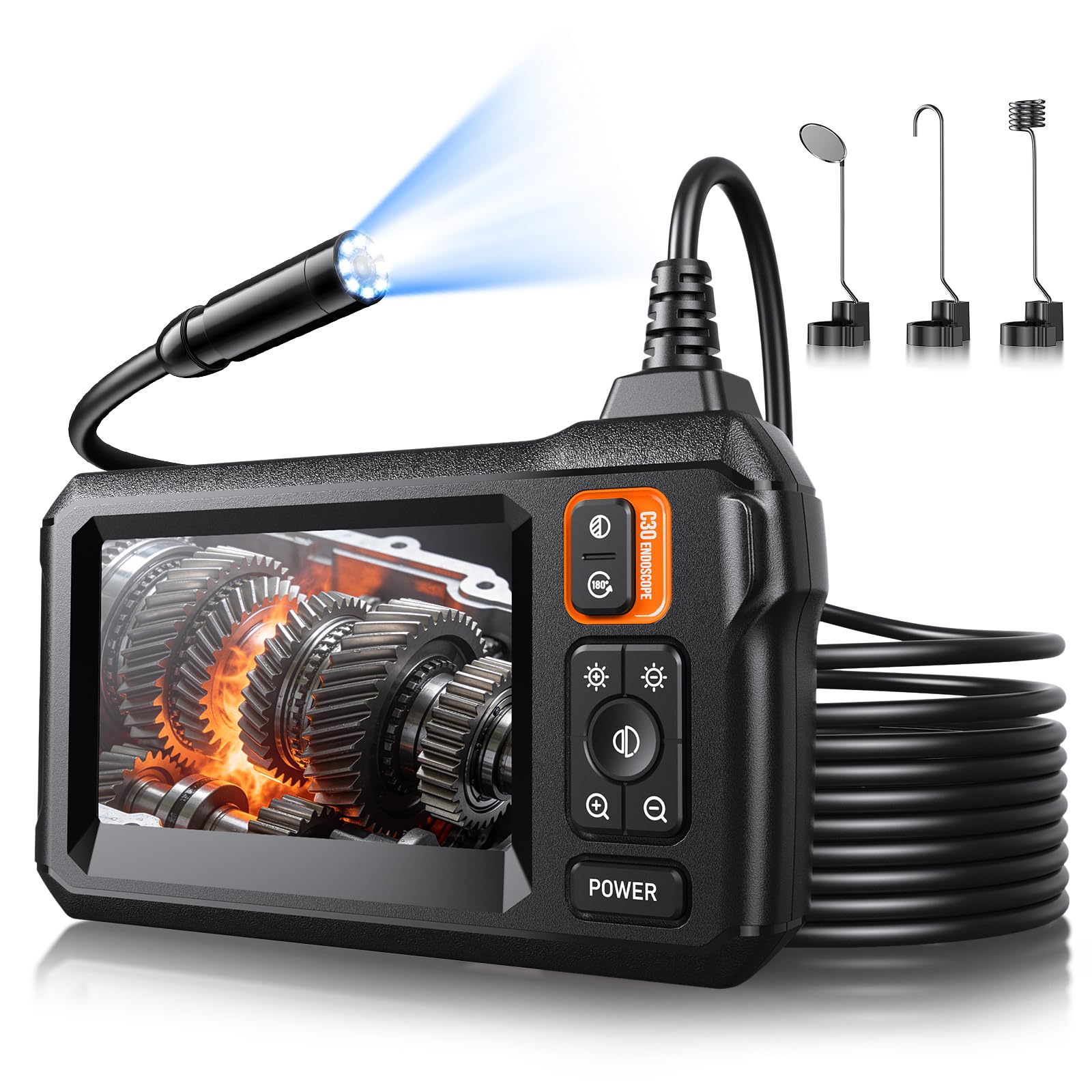
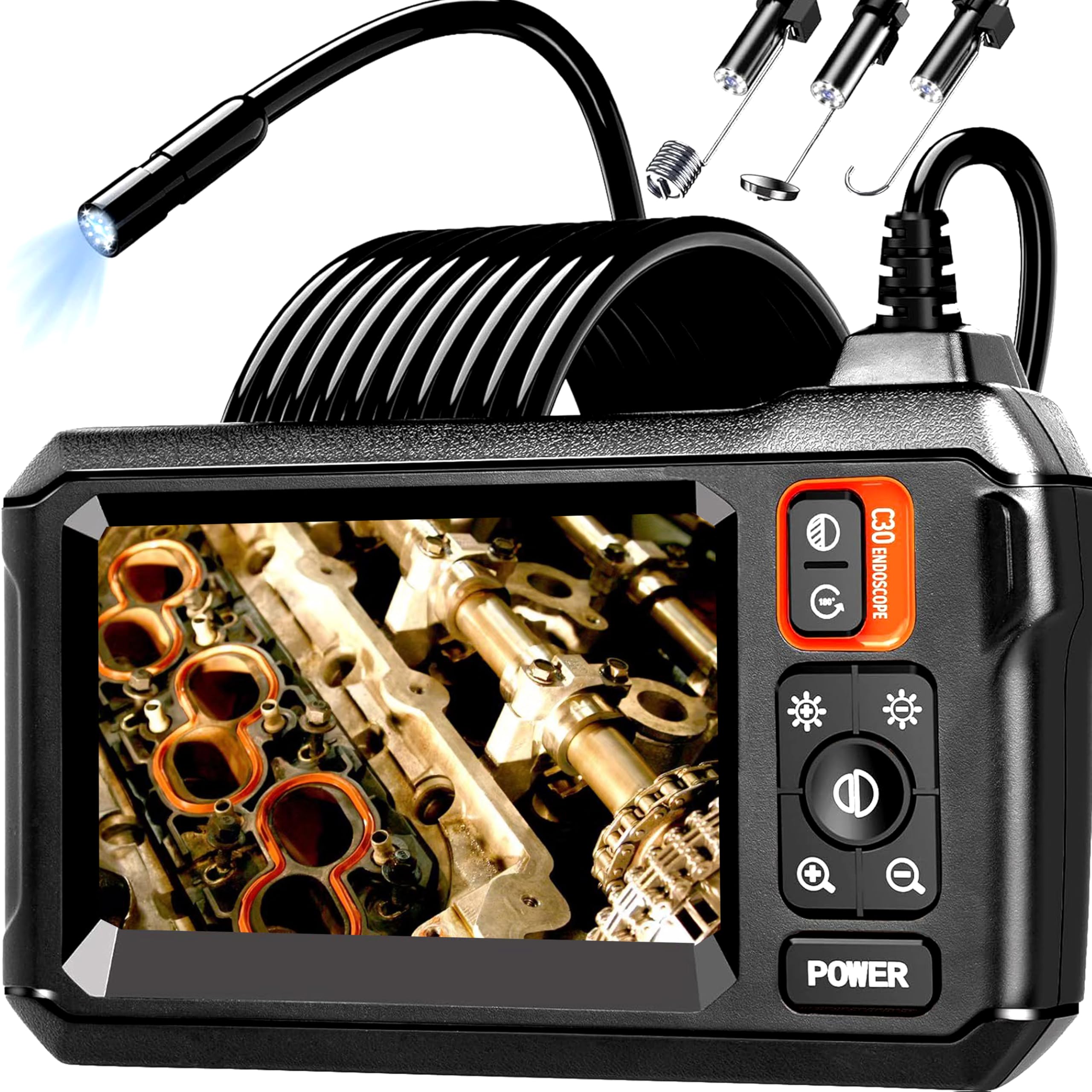
Press the power button and you are already looking: no app, no pairing, no phone. The C30 is the scope we hand to someone who has never used one, and its 16.5-foot cable means reach is rarely the thing that stops you.

The 8mm probe and its eight adjustable LEDs handle the ordinary jobs, whether that is down a drain, through a wall cavity, or past an intake, and the accessories are in the box rather than sold separately. Battery is rated at 3.5 hours, it charges over USB-C, and the hook, magnet, and mirror all fit the same threaded tip.

Focus is fixed, with a stated sweet spot of about 1.5 to 5 inches from the lens; outside that the image softens, which is a property of the design rather than a fault. Judge it as a finder: you will see a blockage or a crack, and you will not be making prints.

Where it lands is the cheap, capable, no-learning-curve end of this group, and it is the one we suggest for a homeowner with one plumbing question and no interest in a second career. What it cannot do is aim, so cylinder-wall diagnosis still belongs to the articulating scopes.

Pros

  • 16.5-foot cable for real household reach
  • Built-in screen with no app involved
  • 3.5-hour battery charged over USB-C
  • Hook, magnet, and mirror included

Cons

  • Picture is softer than the 1080p label suggests
Our verdict

For finding a leak or a blockage without spending much or learning an app, the C30 is the easy budget call, as long as you do not expect the 1080p picture the listing implies.

Check Latest Price
8

Detail on a Phone

DEPSTECH NTC55

83 /100
Keeper Score Excellent

Key details

Lenses
Front and side
Resolution
2560 x 1440
Probe Length
16.5 ft semi-rigid
Phone Adapters
USB-C, Lightning
Check Price on Amazon

The sharpest picture in this group reaches you through your phone rather than a screen in the handle. That is the trade the NTC55 asks you to make, and with 2560 by 1440 coming off a front lens and a side lens, it is a reasonable one.

The side lens is what makes the dual-lens design worth having: on a drain or a wall cavity you switch to a sideways view without bending the cable, and the 16.5-foot semi-rigid snake reaches far enough for that to matter. Nine LEDs dim all the way down, which we rate above raw brightness when you are inches from a wet, shiny surface and fighting reflections.

The app is the risk. Compatibility is the most divided thing about this scope: it works on the first plug-in for some phones and is not detected at all on others, and an unrecognized camera is a cable with a light on the end. Install the app, plug in, and confirm live video before the return window closes.

So buy it for the picture and the two views, and treat the connection as something you verify rather than assume. Do that and the NTC55 is the sharpest thing here to look through, and the whole kit packs down to a coiled cable with a hook and magnet on the end.

Pros

  • 2560 x 1440 with front and side lenses
  • 16.5-foot semi-rigid cable
  • Nine dimmable LEDs
  • USB-C and Lightning adapters included

Cons

  • App does not detect every phone
Our verdict

The NTC55 pairs the highest stated resolution here with a side lens and a phone you already own; buy it, test the app the day it lands, and it delivers.

Check Latest Price

How We Tested Borescopes in Garages, Walls, and Drain Lines

We started with about 40 borescopes pulled from manufacturer specs and retailer listings, then cut the field by asking whether the head fit through a hole a homeowner would actually drill, whether it worked without a phone, and whether anything in the box protected it. Twelve made the cut, spanning the price range, and we bought every one.

Testing ran six months and almost none of it happened at a desk. Each scope went after a real problem: a vacuum leak behind an engine, a ceiling stain with no obvious source, eight feet of floor drain, the inside of an HVAC return, and a fender bolt that had rolled into a cavity no hand fits. We also walked each cable around a 90-degree corner and dragged it over a sheet-metal edge a dozen times to see whether it kinked or the sheath nicked.

Picture quality got graded on tasks, not numbers: could I read the small print on a garden hose at two inches, could I tell copper from brass under garage light. We cycled every lamp through its full range and noted where the LEDs blew out into a white hotspot, and judged field of view by how much of a 3-inch pipe wall filled the frame. Articulation was scored on whether the tip could round a corner and hold its heading. Phone models got paired with both an iPhone and an Android, timed to connect, and watched for dropouts.

At the end we weighed value: what came in the case, and whether the scope did anything the cheaper ones around it couldn't.

How to Choose a Borescope

Start With the Opening, Not the Screen

We start every shortlist with probe diameter, because everything else is moot if the probe will not go in. An 8mm head handles spark plug holes, most drain lines, and a hole drilled for cable in drywall. Below that it gets specific: the FOXWELL's 6.2mm probe reaches injector bores and small vacuum ports, and the Klein's 5.5mm tip is the slimmest here.

Measure the port before you shop rather than after. If it is snug, run without the protective cap, which adds a fraction of a millimeter that can be the difference between in and stuck.

Decide Whether You Need Articulation

A fixed tip looks where you point it, which is all a drain or a straight pipe run asks for. Articulation earns its money when the surface you care about sits perpendicular to the hole: a cylinder wall, the inside of a duct, the far side of a bend. The two-way heads on the Teslong, FOXWELL, and Acoath steer roughly 210 to 220 degrees.

A side lens, as on the TGJOR and Acoath, is the cheaper answer. Instead of steering the head, you switch cameras, which is faster in a short bore and useless in a long, curving one.

Screen in the Handle or Your Phone

Handheld units cost and weigh more, but they need no app, no OS version, and no adapter, and the screen is always where you left it. Phone-tethered scopes like the Kinpthy and DEPSTECH are cheaper, lighter, and put the picture on a better display than any 4.3-inch panel, until the app refuses to recognize the handset.

Here is the trap: the purchase is not finished when the box arrives. Install the app and confirm live video the same day, because a phone scope that will not connect is a cable with a light on the end.

Length and Stiffness Decide How Far You Get

Five feet covers an engine bay, a wall cavity, or the trap under a sink; 16 feet and up is for ducts, sewer laterals, and chases. The Klein's 9.8 feet is the useful middle. Semi-rigid cable should hold the shape you bend into it and still push, because too soft and it curls in a drain, too stiff and it will not take the bend at all.

Coil it in a loop bigger than your hand between jobs and it behaves on the next one.

What Resolution and LED Claims Are Worth

Treat 1080P, 1920P, and 2K as labels until you see the picture. A 2MP sensor behind a fixed-focus lens is sharp only at its stated distance, usually a couple of inches to a foot, and in our own use glare has spoiled more images than low pixel counts.

LED count matters less than whether brightness adjusts. Eight LEDs at full power on a polished piston return nothing but glare, so turn the light down and move the tip to the distance the listing names before you judge the scope.

Frequently Asked Questions

Final Verdict

The Teslong TD450S is the borescope we point most people to, and the reason is simple: a steerable head and a 4.5-inch screen are what turn an inspection into an answer. It covers an engine bay, a wall cavity, and a short drain run without a phone in the loop.

If the openings you work through are smaller than a standard 8mm probe, the FOXWELL Y400 is the better buy at 6.2mm and still steerable. That one measurement should change your mind more than any resolution figure on the box.