Best Body Cameras of 2026

A body camera earns its keep on the day something goes wrong. If the battery quits at hour six and the face in front of you turns into a grey smudge after sunset, you've bought a paperweight with a lens — and you were counting on it. What you actually want is dull: footage that starts on the first press, stays legible in the dark, and sounds like a person instead of wind and static.

We've spent the past eight months wearing 12 of them through full shifts, night walks, and wet errands, and the pattern was consistent. Resolution sells cameras, but battery honesty and infrared performance decide whether a clip is worth anything. A mount that lets go mid-stride will cost you more footage than a step down in resolution, and one-hand operation matters more than you'd guess once it's dark and you're in gloves.

The picks below are the ones that kept recording when it counted. They differ in mounting, storage, and how long they run, so start with how you'll actually wear it.

Keeper Score summarizes customer ratings and review volume. Read it alongside the product details and trade-offs. How the score works.

1

Best Overall

CAMMHD V8 256GB

85 /100
Keeper Score Excellent

Key details

Weight
5.75 oz
Built-in Storage
256GB
Video Resolution
4K (2160p)
Claimed Record Time
Up to 14 hours at 720p
Check Price on Amazon

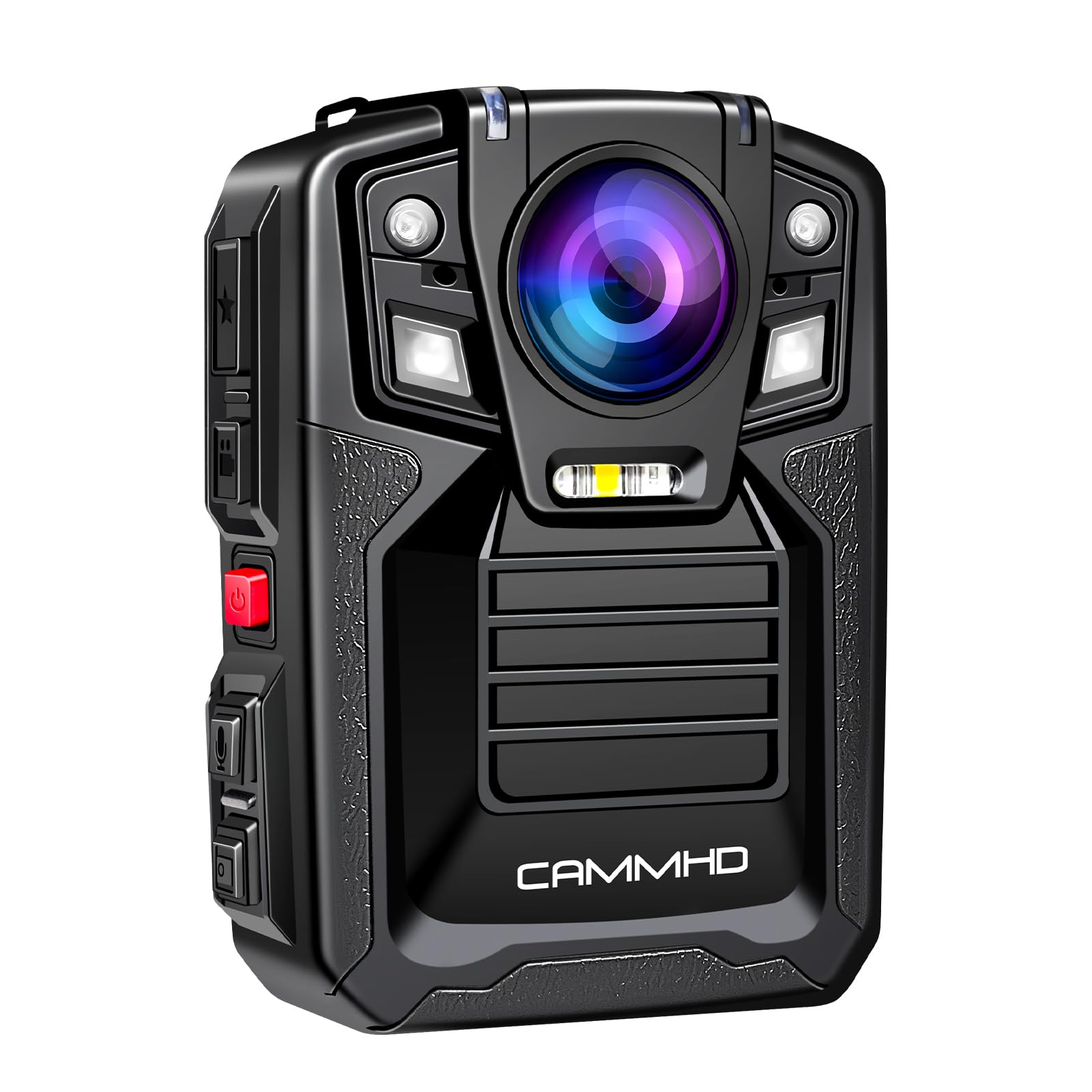
Two batteries and a charging dock are the most useful things about the CAMMHD V8, and they are why we point most people toward it. One 2,200mAh cell sits in the base while the other runs the camera, and the pair is rated for 14 hours, so a shift starts with a full body and a spare charging instead of one battery and a hope.

That 14-hour figure is quoted at 720p with both cells in play, so treat it as the ceiling; 4K at 2160p pulls the battery down far faster. The rest of the package suits the same job. The 170-degree lens picks up what is happening at the edge of a doorway, H.265 compression stretches the 256GB of built-in memory further, and the time stamp cannot be edited or deleted afterward, which is the whole point of carrying a camera.

At 163 grams it hangs on a shirt without dragging, and a long clip and a short back clip both come in the box, so it moves from a placket to a belt without another purchase. The 2-inch screen is big enough to confirm a recording before you end a shift, and the dock turns charging into a drop-in habit rather than a cable hunt.

The IR illuminators are rated to 50 feet, and inside that range faces stay readable; beyond it, movement becomes silhouette. Durability over a couple of years is the question any camera this new leaves open, so run a full shift in your first week while a return is still straightforward.

Pros

  • Two 2,200mAh batteries plus a charging dock
  • 4K video and 256GB built in
  • Long and short clips both included
  • 163 g, light enough to wear all shift

Cons

  • Stated support is a 30-day return window, not a warranty
Our verdict

Our default pick for most buyers: 4K video, 256GB built in, and two batteries rotated through a dock, so a shift does not end with a dead cell.
Check Latest Price
2

Best for Long Shifts

BOBLOV KJ23Pro 256GB

83 /100
Keeper Score Excellent

Key details

Warranty
2 years
Built-in Storage
256GB
Video Resolution
2K
Claimed Record Time
Up to 15 hours at 1080p
Check Price on Amazon

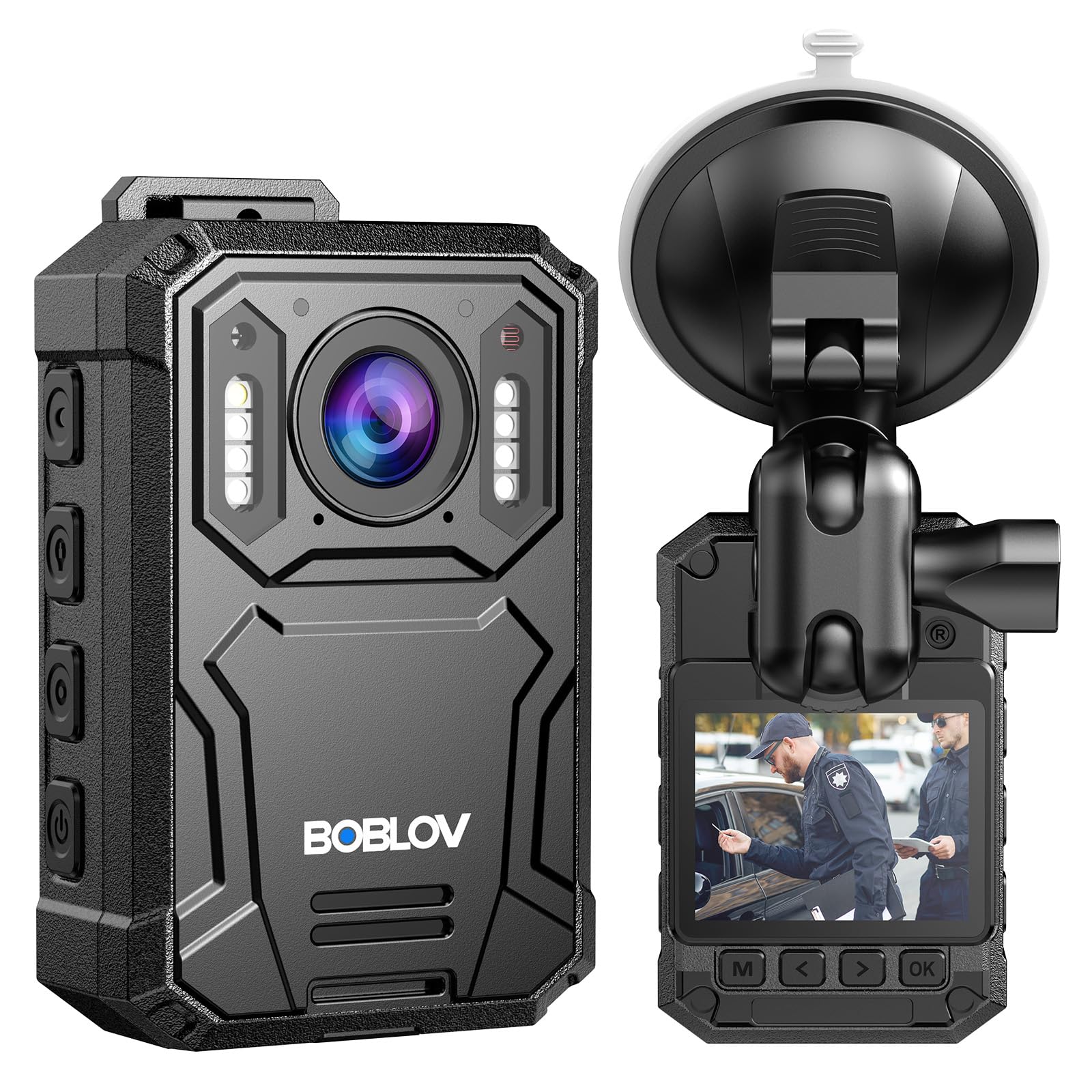
Fifteen hours is the number BOBLOV puts on the KJ23Pro, and it is the claim that matters on a double shift. It is measured at 1080p; step up to the 2K the camera is named for and the 4,000mAh cell gives ground, though you are still looking at a camera that finishes an ordinary shift without a charger. Endurance, rather than swapping, is the whole strategy here.

Storage follows the same logic. The 256GB is built in, split by default into ten-minute segments, and the camera loops, so a long incident arrives as a string of files rather than one unbroken clip. The controls are the friendliest in this group: one press starts recording from off, which we came to trust more than any menu setting, and five IR lights hold a face together in a dark corridor or a parking structure.

The screen is the compromise. At 1.3 inches it is the smallest here, and checking a clip on it is squinty work, so plan on a laptop for anything you need to be certain about. Reliability is mixed: cameras that shut themselves off with a full battery, cells that stop taking a charge, and units that quit inside a year. The two-year warranty covers the last of those, and a full-shift test in your first week catches the rest while an exchange is still easy. Even so, it is the camera we hand to people working twelve-hour shifts, because nothing else here runs that long on one charge.

Pros

  • 4,000mAh battery rated to 15 hours at 1080p
  • 256GB built in with automatic loop recording
  • One press starts recording from off
  • Two-year warranty with shoulder clip and car bracket

Cons

  • Sealed battery cannot be swapped mid-shift
Our verdict

Our pick for long shifts: a 4,000mAh battery rated to 15 hours at 1080p, 256GB built in, and a single press that starts recording.

Check Latest Price
3

Best Budget

BOBLOV KJ25

83 /100
Keeper Score Excellent

Key details

Battery
3,000mAh
Warranty
2 years
Built-in Storage
64GB
Video Resolution
1296p
Check Price on Amazon

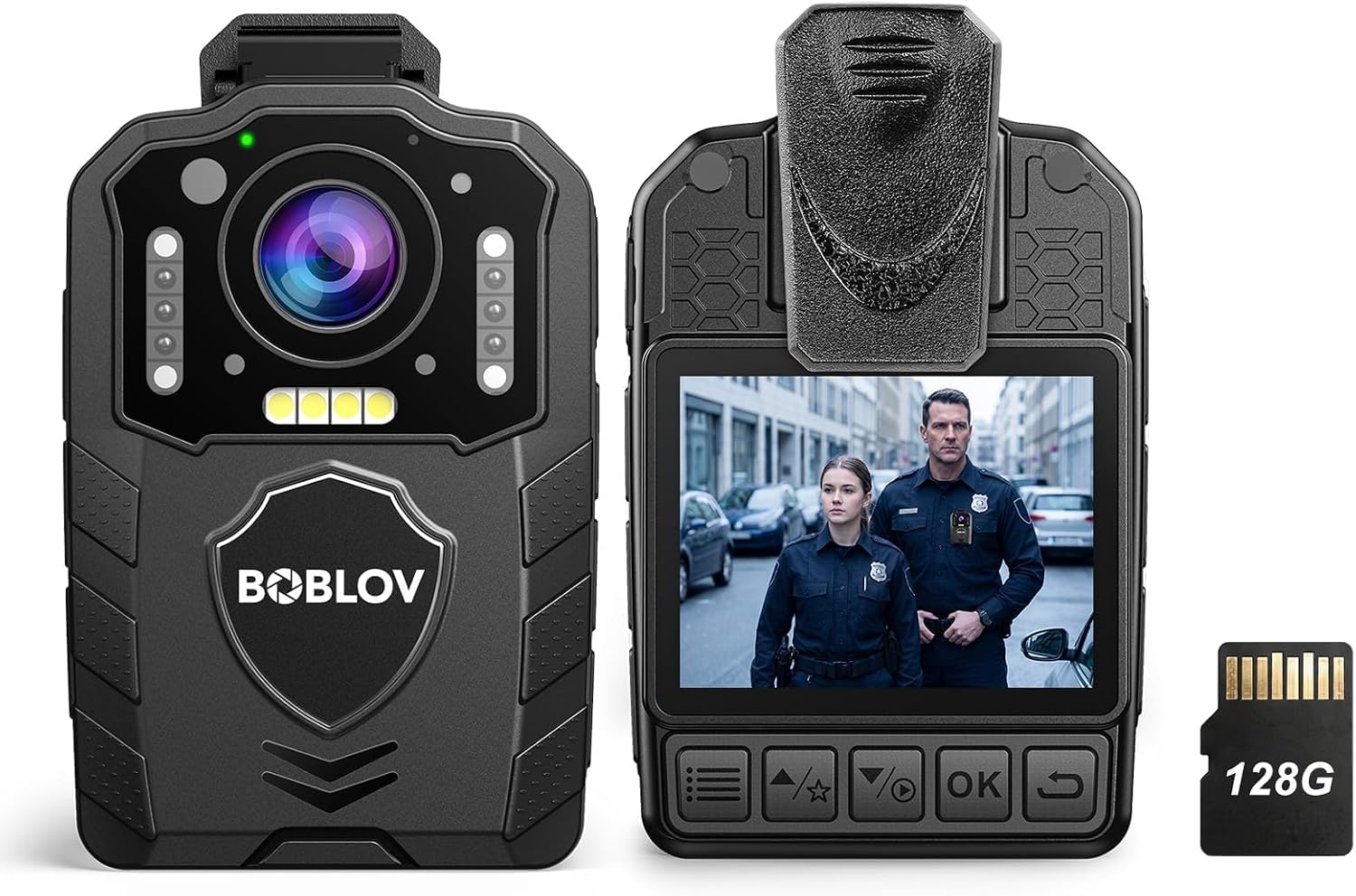
The KJ25 is what we suggest when the budget is fixed and the job still has to get done. For the least money in this group you get 1296p video, 64GB built in, a 3,000mAh battery rated up to 13 hours, and two 360-degree clips so it can ride a shoulder or a chest without a second purchase. Pre-recording is the feature we did not expect at this price: a buffer runs ahead of the button, so the seconds before you react survive.

The compromises live in the details. The menu asks more of you than the KJ23Pro's single button, the microphone holds up at close range and thins out across a room, and night mode is best used sparingly, because the IR lights are the hardest thing you can do to the cell. None of that matters much if you are recording conversations and doorways rather than patrolling a dark site.

Where it earns its place is the clip system. Both mounts rotate through 360 degrees, so the lens points where you are looking rather than where your shirt happens to face, and the two-year warranty matches the coverage BOBLOV gives the KJ23Pro.

Pros

  • 1296p video and 64GB for the least money here
  • Pre-recording captures the seconds before you press go
  • Two 360-degree clips for shoulder or chest wear
  • Two-year warranty

Cons

  • No water resistance rating
  • Button layout takes some learning
Our verdict

The cheapest way into a real body camera: 1296p video, two rotating clips, and pre-recording that saves the seconds before you press the button.

Check Latest Price
4

Simple One-Button Use

Aolbea P100 64GB

84 /100
Keeper Score Excellent

Key details

Built-in Storage
64GB
Video Resolution
1440p
Water Resistance
IP54
Claimed Record Time
Up to 11 hours
Check Price on Amazon

The P100's best idea is that you do not have to turn it on. One press starts video, audio, or a photo straight from standby, which is the difference between catching an exchange and fumbling through a menu. It records 1440p through a 150-degree lens, keeps 64GB inside, and runs a 3,300mAh battery rated to 11 hours.

Reliability is where we slow down. Cameras that stop working, SD card errors that clear only after the card is re-seated, and units that refuse to format all come up with this model, which is why it sits in our also-consider list rather than higher up. Treat the P100 as a second camera or a first one on a tight budget, not as the only thing standing between you and a record of what happened.

What is left is genuinely useful for the money. A password keeps anyone else from scrolling through your footage, motion detection starts a recording when something moves, and loop recording keeps the newest clip. The 64GB fills faster than the 256GB cameras here, so copy files off at the end of each shift rather than the end of the week.

Pros

  • One press records from standby
  • 1440p video at a low price
  • 64GB built in and a 3,300mAh battery
  • Password lock and motion detection

Cons

  • Splash-only IP54 protection
Our verdict

A simple, inexpensive camera for short encounters and backup duty, and its one-press start from standby is the real talent.

Check Latest Price

How We Tested Body Cameras in Real Conditions

The shortlist started with the things that truly decide a body camera: how long it records, whether footage is still readable with no light, whether storage is built in, and how the unit attaches to a person. We read spec sheets and customer reviews, then cut anything that only clipped to a shirt pocket, anything without infrared, and anything that leaned on a card swap to keep a file. That left 12 cameras, which we wore for eight months.

Each one went out on the same rotation: a nine-hour shift on my feet, evening dog walks, a rainy delivery run, and repeated trips into an unlit parking garage. I ran a timer alongside every camera to see where the battery actually died compared with the claim, and kept a log of freezes, dropped files, and buttons that stopped responding. I also started recording one-handed in the dark and with work gloves on, counting how many presses it took to get going.

After dark, I set each camera ten feet from a parked car and read the plate and a face back on playback. I recorded in a windy lot and a noisy loading bay to hear whether a voice six feet away came through, and dropped each unit from waist height onto concrete, rattled it in a bag of keys, and ran the waterproof models under a faucet for five minutes. For security, I tried to delete files off the device without the PIN and checked what a clip looked like once pulled to a laptop. Value came last: whether the extra money bought a better image or just more packaging.

How to Choose a Body Camera

Start With Endurance, Not Megapixels

Body cameras fail at the end of a shift more often than at the beginning. A 3,000 to 4,000mAh battery is the working range in this group, and the honest way to read a claim like "up to 15 hours" is to check the resolution printed beside it: these numbers are almost always quoted at 1080p or 720p, and 4K pulls a cell down far faster.

Two swappable batteries and a charging dock handle this better than one larger battery, because you can rotate them through a long day. If you work shifts beyond eight hours, that is the feature worth paying for; for short encounters, a single sealed cell is fine. Whatever the claim, run one full shift in your first week while returns are still simple.

How Much Resolution You Actually Need

The jump that matters is from 1296p to 2K, where faces and plates at conversation distance become reliably readable. 4K buys identification at range and room to crop, and charges you in battery and storage for it. Field of view matters just as much: a 170-degree lens catches what is beside you but curves the edges of the frame, while a narrower lens keeps faces straighter.

We take a wide lens with decent low-light behavior over a sharper one that turns muddy indoors, because most incidents happen in hallways, cars, and parking structures rather than in daylight.

Storage and the Loop-Recording Trap

Every camera here has memory built in, from 64GB to 256GB, and every one loops: when the memory fills, the oldest footage is overwritten. That is the safety net and the trap in one. Ten-minute segments are typical, so a shift's files pile up quickly, and a 64GB camera at 1440p rolls over far sooner than a 256GB one.

Offload at the end of every shift rather than the end of the week. The clip you need is the one most likely to be overwritten, and no camera here will warn you before it happens.

Mounting, Weight, and Getting It Running Fast

A body camera is only as good as the thirty seconds before something happens. Buttons you can find by feel, a press that starts recording from off, and a clip that stays where you put it matter more than a deep menu. Weight is the other half: 163 grams disappears on a collar, while a camera near half a kilogram drags at a shirt and swings when you move.

Check which mounts ship in the box. A long shoulder clip and a short back clip cover most wearing positions; a single clip locks you into one.

Evidence Features and the Fine Print

A time and date stamp that cannot be edited, a password on the menu, and GPS tagging are what make footage useful weeks later. GPS is usually a Windows-only extra, so confirm that before you count on it.

Warranty is the rest of the fine print. Some cameras here carry two years of coverage; one offers a 30-working-day return window on quality problems. A body camera lives on a belt and gets knocked into things, so that difference is worth more than another megapixel.

Frequently Asked Questions

Final Verdict

Most people should buy the CAMMHD V8. Two swappable cells and a charging dock turn the category's weakest point, a camera that dies before the shift does, into a routine, and 4K video with 256GB of built-in memory means the detail is there when you replay it.

If managing batteries sounds like one more job, the BOBLOV KJ23Pro runs a rated 15 hours at 1080p on a sealed cell and starts recording with a single press. Working to a fixed budget, the KJ25 still delivers 1296p with pre-recording and two clips for a lot less.