Best Trail Cameras of 2026

A trail camera is a small bet you place with the outdoors: strap it to a tree, walk away, and come back a week later to find out whether it caught the buck working the same sapling or six hundred frames of a swaying fern. The difference between a good one and a frustrating one comes down to the half-second after something walks past, and to whether the batteries are still alive when it does. Get those two things right and you have photos worth keeping.

I've run cameras behind my house for years, and we just spent eight months with 12 of them — cellular and non-cellular, singles and multipacks — on a deer trail, a farm pond, and a backyard the raccoons treat as a buffet. One thing buyers miss: those megapixel numbers are interpolated, so a 64MP shot often looks no better on screen than a clean 12MP one. Night range, trigger speed, and a menu you can work in the dark decide whether you actually get the picture. The picks below are the ones that kept delivering.

Keeper Score summarizes customer ratings and review volume. Read it alongside the product details and trade-offs. How the score works.

1

Best Overall

GardePro A3S

86 /100
Keeper Score Excellent

Key details

Video
1296p
Night Vision
100 ft no-glow
Trigger Speed
0.1 sec
Photo Resolution
64 MP
Check Price on Amazon

The GardePro A3S earns the top spot here because it gets the two things that decide most trail-camera footage right: a 0.1-second trigger and a 100-foot no-glow flash, backed by a Sony Starvis sensor built for low light. We prefer that combination to a longer feature list, because a camera that misses the first second or turns a fox into a blur is not much use.

The rest of the spec sheet supports the same job. It shoots 64MP stills and 1296p video, covers a 120-degree PIR arc, and can fire a five-shot burst. Power comes from eight AA batteries, with an optional GardePro solar panel, and it accepts cards up to 512GB. There is no app or cellular radio, so you pull the card to see what it caught; for a property you visit anyway, that simplicity is a feature, not a problem.

We do keep an eye on the long-term reports. The imaging is the strong part; moisture and dead units are the caveat, so check the seal, use a mount that keeps the door clear, and register the one-year warranty. The A3S is at its best on a scrape, feeder, or gate you can visit every few weeks — not on a remote ridge you expect to leave untouched for a year.

Pros

  • Fast 0.1-second trigger catches moving animals
  • 100-foot no-glow flash is easy on wildlife
  • Sharp 64MP photos and 1296p video
  • No app, SIM, or subscription to manage

Cons

  • No cellular remote viewing
  • Long-term durability is the weak spot
Our verdict

This is the trail camera we recommend first: the 0.1-second trigger, 100-foot no-glow flash, and crisp 64MP files make it a strong, fee-free default for scouting and yard monitoring.
Check Latest Price
2

Best Cellular

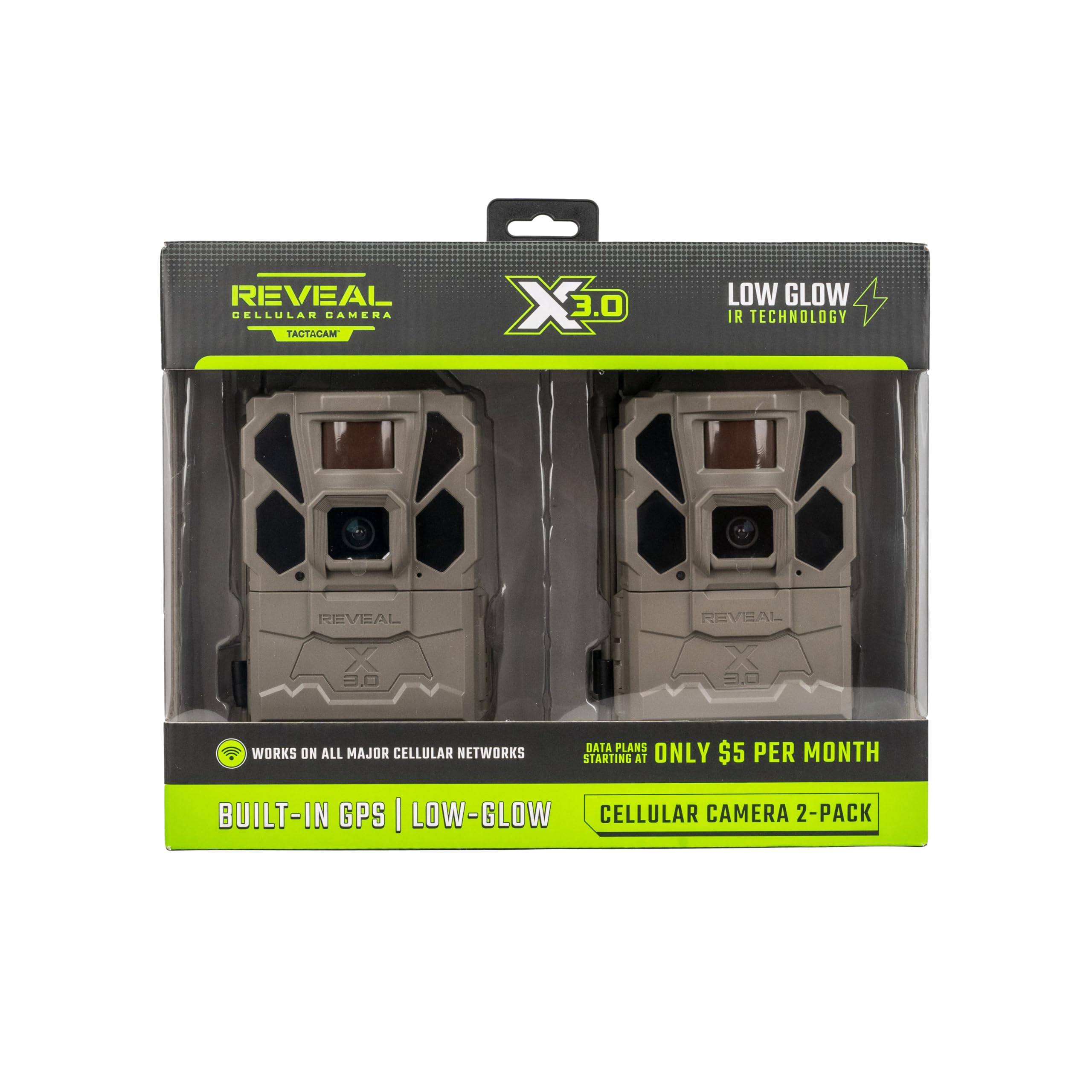
Tactacam Reveal X 3.0

87 /100
Keeper Score Excellent

Key details

Video
1080p
Battery Life
Up to 6+ months
Connectivity
Auto-connect LTE
Photo Resolution
4K
Check Price on Amazon

The Reveal X 3.0 is the camera we reach for when the whole point is not walking back to the tree. It auto-connects to AT&T or Verizon, sends 4K photos to the REVEAL app, and stores images internally, so there is no SD card to forget or swap.

We like that the setup stays simple: the integrated SIM picks the stronger carrier, GPS shows where the camera is, and you can request HD video on demand. The 96-foot low-glow flash and IP66 housing are solid for a camera that may sit through a wet fall. The 2-pack makes more sense than a single unit if you are covering a property, because two cameras show you approach routes, not just one pinch point.

The catch is the same one that comes with every cellular camera: you need a data plan and a usable signal, and the claimed six-plus-month battery life depends on how often it sends. We also see enough inconsistency in photo delivery and battery drain to check the first few weeks closely. The app lets you adjust settings remotely, so a bad angle does not always mean another drive. When the signal is there, the convenience is hard to give up.

Pros

  • No SD card or manual photo retrieval
  • Auto-connects to AT&T and Verizon
  • 4K photos and 1080p video on demand
  • Built-in GPS and simple app setup

Cons

  • Needs a data plan and reliable signal
  • Battery life and photo delivery vary
Our verdict

If you want pictures on your phone without walking to the camera, the Reveal X 3.0 is the cellular pick we recommend first here, with strong 4K images and a no-SD workflow.

Check Latest Price
3

Best Solar

MAXDONE PH970S

86 /100
Keeper Score Excellent

Key details

Power
Solar + 6,000mAh
Video
4K
Connectivity
Local Wi-Fi/Bluetooth
Photo Resolution
64 MP
Check Price on Amazon

A solar panel bolted to the top of a trail camera sounds like a gimmick until you think about the alternative: climbing a ladder to swap eight AA cells every few weeks. The MAXDONE PH970S builds the panel in, pairs it with a 6,000mAh rechargeable battery, and that alone makes it our pick for a set-and-forget budget spot.

The rest is better than its budget position suggests: 64MP stills, 4K video, a 0.1-second trigger, 65 feet of low-glow night vision, and IP66 sealing. It also comes with a 32GB card and a two-year warranty, which takes some of the sting out of the shorter night range. The Wi-Fi and Bluetooth are for your phone within about 55 feet, not for checking from home; if you need remote access, this is the wrong tool.

We treat the local connection as a setup aid and a way to check framing before you walk away. The app is useful, but connectivity is the one place this camera can frustrate, so test the link at the tree before you trust it. For a backyard, garden, or lease you visit often, the solar top-up is the reason to pick it.

Pros

  • Built-in solar panel and 6,000mAh battery
  • Sharp 64MP photos and 4K video
  • Includes a 32GB card and two-year warranty
  • Compact body with IP66 sealing

Cons

  • Wi-Fi is local only, not cellular
  • Night range is shorter than the leaders
Our verdict

For a budget camera you rarely have to touch, the MAXDONE's built-in solar panel and rechargeable battery are the practical reason to choose it; just do not mistake its Wi-Fi for remote cellular access.

Check Latest Price
4

Best Two-Pack

GardePro E5S

87 /100
Keeper Score Excellent

Key details

Cameras
2
Night Vision
100 ft no-glow
Trigger Speed
0.1 sec
Photo Resolution
64 MP
Check Price on Amazon

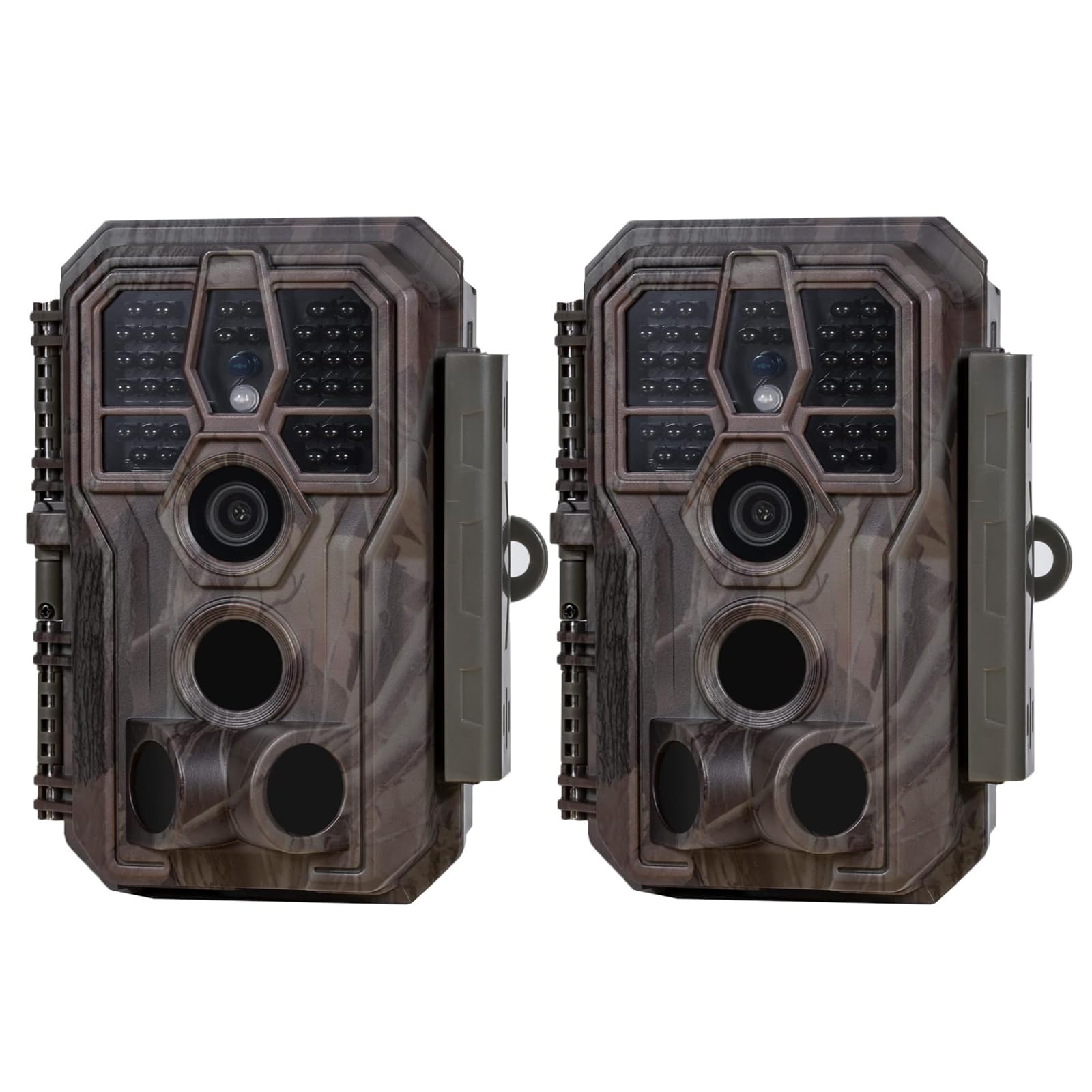
Two cameras in one box is the quiet advantage of the GardePro E5S. Most of us do not need one camera; we need one on the field edge and one on the trail behind it, and buying a second later costs more than starting with a pair.

We think the E5S is the stronger two-camera choice here for a new lease or a property with several pinch points. Each camera shoots 64MP photos and 1296p video, uses three PIR sensors for a 0.1-second trigger, and throws a 100-foot no-glow flash. IP66 sealing and support for the optional GardePro solar panel mean you can leave them out through wet weather and a long season. The pair also shares cards and settings, so you can standardize what you carry.

The trade-offs are small but real: there are no SD cards or batteries in the box, and the night images can go soft when the lens fogs or the air is thick. The one-year warranty is shorter than we like for something that lives outdoors. Buy two SD cards and a set of AA batteries at the same time; the box includes neither.

Pros

  • Two cameras in one purchase
  • Three PIR sensors and 0.1-second trigger
  • 100-foot no-glow night vision
  • IP66 sealing and solar option

Cons

  • No SD cards or batteries included
  • Night images can soften in fog
Our verdict

The E5S is the two-camera pack we point most people toward for scouting: fast 0.1-second triggers, 100-foot no-glow flash, and 64MP photos at a sensible per-camera cost.

Check Latest Price
5

Video-Heavy Scouting

Meidase P70

85 /100
Keeper Score Excellent

Key details

Video
1296p
Cameras
2
Night Vision
100 ft no-glow
Photo Resolution
64 MP
Check Price on Amazon

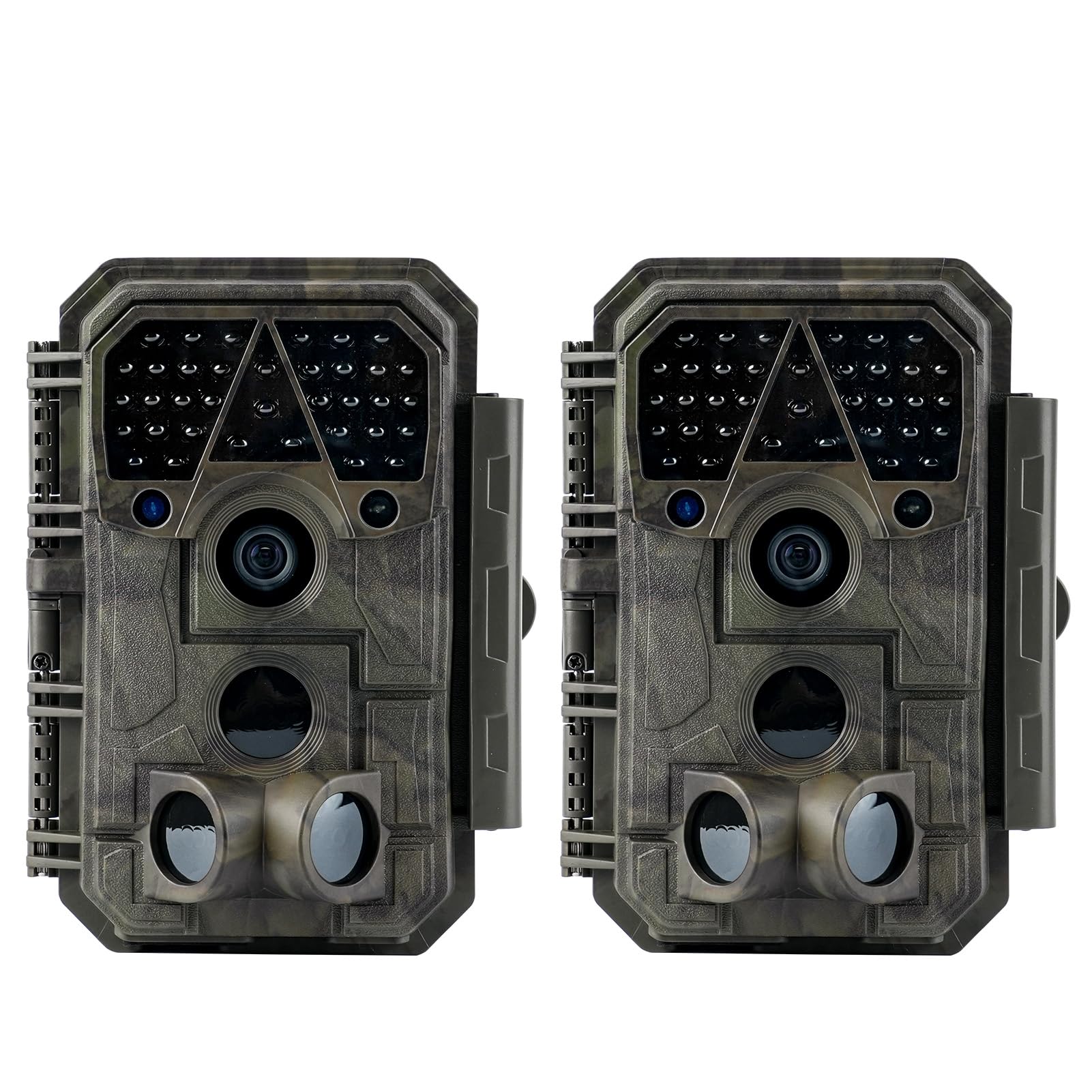
The Meidase P70 has a smaller idea behind it: keep the video files manageable. H.264 compression means a 1296p clip takes less space and copies faster than the older, fatter files some trail cameras produce, which matters when you are reviewing a week of footage on a laptop.

The hardware is otherwise familiar: 64MP stills, a 100-foot no-glow flash, a 0.1-second trigger with two side sensors, and a 2.4-inch color screen for checking the frame while you are standing at the tree. The two-pack includes straps and USB cables, but no cards or batteries, so budget for both.

We like the screen and the file handling more than the raw specs, because those are the details that make a two-camera setup less annoying in practice. Night vision and battery life are the areas to watch; the P70 can produce good night clips, but the night results are not as consistent as the daylight results. If you want two cameras and do not want to wrestle with huge files, this is the pair we point you toward.

Pros

  • H.264 video keeps files smaller
  • 100-foot no-glow night vision
  • 2.4-inch screen for on-site framing
  • Two cameras in the box

Cons

  • No SD cards or batteries included
  • Night vision and battery life vary
Our verdict

The P70 is the two-pack for anyone who hates waiting on big video files: H.264 keeps clips manageable, and the 2.4-inch screen lets you check framing on the spot.

Check Latest Price
6

Wide Property Coverage

WOSODA W300 4-Pack

86 /100
Keeper Score Excellent

Key details

Cameras
4
Night Vision
65 ft
Trigger Speed
0.3 sec
Photo Resolution
30 MP
Check Price on Amazon

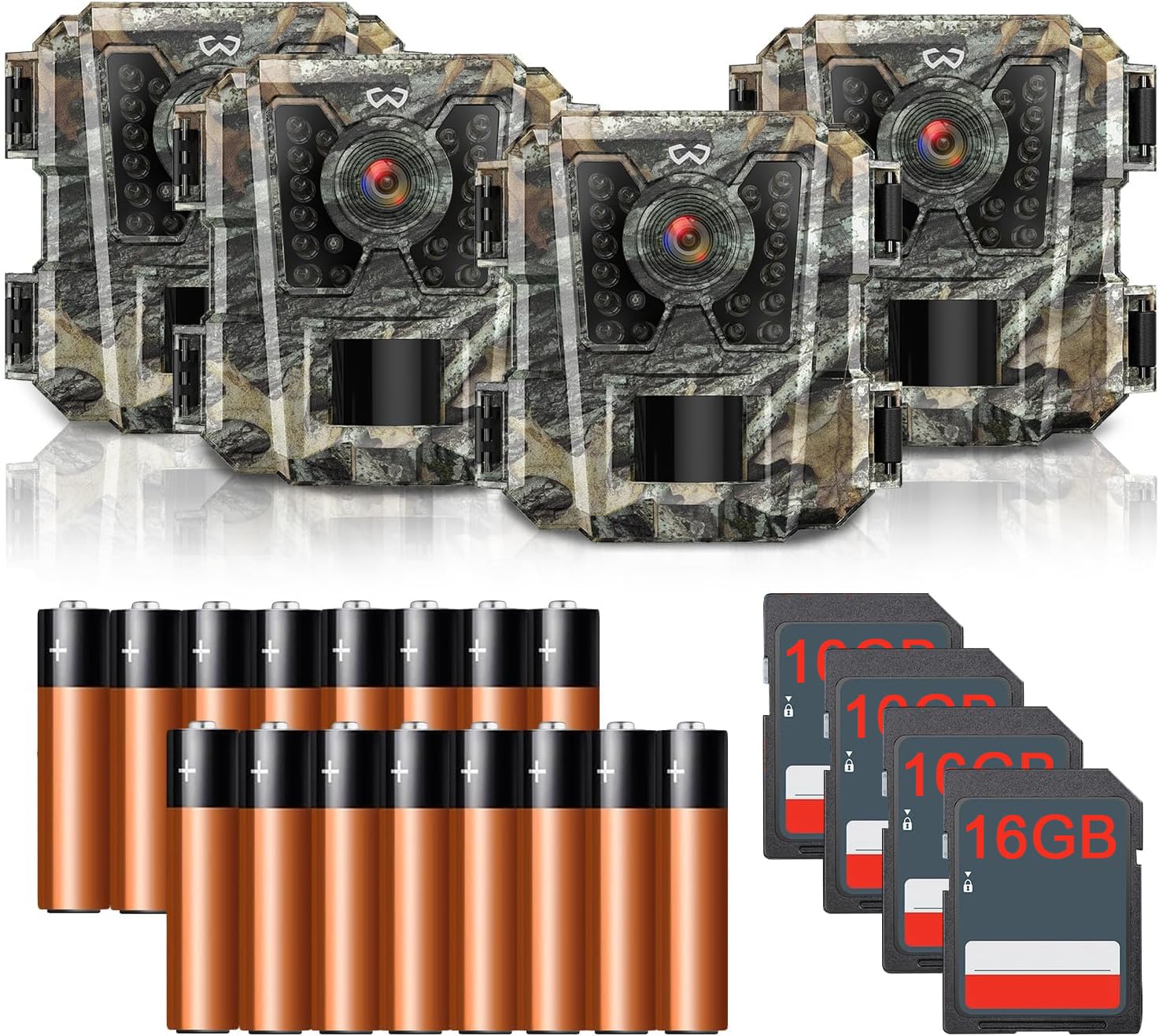
Four cameras change the job from watching one trail to mapping a whole property. The WOSODA W300 four-pack is the practical way here to cover a gate, a feeder, a fence line, and a back lane without buying four premium cameras one at a time.

Each camera is small, camo, and simple: 30MP stills, 1080p video, a 0.3-second trigger, 65 feet of night range, and IP65 sealing. They run on four AA cells instead of eight, which keeps the battery bill down, and the camo body blends into cover better than a shiny black box. The lower resolution and shorter night range are the price of spreading your coverage this wide.

We see this as a coverage-first set, not a trophy-photo set. Night vision and motion detection are the uneven parts, so place the cameras closer to the lanes you care about and check the first week of frames before you trust a quiet camera. For a barn, a large yard, or a lease with several entry points, the four-pack earns its place because it answers the question 'what is happening over there?' rather than 'can I count the points?'

Pros

  • Four cameras for broad property coverage
  • Runs on four AA batteries each
  • 30MP stills and 1080p video
  • Camo body blends into cover

Cons

  • Lower resolution than the leaders
  • Night vision and detection vary
  • Some units stop working
Our verdict

If your goal is to watch several lanes, gates, or fence lines at once, this four-pack is the practical way here to put cameras on all of them without a premium per-camera price.

Check Latest Price
7

First Trail Camera

iZEEKER iG200

84 /100
Keeper Score Excellent

Key details

Video
2K
Night Vision
65 ft no-glow
Trigger Speed
0.2 sec
Waterproof Rating
IP66
Check Price on Amazon

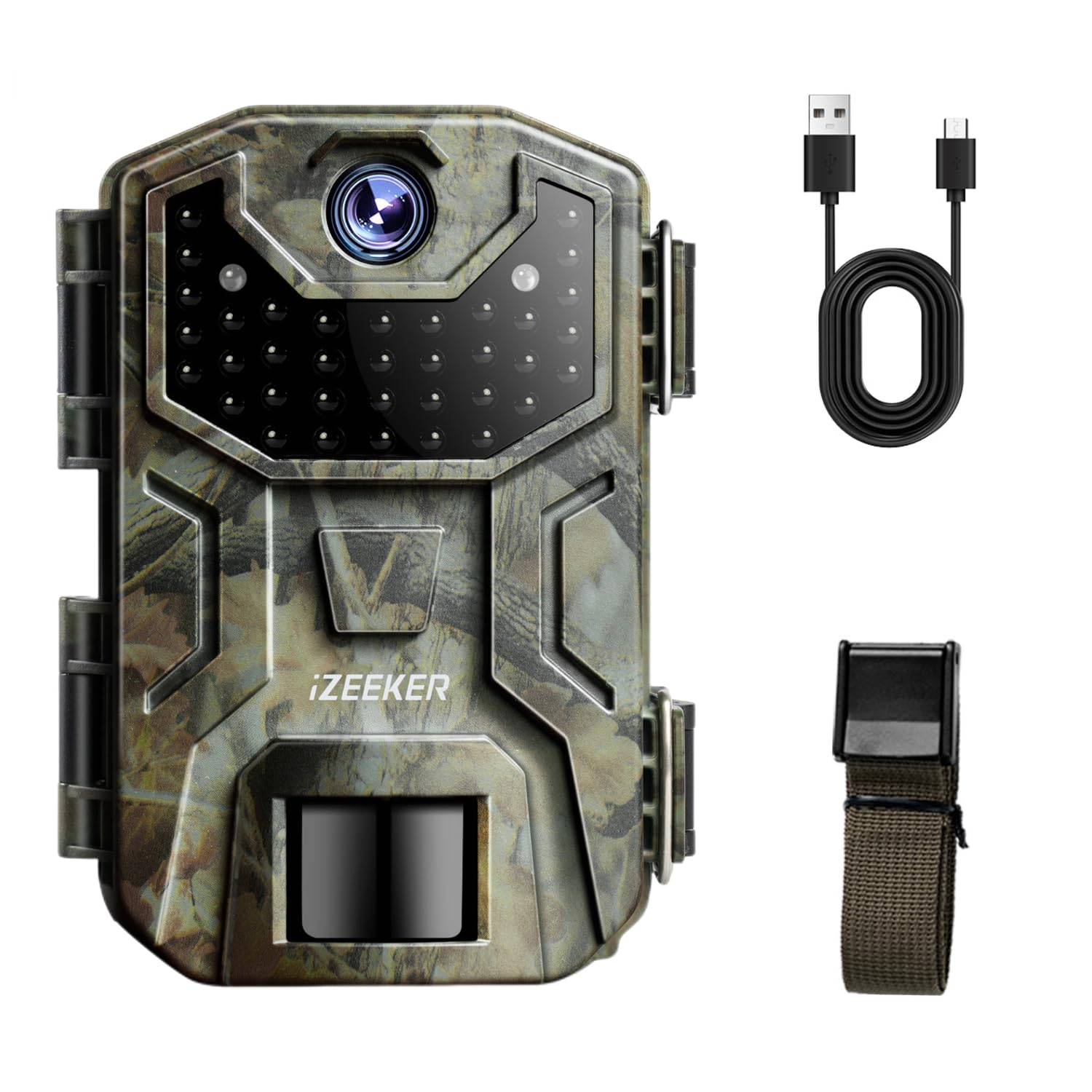
The iZEEKER iG200 opens from the bottom, so the battery door and card slot sit away from the lens and the seal. That clamshell design is the detail we noticed first, and it is a smarter layout than cameras that make you hinge the whole front open in the rain.

The rest is basic but useful: 2K video, a 0.2-second trigger, 940nm no-glow infrared out to 65 feet, IP66 sealing, and a 90-degree field of view. The menu buttons are illuminated, which sounds minor until you are setting the date in a dark garage or before dawn.

The image quality is the compromise. We do not put its stills in the same class as the 64MP GardePro cameras, and the low-light results are the most mixed part of the package. There is no SD card in the box, so add one before you head out. We also check the date-and-time setting on any budget camera after a few weeks, because a camera that loses the clock makes every file harder to use.

For a first camera, a garage, or a spot you can check often, the iG200 is an easy recommendation: it is inexpensive, simple, and quiet at night. We just do not leave it as the only camera on a remote property. The illuminated buttons and bottom-loading door are the two details that make it feel more considered than the rest of the package.

Pros

  • Bottom-loading battery door protects the seal
  • 940nm no-glow infrared
  • Illuminated buttons help in the dark
  • Simple, compact, and inexpensive

Cons

  • Basic image detail in low light
  • No SD card included
Our verdict

The iZEEKER is the cheap trail camera we hand to someone who wants to try the hobby without a big commitment; just expect basic image detail and check it often.

Check Latest Price

How We Tested Trail Cameras (and What Weighed Against What)

We started with every trail camera we could find in stock and reasonably priced, then crossed off anything with a proprietary cable, an oddball card format, or an app that reviewers repeatedly described as a fight. That left 12 cameras. We mounted them in pairs aimed at the same spot, so the same animal got photographed by two cameras in the same light, and we ran the test from late summer through a snowy February.

The cameras lived where trail cameras actually live: a deer trail above a mineral lick, the fence line of a farm pond, my backyard bird feeder and garbage cans, and a side gate. Every two weeks I pulled cards and compared daytime shots in flat light and at dusk, night frames at the near and far edge of the IR range, and video clips with sound. We also noted how wildlife reacted to the flash — animals ignored the no-glow models and often paused to stare at the ones with a visible red glow.

Trigger speed we tested with our feet: walking past at a normal pace, jogging past at an angle, and letting a dog cross the frame, then counting blank frames and near-misses. Battery life was logged from install date to the day each camera went dark, including a January cold snap that separated the efficient ones from the rest. Durability meant rain, fogged lenses, and seals checked after every storm. On cellular models we tracked how fast clips reached the phone and how often the connection dropped; ease of use was judged by programming each camera in the dark with a headlamp. Value came down to usable frames per battery change, not sticker price.

How to Choose a Trail Camera

Decide between cellular and card-pull first

The biggest fork is whether you need photos sent to your phone. A cellular camera like the Tactacam Reveal X 3.0 is the right choice for a remote lease or a property you cannot visit often, but it needs a data plan and a usable signal, and those costs continue after purchase. A card-pull camera like the GardePro A3S has no subscription, no SIM, and no app to learn, but you have to physically retrieve the card. If you are already on the property every week or two, that is not a hardship; if you are three hours away, it changes the decision.

Look at night performance, not just megapixels

Resolution numbers sell cameras, but the frame you care about is usually at dawn, dusk, or under infrared. A 64MP sensor with a weak flash gives you a large, soft image; a lower-resolution camera with a good lens and a strong no-glow array can be more useful. Check the night-vision range, whether the flash is no-glow or low-glow, and how wide the detection angle is. The GardePro A3S and E5S both pair a 100-foot no-glow flash with a 0.1-second trigger, which is the combination we prioritize for moving animals.

Treat battery life as an operating cost

Most cameras here run on AA cells or a rechargeable pack, and cellular models spend more power because they transmit. Solar and rechargeable designs are worth the extra bulk if the camera sits in decent sun: the MAXDONE PH970S pairs a 6,000mAh battery with an integrated panel, and that is the version we choose for a set-and-forget spot. For a card-pull camera, a larger AA count can mean fewer visits, but only if the camera is not constantly triggering on moving grass. Buy rechargeable AAs and a spare card before the season starts.

Plan for weather, mounts, and the long haul

An IP66 rating is a starting point, not a guarantee: door seals, hinges, and straps are the parts that fail first. Look for a camera with a secure latch, a mounting thread or a strap that will not slip, and a warranty you can live with. We check the seal and the strap before trusting a new camera to a season outdoors, and we bring it in after the first heavy rain if the door has been opened. A cheap camera that stays dry is worth more than a feature-packed one with a tired gasket.

Match the pack to the property

One camera on one trail is a sample; several cameras are a picture of how animals move. A two-pack like the GardePro E5S or Meidase P70 covers a field edge and a trail without buying twice, while the WOSODA W300 four-pack is for a larger property where coverage matters more than resolution. Count the spots you actually want to watch before you buy, then add one camera for the spot you forgot.

Frequently Asked Questions

Final Verdict

Our default is the GardePro A3S. It has the best balance here of fast triggering, useful night range, and clean 64MP files, and it does not ask you to pay for a data plan. Choose the Tactacam Reveal X 3.0 instead if you need photos on your phone from a property you cannot visit, and choose the MAXDONE PH970S if solar charging matters more than remote access. The rest of the list is about coverage, pack size, and budget, not a better version of the same job.