Best Binoculars of 2026

Binocular shopping has one reliable trap, and it's the number printed largest on the box. Magnification sounds like power — 12x must beat 10x, and 20x must be incredible — until you try holding a 20x view steady on a bird that won't sit still. What you actually see comes down to the glass, the coatings, and how much light reaches your eye in the last twenty minutes before dark.

Then there's the part the spec sheet never mentions: the pair you'll actually carry. I've left decent binoculars in the truck because they were heavy enough to notice on a long walk, and I've fought a stiff focus wheel while a warbler moved through the canopy. Over the past six months, my team and I have used 14 pairs — pocket compacts, mid-size, and full-size — on hikes, at ball games, and one cold morning at a hawk watch.

The sweet spot usually sits a step below the biggest numbers on the shelf. A generous objective lens and good glass buy you more than another digit of magnification, and if you wear glasses, eye relief matters before almost anything else. The picks below cover the range.

Keeper Score summarizes customer ratings and review volume. Read it alongside the product details and trade-offs. How the score works.

1

Best Overall

Vortex Crossfire HD 10x42

96 /100
Keeper Score Outstanding

Key details

Weight
1.4 lb
Warranty
Unlimited lifetime
Magnification
10x
Objective Lens
42 millimeters
Check Price on Amazon

Ten-by-forty-two is the pair we hand to someone who asks what to buy first, and the Crossfire HD is the one in this set we keep coming back to. Ten power pulls a warbler out of a treetop without turning every breath into an earthquake in the eyepiece, and 42 millimeters of objective keeps the image bright enough to be worth the trouble. What tipped it for us is the warranty: unlimited, unconditional, and lifetime, which is a rare thing on a pair at this price.

The glass is honest rather than spectacular, and honest is what you want at this level. Fully multi-coated lenses and a 4.2 mm exit pupil held color and detail together well past the point where the sky stopped being generous, and the 1.4-pound body sits still enough in the hand that we stopped thinking about holding it. Field of view comes in at 325 feet, narrower than the Athlon's, and you notice it when a bird flits from one branch to the next.

What's in the box matters more here than the spec sheet suggests. The GlassPak chest harness keeps the binoculars flat against your sternum instead of swinging from your neck on a hike, and there's a padded case, tethered objective covers, and a rainguard for the eyepieces. Nitrogen purging and O-ring seals mean a wet morning doesn't fog the tubes from the inside. Eyecups twist up for bare eyes and down for glasses, and the diopter ring sets the two barrels to your eyes once and then stays put.

Pros

  • Unlimited, unconditional lifetime warranty
  • Waterproof and fogproof for wet, cold mornings
  • Chest harness and padded case included
  • 1.4 pounds rides a strap all day

Cons

  • 15 mm eye relief is tight behind thick frames
Our verdict

For one pair that covers birds, deer, and travel, we point most people to the Crossfire HD: sealed, easy to hold steady, and covered by a lifetime warranty.

Check Latest Price
2

Best for Bird Watching

Athlon Midas UHD 8x42

95 /100
Keeper Score Outstanding

Key details

Weight
1.6 lb
Field Of View
8.1 degrees
Magnification
8x
Objective Lens
42 millimeters
Check Price on Amazon

An 8.1-degree field of view is what sells this pair, and it's the first thing you notice when you raise it. Point it at a hedge and you get the whole hedge instead of a moving circle the size of a dinner plate, and at 8x the image is steadier than the 10x and 12x pairs here, so a bird stays in frame while you follow it from branch to branch.

ED glass is why we rate the image as highly as we do. It cuts the purple-green fringing that shows along a backlit branch on cheaper optics, the dielectric-coated prisms keep colors clean out to the edge of the frame, and the 5.25 mm exit pupil is the brightest here — exactly what you want at the hour when birds are most active and light is least cooperative. With 17.2 mm of eye relief we kept the full view with glasses on, eyecups twisted down.

The trade-off is bulk. At 1.6 pounds this is the heaviest binocular in the set, and on a long hike it sits on your shoulders differently than the 1.1-pound Adorrgon. What the weight buys is steadiness at 8x and a bigger objective, and argon purging means a cold, wet morning doesn't fog it from the inside. It's also backed by a lifetime warranty that transfers if you hand the pair on.

Pros

  • Widest field of view in this set at 8.1 degrees
  • Brightest exit pupil here for dusk viewing
  • ED glass controls color fringing
  • 17.2 mm eye relief works with glasses

Cons

  • Heaviest binocular here at 1.6 pounds
Our verdict

We reach for the Midas when the birds won't sit still: an 8.1-degree view and a 5.25 mm exit pupil make it the easiest pair here to find a moving target with.

Check Latest Price
3

Best for Long Distance

Vortex Diamondback HD 12x50

95 /100
Keeper Score Outstanding

Key details

Weight
1.8 lb
Field Of View
271 feet
Magnification
12x
Objective Lens
50 millimeters
Check Price on Amazon

Twelve power is a commitment. Every tremor in your hands doubles in the eyepiece, and a 1.8-pound pair is not the one you stuff in a jacket pocket on a whim. What the magnification buys is real, though: a buck on a ridge a quarter mile out turns from a smudge into an animal you can read, and the 50 mm objective keeps that image usable while the light drains out of the field.

The first trade-off you feel is the window. A 271-foot field of view is roughly two-thirds of what the Crossfire gives you, so a bird that hops behind a branch can take a second sweep to relocate, and tracking anything on the move takes more panning than it does through an 8x.

Where this pair earns its place is glass and light. The dielectric coating and argon purging produce bright, color-accurate images in conditions that flatten cheaper optics, and the weight that's a nuisance on a hike is exactly what steadies a 12x view. Thread it onto a tripod or a window mount — the mounting point is there — and it becomes a glassing tool rather than a walking companion. Same unconditional lifetime warranty as the Crossfire, same GlassPak harness in the box.

Pros

  • 12x50 reach for open country and ridge lines
  • Dielectric coating and argon purging hold up in low light
  • Tripod and window-mount adaptable
  • Lifetime warranty and GlassPak harness included

Cons

  • 14 mm eye relief is tight with thick glasses
Our verdict

For the far side of the valley and the last twenty minutes of light, the Diamondback's 12x50 glass is the reach we want — as long as you have something to lean on.

Check Latest Price
4

Best Budget All-Rounder

Adorrgon 12x42

91 /100
Keeper Score Outstanding

Key details

Weight
1.1 lb
In The Box
Phone adapter and tripod
Magnification
12x
Objective Lens
42 millimeters
Check Price on Amazon

A phone adapter and a tripod in the box is the kind of thing we expect from premium optics, and it's the reason this pair stands out at its price. Clamp a phone over the eyepiece, steady the whole rig on the little tripod, and you can take a record shot of the heron at the back of the pond instead of trying to describe it to somebody. Aligning the camera lens over the eyepiece takes a couple of tries the first time; after that it's a thirty-second setup.

As a plain pair of binoculars, the Adorrgon is the best all-around value here. The 12x42 combination gives real reach in daylight, the roof-prism body is rubber-armored and sealed against weather, and at 1.1 pounds it hangs from a strap without the neck ache a full-size pair produces by mid-afternoon. Backyard birds, whales from a deck rail, the far end of a stadium — it handled all three in our testing without asking for anything.

The compromises are about light and eyes. A 3.5 mm exit pupil is thin, so the view flattens well before sunset, and 10 mm of eye relief means glasses wearers have to push the eyecups down and get close to keep the field. Twelve power in a 1.1-pound body also shows hand shake that a heavier pair absorbs, which is where the included tripod earns its keep.

Pros

  • Phone adapter and tripod included
  • 1.1 pounds carries without neck strain
  • 12x42 reach for daylight viewing
  • Waterproof, rubber-armored body

Cons

  • Two-year warranty is the shortest here
Our verdict

The one we hand a first-time buyer on a budget: 12x reach, a light body, and a phone adapter that turns the pair into a beginner's recording rig.

Check Latest Price
5

Best Compact

Hontry 10x25

91 /100
Keeper Score Outstanding

Key details

Weight
9.6 oz
Magnification
10x
Objective Lens
25 millimeters
Interpupillary Range
60mm to 75mm
Check Price on Amazon

If you want one pair that lives in a bag and actually gets used, this is the compact we keep recommending. At 9.6 ounces and roughly palm-size it disappears into a jacket pocket, and the porro-prism body with fully multi-coated lenses turns in a cleaner, more contrasty image than the tiny roof-prism pairs on this page. We carried it on hikes, along a whale-watching rail, and out to a backyard feeder, and it never felt like the weak link.

The hinge is the underrated part. Interpupillary adjustment runs from 60 to 75 millimeters, which covers small faces as well as adult ones, so one pair can genuinely be shared between a kid and a parent without either one squinting. Focus is a center wheel with a diopter ring on the right barrel, and a three-year warranty is longer than most budget pairs bother with.

The accessories are basic — a nylon bag, a strap, a cloth — and the body is rubber over glass rather than the armored shell of the Vortex pairs. Nothing about it feels disposable, and nothing about it feels overbuilt either. It's the pair you leave in the car, take on a cruise, and hand to a child without a briefing.

Pros

  • Palm-size and 9.6 ounces for pocket carry
  • 60–75 mm interpupillary range fits kids and adults
  • Three-year warranty on a budget pair
  • Clear image for the money

Cons

  • 2.5 mm exit pupil goes flat before dusk
  • 10x in a 9.6-ounce body shows hand shake
Our verdict

The compact we recommend without hedging: light enough to live in a bag, wide enough at the hinge to fit a child's face, and clear well beyond its price.

Check Latest Price
6

Glasses Wearers

Occer 12x25

89 /100
Keeper Score Excellent

Key details

Weight
13.8 oz
Eye Relief
20 millimeters
Magnification
12x
Objective Lens
25 millimeters
Check Price on Amazon

Twenty millimeters of eye relief is the spec that makes this pair worth a look. Most budget compacts give you 10 to 15, which leaves glasses wearers pressing the lenses against their frames; here the rubber eyecups fold down and there's room behind them to keep the whole field. The diopter ring adjusts over a wider range than the price suggests, so two people with very different eyes can share it.

Twelve power through a 25 mm objective is a lot of magnification for very little glass, and you pay for it in two places. The view is dimmer than the Hontry's at the same hour, and the field is narrow enough that finding a bird takes a couple of sweeps. The center of the frame is crisp; the edges soften.

The body is ABS plastic with a rubberized finish, sealed to the maker's life-waterproof standard, and it ships with a strap and a small bag. It's light enough to work one-handed, and the focus wheel has enough resistance that a child can find the sharp point without overshooting it.

We treat this as a second pair rather than a primary one, and it's good at that job. It's the binocular that lives in the glovebox for the hawk on the fence post, the one a kid can call their own, and the one that goes into a backpack without a case and comes out fine. If you're buying your only pair, spend more; if you want one that's always within reach, this earns its place.

Pros

  • 20 mm eye relief suits glasses wearers
  • Light enough for one-handed use
  • Wide ±5 diopter adjustment

Cons

  • No warranty stated by the maker
  • Barrels may not open wide enough for broad faces
Our verdict

A cheap second pair to keep in the glovebox or hand to a kid: 20 mm of eye relief makes it unusually friendly to glasses, and the price makes losing it survivable.

Check Latest Price
7

Backyard Stargazing

deesoo 20x52

89 /100
Keeper Score Excellent

Key details

Field Of View
168 feet
Magnification
20x
Objective Lens
52 millimeters
Water Resistance
Not water resistant
Check Price on Amazon

A 20x52 for the price of a takeout dinner is the pitch, and the big 26 mm eyepiece is the part that delivers. It's comfortable to look through for long stretches, the long eye relief means glasses can stay on, and pointed at a feeder thirty feet from the kitchen window the magnification is genuinely impressive.

Then the field of view arrives. At 168 feet at 1,000 yards you're looking through a keyhole, and at 20x every wobble in your hands is magnified along with the bird, so a tripod stops being optional and becomes the way you use it. Set it up at a window with the mount underneath and it holds a steady, surprisingly useful image; hand-held, it's a wrestling match.

We rate it as a fixed-position tool rather than a pair you carry. Aimed at a tree line, a ridge, or the moon from a tripod, it does a job nothing else here does for the money. The 20x figure is the one claim to verify on arrival — it's the number budget high-power pairs most often overstate, and this one is no exception, so compare it against a known object while you can still send it back.

Pros

  • Large 26 mm eyepiece is comfortable for long looks
  • Tripod mount steadies the high magnification
  • Big 52 mm objective for the money

Cons

  • Not water resistant
  • 30-day warranty only
Our verdict

The cheapest way to get big magnification and a big eyepiece: fine for a feeder or the moon from a fixed spot, less so for anything that moves.

Check Latest Price
8

Theater and Travel

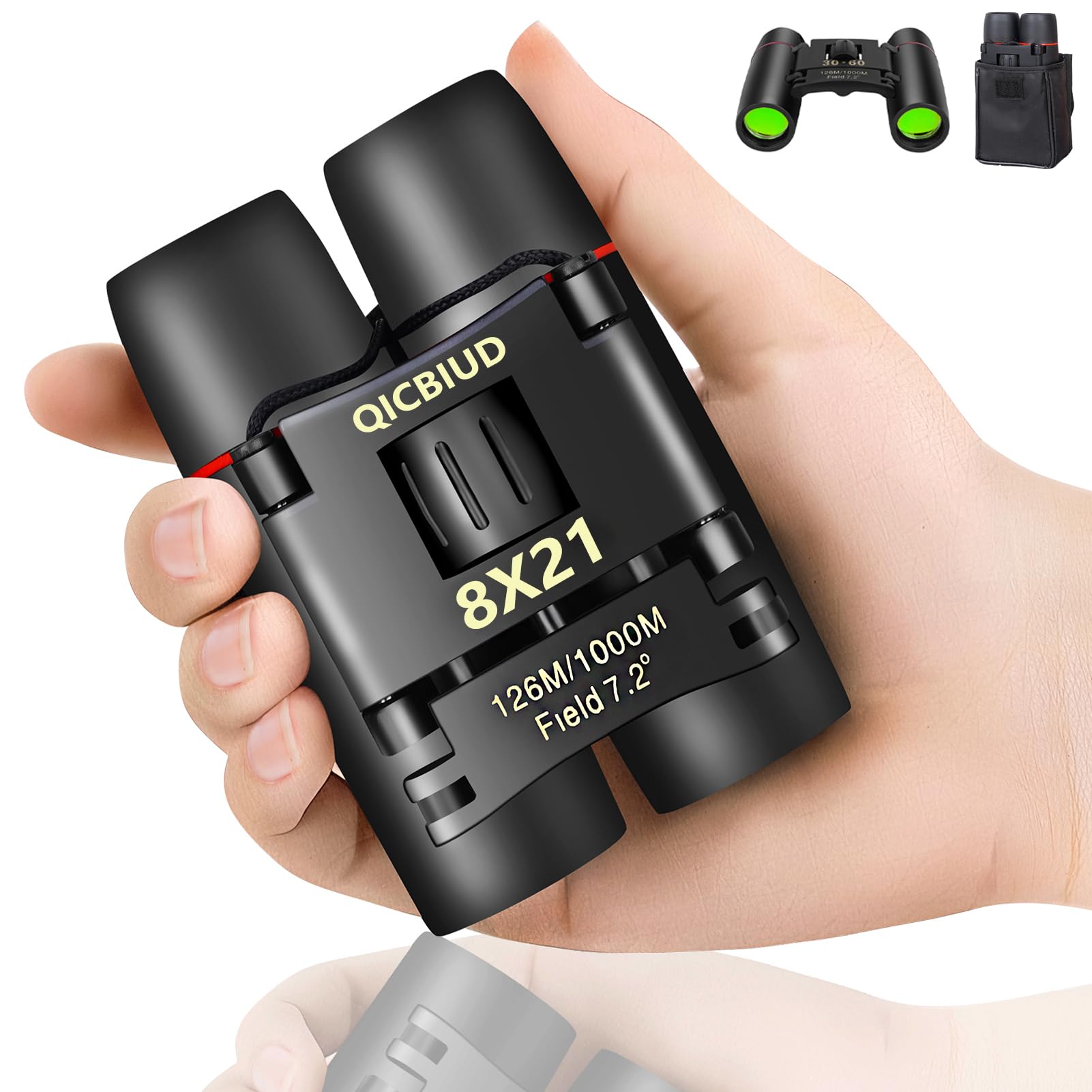
QICBIUD 8x21

86 /100
Keeper Score Excellent

Key details

Weight
5.82 oz
Field Of View
415 feet
Magnification
8x
Objective Lens
21 millimeters
Check Price on Amazon

At 5.8 ounces and under four inches long, this is the pair we end up taking — jacket pocket, glovebox, the bottom of a tote bag. The aluminum frame gives it a firmer feel than the price suggests, and the hinge holds your eye width once you've set it.

Eight power is the sensible choice in a body this small. Ten or twelve power in something this light turns every breath into a jump in the eyepiece, while 8x stays usable one-handed from a seat. A 415-foot field of view also means you find the stage or the bird before you start fiddling with the focus wheel.

Where it comes apart is distance. Across a theater it's crisp enough; at a few hundred yards the image goes soft and the focus wheel hunts for a point it never quite finds. The eyecups are simple fold-down rubber, and the focus adjustment is a single center wheel with no diopter ring, so two people with different eyes can't both have it set perfectly.

We recommend it for the job it does well and nothing more. It's the pair to buy when the alternative is missing the detail entirely — a play, a ballgame from the upper deck, a first pair for a kid — and the one to skip if you want to identify a warbler at fifty yards. The lanyard and case in the box are basic, but they're there and they work.

Pros

  • 5.8 ounces fits any pocket
  • 8x holds steady in a tiny body
  • Aluminum frame and rubber armor

Cons

  • Water repellent rather than sealed against rain
Our verdict

Our pick for the balcony and the glovebox: 5.8 ounces, an 8x view that's easy to hold, and enough clarity for a stage at the far end of the hall.

Check Latest Price

How We Tested These Binoculars

We started with spec sheets for roughly 60 pairs, sorting them by magnification and objective lens size — 8x42, 10x42, 12x50, and the little 10x25 and 12x25 compacts — then narrowed to the models that kept surfacing in owner reviews and among birders and hunters at each price band. Fourteen pairs made the cut, and we've spent six months with them.

Clarity got judged the least polite way possible: a newspaper page and a car's license plate at 30, 60, and 100 yards, read through every pair at noon and again in the last half hour of light, when a lens either earns its coatings or doesn't. We studied backlit rooflines and bare branches for color fringing, and we compared views side by side rather than from memory, since every pair looks fine on its own.

Size, weight, and ease of use we judged by carrying them. Each one spent a two-hour walk on a neck strap and a day stuffed in a jacket pocket or a daypack lid, where we noted when a strap started to dig in or a hinge drifted shut. We turned focus wheels one-handed while tracking birds, set diopters with glasses on and off, and folded eyecups until they loosened up. Build quality and weatherproofing took a five-minute run under the faucet, a steamy bathroom, and a few drops onto grass. Magnification we tested against itself — same target, same distance, 8x through 20x — to see how much usable detail each one held. Value came last: how a view stacked up against pairs selling for twice as much.

How to Choose Binoculars

Start With the Two Numbers

A 10x42 magnifies ten times through a 42 mm front lens. Divide the second number by the first and you get the exit pupil, the width of the light column reaching your eye: 4.2 mm on the Crossfire, 2.5 mm on a 10x25, 5.25 mm on the Athlon's 8x42. That figure is why compacts go flat at dusk while full-size pairs keep going, and it's the most useful arithmetic in the category.

Magnification is the other half of the decision. Ten power is about as much as most people hold steady without a rest, 12x wants a lean or a tripod, and 8x forgives nearly everything. For one pair that covers birding, hunting, and travel, we point people to 10x42. Bird in dense cover and 8x42 wins on view and brightness; glass open country at dusk and the 12x50 is worth carrying.

Field of View Is the Spec Nobody Reads

Field of view is how much world you see at 1,000 yards — 325 feet on the Crossfire, 271 on the 12x Diamondback, and an 8.1-degree angle on the Athlon that opens up wider still. When a subject moves, a wide window matters more than another two power, because you have to find the bird before you can magnify it.

This is the trap in budget high-power listings: the label promises reach, and the narrow view makes the thing harder to aim than an 8x pair you already own. If you can't get the subject into the circle quickly, the extra magnification buys you nothing.

Fit for Glasses, Kids, and Shared Use

Eye relief is the distance your eye can sit behind the lens and still see the whole field. Roughly 17 to 20 mm works with glasses; 10 to 14 mm means pressing close or losing the edges. Twist-down eyecups help, but they can't add relief that the design never had.

The hinge matters just as much when a pair gets shared. Adult interpupillary distance generally runs from about 58 to 72 mm, and binoculars whose barrels stop at 70 mm will never give a broad-faced adult one clean circle. The Hontry's 60 to 75 mm range is what lets one pair serve a kid and a parent on the same walk.

Sealing, Warranty, and What's in the Box

Waterproof and fogproof are different promises from water resistant, and the gap shows on the second wet morning. Nitrogen or argon purging plus O-ring seals is what keeps the inside of the tubes clear when the temperature drops; a water-repellent coating is a surface treatment, not a seal.

Then read the warranty. Both Vortex pairs here carry an unlimited, unconditional lifetime warranty, which is worth real money on a tool that gets knocked against trees. A chest harness and a padded case matter too — a harness keeps the binoculars off your neck and, in our experience, is the difference between carrying them all day and leaving them in the car.

What You Get as You Spend More

At the bottom of the range you get working optics that go dim at dusk, plastic bodies, and short coverage. The middle buys sealing, coated prisms, a lifetime warranty, and glass that holds color when the light drops. The top of this set buys brightness, edge sharpness, and mechanics — a focus wheel that still moves smoothly in the cold.

Our advice is to spend on sealing and support before you spend on magnification. A sharp 8x or 10x pair you can hold still beats a shaky 20x every evening of the week.

Frequently Asked Questions

Final Verdict

Buy the Vortex Crossfire HD 10x42. It covers the most ground of anything here — sealed, steady in the hand, backed for life, and shipped with a harness — and the 10x42 formula suits birding, hunting, travel, and the back deck equally well.

If your birding happens in thick cover, the Athlon Midas and its wide 8x42 view is the better tool. If you glass long distances in fading light, step up to the Diamondback's 12x50 and plan on giving it a rest.