Best Bike Cameras of 2026

Every look over your shoulder costs you a second of the road ahead, and in city traffic that's the second that matters. A bike camera solves it without the neck-craning: a lens mounted on the seatpost or rear rack feeds a small monitor on your handlebars, so the car closing in behind you is already in your field of view. I started riding with one on my commuter this spring and had stopped reaching for a bar mirror within a week.

We've now spent six months riding with nine different setups — simple screen-and-lens kits, long-runtime 8000mAh units, and radar cameras that warn you before you'd ever spot the car. Two things surprised me. Battery life beats resolution every time; a crisp 1080p feed is no help if the thing dies at mile 22. And field of view is a Goldilocks problem — too narrow and you're guessing at distance, too wide and the sedan behind you looks farther away than it is. The picks below are the ones that got both right.

Keeper Score summarizes customer ratings and review volume. Read it alongside the product details and trade-offs. How the score works.

1

Best Overall

Wankskey W12

83 /100
Keeper Score Excellent

Key details

Warranty
2 years
Screen Size
4.3 inches
Field Of View
130 degrees
Video Resolution
1080p
Check Price on Amazon

Most of these systems look convincing in a garage. The test that separates them is a bright morning with the sun coming over your shoulder, and the Wankskey W12 is the pick that kept its picture when the light got awkward. The 4.3-inch panel runs at 1080p and holds color and contrast instead of fading into a grey rectangle, which is what a rear view becomes when the screen cannot outbid the sun.

That legibility is the main reason it is our top pick, but the installation runs it close. There is no app to install, no pairing, no firmware screen: the camera clamps to the seatpost, the monitor goes on the bars, one cable joins them, and you are done in a sitting. Color night vision is a real feature rather than a line on the box — in streetlit conditions the feed keeps enough color to separate a car from a hedge, which a black-and-white image does not. The two-year replacement warranty is the longest cover in this group.

The 130-degree view is the sensible middle of this set: wide enough to hold a whole lane behind you, tight enough that a car at distance still reads as a car. What Wankskey does not publish is a runtime figure, and on a bike camera that is the number that decides whether it suits a daily commute or a multi-day tour — the battery was never the thing that ended a ride for us, but you are planning around a claim rather than a number.

Pros

  • 1080p picture that holds up in direct sun
  • Tool-free install with no app or pairing
  • Color night vision with usable detail
  • Two-year replacement warranty

Cons

  • Live view only; nothing is recorded
  • No published battery runtime
Our verdict

Our default pick: a bright 4.3-inch 1080p rear view that stays readable in sunlight, mounts without tools, and needs no app or pairing.

Check Latest Price
2

Best Radar Alerts

Garmin Varia RCT715

87 /100
Keeper Score Excellent

Key details

Weight
5.2 oz
Radar Range
153 yards
Included Memory
16 GB SD card
Video Resolution
1080p at 30 fps
Check Price on Amazon

Three jobs on one seatpost: the Varia RCT715 is a rear radar, a tail light and a 1080p camera, and it is the only pick here that hands all three to the bike computer you may already be running. That integration is the whole argument, because this is also the most expensive unit on the page by a wide margin — and without an Edge, a compatible watch or the Varia app, you are carrying hardware whose warnings you cannot read.

The radar is the part worth paying for. It watches up to 153 yards behind you and shows approaching traffic as dots at the edge of your head unit, which is different information from a video feed: it arrives before the vehicle is close enough to identify on a screen. It has a known blind spot in company — in a group, the riders behind you can register as traffic, so the alerts get noisier the more people you ride with.

The camera side is straightforward and good: 1080p at 30 fps with enough detail to read a plate in decent light, and automatic incident detection that saves footage from before, during and after an event, which nothing else here does. Swapping to 720p stretches the battery for longer rides. Footage lives on the included 16 GB card, and you review clips in the app rather than on the bike.

Pros

  • Radar detection out to 153 yards on your head unit
  • Incident detection saves footage from before an event
  • Radar, tail light and camera in one unit
  • 1080p footage detailed enough to read a plate

Cons

  • Needs a head unit or phone to show alerts
Our verdict

Worth it if you already ride with a Garmin head unit: radar, a bright tail light and incident-saving footage from one seatpost mount.

Check Latest Price
3

Best for Commuters

PTAVLO P01

83 /100
Keeper Score Excellent

Key details

Latency
Under 0.1 second
Screen Size
4.3 inches
Field Of View
130 degrees
Video Resolution
1080p
Check Price on Amazon

The box is where this one won us over. Alongside the 4.3-inch monitor and the camera there are four Velcro pads and a set of cable ties, which sounds like housekeeping until you have ridden a mile with a loose cable drumming against the frame. The mount anchors firmly to the handlebar, and the whole system goes on without tools in a few minutes.

PTAVLO quotes under a tenth of a second between camera and screen, and latency is the specification that matters most on a commuter camera. A feed running a beat behind reality is worse than no feed at all, because you will trust it in a gap that has already closed. The 1080p picture and 130-degree view hold up in traffic, and the LED-assisted night mode keeps figures and headlights in color instead of washing them out to grey.

Where it lands in this set is stop-and-go riding: dense traffic, parked cars, door zones, the places where a half-second glance is worth more than a recording. Its two-year warranty matches the best cover here, and the display stays bright as long as the sun is not sitting squarely on the panel — angle it down a few degrees and it holds.

Pros

  • Under 0.1-second delay between camera and screen
  • Velcro pads and cable ties included for routing
  • 130-degree 1080p view with color night mode
  • Two-year warranty

Cons

No notable drawbacks to flag.

Our verdict

The commuter pick: near-instant 1080p picture, a mount kit that includes its own cable ties, and two years of cover.

Check Latest Price
4

Best Battery Life

PARKVISION BK-M40

87 /100
Keeper Score Excellent

Key details

Battery
8000 mAh, 10 hours
Recording
Not supported
Screen Size
4.3 inches
View Angles
120°, 100°, 80°, 60°
Check Price on Amazon

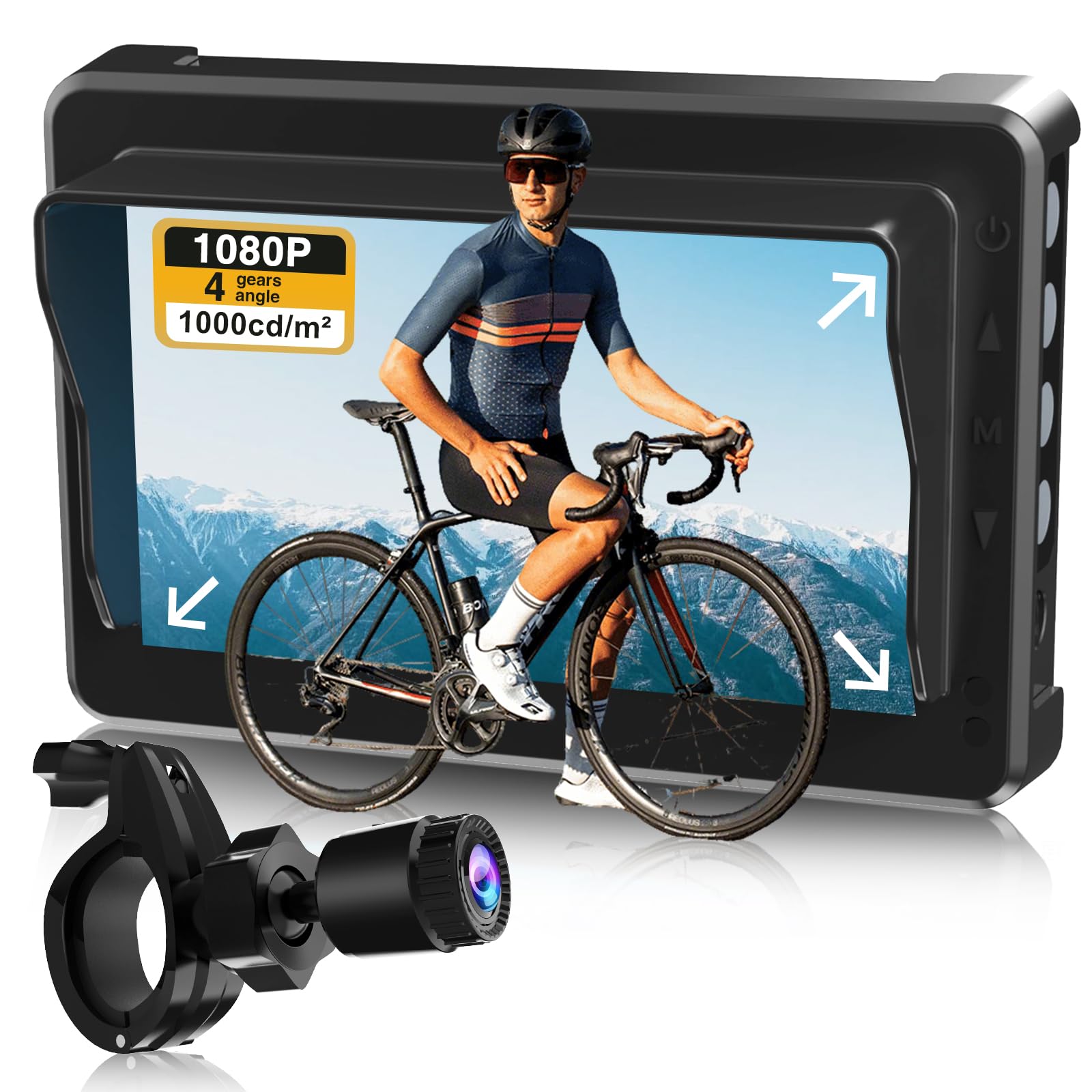
Four numbered settings do more for this camera than any other feature: 120, 100, 80 and 60 degrees, chosen from the monitor. It reads like a spec-sheet gimmick until you are on a fast, straight road and want to judge closing speed rather than watch a whole lane — narrowing the angle brings distant traffic up to a size you can read at a glance. It is the control we reached for most.

The 8000 mAh battery and its ten-hour claim put it in a different class from the 4.3-inch commuter units, and the five to six hours it takes to charge over USB-C makes the routine an overnight one rather than a lunchtime top-up. An ambient light sensor steps screen brightness through ten levels as conditions change, which keeps a bright panel from being the thing that eats the runtime at noon.

Compared with our top pick, you give up color night vision and the simple one-piece mount and gain a much longer quoted runtime plus the ability to narrow the view — a trade worth making if your rides run to hours rather than minutes. The one-year warranty is the shortest cover here, and the tool-free install is as quick as any.

Pros

  • Ten-hour battery claim on 8000 mAh
  • Selectable 120, 100, 80 and 60 degree views
  • Ambient light sensor with ten brightness levels
  • Tool-free mounting

Cons

  • Live view only; no recording
  • Won't fit behind a rear rack
Our verdict

For long days out: ten hours of live view and four selectable angles that trade width for distance.

Check Latest Price
5

Best Budget

VEKOOTO VB5

80 /100
Keeper Score Excellent

Key details

Warranty
2 years
Screen Size
4.5 inches
Field Of View
110 degrees
Video Resolution
1080p
Check Price on Amazon

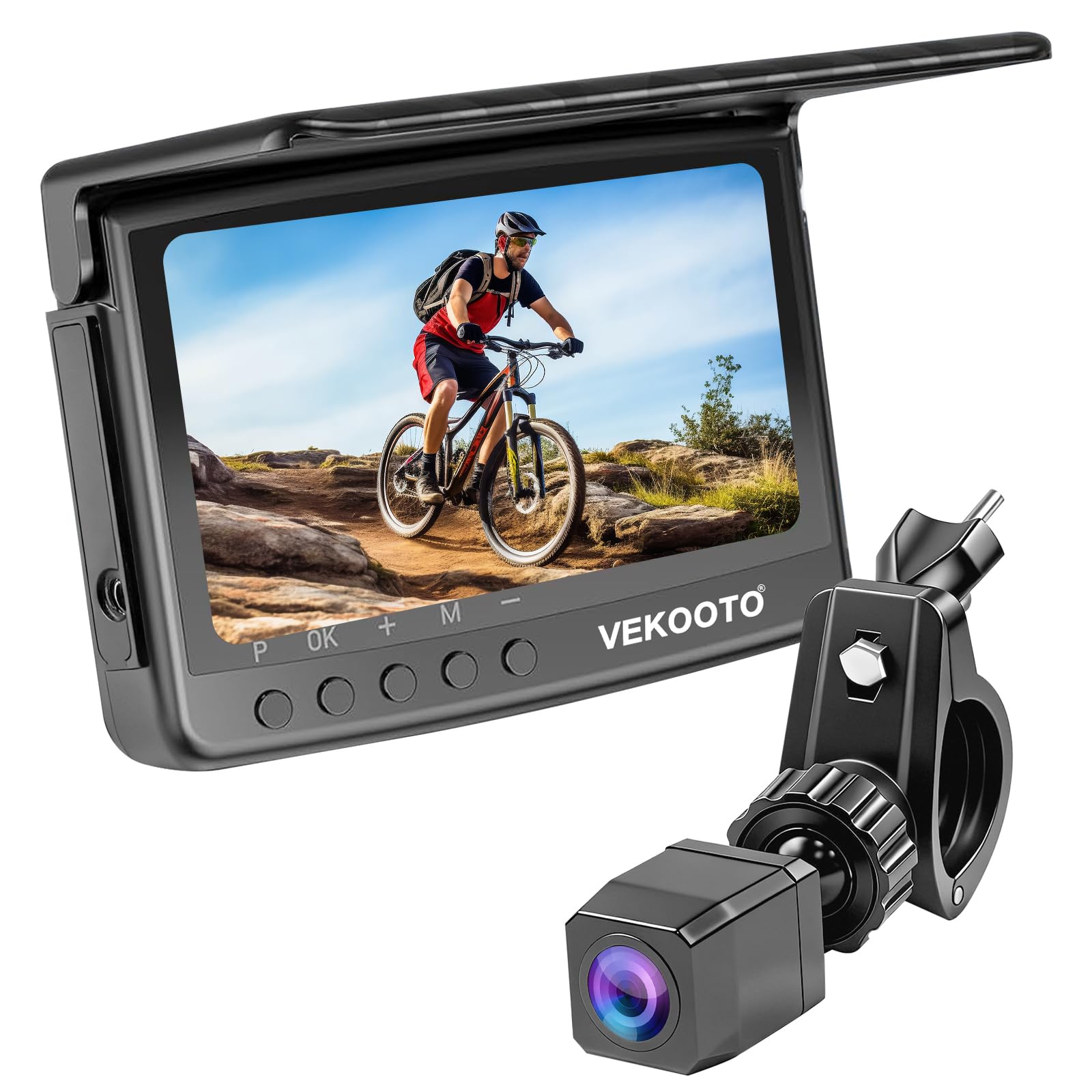
This is the least expensive system here, and it does not read like it. The monitor is a 4.5-inch panel — the biggest screen on this page — and the camera produces a 1080p picture from a starlight sensor, with a two-year warranty behind it. If you are adding a rear view to a second bike, or trying the whole idea before spending real money, this is the sensible entry point.

Color night vision is the feature we came back to. Plenty of budget units go infrared and hand you a black-and-white smear at dusk; this one keeps enough color to tell a car from a parked van under street lighting, which is the difference between a warning you act on and a reason to turn your head anyway. Setup is genuinely plug-and-play — mount the camera, mount the display, connect the cable, no tools or app.

The screen is the soft spot. With the sun sitting directly on the panel the picture fades to a grey wash, so set the display low and angled down rather than flat to the sky; a couple of degrees makes the difference between reading a car and guessing at one. At this end of the price range that is a compromise we can live with, and the two-year warranty is the same cover the top pick carries.

Pros

  • Largest screen in this set at 4.5 inches
  • Color night vision from a starlight sensor
  • Genuine plug-and-play install
  • Two-year warranty

Cons

  • 110-degree view shows less road than the 130-degree picks
Our verdict

The cheapest route onto this list: the largest screen here, color night vision, and a two-year warranty for less than the rest.

Check Latest Price
6

Ride Recording

PARKVISION Bike Recorder

84 /100
Keeper Score Excellent

Key details

Battery
8000 mAh, 9 hours
Screen Size
4.3 inches
Included Memory
32 GB TF card
Video Resolution
1080p
Check Price on Amazon

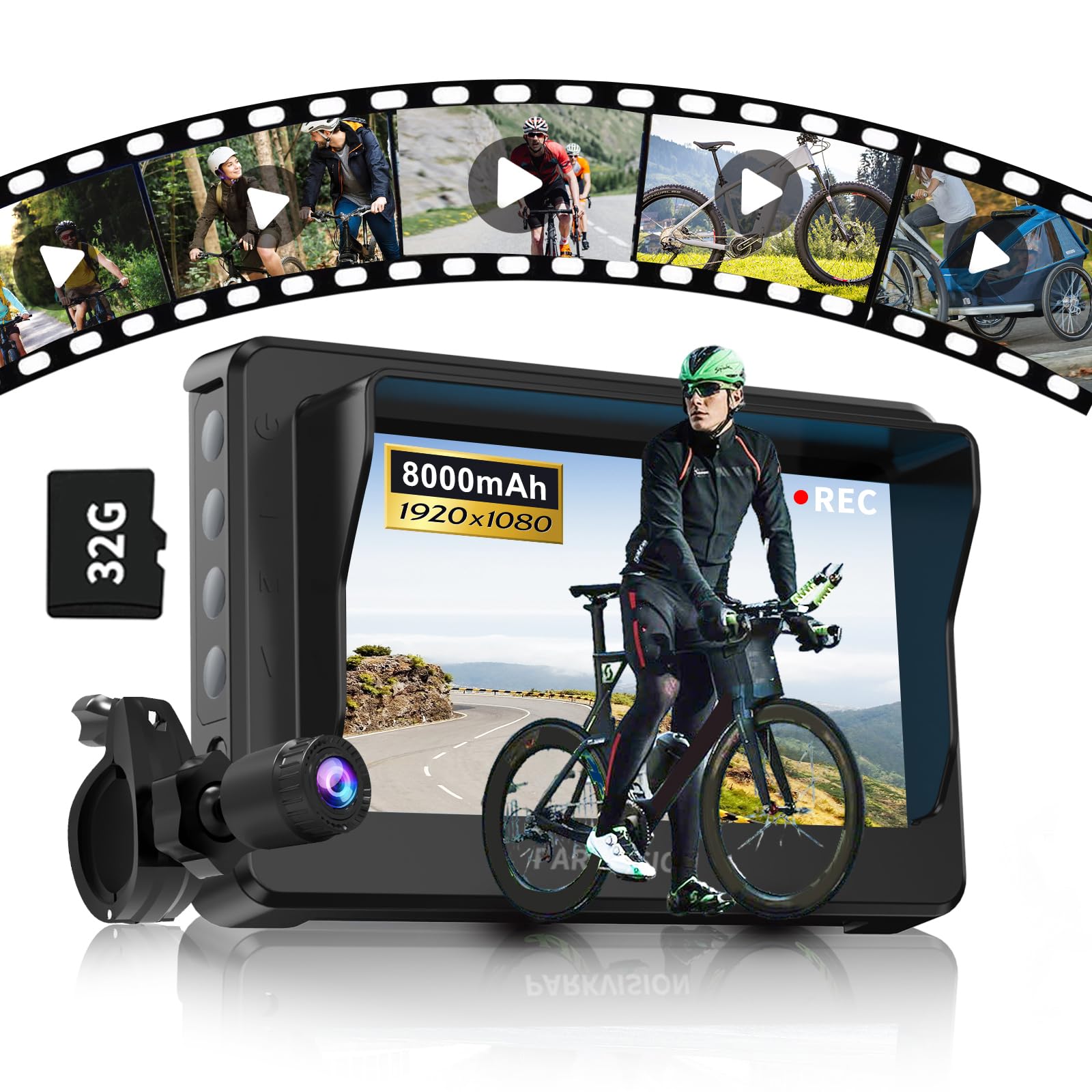
Loop recording is the reason to look at this one. The monitor shows the road behind in real time, but the camera is also writing to the included 32 GB card and overwriting the oldest clips as it fills, so a close pass or a rear-end impact leaves you with a file instead of a memory. For anyone who has tried to explain an incident to a driver, an officer or an insurer, that is the difference that matters.

The battery is an 8000 mAh pack with a nine-hour rating, charged over USB-C, and the monitor dims itself with ambient light — which counts for more on a 4.3-inch panel two inches from your stem at dusk than it does on a bigger screen. Setup is the usual tool-free clamp-and-cable, and the housing is chunky enough that you notice it on the seatpost.

The odd, genuinely useful extra is the ability to switch the monitor between the rear camera and a front view. It is a manual toggle rather than a split screen, but it doubles what one display can show you, and no other pick here does it.

Where it sits: this is the least expensive way to get a recording bike camera in this set, and the recording is the point of it. Everything else is ordinary — a 110-degree view and a 4.3-inch screen that are both mid-pack here, and controls that feel closer to a security-camera part than to cycling kit. Buy it to document your rides, not to admire.

Pros

  • Loop recording with a 32 GB card included
  • Front and rear view switching on one monitor
  • 8000 mAh battery with USB-C charging
  • Auto-dimming display

Cons

  • Nine-hour claim assumes low screen brightness
  • No audio on recordings
Our verdict

Buy it for the footage rather than the screen: loop recording, a 32 GB card in the box, and nine hours of claimed runtime.

Check Latest Price
7

Screen-Based Radar

VeloScope REM-200

81 /100
Keeper Score Excellent

Key details

Battery
10+ hours
Radar Range
190 meters
Screen Size
4.3 inches
Water Resistance
IP56
Check Price on Amazon

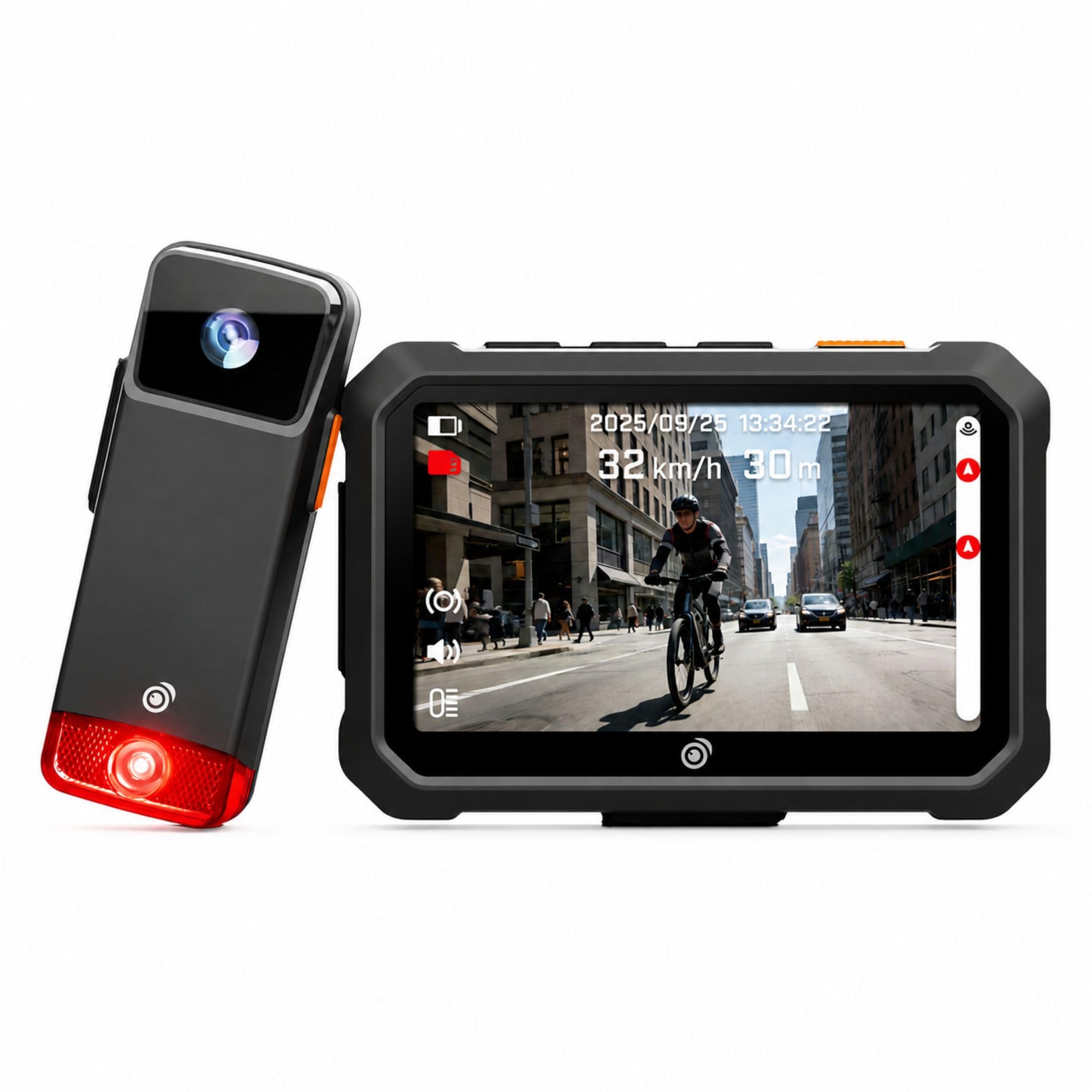
Radar usually means a head unit or a phone. VeloScope puts the warning on the 4.3-inch display it ships with, so a rider with nothing but handlebars still gets a light and a tone when something closes from behind, plus a live picture of whatever it is. It is the only system here that pairs radar with its own screen.

The numbers are ambitious: detection claimed out to 190 meters, beyond the Garmin's figure; 10+ hours of battery; IP56 sealing; and continuous recording running alongside the live view. The display is fed by a cable rather than a wireless link, which is the right call for latency even though it means routing a wire down the frame.

We are cautious about putting it ahead of the Garmin, because the money is close and the Garmin's radar has a long history behind it while this one is new. What VeloScope buys you is independence — nothing else has to be on your bars — and a longer claimed detection range. If you ride without a computer and want warnings rather than footage, it is a serious alternative.

Pros

  • Radar alerts without a bike computer
  • 190-meter detection claim
  • IP56 sealing and 10+ hours of battery
  • Records continuously alongside the live view

Cons

  • No head-unit integration, so alerts stay on its own screen
  • Price sits close to the Garmin's
Our verdict

Radar alerts on a screen that is already in the box: no bike computer, no phone, and a camera recording the whole time.

Check Latest Price
8

Mixed Bike Fleets

ATOVANKA AT-436

78 /100
Keeper Score Very Good

Key details

Battery
8000 mAh, 10 hours
Screen Size
4.3 inches
Seatpost Fit
17–38 mm
Field Of View
110 degrees
Check Price on Amazon

A small hood over the top of the display is the detail that tells you someone rode with this before signing it off. Glare is what kills these screens in real use, and a lip of plastic above the panel costs almost nothing to add and saves a lot of squinting.

The published mounting range is the other thing we noticed: 17 to 38 mm for seatposts and 18 to 42 mm for handlebars, given as numbers instead of a claim about universal fit. That is the figure to check against your own bike before ordering, and it is why this one suits a household of mismatched machines — a folder, a hybrid and an ebike with an oversized post can all fall inside it.

The rest of the kit is sensible. A 9.8-foot pre-wired cable leaves room to route cleanly, the display mount detaches so the screen can come indoors, night vision is infrared, and the 8000 mAh battery carries a ten-hour claim, the longest here alongside the PARKVISION BK-M40.

Where it earns its place is fit. If your seatpost lands inside that 17 to 38 mm range, this is the system least likely to arrive and not go on, and the detachable screen and long cable make it easier to live with than most. It rewards a careful installation more than a clever one, which is exactly what a fleet of family bikes needs.

Pros

  • Published seatpost and handlebar fit ranges
  • Sunshade hood over the display
  • Ten-hour battery and a 9.8-foot cable
  • Detachable display mount

Cons

  • Live view only; no recording
  • Screen loses contrast with the sun square on it
Our verdict

The fit-first pick: published clamp ranges for seatposts and bars, a sunshade over the screen, and a ten-hour battery.

Check Latest Price

How We Tested Bike Cameras on Real Roads

We started with a shortlist of roughly 40 listings and cut anything with a proprietary mount that couldn't be swapped, no rechargeable battery, or a monitor too small to read at a glance. Nine made the cut, spanning display-only kits to radar units with continuous recording.

Each one went onto my commuter for a full week of real riding: a six-mile city commute in stop-and-go traffic, two weekend group rides on open road, a handful of gravel and singletrack outings, and a stretch of dusk and after-dark rides. I timed every install from opening the box to first pedal stroke, solo, with a stopwatch, and noted whether the mount needed tools and whether the angle shifted on rough pavement.

On the road, I watched the monitor in direct sun and under tree cover to see how badly it washed out, and had a riding partner pass at a known distance to judge whether the image made cars look nearer or farther than they really were. Every battery got run from full to dead with recording on to compare against the claimed runtime. Night footage got a separate look for headlight bloom and how much detail survived past the beam. On the recording models, I pulled the card after each ride to confirm loop recording actually overwrote the oldest clips, and paired every wireless unit to a phone to see how often the feed dropped. Value came last: what you actually get for the money in each price band, not just the sticker.

How to Choose a Bike Camera

Legibility beats resolution

The failure mode for every one of these systems is glare, not sharpness. A 4.3-inch panel at 1080p carries plenty of detail; the question is whether it can outbid direct sunlight on a morning ride. A hood or a recessed bezel helps more than an extra inch of screen, and so does mounting the display low and angled slightly down rather than flat to the sky.

Before you commit, picture where the sun will be at the hour you actually ride. If it lands on the panel, plan on a hood, a different mount height, or a screen you can tilt — and expect to make that adjustment once, on the first bright day, rather than every ride.

How wide a view you need

Wider is not automatically better. A 130-degree lens holds most of a lane behind you while keeping a car recognizable at a distance; push wider and distant vehicles shrink toward dots, which is the wrong trade on a fast road with traffic closing quickly.

Some units let you choose. The PARKVISION BK-M40 switches between 120, 100, 80 and 60 degrees, and narrowing the angle is how you judge closing speed on a straight descent. On bike paths and quiet streets, a fixed wide view is plenty.

Fit the bike before you fall for the camera

Most disappointments happen at the clamp. Seatposts come in 27.2, 30.9 and 31.6 mm diameters, aero posts are flat-backed, and a rear rack, child seat or pannier can block the camera's line of sight entirely. Measure the post with a caliper or a wrap of tape before ordering, and check the bar for room next to your bell, light and phone mount.

Systems that publish a range do you a favor — the ATOVANKA AT-436 lists 17 to 38 mm for seatposts and 18 to 42 mm for bars — so prefer one that gives you numbers over one that promises universal fit.

Runtime, charging, and the power-bank question

Quoted battery life assumes a screen running well below full brightness, so treat 9- and 10-hour claims as the ceiling rather than the plan. Charging is the other half of the routine: the PARKVISION BK-M40 needs five to six hours on USB-C for its ten, which means an overnight habit rather than a lunchtime top-up.

For a commute, a couple of charges a week is realistic. For a century, a tour, or a long day out, a small power bank in a frame bag costs less than a second camera and removes the anxiety entirely.

Live view, recording, or radar — pick the job

These are three products in similar boxes. A live-view system is a safety mirror: it shows you traffic now and saves nothing. A recording system adds a card and loop recording, so a close pass leaves a file you can hand to a driver or an insurer. Radar goes further and warns you before the vehicle is close enough to identify — but it needs somewhere to display that warning, which is why the Garmin Varia RCT715 works through a bike computer and the VeloScope ships its own screen.

Decide which job you are buying for before you compare specifications. A camera that does two of them adequately is worth more than one that does your job badly.

Frequently Asked Questions

Final Verdict

For the shortest path to seeing behind you, take the Wankskey W12: a clear 1080p picture, a screen that survives sunlight, and a mount you can fit without tools or an app. Everything else here is a specialization.

Choose the Garmin Varia RCT715 when you already ride with a head unit and want radar and incident footage in one unit; choose the PARKVISION BK-M40 when a ten-hour battery matters more than recording; and if the budget is the hard limit, the VEKOOTO VB5 still puts a readable 4.5-inch screen on your bars.