Best Battery-Powered Strobes of 2026

The first time I ended up behind a hay wagon on a two-lane road after dark, the only thing warning me it was there was one dim amber light under a coat of road dust. That's when I started taking battery-powered strobes seriously — a good one buys you a couple of seconds of another driver's attention while you're changing a tire on the shoulder, crawling behind a plow, or hauling a load that overhangs the lane.

We've spent the past five months living with 14 of them, and the differences come down to less glamorous things than brightness. Magnet strength, honest battery life, and whether the charging port survives a muddy glove are what decide whether a light is still stuck to your truck in March.

The bit of wisdom I'd pass along: these lights get judged from a distance, at an angle, in the rain, so side visibility and a steady mode you can reach without cycling through a menu matter more than the brightest setting. The picks below run from something that lives permanently on a roll cage to something you keep in the glovebox, and none of them cost enough to make you wince.

Keeper Score summarizes customer ratings and review volume. Read it alongside the product details and trade-offs. How the score works.

1

Best Overall

NeaLia Wireless Beacon

90 /100
Keeper Score Outstanding

Key details

Charge Time
2 hours
Power Source
Rechargeable battery, USB-C
Weather Rating
IP67
Claimed Runtime
12 hours
Check Price on Amazon

A 12-hour claimed runtime and USB-C charging are the two specs that make the NeaLia the one we reach for first. At 4.16 ounces, the compact body fits in a door pocket or console, and the built-in magnet lets you move it from a truck bed to a fender without wiring or a cigarette-lighter cord. With 32 LEDs and seven modes, there's enough pattern choice to find a warning flash that reads clearly without becoming a light show. We also appreciate that it runs from its own battery when the vehicle is off—exactly when a warning light is most useful.

The charging routine is the practical advantage. A two-hour charge is quick enough to top up between jobs, and the IP67 rating means rain and road spray aren't an automatic reason to bring it inside. The magnetic base makes setup simple: no suction cup to peel off, no cord to route through a door. That matters when you're setting up in the dark or moving the light between vehicles.

The trade-off is the mounting surface. A magnetic base needs ferrous metal, so an aluminum-bodied truck, a plastic roof, or some side-by-sides will need a steel plate or another mounting point. The compact base is also less planted on a curved panel than a six-magnet design. For most drivers, though, the NeaLia is the best balance of runtime, charging convenience, and everyday portability in this group.

Pros

  • USB-C charging with a 2-hour charge time
  • 12-hour claimed runtime
  • Compact magnetic body mounts in seconds
  • IP67 weather resistance

Cons

  • Charging faults can appear over time
Our verdict

We recommend the NeaLia as our best all-around battery-powered beacon for most drivers: USB-C charging, long claimed runtime, and a compact magnetic body make it the easiest to live with here.

Check Latest Price
2

Best for High-Speed Mounting

Agrieyes W08 Beacon

89 /100
Keeper Score Excellent

Key details

Class
SAE Class 1
Mount
6 magnets plus suction cup
Charge Time
3.5 hours
Claimed Runtime
5 hours
Check Price on Amazon

The Agrieyes W08 is the bigger, heavier answer to the same problem the NeaLia solves. It uses six magnets instead of a compact base, carries an SAE Class 1 rating, and lists a 60 mph holding speed. Agrieyes also supplies a suction cup for surfaces that won't take a magnet, which makes it more adaptable around mixed equipment.

We like that trade for oversize loads and highway work. The six-magnet base is the most planted setup in this group, and the Class 1 rating gives the light a clear role on a trailer or wide load where a compact beacon can feel undersized. The five-hour claimed runtime is the compromise: it's shorter than the NeaLia's 12-hour claim, and a 3.5-hour charge means you need a top-up plan for a long shift. For high-speed work, the security is worth it.

The W08 is also the pick we reach for when the mounting surface is questionable. The suction cup adds an option for glass or smooth panels, though a dirty or curved surface still needs a careful check before you drive. At 5.1 inches square and 15 watts, it takes up more space than the mini beacons; the payoff is a warning light that feels like equipment rather than an accessory.

Pros

  • Six magnets hold at highway speed
  • SAE Class 1 warning output
  • Suction cup for non-metal surfaces
  • Rugged polycarbonate housing

Cons

  • Charging-port failures can occur
  • Can still shift in a hard impact
Our verdict

For oversize loads and high-speed routes, the W08 is our most secure beacon here: six magnets and Class 1 output make it the one to mount when a compact light feels undersized.

Check Latest Price
3

Best Compact Long-Runtime

Agrieyes W56B Beacon

87 /100
Keeper Score Excellent

Key details

LED Count
32
Charge Port
USB-C
Charge Time
2.5 hours
Claimed Runtime
Over 10 hours
Check Price on Amazon

The Agrieyes W56B packs 32 LEDs and a USB-C port into a body that's small enough to leave in a glovebox. On paper it looks like a shrunken version of the W08, but its priorities are different: a claimed 10-plus-hour runtime, a 2.5-hour charge, and a built-in magnet rather than a six-magnet array.

The compact size is the first thing you notice. A 10-hour claim is long enough for a full shift, and USB-C charging is easier to live with than a proprietary vehicle cord. The seven modes include a cruising pattern, so the light can stay on a slow-moving vehicle without using the most aggressive flash. The built-in magnet keeps the package simple: no separate base to lose.

What settles it for us is the runtime-to-size ratio. The W56B is the one we prefer when the day is long and the mounting spot is flat steel, because it is easier to carry and quicker to top up than the W08. It isn't as planted on a rough route, and the magnet may need a steel plate on a curved or aluminum panel. That is the right trade for a compact utility beacon.

Pros

  • Over 10-hour claimed runtime
  • USB-C charge in 2.5 hours
  • 32 LEDs and 7 flash modes
  • Compact body stores easily

Cons

  • Battery can fail to take a charge
Our verdict

The W56B is our compact long-shift pick: USB-C charging and a 10-hour claimed runtime make it easy to live with, and the smaller body is easier to stash than the W08.

Check Latest Price
4

Best Two-Light Rechargeable Kit

AnTom 2-Pack Strobe

85 /100
Keeper Score Excellent

Key details

Mount
Magnetic bases
Warranty
2 years
Pack Count
2 beacons
Power Source
Rechargeable lithium polymer
Check Price on Amazon

Two rechargeable beacons in one box is the reason the AnTom kit earns a place. It solves a different problem from the single-light picks: covering both ends of a trailer, two vehicles, or a work zone without buying two separate units. Each light has its own magnetic base, and the kit includes multiple bases for moving between vehicles.

We like that flexibility for small fleets and people who share a truck with a trailer. The 10-watt output and impact-resistant dome suit general warning use, and the two-year warranty is longer than most here. You aren't getting the W08's six-magnet array or SAE Class 1 rating, but you are getting two rechargeable lights for about the price of one premium beacon. For a two-vehicle setup, that math is hard to argue with.

The charging setup is where we pause. The kit is rechargeable but comes with a cigarette-lighter plug rather than a USB-C cable, so you need the vehicle socket or a separate adapter. If you need two lights and can keep the charger in the truck, it's a practical kit; if you want the simplest charging, the NeaLia or W56B is easier.

Pros

  • Two rechargeable beacons in one kit
  • Two-year manufacturer warranty
  • Multiple magnetic bases included
  • Impact-resistant polycarbonate dome

Cons

  • Magnetic hold varies on curved panels
Our verdict

The AnTom kit is our two-light pick for trailers and shared vehicles: two rechargeable beacons and a two-year warranty make it the practical way to cover both ends of a load.

Check Latest Price
5

Best Budget Emergency Kit

StonePoint Road Flare Kit

87 /100
Keeper Score Excellent

Key details

Pack Count
3 flares
Battery Type
3 AAA each (not included)
Flash Runtime
60 hours
Steady Runtime
20 hours
Check Price on Amazon

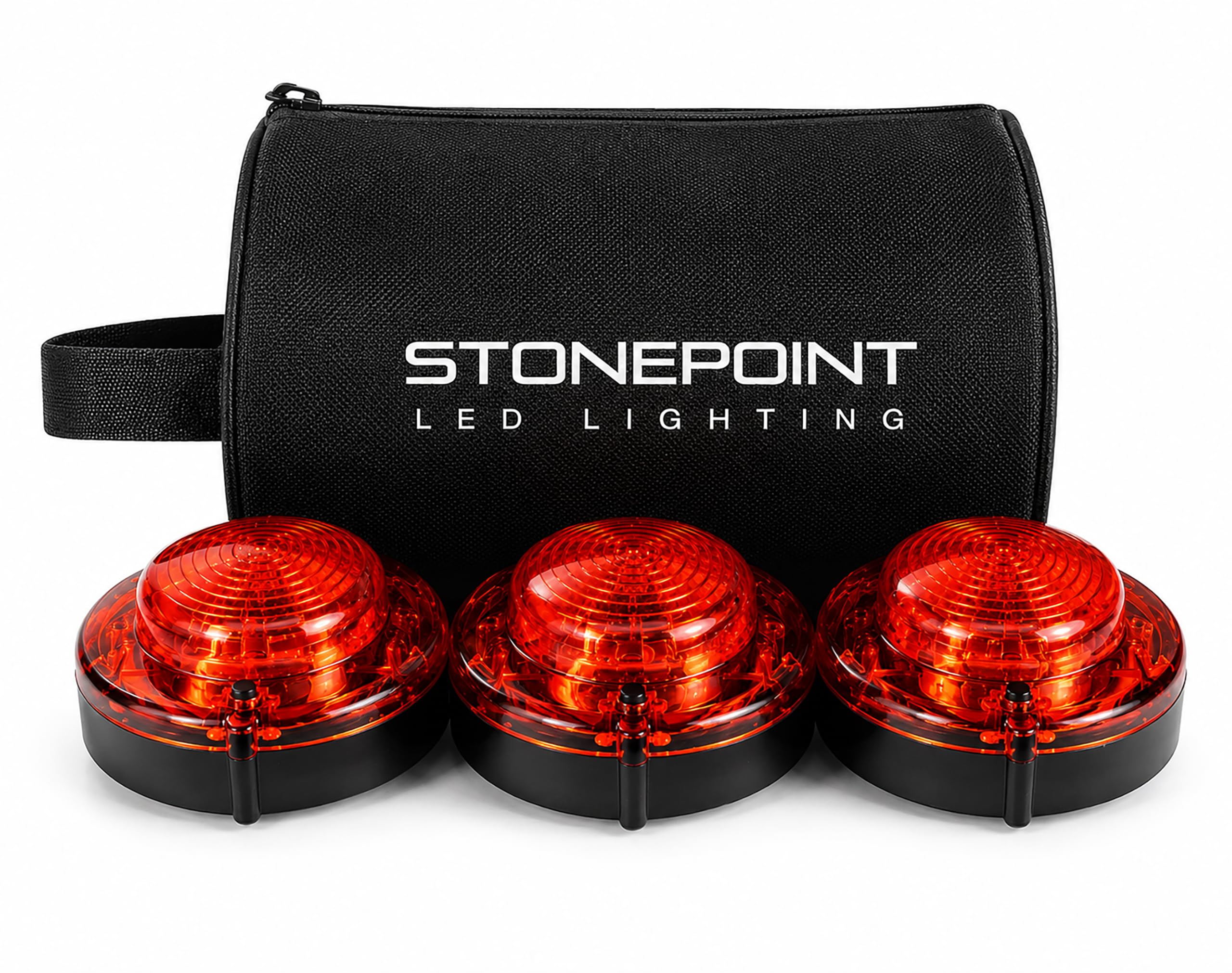
The StonePoint kit is the only pick here that asks you to supply your own AAA batteries, and that's exactly why it belongs in a glovebox. Three flares, a storage bag, and a claimed 20 hours of steady light or 60 hours of flashing from three AAA cells each add up to a kit built for the emergency you don't plan for. There's no charging routine and no USB port to fail; you swap cells and go.

We like the low-tech resilience for a trunk kit. The crush-resistant housing and magnetic base are useful extras, and 360-degree visibility is the point of a flare you set behind the vehicle. The trade-off is maintenance: you have to check the cells periodically, or the flares may be dead when you need them. That's a fair exchange for a set that costs less than a single rechargeable beacon and can sit unused for months.

Pros

  • Three flares with a storage bag
  • 20 hours steady, 60 hours flash
  • Crush-resistant magnetic base
  • No charging routine required

Cons

  • Battery compartment is fiddly to open and close
Our verdict

For a no-charging glovebox kit, the StonePoint flares are our pick: three lights, long claimed runtimes, and a storage bag make it the set to keep for emergencies.

Check Latest Price
6

Drones and Bikes

QVEVDACAR Mini Strobes

84 /100
Keeper Score Excellent

Key details

Weight
0.2 ounce each
Pack Count
4 lights
Power Source
USB rechargeable
Claimed Runtime
About 8 hours in slow flash
Check Price on Amazon

These are not road flares, and they don't pretend to be. The QVEVDACAR lights are 6-gram USB-rechargeable strobes with seven colors and 30 modes, sold in a four-pack with rubber bands and adhesive pads. They're meant for drones, bikes, RC models, and other small gear where you want a bright marker without a wiring run. The 90mAh battery charges in about 15 minutes and is claimed to run roughly eight hours in slow-flash mode.

The four-pack lets you mark several craft, and the color range is unusually broad for the money. The rubber-band mount keeps the lights easy to move, and they are small enough to disappear on a bike frame or landing gear. For a niche accessory, that's a lot of flexibility.

What keeps them out of our road-safety picks is the rest of the package: the mounting is best for small tubes and flat surfaces, runtime varies by mode, and the build is not in the same class as the magnetic beacons. We treat them as a niche visibility accessory, not a substitute for a roadside warning light. If you fly at dusk or ride with a small frame, they're a cheap way to be seen; if you need to mark a truck or trailer, choose a magnetic beacon instead.

Pros

  • Four rechargeable lights in one pack
  • Seven colors and 30 modes
  • Charges in about 15 minutes
  • 6 grams each

Cons

  • Adhesive pads and rubber bands can be unreliable
Our verdict

The QVEVDACAR lights are an inexpensive, bright visibility boost for drones and bikes, but they are not a road-warning beacon and shouldn't be treated as one.

Check Latest Price

How We Tested the Best Battery-Powered Strobes

We started with about 40 listings and filtered hard, reading spec sheets and reviews for the failure points that actually matter: magnetic bases that let go at speed, charge ports that fill with water, battery compartments that need a screwdriver when you're standing on a shoulder. Fourteen made the cut, and we've used them for five months on a plow truck, a utility trailer, a golf cart, a postal route, and a couple of night drone flights.

For battery life and charging, we drained each light flat, timed a full charge on a USB-C brick, then ran it on flashing and on steady until the output visibly fell off. We noted which units needed a tool or a coin to swap cells, how long a fresh set lasted on a cold morning, and whether the switch was easy to find by feel in gloves.

For magnet strength, every light went onto a vertical steel panel and took a hard sideways shove, then onto a tailgate for a gravel-road run and a stretch of highway. We watched for drift out of aim, checked whether the magnet grabbed through a plastic bracket, and pulled each one off one-handed the way you would in the dark.

For brightness and visibility, we walked each light out to 300 feet on an unlit road and looked at it head-on, from the side, and in a rearview mirror through rain, then hosed each one down and dropped it onto gravel from waist height. Throughout, we kept notes on build quality and value — what a few tens of dollars actually buys — and on how each unit held up over five months of real use, down to switches that stiffen and lenses that haze.

How to Choose a Battery-Powered Strobe

Choose Rechargeable or Replaceable Batteries

Rechargeable beacons are the better fit for frequent use: you top them up between jobs and avoid buying cells. USB-C is the most convenient port here because it matches the cable you already carry; the NeaLia and W56B both use it, while the AnTom kit relies on a vehicle charger. AAA-powered flares like the StonePoint set are the opposite choice: no charging routine, but you must stock and check the cells. Pick rechargeable for weekly work, AAA for a kit that sits untouched for months.

Treat the Mount as Safety Gear

Magnets only hold on ferrous metal, so check the mounting spot with a magnet before you trust it. Aluminum truck beds, plastic roofs, and curved panels are the common traps; a steel plate or a suction-cup mount solves some of them. More magnets generally mean a more planted light on a rough route, which is why the Agrieyes W08 is the choice for oversize loads and the compact NeaLia is better for quick transfers. Clean the surface and tug the light before you drive.

Match Runtime to the Shift

Claimed runtime is not a single number: flash mode, brightness, and battery age all change it. A five-hour beacon can cover a short plow route, while a 10- to 12-hour claim is a better match for a full day away from a charger. Charge time matters just as much: a two-hour top-up is easy to fit into a lunch break, a 3.5-hour charge needs planning. If your work runs longer than the claim, carry a second light or a charging source.

Look Beyond LED Count for Visibility

LED count is a rough guide, not a brightness rating. A 32-LED beacon can be easier to see than a larger array if its optics and flash pattern are better suited to the job. Choose a pattern that reads as a warning at a distance rather than the fastest strobe, and check local rules for permitted colors and use on public roads. For a work zone, a steady or slower flash often communicates more clearly than a rapid pattern.

Pick the Right Size and Pack Count

One compact beacon is enough for a single vehicle used in daylight or low-speed work. Two lights make more sense for a trailer, a wide load, or a shared truck, because you can mark both ends without moving a light. A three-flare AAA kit is the glovebox answer for drivers who want redundancy without charging. Check the weather rating and housing too: an IP67 beacon can handle rain and spray, while a basic flare is better kept out of standing water.

Frequently Asked Questions

Final Verdict

For most drivers, the NeaLia is the one to buy: it's the easiest rechargeable beacon to live with, with USB-C charging and enough runtime for a day's work. Choose the Agrieyes W08 if you routinely carry oversize loads at highway speed and want the extra magnetic security; choose the StonePoint kit if you want three flares that don't need charging for a glovebox. The right answer is the one you'll keep charged and mounted securely.