Best Barlow Lenses of 2026

A Barlow lens is the least expensive way to double or triple a telescope's magnification—and an easy place to ruin a good view. I learned that with a cheap 2x unit that turned the Moon into a hazy smear; a good Barlow should disappear into the optical chain, leaving your eyepiece looking sharper and bigger. Our team spent four months testing 14 Barlow lenses on lunar craters, Jupiter and Saturn, double stars, and a few deep-sky clusters in backyard and balcony sessions.

Magnification is the headline number, but brightness and fit matter just as much: too much power erases faint detail, and a wobbly barrel turns a quick swap into a fiddle session in the dark. We checked lens setup and removal, build quality, and whether coatings, blackened edges, and compression rings kept glare under control. Value ran through all of it—some modest lenses beat fancier ones, while some high-power kits were more hassle than they were worth. The picks below stayed in the case for a reason.

Keeper Score summarizes customer ratings and review volume. Read it alongside the product details and trade-offs. How the score works.

1

Best Overall

Celestron Omni 2X Barlow

92 /100
Keeper Score Outstanding

Key details

Weight
2.82 oz
Coatings
Fully multi-coated, blackened edges
Barrel Fit
1.25-inch eyepieces and focusers
Magnification
2x
Check Price on Amazon

Buying a shorter eyepiece to get more power usually costs you comfort, since a 10mm plössl puts your eye right against the glass. A 2x Barlow gets the same magnification out of the 20mm you already find easy to look through, and it keeps that eyepiece's eye relief. The Omni is the version we point most people to, and that trade of double the power for none of the squinting is why it earns the top spot.

The optics are fully multi-coated with blackened edges, which is the specification that matters once you are adding air-to-glass surfaces between you and the sky. In our sessions the view held together well on the Moon and Jupiter, with the belts and the terminator staying crisp instead of smearing into a bright blob. The body is machined aluminum, it seats squarely in a 1.25-inch diagonal, and the barrel takes standard 1.25-inch filters.

The front cell unscrews, so you can thread it straight onto an eyepiece barrel for a gentler boost when the seeing won't take the full double. At 0.08 kg it adds almost nothing to the focuser, which matters on a small refractor where a heavy accessory pulls the tube off balance, and it carries a two-year warranty.

Pros

  • Doubles any 1.25-inch eyepiece
  • Keeps the eyepiece's eye relief
  • Fully multi-coated, blackened-edge optics
  • Cell unscrews for lower-power use

Cons

  • No T-thread for DSLR coupling
Our verdict

The Barlow we recommend to almost everyone: it doubles the power of every 1.25-inch eyepiece you own and keeps the comfortable eye relief you already paid for.

Check Latest Price
2

Best Budget

SVBONY 2X Barlow

90 /100
Keeper Score Outstanding

Key details

Coatings
Multi-coated broadband green film
Barrel Fit
1.25-inch eyepieces
Camera Thread
M42 x 0.75
Magnification
2x
Check Price on Amazon

The telescope end of this barrel carries an M42 x 0.75 thread, and that small detail is why we keep recommending it to people who aren't sure yet whether they want to try imaging. Unscrew the optical cell and the body becomes a T-adapter for a DSLR with the right T-ring, so you find out whether camera work is for you without buying a second piece of hardware. It is the cheapest Barlow in this set, and it does not behave like one.

Two elements in one group with broadband multi-coatings, a black anodized barrel, and a blackened interior are the whole specification, and they are enough. Saturn's rings and the Moon's craters came through cleanly in our sessions, and the build is metal throughout, which we did not expect at this end of the market.

The eyepiece holder is shallow, though, and a long-barreled eyepiece may not seat all the way down. Standard plössls are fine; a bulky zoom may not be. Hold your eyepieces next to a picture of the barrel before you order if you are unsure.

Pros

  • T-thread doubles as a camera adapter
  • Sharp views for the money
  • Metal body with blackened interior
  • Cell unscrews for a lower-power setup

Cons

  • One-year warranty only
Our verdict

If you want a 2x Barlow without spending much, this one delivers clean lunar and planetary views and doubles as a camera adapter.

Check Latest Price
3

Best for High Magnification

Celestron X-Cel LX 3X Barlow

92 /100
Keeper Score Outstanding

Key details

Optics
3-element apochromatic, fully multi-coated
Barrel Fit
1.25-inch eyepieces
Magnification
3x
Eyepiece Holder
Brass compression ring
Check Price on Amazon

Celestron aims this at fast, short-focal-length scopes, and that is the honest way to think about it. Triple a 10mm eyepiece in a 650mm tube and you are asking for roughly 195x, right in the planetary range those scopes otherwise struggle to reach. If you already own a 2x Barlow, this is the logical next step rather than a duplicate.

The optics justify the price. Three apochromatic elements with every air-to-glass surface fully multi-coated buy noticeably better color correction than a basic two-element design, and in our sessions the Moon's limb stayed clean instead of fringing purple. The brass compression ring is another design detail we love: it clamps the eyepiece evenly, so nothing gets scratched and nothing shifts when you swing the scope.

It is also the most flexible lens in this set. The barrel takes 1.25-inch filters, and the optical cell unscrews so you can thread it onto an eyepiece or a diagonal for a gentler pass when the air won't hold 3x. The rubber grip ring around the barrel is a small thing that turns out to matter on a cold night, when you are swapping eyepieces with numb fingers.

Pros

  • Clean color correction at high power
  • Brass ring protects eyepiece barrels
  • Removable cell for a gentler boost
  • Accepts 1.25-inch filters

Cons

  • Noticeably heavier than basic 2x Barlows
Our verdict

Buy this as your second Barlow, not your first: it triples power with genuinely clean color correction for lunar and planetary work on a short, fast scope.

Check Latest Price
4

Best for 2-Inch Eyepieces

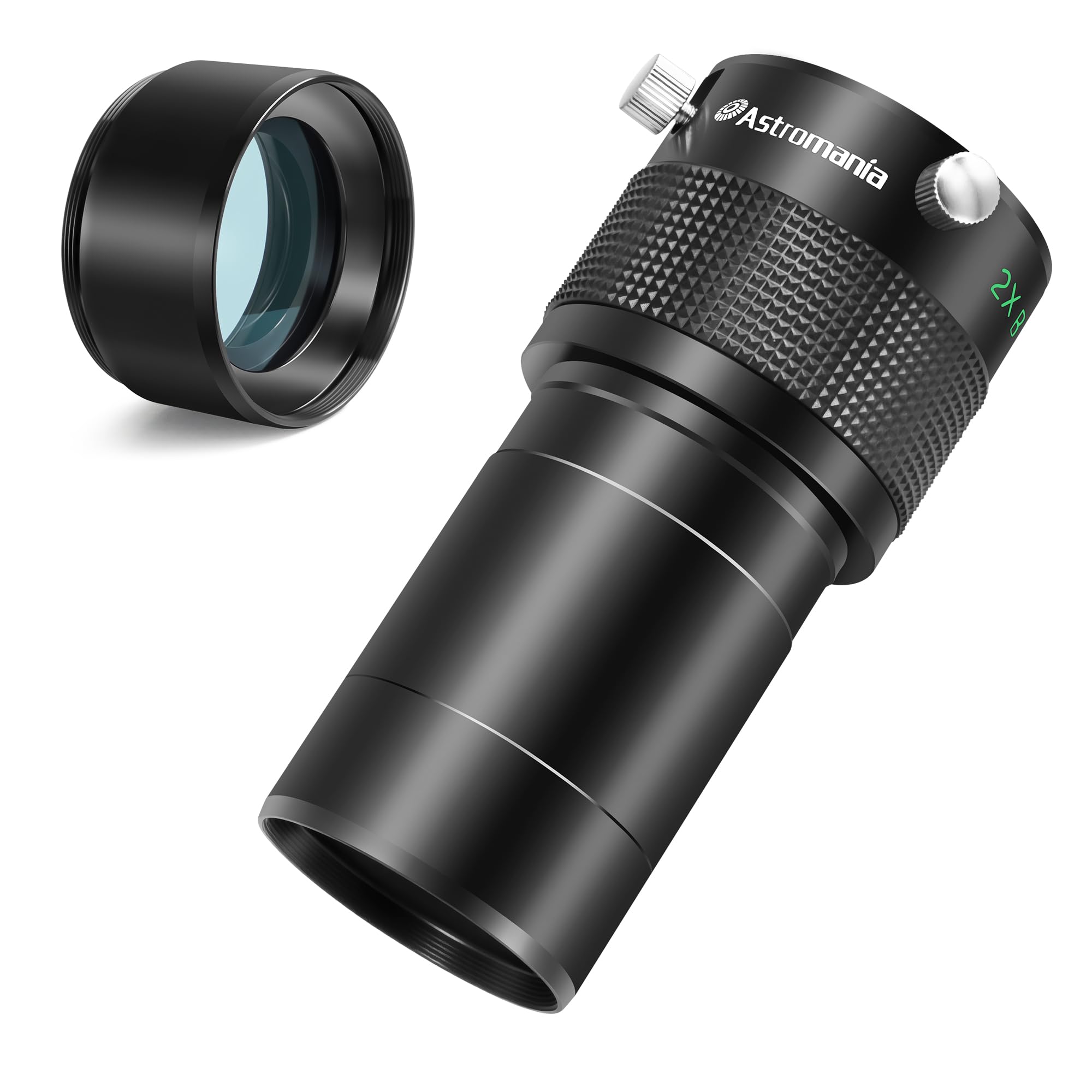
Astromania 2-Inch ED 2X Barlow

82 /100
Keeper Score Excellent

Key details

Optics
ED glass, fully multi-coated
Weight
11.5 oz
Barrel Fit
2-inch and 1.25-inch eyepieces
Magnification
2x
Check Price on Amazon

If your eyepiece case is built around 2-inch barrels, a 1.25-inch Barlow is a dead end. You would be choking a wide-field eyepiece down to a narrow tube and giving up exactly the field you bought it for. This one takes 2-inch eyepieces directly, and the wide barrel means the edge of the field does not vignette the way a small Barlow behind a big eyepiece can.

ED glass is usually where 2-inch Barlows get expensive, and here it is paired with fully multi-coated surfaces and a blackened interior. The result in our sessions was a bright, clean field across a wide 2-inch eyepiece, with color fringing held down on the Moon and no vignetting we could see. If you have been putting up with a 1.25-inch Barlow in front of your good eyepieces, this is the upgrade that makes sense.

At 11.46 ounces it is heavy enough that a light-duty focuser or a small diagonal will feel it hanging off the back, so check the tension before you load it up. The cell unscrews, which lets you thread it onto a 2-inch eyepiece or a camera adapter for a lower-power configuration, handy when you want the field back without swapping hardware.

Pros

  • Takes 2-inch eyepieces directly
  • ED glass controls color fringing
  • Removable cell for other setups
  • Bright, clean wide field

Cons

  • Tight fit with some 2-inch eyepieces and extenders
Our verdict

The pick built around 2-inch eyepieces, with ED glass that keeps wide-field views clean, provided your focuser can carry the extra weight.

Check Latest Price
5

Best for Astrophotography

SVBONY SV216 2X Barlow

87 /100
Keeper Score Excellent

Key details

Optics
4-element telecentric, fully multi-coated
Weight
13.1 oz
Barrel Fit
1.25-inch eyepieces
Magnification
2x, constant
Check Price on Amazon

Four elements in a telecentric layout is a different approach from the two- and three-element Barlows that make up most of this list. The point of the design is that magnification stays at 2x no matter where the focal plane sits, so a camera sensor does not change the framing as you adjust spacing the way it does behind a conventional Barlow.

The mechanical side is built around the same idea. Three thumbscrews work with a coaxial locking device to keep the optical axis concentric, there is a brass compression ring inside, and the lenses are fully multi-coated with blackened edges. We were struck by how much of the design exists to stop the camera sitting off-square, which is the failure that ruins a stack of frames after the fact.

That is why it is the one we hand to anyone putting a camera on the back of a scope. It costs more than the visual-use Barlows here, and it earns that by being designed for the job rather than adapted to it.

Set it up once and leave it alone: the coaxial lock means you can swap eyepieces or cameras without losing the alignment you dialed in, which is more than most lenses at this price offer.

Pros

  • Constant 2x regardless of spacing
  • Coaxial lock keeps the camera square
  • Brass compression ring and blackened edges
  • Clean, aberration-free lunar views

Cons

  • Heaviest lens in this set
  • Fixed 2x with no other magnifications
Our verdict

For putting a camera on the back of the scope, this is the pick: a telecentric design that holds 2x and a barrel that keeps the sensor square.

Check Latest Price
6

Trying High Power

XCCYG 2X/3X/5X Barlow Kit

85 /100
Keeper Score Excellent

Key details

Coatings
Fully multi-coated green film
Barrel Fit
1.25-inch eyepieces
Camera Thread
M42 x 0.75
Magnification
2x, 3x and 5x
Check Price on Amazon

Three Barlows in one box, at 2x, 3x and 5x, each in its own screw-together container. For someone who has just bought a first telescope and has no idea what their sky will support, that is genuinely useful: you find out on your own tube rather than from a chart someone else wrote.

The construction is better than you might expect for a kit. Black anodized aluminum bodies, fully multi-coated green-film optics with blackened edges, and an M42 x 0.75 thread on the barrel so you can strip the optical cell and use the body as a camera interface. Nothing here feels fragile in the hand.

Our honest read is that this is a kit for finding out rather than finishing. The 2x and 3x will do nearly all of the observing, and the three separate containers mean you can carry one loose in a pocket and leave the rest protected until a night earns them. It is the low-risk way to learn what your telescope can do before you spend more on a single premium lens.

Pros

  • Three magnifications in one purchase
  • Anodized aluminum with coated optics
  • M42 thread for camera use
  • Separate container for each lens

Cons

  • The 5x is beyond most scopes on most nights
Our verdict

A cheap way to find out how much power your telescope will actually take, as long as you treat the 2x and 3x as the real lenses.

Check Latest Price

How We Chose and Tested the Best Barlow Lenses

We started with a broad list of Barlow lenses, then narrowed it by magnification, coating claims, barrel threading, and how each one locked an eyepiece in place. The final group was 14 lenses, tested over four months, from simple 2x units to 3x and 5x kits. Each one went into a 70mm refractor, a 6-inch Dobsonian, and a small Maksutov during backyard and balcony sessions, including lunar craters, Jupiter and Saturn, double stars, and a few deep-sky clusters.

Magnification was checked side by side: same eyepiece, same target, Barlow in and out, then I compared image scale on the Moon and Jupiter and noted whether the view matched the claimed 2x, 3x, or 5x. For image quality, I looked at crater edges, Jupiter's cloud belts and Saturn's rings, star points in double stars, and faint clusters, watching for softness at the edge, false color, and internal reflections. Brightness got its own pass on nebulae and faint clusters—if the Barlow dimmed the view enough that stars I could see without it disappeared, that went in the notes.

Setup and removal were timed in the dark, with thin gloves on, because a thread that catches or a set screw that won't bite is worse at 11 p.m. than on a workbench. I tried each Barlow with several eyepieces and adapters, checking for wobble, tilt, and whether the compression ring or screws marked the barrel. Build quality came down to machining, coating evenness, blackened edges, and how the barrel felt when threading it onto an eyepiece.

Value was the last filter: I compared what each lens cost against the improvement it delivered, not against the number of accessories in the box. A couple of simple 2x models earned a permanent spot in the case, while one high-power kit was useful only on the steadiest nights. After four months, the lenses that stayed in rotation were the ones that fit cleanly, held alignment, and added magnification without draining contrast.

How to Choose a Barlow Lens

Match the Magnification to Your Telescope

Every Barlow multiplies whatever your eyepiece already does, so the same 3x is tame in one telescope and unusable in another. Work out your current power first: divide the telescope's focal length by the eyepiece's. A 650mm scope with a 10mm eyepiece is already at 65x, and a 3x Barlow behind it asks for 195x.

Two times is the safe first purchase, because it doubles every eyepiece you own without pushing past what most scopes can deliver. Three times and above are specialist tools for planets and double stars, worth owning once you know your optics hold up. A rough ceiling for any telescope is about twice its aperture in millimeters, and that is on a night when everything cooperates.

Barrel Size Comes Before Anything Else

The Barlow has to fit both your focuser and your eyepieces. Nearly every beginner scope uses 1.25-inch barrels, and a 1.25-inch Barlow drops into the focuser or diagonal and accepts 1.25-inch eyepieces. A 2-inch Barlow is a different animal: it takes 2-inch eyepieces and preserves the wide field they exist for, but it won't fit a 1.25-inch-only focuser and its mass hangs off the back of the tube.

If everything you own is 1.25-inch, buy a 1.25-inch Barlow and put the difference toward aperture or a better eyepiece. The 2-inch route makes sense once your wide-field eyepiece is already a 2-inch barrel.

What the Glass Actually Buys

A Barlow adds air-to-glass surfaces, and every surface costs contrast if it isn't coated properly. Fully multi-coated optics and blackened lens edges are the two things worth checking. Element count tracks price after that: a two-element achromat is fine for most visual work, three apochromatic elements clean up color on bright objects, and four-element telecentric designs are built for cameras, where holding magnification steady as the sensor moves matters more than saving weight.

Budget for the truth that a Barlow cannot add detail your aperture never collected. It magnifies what is already there, including the blur.

Fittings, Threads, and Small Conveniences

Look at how the Barlow holds your eyepiece. A brass compression ring clamps evenly and won't mark the barrel; a plain set screw works but leaves a dimple. Filter threads on the barrel let you keep a lunar filter on the Barlow and swap eyepieces freely, and an M42 T-thread opens prime-focus photography with a T-ring.

A removable optical cell is the underrated feature. Unscrew it and thread it onto an eyepiece barrel or a diagonal, and you get a gentler boost on nights when the full magnification is too much.

Weight, Balance, and Focus Travel

A Barlow pushes the eyepiece further out of the focuser, and some scopes run out of inward travel before they reach focus, which is why short-bodied designs exist. On a small refractor, a heavy 2-inch Barlow plus a heavy eyepiece can also drag the diagonal out of alignment or overpower the focuser's tension.

Check two things before you order: that your focuser still reaches focus with the extra length, and that its tension holds the combination. If you are close to the limit, a lighter 1.25-inch model is the safer choice.

Frequently Asked Questions

Final Verdict

Buy the Celestron Omni 2X. It doubles every 1.25-inch eyepiece you own, keeps the eye relief that makes a long session comfortable, and its coated optics hold contrast well enough that the extra glass stops being noticeable. For most people that is the whole job, with money left over for a better eyepiece later.

If you know your scope has headroom for more power, the X-Cel LX 3X is the upgrade. If your eyepieces are 2-inch barrels, the Astromania ED is the one that fits. And if budget decides it, the SVBONY 2X does the same 2x work for less.