Best Backup Cameras of 2026

A backup camera should make you a confident driver, not a weekend electrician. The promise: see what's behind you before you reverse. But the category splits into two camps—some systems need a fish tape to route cable from tailgate to dash, while others stick on with a magnet and pair to a solar-powered screen. What you're buying is fewer blind spots and less guesswork when parking or hitching a trailer. Over the past seven months, we've installed and lived with 12 backup camera systems in pickups, small RVs, and daily drivers to see which deliver a clear picture without fuss.

The monitor matters as much as the camera—a 7-inch anti-glare screen is easier to read than a 4.3-inch one. Night vision isn't a checkbox—some wash out headlights, others keep contrast. Wireless systems have gotten reliable, but depend on a clean signal and a charged battery; wired systems are fussier to install but never need charging. We checked cable length, mounting, and solar battery life; the picks below are the ones that held up.

Keeper Score summarizes customer ratings and review volume. Read it alongside the product details and trade-offs. How the score works.

1

Best Overall

Pemacom P15

87 /100
Keeper Score Excellent

Key details

Power
15,000mAh battery, solar panel
Screen Size
7 in
Camera Mount
Magnetic, six magnets
Video Resolution
1080p
Check Price on Amazon

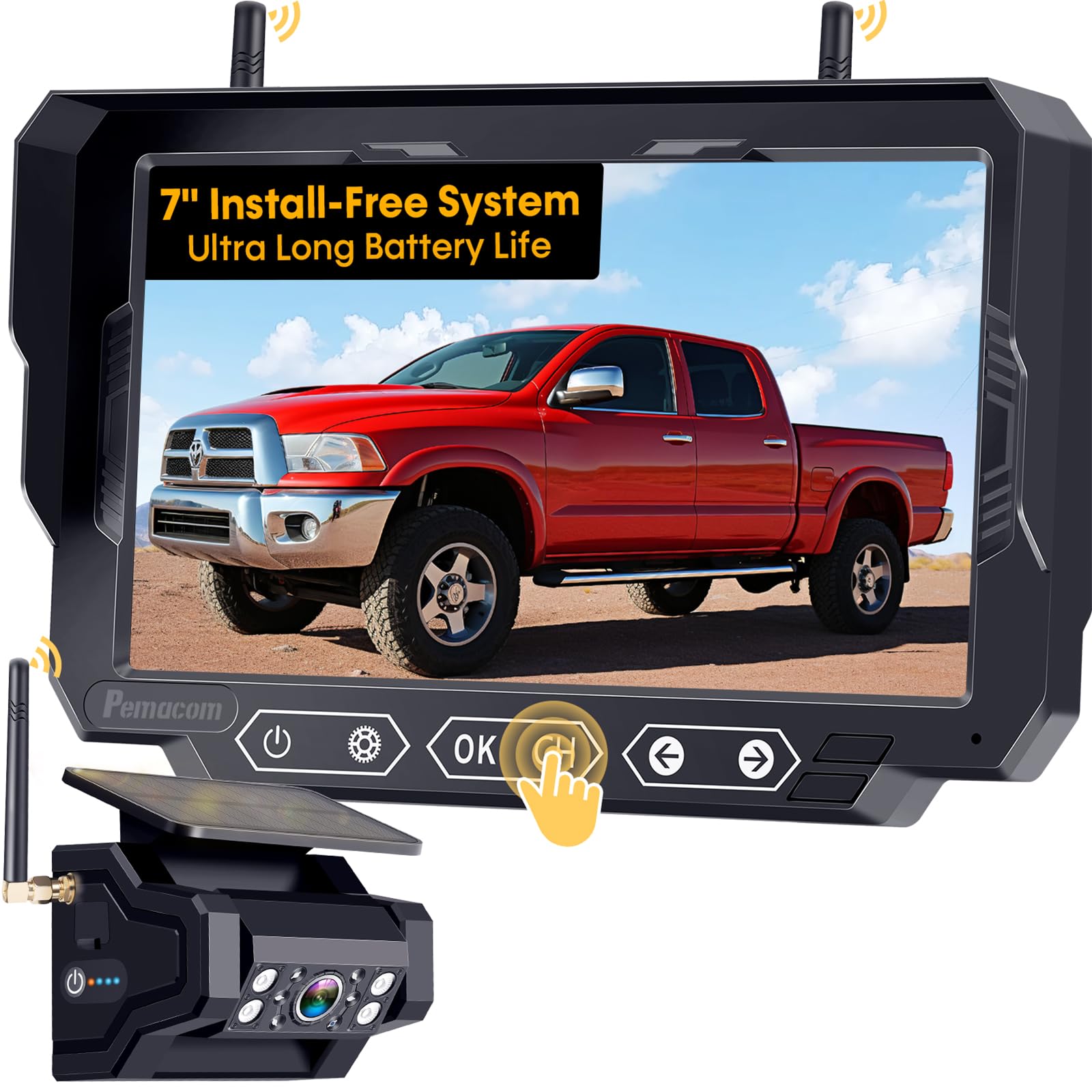
What sold us on the Pemacom is the part of the job it deletes. Instead of threading a video cable from the tailgate to the dash, you set a six-magnet base on a steel panel and plug the 7-inch monitor into the cigarette lighter. The cable run is the reason a lot of backup cameras stay in their boxes for a year, and this kit takes that excuse away, with the bonus that the whole system moves to a second vehicle whenever you need it there.

The picture holds up its end. The 170-degree lens is wide enough to show the corners of a truck bed, brightness and contrast are adjustable from the monitor, and the anti-glare screen is there for the daylight hours when reversing displays usually wash out. Signal is the part that matters once a trailer is behind you, and the frequency-hopping 2.4GHz link here is one of the steadier wireless setups in this group.

Power is where our enthusiasm has a limit. The 15,000mAh battery is rated for 24 hours and the solar panel tops it up between trips, but sun and screen time decide how far that goes: leave the monitor powered in a shaded spot and you will be reaching for the charging cable. Treat the panel as a trickle charger rather than a fuel tank and it behaves.

The one hard requirement is steel. Magnets this strong will not let go at highway speed, but an aluminum-bodied truck, a fiberglass trailer cap or a plastic bumper gives them nothing to grab, and there is no bracket in the box to fall back on. Check the panel with a fridge magnet before you order. Where there is steel, the tool-free install and the two-year warranty make this the least painful way into a clear reversing picture.

Pros

  • No cable run; system moves between vehicles
  • 7-inch anti-glare screen with adjustable brightness
  • 170-degree view covers a truck's corners
  • 15,000mAh battery with solar top-up

Cons

  • Camera only powers down with the monitor
  • Uses the 12V socket while running
Our verdict

For most cars, trucks, and utility trailers this is the kit we recommend: a clear 7-inch picture with no cable to run and a camera you can move.

Check Latest Price
2

Best Budget

LeeKooLuu LKL-080

89 /100
Keeper Score Excellent

Key details

Connection
Wired, 4-pin cable
Screen Size
4.3 in
Video Resolution
1080p
Waterproof Rating
IP69
Check Price on Amazon

Four and a third inches is small for a screen. That is what the LeeKooLuu LKL-080 gives you, and it is also why the kit costs so little: a compact monitor, a camera, and a single 4-pin cable that carries both video and power to the back of the car. In a hatchback, a sedan or a small SUV the size is fine, since the monitor sits within arm's reach and the parking grid lines are what you are actually reading.

One cable, a camera that screws to the surface, and a monitor that sits on the dash: that is the whole install. The housing is ABS with a nano-coating sealed to IP69, so rain and a washdown are not the worry they are on a bare camera. Plan the route before you start, though, because the cable you get is the cable you get, and a long-bed truck or a van is where that becomes tight.

Where this kit earns its place for us is the price of admission. Nothing else here puts a working camera and screen in your car for less, and there is no battery to remember to charge. It is a compact-car kit, though. Put it on a crew cab and you will spend the whole maneuver squinting at a screen the size of a phone.

Pros

  • Lowest-priced complete kit in this group
  • One 4-pin cable carries video and power
  • IP69 housing handles rain and washdown
  • No battery to charge or replace

Cons

  • 4.3-inch screen is small for a large vehicle
  • Adhesive monitor mount cannot be repositioned
Our verdict

Buy it if the budget is the whole decision and the vehicle is small: nothing else here puts a working camera and screen in your car for less.

Check Latest Price
3

Best Budget Wireless

LeeKooLuu LK10

86 /100
Keeper Score Excellent

Key details

Connection
Wireless video, 12V camera
Screen Size
7 in
Field Of View
150 degrees
Video Resolution
1080p
Check Price on Amazon

The pitch here is simple: the same 7-inch wireless layout as our top pick, without the magnets or the battery, for appreciably less money. The monitor suctions to the glass and plugs into the lighter; the camera pairs on power-up, so there is no menu to work through on the first install.

We think that is the right trade for a lot of buyers. Nothing goes through the body of the car for the video, so a 15-minute install is realistic on a first attempt, and the parking lines can be dragged in to match your vehicle's width rather than sitting where the factory put them. It is the wireless kit we point to when the budget will not stretch to a magnetic system.

Two things worth knowing before you order. The camera still wants 12 volts at the rear, so most installs tap a reverse light: you are skipping the long video cable, not all wiring. And the 2.4GHz link is the least reliable part of any affordable wireless kit. This one holds better than most, but a stuttering frame in a crowded parking structure is the kind of thing that happens with wireless and never with a cable.

Pros

  • 7-inch screen at the lowest wireless price here
  • Adjustable parking lines match your vehicle
  • Camera pairs automatically on power-up

Cons

  • Camera still needs a 12V connection at the rear
  • Wireless feed can stutter in busy areas
Our verdict

A sensible middle: 7-inch wireless video at a budget price, as long as you accept a 12-volt tap at the rear and the odd stutter.

Check Latest Price
4

Best for Heavy Equipment

ATPTK MC732611

88 /100
Keeper Score Excellent

Key details

Screen Size
7 in
Input Voltage
DC 12-24V
Video Resolution
1080p
Waterproof Rating
IP69K
Check Price on Amazon

Read the compatibility list before you decide this one is overpriced: skid steers, excavators, tractors, combines, forklifts, dump trucks. The ATPTK is built for machines that shake, run on 24 volts and sleep outdoors, which is a different brief from a camera for a hatchback. If your vehicle is on that list, this is our pick for it.

The hardware backs it up. The camera body is metal and sealed to IP69K, the 4-pin connector screws down instead of pushing on, and the vibration rating is 10G, the number that matters if the camera is going on a machine rather than a truck. The DC 12-24V input means it wires straight into a tractor's electrical system without a converter, and the trigger wire brings the monitor on automatically when you shift into reverse.

Two limits. The 120-degree lens is the narrowest view in this group: fine for watching the back of a machine, less help in a tight yard. And the monitor is not waterproof, so it lives in the cab on its U-bracket. This is also the most expensive wired kit here, and what you are paying for is the housing, the voltage range and the connector rather than extra pixels.

Pros

  • DC 12-24V input suits tractors and heavy trucks
  • IP69K sealed metal camera body
  • Screw-lock 4-pin connectors resist vibration
  • Trigger wire switches the monitor on in reverse

Cons

  • 120-degree view is the narrowest here
  • Monitor is not weatherproof
Our verdict

It is the pick for anything that shakes: a sealed metal camera, screw-down connectors, and 12- to 24-volt input for farm and construction machines.

Check Latest Price
5

Best for Trailers and RVs

AUTO-VOX SOLAR5

86 /100
Keeper Score Excellent

Key details

Power
Solar panel, rechargeable battery
Recording
Two-channel split recording
Screen Size
7.2 in
Video Resolution
1080p
Check Price on Amazon

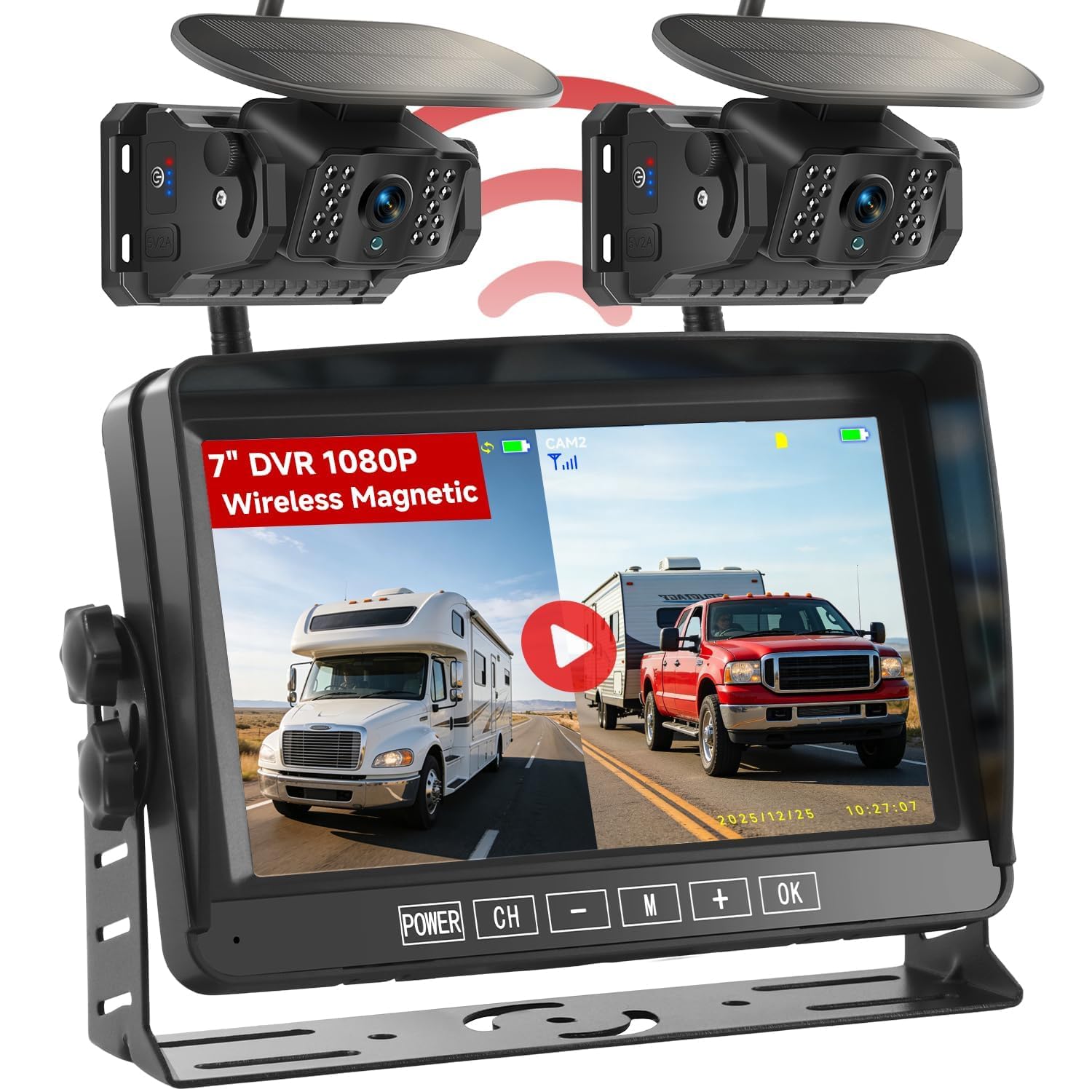
The 7.2-inch screen splits into two feeds, and the monitor records both to a memory card. That combination is what makes the SOLAR5 our trailer pick: you can watch down the side of a long trailer and keep an eye on the hitch at the same time, and if something happens behind you there is footage rather than a memory of a screen.

Installation follows the magnetic routine, six magnets and a soft base with no drilling, and the dual-antenna link is the part engineered for distance rather than for a parking lot. The iron bracket in the box matters more than it sounds: on a fiberglass or aluminum panel it gives the magnet a steel landing pad where there would otherwise be nothing to hold.

Think honestly about the solar panel. The battery is rated at up to 20 hours of continuous use and auto-sleep stretches that across several short trips, but a full towing day with the monitor on will use most of a charge, and a panel in shade puts very little back. The power pigtail at the camera is short on some installs too, so plan on splicing if your reverse-light wiring sits far from the mounting point.

Trailer work is what this kit is for, and the split screen plus the recording are things the cheaper wireless systems simply do not do. The 18-month warranty is longer than most here. Just do not buy it for a sedan, where a 7.2-inch monitor is a lot of dash furniture for a car that only reverses out of a driveway.

Pros

  • Split screen shows two camera feeds at once
  • Records both feeds to a memory card
  • Dual-antenna link built for trailer distance
  • Iron bracket mounts to non-steel panels

Cons

  • Solar panel will not carry a full towing day
  • Short power pigtail may need splicing
Our verdict

Two views and a recording of both, with no cable to the cab: the trailer pick, provided you will keep the battery charged between trips.

Check Latest Price
6

Sharp Wired Picture

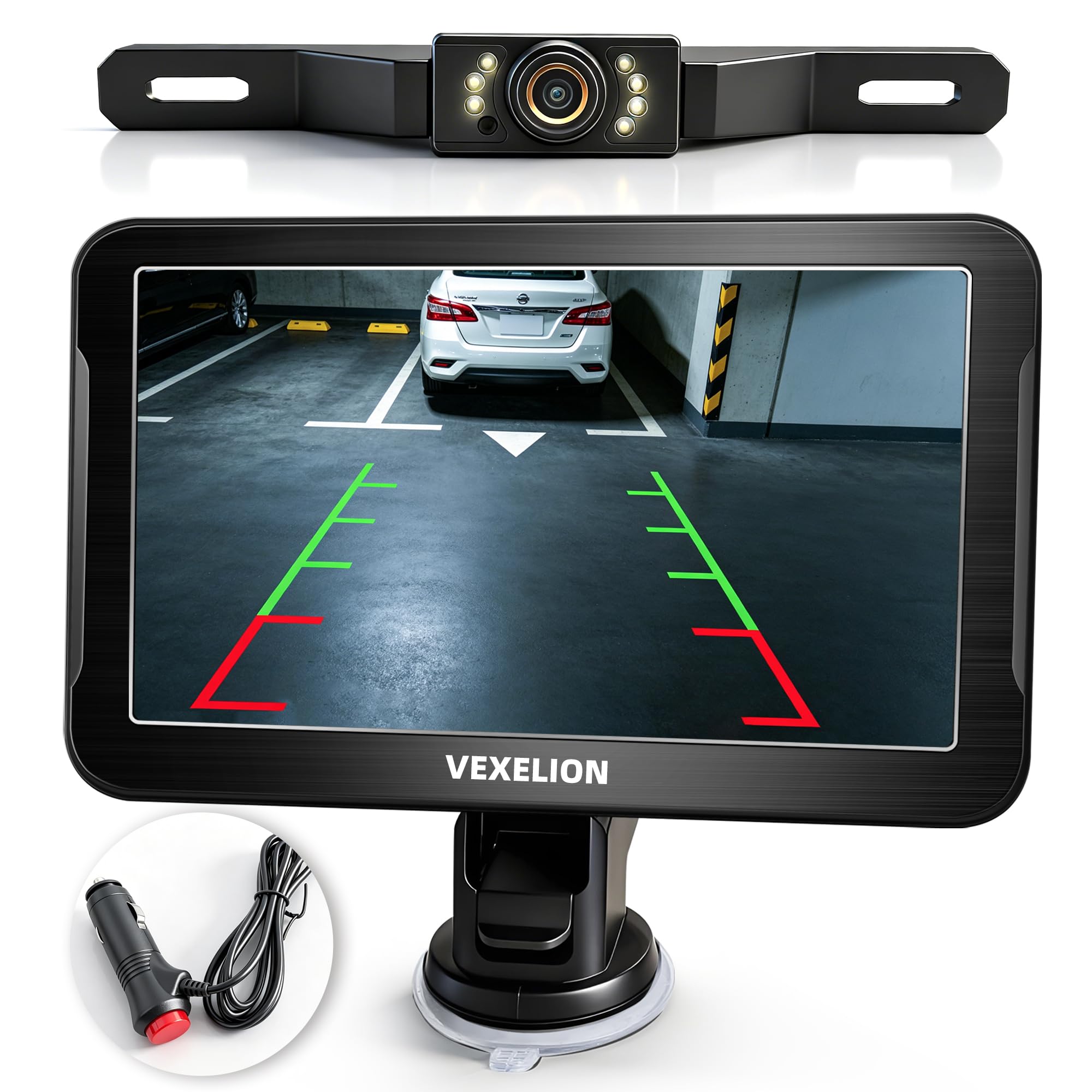
Vexelion 2K

87 /100
Keeper Score Excellent

Key details

Connection
Wired, single cable
Screen Size
7 in
Video Resolution
1440p
Waterproof Rating
IP69K
Check Price on Amazon

1,440p is the highest resolution in this group, and it is not just a number on the box: the extra pixels show up at the edges of the frame, where a curb, a post or a hitch ball sits. On a 7-inch monitor that is the difference between seeing what you are about to touch and seeing a smudge. The single cable carries power and video, the camera is rated IP69K, and the 170-degree lens covers the full width of the vehicle.

Two reservations keep us from putting it higher. Night performance is the first: resolution is a daylight advantage, and a 2K sensor does not automatically see better in the dark, where this one is merely adequate. The second is history, since the design does not have the track record behind it that the picks above do, so the day-one picture is more certain than the two-year one. At this price, on a car that needs a sharp daylight view, that is a risk worth taking.

Pros

  • Highest resolution in this group
  • 7-inch monitor at a budget price
  • IP69K waterproof camera housing

Cons

  • Low-light image is only adequate
  • Short track record behind the design
Our verdict

The sharpest daylight picture for the least money, with the caveat that low light and long-term durability are less certain.

Check Latest Price
7

Existing Displays

Pixelman PMD2A-S

90 /100
Keeper Score Outstanding

Key details

Sensor Size
1/2.7 in
Field Of View
170 degrees
Video Resolution
1080p AHD
Waterproof Rating
IP69
Check Price on Amazon

No monitor in the box. If that reads as a drawback, it is also the point: the PMD2A-S is a camera for a vehicle that already has a screen, whether that is a factory head unit with a reverse input, an aftermarket radio that takes an RCA video feed, or a straight replacement for a dead factory camera. Buy it as your first camera and you are buying a display as well.

What you get for that is the most substantial camera body in this group: a 1/2.7-inch sensor, a 170-degree glass lens, and a metal housing sealed to IP69 rather than a plastic shell. There is also a switch between HD and AHD output, the detail that saves a return, because a monitor that does not understand AHD can show a blank or a rolling image and this camera can drop back to a signal it does understand.

How long it lasts is where we hesitate. Cameras that quit inside a year are the failure worth knowing about, and the warranty covers only the first twelve months, so keep the receipt. Set against that, the price is low, the picture is sharp, and the supplied cable run reaches the back of a full-size SUV. If you already own a compatible display, this is the cheapest good picture here.

Pros

  • Sharp 170-degree view from a metal body
  • HD or AHD output switch matches older monitors
  • Cheapest way to add a camera to an existing screen

Cons

  • No monitor included
  • One-year warranty only
Our verdict

The right camera if you already have a screen and want a metal-bodied 170-degree view; buy a monitor as well if you do not.

Check Latest Price
8

Two-Camera Setups

Venluna VA001

84 /100
Keeper Score Excellent

Key details

Power
15,000mAh battery, solar panel
Screen Size
7 in
Cameras Included
2
Video Resolution
1080p
Check Price on Amazon

Two cameras and a 7-inch monitor, at a price that is not double the single-camera systems here. Venluna's VA001 covers the back of a fifth wheel and the hitch at the same time, or the rear and one side of a work truck, without asking you to buy and pair a second kit.

The design detail we appreciate most is the camera body: it tilts about 90 degrees up and down independently of the magnetic base, so one camera can aim at the hitch and the other down the length of the trailer without moving either mount. The monitor takes up to four channels, which means the pair in the box is not the ceiling if you add more later.

Power is a 15,000mAh battery with a solar panel, and Venluna states in its own notes that the panel is not the primary charging method. That is more honest than most listings here, and it sets the routine: charge from the cord, let the sun stretch the intervals, and rely on the 30-second auto-sleep once the monitor powers down.

Battery life is the part to watch. A camera that is already flat will not be rescued by a panel this size, and the routine above matters more than the capacity figure suggests. Buy this one for the second camera and the aimable mounts; for a single view, the cheaper magnetic systems above are the safer call.

Pros

  • Two cameras and a four-channel monitor
  • Cameras tilt 90 degrees independently of the mount
  • Maker states the solar panel is a supplement
  • Three-year warranty

Cons

  • Magnets need a steel mounting surface
Our verdict

Worth it when you need two camera views from one screen, especially if one of them has to aim at a hitch.

Check Latest Price

How We Tested Backup Cameras in Real Driving Conditions

We started by pulling together the best-selling backup camera kits from major retailers, then narrowed the field by resolution (1080p and up), monitor size, power source (wired, wireless battery, solar), weather rating, and price. That left us with 12 systems to test, from simple magnetic wireless units to full wired AHD kits. We installed each one in a real vehicle—a pickup, a 24-foot travel trailer, a compact SUV, and a work van—and ran them for seven months through everyday driving, trailer hookups, and parking garages.

Installation was timed from unboxing to first successful reverse, and we noted whether the kit included enough cable to reach from tailgate to dash without extensions. For wired units, we routed cable along door sills and through firewalls, checking for pinching. For wireless and solar units, we monitored battery levels over weeks, including cloudy stretches, and noted how often we recharged. Mounting got a separate test: we stuck magnetic bases to steel and brackets to plastic, then drove a washboard gravel road to see if the camera shifted or the magnet let go. At night, we backed toward a dark garage door and a black trash can to judge how much detail we could see before headlights washed out the screen.

Durability was judged by leaving each camera out in rain, dust, and direct sun for the full test period, then checking for fogging, cracked housings, or water intrusion. We also compared picture quality in bright sun, dusk, and rain, looking for lag, grain, or a washed-out horizon. Finally, we weighed what each system cost against what it actually delivered—easy install, stable signal, reliable night vision—to separate the genuine values from the ones that just look good on paper.

How to Choose a Backup Camera

Start With How It Gets Power

A wired kit runs one cable from the rear to the dash and taps the reverse light for power. There is no battery to charge and no signal to lose, and the camera only wakes when you shift into reverse, which is the arrangement that lasts longest. A wireless kit drops the video cable, but most still need 12 volts at the camera, so you are tapping a light anyway. Only the battery and solar systems are genuinely wire-free at both ends, and they cost more and need charging.

Match the choice to how long you will keep the vehicle. For a permanent install, wire it. For a camera that moves between a trailer, a truck bed and a second car, the battery systems earn their price.

Check What You Are Mounting To

Magnetic bases are the fastest install in this category and the one that fails on the wrong vehicle. Six magnets hold at highway speed on a steel panel; an aluminum body, a fiberglass trailer cap or a plastic bumper gives them nothing to grab. Some kits include an iron bracket to create a steel landing pad and some do not, so take a fridge magnet to the tailgate before you order.

The monitor raises the same question in miniature. A suction cup on glass can be repositioned and moved between vehicles; an adhesive pad is a one-shot decision, so dry-fit it before you peel the backing.

Match the Screen and Sensor to the Job

A 4.3-inch monitor is fine at arm's length in a compact car and close to useless across the cab of a pickup; 7 inches is where parking lines become readable at a glance, and it is the size most of this group uses. Resolution helps at the edges of the frame: 1440p picks out a hitch ball or a curb that 1080p smears, but it is a daylight advantage.

Night vision comes from infrared LEDs that light a few feet behind the lens, not from pixel count, so judge a camera on its low-light image rather than its resolution. A camera with modest night vision is still useful if you reverse on lit streets; it is the unlit driveway that separates the good ones.

Fit the Kit to the Vehicle

Voltage first. A 12-volt camera on a 24-volt machine needs a converter, while the heavy-equipment kits built for tractors and excavators take 12 to 24 volts directly. Distance next: a long trailer stretches a wireless link and a long truck bed stretches a cable, so dual antennas and generous cable runs are the two answers. Camera count last, since a split-screen monitor with two inputs lets you watch the trailer and the hitch without switching views.

Weather Sealing and Where It Lives

IP69 and IP69K mean the camera survives a pressure wash; the monitor usually does not, and most are rated for the cab only. Mount the camera high and centered, angled down far enough to catch the bumper or the hitch in the bottom of the frame, and seal any hole you drill through a panel. Cable that crosses a bare metal edge without a grommet will chafe through in a season.

Frequently Asked Questions

Final Verdict

The Pemacom P15 is the kit we point most buyers to, because it removes the two obstacles that keep backup cameras in their boxes: the cable run and the drilling. Six magnets, a lighter plug and a 7-inch picture you can read at a glance.

Choose differently in two cases. If you tow a long trailer regularly, the AUTO-VOX SOLAR5 split screen and recording justify the extra outlay. If you have a compact car, plan to keep it, and never want to charge anything, the wired LeeKooLuu LKL-080 is the cheapest route to a permanent view.