Best AV Receivers of 2026

An AV receiver is the box everything else plugs into — console, streamer, turntable, TV — and it's what decides whether a movie sounds like a movie. Buy the wrong one and it becomes the component you touch least and blame most. We've spent the past six months with eight of them wired into living rooms and basements, and the gap between a good one and a merely loud one shows up in the first ten minutes.

The number first-time buyers fixate on is wattage, which tells you almost nothing about how a receiver sounds in a normal room. What matters is how cleanly it passes video — 8K, 4K at 120Hz, eARC back from the TV — how well its room correction copes with a couch against one wall and one speaker jammed near a bookshelf, and whether Bluetooth and streaming work without an app fight. That's where our testing went.

Every pick below got the fundamentals right: honest power, stable HDMI handshakes, and a setup that doesn't require a manual and a prayer. The rest is a question of your room and your budget.

Keeper Score summarizes customer ratings and review volume. Read it alongside the product details and trade-offs. How the score works.

1

Best Overall

Denon AVR-X1700H

87 /100
Keeper Score Excellent

Key details

Power
80 watts per channel
Channels
7.2
8K Inputs
3 dedicated
Streaming
HEOS, Bluetooth, Wi-Fi
Check Price on Amazon

We started with the AVR-X1700H because it covers the modern basics without making you buy a flagship. Three of its HDMI ports are dedicated to 8K, the full layout is 7.2 channels, and HEOS is built in. That combination matters more than a big wattage number for a living-room theater: you can connect a TV, a console, a streaming box, and a disc player, then add height speakers when the room allows.

Denon's on-screen setup guide is the part we appreciate most. Receivers can bury simple tasks under layers of menus, and this one walks you through speaker connections and EQ settings in a way that feels deliberate. The 80 watts per channel are a sensible match for ordinary speakers in a normal room, and the guided setup helps you set levels without guesswork.

What seals it for us is the balance of inputs, channels, and streaming. HEOS means the receiver can play music without waking the TV, and Dolby Atmos and DTS:X support give you a path to a more immersive layout. We also like that the back panel is laid out for labels and repeat visits, not just a one-time install. The X1700H is the receiver we point to when someone wants a serious home theater without turning the purchase into a research project.

Pros

  • Seven-channel Atmos and DTS:X support
  • Three dedicated 8K HDMI inputs
  • HEOS, Bluetooth, and Wi-Fi streaming
  • Guided on-screen setup

Cons

  • 80 watts is modest for very large rooms
Our verdict

We recommend the AVR-X1700H as the default home-theater receiver here: it covers 7.2 channels, three 8K inputs, and HEOS streaming without asking you to overbuy.

Check Latest Price
2

Best Budget

Denon AVR-S570BT

84 /100
Keeper Score Excellent

Key details

Power
70 watts per channel
Channels
5.2
Wireless
Bluetooth
HDMI Inputs
4 (8K)
Check Price on Amazon

We start with the limit because it is the whole point: the AVR-S570BT is a 5.2-channel receiver. If you have five speakers and one subwoofer, that is not a compromise. It gives you four 8K HDMI inputs, 70 watts per channel, and Bluetooth in a chassis that is easier to fit than the seven- and nine-channel models here. We like it for a first theater where the speaker count is already settled.

The on-screen HD setup assistant is the feature that makes this one feel friendlier than its price suggests. It walks you through the TV connection, speaker setup, and EQ basics, so you are not left reading a PDF on your phone. Bluetooth is built in for phone playlists, and the receiver can pass 4K and 8K sources through to a compatible TV. It is a straightforward box for a straightforward room.

Compared with the X1700H, the S570BT gives up two channels, HEOS, and some HDMI flexibility. What you keep is the 8K foundation and a simpler install. We recommend it when the room is a straightforward 5.2 setup and the budget is better spent on speakers or a subwoofer. The back panel is not crowded with features you will never use, and that is part of the appeal.

Pros

  • Four 8K HDMI inputs
  • Easy on-screen setup assistant
  • 70 watts for a simple 5.2 room
  • Bluetooth streaming built in

Cons

  • No Wi-Fi or HEOS streaming
  • Bluetooth pairing can be inconsistent
Our verdict

If your plan stops at a 5.2 speaker layout, we think this is the smart place to save: four 8K inputs and easy Bluetooth cover the basics.

Check Latest Price
3

Best for Nine-Channel Atmos

Onkyo TX-NR7100

83 /100
Keeper Score Excellent

Key details

Power
100 watts per channel
Channels
9.2
HDMI Ports
8
Room Correction
Dirac Live
Check Price on Amazon

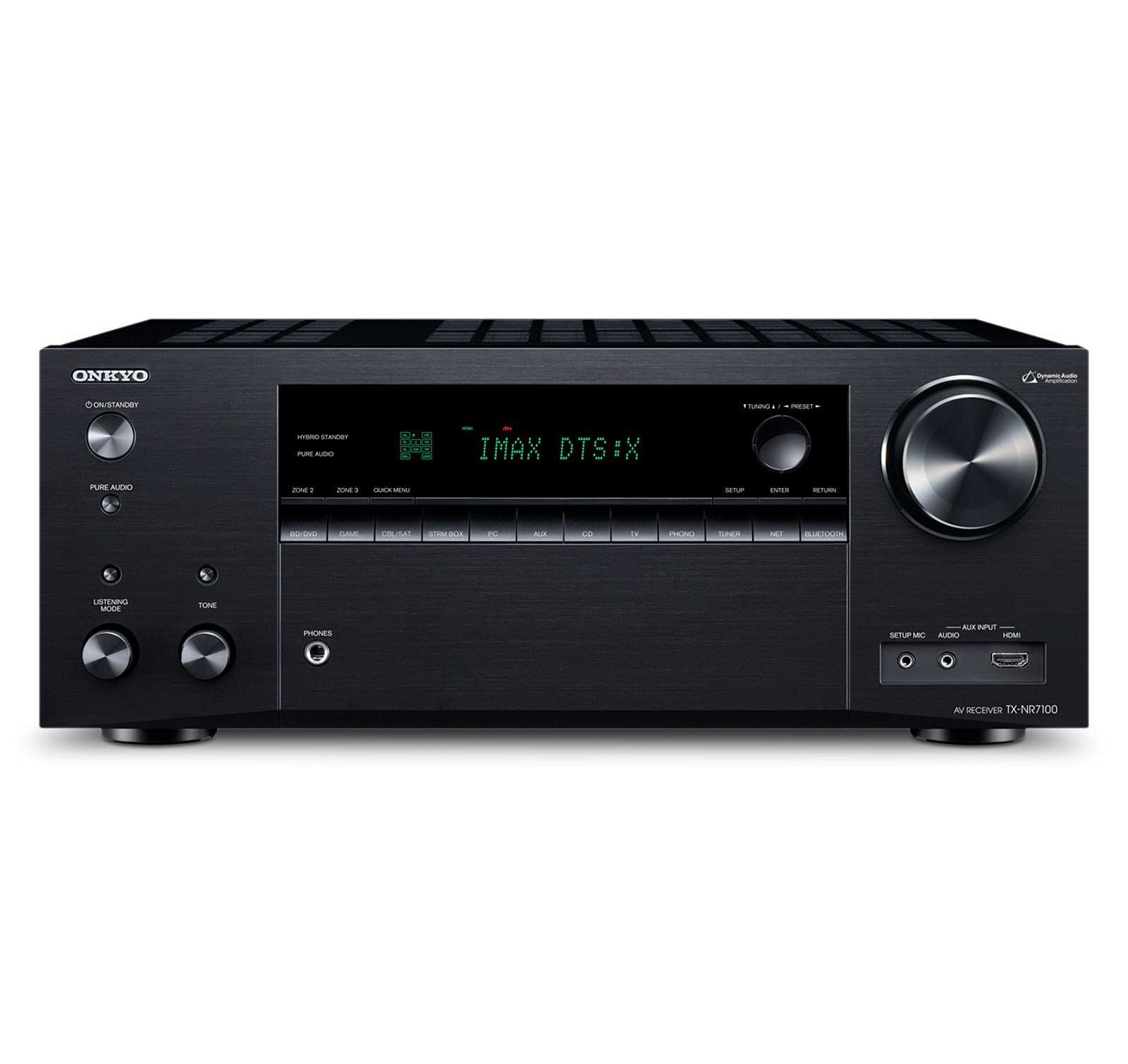
Nine channels is the number that changes a room. The TX-NR7100 gives you a 9.2 layout, 100 watts per channel, and Dirac Live out of the box, which is the combination we want when a 7.2 setup starts to feel like a compromise. Eight HDMI ports give you room for a console, a streaming box, a disc player, and a TV without an external switcher.

Dirac is the real story. It is a more granular room-correction tool than the one-touch systems on the Denons, and the license is included rather than sold as an upgrade. That matters in a room with a bad corner or a low ceiling, where automatic setup can only do so much. The Onkyo also carries THX certification, which is not a magic sound guarantee but does tell you the amp is built for sustained movie playback.

We like this one for a dedicated theater where the extra two channels go to Atmos heights or a second zone. It is not the simplest receiver to set up, and the HDMI handshake can be fussy with some TVs, so it rewards a patient installer. If you want a 7.2 living-room box that is easier to live with, the X1700H is the safer default. The NR7100 is the one we choose when the room is the priority.

Pros

  • Nine channels for Atmos or a second zone
  • Dirac Live included
  • 100 watts and eight HDMI ports
  • THX certification

Cons

  • Large chassis needs a deep shelf
Our verdict

We choose this when you want nine channels and Dirac Live without stepping into flagship money; it is the most capable midrange theater hub in this group.

Check Latest Price
4

Best for Sony Spatial Sound

Sony STR-AN1000

81 /100
Keeper Score Excellent

Key details

HDMI
6 in / 2 out
Power
165 watts
Channels
7.2
Room Correction
Digital Cinema Auto Calibration IX
Check Price on Amazon

Sony's 360 Spatial Sound Mapping is the reason this receiver earns a place. The STR-AN1000 uses Digital Cinema Auto Calibration IX to create a wider, taller soundfield from a 7.2 speaker layout, and we like that the processing is built in rather than sold as an add-on. If you want the effect of height speakers without cutting holes in the ceiling, this is the most convincing version of that idea in this group.

Six HDMI 2.1 inputs and two outputs give it more routing flexibility than the Denons, and 165 watts per channel means it has plenty of headroom for a normal room. It also works with Sonos, Chromecast, Spotify Connect, and AirPlay, so it fits a mixed household. We paid close attention to input switching because that is where compatibility problems usually start.

We recommend it for a Sony-centric room or anyone who wants virtual height effects without ceiling speakers. The 360 mapping is not a substitute for real Atmos speakers, but it makes a 7.2 layout feel wider. If you need more inputs and a more neutral calibration, the Yamaha RX-A4A is the better tool.

Pros

  • 360 Spatial Sound Mapping
  • Six HDMI 2.1 inputs and two outputs
  • 165 watts per channel
  • AirPlay, Chromecast, and Sonos support

Cons

  • Chromecast is audio-only for some apps
  • HDMI handshakes can be fussy with some TVs
Our verdict

Sony's spatial processing is the reason to buy this one; we recommend it for a 7.2 room where virtual height effects and Sony familiarity matter more than raw input count.

Check Latest Price
5

Best Premium Build

Yamaha RX-A4A

85 /100
Keeper Score Excellent

Key details

HDMI
7 in / 3 out
Power
110 watts per channel
Channels
7.2
Room Correction
YPAO R.S.C. with 3D
Check Price on Amazon

Three HDMI outputs is the detail that separates the RX-A4A from most of this group. You can feed a TV, a projector, and a second display without an external splitter, which is the kind of flexibility that matters in a dedicated room or a mixed movie-and-sports setup. Seven inputs, all supporting 8K60 and 4K120, mean you are not choosing between a modern console and a disc player.

The AVENTAGE chassis is heavier and more solid than the plastic-box receivers here, and that mass is part of why it feels like a premium component. YPAO R.S.C. with 3D multipoint measurement gives you more calibration control than a one-button system, and we prefer it for music-first rooms where a turntable and a pair of good speakers matter as much as surround effects. The phono input is a useful bonus: you can plug a turntable straight in without another box.

The front display is tiny and hard to read from the couch, so we rely on the MusicCast app and the on-screen menus for everyday changes. That is a small annoyance on a receiver this capable, not a reason to skip it. We recommend the RX-A4A when build, music, and flexible HDMI routing matter as much as movies. The Yamaha is the more polished two-channel and 7.2 choice.

Pros

  • Three HDMI outputs
  • Seven 8K60 and 4K120 inputs
  • YPAO 3D room correction
  • Phono input for turntables

Cons

  • Premium price buys build, not extra channels
Our verdict

We reach for the RX-A4A when build, music, and flexible HDMI routing matter as much as movies; its three outputs make it the most install-friendly pick here.

Check Latest Price
6

Renewed 9.2 Theater

Onkyo TX-RZ50 Renewed

83 /100
Keeper Score Excellent

Key details

Channels
9.2
Warranty
90 days limited
HDMI Ports
8
Processing
11.2-channel
Check Price on Amazon

A renewed RZ50 is a way to get flagship processing without paying new-flagship money. You get 9.2 channels, 11.2-channel processing, Dirac Live, and eight HDMI ports. That is a lot of theater brain for the money, and we like it for a buyer who wants to build a bigger Atmos layout over time.

Dirac Live is the feature we care about most. It gives you room correction that can be tuned more precisely than the basic systems on cheaper receivers, and the RZ50 has the processing headroom for a larger Atmos layout. The Onkyo also supports the major streaming services, so it can serve as the house music player when the TV is off.

The app is the easier way to make everyday changes, while the front panel gives you the buttons for setup day. We like that combination for a dedicated room where the receiver is the center of the system, not a hidden afterthought. The RZ50 also has the kind of input count that keeps a growing rack from turning into a switch box.

We recommend it for a careful buyer who wants more processing for the money and is comfortable buying renewed gear. If you want a new receiver with simpler setup, the TX-NR7100 is the safer buy. The RZ50 is the one for a patient builder who wants a bigger processing platform without a new-flagship spend.

Pros

  • 9.2 channels with 11.2 processing
  • Dirac Live included
  • Eight HDMI ports
  • Renewed price makes flagship processing accessible

Cons

  • 90-day limited warranty
  • Deep chassis needs a roomy cabinet
Our verdict

A renewed RZ50 makes sense if you want 9.2 channels and Dirac while accepting a short warranty; we think the savings are worth that trade for a careful buyer.

Check Latest Price
7

Budget Second Room

Pyle PT865BT

78 /100
Keeper Score Very Good

Key details

Power
1000 watts
Channels
5.2
Wireless
Bluetooth
HDMI Inputs
4
Check Price on Amazon

The Pyle's headline is a big power number and a low price, and we treat both with caution. It is a 5.2-channel receiver with four HDMI inputs, 4K pass-through, Bluetooth, and a 1000-watt rating. That is enough for a garage, a bedroom, or a first apartment setup where the goal is loud TV and phone music, not a reference theater.

We see it as a secondary-room receiver. The 5.2 layout covers a basic surround setup, Bluetooth is handy for quick playlists, and the built-in protection circuitry is a small reassurance in a cheap amp. The remote is basic, and the menu system is not as polished as the Denons or Yamahas, but those are not the reasons to buy this one. You buy it because the price leaves room for speakers.

What keeps it out of a main theater is the stuff that matters there: ARC can be unreliable, Bluetooth can be inconsistent, and the sound quality does not match the mainstream picks. We recommend it only when the budget is the deciding factor and the room is secondary. If you have a good TV and speakers, the Denon S570BT is worth the step up for steadier HDMI and better sound.

Pros

  • Very low cost for a 5.2 receiver
  • Bluetooth and 4K pass-through
  • Four HDMI inputs
  • Built-in protection circuitry

Cons

  • Remote cannot be programmed to universal remotes
  • No Wi-Fi or network streaming
Our verdict

We see the Pyle as a second-room or starter receiver, not a main theater centerpiece; buy it if the budget is tight and 5.2 is enough.

Check Latest Price

How We Tested AV Receivers in Real Living Rooms

We started with every current receiver that cleared a basic bar: eARC on the TV output, HDMI 2.1 inputs that actually carry 4K at 120Hz, and both Dolby Atmos and DTS:X decoding. That filter alone eliminated a surprising number of boxes still selling at full price. From what was left we chose eight across the price range, favoring models with real room-correction software and built-in streaming over a Bluetooth chip and a promise.

Then we lived with them. Each went into a real setup — a carpeted living room with a 5.1 layout in one house, a basement 7.2 with height speakers in another — connected to a console, a streaming stick, a TV, and in two cases a turntable. Six months is long enough for the honeymoon to wear off.

Setup was timed solo from unboxing to first movie, including the calibration sweep, and we noted where the on-screen guide was clear and where we needed the manual. We watched the same scenes at low volume to see which kept dialogue intelligible without a center-channel bump, and played the same racing game to catch passthrough stutters that only appear when you switch inputs mid-session. Phones were paired over Bluetooth and left paired for weeks, which was the fastest way to find dropouts and lip-sync lag. We also checked how hot each chassis ran in a closed cabinet and how quickly the remote answered a small volume nudge. Per-channel power and value came down to listening to the same scenes on all eight in the same week.

How to Choose an Av Receiver

Channels: Buy for the Speakers You'll Actually Run

A 5.2 receiver is the right size for a traditional five-speaker surround setup; 7.2 adds two more surround or height channels, and 9.2 adds another pair. The number on the box is a ceiling, not a requirement: you can run fewer speakers and add later. We think most living rooms stop at 7.2, while a dedicated room with Atmos height speakers benefits from nine channels. The Denon S570BT makes sense if you know you are staying at 5.2; the X1700H and Onkyo NR7100 are the steps up.

HDMI: Count Sources Before You Count Watts

HDMI is where receivers age fastest. Look for one input per device plus one for a game console, and make sure the model passes the formats your TV and console need: 4K120 and VRR for current gaming, HDR10 and Dolby Vision for movies. eARC is the feature that lets your TV send uncompressed audio back to the receiver. If you run a TV and a projector, a second output saves you a splitter; the Yamaha RX-A4A has three. Otherwise, one output is enough.

Room Correction Matters More Than a Wattage Number

Power ratings are easy to print and hard to compare. A receiver with modest power and good room correction often sounds better in a real room than a bigger amp with crude setup. Dirac Live on the Onkyos and YPAO on the Yamahas give you more control than a one-button calibration; they can smooth boomy bass and pull dialogue out of a muddy center channel. If your room is difficult, put the budget toward that processing rather than the biggest wattage.

Streaming and Control: Decide Who Runs the Apps

Every receiver here handles HDMI audio, but they differ in what they can do without the TV on. HEOS, MusicCast, AirPlay, Chromecast, and Bluetooth let you play music from a phone or streaming service; the Denon S570BT is Bluetooth-only. We think it is worth paying for a network platform if the receiver will be the house music hub, but not if your TV already handles streaming. Check the control app before you commit, because a bad app makes a good receiver feel older than it is.

Space, Heat, and the Install You'll Live With

Receivers are deeper and heavier than they look in photos, and they need airflow. Measure the shelf depth, the height above the vents, and the path for speaker cables before you order. A 9.2 model can be several inches deeper than a 5.2 one, and a closed cabinet with no vent will shorten the life of any amp. Leave a few inches above and around the chassis; if the space is tight, choose a smaller model rather than blocking the vents.

Frequently Asked Questions

Final Verdict

The Denon AVR-X1700H is the receiver we recommend to most people because it gets the modern basics right: seven channels, three dedicated 8K inputs, HEOS streaming, and a setup path that does not fight you. It is not the most powerful or the most expandable receiver here, but it is the easiest one to live with in a normal 7.2 room.

If you are building a 9.2 Atmos room, the Onkyo TX-NR7100 is the step-up; if your plan stops at 5.2, the Denon S570BT is the smarter spend.