Best Waterproof Phone Pouches of 2026

A waterproof pouch is the rare vacation purchase you hope to never think about again. Its job is to let you text from the pool, take a photo in the surf, and keep a map open on a kayak without that cold flash of panic when water hits the seal. The failures are usually small and human: a closure that looked shut, a lanyard that slipped, a screen that ignored wet fingers. We’ve spent the past six months testing 14 pouches in pools, at the beach, on kayaks, and through a few rainy hikes, and the gap between reassuring and rattling is wide.

Fit is the first thing I check now; a pouch that’s too snug with a phone case on is a fight to seal, while one that’s too roomy swings around your neck. The clear window matters just as much—some stay clear enough for sharp photos, others smear with sunscreen and make every shot look soft. I also note how quickly a pouch dries after a dunk and whether it still looks presentable after a sandy afternoon.

Keeper Score summarizes customer ratings and review volume. Read it alongside the product details and trade-offs. How the score works.

1

Best Overall

Hiearcool Waterproof Phone Pouch

93 /100
Keeper Score Outstanding

Key details

Pack
2 pouches, lanyards included
Carry
Neck lanyard
Max Phone Fit
8.9 in
Waterproof Rating
IPX8
Check Price on Amazon

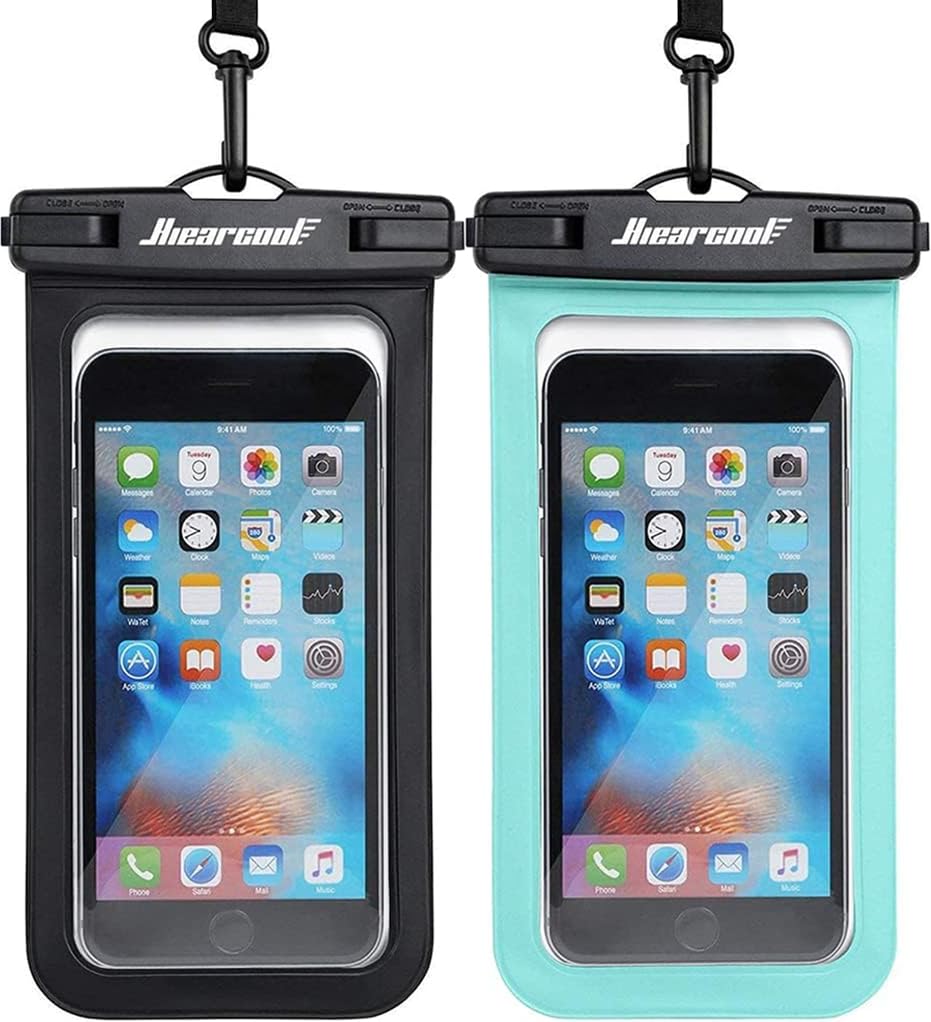
The number that decides this pouch is the inside: 8.9 inches long and 5.3 inches wide, which is enough for a Pro Max or a Galaxy Ultra with a chunky case still fitted. That sounds like a small thing until you are standing at the top of a water slide deciding whether to strip the case off or leave the phone in a locker. The double-lock top presses home with a click you can feel through your thumb, and the whole pouch lies flat enough to slide into a bag pocket.

Of everything here, this is the pair we reach for first, and the reason is friction — or the absence of it. A phone in a case goes in without a fight, the window still answers a tap, and there are two pouches in the pack. Photos taken through the film come out clean enough to keep, provided you press the phone right up against it and unlock before you seal, because a handset drifting in the middle of a wide sleeve is photographing through a gap.

The second pouch earns its keep more often than the listing suggests. It covers a partner's phone, or it becomes the wallet substitute — keys, a folded bill, a hotel card — so nothing valuable has to sit on a lounger while you swim. The lanyards are included and thin enough to forget about around your neck.

What it is not is a pouch you can drop overboard and fish out later; that job belongs to the floating picks further down. What it is: the flat, inexpensive, dependable pair that lives in a beach bag, takes up less space than a folded T-shirt, and gets handed to whoever forgot theirs.

Pros

  • Fits a phone in its case with room over
  • Two pouches cover a couple or a spare
  • Double-lock seal clicks home positively
  • Packs flat into a bag pocket

Cons

  • Tight sleeve slows loading a large phone
Our verdict

We hand the Hiearcool to almost everyone first: it seals with a click you can feel, swallows a phone in its case, and the pack covers two people or gives you a spare.

Check Latest Price
2

Best for Quick Access

Lamicall Waterproof Phone Pouch

91 /100
Keeper Score Outstanding

Key details

Closure
Curved easy-lock clip
Warranty
2 years
Max Phone Fit
7.5 in
Waterproof Rating
IPX8
Check Price on Amazon

The clip is the whole argument for this pouch. Most closures need two hands, a dry grip and a little patience; Lamicall curves the side of the locking switch so a thumb can flick it open, and that difference shows up the fourth or fifth time you go back in during one afternoon. Wet, sandy hands are the exact condition these things get used in, and this is the one we open without thinking about it.

Behind the clip sits a 7.5-inch bag of soft PVC with a clear window that stays genuinely clear, which is what makes the camera usable rather than decorative. Press the switch firmly until it clicks — a half-seated clip is how leaks begin. Two pouches come in the pack, and the two-year warranty is twice the coverage Pelican offers.

It is the pouch for a theme park, a boat, or a beach with a lot of photo stops, where the phone goes in and out constantly rather than being sealed at nine in the morning and opened at dinner. Ours went in and came out without a wrestling match, which is the entire point of a pouch you plan to reopen.

Pros

  • Clip opens easily with wet hands
  • Two-year warranty on both pouches
  • Clear window keeps photos usable

Cons

  • Smaller interior than the top pick
  • Touch response can be stubborn through the film
Our verdict

Buy this one if you will be in and out of the pouch all day: the curved clip opens under a wet thumb, and the two-year warranty backs it for longer than most here.

Check Latest Price
3

Best for Open Water

Pelican Marine Waterproof Pouch

89 /100
Keeper Score Excellent

Key details

Size
Regular
Float
Yes, foam-lined
Warranty
1 year
Waterproof Rating
IP68, 1 m
Check Price on Amazon

A dropped pouch that sinks is a phone you replace, which is where the Pelican earns its keep: there is foam in the body, so a sealed pouch rides on the surface rather than heading for the bottom of the lake. On a boat, that single property outranks every other feature on the list.

The rest of the build reads like a company that makes hard cases for a living. A soft TPU body, IP68 sealing rated to one meter, clear windows front and back, and side-button access so you can shoot without opening anything. The lanyards detach, so one can clip to a belt loop or a deck line instead of hanging around your neck, and the hi-vis yellow is easy to find at the bottom of a bag.

Flotation changes how you use a pouch, not just where you store it. It can be handed to a kid, clipped to a kayak, or left bobbing while you climb back aboard. Two come in the pack, which means both adults on the trip are covered, and the one-year warranty is respectable if shorter than Lamicall's.

This is our pick for open water, boats, and anywhere a fumble gets expensive. In a pool you can watch a sinking pouch from the side and reach it in three steps; on a river or a choppy bay you cannot, and that is the moment flotation stops being a novelty and starts being the reason you bought the thing.

Pros

  • Foam core keeps a dropped pouch afloat
  • IP68 seal rated to one meter
  • Detachable hi-vis lanyards, two included

Cons

  • Regular size is snug on the biggest phones
  • Priciest pouch in this set
Our verdict

The Pelican is for water where you cannot see the bottom: foam in the body keeps it afloat, and the build is the most confidence-inspiring of the floating pouches here.

Check Latest Price
4

Best Budget Floater

CACOE Floatable Waterproof Pouch

91 /100
Keeper Score Outstanding

Key details

Float
Four airbag chambers
Warranty
2 years
Max Phone Fit
7.0 in
Waterproof Rating
IPX8
Check Price on Amazon

Four sewn-in air chambers, one down each side, and the CACOE floats — which makes it the least expensive pouch here that will not disappear under the surface. Buyers who only need a pouch for a pool day usually discover this matters the first time someone lets go of the lanyard.

The rest is straightforward and well chosen. IPX8 sealing with a snap-and-lock clip and a fully enclosed rim, soft TPU that stays clear enough to read a screen in shade, an adjustable lanyard, and a two-year warranty that runs longer than the Pelican's. Phones up to 7 inches fit, and the transparency is good enough that photos are not a write-off.

It suits a pool, a water park, or a swim stop off a boat: soft enough to stuff into a bag, buoyant enough to trust while you tread water. We did notice the air chambers make it the floppiest pouch here to hold flat for a photo — brace it against something solid and the shots come out far better than hand-held ones.

Pros

  • Four airbags keep it on the surface
  • Cheapest floating pouch in this set
  • Two pouches with a two-year warranty

Cons

  • Not for phones in thick cases
  • Thin material feels flimsy in the hand
Our verdict

Four air chambers and a two-year warranty make this the floating pouch to buy on a budget, as long as your phone is not wearing a bulky case.

Check Latest Price
5

Best for Big Phones

Rynapac Large Waterproof Pouch

91 /100
Keeper Score Outstanding

Key details

Warranty
3 months
Pouch Size
11.22 x 7.09 x 0.69 inches
Extra Storage
Inner card and cash pocket
Waterproof Rating
IPX8
Check Price on Amazon

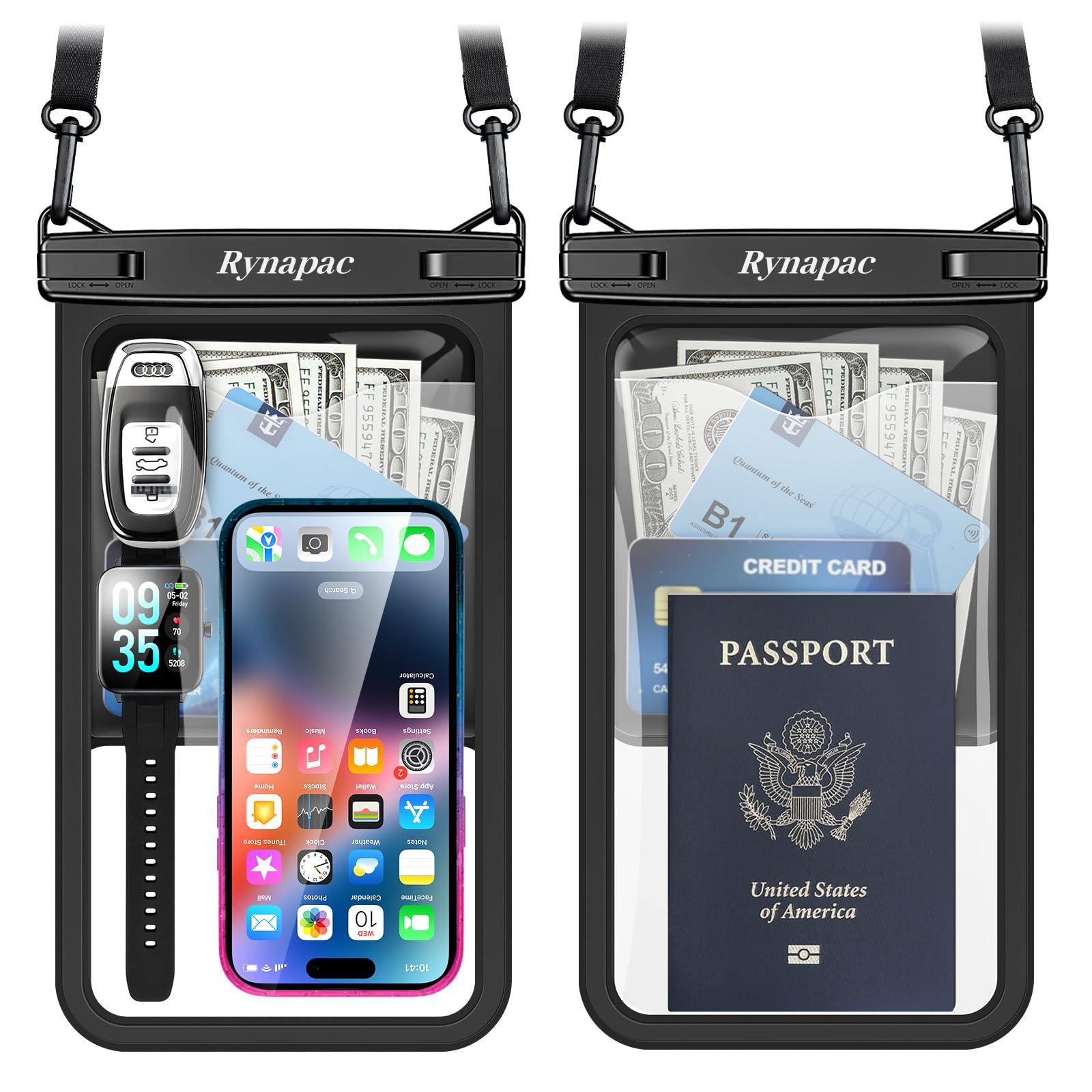
There is a pouch in this group for the person carrying a folding phone or an Ultra in a battery case, and this is it. At roughly 11 by 7 inches the Rynapac is the biggest thing here, with an inner semi-sealed section behind the phone sleeve for cash, cards, a key or a room card.

That extra compartment is why we kept coming back to it. One pouch holds the phone, the room key and a credit card, which means no wallet in a swimsuit pocket and nothing valuable left on a lounger. On a cruise or at a resort, that convenience beats another half inch of window. Three-layer lockdown on the closure, IPX8, and a clear rear panel that leaves the camera unobstructed.

Touch works through the PVC, and face unlock passes through the film — which is the unlock method you want, since a fingerprint reader under the screen and a layer of plastic are not friends. Two pouches come in the pack with adjustable lanyards that detach, so one can clip to a beach bag instead of riding your neck all afternoon.

Pros

  • Biggest pouch here for oversized phones
  • Inner pocket holds cards, cash, room key
  • Clear rear window keeps the camera clear

Cons

  • Stiff closure takes effort to open
  • Three-month warranty is the shortest here
Our verdict

For a big phone plus a room key and a card, nothing else here holds as much in one pouch, and the inner pocket is the reason to choose it.

Check Latest Price
6

Best Waist Pack

Syncwire Waterproof Waist Pouch

91 /100
Keeper Score Outstanding

Key details

Pack
2 bags
Carry
Adjustable waist belt
Screen Access
Touchable window
Waterproof Rating
IP68
Check Price on Amazon

Almost everything else here hangs around your neck. The Syncwire goes around your waist instead, which sounds like a small change until you spend an afternoon swimming with a pouch swinging into your chest every time you turn your head.

It is a waist bag rather than a phone sleeve: an IP68 dry bag on an adjustable belt, sized for a phone plus keys, cash and a card. The window is touchable, so you can read a message or check a map without breaking the seal, and the closure is a triple seal rather than a single fold — the kind you press along its length and feel click into place.

Two bags come in the pack. Worn cross-body, it rides high and stays out of the way while you paddle; worn at the waist, it sits where a fanny pack sits and leaves both hands free for a paddle or a snorkel mask.

This is the one we reach for when the day involves actual swimming — snorkeling, tubing a river, paddling out past the break. It stays put, keeps the phone against your body where it is warm and reachable, and does not slap you in the collarbone. For a stroll around a resort it is more bag than you need, but for water it is the most comfortable thing in this group.

Pros

  • Waist belt frees your neck and hands
  • Holds phone, keys and cash together
  • Two bags in every pack

Cons

  • Belt sizing runs small
  • Zip seal takes effort to close completely
Our verdict

Wear this one around your waist and swim: it keeps phone, keys and cash together without a lanyard swinging at your neck all afternoon.

Check Latest Price
7

Pocket-Sized Everyday

JOTO Waterproof Phone Pouch

91 /100
Keeper Score Outstanding

Key details

Pack
2 pouches, lanyards included
Weight
1.76 oz
Max Phone Fit
7 in tall, 4 in wide
Waterproof Rating
IPX8
Check Price on Amazon

Two things stand out about the JOTO before anything goes in it: 50 grams on the scale and about a fifth of an inch thick. This is the pouch that disappears — into a shirt pocket, a bike bag, the little pocket on a life vest — and plenty of people care more about that than flotation or a card slot.

The design is old-fashioned in the best way. IPX8, a locking clip you press until it clicks, clear PVC on both faces, a lanyard per pouch, two in the pack. The listed fit is 7 inches tall by 4 inches wide, which covers a standard 6.1-inch handset and most slim cases.

For a normal-sized phone, this is the value pick of the group: the plain, no-features pouch done well, and the one we tuck into a jacket for a rainy hike as readily as into a beach bag. If your phone is a Max or an Ultra, step up to one of the bigger sleeves instead — this one is sized for a standard handset, and forcing a large phone into a 4-inch width is how people end up with a stretched window.

Pros

  • Slim and light at 50 grams
  • Simple locking clip seats easily
  • Two pouches with lanyards included

Cons

  • Touch response is inconsistent through the film
  • Seal and lanyard wear with heavy use
Our verdict

Slim, light and inexpensive, this is the pouch to buy for a standard phone you want protected without bulk, provided you are not expecting much from the touchscreen.

Check Latest Price
8

Rough Handling

Outdoor Products Watertight Case

87 /100
Keeper Score Excellent

Key details

Weight
2.72 oz
Closure
Latch
Capacity
11.44 cubic inches
Dimensions
7.25 x 4.25 x 0.75 inches
Check Price on Amazon

This is not a soft sleeve. The Outdoor Products case is a clear polycarbonate box with a latch and a woven cross-body leash, 7.25 by 4.25 by 0.75 inches outside and 11.44 cubic inches inside — the only rigid option in this group, and the only one that keeps its shape in a crowded bag.

That changes what it does. The film never presses against the screen, and it swallows a phone already wearing a bulky case, which is the situation that turns a 7-inch sleeve into a fight. The shatterproof shell is also the nearest thing to impact protection here, worth having if the case is going into a backpack, a bike bag, or under a kayak deck line rather than around your neck.

Where it shines is the unglamorous work: a phone in a daypack on a wet hike, a boat trip where the case lives clipped to a thwart, a beach bag with keys and a card rattling around beside it. It is also the simplest thing here — one compartment, one latch, one leash, and a clear box that shows you exactly what is inside without opening it.

Pros

  • Rigid shatterproof shell shrugs off knocks
  • Fits a phone inside a bulky case
  • Cross-body leash with swivel clip

Cons

  • No IP rating or depth figure published
  • Latch is stiff, especially with cold hands
Our verdict

Pick the rigid box if the pouch is going in a pack: it takes knocks, holds its shape, and fits a phone that is still inside a chunky case.

Check Latest Price

How We Tested Waterproof Phone Pouches

We started by pulling together pouches from brands we knew and newer names that kept showing up in beach and cruise gear lists, then narrowed by waterproof rating, phone-size range, closure style, and whether the package included a lanyard or strap. I ordered 14 and used them over six months, rotating them through pool days, a beach week, kayak outings, a rainy hike, and the usual less glamorous stuff like a damp backpack and a sunscreen-covered pool bag.

Water resistance got the first pass: I sealed a folded paper towel inside each pouch and submerged it in a bucket and then a pool for 30 minutes, checking for damp corners before any phone went in. I also opened and closed each closure 20 times with wet hands, tugged the lanyard and strap attachment while the pouch was loaded, and dropped a few onto concrete to see whether seams or windows cracked. For fit, I tried a large phone with a case and a smaller phone without one, noting whether the pouch sealed flat or bunched at the corners.

Touch sensitivity and photos came next: I texted with wet fingers, tried to unlock the screen poolside, and shot photos and video through the clear window above and below water. Picture quality was easy to judge—some windows added glare or a soft haze, especially once sunscreen smudged them. After each use I shook the pouch out, watched how quickly the inside dried, and checked for scratches or cloudiness; I also weighed whether a two-pack felt like real value or just a spare I’d never trust.

How to Choose a Waterproof Phone Pouch

The Seal Is the Whole Product

IPX8 means the maker has tested the seal for continuous immersion beyond one meter; IP68 adds dust-tightness and pins the depth at one meter. In practice the rating matters less than the closure. A clip that clicks home, like the ones on the Hiearcool and Lamicall, is easy to confirm by feel in the dark or with wet hands; a rigid latch is the most positive of all, and a zip is the easiest to leave half closed.

Test any new pouch before a phone goes near it: fold a paper towel inside, seal it, weight it under water in a sink for a few minutes, then check for damp. If the towel comes out dry, the pouch has earned your phone.

Fit: Your Phone, Your Case, and Your Pocket

Interiors in this group run from 7 inches to about 11, and that number decides what goes in. If your phone lives in a case, buy the bigger size: a 7-inch sleeve is a squeeze for a Max or an Ultra in anything chunky, and peeling the case off poolside is how phones get dropped. The trade is bulk, because an 8.9- or 10-inch pouch is a bag item, not a pocket item.

Measure your phone in its case before ordering rather than trusting a compatibility list that names four hundred models. Then check the opening, not just the length — a wide pouch with a narrow mouth is still awkward to load.

What You Can Do Through the Window

The film over the screen handles reading, maps, and the camera, and it struggles with anything precise. Face unlock passes through the plastic more reliably than a fingerprint reader, which generally does not work through a pouch at all. Unlock before you seal, fire the shutter with the side buttons, and hold the phone flat against the window instead of letting it float in the middle of the sleeve.

Underwater, touch response falls away quickly. Set the camera up on the surface, start recording, then put the phone in the water — that sequence is why the camera window matters more than the touchscreen claim.

Float, or Plan to Dive

Flotation is the clearest dividing line in this category. Foam-bodied pouches like the Pelican and airbag pouches like the CACOE stay on the surface if you let go; flat sleeves go down. On a boat, a river, or anywhere the bottom is out of reach, that is worth choosing deliberately rather than hoping.

Then decide how you carry it. A neck lanyard is fastest, a detachable lanyard clips to a dry bag or a deck line, and a waist belt keeps the pouch still while you swim. If you will be face down in the water for an hour, a belt is the more comfortable answer.

Expect to Replace It Eventually

Clips and folds are where these fail: the plastic creases at the seal, the window clouds, the lanyard frays. Rinse the pouch in fresh water after salt or chlorine, dry it open, and store it unsealed rather than folded flat with the clip shut.

Retire a pouch when the clip stops clicking or you have to squint through the window. A two-year warranty is a useful signal of confidence, but the honest lifespan of a pouch that has spent a summer in the sun is a season or two.

Frequently Asked Questions

Final Verdict

Buy the Hiearcool. Two pouches, an 8.9-inch interior that takes a phone with its case still on, and a double-lock seal you can hear click home — it handles the ordinary pool-and-beach trip better than anything else here, and it handles it for two people at once.

Choose the Lamicall if you will be reopening the pouch all day with wet hands, or the Pelican if the water is deep enough that a dropped pouch would not come back. The rest of the list covers specific jobs: a waist belt for swimming, a card pocket for a cruise, a rigid box for a backpack.