Best Power Inverters of 2026

A power inverter seems like a solved problem: plug it into the 12-volt socket, plug your laptop in, done. Then you're two hours into a road trip with a laptop at 3 percent, the fan is screaming, and the unit has cut out because the load was bigger than the label promised.

My team has spent seven months with 12 of them, from palm-sized 150-watt plug-ins to a 2,000-watt box that lives in the garage for storm season. They've charged laptops, run a fan through a two-day outage, and topped off tires off an air compressor. Two things I didn't expect to care about: whether the USB ports actually fast-charge, and whether the plug stays seated over a pothole.

Worth knowing before you shop: pure sine wave models cost more and earn it mainly when you're powering something with a motor or a sensitive board, like a CPAP; for chargers and lamps, the cheaper modified sine wave units do the job. The picks below span both, and most of them are compact enough to leave plugged in.

Keeper Score summarizes customer ratings and review volume. Read it alongside the product details and trade-offs. How the score works.

1

Best Overall

BESTEK 300W Power Inverter

91 /100
Keeper Score Outstanding

Key details

Output
300W continuous, 700W peak
AC Outlets
2
Input Range
11–17V DC
USB Charging
Dual 4.8A
Check Price on Amazon

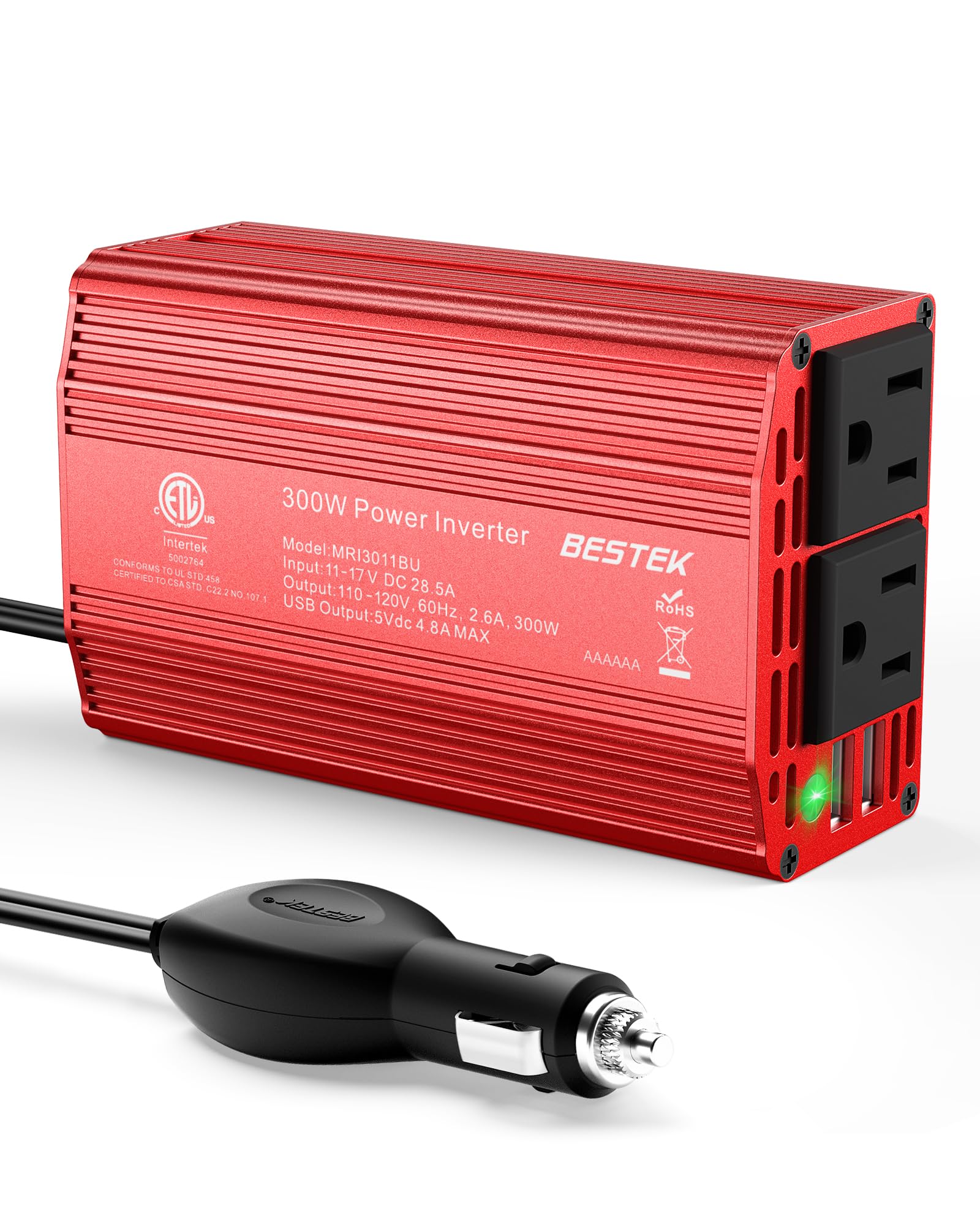
Four and a half inches long and under two inches tall, the BESTEK 300W takes less console space than a paperback and still fits two AC outlets, two USB ports and a 40-amp fuse inside the case. The aluminum shell is what we noticed first — it feels like a small brick rather than the thin plastic you might expect, and it takes being rattled around a door pocket without complaint.

The specification that earns it the top spot is the input range. It runs on 11 to 17 volts, so it works in an ordinary 12-volt socket and in the higher-voltage accessory circuits newer vehicles use, and the 32-inch cord stretches from a front console socket to the back seat. At 300 watts continuous and 700 peak it covers the realistic car load: a laptop, two phones, a camera battery charger and a small fan, all at once. The dual 4.8-amp USB pair is quicker than the ports most cars come with.

Longevity is the honest caveat. Compact inverters that fail tend to fail in their first weeks rather than their second year, so put this one straight to work on a real load, keep the 18-month warranty in mind, and don't judge it on a single gentle phone charge. If your load is a CPAP machine or anything with a motor in it, skip to the pure-sine pick below.

Where it earns its keep is the unglamorous middle ground: a laptop topped up between meetings, a drone battery that has to be ready for a second flight, a phone dying halfway through a road trip. None of that needs a plan, which is rather the point of keeping one in the car.

Pros

  • 300W continuous with 700W of surge headroom
  • Runs on 11–17V, including newer accessory circuits
  • Two AC outlets plus a fast 4.8A USB pair
  • Aluminum case small enough for a door pocket

Cons

  • Modified sine wave, so motors and audio hum
  • Fan becomes audible under sustained load
Our verdict

For most cars and most loads this is the one to buy: 300 watts, four outlets and a metal body that disappears into the console.

Check Latest Price
2

Best for Sensitive Electronics

BESTEK 300W Pure Sine Wave

91 /100
Keeper Score Outstanding

Key details

Output
300W continuous, 700W peak
Weight
1.4 lb
Waveform
Pure sine wave
AC Outlets
2
Check Price on Amazon

Waveform is the line on the spec sheet nobody reads until something misbehaves. A modified sine inverter approximates the wall outlet's smooth curve with a stepped one; a pure sine unit reproduces it. Laptop bricks, phone chargers and LED lights genuinely don't care. A CPAP with its humidifier running, a piece of audio equipment, a variable-speed tool or a fridge compressor does — and those are the loads this BESTEK exists for. Same 300 watts continuous and 700 peak as our top pick, so what you pay for here is the shape of the wave, not more power.

What you give up is pocketability. At 8.1 by 5.3 by 2.6 inches and about a pound and a half, it's a bench box rather than something that vanishes into a cupholder, and it takes real space in a console. In exchange you get a vented aluminum case, a 40-amp fuse, and ETL listing alongside FCC and RoHS — the reassurance we want on something that rides on a seat beside us. It's also the least expensive pure-sine unit in this group by a wide margin, which is why it's here at all.

Reach is the practical limit. A 12-volt accessory socket is fused well below what this inverter can pass, so treat 300 watts as a ceiling you reach only with a battery connection and plan everyday loads around 150. The reward for the upgrade is mostly what doesn't happen: no hum through a speaker, no stutter from a device that objects to stepped power.

Pros

  • True sine wave for CPAP, audio and motor loads
  • Same 300W/700W envelope as our top pick
  • ETL, FCC and RoHS listed

Cons

  • Bigger and heavier than the modified-sine 300W
  • Fan works hard on sustained loads
Our verdict

Buy this if your load is a CPAP machine, audio gear or a motor: a true sine wave in a body that still fits a console, for a modest step up.

Check Latest Price
3

Best for Bigger Loads

Pro Chaser 400W Power Inverter

89 /100
Keeper Score Excellent

Key details

Output
400W continuous, 800W peak
Waveform
Modified sine wave
AC Outlets
2
Cord Length
30 in
Check Price on Amazon

Thirty inches of cord changes where an inverter can live. In a crew cab that's the difference between the front 12-volt socket and a child seat in the second row; in a hatchback it's the run from the console to a laptop on the passenger floor. The Pro Chaser gives you that reach and pairs it with 400 watts continuous and 800 peak, more headroom than any other plug-in unit in this guide.

For the loads people actually carry, that headroom is the whole argument. A 90-watt laptop brick, a tablet and two phones don't come close to 400 watts, but the tool charger or the inflator you plug in for two minutes pulls a surge well above its label, and the extra rated capacity is what keeps the unit from tripping. We also appreciated the fan logic: it cuts in at 113°F rather than running from the moment you switch on, so short charging sessions stay quiet.

Two things to weigh. The case gets warm during long, heavy runs, and the maker's own instructions ask for a cool, dry spot with the vents clear — worth honoring rather than stuffing it under a seat. And 400 watts is not a licence to run a kettle or a hair dryer; nothing on a 12-volt plug will, whatever the carton implies.

Pros

  • 400W continuous with 800W peak
  • 30-inch cord reaches the back seat
  • Fan cuts in only once the case warms

Cons

  • Case warms up on long, heavy runs
  • Modified sine wave, so motors run hotter
Our verdict

The pick when the laptop and the tool charger both need to run: 400 watts and a 30-inch cord that actually reaches the back seat.

Check Latest Price
4

Best for RV and Emergency Power

YSOLX 2000W Power Inverter

90 /100
Keeper Score Outstanding

Key details

Output
2,000W continuous, 4,000W peak
AC Outlets
3
Cable Length
16 in
Check Price on Amazon

Two thousand watts is a different machine. It's the only inverter in this group that can be asked to run a small appliance, and it's the one whose rating has least to do with the socket on your dash: 2,000 watts at 12 volts is somewhere around 165 amps, several times what any accessory circuit is fused for. That piece of arithmetic is the whole story with big inverters.

As a box it's straightforward: three AC outlets across a 10.2 by 5.5 inch case that weighs under four pounds, FCC, CE and RoHS listed, with a 16-inch cable. The short cable is a design statement as much as a limitation — this belongs next to the battery, not on your lap, and a short run keeps the losses down. Output is modified sine, so it's the right tool for a fridge, a fan, lights and power tools, and the wrong one for a CPAP.

Our advice: buy it for the camper, the jobsite or the outage, run proper cable to the battery, and treat the lighter plug as a convenience for small loads only. Used that way, three outlets and real wattage make it the one unit here that can carry a campsite — a fridge, a couple of fans, a laptop and a string of lights at once. Fed through a 15-amp socket, it will blow a fuse and look broken, and the difference matters before you buy rather than after.

Pros

  • 2,000W continuous with a 4,000W peak
  • Three AC outlets for multi-appliance loads
  • Only unit here built for household-scale loads

Cons

  • Full output needs battery wiring, not a plug
  • 16-inch cable limits where it sits
Our verdict

For an RV, a work truck or a blackout, this is the only unit here with household-scale output — provided you wire it to a battery and not a lighter socket.

Check Latest Price
5

Best Budget Pick

FOVAL 150W Car Power Inverter

91 /100
Keeper Score Outstanding

Key details

Output
150W continuous, 300W peak
Weight
8 oz
Waveform
Modified sine wave
Dimensions
3.2 × 2.5 × 1.5 in
Check Price on Amazon

Credit-card size is the claim and it's close: 3.2 by 2.5 by 1.5 inches and about eight ounces, which means it disappears into a glovebox, a door pocket or the gap beside the cupholder. The shell is aluminum rather than plastic and the fan is the quiet kind — the two things we check first on a unit this small. Behind it sits a two-year warranty, longer cover than anything else in this guide.

150 watts continuous and 300 peak is enough for a standard laptop, a tablet and two phones together, and the AC outlets are there for the brick rather than for appliances. It won't run a kettle, a hair dryer or a space heater, and that ceiling is a sensible one for something you'll leave plugged in permanently.

What decides it is how little it asks of you: no console space, no thought, no fuss, and a metal case that survives being forgotten about. For a second vehicle, a boat or a commuter car where the whole job is keeping a laptop and a phone alive, that's the right trade.

Pros

  • Credit-card footprint for a glovebox
  • Two-year warranty, the longest in this guide
  • Quiet fan and an aluminum shell

Cons

  • 150W ceiling rules out heaters and kettles
  • Both USB ports share 3.1A total
Our verdict

The glovebox answer: small enough to forget, modest enough in price to own two, and honest about its 150-watt ceiling.

Check Latest Price
6

Charging Several Devices

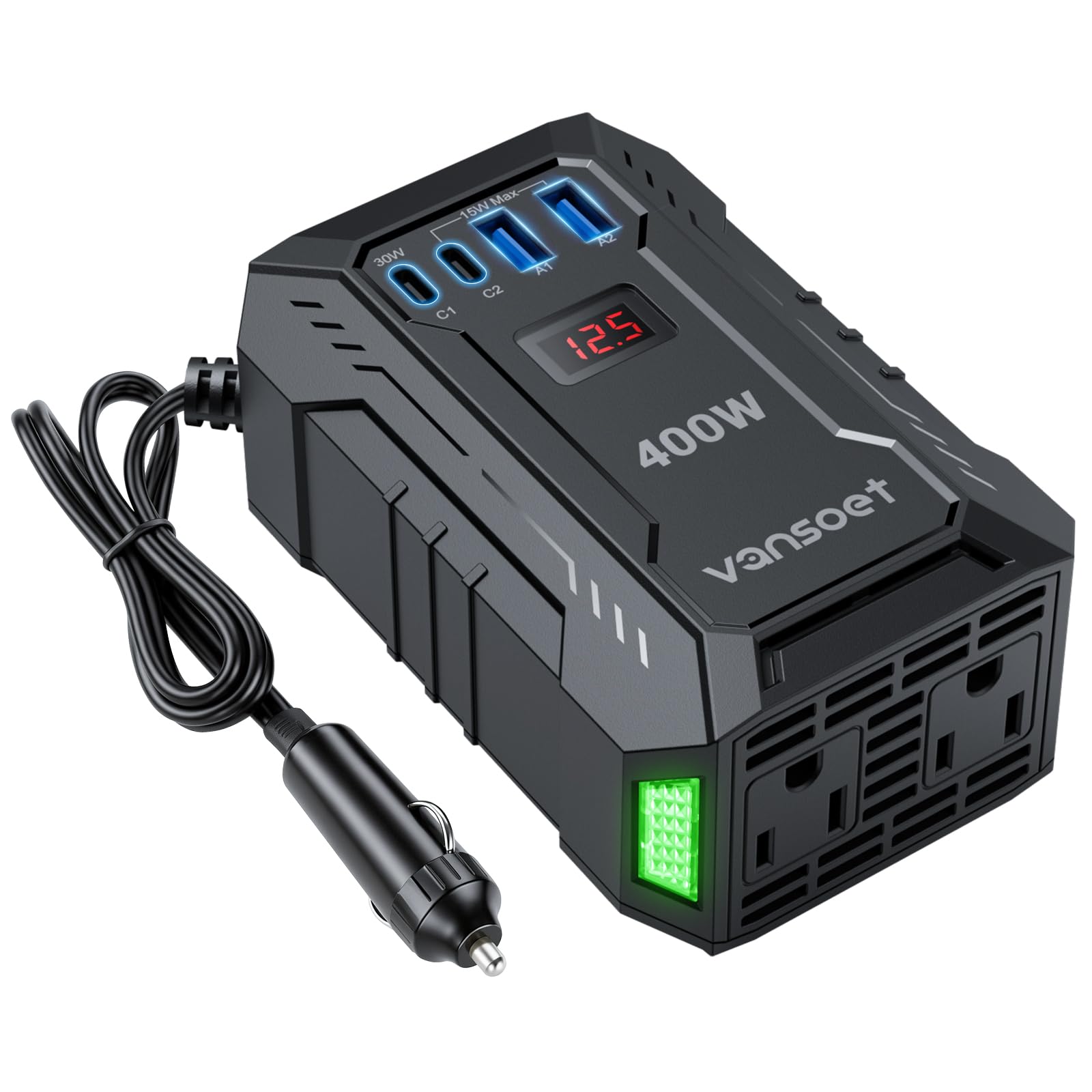
vansoet 400W Power Inverter

88 /100
Keeper Score Excellent

Key details

USB-C
30W PD
Output
400W
AC Control
Dedicated on/off switch
AC Outlets
2
Check Price on Amazon

A dedicated switch for the AC outlets sounds like a small thing until you've wrestled a stiff cigarette plug out of a socket for the fifth time. On the vansoet the outlets can be killed without unplugging anything, so the unit stays where it is and the socket stays busy. Beside the switch sits a status light that shows green for normal and red for a fault — more feedback than most of this group offers, and the sort of detail you appreciate the one time it tells you something is wrong.

The rest of the sheet is current: 400 watts, two AC outlets, a 30W USB-C PD port and a 15W USB-A port, in a body intended for 12-volt systems in cars, SUVs, trucks and RVs. That USB-C port is the fastest single one on this page, quick enough to fast-charge a phone and to trickle a USB-C laptop, and finding one on a car adapter is still less common than it should be.

Where we part company with it is value and reach. It costs more than the other 400-watt unit here and doesn't come with the long cord, so if your laptop rides in the back seat the Pro Chaser is the better buy. If the inverter will live in one spot and you want the outlets under your thumb rather than behind a plug you have to pull, this one is the easier thing to own.

Pros

  • AC outlets switch off independently
  • 30W USB-C PD, the fastest port here
  • Red/green status light flags faults

Cons

  • Costs more than the other 400W pick here
Our verdict

Worth a look for the switch alone: the AC outlets have their own on/off control, and the 30W USB-C port is the quickest single port in this group.

Check Latest Price

How We Chose and Tested These Inverters

We started by gathering every inverter we could find with a believable continuous wattage rating, then filtered for what actually decides whether one earns a permanent spot in the car: footprint against a cupholder, plug type, USB output, and price against the wattage you get. Anything that overstated its continuous rating or needed hardwiring was out. That left 12 units, from 150 watts up to 2,000.

Each one then lived with us for seven months of ordinary use. Every unit did commuter duty first, running a laptop and a phone from the passenger footwell, before moving to weekends: a camping trip, a tailgate, a two-day outage, and an afternoon spent filling four tires off an air compressor. We clocked how quickly each fan kicked on and how loud it got at arm's length, and took an infrared thermometer to the case after half an hour under load.

Power output was judged under a real load: we watched whether each unit held steady at its rating or tripped, and the ones that sagged under a load they claimed to handle dropped out. For compatibility, we cycled through a phone, a laptop brick, a CPAP, and a compressor, and checked charging speed on the USB ports with a tester, since a fast-charge label doesn't guarantee a fast charge.

Cord length came down to how far the unit reached into the back seat and whether the plug stayed seated over speed bumps; a wobbly connection ended more than one test early. Durability and reliability showed up in the dull details — fuses that blew on an ordinary load, cases that ran hot, plugs that loosened after a few weeks. Value got settled last, once we knew which ones were still working without complaint.

How to Choose a Power Inverter

What your 12-volt socket can actually deliver

Most 12-volt accessory sockets are fused at 15 amps, which works out to roughly 180 watts at 12 volts and less once the plug and wiring warm up. That is why a 400- or 500-watt inverter with a cigarette plug on it behaves like a 150-watt inverter in practice: the plug is the bottleneck, not the electronics. The number to shop by is your load, not the label.

If your loads are laptops, phones, camera batteries and a fan, a compact plug-in unit is the right buy and the bigger numbers are marketing. If you want a fridge, a heater or power tools, buy something that accepts battery cables and plan the install — the YSOLX here is that machine, and it belongs beside the battery rather than on your lap.

Modified sine or pure sine

A modified sine inverter approximates the wall outlet's smooth wave with a stepped one. Chargers, laptop bricks, LED lights and most small electronics genuinely don't mind. Motors run warmer, audio gear hums, and a few fussy devices refuse to start at all.

Pure sine costs more and buys a waveform that behaves like household power, which is what we look for when the load is a CPAP machine, a pump, a compressor or anything with a speaker in it. Our top pick is modified sine; the BESTEK 300W pure sine is the version to buy when the thing you need to run is the reason you're shopping.

Outlets, ports and honest USB numbers

Two AC outlets is the norm, and it's enough for a laptop brick plus one other plug once you allow for how bulky the bricks are. Ports are where the specifications get slippery: a dual USB pair rated at 3.1 amps total splits that current two ways, which is slower than one modern phone wants on its own.

A 4.8-amp pair or a dedicated USB-C PD port is worth a little more if phones and tablets are the main load. Count what you'll have plugged in at the same time, not what the bullet list totals.

Fit, cord and noise in a small cabin

A compact inverter is only portable if it fits somewhere specific: a cupholder, a console tray, the pocket in the door. Cord length matters as much as size — 30 inches reaches the back seat, 16 inches keeps the unit beside the socket it's plugged into.

Then there's noise. Fans that run from switch-on are audible in a quiet cab; fans that cut in under load only bother you while you're actually working the unit. Wherever it ends up, leave the vents clear — a unit buried under a jacket will heat up and shut down, and that isn't a fault.

Frequently Asked Questions

Final Verdict

The BESTEK 300W is the one we recommend to almost everyone: small enough to leave in the car, enough outlets for the devices people actually carry, and an 11–17V input range that keeps it useful in newer vehicles.

Spend more only when the load demands it — the BESTEK 300W pure sine if you're running a CPAP machine, audio gear or a motor, and the YSOLX if you're wiring an RV or a jobsite and need real household wattage rather than a bigger number on a cigarette plug.