Best Office Chairs of 2026

A bad office chair doesn't announce itself. It shows up months later as a low ache between the shoulder blades, a numb spot behind one thigh, or the habit of standing up every twenty minutes for no reason. Your desk can be perfect and still be undone by a seat that pins you in one position all day. What a good chair actually fixes is movement: it lets you shift, lean back, and plant your feet without fighting the thing.

I've worked from a kitchen table, a real office, and a converted closet, and the chairs that survived all three had a few things in common. Over the past six months, my team assembled and sat in a dozen chairs at our own desks, from low-back armless models to high-back mesh chairs built for taller sitters. The differences that mattered were rarely the ones in the product photos: a flip-up arm that clears a shallow desk, a lumbar panel that stays where you set it, a base that doesn't skitter when you lean. Ignore cushion thickness, too — a thick pad feels great for a week and flattens by spring. Here's what we'd keep.

Keeper Score summarizes customer ratings and review volume. Read it alongside the product details and trade-offs. How the score works.

1

Best Overall

X XISHE Ergonomic Mesh-Back Chair

90 /100
Keeper Score Outstanding

Key details

Armrests
Flip-up
Seat Depth
19.29 inches
Seat Height
20.5 inches
Weight Capacity
300 lb
Check Price on Amazon

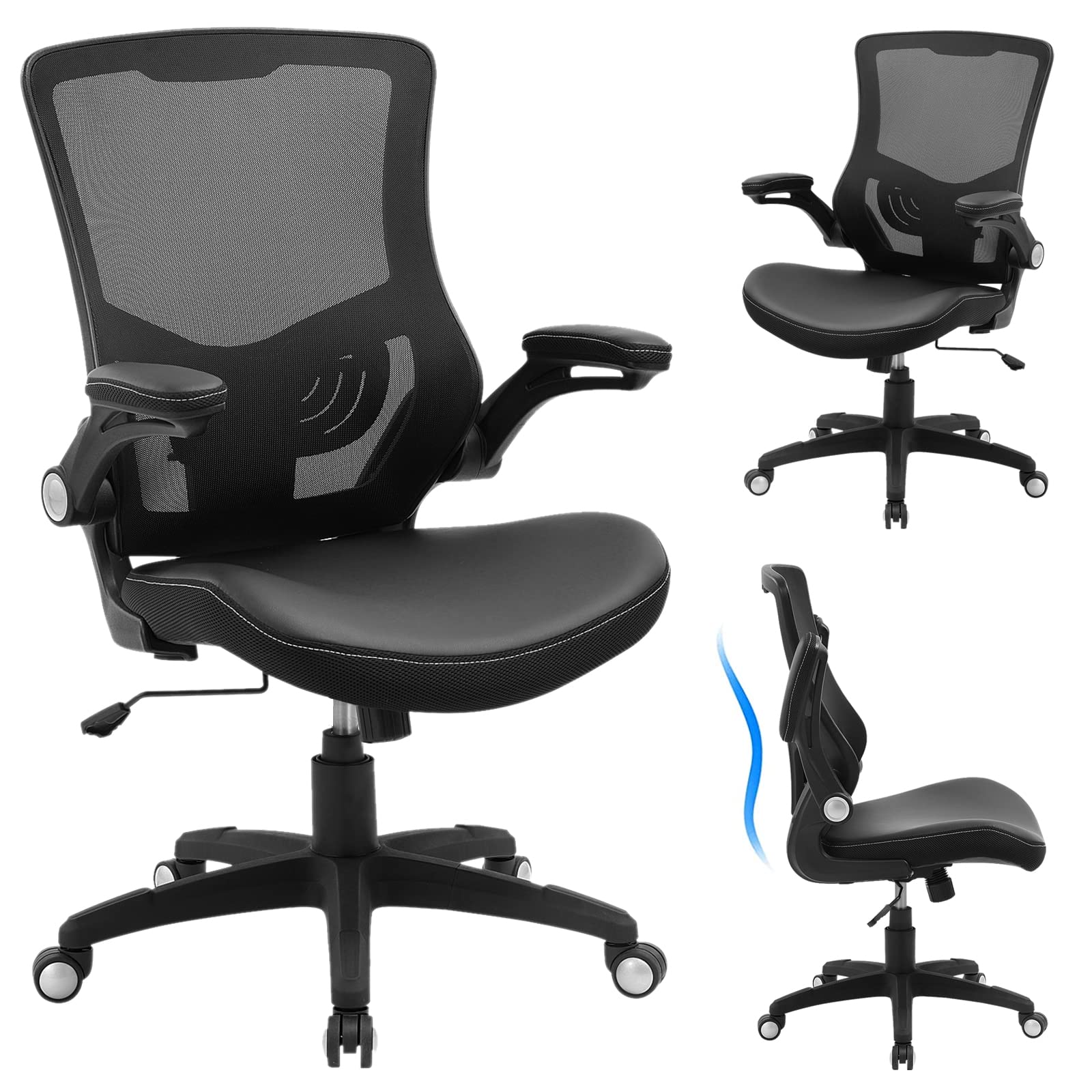
Most chairs at this end of the market treat lumbar support as a bump molded into the backrest, and you either sit against it or you don't. This one gives you a pad that slides up and down the back, and we spent the first week moving it around to find the spot where it stopped the ache between our shoulder blades and our belt line. That adjustable pad is the reason this chair leads our list: nothing else here combines one with a mesh back, flip-up arms and a 300-pound rating.

The rest of the chair is quietly sensible. The seat is padded PU leather rather than mesh, which is warmer but wipes clean after lunch, and at 19.29 inches deep it supports a full thigh without pressing behind the knee. The back is 18 inches wide and breathes, the arms fold up to clear a desk, and the base carries the same 300-pound rating as the frame.

Where it gives ground is at the margins. The seat height is listed at 20.5 inches and the recline offers two positions rather than a continuous range, so a very tall sitter or someone who works half-reclined won't find much to play with. For the standard desk-and-laptop setup most of us actually use, we didn't miss either: the chair rolls quietly, swivels on the spot, and the mesh back means you aren't peeling yourself off leather in July.

Pros

  • Lumbar pad adjusts up and down
  • Flip-up arms slide under a desk
  • Mesh back over a padded, wipe-clean seat
  • 300-pound weight rating

Cons

  • Armrests flip but don't adjust for height
Our verdict

Our default recommendation: a lumbar pad you can actually move, arms that fold out of the way, and a mesh back that keeps a long workday comfortable.

Check Latest Price
2

Best Big and Tall

GABRYLLY High-Back Mesh Chair

91 /100
Keeper Score Outstanding

Key details

Armrests
Flip-up, 45 degrees
Headrest
Adjustable 3D headrest
Overall Size
24.5"W x 27.5"D x 46"H
Weight Capacity
300 lb
Check Price on Amazon

The listing's sizing note, roughly 5'2" to 6'1", is unusually specific for this category, and it's the first thing we checked. At 24.5 inches across and 41 pounds, this is a big chair: wide enough that a broad-shouldered sitter isn't wedged between the arms, and tall enough that the 3D headrest lands behind your neck rather than your shoulder blades.

What we appreciate most is that the size isn't the only thing you're paying for. The arms flip up 45 degrees so the chair tucks under a desk, the tilt locks in three stages, and the mesh runs through both the seat and the back. We noticed that last part on a warm afternoon when the leather-seated chairs in the office turned sticky and this one didn't. If you're the tallest person in your house, it's the chair that stops feeling like a compromise.

One part deserves watching. A gas lift that slowly sinks under you is the failure we check for first on any chair. If yours starts creeping down over the course of an afternoon, treat it as a warranty conversation while the coverage is fresh rather than something to live with, and test the height in the first week, when sending the chair back is still easy.

Pros

  • 24.5-inch-wide seat with a 300-pound rating
  • Adjustable 3D headrest at neck height
  • Flip-up arms and a three-stage tilt lock
  • Breathable mesh seat and back

Cons

  • Lumbar support is a fixed curve, not a movable pad
Our verdict

Buy this one if you're tall or broad and want a headrest: it's the roomiest chair in this group, with a 24.5-inch-wide seat and a 300-pound rating.

Check Latest Price
3

Best Premium

ELABEST X100 Ergonomic Chair

91 /100
Keeper Score Outstanding

Key details

Lumbar
3D adjustable
Recline
3 positions with footrest
Armrests
5D flip-up
Weight Capacity
300 lb
Check Price on Amazon

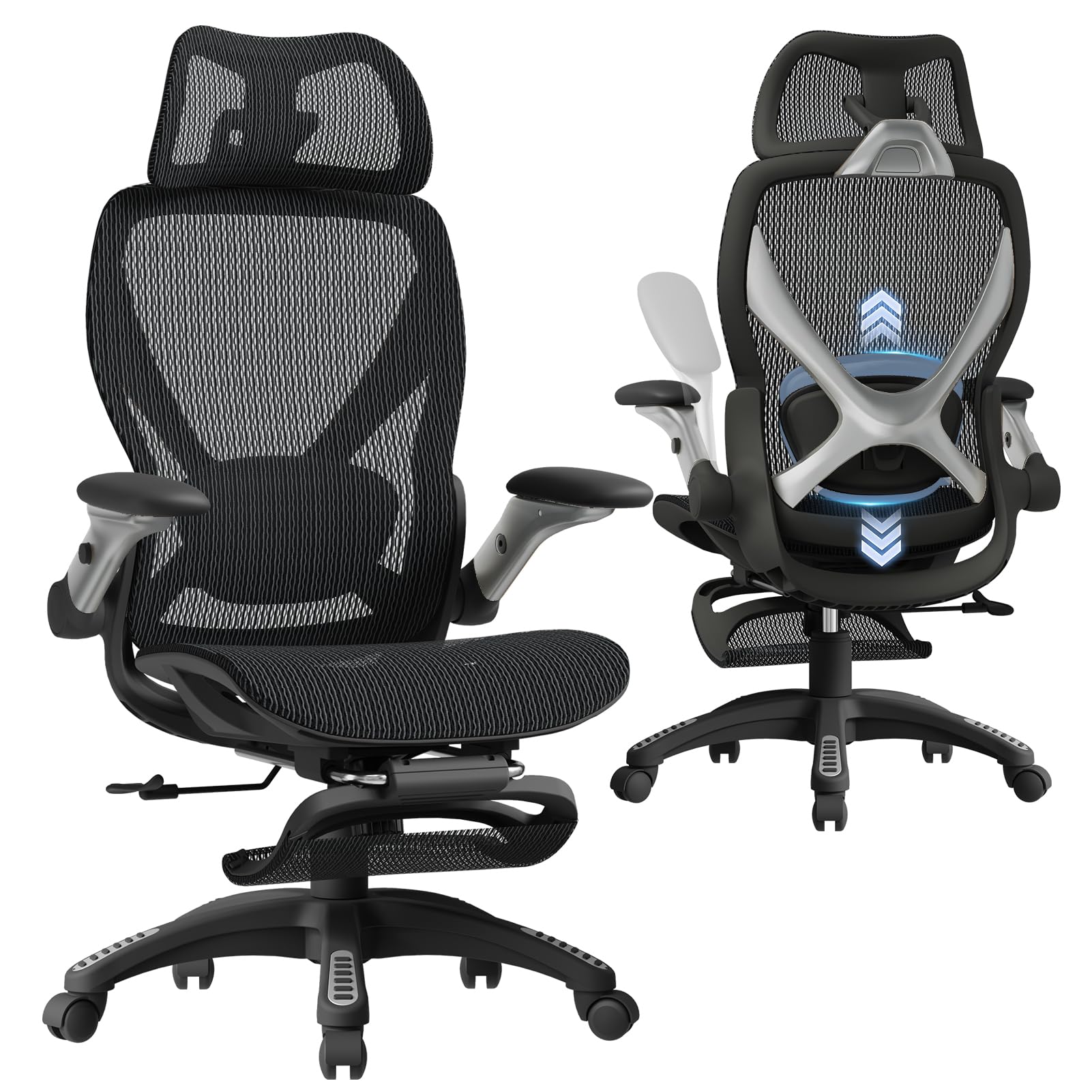
This is the most expensive chair in the group, and the only one that tries to be a task chair and a recliner at once. Whether that's worth it depends on how you work. If your afternoon slides between typing and leaning back with your feet up, the X100 gives you a lumbar pad that moves in three directions, including in and out on a spring, a footrest that extends 18 inches, and three recline stops. We used the footrest far more than we expected to.

The arms are the other party trick: they flip up, slide in and out, and pivot, so they can go under a desk, out of the way of a guitar, or level with a keyboard. The back is a dense double-layer mesh, and the seat is a mesh pan rather than foam, which is cooler than the leather chairs here and firmer, a trade we were happy with and a lighter sitter may not be.

Nothing this adjustable comes small. At 43 pounds and 26 inches deep it wants a real desk and a clear stretch of floor behind it, and the back is 20.2 inches across, so if you're broad through the shoulders the GABRYLLY gives you more room. Compare the footprint against your room before you fall for the footrest, because this is a chair you notice in a small office.

Pros

  • Lumbar pad with spring-loaded depth adjustment
  • Five-way flip-up armrests
  • 18-inch footrest with three recline stops
  • Dense mesh back and seat stay cool

Cons

  • Headrest can drift out of position when reclining
  • 43 pounds and 26 inches deep needs floor space
Our verdict

Worth the premium if you recline between tasks: depth-adjustable lumbar, five-way arms, and an 18-inch footrest you'll actually use.

Check Latest Price
4

Best Budget

Amseatec Mesh Office Chair

89 /100
Keeper Score Excellent

Key details

Recline
90-110 degree rocking
Armrests
Flip-up
Seat Cushion
3 inches
Weight Capacity
300 lb
Check Price on Amazon

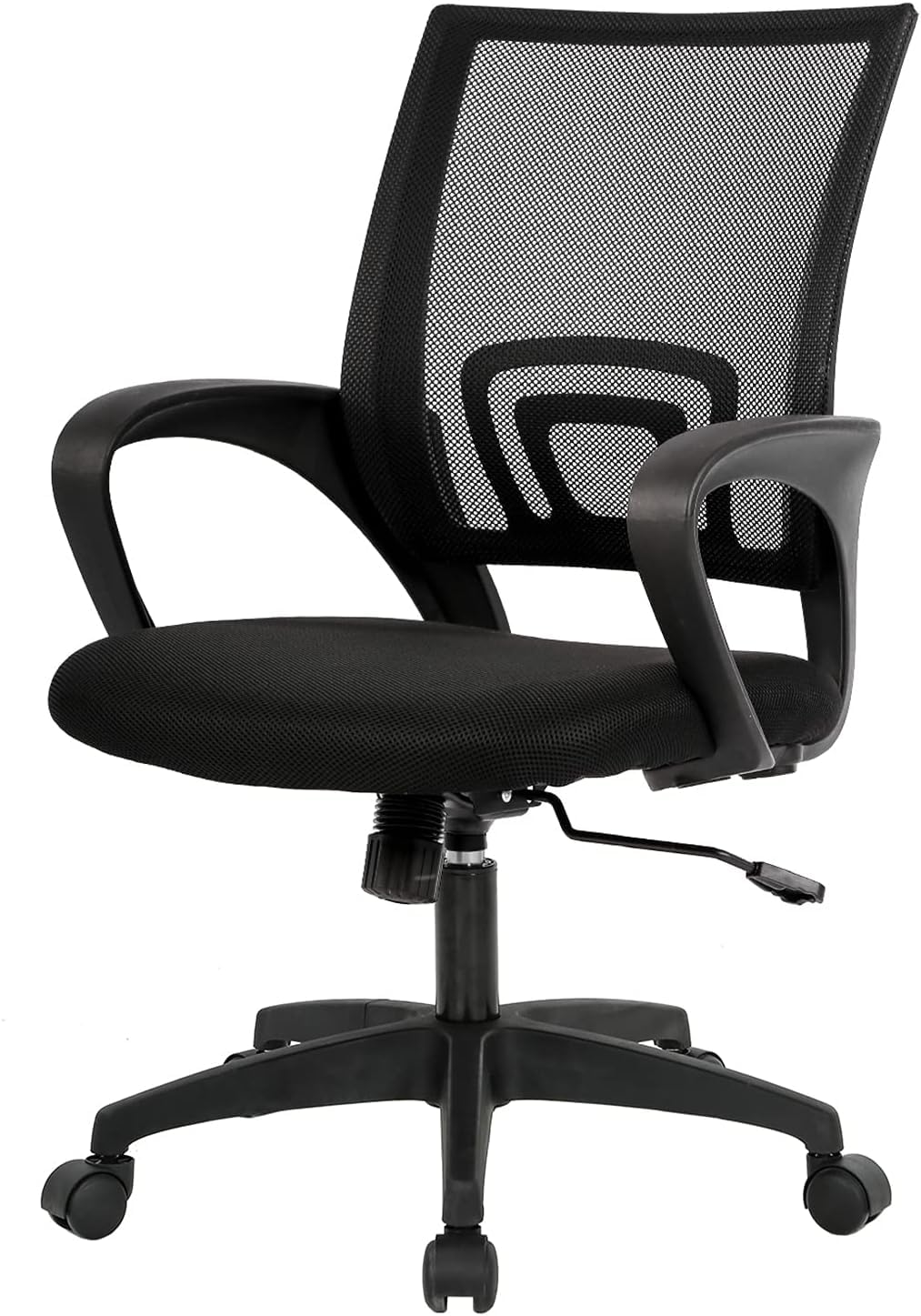
Lifting this chair out of the box is the first surprise: 23.2 pounds, light enough to shift around a room without thinking about it. The second is the seat. A three-inch cushion is generous at this price, and it's the part of the Amseatec we expected least from.

The back is mesh on a curved frame with a fixed lumbar bulge, the arms flip up and out of the way, and the base is rated to 300 pounds, fifty more than the cheapest chair here. It rocks between 90 and 110 degrees on a tension knob underneath, which is enough movement to take the stiffness out of a long afternoon and not enough to fall asleep in.

Two things to expect. The seat arrives firm and softens over the first week or so, so give it a few working days before deciding it's too hard. And the casters are happier on hard floor than on deep carpet, where the chair takes a shove to get moving.

What it doesn't offer is fine adjustment: no lumbar pad to reposition, no arm height to set. So it suits a straightforward desk rather than a body with specific complaints. Set against that, the geometry is sensible and the cushion is real. As a first proper office chair, or a second one for a spare room, it does the important things well.

Pros

  • Three-inch seat cushion at a budget price
  • Flip-up arms and a 300-pound rating
  • Rocking tilt with tension control
  • Light at 23.2 pounds

Cons

  • No lumbar or armrest height adjustment
Our verdict

The budget pick we're happiest recommending: three inches of seat foam, flip-up arms and a 300-pound rating for very little money.

Check Latest Price
5

Best for Small Spaces

DUMOS Armless Desk Chair

92 /100
Keeper Score Outstanding

Key details

Armrests
Armless
Upholstery
PU leather
Overall Size
18.11"D x 22.83"W x 34.25"H
Weight Capacity
250 lb
Check Price on Amazon

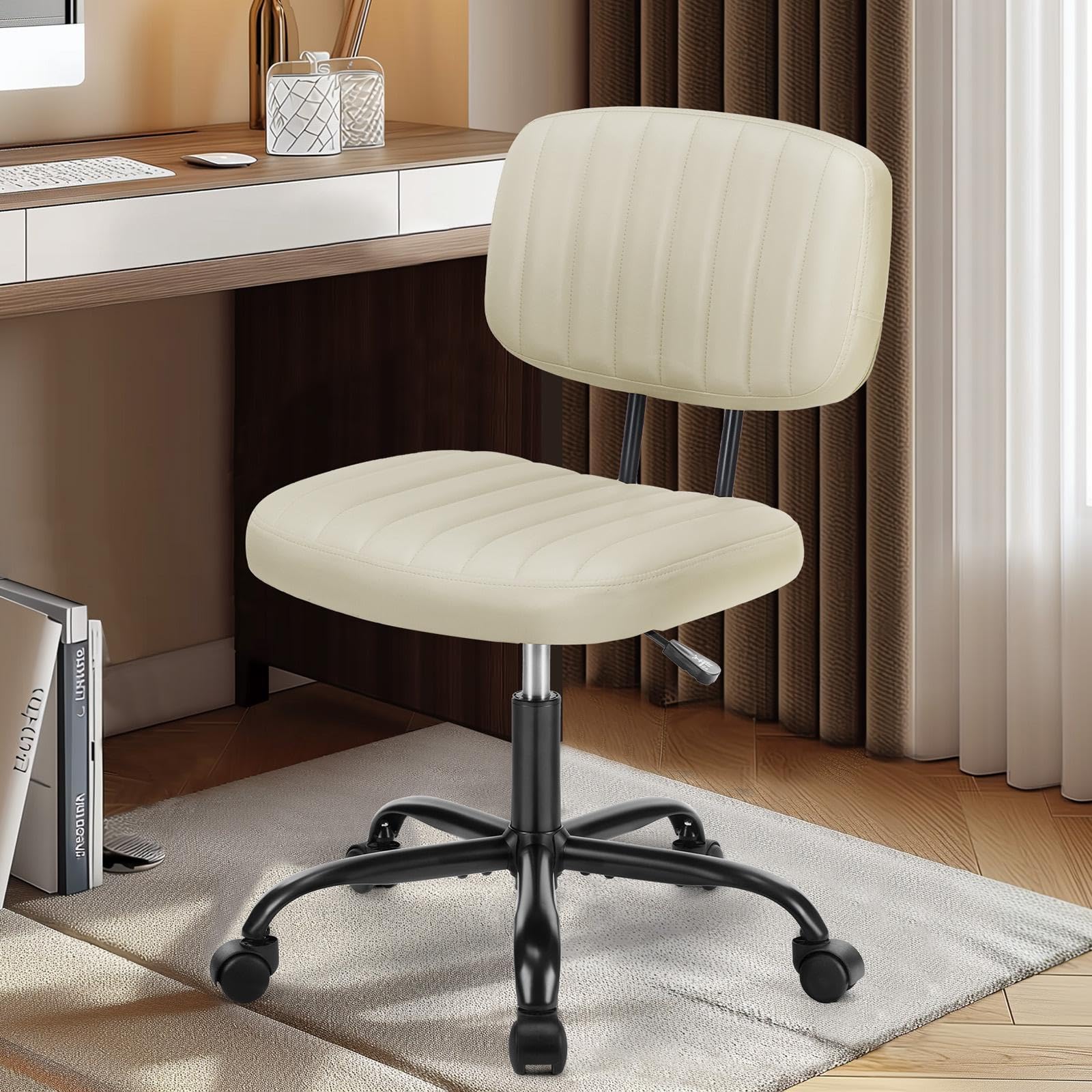
Not every chair needs to be a task chair. If yours lives at a sewing table, a vanity or a corner desk in a bedroom, an armless low-back chair is the better tool: it slides under anything, takes up almost no floor, and doesn't need three clear feet behind it to recline. That's the job this one does, at 34.25 inches tall and 19.2 pounds.

We like it precisely because it doesn't overreach. It tucks in, rolls smoothly on hard floors, and the padded low back gives you something to lean against without pushing your shoulders forward. The height range surprised us: there's enough travel for a tall desk and enough drop for a sitter around 5'1". And it doesn't recline at all, which for this kind of chair is a feature, since there's nothing to tip.

The trade-offs are predictable. The seat is 16.33 inches wide and the chair is rated to 250 pounds, so it isn't the one for a broad sitter, and the PU leather runs warmer than mesh in a small room. Set against that, it comes in beige as well as black, wipes clean, and is one of the simplest builds here, with the key in the box.

Pros

  • Armless and compact for tight corners
  • Height range suits tall desks and shorter sitters
  • Padded low back with lumbar foam
  • Light at 19.2 pounds

Cons

  • 250-pound rating and a 16.33-inch-wide seat
  • PU leather seat runs warm
Our verdict

For a sewing table, a vanity or a bedroom corner, this armless chair does the job at 19 pounds and tucks away when you're done.

Check Latest Price
6

Best Leather Look

YFO Leather Office Chair

89 /100
Keeper Score Excellent

Key details

Casters
Rubber
Seat Depth
20 inches
Seat Width
22 inches
Weight Capacity
300 lb
Check Price on Amazon

Most leather chairs in this bracket are black, boxy and a little shiny. This one is brown, with a rounded retro back and casters that roll across a wood floor without the plastic clatter. If the chair sits in a room you actually look at, that counts for more than a spec sheet admits.

Underneath the finish it's a serious chair. The seat is 22 inches wide and 20 inches deep, the widest here, with a spring pack under the foam so it gives when you sit rather than bottoming out. The arms can be left off entirely, which turns it into a cross-legged chair for a reading corner, and the rubber casters are quiet and kind to hardwood.

The back is a fixed curve with a lumbar pad built in, and the chair is big. On a small frame that width works against you: you end up perched forward to reach the backrest instead of sitting into it. We'd match it to a broad or tall sitter, or to anyone who wants to sit cross-legged, and point a slighter one at the DUMOS or the Amseatec.

Pros

  • 22-inch seat with a spring-packed cushion
  • Brown leather wipes clean
  • Arms can be left off for cross-legged sitting
  • Quiet rubber casters for hard floors

Cons

  • Wide seat feels oversized on a small frame
  • Fixed lumbar curve with no adjustment
Our verdict

A brown leather chair that holds up to a full working day, with a 22-inch seat and quiet rubber casters for wood floors.

Check Latest Price
7

Lower-Back Support

TRALT Ergonomic Mesh Chair

88 /100
Keeper Score Excellent

Key details

Back
Tensioned mesh
Lumbar
Adjustable depth
Seat Depth
17.3 inches
Weight Capacity
330 lb
Check Price on Amazon

Two failures end most cheap office chairs: the foam flattens and the gas lift starts sinking. TRALT has built its pitch around both, with a high-resilience molded foam seat and a Class 3 BIFMA-certified cylinder, and thrown in a 330-pound weight rating, the highest in this group.

The lumbar support is the part we'd point a sore back at. It adjusts in depth as well as height, so you crank it forward into the curve of your lower back instead of hoping a fixed bulge lands in the right place. The back is tensioned mesh, the base has a metal core, and the chair weighs 28 pounds, light enough to move and heavy enough not to skitter.

Its measurements ask something of you. The seat is 17.3 inches deep, shallower than most here, which suits a shorter leg and leaves a taller sitter feeling under-supported at the thigh. If you're much past six feet, the XISHE's 19.29-inch seat is the safer shape.

Where it lands for us is on the parts that usually give out first. The foam and the lift are the two things TRALT spent money on, and that's worth more than a headrest in a chair you sit in for eight hours. It won't win a beauty contest, with plain black mesh and functional lines, but in a home office nobody sees, that's a fair trade for the parts underneath.

Pros

  • Lumbar pad adjusts in depth, not just height
  • 330-pound rating, the highest here
  • High-resilience molded foam seat
  • Certified gas lift and metal-core base

Cons

  • Seat pan can sit at a forward tilt
Our verdict

The chair we point to when lower-back support is the specific problem, with a lumbar pad that adjusts in depth and the highest weight rating here.

Check Latest Price
8

Light Use

BestOffice Mid-Back Desk Chair

88 /100
Keeper Score Excellent

Key details

Back
Mid-back mesh
Seat Width
18 inches
Seat Height
17.1-20.3 inches
Weight Capacity
250 lb
Check Price on Amazon

This is the lowest price in the group, and it's worth being clear about what that buys: a 19-pound chair with a mesh back, a sponge seat, height adjustment between 17.1 and 20.3 inches, and a 250-pound rating.

For a teenager's homework desk, a spare room or a first apartment, that's enough. The mesh back breathes, the seat is soft rather than supportive, and the build is a short job with the hardware in the box. It swivels, it rolls, and it does the basic job.

The limitations show up in the measurements. The seat is 18 inches wide and the back 16.5 inches across, which is snug for a grown adult: fine for a smaller sitter, tight for anyone broad. And this is a chair for light use, since the money has come out of the frame and the cushion. If the chair has to survive daily work, the Amseatec costs a little more and holds up better.

Pros

  • Mesh back and padded seat for very little
  • Adjustable height from 17.1 to 20.3 inches
  • Light at 19 pounds

Cons

  • 18-inch seat and 16.5-inch back run narrow
  • Built for light use, not long workdays
Our verdict

The cheapest way into a mesh-back swivel chair here, and a fair one, as long as the seat is for light use rather than eight-hour days.

Check Latest Price

How We Tested These Office Chairs

We started with a long list of chairs selling in the same rough range, then cut anything with a vague weight rating, a seat-height range too narrow for our shortest or tallest tester, or arms that couldn't get out of the way. That left a dozen chairs, which we built ourselves and lived with for six months.

Assembly came first, timed with a stopwatch and done solo. We counted the steps, noted whether the hardware was bagged and labeled, and watched for the moment the holes don't line up or a second pair of hands becomes necessary. Most went together in under half an hour; one took a second attempt and a lot of patience.

Then we sat. Each chair went into a real workday rotation — eight hours of typing, video calls, leaning back to read, and rolling between a hardwood floor and a low-pile rug. We noted where the seat edge pressed into a thigh, whether the mesh lost its tension by month three, and whether the base creaked or drifted when we shifted weight.

Testers from 5-foot-2 to 6-foot-4 swapped seats weekly. We set the lumbar panel, arm height, and tilt lock, then checked a week later whether the settings had held. We also measured how much floor each chair's footprint ate up in a small room and whether the arms dropped low enough to slide under a shallow desk — the flip-up ones almost always did. By month four we asked every tester whether they'd buy their chair again at full price, and the answers were more split than the spec sheets suggested.

How to Choose an Office Chair

Start With Seat Height and Depth

Seat height decides whether your feet reach the floor. Most task chairs top out between 17 and 21 inches, which suits a standard desk; if your desk runs tall or you're shorter than average, check the range before anything else. Depth matters just as much, and you want two or three fingers of clearance behind your knee, no more. The GABRYLLY's 20-inch seat suits a long leg; the TRALT's 17.3 inches is better for a shorter one. Read weight capacity as a structural limit, not a durability score.

Decide Whether the Lumbar Support Has to Move

Every chair here has some kind of lumbar curve; the question is whether you can put it where your back wants it. A fixed bulge works only if it happens to land in the right spot, which is close to a coin flip. A pad that slides up and down, as on the XISHE, or moves in and out on a spring, as on the ELABEST, lets you tune it to your own spine. If you already have lower-back trouble, that adjustment is worth more than a headrest, a footrest or a nicer finish.

Arms, Desk Clearance and the Space Behind You

Armrests are where chairs and desks fight. Flip-up arms, which most of these have, let you push the chair right under the desk and get the arms out of the way when you're playing guitar or sitting cross-legged; fixed arms need a couple of inches of clearance under the desktop. Measure from the floor to the underside of the desk, drawer box included, and compare that with the chair's arm height, because a chair sold as compact can still be too tall for a slim desk. Then check the footprint: a recliner with a footrest wants three clear feet behind it, while an armless chair like the DUMOS only needs room to swivel.

Mesh or Leather, and What's Underneath

Mesh backs breathe and hold their shape; leather and PU wipe clean and feel warmer. Neither is better in the abstract, since a hot home office wants mesh and a house with small kids wants something you can sponge. What's underneath matters more than either: a five-point base, and casters matched to your floor. Rubber and polyurethane wheels protect hardwood and quieten a bedroom office, while hard casters roll better on low carpet. If the chair will double as furniture in a living room, buy for the look as well.

Frequently Asked Questions

Final Verdict

Most people should buy the XISHE. It gets the two things that decide whether you're comfortable at four in the afternoon, a lumbar pad you can move and arms that get out of the desk's way, without the bulk or the price of the premium chairs here. If you're broad or tall, the GABRYLLY's wider seat and headrest are worth the step up.

And if your afternoon includes a proper break with your feet up, nothing here reclines like the ELABEST. Pick the chair that matches your body and your room, and spend the rest on a desk mat.