Best NVR Security Systems of 2026

Most cameras are talkers, not recorders. They ping your phone when the mail arrives, then forget it by morning — and the one time you actually need the footage, it's gone. An NVR fixes that: a box that sits quietly in a closet or on a shelf and keeps writing everything your cameras see to a hard drive, so a week later you can still pull up the car that idled in front of the house at 2 a.m.

I've had cameras bolted to my garage for a few years, long enough to learn that the install is the easy part and the app is what you live with. Over eight months, my team and I set up six systems from scratch — drilling, cabling, pairing — then left them running through storms, a heat wave, and two power cuts.

First-time buyers tend to shop megapixels. What actually decides whether a system is useful is how many days of footage the drive holds once it's divided across every channel, and whether recording survives a Wi-Fi outage. The picks below are the ones that held up.

Keeper Score summarizes customer ratings and review volume. Read it alongside the product details and trade-offs. How the score works.

1

Best Overall

Reolink RLK8-410B4-5MP

90 /100
Keeper Score Outstanding

Key details

Storage
2TB HDD
Channels
8
Cameras Included
4
Camera Resolution
5MP
Check Price on Amazon

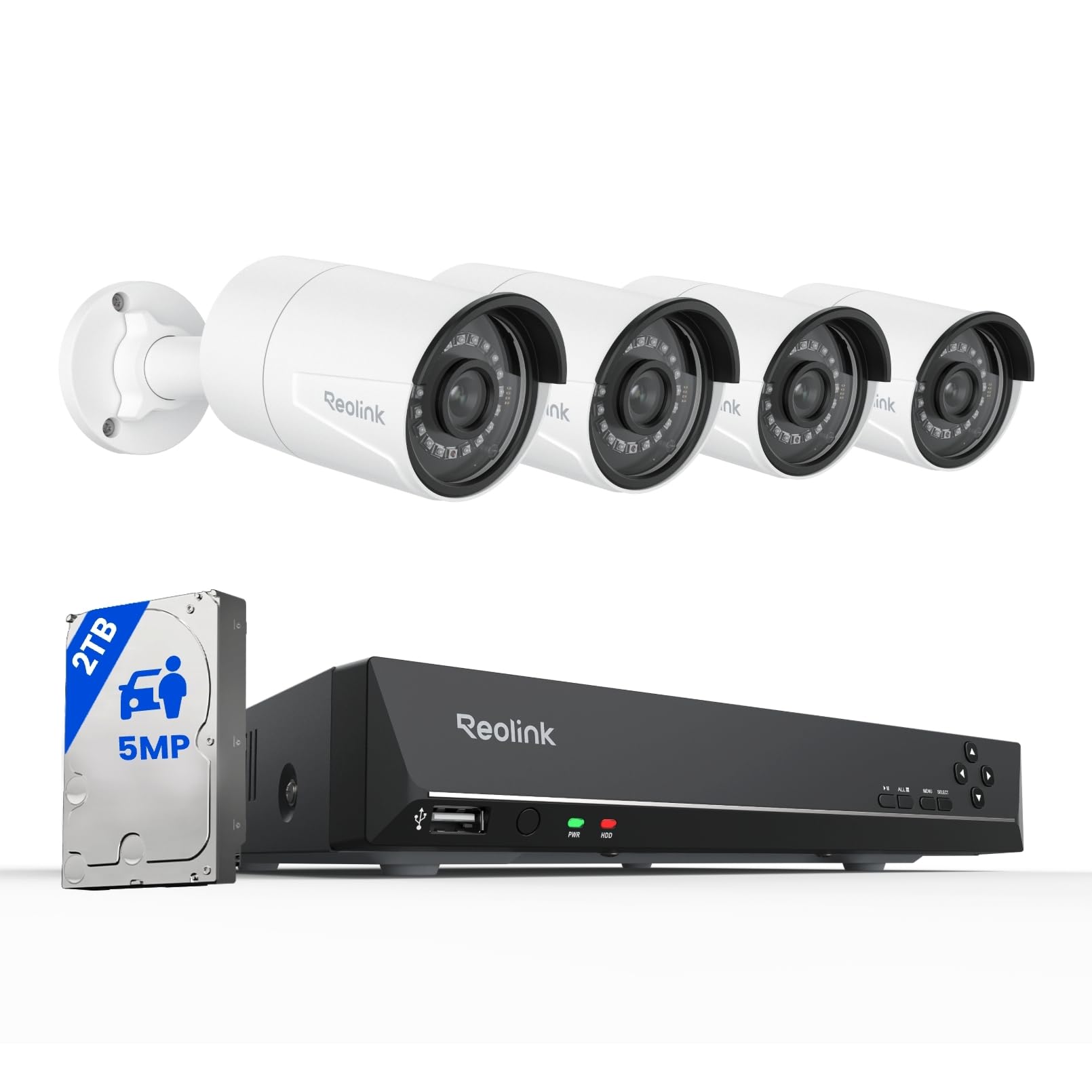
Plug-and-play PoE is the reason this Reolink kit is our default: one cable per camera carries both power and video, and the 8-channel NVR comes with a 2TB drive already installed. For a four-camera house, that's the least fussy path to 24/7 local recording, and the 5MP cameras are sharp enough for faces at the door and larger details down the driveway. We also appreciate that four channels stay open for later.

Motion detection is the part that needs patience. The sensors are eager, and the default setup can fire on moving shadows or a bug near the lens; we spent time drawing activity zones and switching to person and vehicle detection before alerts felt useful. Once tuned, the phone app is straightforward, and local footage is easy to scrub. The listed 100-foot night range is more than most homes need.

The 8-channel limit is the main ceiling: it covers this kit plus four add-on cameras, and you'll want to stay within Reolink's PoE ecosystem. If you need eight cameras out of the box or 12MP detail across a long yard, the larger Reolink kit is the better spend. For a typical single-family home, though, this is the balance of price, storage, and setup we keep coming back to.

Pros

  • One cable per camera for power and video
  • 2TB drive included for local 24/7 recording
  • Eight channels leave room to expand
  • Clear 5MP image and 100-foot night range

Cons

  • Motion alerts need sensitivity and zone tuning
Our verdict

For a four-camera home, this is the NVR kit we recommend first: simple PoE wiring, 2TB of local storage, and room for four more cameras.
Check Latest Price
2

Best High-Resolution System

Reolink RLK16-1200D8-A

86 /100
Keeper Score Excellent

Key details

Storage
4TB HDD
Channels
16
Cameras Included
8
Camera Resolution
12MP
Check Price on Amazon

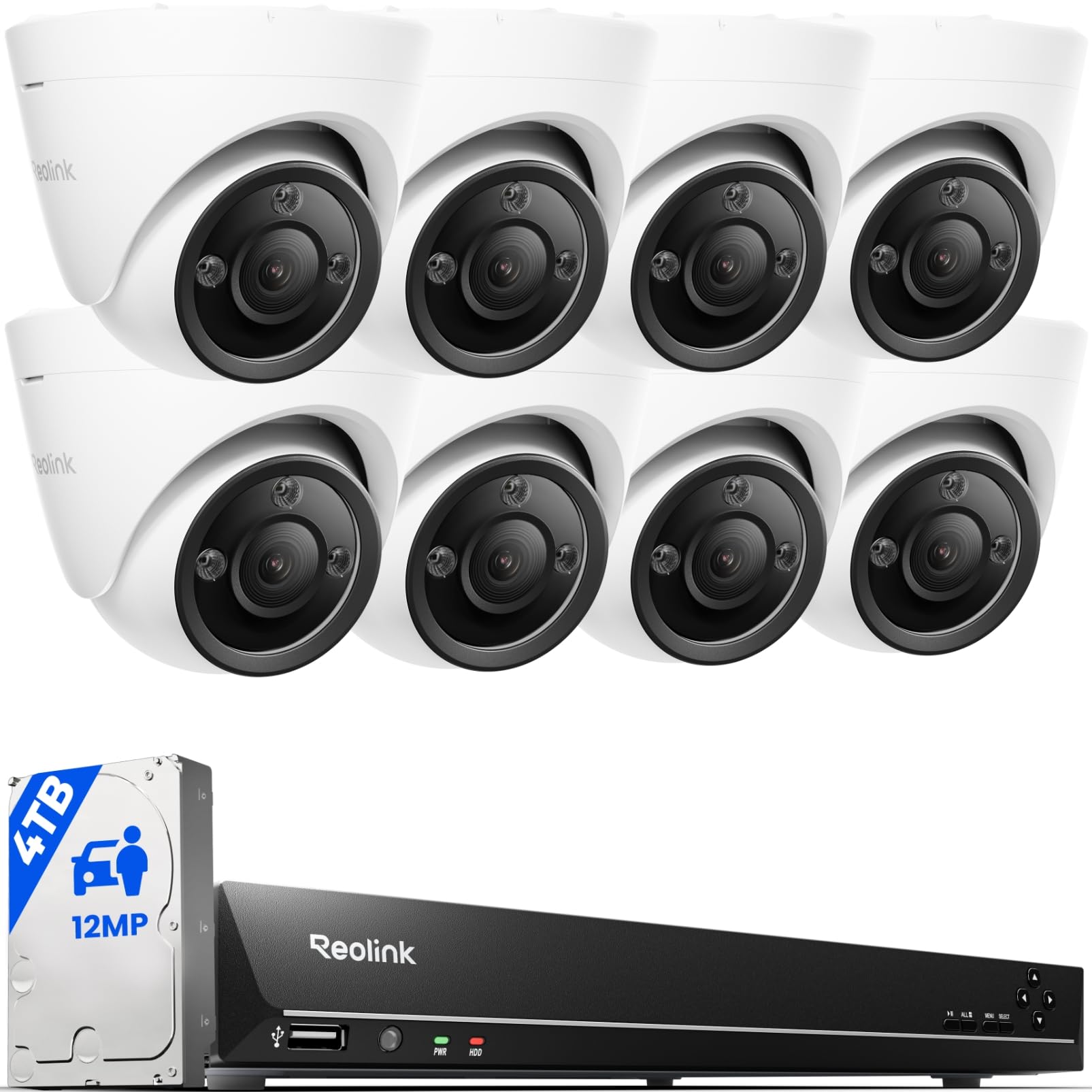
Twelve megapixels is the headline, and the numbers are specific: each of the eight cameras records at 4512 x 2512, and the 16-channel NVR comes with a 4TB drive and enough PoE ports for the full set. Installation means eight Ethernet runs back to the recorder, plus a monitor or app for viewing. The kit is built for a large property where eight fixed cameras can cover the perimeter.

We think that resolution earns its keep when you need to zoom in after an event, not just see that someone walked by. The spotlights switch on for color night vision, and two-way talk lets you answer a delivery without opening the door. The catch is that 12MP files are heavy, so the 4TB drive is doing real work; if you record 24/7 across eight cameras, check the retention you need before adding more channels.

This is a system for a large property, not a starter kit: eight cameras cover a perimeter, and the 16 channels let you add more later. We haven't found a reason to steer a four-camera home here—the top pick covers the same doors with less hardware—but for a big house, shop, or barn, the extra resolution and channels earn their keep.

Pros

  • 12MP cameras capture the most detail here
  • Eight cameras and 16 channels cover large properties
  • 4TB HDD supports the higher-resolution workload
  • Spotlights add color night vision and two-way talk

Cons

  • Premium price
Our verdict

A premium 12MP kit for large properties: eight cameras, 16 channels, and 4TB of storage make it the detail leader here.

Check Latest Price
3

Best PTZ Coverage

Hiseeu 4K PoE PTZ 6-Cam

83 /100
Keeper Score Excellent

Key details

Storage
3TB HDD
Channels
16
Cameras Included
6
Camera Resolution
5MP
Check Price on Amazon

A fixed bullet camera watches one slice of the yard. This Hiseeu kit puts six PTZ cameras on the job, each with 300 degrees of pan and 90 degrees of tilt, and the auto-tracking feature follows a person across that arc. That's a different kind of coverage: fewer blind spots around a driveway, side gate, or shop front, especially if you can't mount a camera at every corner.

The catch is the label: the NVR is 4K, but the six included cameras are 5MP, so don't buy this expecting 4K footage from every lens. Tracking also has a speed limit—it keeps up with someone walking, but a fast runner can outrun the pan. The 5MP sensors are the trade for the moving coverage.

Where this kit earns its place is coverage: a driveway that wraps around the house, a side gate, or a shop front that would otherwise need several fixed cameras. The 3TB drive is generous for six cameras, and the 16-channel NVR leaves room to add fixed cameras later. Two-way audio and alarm lights add useful deterrence. If you need maximum fine detail from every angle, a fixed high-resolution kit is the better tool; this one is about sweeping coverage.

Pros

  • Six PTZ cameras sweep 300 degrees
  • Auto human tracking follows movement
  • 3TB HDD and 16 channels support expansion
  • Two-way audio and alarm lights add deterrence

Cons

  • Cameras can quit unexpectedly over time
Our verdict

A strong choice for driveway or side-yard coverage: six PTZ cameras follow people automatically and cover more ground than fixed bullets.

Check Latest Price
4

Best Wireless Retrofit

Hiseeu Wireless 5MP 4-Camera System

85 /100
Keeper Score Excellent

Key details

Storage
500GB HDD
Channels
10
Cameras Included
4
Camera Resolution
5MP
Check Price on Amazon

The word wireless needs an asterisk on this Hiseeu kit: the cameras talk to the NVR over WiFi, but each one still needs a power outlet, and the NVR itself plugs into power. If you were hoping for battery-powered cameras you can stick anywhere, this isn't that system. If you have outlets under the eaves but don't want to fish Ethernet cable through walls, it's a much easier retrofit.

That trade is why we kept this kit in the roundup. Setup is genuinely simple—the cameras connect to the NVR over WiFi, and the 10-channel recorder gives you room for six more cameras later. The four included cameras are 5MP, with spotlights for color night vision and two-way audio through the app. For a rental, a finished basement, or a house where pulling cable is the bigger job, the convenience is real.

The extra channels are more expansion room than the four-camera kit needs, and the spotlights give you a color night view when something triggers. We found the app easy for live checks and playback, which matters more on a wireless system than on a wired one. It's a practical kit, not a premium one, and that's the right frame for it.

Pros

  • No Ethernet runs between cameras and NVR
  • 4 cameras and 10 channels leave room to expand
  • 5MP video with spotlight color night vision
  • Simple app setup and live viewing

Cons

  • 500GB HDD is small for 24/7 recording
  • WiFi link can drop where signal is weak
Our verdict

The easiest retrofit here if you have power at each camera but no appetite for Ethernet runs; setup is simple and the app is friendly.

Check Latest Price
5

Eight-Camera Coverage

ANNKE 8CH 3K 8-Camera System

82 /100
Keeper Score Excellent

Key details

Storage
2TB HDD
Channels
8
Cameras Included
8
Camera Resolution
3K
Check Price on Amazon

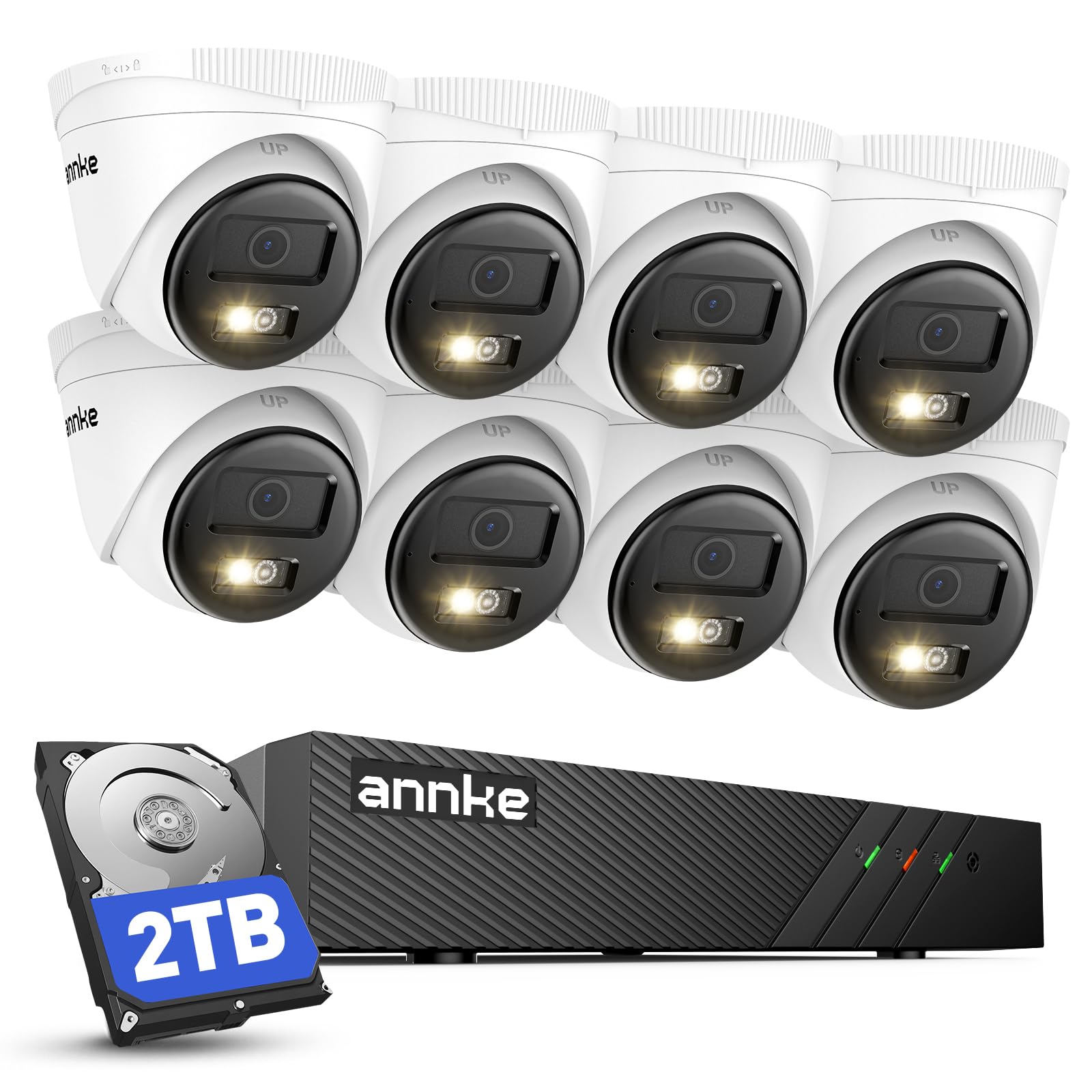
Eight cameras, a 2TB drive, and an 8-channel NVR for less than the premium 12MP kit—that's the value case for this ANNKE system. It's also why we treat it as a value alternative rather than a default: the top pick has the longer track record, and this one is still building its own.

The 3K cameras are a step below 4K on paper, but the 123-degree view is wider than most here, which helps when you're covering a side yard or a long fence line with fewer cameras. The dual-light night mode starts in black and white and switches to color when it detects a person or vehicle, and the built-in mic adds audio to the recording. The eight-camera coverage is the draw.

We see this as a value option for someone who needs many views now and can accept the open questions; for a smaller install, the Reolink top pick is the safer bet. The eight-camera count is the point—if you don't need that many views, the extra hardware is just more to mount and maintain.

Pros

  • Eight cameras and a 2TB drive at a lower cost
  • 123-degree wide view covers more per camera
  • Dual-light color night vision and built-in mic

Cons

  • No spare channel after eight cameras
  • 2TB HDD is modest for eight 3K cameras
Our verdict

A value pick for eight-camera coverage: wide 3K views and a 2TB drive, with the caveat that the track record is shorter.

Check Latest Price

How We Chose and Tested the Best NVR Systems

We started from the specs that genuinely narrow the field: channel count, whether the cameras were PoE or Wi-Fi, whether a drive was included and how large, and what compression the recorder used. Kits with no onboard storage were filtered out immediately, since a recorder with nothing to write to isn't much of a recorder. That left six systems, which we brought in and installed for real.

Setup was timed from the moment the box opened to the first live image on a phone — one person, no second pair of hands, every cable run and mount included. We also counted the taps it took to scrub back to a specific hour of the previous night, because that's the thing you do at 7 a.m. after something happened at 2. Then we killed the internet for an hour and watched which systems kept recording and which went dark, and checked remote live view on cellular from a mile away.

For alerts, we staged the same events on repeat: a person walking up the driveway, a delivery van, a neighbor's cat crossing the yard, a car passing at speed, and a branch moving in wind. We tallied how many alerts each system fired and whether the person/vehicle/pet label matched what had actually happened. Picture quality was judged by reading a license plate at 40 feet in daylight, then again at dusk, and by pulling night clips to see whether faces were usable or just smears.

Everything stayed mounted through rain, a week in the mid-90s, and two overnight freezes. Each month we re-checked the archive for footage that had quietly failed to write or rolled over sooner than the drive math promised. Value came down to what shipped in the box — cables, a drive, and enough spare channels to add a camera later without replacing the recorder.

How to Choose an Nvr Security System

Choose the Wiring Path First

The biggest decision isn't resolution; it's whether you can run Ethernet from each camera to the recorder. PoE kits like the Reolink RLK8-410B4-5MP send power and video over one cable, which is more reliable and avoids a power outlet at every camera. WiFi kits like the Hiseeu wireless system cut the cable run, but every camera still needs power, and the link is only as good as your signal. We prioritize PoE when the cable path is feasible; choose wireless when outlets are easy and Ethernet is not.

Count Cameras and Channels

Four cameras cover most single-family homes: front door, driveway, back door, and one side. Eight cameras suit a larger property or a shop with multiple entrances, but every added camera means another cable, mount, and storage load. Check the channel count, not just the camera count—an 8-channel NVR with eight cameras has no room to grow. A PTZ camera can cover more ground than a fixed bullet, so six moving cameras may do the work of more fixed ones. Buy at least two spare channels if you expect to add later.

Match Resolution to Distance

5MP is a sensible baseline for a door or driveway where the subject is close. 4K and 12MP systems give you more pixels to crop into when a face or plate is farther from the lens, but they also produce larger files and demand more storage. A 4K label on the NVR doesn't guarantee 4K cameras—some kits pair a 4K recorder with 5MP cameras, so check the camera resolution separately. We see 5MP as enough for most homes; step up to 4K or 12MP when zooming in after an event is the point.

Size Storage for Retention

The included hard drive sets how far back you can go. A 2TB drive is a reasonable starting point for a four-camera 5MP kit recording continuously; 500GB is tight for 24/7 use and better suited to motion recording. More cameras and higher resolution fill the drive faster, so an 8-camera 3K or 12MP system needs the 3TB or 4TB drives these kits include. If retention matters, check the NVR's maximum drive size before buying and plan to add a larger drive rather than relying on cloud storage.

Tune Motion Alerts and Night Vision

Motion alerts are where a good install starts to feel like a chore. The default sensitivity on many kits is eager enough to trigger on insects, headlights, or moving branches, so use person and vehicle detection, activity zones, and a lower sensitivity before you trust the notifications. Night vision is a separate check: IR range matters, but so does the amount of reflected light and the camera's angle. We treat motion tuning as part of setup, not an optional extra; a quieter alert stream is more useful than a constant one.

Frequently Asked Questions

Final Verdict

For most homes, the Reolink RLK8-410B4-5MP is the system we point to first: four PoE cameras, 2TB of local storage, and an 8-channel NVR that leaves room to grow. Its motion alerts need tuning, but the setup and picture quality make it the safer default. If you need more detail across a larger property, the 12MP Reolink kit is the step up; for a no-Ethernet retrofit, choose the Hiseeu wireless kit and plan an outlet at each camera.