Best Nikon Lenses for Sports Photography of 2026

Sports photography asks one thing of a lens before anything else: reach. That's where the tradeoffs start, too — the longer a lens goes, the less light it lets in, and the heavier it hangs on your shoulder by the fourth quarter. I've shot from sidelines and gym baselines for years, and the lens that stays on my camera is rarely the one with the biggest number on the barrel. It's the one that locks focus fast enough to catch the moment and stays light enough to hand-hold in the third hour.

Over ten months, my team and I shot with eight lenses — constant-aperture f/2.8 zooms, budget superzooms, and a compact prime — at football games, indoor basketball, and a few early wildlife mornings. Sensor format matters more than buyers expect: a DX lens on an FX body crops the frame, and older screw-drive designs won't autofocus on some bodies at all. Stabilization rescues more panning shots than a faster aperture does, and the used market is where the value sits, so condition deserves as close a look as the glass. The eight below are the ones I kept reaching for.

Keeper Score summarizes customer ratings and review volume. Read it alongside the product details and trade-offs. How the score works.

1

Best Overall

Nikon 70-200mm f/2.8E FL ED VR

91 /100
Keeper Score Outstanding

Key details

Mount
Nikon F
Weight
3.2 lb
Focal Length
70-200mm
Max Aperture
f/2.8
Check Price on Amazon

For most Nikon sports shooters, the lens to start with is a 70-200mm f/2.8, and this is the version we recommend first in this group. The f/2.8 aperture keeps indoor gyms and evening fields workable, while the 70-200mm range covers a sideline portrait one moment and a runner coming toward you the next. It is sharp through the zoom range, and the autofocus is quick enough to stay with moving subjects.

The VR helps when you are panning or working in poor light, and the 3.6-foot minimum focus distance gives you a little room for close action. The lens is at its best on a monopod, but the balance makes handholding possible for shorter bursts. We also appreciate the weather resistance for a wet sideline, though it is not a license to dunk the lens.

Compared with the 80-200mm f/2.8D, this lens buys much faster autofocus and VR. Compared with the 200-500mm, it gives up reach but gains a brighter aperture and quicker handling. For indoor volleyball, basketball, or a sideline football kit, that is the right trade. If most of your action is far away in good light, the longer zooms here make more sense; otherwise, this is the one we recommend first.

Pros

  • Fast f/2.8 aperture
  • Quick autofocus for moving subjects
  • Sharp through 70-200mm
  • VR and weather resistance

Cons

  • Heavy at 3.2 pounds
  • Premium price
Our verdict

We recommend the 70-200mm f/2.8E as the default sports lens for Nikon DSLR shooters who need fast focus, a bright aperture, and pro-level sharpness in one zoom.

Check Latest Price
2

Best Long-Reach Value

Nikon 200-500mm f/5.6E VR

93 /100
Keeper Score Outstanding

Key details

VR
4.5 stops
Mount
Nikon F
Focal Length
200-500mm
Max Aperture
f/5.6
Check Price on Amazon

Five hundred millimeters changes what you can shoot from the sideline. The 200-500mm gives you that reach on FX and a 750mm equivalent on DX, enough to fill the frame with a receiver, a sprinter, or a bird at the edge of the marsh. The constant f/5.6 aperture is a real convenience: you can zoom without losing a stop.

We think it earns its place as the long-reach value in this group. The 4.5-stop VR with Sports mode helps steady a pan, and the optics are sharp enough to crop. The catch is light: f/5.6 is slow for indoor gyms and night games, and the lens is at its best on a monopod. In good light, it is a capable field-sports lens; in a dim gym, it is the wrong tool.

The zoom extends as you go long, which shifts the balance forward, so a monopod is more than a nicety for a full game. Compared with the Sigma 150-600mm, it gives up 100mm at the long end but keeps a constant aperture and native Nikon handling. Compared with the 300mm f/4E PF, it is far more flexible for framing but much heavier. For daylight field sports where you need 500mm without a premium price, it is the pick.

Pros

  • 500mm reach at constant f/5.6
  • Sharp optics for the price
  • 4.5-stop VR with Sports mode

Cons

  • Autofocus can hunt on fast approaches
  • Heavy and front-heavy when zoomed
Our verdict

We like the 200-500mm for outdoor field sports and wildlife when reach matters more than the fastest autofocus, especially if you shoot from a monopod.

Check Latest Price
3

Best Compact Prime

Nikon 300mm f/4E PF ED VR

87 /100
Keeper Score Excellent

Key details

Mount
Nikon F
Weight
1.66 lb
Focal Length
300mm
Max Aperture
f/4
Check Price on Amazon

At 755 grams and 147.5mm long, this is the 300mm that feels almost wrong in a camera bag. The Phase Fresnel element is the reason it is so small, and the lens still covers a full-frame image circle. On FX it gives you a true 300mm; on DX it behaves like a 450mm f/4, which is a useful field-sports combination.

We like it most for handholding. The VR helps steady the viewfinder, the focus is quick, and the lens stays sharp wide open. It also works with a 1.4x teleconverter, turning it into a 420mm f/5.6 on FX or a 630mm equivalent on DX. That flexibility is why it earns a runner-up spot despite being a prime.

The limitation is framing. A fixed 300mm asks you to zoom with your feet or carry a second body. If you shoot from one spot and need to cover the whole field, a zoom is more practical. If you move along the sideline and want a lens that stays with you all game, this is the one we prefer.

Pros

  • Light 755-gram build
  • Sharp wide open
  • VR and teleconverter friendly

Cons

  • Premium price
Our verdict

We choose the 300mm f/4E PF when you want a handholdable prime that stays sharp and compact without giving up reach.

Check Latest Price
4

Best for Z-Mount Reach

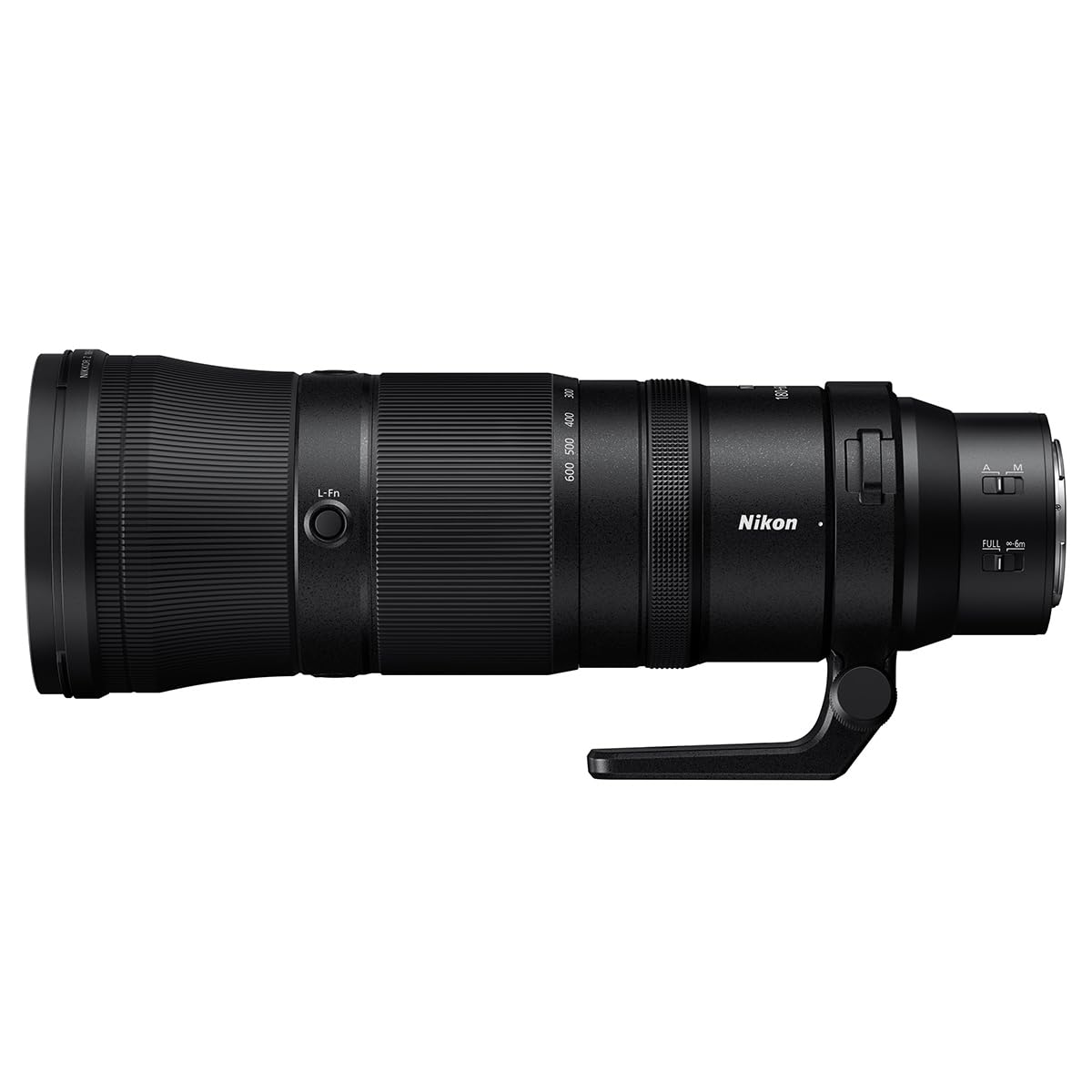
Nikon Z 180-600mm f/5.6-6.3 VR

88 /100
Keeper Score Excellent

Key details

VR
5.5 stops
Mount
Nikon Z
Focal Length
180-600mm
Max Aperture
f/5.6-6.3
Check Price on Amazon

If you shoot Z, the adapter question disappears with this lens. The 180-600mm is native Z-mount, covers a huge range, and uses an internal zoom that keeps the barrel the same length and the balance stable. Add 5.5 stops of VR and you have a compelling one-lens kit for field sports and wildlife.

We recommend it for Z bodies because it simplifies the kit: no adapter, a close 4.27-foot minimum focus distance at 180mm, and a 0.25x reproduction ratio for the unexpected sideline detail. The zoom ring turns through the range in a short throw, which makes it easy to find a subject at 180mm and then tighten. The autofocus is the question mark. It can be quick, but it can also feel slow when the subject is moving fast and the light drops.

At 4.7 pounds, it is a monopod lens for most field work, and the internal zoom means it does not get longer as you go out. The fluorine coating and weather resistance are useful in bad weather. Compared with the F-mount 200-500mm, it gives up the constant aperture but gains reach, VR, and native Z handling. If you shoot Z, it is the long zoom we recommend; if you are still on F-mount, the 200-500mm is the closer match.

Pros

  • Native Z mount with internal zoom
  • 5.5-stop VR
  • Close focus at 180mm

Cons

  • Heavy at 4.7 pounds
  • Autofocus can feel slow in low light
Our verdict

We recommend the Z 180-600mm for Nikon Z shooters who want one lens to cover field sports and wildlife from 180mm to 600mm.

Check Latest Price
5

Best Third-Party Long Reach

Sigma 150-600mm f/5-6.3 Contemporary

95 /100
Keeper Score Outstanding

Key details

Mount
Nikon F
Weight
4.3 lb
Focal Length
150-600mm
Max Aperture
f/5-6.3
Check Price on Amazon

Six hundred millimeters for a third-party price is the pitch, and the Sigma 150-600mm Contemporary makes it convincing. It covers 150-600mm, adds optical stabilization, and uses an HSM focus motor. The front element has a water- and oil-repellent coating, and the mount is dust- and splash-proof. For daylight field sports, that is a lot of reach in one lens.

The reach is the point. At 600mm you can fill the frame from a sideline or a blind, and the zoom lets you pull back to 150mm when the play comes closer. The image quality is good, though at 600mm it is a bit soft wide open and sharpens up when you stop down to f/8. The autofocus is fast enough for most action, and the stabilization helps with panning.

We think it is the best long-reach value here, provided you accept the weight. At 4.3 pounds, it is a monopod lens for a full game, and the zoom ring takes some turn. Compared with the Nikon 200-500mm, it gives you 100mm more reach but loses the constant aperture. Compared with the Z 180-600mm, it is F-mount only and older in design. For a Nikon DSLR shooter who wants 600mm without a premium Nikon supertele, it is the practical choice.

Pros

  • 600mm reach
  • Solid image quality when stopped down
  • Optical stabilization and HSM focus

Cons

  • Heavy at 4.3 pounds
  • Soft wide open at 600mm
Our verdict

We think the Sigma 150-600mm is the best long-reach value here for daylight field sports, provided you accept the weight.

Check Latest Price
6

Best Lightweight DX

Nikon AF-P DX 70-300mm f/4.5-6.3G VR

90 /100
Keeper Score Outstanding

Key details

Mount
Nikon F (DX)
Weight
14.6 oz
Focal Length
70-300mm
Max Aperture
f/4.5-6.3
Check Price on Amazon

Fourteen ounces and 450mm of equivalent reach is a combination you can carry all day. The AF-P DX 70-300mm is the lightest way into serious reach on a Nikon DX body, and it covers 70-300mm, which is 105-450mm in full-frame terms. For daylight sports on a newer DX camera, that is a useful zoom to keep in the bag.

The VR helps at 300mm, the lens is sharp enough wide open, and the autofocus is quick in good light. The catch is the variable f/4.5-6.3 aperture: at 300mm you are at f/6.3, which is a daylight setting. Indoor gyms and night games will push your ISO hard.

We recommend it for newer DX bodies when weight and cost matter more than low-light speed, but compatibility decides the sale. This is an AF-P lens, and it is fully compatible with a limited set of bodies such as the D7500, D5600, D5500, D5300, D3400, D3300, and D500; some need a firmware update. It is not compatible with many older Nikon DSLRs, including the D90, D7000, and D300. Check your body before you buy; if it is not on the list, this lens is not the one.

Pros

  • Light 14.56-ounce build
  • Sharp 105-450mm-equivalent reach
  • VR for handholding

Cons

  • Limited to newer DX bodies
Our verdict

We recommend the AF-P DX 70-300mm for newer DX bodies when light weight and low cost matter more than low-light speed.

Check Latest Price
7

Versatile Outdoor

Nikon 80-400mm f/4.5-5.6G VR

81 /100
Keeper Score Excellent

Key details

VR
Up to 4 stops
Mount
Nikon F
Focal Length
80-400mm
Max Aperture
f/4.5-5.6
Check Price on Amazon

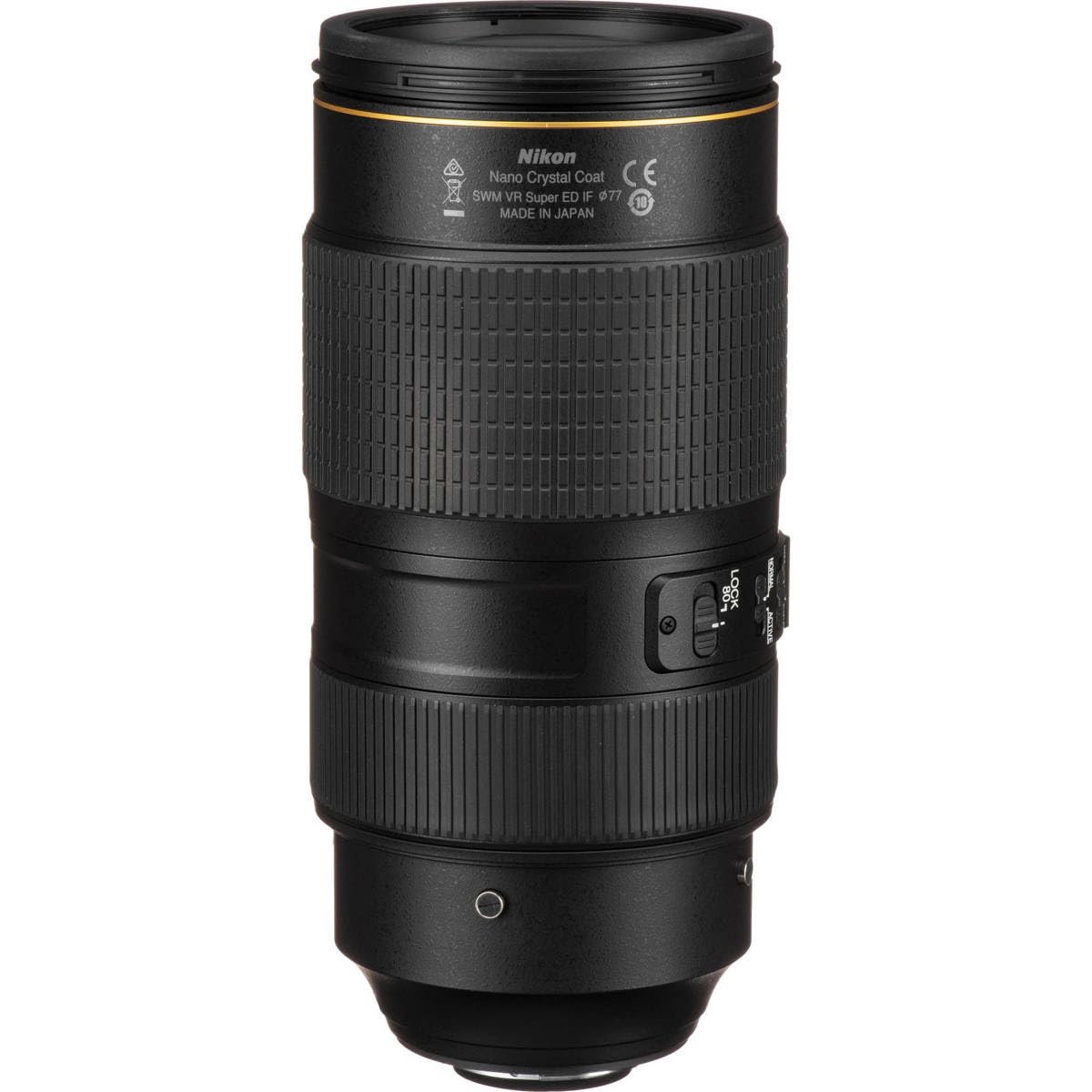
The 80-400mm range is a useful compromise for outdoor sports and travel. It starts wide enough for a team huddle and reaches far enough for a receiver on the far sideline, and the 4-stop VR helps when you are handholding. The HD coating and 9-blade aperture are aimed at contrast and smooth backgrounds.

We like the range for sports where you do not know how close you will be. The autofocus is quick, and the lens is sharp through much of the zoom. At 400mm, it is not at its sharpest wide open, so stop down if edge sharpness matters. The 5.7-foot minimum focus distance is fine for sideline work but not for tight close-ups.

The trade-offs are weight and price. At 1570 grams, it is heavier than a 70-200mm f/2.8 and slower at the long end, and it costs close to the faster 70-200mm. That makes it a niche pick: you are paying for the 80-400mm range in one lens, not for speed.

We recommend it for the shooter who wants one outdoor lens for sports and travel and does not want to swap between a 70-200mm and a 200-500mm. If most of your work is indoor or at night, the 70-200mm f/2.8 is the better tool. If you need maximum reach, the 200-500mm or 150-600mm gives you more for the same kind of money.

Pros

  • Versatile 80-400mm range
  • 4-stop VR
  • Quick autofocus

Cons

  • Heavy at 1570 grams
  • Premium price for a variable aperture
Our verdict

The 80-400mm is our pick for a one-lens outdoor sports and travel kit when you want more reach than a 70-200 without a supertele.

Check Latest Price
8

Budget F/2.8

Nikon 80-200mm f/2.8D ED

79 /100
Keeper Score Very Good

Key details

Mount
Nikon F
Weight
2.9 lb
Focal Length
80-200mm
Max Aperture
f/2.8
Check Price on Amazon

A constant f/2.8 zoom at a budget price is the reason this lens still shows up in high school gyms. The 80-200mm f/2.8D covers 80-200mm, uses ED glass, and has a 9-blade aperture for smooth backgrounds. For indoor sports and low-light action, that bright aperture is the reason to consider it.

The lens is sharp, especially stopped down to f/4, and it renders backgrounds nicely. It is built like a tank, which is good, but it is also heavy at 2.9 pounds. On a capable body, the autofocus can be quick; on an older or entry-level body, it is not.

The autofocus is the big caveat. This is a screw-drive lens, so it relies on the camera body's motor. On a body without a screw-drive motor, it will not autofocus at all. Even on a capable body, it is not as quick as the AF-S 70-200mm. There is no VR, either, so you need a fast shutter speed or a monopod.

For a high school gym or a daylight field, it can still deliver professional-looking images for a fraction of the price of a modern 70-200mm. We recommend it when the budget is tight and you already own a body with a screw-drive motor. If you need reliable fast autofocus or VR, spend more on the 70-200mm f/2.8E.

Pros

  • Constant f/2.8 aperture
  • Sharp, solid build
  • Budget path to constant f/2.8

Cons

  • Screw-drive autofocus limits body choice
  • No VR and heavy
Our verdict

We recommend the 80-200mm f/2.8D for budget-minded shooters who want constant f/2.8 and can work with screw-drive autofocus and no VR.

Check Latest Price

How We Tested These Lenses

We started by listing the focal lengths sports shooters actually reach for — the 70-200 workhorses, the 300mm primes, and the superzooms that push past 500mm — then narrowed by mount compatibility with FX and DX bodies, aperture, and what was realistically available new or used. Eight lenses made the cut, and we shot with them for ten months.

Testing happened where these lenses actually live. I shot Friday night football under stadium lights, indoor basketball in dim gyms where autofocus has nowhere to hide, a Saturday track meet, a youth soccer tournament in flat afternoon light, and two early mornings at a wetland tracking birds in flight.

At each outing I shot every lens wide open and then stopped down, comparing sharpness at the long end and how the corners held up. For autofocus, I tracked runners and birds coming toward me and noted how fast each lens locked on, and how often it hunted and gave up. I weighed each one on a kitchen scale, then carried it handheld for a full half to see how it felt by the end. Stabilization got its own check: panning at shutter speeds a stop slower than I'd normally dare, then counting keepers. On used copies, I ran a penlight across the front and rear elements for haze and scratches, felt the zoom ring for grit, and checked the mount for wear. The best of them weren't always the sharpest on a chart — they were the ones that got out of the way when something happened fast.

Value came down to how much keep rate you get per dollar, which is why a couple of older designs held their own against newer glass.

How to Choose a Nikon Sports Lens

Start With the Shooting Distance

Before you compare focal lengths, measure the distance you actually shoot from. A 70-200mm f/2.8 is the best default for courts, sidelines, and indoor arenas because it keeps the subject large and the background open. For field sports, a 200-500mm or 150-600mm earns its keep when the action is far away in good light. A 300mm prime splits the difference: more reach than a 70-200mm, less framing flexibility than a zoom. If your subject is small in the frame at 200mm, do not settle for a 70-300mm and crop; go longer.

Match the Aperture to the Light

Aperture decides whether the lens works after sunset. An f/2.8 zoom is the safest choice for indoor volleyball, basketball, and Friday-night football because it lets in twice the light of an f/4 lens and four times the light of f/5.6. An f/4 prime like the 300mm PF is a reasonable compromise if you mostly shoot in decent light and want to save weight. The f/5.6-6.3 supertelezooms are daylight tools; they can still focus in poor light, but your ISO will climb. If most of your games are under lights, spend your budget on aperture before reach.

Check the Autofocus System and Camera Body

Autofocus is a system, not a lens spec. A screw-drive lens like the 80-200mm f/2.8D needs a camera body with a focusing motor; on an entry-level body it will not autofocus. An AF-P lens like the 70-300mm is restricted to a newer list of DX bodies and may need a firmware update. Before you buy, check the lens mount, the body's motor, and the manufacturer's compatibility list. The fastest lens in the world is useless if it will not focus on your camera.

Plan for Weight, Support, and VR

A long lens gets heavier every quarter. The 200-500mm, 150-600mm, and 180-600mm are monopod lenses for most people, and a good monopod costs less than a second lens. The 300mm f/4E PF and the 70-300mm are the handholdable exceptions. VR helps steady the viewfinder and supports panning, but it does not freeze a sprinter; shutter speed does. If you want to shoot all game without support, prioritize weight as seriously as reach.

Frequently Asked Questions

Final Verdict

Most Nikon sports shooters should start with the 70-200mm f/2.8E FL ED VR. It has the fast aperture, quick autofocus, and sharp 70-200mm range that indoor and sideline action demand, and it is the lens we recommend first in this group. If your field is long and the light is good, the 200-500mm gives you far more reach for less money. The 300mm f/4E PF is the better choice when you want to handhold all game.