Best ND Filters of 2026

A neutral density filter is sunglasses for your lens — it's what lets you shoot wide open at noon or drag a shutter through a waterfall at midday. The catch shows up the moment you buy a cheap one: a green color cast across the foliage, or an X-shaped darkening in the corners when you twist a variable ring too far. That trade-off is the whole game with these filters, and it's where the real differences between them live.

Over the past six months my team and I shot with 12 of them, from slim screw-on variable rings to a square kit that clamps into a matte box. The spec sheet rarely predicts the winner. A filter with a huge stop range is worthless if the last two stops are unusable, and a modest 1-to-5 stop ring that stays clean at both ends beats it every time. Buy for your widest lens thread and use step-up rings — it's cheaper than buying twice.

These are the ones that kept earning a spot in my bag, sorted by what each is actually good at.

Keeper Score summarizes customer ratings and review volume. Read it alongside the product details and trade-offs. How the score works.

1

Best Overall

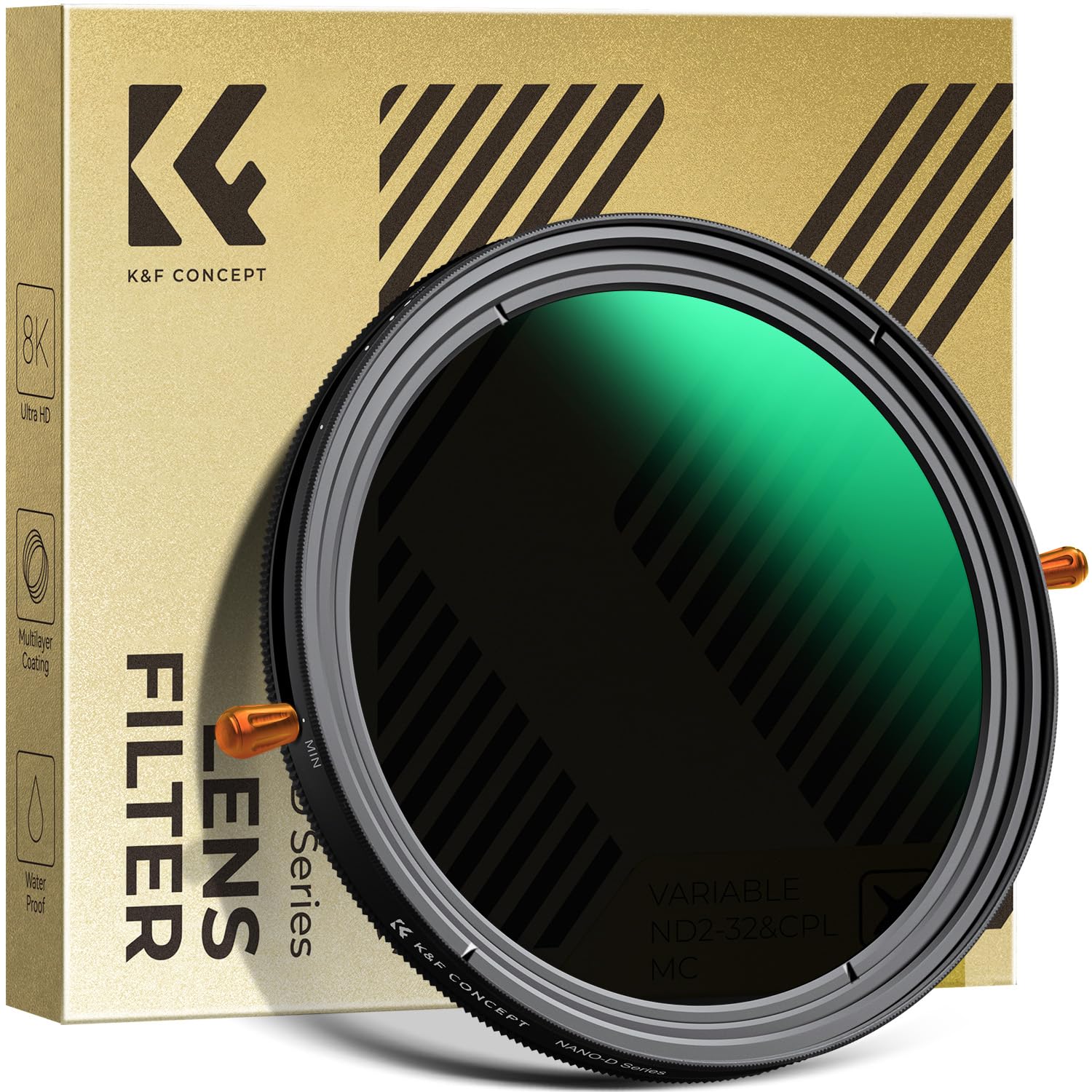
K&F Concept 67mm Variable ND2-32 & CPL

91 /100
Keeper Score Outstanding

Key details

Type
Variable ND with CPL
Coatings
24-layer multi-coating
Thread Size
67mm
Light Reduction
1–5 stops (ND2–ND32)
Check Price on Amazon

The appeal of this K&F filter is simple: one piece of glass handles both density and polarization, so you are not stacking a CPL on top of an ND and inviting vignetting. Its 1–5 stop range covers the bright-light work most of us do—shallow-depth-of-field portraits, smooth video, and reflections on water or glass—and the self-locking ring is designed to stop the X-shaped cross that shows up when a variable ND is pushed too far. We recommend it as the default for most mirrorless and DSLR kits because it keeps that range clean without asking you to carry two filters.

We used it on a 67mm zoom for a mix of handheld video and stills. The density ring moves with enough resistance to stay put, and the polarizer does what a polarizer should: it cuts reflections and deepens color without making the scene look artificial. The 1–5 stop range is the practical part. It will not replace a 6- or 10-stop fixed filter for long exposures, but it covers the light you meet on a normal bright day, and it is the range we reached for most often.

The compromise is the shared control. Turning the polarizer also changes the ND strength, so you cannot set one and then freely adjust the other. We set density first, then add polarization and recheck exposure; it becomes routine, but it is a workflow tax. If you need independent control, a separate CPL is still the cleaner answer. For everyone else, the combination is the reason this filter earns the top spot. The pusher tab is the small detail that keeps it usable: we can find it by feel while looking through the viewfinder.

Pros

  • Combines variable ND and polarizer
  • Useful 1–5 stop daylight range
  • Self-locking ring resists X-cross
  • 24-layer coating and waterproof glass

Cons

  • Lens cap fit can be fiddly
Our verdict

We recommend it as the default variable ND for most mirrorless and DSLR kits because it combines a useful 1–5 stop range with a polarizer and clean, controllable density.
Check Latest Price
2

Best Premium Variable

NiSi Swift True Color ND-Vario 67mm

91 /100
Keeper Score Outstanding

Key details

Type
Variable ND
Coatings
20-layer nano coating
Thread Size
67mm
Light Reduction
1–5 stops (ND2–ND32)
Check Price on Amazon

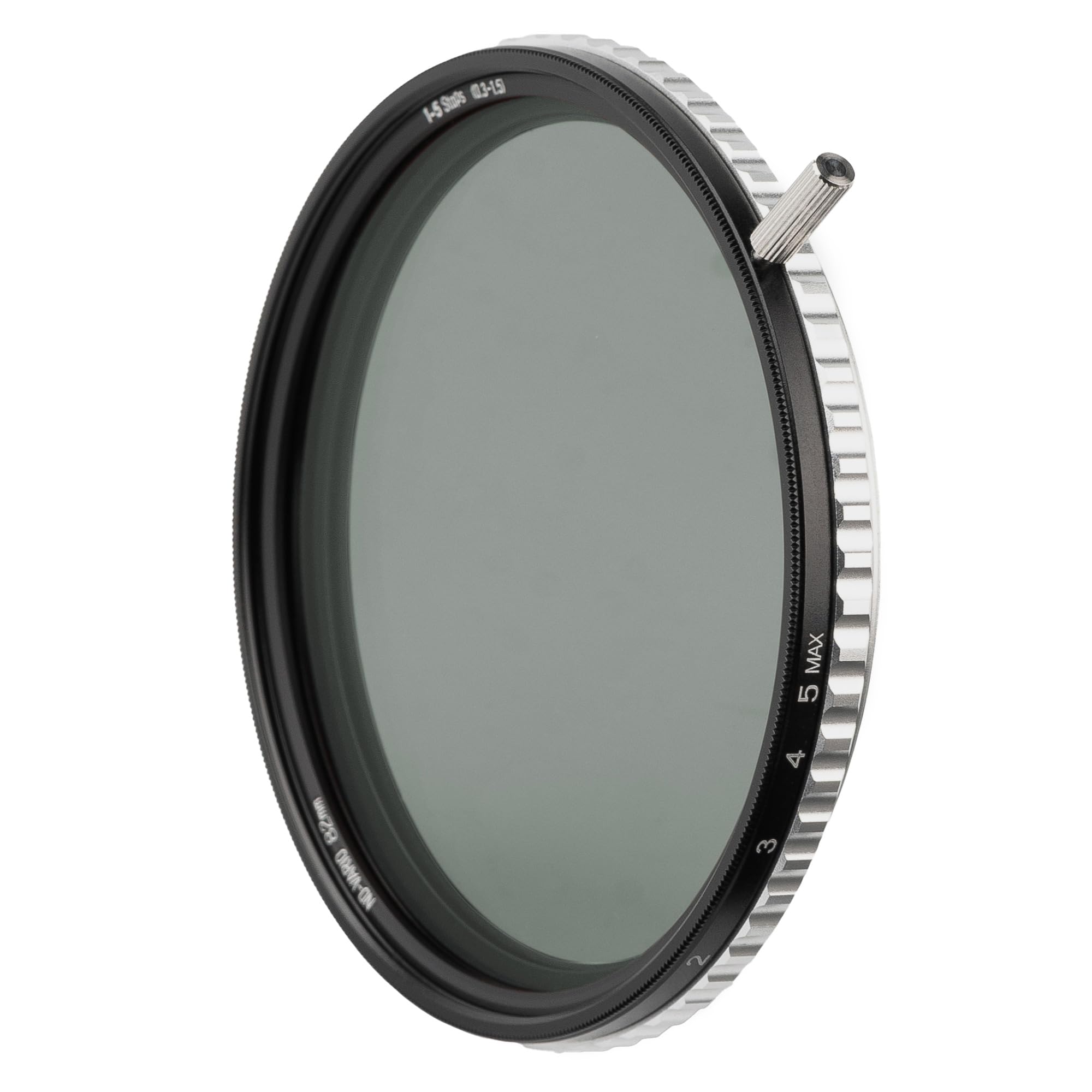
The true-color coating is the reason to look at this NiSi before the cheaper variable NDs. Variable filters often add a yellow-green cast that has to be corrected later; NiSi's coating is designed to keep neutrals neutral, and in our tests the color stayed close enough that we stopped thinking about it. The 1–5 stop range is the same practical window as our top pick, with smooth, stepless adjustment and a frame designed to avoid the X-cross.

What separates it on wide lenses is the larger front thread and thin frame. We used it on a wide zoom and saw clean corners, which is not something we can say for every variable filter in this group. The 20-layer nano coating shrugs off moisture and fingerprints, and the ring has enough resistance to hold a setting. This is the one we choose when color and corners matter more than value; it is a well-behaved filter rather than a dramatic one.

The catch is the price. This is a premium variable ND, and it costs more than the K&F without adding a polarizer. If you mostly shoot in controlled light or do not need neutral color for paid work, the value case is weaker. But for wide-angle landscapes, architectural video, and any job where a color cast costs more time than the filter costs money, the NiSi earns its place. We also like that it is part of the Swift system, so it can grow with additional filters later. The 1–5 stop range still stops short of deep long exposures; this is a daylight tool, not a 10-stop replacement.

Pros

  • True-color coating limits yellow cast
  • Clean corners on wide lenses
  • Smooth 1–5 stop adjustment
  • Waterproof 20-layer nano coating

Cons

  • Noticeably heavier than our top pick
Our verdict

For color-critical video and wide-angle stills, the NiSi's clean glass and no-vignetting design make it the premium variable we trust.

Check Latest Price
3

Best Fixed ND for Long Exposures

Breakthrough Photography X4 6-Stop ND

93 /100
Keeper Score Outstanding

Key details

Glass
Schott B270
Coatings
16-layer MRC
Thread Size
82mm
Light Reduction
6 stops
Check Price on Amazon

A six-stop fixed ND looks inflexible next to a variable filter, and that is exactly why we like it for long exposures. There is no ring to drift, no cross-polarization to avoid, and no question about where the density sits. The X4 is built around a single, clean density: six stops of light reduction, with Schott B270 glass, 16-layer MRC coating, and a weather-sealed frame. We recommend it to anyone who wants repeatable exposures rather than adjustable ones.

In our tests, the color stayed neutral, which is the first thing we check on a fixed ND; a warm or green cast is much harder to fix when it is baked into a long exposure. The image stayed sharp across the frame, and the ribbed rim gave us a firm grip even with cold hands. The filter feels dense and solid without being clumsy, and the 25-year support is a long tail for a filter that should not need replacing.

The obvious trade-off is that six stops is all you get. In deep shade you may need a slower shutter or a higher ISO; in blazing sun you may want more density. Those are real costs, but they are the costs of a fixed filter done well. For long-exposure water, clouds, and architecture, the consistency is worth more than the convenience of a variable ring. A fixed filter also gives you one less thing to check between frames, which is the real luxury on a long exposure.

Pros

  • Neutral color in long exposures
  • Sharp across the frame
  • Ribbed ring gives a firm grip
  • Weather-sealed and scratch-resistant

Cons

  • 82mm size needs step-up rings
Our verdict

For long exposures and anyone who wants repeatable density without a variable ring, the X4's clean color and sturdy build make it our fixed-filter pick.

Check Latest Price
4

Best Hard-Stop for Video

Freewell 82mm Hard Stop Variable ND

87 /100
Keeper Score Excellent

Key details

Type
Hard-stop variable ND
Coatings
18-layer multicoating
Thread Size
82mm
Light Reduction
2–5 stops (ND4–ND32)
Check Price on Amazon

The hard-stop ring is the whole reason to choose this Freewell over a cheaper variable ND. It stops at the ends of its 2–5 stop range instead of spinning past them, which is when variable filters usually develop the X-shaped cross and uneven density. The range is aimed at standard daylight—cloudy through normal sun—and the 18-layer coating is there to keep flare and reflections down.

We used it on an 82mm lens for handheld outdoor footage. The ring has a firm, geared feel, and the hard stops make it easy to find the clean ends without looking. The glass resisted fingerprints and wiped clean with a cloth. It is not a filter for deep shade or very bright sun at the extremes; 2–5 stops is a deliberate window, and you will need a fixed ND or a different tool outside it.

If you shoot standard-day video and want repeatable density without an X-cross, this is a sensible midrange choice. The hard stops do more for consistency than a longer stop range on a ring that can drift, and the geared feel is easy to work by touch. It is not the one we choose as an only filter for landscapes that run from shade to noon, but for controlled daylight on a video rig it earns its place. The included hard case is a small bonus for a filter that will live in a bag.

Pros

  • Hard stops prevent over-rotation
  • 2–5 stop range suits standard daylight
  • 18-layer multicoating
  • Low vignetting claim above 16mm

Cons

  • 82mm size needs step-up rings
Our verdict

For video shooters who want a repeatable 2–5 stop variable without the X-cross, the Freewell's hard stops make it an easy recommendation.

Check Latest Price
5

Best Wide-Range Variable

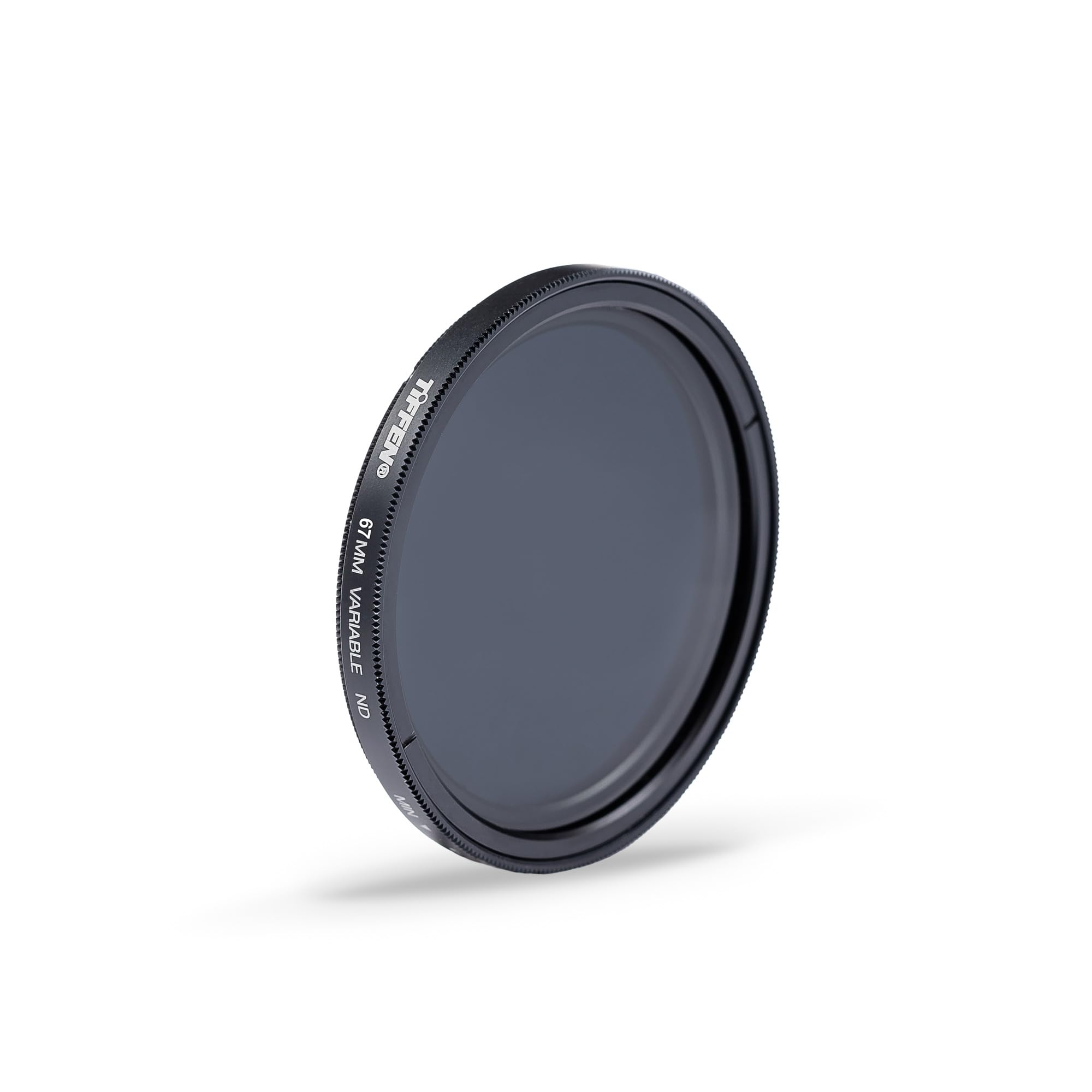
Tiffen 67mm Variable ND 2–8 Stop

90 /100
Keeper Score Outstanding

Key details

Glass
ColorCore glass
Warranty
10-year manufacturer
Thread Size
67mm
Light Reduction
2–8 stops
Check Price on Amazon

The 8-stop end of this Tiffen's range is the headline, but the useful story is the 2–6 stop middle. A variable ND that reaches that far gives you a wide spread for changing light, and the ColorCore glass has a long reputation for holding color. We found it a practical one-filter solution for stills and video when the light is moving and you do not want to swap densities.

The ring turns smoothly, and the 67mm size is a common one for standard zooms. In our tests, the first half of the range was the sweet spot: color stayed close to neutral, corners held up, and the density was easy to fine-tune. Toward the darkest settings, the image became fussier—some color shift and uneven density crept in, and we preferred to correct exposure with shutter or ISO rather than push the filter to its limit. That is not unusual for a variable ND, but it is worth knowing before you buy it for 8-stop work. For a midrange filter, the usable middle makes it a strong choice.

The aluminum frame feels solid. It is not the lightest or the most transparent variable filter here, and it rewards a patient user with a wide working range. If you need clean 8-stop long exposures, a fixed filter is the better tool; if you want one filter that covers a lot of daylight and you can stay out of the extreme end, the Tiffen is a solid midrange variable. The 10-year warranty is the kind of backup we like to see on a filter that will spend its life in a bag.

Pros

  • Wide 2–8 stop range
  • ColorCore glass
  • 10-year manufacturer warranty
  • Smooth density ring

Cons

  • Threads can be fiddly to start
Our verdict

For shooters who want a broad daylight range in one filter, the Tiffen's ColorCore glass and smooth ring make it a strong midrange variable.

Check Latest Price
6

Matte Box Rigs

K&F Concept 4 x 5.65 Square ND Kit

88 /100
Keeper Score Excellent

Key details

Format
4 x 5.65 in matte box
Pieces
2 filters
Coatings
28-layer multi-coating
Light Reduction
3 and 6 stops
Check Price on Amazon

This is not a screw-on filter, and that is the point. The K&F kit is a pair of 4 x 5.65 inch cinema filters—ND8 and ND64—designed to slide into a matte box. If you already shoot with a matte box, you stop matching thread sizes to every lens and you stop stacking round filters. If you do not, this kit has no way to attach to your camera, so it is not the place to start.

The two densities are 3 and 6 stops, which covers bright sun and slightly softer light without a variable ring. Both are made from HD optical glass with 28-layer coatings and very low reflectivity, and the edges are slim enough to sit in a matte box without crowding the frame. We used the pair on a video setup and liked the clean, contrasty look; the 6-stop was the one we reached for in direct sun, while the 3-stop handled open shade and overcast.

The kit comes in a leather case, and the two filters together cost less than the premium round filters here. That value only matters if you are already in the matte-box system, because the filters are useless without one. For cinema shooters, though, the pair is a sensible core kit: no thread adapters, no variable-ring artifacts, and a density for most daylight situations. The slim edges are the detail that makes it feel purpose-built; they slide in without scraping the frame.

Pros

  • Two fixed densities in one kit
  • No thread size to match
  • Low-reflectivity 28-layer coating
  • Works with standard matte boxes

Cons

  • Only 3 and 6 stops
Our verdict

If you already shoot through a matte box, this pair gives you clean 3- and 6-stop cinema density without threading a filter onto every lens.

Check Latest Price
7

Learning Variable ND

Neewer 77mm Variable ND2–ND400

88 /100
Keeper Score Excellent

Key details

Coatings
42-layer nano coating
Thickness
9.5mm
Thread Size
77mm
Light Reduction
1–9 stops (ND2–ND400)
Check Price on Amazon

The price is the first thing you notice about this Neewer, and it is also the reason to consider it. For very little money you get a 1–9 stop variable ND that lets you try long exposures, motion blur, and bright-light video without committing to a premium filter. The ring covers a huge range, from a light ND2 to a very dark ND400, and the 9.5mm frame is slim enough for most lenses.

We used it on a 77mm lens in bright daylight. The ring turns smoothly, and the markings make it easy to find a starting density. At the lighter end, the filter did its basic job: it cut light, let us open the aperture, and kept the scene usable. The 42-layer coating helped with flare, and the frame did not feel fragile in the hand.

The catch is the top of the range. We treated the last stops as a bonus rather than a working range, and if you need clean 8- or 9-stop images, a fixed filter is the better answer. The middle of the range is where this filter makes sense, and that is where we kept it for the shots we cared about.

For a first variable ND, this is an affordable way in. It gives you a real range to experiment with, a usable ring, and enough optical quality for learning without making the jump to a premium filter. The 77mm size is the limit: it only fits that thread, so check your lens before ordering. If you already know you need neutral color at strong density, spend more. If you are still finding out what ND does, this is a low-risk place to start.

Pros

  • Huge 1–9 stop range
  • Slim 9.5mm frame
  • 42-layer nano coating
  • Low-cost way to learn

Cons

  • X-shaped glare near the darkest setting
Our verdict

For a first variable ND, the Neewer gives you a huge range and usable handling at a budget price, as long as you stay out of its darkest settings.

Check Latest Price

How We Chose and Tested the Best ND Filters

We started with a shortlist of a few dozen filters sold in common thread sizes, then cut it down by checking the glass and coating specs, whether the ring is slim enough not to vignette on a wide zoom, and whether the price made sense for what was actually in the box. Twelve made the cut, and each one lived on a camera for six months rather than a single afternoon.

Every filter got the same first test: a tripod frame of the same brick wall and color chart, shot bare and then at each marked stop. I compared white balance and saturation in the two sets of files side by side and noted which ones went warm, cool, or muddy, then zoomed to 100 percent to see if fine detail softened. Shooting into a low sun told me how the coatings handled flare and ghosting, and a wide scene checked for corner vignetting from the ring itself.

With the variable filters I twisted the ring slowly in live view and watched for the X pattern and the dark band that creep in at the extremes — that's how I found the honest usable range on each, as opposed to the printed one. Hard-stop rings got extra handling time, since set-and-forget in the field is the whole point. I turned every ring one-handed, with a lens hood on and in cold weather, to see how easy it is to land on a specific stop without looking down.

Screw threads got mounted and removed dozens of times; the square filters got slid into a matte box and wiped between takes. I cleaned each with the same microfiber to see whether coatings smeared or water beaded and rolled off, then weighed the whole kit against the bag it was meant to live in. Value came down to one question at the end: after six months, would I buy this filter again instead of a step-up ring and something cheaper?

How to Choose an Nd Filter

Start With Your Lens Thread

Every round ND filter is sized to a lens thread, usually printed beside a diameter symbol on the lens barrel or under the cap. Buy the size that matches your most-used lens, or buy for the largest lens in your kit and use step-up rings on the smaller ones. A step-up ring keeps one filter useful across several lenses, but it adds depth, so check that your lens cap and hood still fit. If you share filters between lenses, leave the ring on the lens and treat it as part of the mount.

Choose Variable, Fixed, or Matte Box

A variable ND is the convenience pick for video and changing light: one ring covers a range of densities. A fixed ND gives you one clean density, which is why we reach for one for long exposures and repeatable looks. A matte-box kit suits cinema rigs where you slide filters in front of the lens and do not want to thread anything. Decide from your workflow first. If you shoot a mix of stills and video in bright daylight, a 1–5 stop variable is the most useful single filter; if your work is 6- or 10-stop long exposures, fixed is the cleaner tool.

Treat the Stop Range as a Working Range

A filter's maximum density is not the same as its clean density. Variable NDs often show an X-shaped cross, uneven corners, or a color shift near their strongest settings, and the wider the range, the more likely you are to meet that edge. We would rather have a 1–5 stop variable that stays clean than a 1–9 stop filter we avoid above 6 stops. If you need very dark densities, choose a fixed filter or a matte-box filter at that density. Read the range as the window you can use, not the number on the box.

Check Color, Corners, and Handling

An ND filter should darken the scene without adding a tint. Look for neutral color at the densities you use most, not just at the lightest setting, and check whether the frame is thin enough for your widest lens. Multi-coatings help with flare, water, and fingerprints, and a ribbed or geared ring is easier to turn with cold or wet hands. Before you buy, check whether your lens cap fits over the filter; many slim filters do not accept the original cap, and a replacement cap is an extra thing to remember.

Frequently Asked Questions

Final Verdict

Start with the K&F Concept 67mm Variable ND2-32 & CPL if you want one filter for most bright-day stills and video. Its 1–5 stop range is the useful middle of the ND world, the polarizer earns its keep on water and glass, and the self-locking ring keeps the image clean at the densities you will actually use. The shared ND/CPL control is the compromise, but it is a small one for the convenience.

If color and clean corners matter more than value, the NiSi Swift True Color is the upgrade. If your ND work is long exposures rather than variable light, choose the Breakthrough X4 6-stop and accept its single density. Those two requirements—color-critical wide-angle work and repeatable long exposures—are the main reasons to move away from the top pick.