Best MagSafe SSDs of 2026

The first time my phone ran out of room mid-take, it stopped at 1:47 of what should have been a four-minute clip, and there was no second take. If you shoot ProRes or high-bitrate video on a phone, a magnetic SSD that snaps onto the back of it solves that problem in about five seconds. The catch is that not all of them stay attached, and not all of them hold their speed once they warm up.

I've spent the better part of seven months with 12 of these drives clipped to phones and laptops, and the number printed on the box turned out to be the least useful thing about any of them. What your phone actually writes at depends on its port, the cable in the box, and how the drive handles heat during a long recording. Magnet hold matters just as much — a drive that slides off in your pocket is a drive you stop trusting with footage you can't reshoot.

The picks below survived real shoots, long transfers, and a lot of jostling. Some are built for capacity, some for outright speed, and a couple are worth it mainly because they never once disconnected on me.

Keeper Score summarizes customer ratings and review volume. Read it alongside the product details and trade-offs. How the score works.

1

Best Overall

SanDisk Creator Phone SSD

87 /100
Keeper Score Excellent

Key details

Weight
1.92 oz
Capacity
1 TB
Warranty
5-year limited
Max Read Speed
Up to 1,000MB/s
Check Price on Amazon

Buy an iPhone Pro for ProRes and the arithmetic changes fast: recording to the camera roll fills the phone far sooner than people expect. The SanDisk Creator Phone SSD exists for that moment. It is a 1TB drive that snaps onto the back of a MagSafe iPhone, takes the short USB-C cable in the box, and lets an iPhone 15 or 16 Pro write ProRes 4K at 60fps straight to the drive instead of the phone.

That single-mindedness is why it is our top pick. It is the lightest drive in this group that carries both an IP65 rating and a five-year warranty — 1.92 ounces, 3.25 by 2.7 inches — and the combination is what makes it the one we recommend to someone who wants to stop thinking about storage and start shooting.

The 1,000MB/s read rating looks tame beside the 2,000MB/s claims further down this list, and that comparison flatters the wrong number. Those figures need USB 3.2 Gen 2x2 on the host, and phones do not provide a 20Gbps link. What matters on the back of an iPhone is a sustained write that keeps pace with the codec, and there is plenty of headroom here.

What you accept for it is size. At 3.25 by 2.7 inches it is a substantial square on the phone's back, more noticeable in a one-handed grip than the slim drives here — the price of a shell rated to survive a three-meter drop. A month of Adobe Creative Cloud comes in the box, a small bonus if you were going to subscribe anyway.

Pros

  • IP65 rated, survives a three-meter drop
  • Five-year limited warranty
  • 1.92 oz, lightest rugged drive here
  • Records ProRes 4K60 from an iPhone Pro

Cons

  • Costs more than the Aiffro for the same 1TB
Our verdict

We recommend it first because it is the lightest drive here with a rugged rating and a five-year warranty, and it records ProRes 4K60 without asking you to think about it.
Check Latest Price
2

Best for Long Shoots

Lexar ES5 Magnetic SSD

87 /100
Keeper Score Excellent

Key details

Weight
4.16 oz
Capacity
2 TB
Durability
IP65, drop resistant to 3 m
Read And Write Speed
Up to 2000MB/s read and 2000MB/s write
Check Price on Amazon

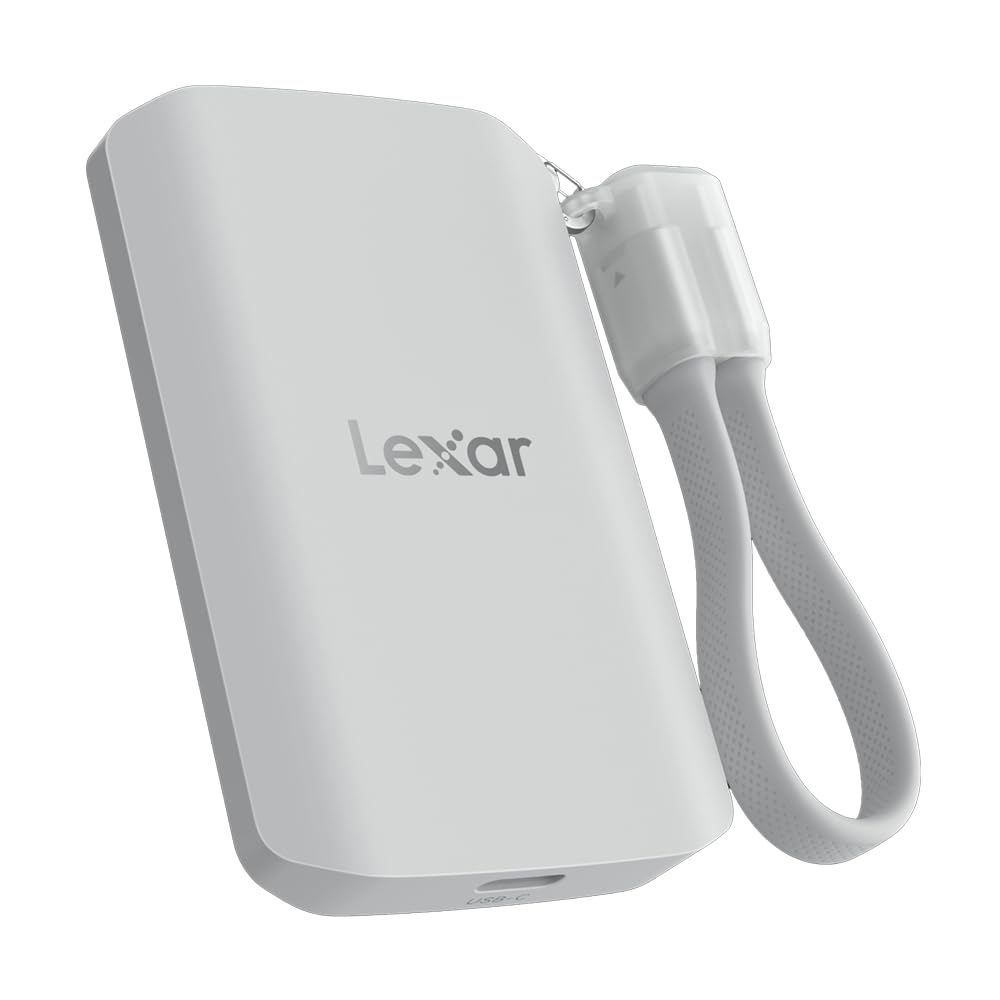
Two terabytes, 2,000MB/s reads and writes, and 4.16 ounces: the Lexar ES5 leads this set on the first two and outweighs everything else in it, at more than twice the weight of our top pick. For a shoot where the drive sits on a table, a cage, or a laptop lid rather than in your palm, that is a trade we make without hesitating.

The recording spec is the widest here: ProRes at 4K and 120fps on iPhone, Samsung Pro Video at 8K and 30fps, IP65 sealing, a three-meter drop rating, and a five-year warranty. The Lexar app adds automatic backup of phone media, the sort of convenience you stop noticing until the day it saves you. Long capture is what this drive is for, and 2TB means you are not clearing it between takes.

The one thing to understand before buying is where the speed goes. A 20Gbps host is required to see the 2,000MB/s at all, so on a phone this will not feel quicker than the 1,000MB/s SanDisk — the headroom is for the edit afterwards, when the drive is plugged into a laptop and the footage has to move. That is the deal: heavier on the phone, much faster off it.

Pros

  • 2TB, double every other pick here
  • IP65 plus a three-meter drop rating
  • Five-year limited warranty
  • ProRes 4K120 and Samsung 8K30 support

Cons

  • Priciest drive in this group
Our verdict

We rate it the capacity pick: 2TB and the fastest sustained writes in this group, built for shoots where the drive is not in your hand.

Check Latest Price
3

Best Value

Aiffro P10 Magnetic SSD

81 /100
Keeper Score Excellent

Key details

Weight
1.45 oz
Capacity
1 TB
Thickness
6.5 mm
Max Transfer Speed
Up to 2000MB/s
Check Price on Amazon

Cost is where the Aiffro P10 makes its case: 1TB and a 2,000MB/s USB 3.2 Gen 2x2 rating for noticeably less than our top pick, in a body 6.5 mm thick that weighs 41 grams. If you want the fast, unobtrusive option without spending more than the job requires, this is the drive we point to.

The specifications are good rather than merely cheap. A single SM2320 controller keeps the board simple, the aluminium shell doubles as a heat spreader, and ProRes 4K at 60fps is supported on a current iPhone. What struck us in use is how little it changes the phone: 41 grams on the back barely registers, and the flat profile sits close against the case instead of hanging off it.

Two practical notes. It runs warm during long transfers — normal for a metal-cased drive, worth knowing if the phone is wrapped in a thick case — and the box contents list only the drive itself, so have a short USB-C cable ready before the first shoot.

Pros

  • 41 g and 6.5 mm on the phone
  • Up to 2,000MB/s over USB 3.2 Gen 2x2
  • Cheapest of the 2,000MB/s 1TB drives

Cons

  • Two-year warranty against five-year rivals
Our verdict

This is the fast 1TB drive we point to when the budget has a ceiling: 41 grams, 2,000MB/s, and nothing missing that a phone shooter needs.

Check Latest Price
4

Best for All-Day Recording

TWOPAN Magnetic Portable SSD 1TB

77 /100
Keeper Score Very Good

Key details

Weight
0.82 oz
Capacity
1 TB
Extra Port
USB-C PD 3.0
Read And Write Speed
990MB/s read, 960MB/s write
Check Price on Amazon

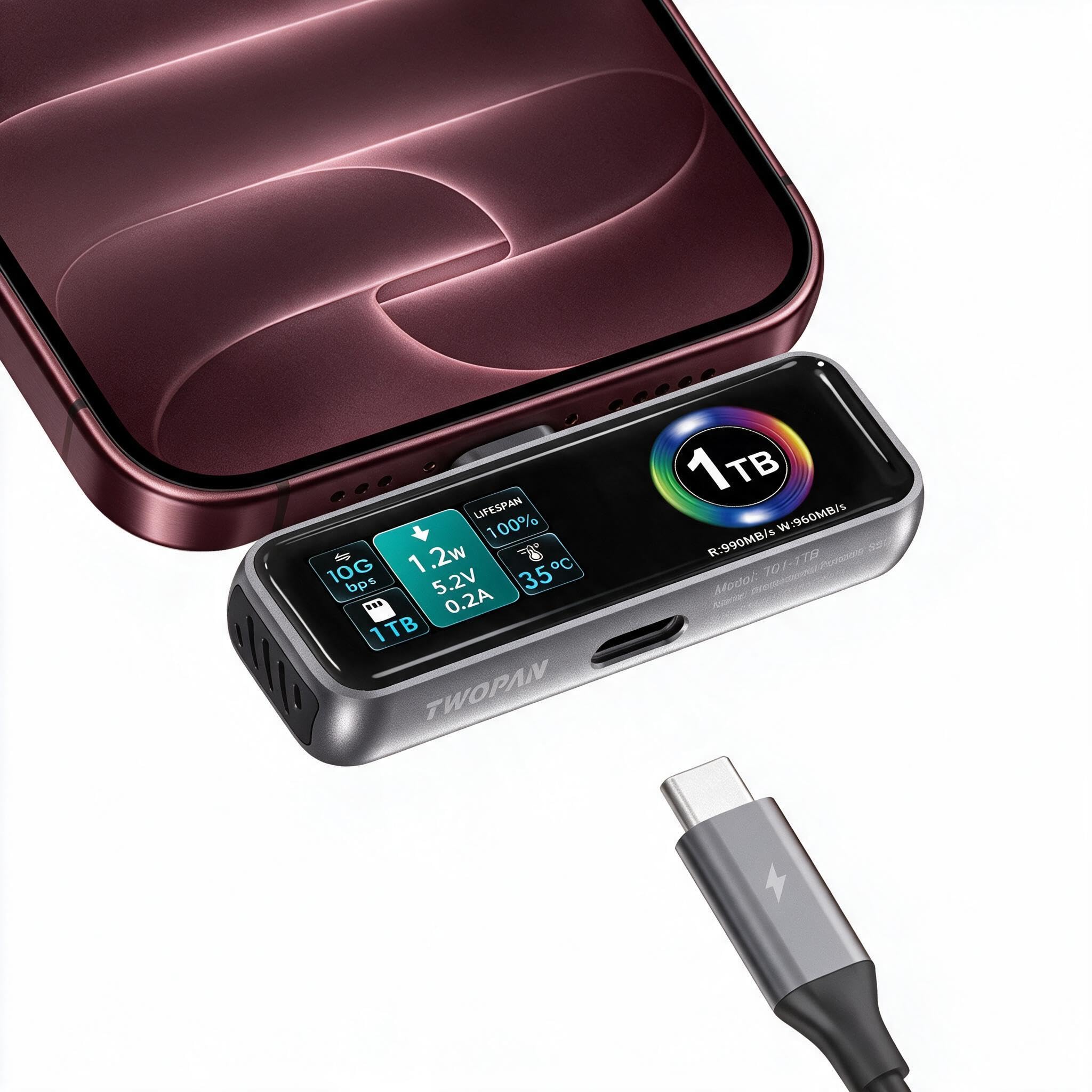
Most drives in this group take a port away from your phone. The TWOPAN T01 gives one back: a USB-C PD 3.0 port on the drive itself, so a charger plugged into the drive keeps the iPhone topped up while it records. Over a long day that is the difference between finishing the shoot and hunting for a battery.

That port is why this is our pick for all-day recording, but it is not the only extra. A small LCD shows transfer speed, temperature and drive health at a glance, which is genuinely useful when you are deciding whether the last take is safe. A noiseless fan keeps sustained writes from cooking the enclosure, and TLC NAND rather than QLC is the more meaningful spec of the two — it is what keeps write speeds from sagging once the cache fills.

At 0.82 ounces it is the lightest drive here, and at 2.5 by 1.3 inches it hides behind the phone rather than hanging off it. The 990MB/s read and 960MB/s write ratings are the honest part of the package: half what the 2x2 drives claim, and something you feel on a laptop transfer rather than on a phone.

Pros

  • Pass-through USB-C PD keeps the phone charged
  • LCD tracks speed, temperature, drive health
  • 0.82 oz, lightest drive in this group
  • TLC NAND for steadier sustained writes

Cons

  • Highest price among the 1TB drives
  • 18-month warranty
Our verdict

If your shooting days run long, the pass-through port and the status screen make this the drive we reach for.

Check Latest Price
5

Best for Phone-To-Laptop Work

OSCOO MD200 Magnetic SSD

85 /100
Keeper Score Excellent

Key details

Weight
1.7 oz
Capacity
1 TB
Warranty
3-year
Max Transfer Speed
Up to 2000MB/s
Check Price on Amazon

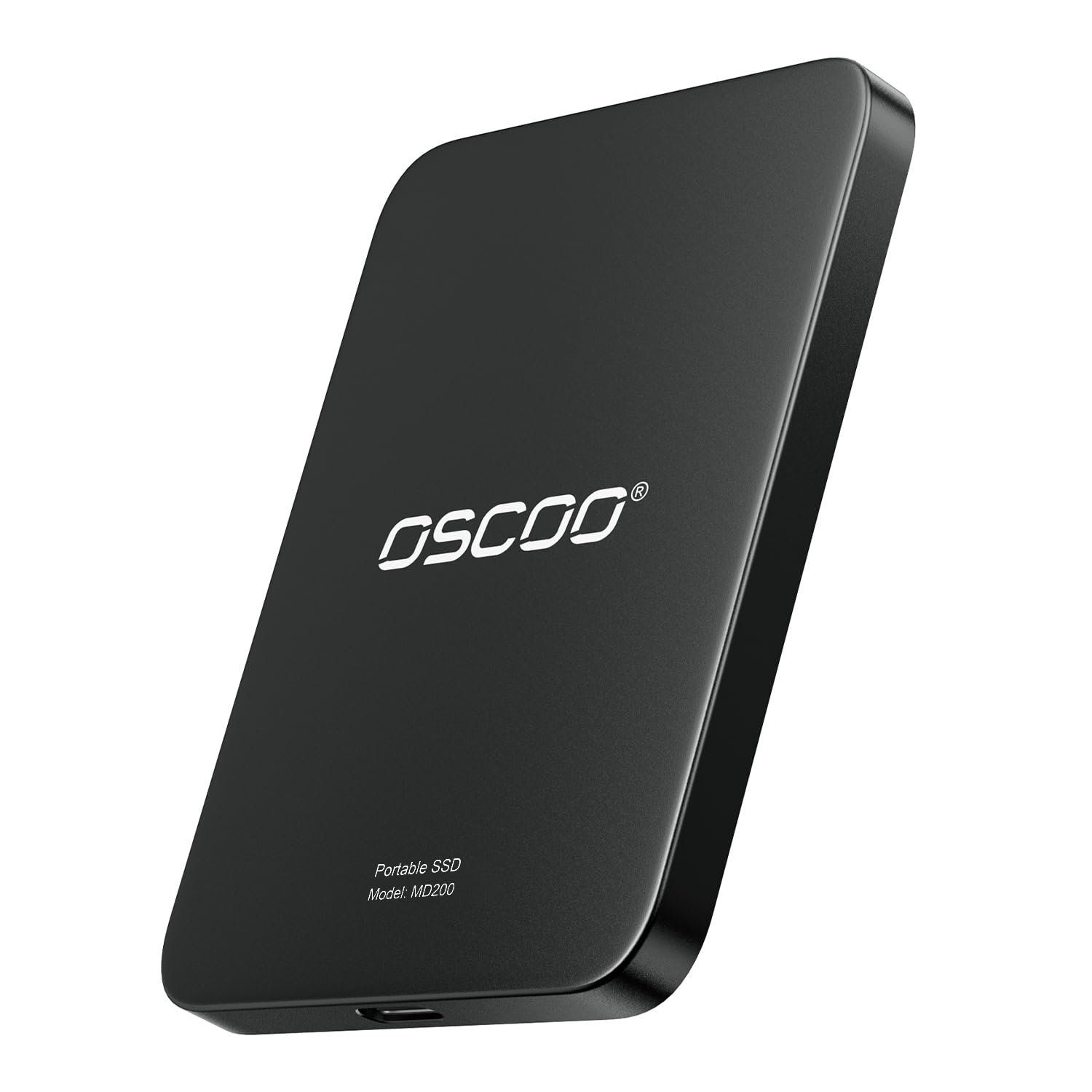
Two drives here claim 1TB at 2,000MB/s; the OSCOO MD200 is the aluminium one, and the one that arrives preformatted exFAT so it can go from a phone to a laptop without a reformatting detour.

That format is the unglamorous detail that saves an evening: the same drive mounts on iPhone, Mac, Windows and Android as it comes. The 48.3-gram aluminium body handles heat while a large folder crosses over, and the 2,000MB/s USB 3.2 Gen 2x2 rating is a figure you can compare directly with the rest of the fast group — it is the same class of number, not a marketing multiplier.

It earns its place as the second drive in a bag rather than the only one. The phone job is handled competently — magnets that hold, ProRes capture supported, photo libraries moving quickly — but if you shoot outdoors, the IP65 drives above are the safer default. For anyone whose footage ends up on a laptop most nights, that is an easy trade to accept.

Pros

  • Ships exFAT, so it mounts anywhere
  • Up to 2,000MB/s over USB 3.2 Gen 2x2
  • 48.3 g aluminium body handles heat

Cons

  • Three-year warranty rather than five
Our verdict

It earns its place as the drive that moves between phone and laptop: exFAT out of the box, 1TB, and quick on both.

Check Latest Price
6

First Magnetic Drive

JOIOT Magnetic Portable SSD 512GB

84 /100
Keeper Score Excellent

Key details

Weight
2.82 oz
Capacity
512 GB
Warranty
1-year
Max Transfer Speed
Up to 2000MB/s
Check Price on Amazon

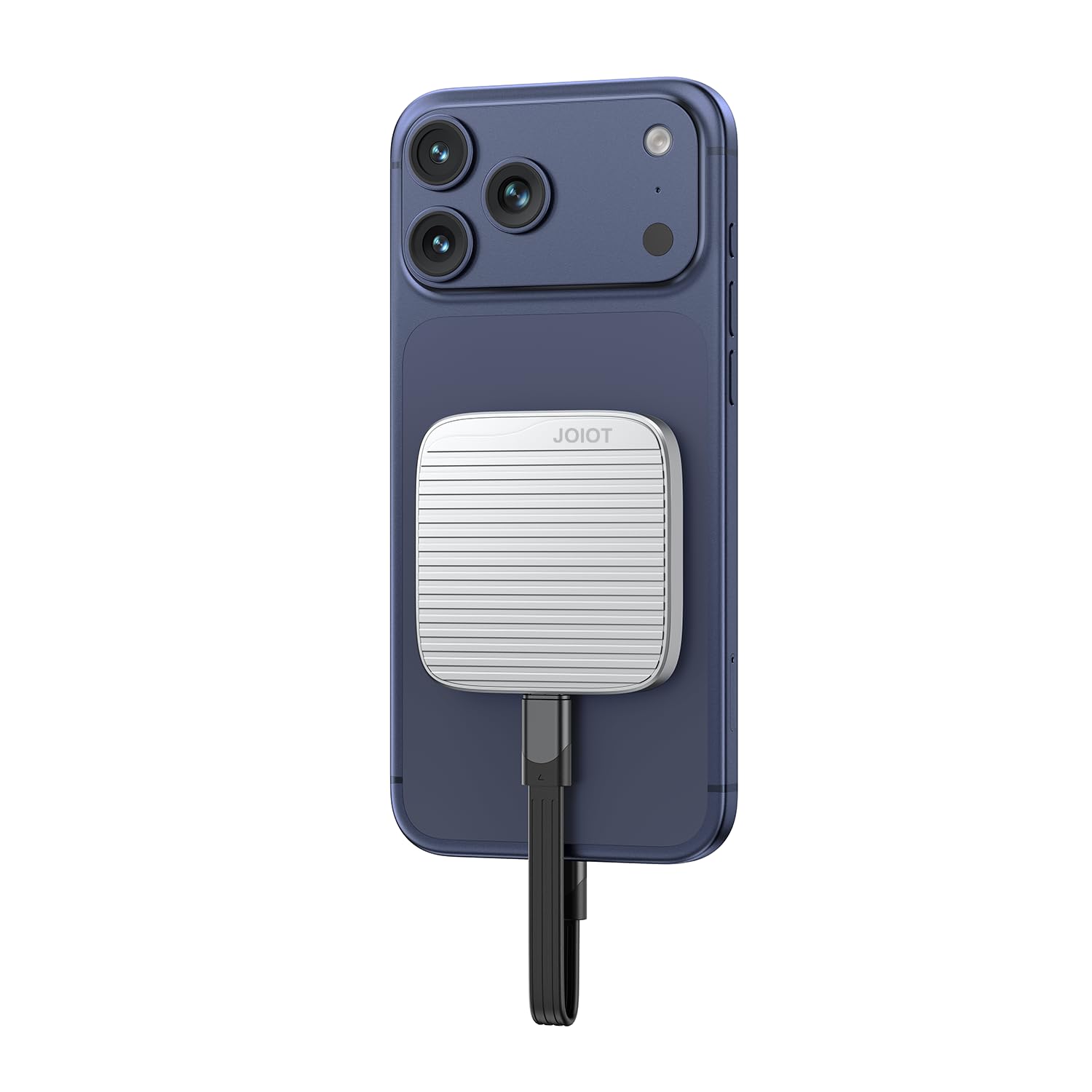
Half a terabyte is the number that defines the JOIOT drive, and the reason it sits at the bottom of the price range. Everything else about it is full-size: a 2,000MB/s USB 3.2 Gen 2x2 rating, magnets that hold it flat against the phone, and a spare magnetic ring in the box for a case or a non-MagSafe device.

512GB goes further than it sounds for photos and ordinary video, and much less far once ProRes is switched on, so treat this as working storage for a shoot rather than the place an archive lives. At 2.32 inches square it is among the smallest bodies here, which matters more than it sounds when the phone is in one hand and a camera app is open.

For a first magnetic drive, or a spare that lives in a camera bag, that is a fair trade. What stays with us is the recording spec: ProRes at 4K and 120fps on an iPhone 16 Pro Max is the most demanding mode the phone offers, and the cheapest drive in this roundup supports it.

Pros

  • Lowest price in this group
  • ProRes 4K120 on an iPhone 16 Pro Max
  • Spare magnetic ring for cases

Cons

  • One-year warranty
  • Large video transfers can drag
Our verdict

We see it as the entry point: 512GB, ProRes support, and the lowest price in this group.

Check Latest Price
7

Camera Roll Offloads

ORICO K5MINI Magnetic SSD

79 /100
Keeper Score Very Good

Key details

Weight
0.13 lb
Capacity
1 TB
Warranty
18 months
Max Transfer Speed
Up to 460MB/s
Check Price on Amazon

460MB/s is an unusual figure to find on a magnetic drive in this company, and it is worth being precise about what it buys. As a place to park photos and clips off a phone, the ORICO K5MINI does the job: files land, the magnets hold, the aluminium body stays cool, and 1TB is 1TB.

What the listing never claims is ProRes capture. Every other drive here states a recording spec — 4K at 60fps in most cases, 120fps on two of them — and this one stops at expanding storage. If you want the iPhone writing straight to the drive during a take, that omission decides it for you; if you want somewhere to empty the camera roll, it does not matter at all.

There is one thing here that nothing else in the group offers: a route to Lightning. ORICO sells an LC10 adapter for the iPhone 14 and earlier, and warns that other brands' adapters are not supported, which matters if the phone full of footage is an older one.

For everyone else this is a straightforward budget drive, and we mean that as praise: a metal shell, a magnetic ring in the box, and a terabyte that behaves itself. At 0.13 pounds it is happier on a desk than on the back of a phone during a handheld take, and that is the honest boundary of what it is for.

Pros

  • Aluminium body at a budget price
  • Magnetic ring included for any device
  • Only Lightning adapter route here

Cons

  • Slowest drive here at 460MB/s
  • 18-month warranty
Our verdict

We recommend it to anyone with a Lightning-era iPhone full of footage, or anyone who wants a cheap metal drive for offloading.

Check Latest Price

How We Tested the Best Magnetic SSDs for Phones

The shortlist started with every magnetic portable SSD we could find that mounts directly to a phone without a case adapter or a companion app, and we cut anything that needed extra hardware to stay on. From there we filtered by capacity, internals, and price so the final group covered the range people actually shop in — 512GB up to 2TB, budget to near-flagship speed. That left 12 drives, and we used them for seven months.

Testing looked like actual filming. I clipped each drive to the back of a phone and shot high-bitrate clips while walking, then carried the phone in a jacket pocket and loose in a bag to see which mounts held. I also turned the phone face-down and shook it, because a magnet that lets go over a sidewalk is the whole story. Files came off the drives onto a laptop, and went onto the drives from a laptop, using folders big enough to take minutes rather than seconds.

Speed got measured in practice, not quoted from the packaging: I timed the same folder onto every drive and noted where each one leveled off instead of citing its peak. I watched closely for the slowdown that appears after several minutes of continuous writing, since that is exactly what a long take does to a drive. Capacity was checked after formatting, because what you can store is never quite the number on the label, and I paid attention to how warm each one got in the hand and whether it dropped its connection when it did.

How to Choose a Magsafe Ssd

Check for a Recording Claim Before Anything Else

A magnet and a USB-C port do not make a drive a recording drive. An iPhone writing ProRes needs the SSD to hold a sustained write, and the maker has to state which iPhone models and frame rates are supported. The SanDisk lists 4K at 60fps on the iPhone 15 and 16 Pro, the Lexar goes to 4K at 120fps, the JOIOT matches that on the 16 Pro Max, and the ORICO publishes no capture claim at all.

If filming straight to the drive is the point, that line on the listing is the one to find. If you only want somewhere to empty a camera roll, any of these will do.

The 2,000MB/s Number Is for Your Laptop, Not Your Phone

Headline speeds of 2,000MB/s require USB 3.2 Gen 2x2, a 20Gbps link phones do not offer — Lexar says outright in its own listing that systems without 2x2 run slower. The extra headroom shows up when the drive is plugged into a desktop or a newer laptop, not when it hangs off an iPhone.

Decide where the drive spends most of its life. For phone-first use, the SanDisk's 1,000MB/s is ample. For a drive that doubles as an editing disk, the faster rating earns its keep.

Weight and Footprint Change How the Phone Handles

41 grams and 6.5 mm disappears on the back of a phone; 4.16 ounces is a counterweight you feel, especially on a gimbal. If you shoot handheld for minutes at a time, favour the light drives — the Aiffro at 41 g and the TWOPAN at 0.82 oz are the lightest here.

If the phone lives on a tripod or in a cage, weight stops mattering and capacity should win instead. Wide bodies are the other thing to picture: the SanDisk and the ORICO are both around three inches across, which is a lot of the phone's back.

Match Capacity to How Long You Are Away From a Computer

512GB is a shoot, 1TB is a shoot plus the edit, 2TB is a trip. ProRes changes the arithmetic sharply, so if you are recording rather than offloading, buy the largest drive you can justify and treat it as working storage that gets emptied, not as an archive.

For photos and ordinary video, a terabyte covers a lot of ground, and the Aiffro and OSCOO both put one in a pocketable body. The Lexar's 2TB is the only option here for a multi-day job without a laptop.

Power, Heat, and What the Warranty Tells You

Long takes drain the phone, and only the TWOPAN offers a pass-through USB-C PD port to keep it charged while it records. Every metal-cased drive here warms up during sustained writes; an aluminium shell helps, the TWOPAN's fan helps more, and a thick phone case makes all of it worse.

Warranty length varies more than it should — five years from SanDisk and Lexar, three from OSCOO, two from Aiffro, 18 months from ORICO and TWOPAN, one year from JOIOT — and it is a fair proxy for how long the maker expects the drive to keep working.

Frequently Asked Questions

Final Verdict

The SanDisk Creator Phone SSD is the drive we point most people to first. A terabyte, an IP65 shell, five years of cover and 1.92 ounces that do not change how the phone feels make it the safest default for anyone recording ProRes on an iPhone — and its 1,000MB/s rating is already more than the phone's port can use.

Change the requirement and the answer changes. For multi-day shoots where 2TB and the fastest sustained writes matter more than weight, take the Lexar ES5. If your phone has to keep charging while it records, the TWOPAN T01 is the only one here with a port for it.