Best Magnetic Camera Filter Systems of 2026

Screw-in filters do one job beautifully and one job badly: the moment the light shifts and you need a different density, you're balancing a lens cap on your knee and trying to unthread a filter without putting a fingerprint through the middle of it. Magnetic systems exist to delete that moment — snap off, snap on, keep shooting. What they don't all get right is everything after the snap: whether the ring stays seated when you tilt the camera down, and whether the glass behind the magnet is worth the premium you paid for the convenience.

I've shot landscapes long enough to be suspicious of anything that promises speed, so over the past six months my team and I ran 12 of these systems through real shooting days — golden hour on a windy overlook, a dusty trail at midday, a weekend of handheld video — swapping them far more often than any sensible person would. The lesson: the magnet is the easy part. What separates these kits is the adapter ring, the caps, and whether the ND holds its color once you stack a second filter on top. The picks below are the ones that never went back in the box.

Keeper Score summarizes customer ratings and review volume. Read it alongside the product details and trade-offs. How the score works.

1

Best Overall

Freewell M2 Magnetic 5-Pack

89 /100
Keeper Score Excellent

Key details

Glass
German optical glass, multi-coated
Thread Size
82mm
Filters Included
ND8, ND64, ND1000, CPL, UV
Check Price on Amazon

Five filters in one case is what puts this kit first: an ND8, an ND64, an ND1000, a CPL and a UV, all 82mm, all magnetic. The ten-stop is the one that seals it. A 10-stop is what turns a midday seascape into a seconds-long exposure, and it's the filter that separates a kit you can shoot all day with from one you carry for sunny portraits.

We were skeptical about the swap and came away convinced. There's no thread to cross, the filters sit flat on the base and lift off with a fingernail, and going from ND8 to ND1000 between frames takes a second and one hand — which matters when the camera is already framed on a tripod. The fiddly part is the stack. With two filters nested, lifting the top one can bring the one beneath it with it, and the case holds them loosely enough that a filter can work free in a bag that gets knocked around. Ours live in the slots and we check them before a shoot.

The 82mm thread is the practical catch. It suits the fast zooms that take an 82mm filter, and anything smaller needs a step-up ring — fine on a 77mm lens, worth thinking about if your widest glass is 67mm and you care about the corners. What the money buys over the budget kits is the glass: German optical glass with a multi-layer coating, and files that came back neutral enough that we left white balance alone.

Pros

  • Five filters, including a true ten-stop ND
  • One-second swaps, even mid-composition
  • Neutral, multi-coated German glass
  • Magnetic lens cap with a holder

Cons

  • 82mm thread only; smaller lenses need step-up rings
  • Nested filters can lift together
Our verdict

Our default recommendation: five filters from UV to a ten-stop ND, one-second swaps and glass that holds up, for a mid-range price.

Check Latest Price
2

Best for Multiple Lenses

NiSi JetMag Pro Landscape Kit

84 /100
Keeper Score Excellent

Key details

Weight
8.82 oz
Adaptor Sizes
67mm, 72mm, 77mm, 82mm
Also Included
Two front caps, back cap, pouch
Filters Included
ND 3/6/10 stops, true-color CPL
Check Price on Amazon

Four adaptor rings — 67, 72, 77 and 82mm — are the reason to look here. If your bag holds a 24-70 and a 70-200 with different front threads, you buy one set of filters and a ring for each lens, and the glass moves between them. That is the whole promise of a magnetic system, and this is the only kit in this group that ships ready for more than one thread size.

The filter selection is a landscape photographer's, deliberately: 3, 6 and 10 stops plus a true-color CPL, and nothing aimed at video. We like that discipline. Fixed NDs don't show the X-pattern a variable filter can produce past its marked range, and there's no diffusion disc you'll never mount. At 250g for the whole set it disappears into a side pocket, and the front and back caps mean the mount stays covered in the bag instead of collecting grit.

You do pay for it. This is the most expensive kit we're recommending, and the machining is where the money goes — you notice it when you thread an adaptor onto a lens for the first time. The detail that sold us is duller than that: a back cap for the mount itself. Carry a bare magnetic ring in a bag for a week and you'll understand exactly why it's there.

Pros

  • Adaptors for 67, 72, 77 and 82mm lenses
  • 3-, 6- and 10-stop NDs plus a true-color CPL
  • Front and back caps cover the mount
  • 250g for the entire set

Cons

  • Most expensive system in this group
  • Fixed NDs only, nothing for video ramping
Our verdict

For lenses that don't share a thread size, this is the kit to own: four adaptor rings, three NDs and a CPL, at a premium.

Check Latest Price
3

Best for Run-And-Gun Video

Freewell Versatile VND System

88 /100
Keeper Score Excellent

Key details

Frame
CNC metal with magnets
Weight
15.5 oz
Thread Size
82mm
Filters Included
VND2-5/CPL, VND6-9/ND32-CPL
Check Price on Amazon

Ramping exposure mid-take is the job this system was built for. Two variable filters — one covering 2 to 5 stops, the other 6 to 9 — each carry a polarizer in the same frame, so you can pull density during a pan without stopping to swap glass. On a gimbal, or handheld while the light is changing, that's the difference between a usable take and a re-shoot.

We rate it above the single-filter hybrids here for one reason: the hard stops. Both rings stop at the ends of their marked range, which is how you avoid rotating into the X-pattern that ruins a wide shot, and the CPL rides with the density instead of sitting in the stack as a second disc. CNC metal frames and 18-layer coatings are the build story, and the weight tells you so — 439g with both bases in the bag, which you feel on a small body.

The learning curve is real. Lining up the 2-5 and 6-9 markings so the scale reads correctly takes a try or two, and the two bases aren't obviously labeled in the field. After a couple of shoots it's muscle memory — and then it's the fastest way in this group to hold a look as the light moves.

Pros

  • Two variable ranges with hard stops
  • Polarizer built into each variable filter
  • CNC metal frames with 18-layer coatings
  • Second base for mist elements included

Cons

  • Heavy at 439g in the bag
  • Markings take practice to line up
Our verdict

If you shoot video that needs continuous exposure control, two variable ranges with hard stops replace a bag of fixed NDs.

Check Latest Price
4

Best Budget

K&F Concept 67mm Magnetic Kit

86 /100
Keeper Score Excellent

Key details

Glass
Japanese AGC, 28-layer coating
Thread Size
67mm
Filters Included
CPL, ND8, ND64
Check Price on Amazon

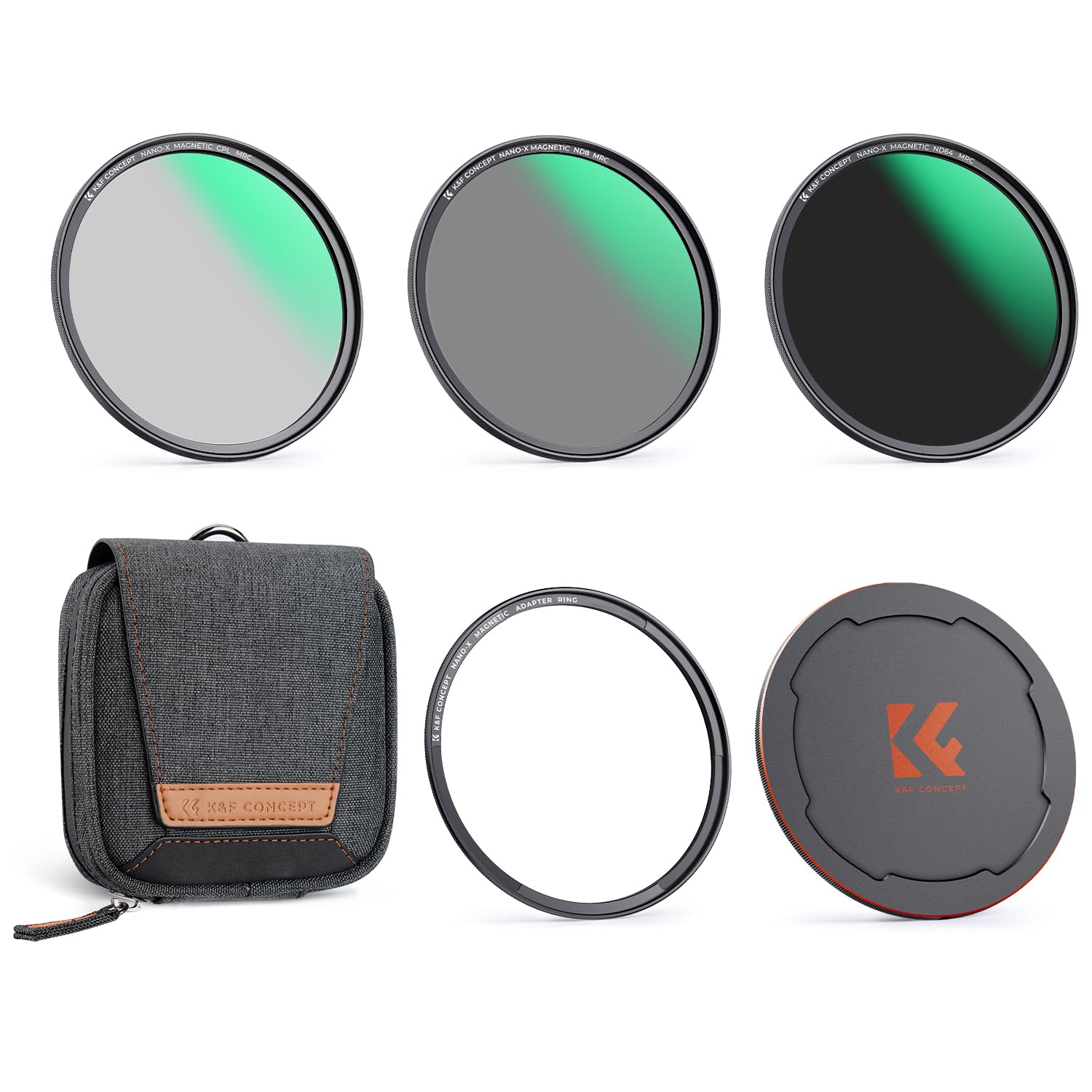
Cheapest complete kit in this group, and the one we hand to someone buying filters for the first time: a CPL, a 3-stop ND8 and a 6-stop ND64, with the magnetic basic ring and a magnetic cap. That's the two things most people actually buy filters for — cutting reflections and slowing the shutter in bright light — without a ten-stop they'll rarely use or a diffusion disc they don't understand yet.

The glass is the surprise at this price. Japanese AGC optical glass with 28-layer coatings, and the polarizer pulls reflections off water and window glass the way it should. What struck us in use is how much the basic ring does: it stays threaded on the lens and everything else snaps to it, so going from CPL to ND64 is one motion rather than a minute of careful threading.

Two things to know. The 67mm thread is fixed, so unless your other lenses share that size this is a one-lens kit until you add step-up rings. And the hold is the weakest part of the design — bump the front of the lens against your body with the camera slung and a filter can come away, and a deep hood can foul the ring at the front. We swap freely on a tripod and keep a hand on the barrel when walking.

Pros

  • CPL, ND8 and ND64 with ring and cap
  • AGC glass with 28-layer coatings
  • Ring stays on the lens; filters snap on
  • Lowest price in this group

Cons

  • 67mm thread only
  • No ten-stop for long daylight exposures
Our verdict

The cheapest way into a real magnetic kit: a polarizer, two NDs, a ring and a cap that cover the basics on a 67mm lens.

Check Latest Price
5

Best for Vlogging

K&F Concept 55mm Video Kit

80 /100
Keeper Score Excellent

Key details

Thread Size
55mm
Also Included
Basic ring, lens cap, case
Light Reduction
1 to 5 stops
Filters Included
CPL, ND2-32, Black Diffusion 1/4
Check Price on Amazon

Diffusion is the odd one out in every other kit here, and it's why this one exists: a black diffusion 1/4 to take the hard edge off skin and highlights, a variable ND from 1 to 5 stops to hold a 180-degree shutter, and a CPL for reflections. On a small mirrorless body that's a whole look in three discs and one ring.

The variable ND is the piece we reached for most. Hard stops at both ends of the range mean no accidental X-pattern, the rotation is smooth enough to ramp exposure during a take without a visible jump, and the front element turns freely enough to dial polarization without unscrewing anything. Stacking is where the design earns its keep: the CPL sits on the ring, the VND goes over it, and you can adjust either without pulling the stack apart.

Two limits, both about size. 55mm is a small thread — right for kit zooms and compact primes, wrong for a 77mm f/2.8 zoom, which needs a step-up ring that adds depth in front of the glass. And the VND tops out at 5 stops, so this isn't the kit for a 30-second daylight exposure. What it is good at is the look: the diffusion softens highlights without smoothing skin into plastic, which is the reason to pay for this set rather than the 67mm one above.

Pros

  • Polarizer, variable ND and black diffusion together
  • Hard stops prevent the X-pattern
  • Filters stack without disassembly
  • Ring, cap and case included

Cons

  • 55mm thread suits small lenses only
  • VND tops out at 5 stops, so no long daylight exposures
Our verdict

A compact video set — polarizer, 1-to-5-stop variable ND and black diffusion — that covers exposure and the look in one stack.

Check Latest Price
6

Small-Lens Travel

Urth 49mm 4-in-1 Kit

79 /100
Keeper Score Very Good

Key details

Caps
Two included
Glass
20-layer nano-coated SCHOTT glass
Thread Size
49mm
Filters Included
UV, CPL, ND8, ND1000
Check Price on Amazon

49mm is the whole story. This is the only kit in the group sized for the small front elements on compact bodies and rangefinder-style zooms, and if that's what you carry, the alternative is a step-up ring and a heavier stack hanging off the nose of the lens.

Four filters — UV, CPL, an ND8 and an ND1000 — plus two caps is a sensible travel set: enough to kill reflections and stretch a waterfall exposure, without a diffusion disc or a variable ring you may not need. The glass is SCHOTT with a 20-layer nano coating and the frames are magnalium, so the stack stays slim enough that it doesn't creep into the corners of a wide prime.

The magnet is the honest weak point. These filters sit on the adaptor with less grip than the Freewell or NiSi kits, and if the UV isn't threaded onto the lens as the base, pulling the cap can lift the whole stack with it. You learn that in an afternoon — take the cap by the rim, not the face — but it means we treat this as a lens-cap-on, camera-in-the-bag kit rather than something to swap mid-walk. Given how little space the set takes, it still travels with us.

Pros

  • UV, CPL, ND8 and ND1000 in one set
  • Slim magnalium frames suit small lenses
  • 20-layer nano-coated SCHOTT glass
  • Two caps included

Cons

  • Weakest magnetic hold in this group
  • 49mm variant only fits 49mm lenses
Our verdict

A tidy four-filter set for 49mm lenses: UV, polarizer, and 3- and 10-stop NDs in one slim case.

Check Latest Price

How We Tested the Best Magnetic Camera Filter Systems

We started with every magnetic system sold as a kit with an adapter ring, then narrowed by thread size, what came in the box, and price, landing on 12 systems. Testing ran six months, and most of it happened where these filters actually get used: a tripod on a coastal overlook at golden hour, a dusty trail at midday, and handheld video work around town.

Magnetic mounting got the harshest treatment. We mounted each ring on a lens, then tried to knock the filter loose by tilting the camera down, walking with it at hip height, and shaking the rig. We also swapped filters one-handed in gloves and timed it, since that's the whole promise of the category. What we watched for was the ring unscrewing along with the filter — the failure that costs you a filter over a cliff — and whether the magnet held a second, stacked filter.

For image quality, we shot the same scene through each filter and through bare glass, comparing color casts through the polarizers and 10-stop NDs and checking corners on wide lenses for vignetting. Shooting into the sun, we noted flare and ghosting. Build quality got judged by hand: how the rings threaded, whether coatings wiped clean or smeared, and how the caps and pouches survived a bag.

Fit mattered more than expected — a ring with a little play makes every swap feel uncertain, and a kit covering one thread size is a different proposition from one with adaptors for 67mm through 82mm. Value came down to what's actually in the box: glass, rings, caps, and a case that keeps the stack clean. The systems that stayed in my bag were the ones where the swap went invisible.

How to Choose a Magnetic Filter System

Match the thread before you look at filters

A magnetic system is built around one base ring per thread size, so the number that matters is the Ø figure printed on your lens barrel or cap. If every lens you own is 77mm, a single-size kit covers you completely. If you mix 67mm and 82mm glass, either buy a system that ships several adaptor rings or budget for step-up rings, which add depth in front of the glass and can push a wide lens into the corners.

Write your thread sizes down before you shop. It is the one check that turns a good kit into a frustrating purchase, and it takes a minute.

Fixed stops or a variable ring

Fixed NDs come in marked densities — 3, 6 and 10 stops are the useful ones — and they don't shift as you turn them, which is why they suit long exposures and any frame where a polarizer is already doing work. A variable ND covers a range in one disc and lets you ramp exposure mid-shot, but most stop at 5 stops, so a variable can't stand in for a ten-stop at noon. Video leans variable; landscape leans fixed. If you shoot both, the fixed set earns its place first.

How the magnet actually behaves

Hold strength is a Goldilocks problem and you can judge it by the cap. If the cap grips the filter harder than the filter grips the ring, removing the cap lifts the stack; if the filter sits loosely, a slung camera can lose it against your jacket. Test the take-off before you commit: the cap should release the filter, not the ring.

Until you trust the hold, carry the camera in the bag rather than on a strap, and keep the lens hood off while you're swapping.

Glass, coatings and the wide-angle stack

Multi-layer coatings do the real work, cutting flare and keeping a polarizer from going muddy; nano coatings make rain and fingerprints wipe off instead of smearing. The stack matters as much as the glass. Every filter you add pushes the front element further out, and on a 16mm or 17mm lens that shows up as dark corners. Slim frames help, and so does refusing to stack three discs when two will do.

Frequently Asked Questions

Final Verdict

The Freewell M2 5-Pack is the system we point most people to, because five filters — including a genuine ten-stop — cover nearly everything daylight throws at you, and the swaps are quick enough to use mid-composition. The 82mm thread is the one thing to plan around: if your lenses don't share it, add step-up rings before you buy rather than after.

If your lenses have three different front threads, the NiSi JetMag Pro earns its premium, since four adaptor rings turn one set of filters into a system for the whole bag.