Best Inverter Chargers of 2026

An inverter charger does two jobs, and most shoppers only research one of them. It turns battery power into household AC, and it takes shore or generator power and pushes it back into the bank — that second half is the part you'll live with every day. Buy on wattage alone and you end up with a unit that runs the microwave fine but howls like a hair dryer while it does it, or takes all night to refill a bank that a better charger would top off by lunch. A good one just quietly keeps the fridge, the router, and the CPAP running through an outage and puts the power back before morning.

I've spent time around a van build and a basement backup bank, and the failures are rarely the ones printed on the spec sheet. We ran eight inverter chargers for nine months across a campervan, a sailboat, an off-grid cabin, and a home backup panel, and the real differences came down to unglamorous things: how the charger reads a battery's state, how loud the fan gets at 2 a.m. six feet from a bunk, and how fast it hands over when the grid drops. Here's the thing nobody tells a first-time buyer — the battery settings matter more than the headline wattage. If the unit can't be told you're running lithium versus flooded, you'll either cook the bank or leave half its capacity unused.

Some of the picks below are for people who want to program every parameter and watch the charge curve. Others are for someone who wants to land four cables, set the battery type once, and forget it exists. Either way, the good ones share one trait: after the first week, you stop thinking about them.

Keeper Score summarizes customer ratings and review volume. Read it alongside the product details and trade-offs. How the score works.

1

Best Overall

Victron MultiPlus 3000VA

87 /100
Keeper Score Excellent

Key details

Peak Output
6000 W
Output Waveform
Pure sine wave
Battery Charging
120 A at 12 V
Continuous Output
3000 VA / 3000 W
Check Price on Amazon

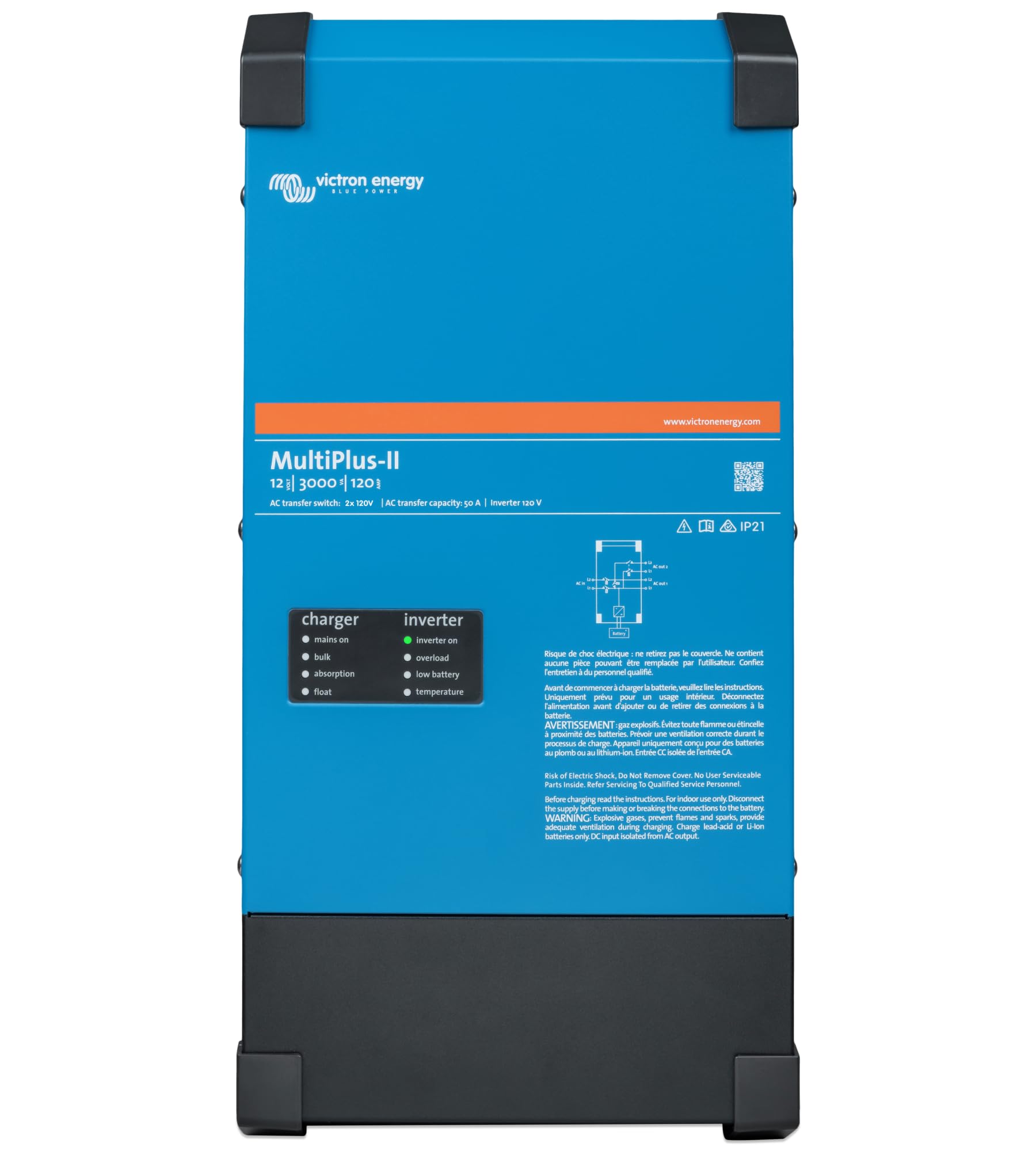
The MultiPlus is the inverter/charger we reach for when the system has to run more than a few gadgets. Its 3,000VA continuous rating and 6,000W peak give a 12V bank real headroom for motor starts, while the 120A charger can refill a sizable bank without a separate charger. Pure sine wave output matters here: it keeps electronics, pumps, and motor-driven appliances running on the waveform they expect.

PowerAssist is the feature that earns its keep on a 30A campsite hookup. Instead of letting a coffee maker and an air conditioner trip the pedestal breaker, the MultiPlus supplements shore power from the battery and then recharges when the load drops. We also appreciate the fast transfer to inverter power when shore or generator power disappears; the 20ms switch is quick enough that most equipment won't notice. Up to six units can be paralleled if a system grows, which is a useful ceiling for an off-grid build.

This is a professional-grade unit, and we treat it that way. Plan the DC cables, fusing, and ventilation around a 39.5-pound chassis. For a 12V RV, boat, or small off-grid panel, we haven't found a more complete single-box starting point in this set.

Pros

  • 3000VA continuous and 6000W peak
  • 120A charger for large 12V banks
  • PowerAssist supports limited shore power
  • Pure sine wave with 20ms transfer

Cons

  • Advanced programming can require an adapter and laptop
Our verdict

We recommend the MultiPlus 3000VA first for a 12V RV or off-grid system that needs whole-house surge capacity and a fast, flexible battery charger.
Check Latest Price
2

Best Solar-First Off-Grid Value

SUMRY 4000W Hybrid

91 /100
Keeper Score Outstanding

Key details

DC Input
24 V
Peak Output
8000 W
Solar Charging
140 A MPPT
Continuous Output
4000 W
Check Price on Amazon

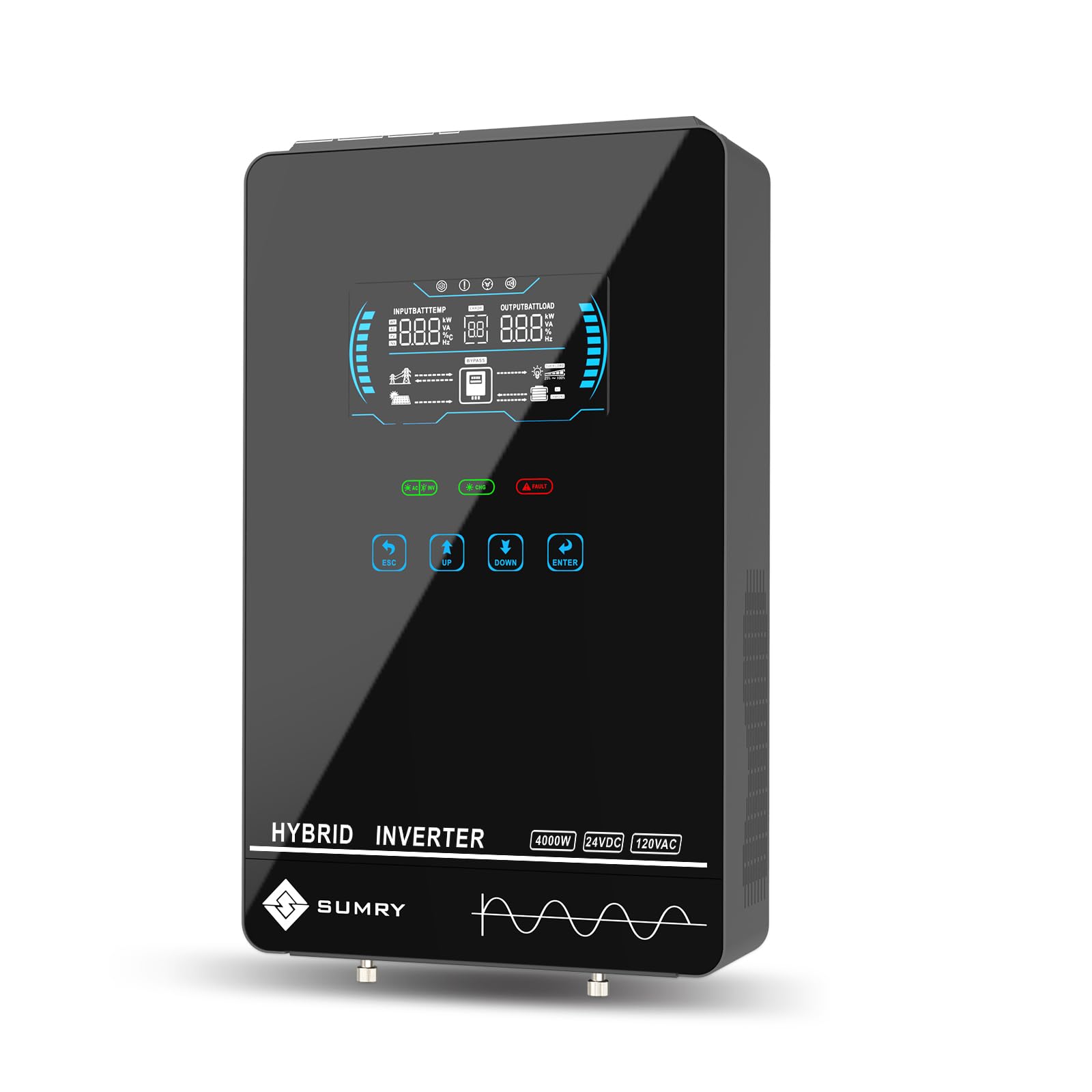
The SUMRY is the solar-first value pick in this group. A 140A MPPT controller is built into the same chassis as the 4,000W inverter, so a 24V off-grid system can skip a separate solar charge controller and the wiring that goes with it. The 8,000W peak rating gives it room for a well pump, a shop vac, or a small air conditioner, and the pure sine wave output keeps those loads running smoothly.

We like the glass top and the 6.25-inch LCD more than we expected to. In a garage or utility room, being able to glance down and see the system status without opening a laptop is a real convenience, and the touch buttons make the unit easier to live with than a plain black box. The 7.5 kg chassis is also light enough to lift onto a shelf or workbench, which helps in a tight power corner.

The battery-less daytime mode is the clever part: the SUMRY can run loads from PV during the day without a battery, which is useful for a shop or a remote cabin that only needs daytime power. It is a 24V unit, so a 12V bank is out; if you already have 24V batteries and a solar array, this is a lot of capability for the money.

Pros

  • 140A MPPT controller built in
  • 4000W continuous and 8000W peak
  • Glass-top LCD shows system status
  • Runs daytime loads without a battery

Cons

  • Battery-less mode needs high PV voltage and no grid
Our verdict

We recommend the SUMRY 4000W for a solar-first off-grid build where you want MPPT charging and strong surge power without a separate controller.

Check Latest Price
3

Best for 50-Amp RVs

Victron MultiPlus-II 2x120V

86 /100
Keeper Score Excellent

Key details

Peak Output
4243 W
AC Configuration
2x120 V, 120/240 V
Battery Charging
120 A at 12 V
Continuous Output
3000 VA
Check Price on Amazon

The 2x120V model is the Victron for a rig with two 120V legs. It takes a 120/240 source and keeps both legs powered, which is the difference between a normal 50-amp RV setup and a single-leg inverter that leaves half the panel dead. The 3,000VA continuous and 4,243W peak ratings are enough for a roof air conditioner, a microwave, and the usual house loads, provided the battery bank is sized for the surge.

PowerAssist is still the headline. On a 30A or 15A hookup, the unit can supplement the pedestal with battery power instead of tripping the breaker, then switch back to charging when the load drops. The 20ms transfer to inverter power is quick enough that clocks and electronics usually ride through an outage, and up to six units can be paralleled for a larger system. We also like that the same box can serve a marine, vehicle, or land-based off-grid installation.

This is a more specialized unit than the standard MultiPlus, and it earns its place when the AC side is split-phase. If your panel is ordinary 120V, the standard MultiPlus is the better match. The difference is the AC architecture, not the inverter rating.

Pros

  • Two 120V legs from 120/240 input
  • 3000VA continuous and 4243W peak
  • PowerAssist and 20ms transfer
  • Parallel up to six units

Cons

  • Advanced configuration can require the MK3-USB interface and a laptop
Our verdict

We recommend the MultiPlus-II 2x120V for a 50-amp RV or a 120/240 off-grid panel that needs two 120V legs and seamless backup.

Check Latest Price
4

Best Drop-In Replacement

Xantrex Freedom 458

90 /100
Keeper Score Outstanding

Key details

Peak Output
2500 W
Output Waveform
Modified sine wave
Battery Charging
Automatic 3-stage
Continuous Output
2000 W
Check Price on Amazon

The Freedom 458 is a legacy-shaped solution, and that is exactly why it earns a place here. If you already have a Freedom 458 in a boat or RV and the old unit has failed, this one slides into the same space and uses the same wiring layout, which turns a dreaded electrical project into a straight replacement. We appreciate that kind of continuity in a boat or an older RV, where reworking a battery compartment is the last thing anyone wants.

The automatic three-stage charger with temperature compensation is the real upgrade. It treats deep-cycle batteries better than a simple constant-voltage charger, and the built-in transfer switch and power sharing keep a limited shore circuit from tripping when a load starts. The 2,000W continuous and 2,500W peak ratings are modest by the standards of this group, but they are enough for a typical marine or small RV panel.

The modified sine wave output is the compromise. It runs simple motors and resistive loads, but we don't recommend it for a new build with sensitive electronics or a lithium bank that wants a precise charge profile. The 13.2-inch by 7.9-inch footprint is the detail to check against your compartment before ordering.

Pros

  • Drop-in fit for existing Freedom 458
  • Automatic 3-stage charger with temperature compensation
  • Built-in transfer switch and power sharing
  • 2000W continuous and 2500W peak

Cons

  • 55-pound chassis needs solid mounting
Our verdict

We recommend the Freedom 458 mainly as a drop-in replacement for an existing unit, where its footprint and automatic charger simplify the swap.

Check Latest Price
5

Small Backup Loads

AMPINVT 1200W

85 /100
Keeper Score Excellent

Key details

DC Input
12 V
Peak Output
3600 W
Battery Charging
0-15 A adjustable
Continuous Output
1200 W
Check Price on Amazon

The AMPINVT is the smallest true inverter/charger here, and that is the point. At 1,200W continuous and 3,600W peak, it is sized for a fridge, lights, internet gear, and a few small tools, not a whole RV. The pure sine wave output and low-frequency design give it a sturdier feel than its size suggests, and the five operating modes let you choose whether AC or battery gets priority.

We like the adjustable charging current for a small bank. Setting it low keeps a modest battery from being pushed too hard, and setting it to zero turns charging off entirely when you want the unit to act only as an inverter. The automatic transfer switch makes it a practical DIY UPS for a network cabinet or a camper: it passes shore power through and switches to battery when the grid drops. The 3,600W peak also gives a small motor a fighting chance on startup.

At 19 pounds, it is light enough to mount on a shelf in a utility closet, which is more than we can say for the transformer-based units here. That makes it easier to live with than the 55-pound Freedom 458 if you're building a compact backup cabinet.

Pros

  • 1200W continuous and 3600W peak
  • Adjustable charging current
  • Pure sine wave and automatic transfer
  • Five operating modes

Cons

  • 15A maximum charging is slow for large banks
  • Limited charge-profile control for custom lithium
Our verdict

We recommend the AMPINVT 1200W for a small 12V backup or camper system where a modest charger and true UPS switching are enough.

Check Latest Price

How We Chose and Tested These Inverter Chargers

We started by pulling every inverter charger we could find with a continuous rating that could carry real household loads, then narrowed by what a buyer actually has to fit: charger amperage, surge capacity, supported battery chemistries, whether the terminals could take thick cable without swearing, and whether the manual explained the settings in plain language. We cut anything that needed a proprietary dongle just to change the charge profile. That left eight units, which we ran for nine months in a campervan, a sailboat, an off-grid cabin, and a basement backup panel.

In each install we pulled the shore breaker mid-load and watched what happened — whether the router dropped, whether a desktop stayed up, how long the transfer took before the lights flickered. We ran a 1,500-watt kettle, a microwave, and a shop vac one at a time and then two together, and noted what tripped or sagged. To judge charging, we drained a bank to 50 percent and logged current with a shunt through bulk, absorption, and float, timing how long each stage took and whether the charger actually held absorption or bailed early. We set custom profiles for lithium and for flooded lead acid and checked whether the settings survived a full power-down.

Fan noise got measured the way you'd experience it: a decibel app at six feet, plus my own ears from a bunk at midnight and from the cabin floor above the unit. A clamp meter logged idle draw overnight, since a charger that sips two amps at rest will flatten a bank faster than you'd expect. Installation was timed solo, from mounting to first charge, and we noted whether temperature sensors, remote displays, and communication cables were in the box or an extra purchase — the sort of omission that turns a good value into a mediocre one. Then we kept using them.

How to Choose an Inverter Charger

Size for Surge, Not Just Watts

Start with the loads you need to run at the same time, then add the starting surge for anything with a motor. A 3,000VA inverter charger like the Victron MultiPlus can run a 30A RV panel, but it can still struggle with an air conditioner if the battery bank and peak rating are not sized for the compressor's locked-rotor draw. The SUMRY's 8,000W peak is the kind of headroom that matters for a well pump or a shop tool. Write down continuous watts first, then check whether the peak rating covers the startup.

Match the DC Voltage to Your Bank

Most small RVs, boats, and backup cabinets run a 12V bank, while larger off-grid arrays often move to 24V to keep DC current manageable. The voltage is not a preference you can change at the inverter; the unit has to match the bank. The Victron MultiPlus is built around 12V, and the SUMRY is a 24V unit. If you are starting from scratch, choose the bank voltage first, then the inverter charger, not the other way around.

Charging Current and Battery Profiles

Charging current is the part buyers notice after the first outage. A 120A charger can refill a large 12V bank in a reasonable window; a 15A charger is fine for a small bank but will feel slow on a big one. Just as important is whether the charger has a profile for your battery chemistry, especially lithium. We put charge-profile control ahead of extra AC outlets or a fancy display. Match the charger to the bank size and confirm the unit supports your battery type before you buy.

Transfer Switching and AC Configuration

An inverter charger has to decide when to pass shore power through, when to invert, and when to assist a weak source. For a 30A RV, a unit with PowerAssist can supplement the pedestal with battery power instead of tripping the breaker. For a 50A RV or a 120/240 panel, you need a model with two 120V legs, such as the MultiPlus-II 2x120V. Match the AC configuration to the panel you actually have; a single-leg unit will leave half a split-phase panel unpowered.

Waveform, Installation, and Placement

Pure sine wave is the safe default for electronics, pumps, and modern appliances. Modified sine wave can run simple motors and resistive loads, but it is a compromise for sensitive gear, which is why we keep the Xantrex Freedom 458 focused on replacement work. Installation matters just as much: high-current DC cables, fusing, ventilation, and a solid mounting surface are not optional. Plan for a qualified electrician and leave clearance around the fan and vents; a compact unit that overheats is not compact for long.

Frequently Asked Questions

Final Verdict

The Victron MultiPlus 3000VA is our default because it combines a 3,000VA pure sine inverter, a 120A charger, and PowerAssist in one 12V box that suits an RV, boat, or small off-grid panel. It is not the cheapest or the simplest to configure, but it is the one we trust to run a whole system rather than a few accessories.

If you are building around a 24V solar array, the SUMRY is the value alternative; if you have a 50-amp RV or need two 120V legs, the MultiPlus-II 2x120V is the better fit.