Best High-Resolution Cameras of 2026

The camera that earns a permanent spot in my bag is never the one with the biggest number printed on the front. It's the one I grab without thinking — for a kid blowing out candles in a dim kitchen, or a dog sprinting the length of the yard at dusk. Those are the shots phones fumble, and they're exactly what a real camera is supposed to fix: rotten light, fast motion, and a photographer who'd rather shoot than study a manual.

My team and I spent six months shooting with nine cameras, from pocketable point-and-shoots to beginner mirrorless kits with a lens in the box, and the pattern held. Resolution sells cameras, but past a certain point it's the sensor behind that number, the autofocus, and how fast files reach your phone that decide whether you keep shooting. A camera you don't carry takes no pictures. What follows survived school plays, a rainy hike, and far too many photos of my neighbor's cat — sorted by who each one actually suits.

Keeper Score summarizes customer ratings and review volume. Read it alongside the product details and trade-offs. How the score works.

1

Best Overall

Canon EOS R100

90 /100
Keeper Score Outstanding

Key details

Video
4K at up to 24 fps
Sensor
24.1MP APS-C CMOS
Autofocus
Dual Pixel CMOS AF, 143 zones
Continuous Shooting
6.5 fps
Check Price on Amazon

The EOS R100 is the camera we point to when one body has to cover high-resolution stills and 4K video. Its 24.1MP APS-C sensor gives you room to crop, and the DIGIC 8 processor adds 4K recording at 24 fps plus 1080p slow motion up to 120 fps. What makes it feel current is the autofocus: Dual Pixel CMOS AF with face and eye detection covers up to 143 zones, so it holds a subject better than the older Rebel T7.

We also like how small the R100 is for an interchangeable-lens camera. It's easy to carry with the 18-45mm kit lens, and the controls are simple enough for a first-time user without hiding the manual settings you'll grow into. The body feels more like a small mirrorless than a DSLR, which is why it's the one we take when we want stills and video in one bag. If vlogging is the priority, the Sony ZV-1F is the more natural fit.

The 4K mode stops at 24 fps, so this isn't a high-frame-rate 4K camera. Use 1080p at 60 or 120 fps for slow motion. For a stills-first kit that can also shoot usable 4K, the R100 is the balance we recommend.

Pros

  • 24.1MP APS-C sensor with crop room
  • 4K video with Dual Pixel eye AF
  • Compact body for an interchangeable-lens camera
  • Beginner-friendly controls and menus

Cons

  • Fixed screen limits self-recording
Our verdict

The best stills-and-4K package here, with a 24.1MP APS-C sensor, fast eye-detect autofocus, and a compact body.

Check Latest Price
2

Best DSLR Value

Canon EOS Rebel T7

95 /100
Keeper Score Outstanding

Key details

Video
1080p
Sensor
24.1MP APS-C CMOS
Autofocus
9-point AF
Viewfinder
Optical, 95% coverage
Check Price on Amazon

The least expensive way into a 24MP APS-C sensor here is the Rebel T7, and it's the only DSLR in the group. The sensor matches the R100's resolution, and the optical viewfinder gives it a different feel: bright, immediate, and easy to use in sunlight. That combination is the traditional DSLR recipe: a bright viewfinder, a simple body, and a sensor big enough to crop.

We like the 18-55mm kit lens for its useful everyday range, and the EF mount is the real long-term value. There's a huge supply of affordable lenses, from a 50mm prime for portraits to a longer zoom for travel. The menus are simple, and the scene modes give a beginner a place to start before moving to manual.

The T7 is at its best when you slow down: landscapes, portraits, and family snapshots where you can pick your moment. It doesn't feel like a modern camera in the hand, but the viewfinder and battery-friendly design make it a comfortable one. If you want the same sensor size with 4K and faster autofocus, the R100 is the step up.

Pros

  • 24.1MP APS-C stills at a budget price
  • Optical viewfinder with 95% coverage
  • Deep EF lens ecosystem
  • Simple beginner controls

Cons

  • 1080p video only
  • Slow live-view autofocus
Our verdict

The best stills-first DSLR value here, with a 24.1MP APS-C sensor and an optical viewfinder; video is 1080p only.

Check Latest Price
3

Best for Vlogging

Sony ZV-1F

90 /100
Keeper Score Outstanding

Key details

Lens
20mm f/2.0 fixed
Video
4K UHD
Screen
3-inch side-articulating
Sensor
20.1MP 1-inch CMOS
Check Price on Amazon

If you film yourself at arm's length, the ZV-1F is built for that position. Its 20mm f/2.0 lens is wide enough to hold the camera out and still get a background, and the side-articulating screen flips so you can see yourself. The 1-inch 20.1MP sensor is a step up from a phone in low light, and it records 4K.

We like the Eye-AF and tracking for talking-head clips; it keeps the focus on a face rather than the wall behind it. The 20mm lens is fixed, so there's no zoom. That's fine for vlogging and group shots, less so for details or wildlife. If you need a zoom, the Canon R100 or Rebel T7 is the better fit.

Battery life is the one thing we plan around. A long shoot drains the small battery, so a spare is part of the kit. The wide angle is the point: it makes a small camera feel social, whether you're filming a vlog or a group at dinner.

Pros

  • Wide 20mm lens frames arm's-length selfies
  • 4K video with eye AF and tracking
  • Side-articulating screen for self-recording
  • 1-inch sensor with f/2 lens for low light

Cons

  • No viewfinder
  • No built-in flash
Our verdict

The best compact here for arm's-length vlogging, with a wide 20mm lens, 4K video, and reliable eye autofocus.

Check Latest Price
4

Best Budget Flip-Screen

AUREAPIX DC105

81 /100
Keeper Score Excellent

Key details

Zoom
20x digital
Video
8K
Screen
3.5-inch 180° flip
Sensor
96MP 1/2.3-inch CMOS
Check Price on Amazon

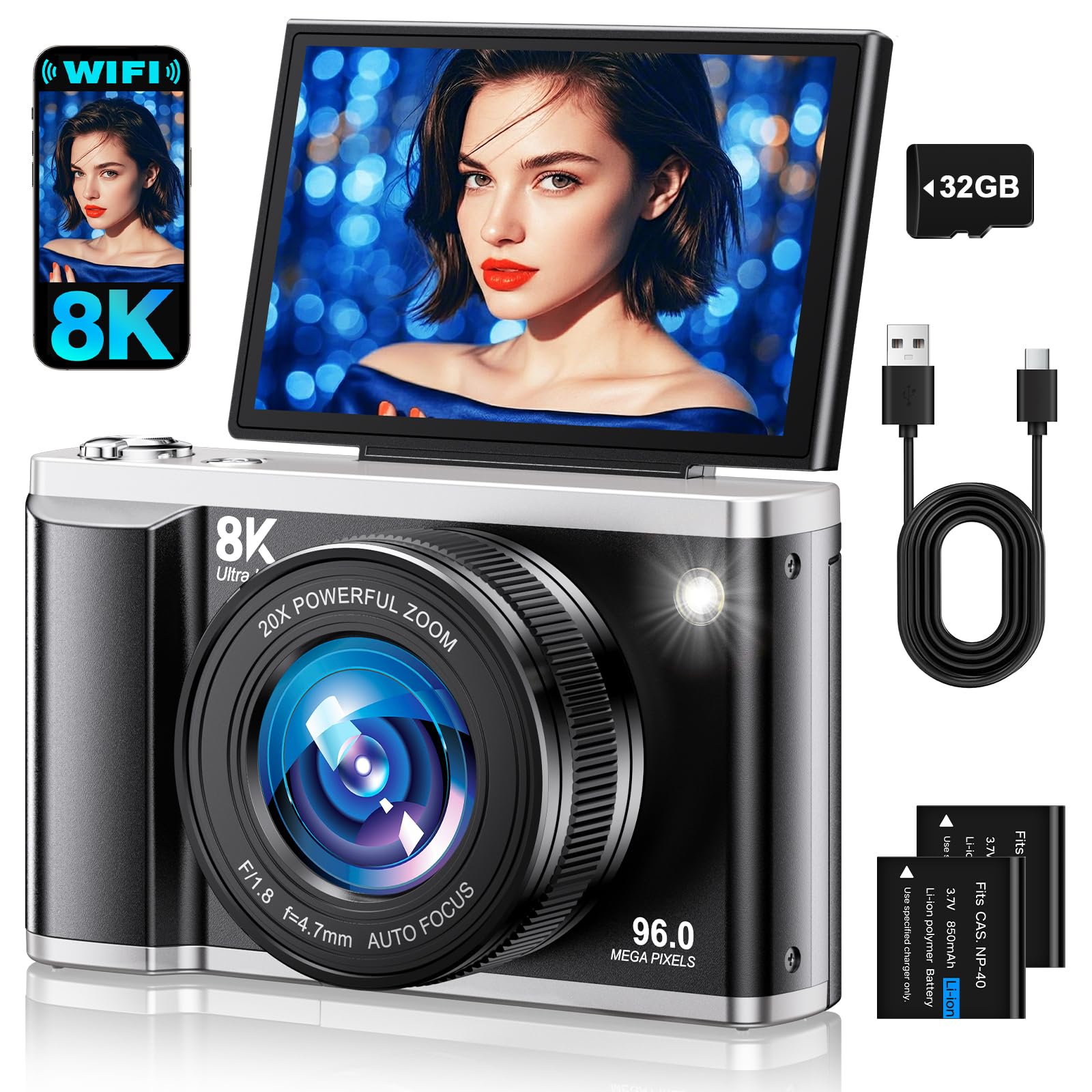
The AUREAPIX DC105 leads with numbers that look impossible for the money: 96MP stills and 8K video. The part that matters is the sensor behind them. It's a 1/2.3-inch chip, the same size class as a point-and-shoot, so those files won't hold the detail of the 24MP APS-C Canons. We treat the 96MP mode as a budget feature, not a substitute for a larger sensor.

What we do like is the flip screen and the kit. The 3.5-inch screen rotates 180 degrees for selfies, and the camera comes with two batteries and a 32GB card, so it's ready to shoot. The f/1.8 lens is brighter than the budget norm, and the autofocus is face-detection based. For casual clips and travel snapshots, that's a generous package.

For high-resolution stills you plan to crop or print, the small sensor is the ceiling. For a first vlogging camera or a travel camera for casual clips, the feature set is the draw. That's the line: buy it for the flip screen and the low-cost kit, not for the megapixel badge.

Pros

  • 96MP stills and 8K video
  • 3.5-inch 180° flip screen
  • Two batteries and 32GB card included
  • Bright f/1.8 lens

Cons

  • Digital-only 20x zoom
Our verdict

The budget flip-screen pick, with 96MP stills and 8K video; a small sensor and digital zoom keep it a casual tool.

Check Latest Price

How We Tested High-Resolution Cameras

We started by pulling together every camera we could reasonably recommend to a first-time buyer, with no brand loyalty in the mix, then trimmed the field using spec sheets, the quality of the included lens, and the questions shoppers actually raise in reviews. Nine made the final cut, and each one stayed with us for six months rather than a weekend.

Testing looked like ordinary life. One camera rode in a tote on weekend trips and shot handheld 4K clips of moving trains; another went to a friend's backyard for a soccer game; several came to a dimly lit birthday dinner where I pushed the ISO until the shadows went grainy. We also handed each camera to someone who had never left auto mode and watched how long it took them to find the settings they wanted — that told us more about ease of use than any spec sheet could. Build quality got judged the unglamorous way: shoved in bags, knocked against tables, used in light drizzle.

Battery life was measured the boring way, with a full charge on a Saturday morning and shooting until the camera died, counting frames and video minutes. For Wi-Fi we timed how long it took to move 20 photos to a phone and whether the app held the connection. Autofocus earned its marks from bursts of a dog running straight at the lens, where we counted sharp keepers against soft misses. And for image quality, we opened files at 100 percent to check noise in shadows and detail in highlights, then asked whether the kit lens did the sensor justice — which is the value question in a nutshell.

How to Choose a High-Resolution Camera

Start with sensor size, not the megapixel badge

A 96MP file from a 1/2.3-inch sensor will not outresolve a 24MP APS-C file when you crop or print large. The larger sensor gathers more light per pixel, so it holds detail and color in shadow. We prioritize a 24MP APS-C sensor over a much higher megapixel count on a tiny chip. If you want the best stills here, the Canon EOS R100 and Rebel T7 are the sensible starting points; the budget 96MP camera is for casual clips, not large prints.

Pick a video resolution you will actually use

4K is the useful baseline for video on this list; 8K sounds better but is far more demanding on cards, storage, and editing hardware. Frame rate matters as much as resolution: the R100 records 4K at 24 fps and 1080p at up to 120 fps, while the ZV-1F is built around 4K clips. If you mostly shoot slow motion, prioritize 1080p at 60 or 120 fps over an 8K badge.

Match the lens to the way you shoot

A fixed 20mm lens like the ZV-1F's is freeing for self-recording but useless for wildlife. An 18-55mm kit lens covers a useful everyday range, and an interchangeable mount lets you add a portrait prime or a longer zoom later. A budget camera that relies on digital zoom will crop and soften the image; optical zoom is the feature to pay for if reach matters.

Autofocus and handling decide how often you get the shot

Eye detection and subject tracking are worth more than a slightly higher megapixel count when people are in the frame. The R100's Dual Pixel AF is the most capable system here; the T7's 9-point AF is basic and slow in live view. Handling matters too: an optical viewfinder helps in bright light, a flip screen helps when you are in front of the camera, and a fixed screen is fine for stills but awkward for vlogging.

Budget for batteries and the kit

High-resolution files fill storage quickly, and small cameras often run through a battery in a long shoot. The AUREAPIX kit stands out for including two batteries and a 32GB card; with the others, check the box contents and plan for a spare battery. A second battery is the accessory we add first, because a camera that dies mid-shoot is worse than one with a slower burst rate.

Frequently Asked Questions

Final Verdict

The Canon EOS R100 is the high-resolution camera we recommend first: its 24.1MP APS-C sensor, 4K video, and eye-detect autofocus cover stills and clips without the bulk of a DSLR. Choose the Rebel T7 if you want an optical viewfinder and shoot mostly stills; choose the Sony ZV-1F if you film yourself and can work with a fixed 20mm lens. The AUREAPIX DC105 is the budget flip-screen pick, as long as you accept the small-sensor limits.