Best Hidden Camera Detectors of 2026

A hidden camera detector answers a specific, uncomfortable question: is there a lens in this room I haven't spotted? These pocket-size tools won't X-ray a wall, but they can catch the infrared glint of a lens, the radio signal from a wireless camera, or the magnet holding a tracker. Most models here combine several modes, which matters because no single method catches everything. Together, they turn a vague worry into a room-by-room sweep you can finish before you unpack.

We've spent five months testing 15 detectors in hotel rooms, rental cars, a shared office, and our own apartments. The differences show up fast: some units beep at every router and phone, while others let you lower sensitivity and scan quietly. Instructions matter more than they should—a cryptic manual means you'll miss the lens finder's sweet spot or misread a magnetic alert. None are luxury purchases, but the cheapest cut corners on filtering and build, and you feel it every false alarm. The picks below are the ones we'd pack.

Keeper Score summarizes customer ratings and review volume. Read it alongside the product details and trade-offs. How the score works.

1

Best Overall

ERYITRDK S620 Detector

84 /100
Keeper Score Excellent

Key details

Weight
0.96 oz
Battery Life
Up to 25 hours
Detection Modes
RF scan, infrared finder, magnetic GPS, door alarm
Check Price on Amazon

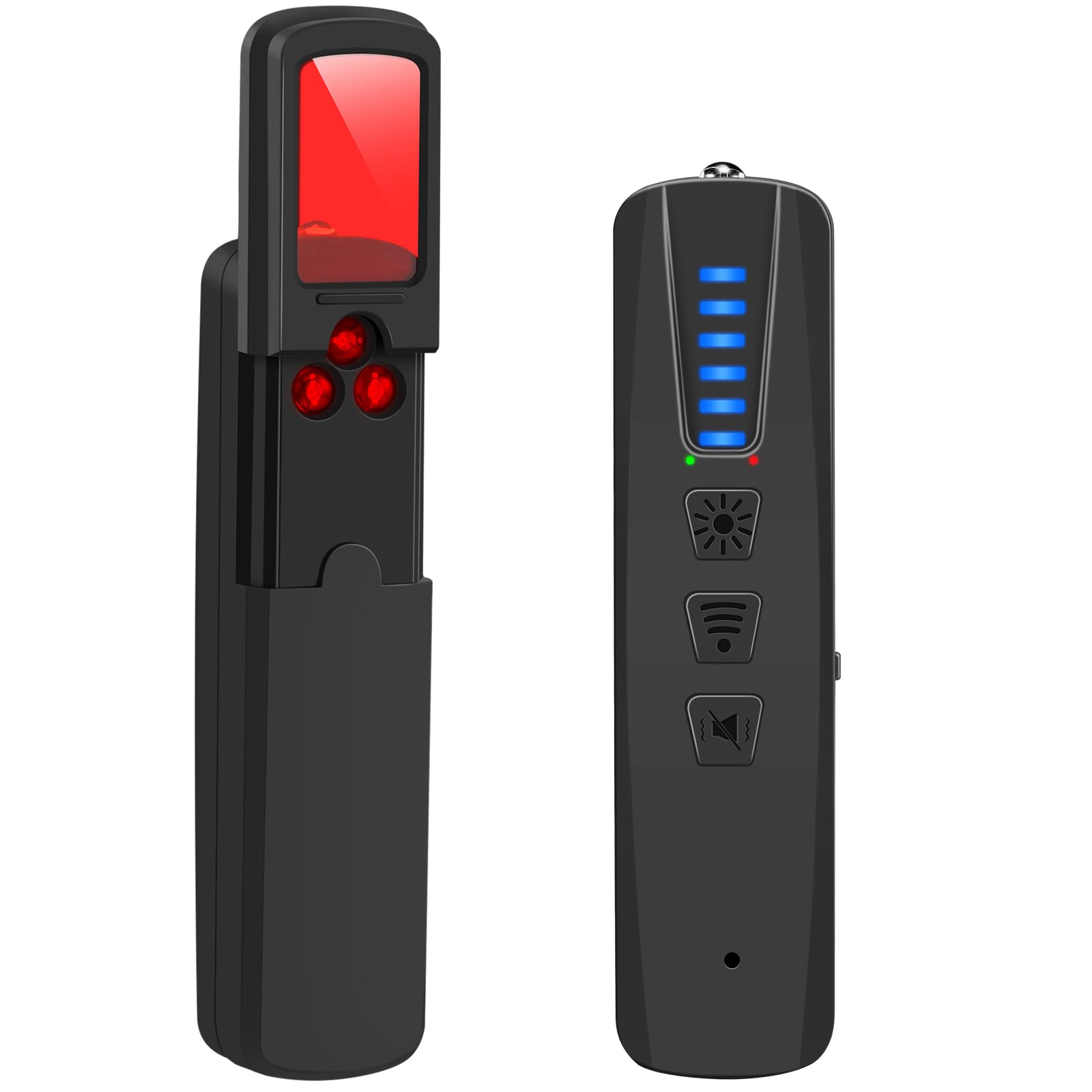
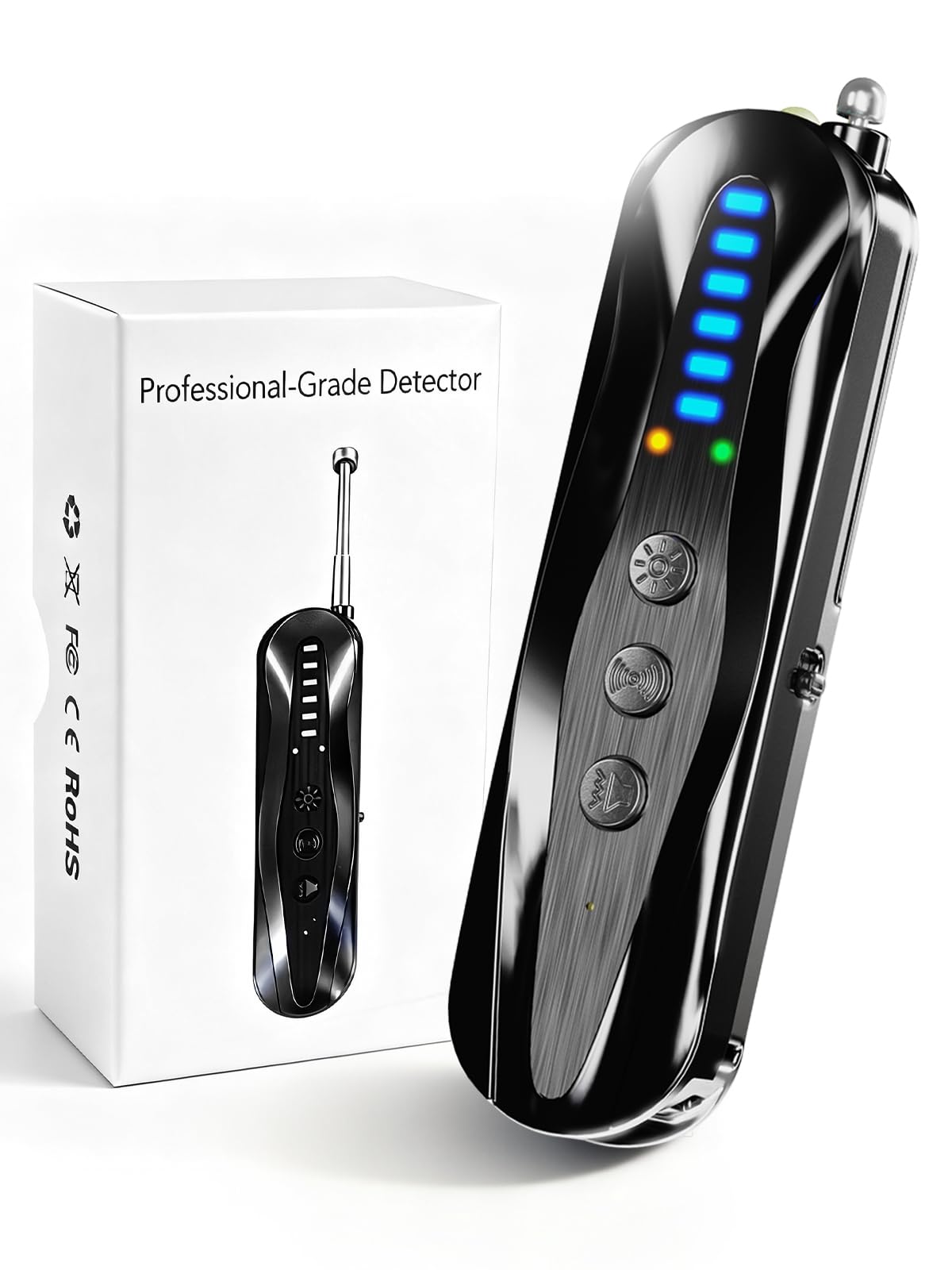
A hotel room sweep is mostly a dark-room exercise: lights off, curtains shut, one slow pass of an infrared finder along the places a lens could hide. We have done that pass with the ERYITRDK S620 in hotel rooms, a rental car, and an office, and it is the detector from this group we reach for first. Four jobs in a 27-gram body: a wireless signal sweep, an infrared lens finder, a magnetic check for trackers, and a door-handle alarm.

Plenty of detectors bundle modes and then leave you guessing which one you are in. This one keeps the signal sweep as the lead act, so you walk the room at a steady pace and watch for a reading to build as you approach the source, and the infrared finder is the part that earns its place. A camera that records to a memory card and never transmits produces no radio signal at all, and it still shows up as a glint through the eyepiece.

Battery life is the quiet reason it travels well. Up to 25 hours on a charge means it is ready on the way out of the door rather than the night before, and the body is small enough to live in the same pouch as your passport. The box lists the detector and a manual, so we keep a spare charging cable with it.

The door alarm is the extra we didn't expect to lean on: hang it on the handle and any attempt to open the door sets it off. That is why this one rides in the carry-on rather than the checked bag, where the sweep happens before the unpacking and the handle is armed before you sleep. It is also the only pick here with a second job once the scanning is finished.

Pros

  • Four detection modes in one small body
  • Infrared finder catches lenses that never transmit
  • Up to 25 hours of battery per charge
  • 27.22 g, so it disappears into a bag

Cons

  • Door alarm responds to the handle only
Our verdict

This is the detector we take on every trip: infrared for lenses, RF for transmitters, and a door alarm, in a body you won't notice in a carry-on.
Check Latest Price
2

Best for Pinpointing a Signal

Qyzue Q-T002 Detector

91 /100
Keeper Score Outstanding

Key details

Display
Mode and signal strength
Dimensions
3.46 x 0.83 x 0.63 inches
Sensitivity
Five levels, highest first
Detection Modes
RF, infrared, magnetic
Check Price on Amazon

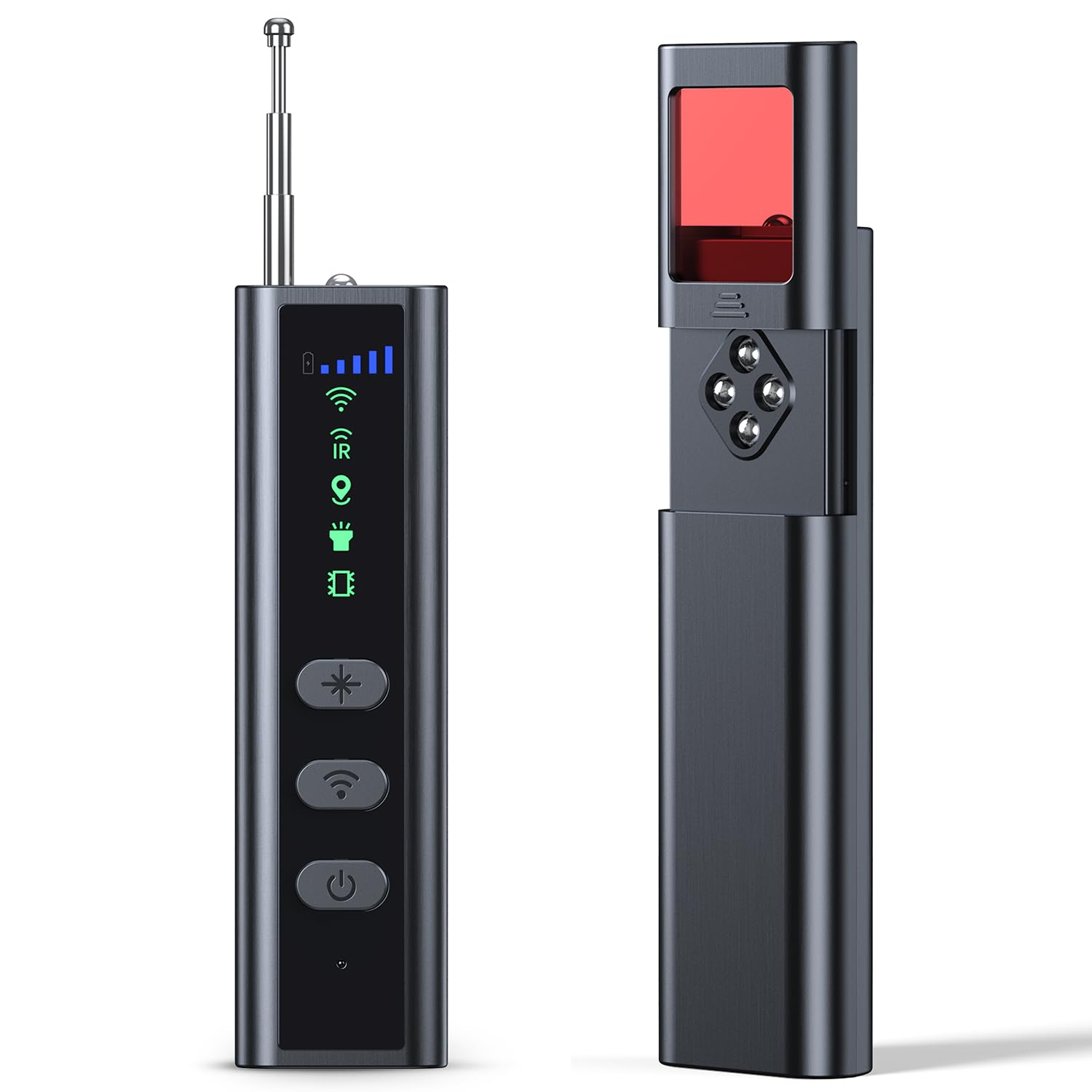
A signal-strength readout is the difference between knowing a room contains a transmitter and knowing which corner it is in. The Qyzue Q-T002 puts that readout on a small screen beside the mode you are in, and that is why it is our pick for narrowing a signal down: the bars climb as you close in, instead of a beep leaving you to guess which way to turn.

The method the listing describes is the right one, and it is worth following rather than inventing your own. Start on level five, the most sensitive setting, walk the room, then step down through the levels and move closer as the reading firms up. Working the other way, lowest sensitivity first, is how a sweep takes twenty minutes and still misses things. Three modes cover the ground: RF for transmitters, an infrared finder for lenses, and a magnetic mode for trackers.

Two practical details stood out. The body is 3.46 inches long, short enough for a shirt pocket, and it ships with a lanyard so it doesn't vanish into a bag. The stated coverage runs two years, longer than most of this group promises. What it cannot do is ignore its surroundings: routers, phones, and the building's own access points all light up the RF mode, as the listing says outright. Turning off your own hot spot and stepping away from the router saves a lot of chasing.

Pros

  • Signal-strength display shows how close you are
  • Five sensitivity steps for narrowing a source
  • Three detection modes including infrared
  • Two-year manufacturer coverage stated

Cons

No notable drawbacks to flag.

Our verdict

We recommend the Q-T002 to anyone who wants to know exactly where a signal is coming from, not merely that one exists somewhere in the room.

Check Latest Price
3

Best Alarm Features

CountureMode G007 Pro

84 /100
Keeper Score Excellent

Key details

Alerts
Buzzer, flashing SOS
Battery
Rechargeable lithium polymer
Detection Range
1 MHz-8 GHz
Sensitivity Levels
6
Check Price on Amazon

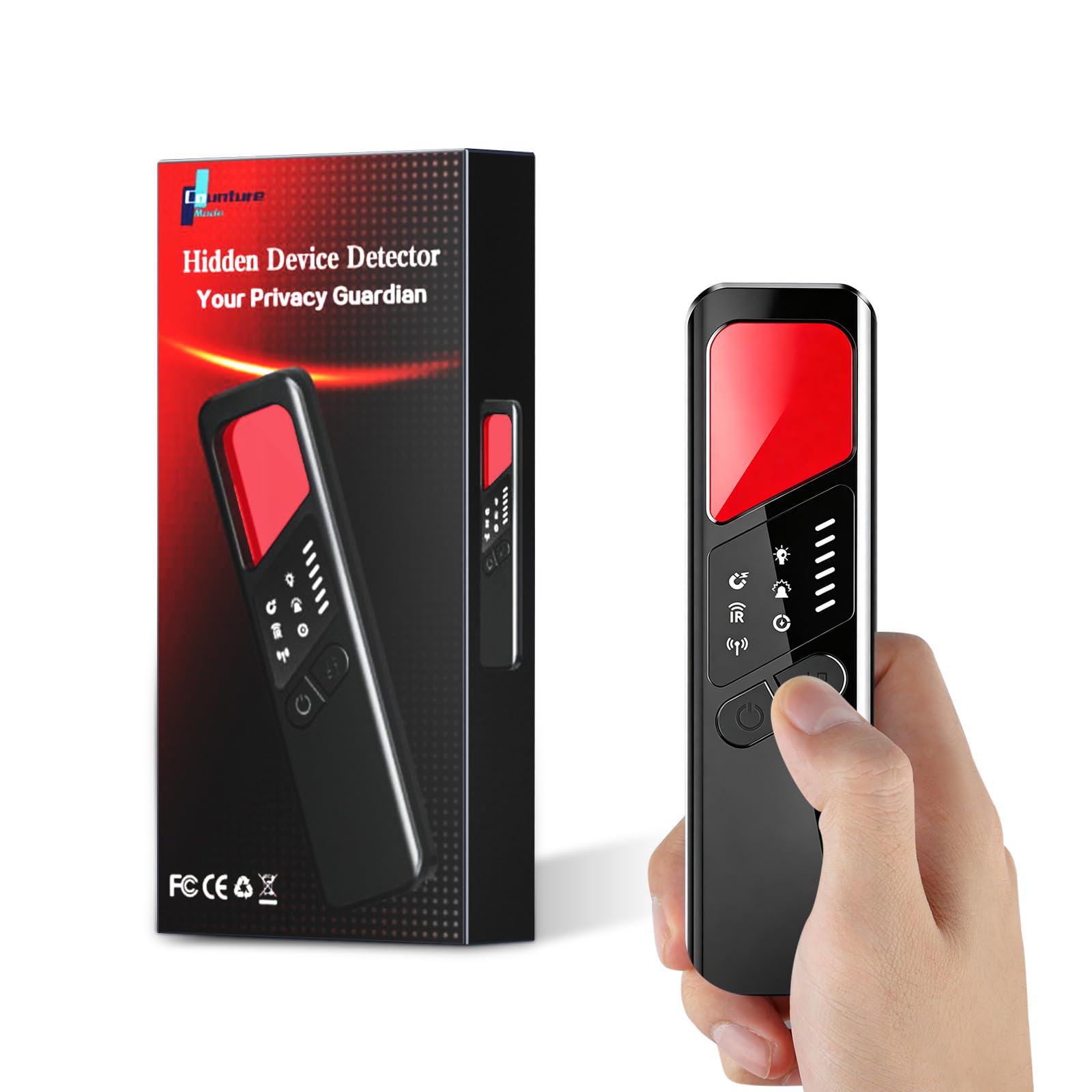
Checking a rental alone at eleven at night is a different job from checking it with someone else in the room. What you want then is a device that raises the alarm on your behalf, and that is the case the CountureMode G007 Pro is built for.

The alert set is why it is here: a buzzer that sounds on an alert, a flashing SOS pattern, and six sensitivity steps so you can start broad and tighten as you go. The stated range runs from 1 MHz to 8 GHz, which takes in the Wi-Fi and cellular bands a wireless camera or a hot mic would use. It charges over the included cable and runs on a built-in lithium polymer cell.

At roughly the size of a thick pen it disappears into a jacket pocket. Think of it as the alarm-first pick: the modes it advertises are signal-based, so it is happiest hunting things that transmit, and a slow visual pass of your own covers the lenses. For a first solo trip with a rental booked, that division of labor holds up, and the six-step ladder gives you more to work with than a single on-off switch.

Pros

  • Six sensitivity steps to tighten a scan
  • Buzzer and flashing SOS for solo checks
  • Wide stated 1 MHz-8 GHz range
  • Rechargeable with cable included

Cons

  • Buzzer and flashing SOS draw attention in a shared room
Our verdict

For travelers who want an alarm as much as a detector, the G007 Pro's buzzer and flashing SOS earn their place in a carry-on.

Check Latest Price
4

Best for Car Sweeps

VigilEye 6-in-1 Detector

86 /100
Keeper Score Excellent

Key details

Weight
3.5 oz
Dimensions
7 x 2.1 x 0.79 inches
Detection Modes
RF, magnetic GPS probe
Check Price on Amazon

A camera in a hotel room is the fear everyone talks about, but the tracker under a car keeps working long after you have flown home. The VigilEye's flexible magnetic probe is aimed at exactly that. Run it along panels, wheel arches, and the rail under a seat, and it responds to the magnet a tracker is usually stuck on with.

Seven inches long, this is the biggest thing in the group by a wide margin, and after a week of carrying it we stopped thinking of it as a pocket device. What the length buys is reach: the probe gets into a wheel well without you kneeling on a parking-garage floor. For the car job we take that trade every time, and it is the only detector here that lives in a glovebox rather than a toiletry bag.

The rest is competent and unremarkable: RF scanning for transmitters, a triple-alert system, and an ABS housing that should shrug off glovebox life. One thing to settle before you order: the listing quotes the warranty as one year in the specifications and two years in the sales copy, so ask the seller which applies and keep the answer in writing.

Pros

  • Flexible magnetic probe reaches wheel wells
  • Built and sold for vehicle security
  • RF scanning plus a triple-alert system

Cons

  • Seven-inch body doesn't fit a pocket
Our verdict

If your worry is a tracker stuck under the car rather than a camera in a vent, this flexible magnetic probe is the pick we point you to.

Check Latest Price
5

Best Discreet Design

Nilcozy Pen-Style Detector

92 /100
Keeper Score Outstanding

Key details

Power
Built-in rechargeable battery
Design
Pen-style body
Controls
Single push button
Check Price on Amazon

Most detectors look like what they are: a black slab with a stub of antenna. That is fine until you want to sweep a shared office without announcing it. The Nilcozy is dressed as a pen, sits in a pen cup without comment, and is the one here we leave out on a desk instead of burying at the bottom of a bag.

Operation is a single button, with indicator lights doing the reporting and a small adjustable antenna doing the aiming. That is the entire interface, and it is why we hand it to someone who has never swept a room: nothing to configure, nothing to get wrong. Inside, an upgraded high-sensitivity chip picks up wireless signals across a spread of frequencies, which covers cameras, listening devices, and the general chatter of a modern room.

The pen styling costs you something. It is the most expensive of the pocket-sized detectors here, and it gives up the sensitivity ladder the cheaper ones have. With one button you take what the chip gives you, and narrowing a signal to a specific outlet becomes a matter of walking closer rather than dialing down. For an office, a shared apartment, or anywhere a slab-shaped detector would raise questions, that is a fair trade. For a straight hunt, spend less and get the steps.

Pros

  • Pen body keeps a sweep low-profile
  • One-button operation needs no setup
  • Rechargeable, with indicator lights

Cons

  • One button means no sensitivity steps
Our verdict

Buy the Nilcozy when a sweep has to look casual: it lives in a pen cup, and one button is all anyone has to learn.

Check Latest Price
6

Long Trips

JAXTIN G9 Pro

85 /100
Keeper Score Excellent

Key details

Weight
Under 30 g
Charging
60 minutes, USB-C
Battery Life
Up to 72 hours
Detection Modes
Signal, infrared, magnetic, laser
Check Price on Amazon

Seventy-two hours is an odd number to print on a detector until you have had one die in a hotel room at midnight. The G9 Pro claims 72 hours of working time, and a USB-C top-up the listing says takes an hour, so a long weekend away shouldn't need the cable at all.

Four detection types are on board: signal, infrared, magnetic, and a laser-induction mode for pointing at a spot from across a room. The infrared finder is the one that matters most in a hotel, and the button layout falls under a thumb once you know the order the modes cycle in.

Getting to that point is the friction. The beep is loud by default, and the fix is to switch it to vibrate. The printed instructions say little about which mode suits which room, so we learned the sequence by cycling through it a few times with the unit in hand.

Under 30 grams, it disappears into a jacket pocket, and the housing feels a step above the plastic-bodied detectors here. What the premium buys is runtime and presentation, gift-ready box included, rather than a detection trick the cheaper picks lack. Charge it before you pack, keep the vibrate mode on, and it handles a two-week trip on one top-up.

Pros

  • Up to 72 hours of working time
  • One-hour USB-C recharge
  • Under 30 grams for a jacket pocket
  • Four detection types including infrared and laser

Cons

  • Manual doesn't explain which mode to use when
Our verdict

We point travelers who want a long weekend of runtime from one charge to the G9 Pro, provided they read the manual before the trip.

Check Latest Price
7

Spare Bag Kit

Koilboane 7-in-1 Detector

80 /100
Keeper Score Excellent

Key details

Weight
0.85 oz
Battery
800 mAh, up to 25 hours
Detection Range
100 MHz-8 GHz
Sensitivity Levels
5
Check Price on Amazon

A stated 100 MHz to 8 GHz detection range in a body that weighs 24 grams is the headline here. That spread covers the Wi-Fi, Bluetooth, and cellular frequencies a wireless camera or a hot mic would use, and it is the kind of figure usually attached to a much bigger device.

Five sensitivity levels, infrared detection, magnetic sensing for trackers, and an emergency flash fill out the list. The 800 mAh battery is rated for 25 hours of work and 30 days of standby, so it can sit in a bag between trips without going flat, and the body measures 0.63 by 0.83 by 3.46 inches.

Where it fits is the bag you don't unpack. At 24 grams and shorter than a pen, it takes up less room than a charging cable, and the standby rating means it is ready when you remember it exists. The five sensitivity steps expect you to know what you are doing, so run a shakedown first: point it at your own router and your phone, learn what a strong reading looks like, and then trust it in a strange room.

Pros

  • Wide 100 MHz-8 GHz stated range
  • 24 g and pen-length for a bag pocket
  • 25 hours of use plus 30-day standby
  • Five sensitivity levels and infrared detection

Cons

  • 2.5-hour recharge is slow before a trip
Our verdict

The Koilboane is the lightest way to carry four detection modes, and it suits anyone who wants a second sweeper that lives in a bag.

Check Latest Price

How We Tested Hidden Camera Detectors

We built the shortlist by reading spec sheets and manuals for the most widely sold detectors, then kept only the ones with a real lens finder, RF detection, and a way to adjust sensitivity. We ruled out anything that claimed multi-mode detection but described only one method in the manual. The final 15 units covered a range of prices and shapes, from pen-style devices to small screened units.

For five months, those 15 detectors went through the same routine: hotel check-in, rental car pickup, a weekend rental, and a normal day at a shared office. In each space, we swept the smoke detector, alarm clock, air vent, mirror, USB charger, and any picture frame facing the bed. We timed a full sweep from the moment we opened the box, noted whether we had to reread the instructions mid-scan, and checked if the beep could be lowered or muted in a quiet room.

We also planted a known camera and GPS tracker in a test room, then recorded how quickly each unit found them and how often it chirped at a harmless router or phone. Portability got the pocket test: we dropped each detector into a jacket pocket and a toiletry bag, then checked whether it switched on accidentally. Build quality showed up in loose buttons, flimsy clips, and screens that washed out in daylight. At the end, we compared what each mode actually did against what the manual promised—that gap is where value for money lives.

How to Choose a Hidden Camera Detector

Look at the modes, not the number in the name

Wireless scanning finds anything broadcasting: a streaming camera, a hot mic, a bug tucked into a smoke detector. An infrared lens finder is what catches the camera recording to a memory card with its radio switched off, because you are looking for the reflection off a lens rather than a signal. Magnetic sensing is a third, narrower tool that responds to the magnet holding a GPS tracker to a car.

We look for RF and infrared named in the same listing, and treat the rest of the mode count as padding. A detector with only a signal mode will walk straight past a camera that never phones home.

Sensitivity is what turns an alert into a location

Start wide and loud: highest sensitivity, walk the room slowly, and find out roughly where the signal lives. Then step down and walk in again, closing the distance until the device only fires when you are near. A detector with fixed sensitivity tells you something is in the room and nothing more, which is the compromise the pen-style Nilcozy makes.

A signal-strength display, like the one on the Qyzue Q-T002, does this job better than a beep, because you can watch the number climb instead of guessing which way to turn.

Buy the size and runtime you'll actually carry

A detector left in a drawer protects nothing, so pocket size and standby time matter more than one extra mode. The picks here run from 24 grams to 3.5 ounces, with quoted working time from 25 to 72 hours, and any of them covers a trip if you charge it before you leave.

Check the charging time as well as the runtime. A one-hour USB-C top-up is easier to build into a packing routine than a two-and-a-half-hour one, and the shorter charge is the difference between a detector that comes along and one that stays plugged in at home.

Match the alert to the room

A beep is easy to follow in an empty hotel room and awkward in a shared office. Vibration, a strength readout, or a pen-shaped body all buy discretion; a loud buzzer and a flashing SOS, like the G007 Pro's alert set, suit a solo traveler who wants the device to make the noise for them.

Plan the lens pass for a dim room. Infrared finding works best with the lights off and the curtains closed, so sweep before you settle in rather than after you have unpacked.

What these detectors can't do

None of these devices jams, blocks, or records anything; they are receivers, and a quiet pass means you didn't find a signal on that pass. Treat an alert as a prompt to look closer and a clean sweep as one useful piece of information rather than proof that a room is clear.

Frequently Asked Questions

Final Verdict

Start with the ERYITRDK S620. It sweeps for transmitters, finds lenses by infrared, checks a car for magnetic trackers, and hangs on a door handle as an alarm, all at 27 grams and for less than the midrange picks here. If you want to walk a signal down to one specific outlet, the Qyzue Q-T002's strength readout and stepped sensitivity do that better.

And if the worry is a tracker under the car rather than a camera in a vent, take the VigilEye and its magnetic probe instead.